
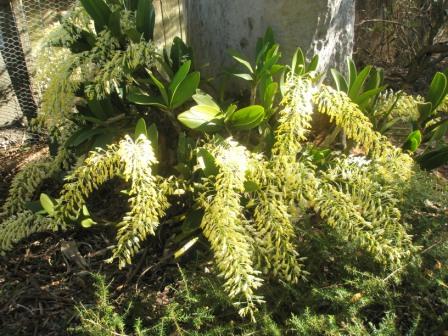
Native Orchids - Dendrobium Speciosum

Violets
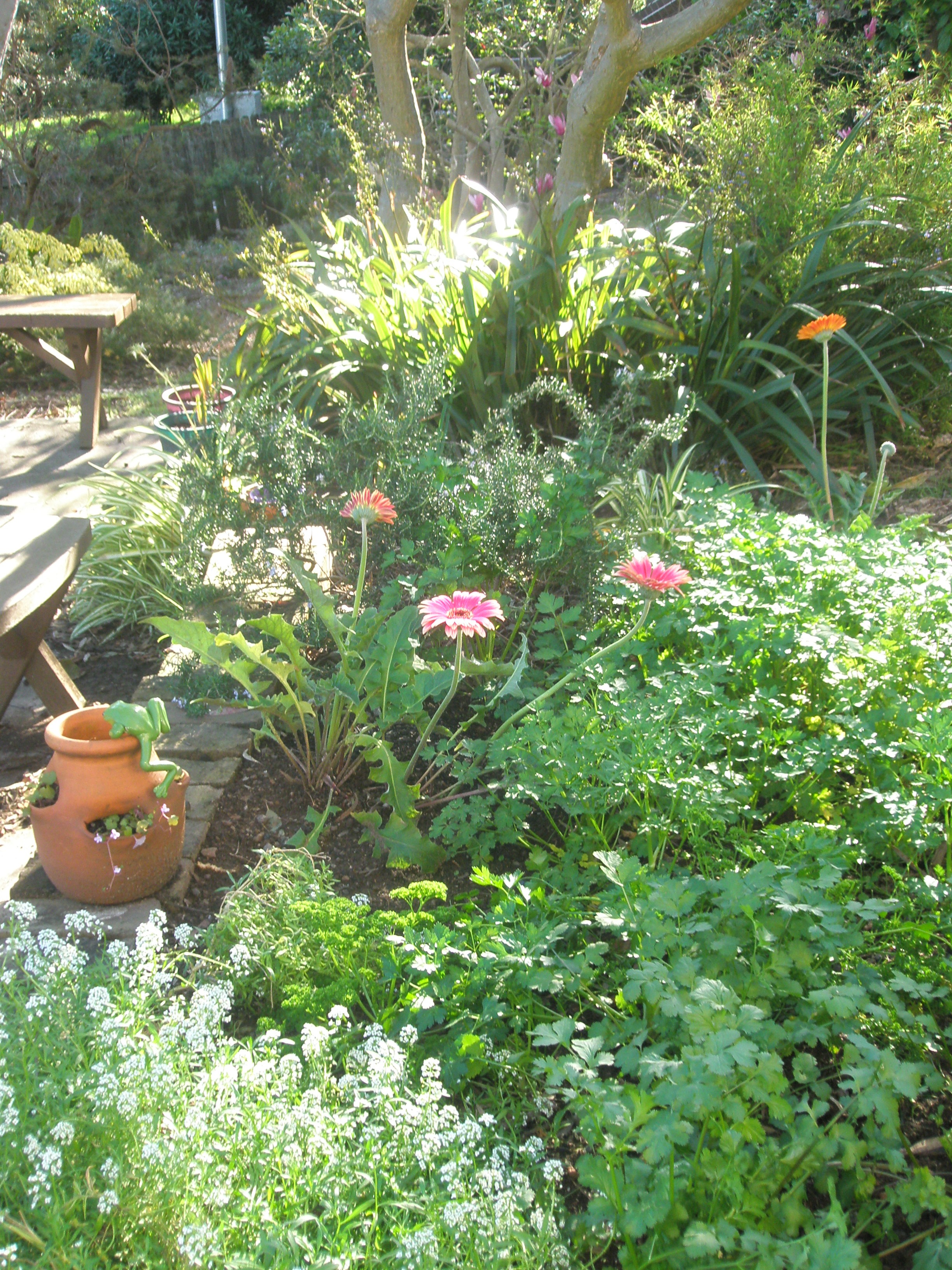
Herb Bed
My traditional answer to this question has been to lurch from near disaster to near disaster as each area rises to the top of the priority list. But every now and again a crisis in one area leads to some others falling off the list altogether. Eventually comeback time comes around, and recently it has been the turn of the garden to be brought back from the brink.

Late Winter Flower Arrangement
If there is one horticultural area in which I can now claim expertise, it is weeds. I might not know all their Latin or even common names, but I know their perfidious ways. Enemy number one at the moment is the soft leafed little crappy weed with tiny blue flowers. It sprouts wherever there is bare earth, and I can’t wait to get mulch down soon. That won’t help the ‘lawn’ (there is buffalo grass in there somewhere) but I hope that pruning back the shady overgrowth, hosing on some Seasol for lawns, and regularly mowing down the invader grasses, will encourage the buffalo to overgrow the most conspicuous problem areas.
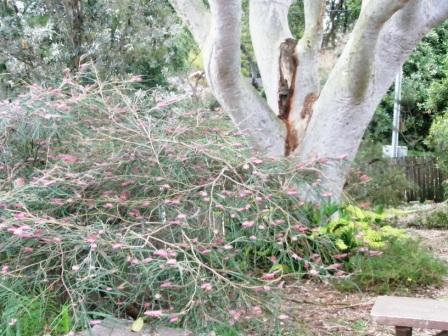
Grevillea Asplenifolia

 Window Dresser's Arms, Pig & Whistle
I’m finding myself quite adept at growing wandering jew. Just can’t get rid of the stuff. Any thoughts?
LikeLike
Let’s just say that after they drop the bomb, the cockroaches will have leafy green areas to enjoy. 🙂
Now, on the topic of Wandering Weed* I really am an egg spurt. Having totally eradicated it from my own garden. Several times. But really, it was only three times, and the latter two were because a neighbour grows a Wandering Weed reservoir along our boundary fence. The second time we’d been away for a few years, and the third time was a long period of general garden neglect. You really do have to get rid of it. It is a haven for vermin including mice and rats.
My recipe for eradication begins with : Take one troop of boy scouts. But if you don’t happen to have boy scout troops readily available, you can substitute with any source of high number of labouring hours over a short period of time; a few days. Own children are a possibility. On the condition they are strong teenagers, you evoke happy memories of how much you’ve done for/with them over the years, mention your bad back/arthritis/heart condition – and pay them a lot. Or hire someone from the Classifieds.
The thing is, you have to bag it all up . This first stage requires no science. You simply get a roll of thick, strong garbage bin bags, and give one to every worker to fill. Ignore details such as pulling out roots. When the bag is full, empty it into your green bin and start again. When the green bin is full, crush it down. Then start tying up the bags and collecting them in a pile nearby. Continue until the remaining Wandering Weed stems are shortish.
You should already have moved your green stuff wheelie bin close by, and not only for efficiency. If a single piece of Wandering Weed escapes from a bag on the way to the bin, it will take root and start a new patch. Even if you drop it on cement, it will wait dormant for over a thousand years for the next storm, dog, whatever to move it to a grain of dirt, or the dirt to it.
In Sydney autumn, the area will be full of spiders and spider webs that you clear in advance. So you really should have shoes, socks, gardening gloves and long-sleeved/legged clothing particularly if kids are involved. I suppose if you have snakes you’d want to take some precaution.
The second ingredient in the recipe is someone who cares. That’s probably yourself. That person has to dig up as much of the remaining Weed as possible by the roots. (If you have clay soil, the whole process needs to have been started after rain, or this won’t be possible unless you water the area heavily.) If your troop is still available, get them to do some of this as well. BYO weeding forks or you can buy them cheap at Bunnings. Repeat daily until you can’t see any more Wandering Weed.
Then repeat hand weeding a few times weekly. Then monthly, or more frequently after rain.
The good thing about Wandering Weed is that it tends to be fairly localised. By the time it’s spread so much it’s a problem though, it’s probably in your neighbour’s garden as well. It pays to offer to clear their boundary as well, on the grounds that you feel responsible. Even if you know full well it came from them originally. If you can’t eradicate it next door for one reason or another, you have to patrol the boundary monthly and more often in wet weather.
LikeLike
* In this more sensitive age I tend not to call it Wandering Jew any more once we’ve established what we’re talking about.
LikeLike
Of course, you will already know that not a single piece of Weed, picked or not, from any part of the plant, can be left anywhere except in a closed garbage bag and eventually the rubbish bin. It roots from the tiniest piece, and if a piece of Wandering Weed looks dead, it is faking.
LikeLike
Agreed, you think you’ve got rid of it then up it springs. I’ve the same problem with other weeds as well dig them out roots and all and then they pop up somewhere else.
LikeLike
The good thing about Wandering Weed is that it can only spread outwardly from existing plants or from pieces being moved about; it doesn’t set seed. So in my garden I only have to look for it in the same area it was before, as I’d never allow a piece to drop elsewhere. Having been eradicated from above ground it’s easy to eradicate completely if you patrol regularly and dig it up by the roots, unless you have an external source such as a neighbour.
LikeLike
It is all lovely Voice. For problem weed areas I have two remedies. One – whipper snipper. Two – Zero spraying.
LikeLike
Very kind of you to say so Vivienne.
I’ve certainly done the Zero. The thing is, you then have to follow up or else you’ve just created the perfect weed site. Now I’m a Weed Expert, I think I would whipper snipper, fertilise, water well for a couple of weeks, Zero, wait a few weeks, then mulch and plant. Mulch is expensive though. Weeds that spread underground, such as couch grass, I think you just have to hand weed vigilantly as they regrow and I suspect mulch would just get in the way of that, at least initially.
LikeLike
We have a major battle on at present with onion weed in a soft buffalo lawn. We let it grow up and then hand wiped neat Zero on the onion grass leaves. Problem is to get the weedicide into the subsoil corms and roots.
Starting to yellow off nicely after five days. Planning a medium haircut and some Shirley’s No 17.
Boy you should see the new growth on the beautifully pruned roses at work. What a difference a week makes.
LikeLike
I mix my own Zero and make it double recommended strength and it works very well in as much as it remains
totally weed free for a long time. Whether or not weeds return probably has fair bit to do with rainfall and up
till now we had precious little of that and only weeds thrived. Too wet here to do any spraying of problem areas but I
did whipper snipper a few days ago and turned myself into a jolly green giant.
LikeLike
Emmjay – good luck with the onion weed. It is impossible to eradicate, as far as I know, with sprays and conventional
means. If it is a small area you could try digging it up and shaking soil off the plants, put plants in a big plastic bag,
restore the surface area and sow with lawn seed.
LikeLike
Yes Vivienne, I should amend my title to Sydney Weed Expert. Although there remains a niggling doubt about bare soil being a good thing. Perhaps now you’ve had some good rains in the growing season, you’ll dance around the weeded areas throwing handfuls of some appropriate native grass seed into the air, and make the weed seeds earn their place. Always assuming, of course, that native grasses weren’t what you were trying to get rid of in the first place.
LikeLike
My problem area requiring the use of high strength Zero is right at the front of the house where it is mulched with
our home grown wood chips. When I zap the weeds I do not have bare earth. I do use it for a few other areas
where it doesn’t matter if it becomes bare. We have 3 hectares all up and have finally had native grasses emerge – they have overtaken the rotten wild oats which blew in many years ago though nothing suppresses that onion weed patch.
LikeLike
Ah ha! It all starts to make sense now Vivienne. The mulch is the reason why it stays weed free for a long time after Zero. You whipper-snip to stop the tall weeds like wild oats setting seed.
LikeLike
Yes, but I haven’t told you about Julia the chook’s favourite digging and scratching spot. Yep, at the front of
the house – I have to rake it back in place everyday. Some of the mulch is turning to compost. Wild oats have gone
but they never made it to the house paddock. I’m a dab hand at the whipper snipper – I use it to cut back my rather
large oregano patch at the end of the season – quicker and better result.
LikeLike
Just dragged my weary bones outside to emulate the Emmjay household with the onion weed. I’ve been putting it off. The real benefit of the Emmjay approach to onion weed is that you can feel virtuous all winter while doing nothing about it. In some other patches I’ve been using the dig, re-dig, re-re-re-re-re-re-re-re-re-re-re-re-re-re-re-re-re-re-re-dig method, followed up finally, where possible, by Zero spray. Next winter will tell. I’m certainly not digging again unless the onion weed is very thin on the ground. Only in the rescue phase, which I think will end officially after the seasons have gone full-cycle.
Depending on your personal Time/Money/Onion-Weed-Tolerance equation, the ultimate solution is to dig up the soil, get in new soil and start again. When I was in Bunnings the other day I overheard a woman getting advice on doing just that.
I guess the rotting weeds will have been composting on top of the wood chips too. Do wood chips ever reach the stage where you can dig them in? If so, I guess the alternative is to go with the flow on the composting process and chuck on some blood & bone to help Julia The Chicken along, if she needs any help.
LikeLike
yo
LikeLike
Well worth all of your effort.
We both love your bird of paradise.
LikeLike
Did you like my frog? Click the Herb bed for a higher res view if you didn’t spot.it.
LikeLike
Nope, what colour is it ?
LikeLike
Ah, dere ’tis !
LikeLike
Love the frog. Much more realistic than our little statues!
LikeLike
Does your frog come with garlic?
LikeLike
Currently just thyme, coriander, flat and curly parsley, and rosemary. Basil and chili soon.
LikeLike
I wish I could share with you the colour of that pinky gerbera in the herb bed. It is a deep, almost purple, pink, with an outer halo of paler pink petals, and in that green background I swear it is luminescent. I just couldn’t capture it, even in a close-up.
LikeLike
The most humble of all orchids would have to be the native ‘nodding greenhood orchid’, extremely shy and difficult to catch above ground. Even so, after many hours of trampbling through bushland I was lucky to spot them once, many years ago. It was on the Old North Road, at the back of Emu Plains while practising for my epic Cradle Back mountain walk to Lake St Claire in Tassie. We practised by carrying six house bricks in our back packs to see how we would go on the five day hike.
I was hoping someone would finally come up with some green stuff.
LikeLike
The ones at the base of my Angophora are total extroverts that repay the least kindness with a generosity that takes my breath away.
LikeLike
Four more weeks and I can start working on my OWN garden, it’s not very large but just right , like Goldilocks bed…I need it to keep me fit and sane.
Having it might also help me to stay reasonably slim so that I don’t have to ever go on another diet anymore.
( to be truthful: I tried some new spring fashions in Sydney yesterday and immediately started my Brand New Spring Diet)
LikeLike
Beautiful piece, Voice. Thank you.
LikeLike