• The Pig’s Arms
  • About
  • The Dump

Window Dresser's Arms, Pig & Whistle

~ The Home Pub of the Famous Pink Drinks and Trotter's Ale

Window Dresser's Arms, Pig & Whistle

Author Archives: astyages

Bilitis (Continued): Elegies at Mytilene

21 Thursday Jun 2012

Posted by astyages in Uncategorized

≈ 6 Comments

Tags

best hoaxes, Bilitis, Elegies at Mytilene, mnasidika, sapphic poetry, sappho

Translation by Astyages

<Eumorphote’rha Mnasidi’ka ta^s hapala^s Gyrhinn_o^s.>

(Mnasidica is far more beautiful than the gentle Gyrrhino”)

SAPPHO

47 – TO THE SHIP

Beautiful ship which brought me here, all along

the coast of Ionia, I abandon you to the shining

waves and with light feet jump onto the beach.

You will return to the land where the virgin is

the friend of the nymphs. Don’t forget to thank

the invisible counsellors, and take them

in offering this branch cut by my own hands.

You, made of pine, and on the mountains, the vast

inflamed Southern Wind stirred your spiny branches,

your squirrels and your birds.

The North Wind now guides you, and

pushes you gently towards the port, black prow

escorted by dolphins by the will of the benevolent sea.

48 — PSAPPHO

I rubbed my eyes… It was already day,

I thought. Ah! Who is near me…? A

woman…? By Paphia, I had forgotten…

Oh! Charity! I am so ashamed…

Into which country have I come, and what is

this isle where one hears so much about love?

If I were not so weary, I would have believed it was

some dream… Is it possible that this is Psappha?

She is sleeping… She is certainly beautiful,

although her hair was cut short like that of

an athlete. But this strange face, this

mannish chest and narrow hips…

I want to leave before she wakes.

Alas! I am beside the wall. I must

jump over her. I’m afraid of grazing her hip and

that she will not take me back to the thoroughfare.

49 – THE DANCE OF GLOTTIS AND KYSE

Two little girls brought me to their home,

and as the door was closed, they

lit the wick of a lamp and

wanted to dance for me.

Their cheeks were not made-up, and

as brown as their little tummies. They

pulled each other by the arms and spoke at

the same time, in an agony of gaiety.

Sitting on their mattress which was born by two

raised trestles, Glottis sang in a sharp

voice and clapped her resonant little hands in time.

Kyse danced by jerks, then stopping,

out of breath from laughing, and, taking her sister

by the breasts, bit her shoulder and

turned her round, like a goat which wants to play.

50 – ADVICE

Then Syllikhmas came in, and seeing us

so familiar, she sat down on the bench.

she took Glottis on one knee, Kyse on

the other and she said:

“Come here little one.” But I stayed distant.

She said again: “Are you scared of us?

Come on… these children love you. They

could teach you something you don’t know: the

honey of a woman’s caresses.

“A man is violent and parasitic. You

know that, undoubtedly. Hate them. They have

flat chests, rough skin, short hair and hairy arms.

but women are completely beautiful.

“Women alone know how to love; stay with

us, Bilitis, stay. And if you have an ardent

soul, you will see your beauty as in a

mirror on the body of your lovers.”

51 – UNCERTAINTY

Between Glottis or of Kyse I don’t know which

I would marry. As they do not resemble each

other, the one could not console me for the other

and I’m afraid of making the wrong choice.

Each of them has one of my hands,

and one of my breasts also. But to who*91

should I give my mouth? To whom should I give

my heart and all that with which I am unable to part?

We could not stay like this, all

three in the same house. They would talk about us

in Mytilene. Yesterday, in front of the temple of Ares,

a woman didn’t say “Hello!”

It’s Glottis that I prefer; but I

cannot reject Kyse. What will become of her

all alone? Should I leave them together as

they were and take another friend for myself?

52 – THE MEETING

I found her like a treasure, in a

field, under a myrtle bush, enveloped

from throat to feet in a yellow robe

embroidered with blue.

“I have no friends,” she said to me, “Because the

nearest town is five miles from

Here. I live alone with my mother who is

old and always sad. If you want, I’ll follow you.

“I will follow you to your house, leaving her on

the other side of the isle and I will live with you

until you send me back. Your hand is

tender, your eyes are blue.

“Let’s go. I’m taking nothing with me, but

the little Aphrodite which is hanging around my

neck. We will put her next to yours,

and we will give them roses in

payment for each night.”

53 – THE LITTLE APHRODITE OF BAKED EARTH

The little guardian Aphrodite which protected

Mnasidika was modelled on Camiros by a potter

of great skill. It is as big as my thumb,

and of fine yellow earth.

Her hair falls all around

her narrow shoulders. Her eyes are

long slits, and her mouth is very

small, because she is the “Ever-Beautiful.”

With her right hand she indicates her divinity,

which is riddled with little holes on the

lower belly and along the groin. Because she

is the “Very Amorous”.

In her left hand she holds her round

heavy breasts. Between her broadened hips

swells a fertile belly. Because

she is the “Mother-Of-All-Things”.

54 – DESIRE

She entered, and passionately, her eyes

half-closed, she united her lips with

mine and our tongues entwined…

Never in my life have I ever had a kiss

like that.

She was standing up against me, all in

love and consenting. One of my knees,

bit by bit, climbed between her warm thighs

which yielded as if for a lover.

My creeping hand under her tunic searched

to divine her unclothed body, which turn and turn

about sinuously writhed, or stiffly bent

with the trembling of her skin.

With the eyes of delirium she indicated her bed;

but we did not have the right to love before the

wedding ceremony and we separated brusquely.

55 — THE WEDDING

In the morning, we made a wedding repast, in the

house of Acalanthis whom she had adopted

as a mother. Mnasidika wore the white veil

and I a man’s tunic.

And then, in the midst of twenty women, she

took off her festal robe. We perfumed it with

Bakkaris; powdered it with golden powder,

and removed her jewels.

In her bedroom, full of foliage, she

waited for me like a wife. And I

placed her on a chariot between me and the

nymphs’ shrine and we cheered all who passed by.

We sang the Nuptial Song; The flutes

were also played. With one arm

round her shoulders and the other under her knees,

I carried Mnasidika across the rose-covered threshold.

56 – THE BED (not translated)

57 – SURVIVORS OF THE PAST

I left the bed as she had left it,

unmade and rumpled, the sheets tangled, so that

the shape of her body stayed imprinted beside mine.

Until tomorrow I shall not go to the baths, I shall

not wear clothes and I shall not

comb my hair, for fear of rubbing away her kisses.

This morning, I shall not eat, nor this evening,

and on my lips I will put neither rouge nor

powder, so that her kisses will remain.

I shall leave the shutters closed and I shall not open

the door, for fear that the memory which remained

might blow away on the wind.

58 – METAMORPHOSIS

Once I was a lover of the beauty of

young men, and the memory of their

speech, of old, would wake me up.

I remember having engraved a name in

the bark of a plane tree. I remember

having left a piece of my tunic in

a path where someone passes by.

I remember having loved you… Oh Pannychis,

my child, in whose hands have I left you?

How, oh unhappy me, could I have abandoned you?

Today, Mnasidika alone, and for

always, possesses me. She receives in

sacrifice the happiness of those whom I have left

for her.

59 – THE NAMELESS TOMB

Mnasidika took me by the hand to

lead me out of the gates of the town, up to a

little meadow where there was a column of

marble. And she said,

“This was my mother’s friend.”

Then I felt a great shudder, and without

letting go of her hand, I leant

on her shoulder, so as to read the four verses

between the hollow cup and the serpent:

“It was not Death who kidnapped me, but

the Nymphs of the streams. I rest here

under an earth lightened by a ‘hairstyle’

cut by Xantho. Let her alone cry for me.

I will not tell my name.

For a long time we remained standing there, and we

put no verse to the libation. Because what

does one call an unknown soul who has entered the multitudes

of Hades?

60 – THE THREE BEAUTIES OF MNASIDIKA

I sacrificed two male hares and two doves

to Aphrodite-The-Lover-Of-Smiles

so that Mnasidika will be protected by the gods.

And I sacrificed to Ares two cocks armed

for the fray, and to the sinister Hecate two

dogs who howled under the knife.

And it is not without reason that I have implored

these three Immortals, because Mnasidika wears on

her face the reflection of their triple divinity:

Her lips are red as copper, her

hair is blue-tinged like iron, and her eyes are

black, like silver.

61 – THE LAIR OF THE NYMPHS

Your feet are more delicate than those of

Thetis of the Silver Hair.

Between your crossed arms you

reunite your breasts, and you gently rock them to sleep

like the bodies of two beautiful doves.

Under your hair you conceal your moist

eyes, your trembling mouth and the red

flowers of your ears; but nothing will stop

my look nor the hot breath of your embrace.

Because, in the secret of your body, it is you,

beloved Mnasidika, who conceal the lair of the

nymphs of whom Old Homer spoke, the place

where the nyads weave their cloths of purple,

The place where flow, spout by spout,

inexhaustible springs, and from where the door to

the North allows men to descend and where the

door to the South allows the Immortals entry.

62 – THE BREASTS OF MNASIDIKA

With care, she opened my tunic with one hand

and held my warm, soft breasts; thus

one offers to the goddess a pair of

living turtledoves.

“Love them well,” she tells me; “I love them

so much! They are darlings, little

children. I busy myself with them when I’m

alone. I play with them; I give them pleasure.

“I wash them with milk. I powder them

with flowers. My fine hair which dries them

is dear down to its little roots. Trembling,

I kiss them. I put them to bed in wool.

“So I shall never have children, to

keep them well-nourished, my love; and, seeing that

they are so far from my mouth, give them lots of

kisses from me.”

63 – CONTEMPLATION (not translated)

64 – THE DOLL

I gave her a doll. A doll made of

wax with pink cheeks. Her arms were attached

by little pins and one could bend her legs.

When we were together she put it to bed

between us and it was our child. In the evening

she rocked it and gave it her breast

before putting it to sleep.

She wove it three little tunics, and

we gave it jewels on Aphrodite’s Day;

jewels and flowers, too.

She cares for her virtue and never lets her

go out without her; not in the sun, above all, because

the little doll was moulded from little pieces of wax.

The Songs of Bilitis (Continued)

03 Sunday Jun 2012

Posted by astyages in Astyages

≈ 7 Comments

Tags

Bilitis, lesbos, mnasidika, pamphylia, pittakos, sapphic poetry, sappho, the bucolic life in pamphylia, the songs of bilitis

Louÿs claimed that the erotic poems he fabricated were the work of “Bilitis,” one of Sappho’s lovers; he even invented a biography of the woman, citing a fictional archaeologist named Herr G. Heim with discovering her tomb. (“Herr G. Heim” translates roughly to “Lord S. Ecret”). Despite the hoax, many critics consider it a work of literary merit, and it’s become something of a cult book among queer theory enthusiasts.

The Songs of Bilitis  by  Pierre Louys

Translated by David L Rowlands

The Bucolic Life in Pamphylia (Part 2)

23 – SONG: SHADOW OF THE WOODS

“Shadow of the woods where she must come”, said I,

Where has my mistress gone?”

“She has gone down to the plain.”

“Plain, where has my mistress gone?”

“She followed the banks of the river.”

“Beautiful river who saw her pass, tell me,

Is she near here?”

“She left me for the path.”

“Path, can you still see her?”

“She left me for the road.”

“Oh, white road, road to the town, tell me,

Where did you take her?”

“To the golden street which enters Sardis.”

“Oh street of light, can you feel her naked feet?”

“She has entered the palace of the king.”

“Oh palace, splendour of the world, give her to me!”

“Look, she has necklaces on her breast and

hoops in her hair, a hundred pearls the length of her legs,

And two arms around her shapely body.”

24 – LYKAS

Come, we shall go into the fields, under the

juniper bushes; we shall eat

honey in the rushes, we shall make traps

for grasshoppers with stalks of asphodel.

Come, we shall go to see Lykas, who guards

his father’s flocks on the peaks of the

shadowy Taurus range. Surely he will give us

some milk.

I can already hear the sound of his flute. He is a

very skilful player. Here are the dogs and the

lambs, and himself, standing under a tree.

Isn’t he as handsome as Adonis!

Oh, Lykas, give us some milk. Here are some

figs from our fig-trees. We are going to stay

with you. Bearded billy-goats, don’t leap about, for

fear of exciting the restless nanny-goats.

25 – THE OFFERING TO THE GODDESS

It is not for Artemis that one adores

Pergamus, this garland woven by my hands,

although Artemis is a good goddess who

keeps me safe in difficult times.

It is not for Athena that one adores

Sidon, although she is of ivory and gold and

she carries in her hand a pomegranate

which tempts the birds.

No, it is for Aphrodite whom I worship

in my breast, because she alone gives me

that which my lips miss, if I hang

my garland of tender roses from her

sacred tree.

But I shall not speak too loudly of that which I

beseech her to grant me. I shall stretch myself up on

the tips of my toes and through a cleft in

the bark I shall confide my secret.

26 – THE AGREEABLE FRIEND

The storm lasted all night. Selenis, of the

beautiful hair, had come to spin with me. She

stayed from fear of the mud. We had

heard the prayers and were squeezed one against

the other… we filled my little bed.

When girls sleep in pairs, sleep

stays at the door. “Bilitis, tell me,

tell me who you love.” She slid

her arm against mine to caress me

softly.

And she said, in front of my mouth: “I know,

Bilitis, who you love. Close your eyes, I

am Lykas.” I replied as I touched her: “Do

I not see very well that you are a girl? Your

joke is pointless.

But she replied: “In truth, I am Lykas,

if you close your eyelids. Here are his arms,

there are his hands…” And tenderly, in the

silence, she enchanted my dreams with a

singular illusion.

27 – PRAYER TO PERSEPHONE

Purified by the ritual ablutions, and

clothed in violet tunics, we have

kissed the earth our hands full of

olive branches.

“Oh, Subterranean Persephone, or whatever name

you desire, if the name agrees with you,

listen to us oh Hair of Darkness. Barren,

Unsmiling Queen.

“Kokhlis, daughter of Thrasymachos, is ill,

and dangerously. Do not call her back

yet. You know she cannot escape you:

One day, later, you will take her.

“But don’t drag her away so quickly, O Invisible

tyrant, because she mourns the loss of her virginity.

She beseeches you through our prayers, and we

give three black unshorn ewes to save her.”

28 – THE KNUCKLEBONES PARTY

As we both loved to do, we

played knucklebones. And this was

a memorable game. Lots of young girls

assisted.

Her first throw gained her the Cyclops, and

I won Solon. But she won

Kallibolos, and, feeling myself lost, I

prayed to the goddess.

I played. I had Epiphenon, she the terrible

Chios, I, the Antiteukhos, she the

Trikhias, and I Aphrodite which won

this lover’s dispute.

But seeing her pale, I took her by the neck

and I spoke very close to her ear (so that only she could hear),

“Don’t worry my little friend.

We shall let them choose between the two of us”

29 – THE DISTAFF

For the whole day my mother had shut me up in

the girls’ school, with my sisters, who I don’t like and

who speak amongst themselves in low voices.

In a little corner, I spun my distaff.

Distaff, as I am alone with you,

it is to you that I shall speak. With your

wig of white wool you are like an

old woman. Listen to me.

If I could, I would not be here,

sitting in the shadow of the wall spinning with

boredom: I would be lying among the violets

on the slopes of the Taurus mountains.

As he is poorer than I am, my mother

does not want him to marry me. And nevertheless, I

shall tell you: or I will not see the wedding-day

where it will be he who carries me across the

threshold.

30 – PAN’S FLUTE

For Hyacinthus Day, he gave me

a flute made of tall reeds,

held together with white wax which is sweet to

my lips, like millet.

He is teaching me to play, sitting on his knees;

but I am trembling a little. He plays it

after me, so softly that I can hardly hear.

We have nothing to say to each other, so close

are we to each other; but our songs

want to respond, and turn and turn about our

mouths unite on the flute.

It is late, here is the song of the green frogs

which starts with the onset of night. My mother

will never believe that I stayed so long

to look for my lost girdle…

31 – THE HAIRSTYLE

He said to me: “Last night I had a dream.

I had your hair around my neck.

I had your hair like a black necklace around

the nape of my neck and on my chest.

I caressed it, and it was mine; and

we were thus tied together forever, by the

same hair, mouth on mouth, in the manner of

two laurels which often have but one root.

And bit by bit, it seemed to me, our

limbs were so entangled, that I was becoming

you or that you were entering into me like my

soul.

When he had finished, he gently put his

hands on my shoulders, and he looked at me

with a look so tender, that I kissed his eyes

with a shiver.

32 – THE CUP

Lykas saw me coming, clad only in a

brief shift, because the days were

stifling; he wanted to mould my breast which

was still uncovered.

He took some fine potter’s clay, kneaded in cold water

and light. When he had pressed it onto

my skin, I thought I would faint, so cold

was this clay.

From the mould of my breast, he made a cup,

rounded and stemmed. He put it to dry

in the sun and painted it purple and

ochre, pressing flowers into it all around.

Then we went up to the spring

that was sacred to the nymphs, and we

threw the cup into the current, with

stalks of gillyflowers.

33 – ROSES IN THE NIGHT

As night mounted the sky, the world

was ours and the Gods’. We’re going to the

fields at the spring, the dark woods with

clearings where we guided our naked feet.

The brilliant little stars enough for the

little shadows which are us. Sometimes,

under the low branches, we find

sleeping deer.

But the most charming part of the night above all

else was a place known to us alone and

which drew us across the forest: a thicket

of mysterious roses.

Because nothing on earth is so divine as

the perfume of roses in the night. How

was it that at times when I was alone I

felt no intoxication?

34 – REMORSE

At first I didn’t answer, and I had a

blush on my cheeks, and the beating of

my heart hurt within my breast.

Then I resisted, I said: “No! No!” I

turned my head away and the kiss did not

broach my lips, nor love my

clenched knees.

Then he asked my forgiveness, he caressed

my hair, I felt his burning breath,

and he was gone… Now I am alone.

I looked at the empty place, the deserted woods, the

trodden earth. And I bit my knuckles until they

bled and muffled my cries in the grass.

35 — THE BROKEN DREAM

All alone I was sleeping, like a

partridge in the heather. The light breeze,

The sound of the waters, the sweetness of the night

kept me there.

I was sleeping, an imprudent thing to do,

and I awoke with a cry. I struggled, and

I wept; but already it was too late.

What can the arms of a woman do?

He didn’t leave me. On the contrary,

More tenderly in his arms he clasped me to

Him and I saw nothing more in the world, neither earth nor

The trees but only the gleam of his eyes…

To you, victorious Kypris, I dedicate these

Offerings still moist, still pink; the traces

Of the sorrows of the virgin, the end of my

Dream and of my resistance.

36 – TO THE WASHERWOMEN

Washerwomen, do not say that you have seen me!

I trust myself to you; do not repeat it!

Between my tunic and my breast I brought you

Something.

I am like a frightened little chicken…

I don’t know if I dare to tell you… My

Heart beats like I shall die… it is a

Veil that I brought you.

A veil and the ribbons from my legs. You

See; there is blood. By Apollo it was

In spite of me! I was well defended; but

A man who loves is stronger than us.

Wash them well; spare neither salt nor

Chalk. I shall put four obols for you

At the feet of Aphrodite; and even

A silver drachma.

37 – SONG

When he returned, I hid my

Face with both hands. He said to me:

“Fear nothing. Who saw us embrace?” “Who

Saw us? The night and the moon.

“And the stars and the first light of dawn. The moon

Was admiring itself in the lake and told the water under

The willows. The water of the lake told the pole.

“And the pole told the boat and the boat

Told the fisherman. Alas! Alas! If that were

All! But the fisherman told a woman.

“The fisherman told a woman: my father and

my mother and my sisters, and

all of Hellas will know.”

38 – BILITIS

One woman envelopes herself in white wool.

Another clothes herself in silk and gold. Another

covers herself with flowers, with green leaves and

grapes.

I know only to live naked. My lover,

take me as I am: without robes nor jewels

nor sandals; here is Bilitis alone.

But my hair is black with its own blackness and my

lips red with their own redness. My curls

float around me, free and round

like feathers.

Take me just as my mother made me in

A night of love long ago, and if I please you

Then don’t forget to tell me.

39 — THE LITTLE HOUSE

The little house where his bed is, is the most

beautiful on earth. It is made with the

branches of trees, four walls of dry earth

and a garland of thatch.

I love it, because we lie there since the nights grew

cold; and the colder the night, the longer it is.

At the rise of day I feel myself finally weary.

The mattress is in the sun; two blankets

of black wool enclose our bodies which

are warming up again. His chest compresses my breasts.

My heart beats…

He enters me so hard that I thought he would break me, poor

little girl that I am; but while he is

in me I no longer know anything of the world, and

you could have cut off my four limbs without

waking me from my joy.

40 – JOY (not translated)

41 — THE LOST LETTER

Alas for me! I have lost his letter. I

had put it between my skin and my breast-band,

in the warmth of my breast. I ran; it fell.

I’m going to retrace my steps: if someone

found it, he would tell my mother and I

shall be whipped in front of my mocking sisters.

If it is a man who finds it, he will give it

back to me; or even, if he wanted to talk to me in

secret I know the means to charm him.

If it is a woman, who puts it up for sale, O Zeus

the Protector, protect me! Because she would tell

everybody, or she would take my lover.

42 – SONG

The night is so deep that it enters through

my eyes. – You could not see the way. You could

lose yourself in the forest.

The noise of the waterfalls fills my

ears. – You would not hear the voice of

your lover even if he was only twenty feet away.

The odour of the flowers is so strong that I

swoon and am about to fall. – You would not feel

them if they carpeted your path.

Ah! It is good, far from here, on the other

side of the mountain, but I see it and I

hear it and I feel it as if it were touching me.

43 – THE OATH

“When the water of the stream flows back up

to the snow-covered summits;

when we sow barley and wheat in

the moving furrows of the sea;

“when the pines sprout in the lakes and the

water-lilies on rocks, when the sun

becomes black, when the moon falls onto the grass.

“Then, but only then, will I take

another wife and forget you Bilitis,

soul of my life, heart of my heart.”

He said that to me! He said that to me! What matters

the rest of the world to me! Where are you, insane happiness

which can compare with my happiness!

44 — NIGHT

It is me now, looking for him again.

each night, very softly, I leave the

house, and I go by a long road,

to his meadow, to watch him sleep.

Sometimes I stay a long time without speaking,

happy just to see him, and I put my lips close

to his, to kiss only

his breath.

Then suddenly, I spread myself over him. He

wakes in my arms, and he can no longer

get back up because I wrestle with him! He submits, and laughs and

pleads with me. And so we played through the night.

… First dawn, Oh mischievous clarity, you already!

In what forever-nocturnal cavern, on

which subterranean meadow could we

love for so long, that we lose even your

memory…

45 – LULLABY (BERCEUSE: lit: ‘She who rocks the cradle’)

Sleep! I asked in Sardis for your toys, and

your clothes in Babylon. Sleep, you are the daughter

of Bilitis and of a king of the rising sun.

The woods, they are the palace in which we fought for

you alone and which I give you. The trunks

of the pines, these are its columns; the high

branches, these are its vaulted roof.

Sleep. So that he doesn’t wake you, I would sell

the sun to the sea. The wind from the wings of

a dove is not as light as your breath.

Daughter of mine, flesh of my flesh, you will tell me

when you open your eyes, if you want the

plain or the town, or the mountain or the

moon, or the white procession of the gods.

46 – THE TOMB OF THE NYADS

The length of the rime-covered woods, I

walked; the hair in front of my mouth was

blossoming with little icicles, and my

sandals were heavy with piled-up slush.

He said to me: “What are you looking for?” “I’m

on the tracks of a satyr. His cloven little footsteps

alternate like the holes in a white

shawl.” He said to me: “The Satyrs are dead.

“The satyrs and the nymphs too. In

thirty years we have not had a winter so

terrible. The footprint which you see is that of

a goat. But let us stay here, where their tomb is.”

And with the iron of his hoe he broke the ice

on the spring where once laughed the Nyads.

He took large cold pieces, and,

lifting them to the pale sky, looked through them.

***** ******* *****

The Songs of Bilitis

20 Sunday May 2012

Posted by astyages in Uncategorized

≈ 15 Comments

Translated by Astyages

Chapter 1

THE BUCOLIC LIFE IN PAMPHYLIA

“Hady`de’moi to`me’lisma. kai` _e’n sy’rhiggi meli’sd_o

k_e’n aul_o*i lale’_o, k_e’n d_o’naki, k_e’n plagiau’l_o*i.”

THEOCRITUS.

1 — THE TREE

I had undressed to climb a tree;

my naked thighs embraced smooth, moist bark;

my sandals walked on the branches.

All on high, but still under the leaves

and shaded from the heat, I was horseback

riding in a secluded fork balancing

my feet in the void

It had rained. Drops of water fell and

flowed over my skin. My hands were

dirtied with moss, and my toes were

red, because of the crushed flowers.

I felt the beautiful tree live when the wind

passed through it; then my legs could go no further

and I applied my open lips

to the mossy nape of a branch.

2 — PASTORAL SONG

I must sing a pastoral song, to invoke

Pan, god of the summer wind. I guard my

flock and Selenis guards hers, under the round shadow

of a trembling olive-tree.

Selenis is lying in the meadow. She

stands and runs, or searches for cicadas, or

picks flowers with herbs, or washes

her face in the cold water of the stream.

Me, I pull wool from the blond backs of the

sheep to fill my distaff, and I spin it. The hours are long.

An eagle passes across the sky.

The shadows turn: let’s swap the basket

of figs and the jar of milk. I must sing

a pastoral song, to invoke Pan, god of the summer wind.

3 — MATERNAL SPEECH

My mother bathed me in darkness, she

dressed me in full sun and combed my hair in

the light; but if I left by the light of the moon,

she tightened my girdle and made a double knot.

She says to me: “Play with the virgins, dance

with little children; don’t look out the window;

fly from the speech of young men

and doubt the counsel of widows.

“One evening, someone, as for everyone, will

come to carry you over the threshold in the middle of a

large procession of sonorous drums and lover’s flutes.

“On that night, when you grow up, Bilito, you

will leave me three gourds of gall: one for

the morning, one for midday, and the third,

the most bitter, the third for the days of the feast.”

4: BARE FEET

I have black hair, growing long down my back,

and a little round skull-cap. My shirt is

of white homespun. My closed legs

turn brown in the sun.

If I lived in town, I would have jewels of gold,

and gilded shirts and shoes of silver…

I look at my naked feet, in their shoes of dust.

Psophis! Come here, you poor little thing! Take me

to the springs, wash my feet in your

hands and press olives together with violets

to perfume them with the flowers.

Today you will be my slave; you will

follow me and you will serve me, and at the end of

the day I will give you, for your mother,

some lentils from my garden.

5 – THE OLD MAN AND THE NYMPHS

An old blind man lived on the mountain.

For having looked upon the nymphs, his eyes

had been dead for a long time. And ever since,

his happiness was a distant memory.

“Yes, I saw them, he said to me.

Helopsychria, Limnanthis; they were

awake, near the edge of Physos’ pond.

The bright water was above their knees.

The napes of their necks inclined under their

long hair. Their nails were slender

like the wings of the cicada. Their nipples

were cupped like the flowers of the hyacinth.

Their fingers played with the water

and pulled long-stemmed water-lilies from

an invisible vase. Around their separated thighs,

the ripples spread… “

6 — SONG

Stiff-necked tortoise, what are you doing there in the middle?

I’m winding the yarn and the thread of Miletus.

Alas alas! Don’t you want to come and dance?

I am in great pain. I am in great pain…

Stiff-necked tortoise, what are you doing there in the middle?

I’m cutting a reed for the funerary flute.

Alas! Alas! What happened?

I will not tell, I will not tell.

Stiff-necked tortoise, what are you doing there in the middle?

I’m pressing olives to make the oil for the gravestone [stele]

Alas! Alas! And who has died?

How can you ask me? How can you ask me?

Stiff-necked tortoise, what are you doing there in the middle?

He has fallen into the sea…

Alas! Alas! How did that happen?

From on top of white horses. From on top of white horses.

7 – THE PASSER-BY

As I was sitting one evening in front of the door

of the house, a young man came passing by.

He looked at me, I turned my head away.

He spoke to me, I didn’t answer.

He wanted to approach me. I took a cleaver (?) [?faulx?] from

Against the wall and would have split his cheek

If he had advanced a single step.

Then, recoiling a little, he put on a smile and

whispered to me through his hand, saying,

“Receive the kiss.” And I shouted and I cried

so that my mother came running.

Worried, thinking that I had been stung by

a scorpion, I cried: “He kissed me.”

My mother also kissed me and took me

into her arms.

8 — THE DREAM

It was already fully day… I had to be

up! But morning sleep is sweet and

the warmth of my bed keeps me curled up.

I want to stay and sleep some more.

Soon I shall be in the stable. I

will give grass and flowers to the goats,

and the goatskin of cold water drawn from

the well, where I will drink at the same time as they.

Then I shall tie them to a stake to milk

their sweet warm udders; and if the

kids are not anxious, I shall suck

with them their now-supple heads.

Did not Amaltheia nourish Zeus?

I will go then. But not yet. The sun

came up too soon and my mother is not yet awake.

9 — THE RAIN

The gentle rain has moistened everything, very

softly, and in silence. It is still raining a

little. I shall go out under the trees. Feet

naked, so as not to dirty my shoes.

The rain in spring is delicious. The

branches loaded with moist flowers have a

perfume which makes me giddy. I can see the

delicate skin of the bark shining in the sun.

Alas! For the flowers on the earth! Have

pity on the fallen flowers. You must not

sweep them into the dirt; but

save them for the queen bees.

The scarabs and the snails cross the

way between the puddles of water; I don’t want

to walk on them, nor to startle the sleeping

lizard which stretches itself and blinks its eyelids

10 — THE FLOWERS

Nymphs of the woods and streams, beneficent

friends, I have come. Do not hide,

but come and help me because I am sorely pained

by so many plucked flowers

I wish to choose from among the whole forest one

poor hamadryad with raised arms. And from

her hair, the colour of leaves I shall pick

my most sultry rose.

See: I have taken so many to the fields that

I could not carry them back unless you make me

A bouquet. If you refuse me, take care:

Those of you with red hair I

Saw yesterday made erect like a beast by the

Satyre Lamprosathes, and I denounce

the impudence.

11 — IMPATIENCE

I threw myself into her arms and cried, and

for a long time she felt my hot tears

cool on her shoulder, before my sadness

let me speak:

“Alas! I am just a child; the

young men do not look at me. When

will I have the breasts of a young girl like yours

which swell the robe and tempt to kiss?

No-one has curious eyes if my tunic

slips; no-one will pick up a flower fallen

from my hair; no-one tells me he will kill me if

my mouth gives itself to another.

She replied to me tenderly: “Bilitis,

little virgin, you cry like a cat at

the moon and you distress yourself without cause. The

most impatient girls are not the earliest chosen.

12 — COMPARISONS

Wagtail, bird of Kypris, sing

with our first desires! The new bodies

of young girls are covered in flowers like

the earth. The night of all our dreams approaches

and we chat amongst ourselves.

Sometimes we compare out beauty,

so different, our hair already long,

our young breasts still small

our pubes round like quails and giddy under

their new-born feathers.

Yesterday I wrestled with destiny against Melancthon

my elder. She was proud of her chest which

sprang up in only a month, and, pointing to

my flat tunic, called me: “little child”.

Not a man could see us, we

mimicked nakedness in front of the girls, and if she

won on one point, I took it further on others.

Wagtail, bird of Cyprus, sing with our first desires!

13 — THE RIVER IN THE FOREST

I was bathing alone in the river

In the forest. Without doubt I scared

The nyads as I hardly understood their troubles from

So far off, under the dark water.

I called them. To resemble them

Entirely, I wove Irises, black as my hair

behind my toes, with the

clusters of yellow wallflowers.

From the long floating grass, I made

Myself a green girdle, and to see it I

pressed my breasts and inclined my head a little.

And I called out: “Nyads! Nyads! Come

And play with me! Be nice!” But the nyads

Were transparent, and perhaps, without

Knowing it, I had caressed their supple arms.

14 — PHITTA MELIAI

When the sun burns less fiercely

We shall go to play beside the river, we

Shall wrestle for a fragile crocus or for a moist hyacinth.

We will make a necklace for the bout and a

garland for the race. We will take each other

by the hand and by the tails of our tunics.

Phitta Meliai! Give us honey. Phitta

Nyads! Let us bathe with you. Phitta Miliades!

Give us sweet shade for our sweaty bodies.

And we offer you, beneficent Nymphs,

Not disgraceful wine, but oil and

Milk and goats and curved horns.

15 — THE SYMBOLIC RING

The travellers who return to Sardis

speak of the necklaces and precious stones which

burden the women of Lydia, from the top of

their hair down to their painted feet.

The girls of my country have no bracelets

nor diadems, but their finger carries one

golden ring, and on the setting is engraved

the triangle of the goddess.

When they turn the point outwards

this means: Psyche is to take them. When

they turn the point inwards, that

means: Psyche has taken them.

The men there believe. The women don’t.

for me I don’t look much at which way

the point is turned, because Psyche delivers

them easily. Psyche is always to take them.

16 — DANCES IN THE MOONLIGHT

On the soft grass, at night, the young

girls with violets in their hair danced

together, and one of two made

reply to the suitors.

The virgins said: “We are not for

you” And as they were shameless

they hid their virginity. An Egyptian [?aegipan?]

played a flute under the trees.

The others said: “You must

come and look for us.” They clawed at the robes

and tunics of the man, and they struggled without

energy while mingling their dancing legs.

Then each one proclaimed himself vanquished, and took

his friend by the ears as one takes a cup by the

two handles, and, with inclined heads,

drank their kisses.

17 — THE LITTLE CHILDREN

The river is nearly dry; the withered

reeds are dying in the mud; the air burns,

and, far from the hollow banks,

a clear stream trickles over the gravel.

It is there where from morning to night naked little

children come to play. They bathe,

no higher than their calves, because the

river is low.

But they wade in the current, and

slip sometimes on the rocks and the

little boys throw water over the

laughing little girls.

And when a group of merchants passes,

leading enormous white bulls to drink in the stream,

they crossed their hands behind their backs

and watched the huge beasts.

18 — THE STORY

I am loved by little children; those who

See me, run to me and cling

to my tunic, clasping my legs in

their little arms.

If they have cut flowers, they give them all

to me; if they have caught a scarab they

put it into my hand; if they have nothing, they

kiss me and make me sit down in front of them.

Then they kiss me on the cheek, they

rest their heads against my breast; and beg

me with their eyes. I know very well what

that means.

That means: “Dear Bilitis, tell us,

as we are good, the story of the hero

Perseus or the death of little Helle.”

19 — THE MARRIED FRIEND

Our mothers were pregnant at the same time and this

night she was married, Melissa, my

dearest friend. The roses are still on the

road; the torches have not finished burning.

And I return by the same path, with

Mummy, and I imagine: Thus, today is hers,

so I too will be able to also.

Am I not already a big girl?

The procession, the flutes, the nuptial song and

the flowered chariot of the spouse, all these festivities,

one more night, unrolls in front of me,

among other things, olive branches.

As at this same hour Melissa, I

shall reveal myself in front of a man, I shall know

love in the night, and later the little

children will nourish themselves at my swelling breasts…

20 — SECRETS

The next day, I went to her house, and

we blushed when we saw each other.

She bade me enter into her bedroom

so we could be alone together.

I had lots of things to say to her; but

I forgot them all upon seeing her. I

didn’t even dare to throw myself

upon her neck. I looked at her high girdle.

I was astonished that nothing was changed on her

face, that she seemed to be still my friend and yet

in the interval, since the vigil, she had

Learned so much that startled me.

Suddenly I sat on her knees, and I took

Her into my arms, I whispered into her ear

Quickly, anxiously. Then she put her mouth

Against my ear, and told me everything.

21 — THE BLUE-EYED MOON

At night, the hair of the women tangles in the

branches of the willows. I

walk beside the water’s edge. Suddenly,

I heard singing: Only then I

recognized that they were young girls.

I said to them: “What are you singing?” They

answered: “The Homecomers.” The one

waited for her father and the other her brother; but

the one who waited for her fiancé was the most impatient.

They had woven for themselves coronets

and garlands, cut palms from

palm-trees and pulled lotuses from the water. They

held each other by the neck and sang, one

after the other.

I had walked the length of the stream, sadly,

and all alone, but when I looked around

me, I saw that behind the large trees the

Moon with blue eyes had led me back.

22 — REFLECTIONS (not translated)

(Okay piglets, here is the first collection of songs from ‘The Life of Bilitis’; this ‘lyrical novel’ is written in three parts of which ‘The Bucolic Life in Pamphylia’ is the first. As there were more songs than I remembered there being, I have posted not only the first half-dozen, but the first 21 or 22. NB Song no. 22 is not translated because this is a little device by the author to suggest authenticity through the use of deliberate lacunae. There are, at various places in the text, a handful of words I have been unable to translate; I think they mostly refer to either ancient items of clothing, or other ancient items whose names are not commonly used in modern French; at least, I couldn’t find them in my French/English dictionary. Where there was the least bit of doubt as to the intended meaning of a word, I have given that word in brackets after its translation. Asty).

The Life of Bilitis by Astyages

12 Saturday May 2012

Posted by astyages in Astyages

≈ 14 Comments

Some time ago Atomou felt the need to tell me what qualities he thought were necessary before one should ever attempt to translate anything from any other language into one’s own. I did not agree at the time, and still don’t. Since then I have briefly explained my disagreement, which is essentially the same as my disagreement with the orthodox dogma of the roman catholic church… the rigidity and inflexibility of orthodoxy is too limiting and rigid in itself at the same time as it refuses to allow the possibility of new interpretations. I did not, however, offer a full critique of what I referred to then (and still refer to) as his ‘diatribe’ on the art of translation; and I shall still refrain from doing so, however, as it’s been a long time since I’ve contributed anything, and as I’ve already ‘threatened’ to post my own translation of Bilitis, (which is the ONLY thing I have ever claimed to actually translate); it seems an appropriate time to post it; even though it risks being labelled ‘presumptuous’ or worse. You will note that I have not translated it from the Greek, but from the French language; the language of its author, who pretends instead to be the ‘discoverer’ of this ‘ancient’ text. I invite any and all piglets who feel interested enough to do so, to comment on my translation and the quality of my interpretation.

Perhaps, if I’m lucky, I may even draw Atomou back to the pub, if only to critique my work.

This first installment is my translation of Pierre Louys’ introduction to the ‘Songs of Bilitis’; I hope you will all enjoy

The Life of Bilitis

By

Pierre Louys

Translated from the French

by

David L Rowlands

THE SONGS OF BILITIS

A Lyrical novel

This little book about ancient love is dedicated respectfully to the young girls of the society of the future. (Pierre Louys)

Introduction: THE LIFE OF BILITIS

Bilitis was born at the beginning of the sixth century before our own era, in a mountain village situated on the border of Melas, to the east of Pamphylia. This country is dangerous and melancholy, darkened by deep forests, dominated by the enormous mass of the Taurus mountain ranges; petrifying springs emerge from the rock into large saltwater lakes; the heights and the valleys are full of silence.

She was the daughter of a Greek father and a Phoenician mother. She seems not to have known her father, because he is not mentioned anywhere in the memories of her childhood. Perhaps he was even dead before she came into the world. Otherwise one could hardly explain how she came to bear a Phoenician name, which only her mother could have given her.

In this nearly deserted land, she lived a peaceful life with her mother and her sisters. Other young girls, who were to become her friends, lived not far from there. On the wooded slopes of the Taurus range, shepherds grazed their flocks.

In the morning, at cockcrow, she rose, went to the stable, to water and milk the animals. During the day, if she wished, she could stay in the women’s quarters and spin wool. If the weather was fine, she could run in the fields and play with her friends the thousand games about which she tells us.

Bilitis had an ardent piety regarding the Nymphs. The sacrifices she offered were almost always for their spring. Often she even spoke to them, but it seems that she never saw them, to the degree that she recounts with veneration the memories of an old man which otherwise would have been surprising.

The end of her pastoral existence was made sorrowful by a love affair which we know a good bit about because she spoke of it at length. She stopped singing about it when it became unhappy. Having become the mother of a child whom she abandoned, Bilitis left Pamphylia, under mysterious circumstances, and never dreamed again of the place of her birth.

We find her again at Mytilene where she had come by the sea route along the beautiful coast of Asia. She was scarcely sixteen years old, according to the conjectures of M. Heim, who plausibly established some dates in the life of Bilitis, taken from a verse which makes allusion to the death of Pittakos.

Lesbos was then the center of the world. Halfway between beautiful Attica and the ostentation of Lydia, she had as her capital, a city more enlightened than Athens, and more corrupt than Sardis: Mytilene, built on a peninsula in sight of the coast of Asia. The blue sea surrounded the town. From the height of the temples one could distinguish on the horizon the white line of Atarnia, which was the port of Pergamus.

The streets, narrow and crowded by the resplendent multitude dressed in multi-colored fabrics, tunics of purple and hyacinth, cyclases (a kind of sleeveless surcoat)of transparent silks, bassaras (a type of mantle or great-cloak) dragging in the dust stirred up by yellow shoes. The women wore large golden rings strung with rough pearls in their ears, and on their arms massive bracelets of silver roughly carved in relief. Even the men had shining heads of well-coiffed hair. Through the open doors could be heard the joyful sounds of instruments, the cries of the women, and the noise of the dances. Pittakos, who wanted to give a bit of order to this perpetual debauch, even passed a law which forbade flute-players who were too tired being employed in the nocturnal festivities; but this law was never severe.

In a society where the husbands are so busy at night with wine and the dancers, the women were inevitably forced to reconcile themselves to find among themselves some consolation for their solitude. with the result that they softened to those delicate amours, to which antiquity has already given their name, and which they maintain; what they thought of men was more true passion than faulty research.

Sappho was still beautiful. Bilitis knew her, and she speaks to us about her under the name of Psappha which she used in Lesbos. Undoubtedly this was what made this admirable woman, who taught young Pamphylians the art of singing in rhythmic phrases, preserve for posterity the memory of these dear beings. Unhappily Bilitis gives little detail about this figure which is today so poorly known and this is cause for regret because the least word touching the great Inspiratrice is precious. In revenge she has left us some thirty elegies, the history of her own friendship with a young girl of her own age who she names Mnasidika, and who lived with her. Already we know the name of this young girl from a verse of Sappho’s where her beauty is exalted; but the name was doubtful, and Bergk was near to thinking that she was simply called Mnais. The songs one reads further prove that this hypothesis must be abandoned. Mnasidika seems to have been a small girl, very sweet and very innocent, one of those charming beings who have for their mission to let themselves be adored, so much more cherished are they that they make less effort to merit that which is given them. Love without reason lasts longest; this one lasted for ten years. We shall see how it was broken off through Bilitis’ fault, whose excessive jealousy failed to understand the least eclecticism.

When she felt that nothing was left for her in Mytilene except unhappy memories, Bilitis made a second voyage: she went to Cyprus, a Greek and Phoenician island like Pamphylia herself and which must have often reminded her of her native country.

So it was that Bilitis recommenced her life for the third time and in a way of which it would be more difficult to make admission if one has not yet understood at which point love became a sacred thing among the ancient peoples. The courtesans of Amathonte were not like our own, creatures in disgrace, exiled from all worldly society; they were girls from the best families in the city, and who thanked Aphrodite for the beauty which she had given them, and consecrated in service to her cult this recognized beauty. All the towns which possessed, like those of Cyprus, a temple rich in courtesans had in the regard of these women the same respectful care.

The incomparable history of Phryne, which Athena has transmitted to us, will give some idea of a real veneration. It is not true that Hyperidas needed to go naked to persuade the Areopagus and nevertheless, the crime was great: she had killed. The orator only tears the top of his tunic and reveals only his breast. And he supplicates the Judges “not to put to death the priestess and those inspired by Aphrodite”. On the contrary the other courtesans went out wearing clothing of transparent silk through which may be seen all the details of their bodies. Phryne was costumed so that even her hair was enveloped in great pleated vestments whose grace the figurines of Tanagra has preserved. No-one, if it were not her friends, ever saw her arms, nor her shoulders, and never would she be seen in the public baths. But one day something extraordinary happened. This was the day of the feast of Eleusis, twenty mule persons, who came from every country in Greece, were assembled on the beach, when Phryne advanced close to the waves: She removed her clothing, she undid her girdle, she even removed her under-tunic, “she let down her hair and entered into the sea”. And in this crowd there were Praxiteles, who after this living goddess drew the “Aphrodite of Cnidus” and Apelle who half-lived in the form of his “Anadyomene”. Admirable people, in front of whom beauty could be displayed nude without exciting laughter or false shame [fausse honte].

I would like this history to be that of Bilitis, because, in translating her Songs, I was seized by a love for the friend of Mnasidika. Without doubt her life was also totally marvellous. I regret only that I have not spoken further and that the ancient authors, those at least we have surveyed, are so lacking in information about her. Philodemus, who plundered her twice, doesn’t even mention her name. In default of pretty stories, I pray that one would really like to content oneself with the details which she gives us herself on her life as a courtesan. She was a courtesan, that is undeniable; and even her last songs prove that if she had the virtues of her vocation, she also had its worst weaknesses. But I do not wish to know only her virtues. She was pious, and even practicing. She lived faithfully at the temple, such that Aphrodite consented to prolong the youth of her purest worshipper. The day she ceased to be loved, she stopped writing, she says. Nevertheless, it is difficult to admit that the songs of Pamphylia were written in the period they were about. How was a little shepherdess from the mountains able to learn how to scan her verses which depended on the difficult rhythms of the Aeolian tradition? It seems more plausible that, on growing old, she could no longer sing for herself the memories of her distant childhood. We know nothing about this last period of her life. We do not even know at what age she died.

Her tomb was rediscovered by M G Heim at Palaeo-Limisso, beside an ancient road, not far from the ruins of Amathonte. These ruins had virtually disappeared for over thirty years, and perhaps the stones of the house where Bilitis lived today pave the quays of Port Said. But the tomb was underground, according to Phoenician custom and it escaped tomb-robbers [voleurs du tresor]. M. Heim penetrated a narrow shaft, filled with earth, at the bottom of which he encountered a walled door which he had to demolish. The cavern, spacious and low, paved with flagstones of marble, had four walls lined with a veneer of black amphibolite, where there were graven in primitive capitals all the songs which we are about to read, as well as three epitaphs which decorated the sarcophagus.

It was there where reposed the friend of Mnasidika, in a large coffin of baked earth, under a cover modeled by a delicate statuary which was figured in potters clay, her death-mask: her hair was painted black, the eyes half-shut and lengthened with pencil as if she were living and the cheeks artfully adorned with a light smile which emphasized the lines of the mouth. Nothing more would ever be said by these lips, at once clear and well-defined, soft and fine, united the one with the other, as if they had drunkenly come together. The celebrated traits of Bilitis were often reproduced by the artists of Ionia, and the Louvre Museum possesses a baked-earth tablet from Rhodes which is her most perfect monument, after the bust by Lanarka.

When the tomb was opened, she appeared in a pose with one hand piously arranged, twenty-four centuries previously. Vials of perfumes were hanging from earthen pegs, and one of these, even after such a long time, still smelled sweet. The polished silver mirror in which Bilitis saw herself and the stylus which had traced the blue on her eyelids were discovered in their proper places. A little nude statue of Astarte, a relic never so precious, keeping perpetual vigil over the ornate skeleton and all her jewels of gold and white, like snow-laden branches but so soft and fragile that at the moment they were gently touched they turned to dust.

PIERRE LOUYS

Constantine, August 1894.

Mum and her Toy-boy

01 Thursday Mar 2012

Posted by astyages in Astyages

≈ 53 Comments

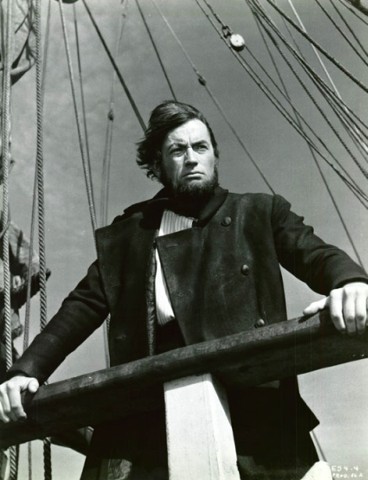
Gregory Peck in "Moby Dick"

Story by Astyages

Well, ah’ll goa to’t foot of ower stairs…

It’s no wonder I’m a technophobe! I had a lot of photos to go with this story, which would have proven beyond doubt that my octogenarian mum and her new gentle-man-friend, Terry are certainly much younger than their years. As I said to ’em both, “You both look like you’ve at least another forty years ahead of you!” Unfortunately all said photos were lost in my attempt to download ’em to my pc… Assuming (fatally!) that I knew what I was doing, and that the pix would simply download straight to my default ‘pictures’ folder, when the camera program asked me if I wanted to ‘delete files after import’, thinking this would simply delete the files on my camera and leave the downloaded files in my default ‘pictures’ folder, I hit the ‘yes’ button!

As it turned out they just disappeared… not just off my camera and my pc, but to all intents and purposes, off the face of the planet entirely, apparently! Thinking they must still be somewhere on my computer I’ve spent the last couple of hours looking for them, but in vain… so you’ll just have to take my word for it!

Oh well! I won’t do that again! (I hope!)

Mum and Terry arrived from the Manchester, via the Gold Coast, where Terry had been visiting his daughter, and Melbourne, last Wednesday and I went to meet them at the airport. I drove around the airport three times looking for a ‘handicapped’ parking space which was supposed to be right in front of the terminal before I finally discovered that one had to go through the normal car park to reach it… and of course, to take a ticket and pay for it!

My first impression of Terry is that he is remarkably fit and agile for his 76 years. This he puts down to a lifetime of sporting interest and achievement… wish I’d taken more notice of his surname… I want to google it to see if he’s famous at all… Maybe later… I drove them to the Paradise hotel, less than 200 meters up the road from my country estate. They decided to take a ‘siesta’ and invited me to join them for tea in the restaurant, establishing a pattern which would only be broken once during their week-long sojourn in our state. After a very nice tea we all adjourned to my place to watch ‘Moby Dick’… the ‘original’ version starring Gregory Peck and Richard Baseheart.

The next day, Thursday, I drove them out to Glenelg, with a short stop at Henley Beach, where we actually managed to walk along the short jetty. Intending to have tea in Glenelg at the HMS Buffalo, I was dismayed to discover it had disappeared! Someone had swiped the ship! By this time my legs and back were playing up badly, so we drove back to the Paradise, where Terry and Mum (her name is really ‘Sarah-Anne’, but she always goes by the name of ‘Sheila’) went for their usual siesta while I went home to rest up until tea-time.

On Friday Mum insisted on taking me shopping to buy some new bedding and would brook no refusal, so I now have some nice new bedding… and more old bedding than you could poke a stick at! Later, while we were having tea at their hotel, she showed me the ring Terry had bought for her – and which she’s wearing! – which is to be hers “… if she says ‘yes’!” according to Terry: A large, heart-shaped pink sapphire, surrounded by small diamonds on a gold band, also surrounded with small diamonds. I told Terry that he certainly could not have phrased his question more appropriately and that Mum had already ‘had the nod’ from me, not that it was ever needed! But she’s still keeping him hanging on a string, saying that she’s ‘had enough wedding cake to last her a lifetime!’ and refers to Terry as her ‘toy-boy’ because he is six years her junior… (She tells me he and his family are ‘rolling in dough’… Terry apparently has no shortage of money, and his daughter is a banker.)

Next day I drove them into town, where I discovered a ‘handicapped’ parking space right in the middle of Rundle Mall (ie. In ‘Gawler Place’ right next to the mall), but this still left us with a considerable walk to the Museum on North Terrace (it would have been a mere trifle and certainly far from a ‘considerable’ walk when I had good legs though!) where, after I had done as much of the ‘tour-guide’ bit as I could possibly manage, I spent much time in a chair staring at the allosaurus while they walked around the rest of the museum. Terry was particularly impressed, after having just watched ‘Moby Dick’ by the size of the sperm whale skeleton… and both were fascinated by the aboriginal exhibits on the ground floor. Sadly though, my legs and back were demanding that we go back home so I could sit in my chair with my feet up, so that was it… time for siesta! Walking back through the mall, we took some moments to observe the buskers who were there to take advantage of the Fringe Festival. Today’s 21st century busker not only plays music in public, he sells his own home-made CDs as well, using his mall performance as advertising. The ones we saw seemed to be doing very well! However, I noticed the importance to these acts of portable amplification systems…

By the time we’d had tea that evening, Mum and Terry had noticed how obviously difficult it was for me to do so much walking, so they said that the next day, Sunday, they would give me a ‘day off’; they planned to return to Rundle Mall and do a bit more exploring on their own…

Monday was still really hot, and I was still stiff as a board and unable to do much walking at all, so I took them for a drive around the Barrossa Valley, and the scenery was beautiful, so they both enjoyed it, although we stopped only once and that very briefly at Strathalbyn for an ice-cream… then back to the Paradise for the usual siesta, and tea, then back to my place to watch several episodes of Mum’s favorite comedy, which Terry, mercifully, also enjoys, ‘Only Fools and Horses’…

Tuesday was a bit cooler, but I was still feeling the cumulative effects of all my exertions so we drove down to Victor Harbor, where I wanted to show them one of my erstwhile favorite fishing spots, the Bluff. Apparently they’ve now built an inn just at the end of the approach road to this popular spot, called the ‘Whalers’ Inn’ and I explained how Victor was originally a whaling town. Then it was back to Paradise for a short siesta then tea and more ‘Only Fools and Horses’… Why my mum didn’t take the opportunity to watch any of the excellent movies I have in my collection is beyond me… another interest Terry and I seem to have in common is an interest in history, but Mum’s eyes glaze over at the very word!

Wednesday morning they insisted they did not need me to drive them to the airport for their early morning flight. Mum insisted that she didn’t want me to get up at 5.30 am and said they could get the bus to the airport, having discovered that the local 174 bus goes right to the terminal. I received a phone call yesterday arvo to let me know they’d arrived safely at the Gold Coast… next stop Singapore and then on home to the UK…

Terry’s already planning a return trip in a couple of years; in the meantime he’s taking her to Rome and Mexico. I must say that Terry strikes me as a very determined man, and I hope that Mum eventually accedes to his wish to ‘tie the knot’…

🙂

Monkey Hangers

24 Thursday Nov 2011

Posted by astyages in Astyages

≈ 15 Comments

Tags

Hartlepool Hung Monkeys

By Theseustoo / Astyages

I realise it’s been some time since I posted anything here and that my next episode of HH is way overdue, but so much has been happening lately, I just haven’t been able to ‘settle’ to write it yet… However, in the meantime, I’ve found an interesting little story to share with you all. I was having a chat with a fellow from Hartlepool in the Northeast of England, just about 13 miles south of where I used to live in Easington Colliery… The inhabitants of Hartlepool are known, more or less affectionately, as ‘monkey hangers’ as the result of an interesting little tale which goes back to the Napoleonic wars. Although this story is not mine, as it was found in a site which is all about advertising the delights of Hartlepool, I don’t suppose they’ll mind if I reproduce it here… It also includes a folk song about the same story too:

The Hartlepool Monkey, Who hung the monkey?
Home > History of Hartlepool > The Hartlepool Monkey, Who hung the monkey?
The monkey-hanging legend is the most famous story connected with Hartlepool. During the Napoleonic Wars a French ship was wrecked off the Hartlepool coast.

During the Napoleonic Wars there was a fear of a French invasion of Britain and much public concern about the possibility of French infiltrators and spies.

The fishermen of Hartlepool fearing an invasion kept a close watch on the French vessel as it struggled against the storm but when the vessel was severely battered and sunk they turned their attention to the wreckage washed ashore. Among the wreckage lay one wet and sorrowful looking survivor, the ship’s pet monkey dressed to amuse in a military style uniform.

The fishermen apparently questioned the monkey and held a beach-based trial. Unfamiliar with what a Frenchman looked like they came to the conclusion that this monkey was a French spy and should be sentenced to death. The unfortunate creature was to die by hanging, with the mast of a fishing boat (a coble) providing a convenient gallows.

In former times, when war and strife

The French invasion threaten’d life

An’ all was armed to the knife

The Fisherman hung the monkey O !

The Fishermen with courage high,

Siezed on the monkey for a French spy;

“Hang him !” says one; “he’s to die”

They did and they hung the monkey Oh!

They tried every means to make him speak

And tortured the monkey till loud he did speak;

Says yen “thats french” says another “its Greek”

For the fishermen had got druncky oh!

Hammer his ribs, the thunnerin thief

Pummel his pyet wi yor neef!

He’s landed here for nobbut grief

He’s aud Napoleon’s uncky O!

Thus to the Monkey all hands behaved

“Cut off his whiskers!” yen chap raved

Another bawled out “He’s never been shaved”,

So commenced to scrape the Monkey, O!

They put him on a gridiron hot,

The Monkey then quite lively got,

He rowl’d his eyes tiv a’ the lot,

For the Monkey agyen turned funky O!.

Then a Fisherman up te Monkey goes,

Saying “Hang him at yence, an’ end his woes,”

But the Monkey flew at him and bit off his nose,

An’ that raised the poor man’s Monkey O!

In former times, mid war an’ strife,

The French invasion threatened life,

An’ all was armed to the knife,

The Fishermen hung the Monkey O!

The Fishermen wi’ courage high,

Seized on the Monkey for a spy,

“Hang him” says yen, says another,”He’ll die!”

They did, and they hung the Monkey O!. They tortor’d the Monkey till loud he did
squeak

Says yen, “That’s French,” says another “it’s Greek”

For the Fishermen had got drunky, O!

“He’s all ower hair!” sum chap did cry,

E’en up te summic cute an’ sly

Wiv a cod’s head then they closed an eye,

Afore they hung the Monkey O!.

—————————-
So is it true? Did it really happen like that? You won’t find many people in Hartlepool who say it didn’t. They love the story.
The term was originally derogatory and for a long, long time after the event, people from neighbouring towns used the tale to mock Hartlepool and its inhabitants, and Hartlepudlians were often on the receiving end of the jibe: “Who hung the monkey?” , and is often applied to supporters of Hartlepool United Football Club by supporters of their arch rivals Darlington. However it has been embraced by many Hartlepudlians, and only a small minority still consider the term offensive; indeed, The local Rugby Union team Hartlepool Rovers are known as the Monkeyhangers, Hartlepool United F.C.’s mascot is a monkey called H’Angus the Monkey. In 2002, Stuart Drummond campaigned for the office of Mayor of Hartlepool in the costume of H’Angus the Monkey and narrowly won; he used the election slogan “free bananas for schoolchildren”, a promise he was unable to keep. He has since been re-elected twice.
Then there are some who point to a much darker interpretation of the yarn. They say that the creature that was hanged might not have been a monkey at all; it could have been a young boy. After all, the term powder-monkey was commonly used in those times for the children employed on warships to prime the cannon with gunpowder.
Whatever the truth the story of the Hartlepool monkey is a legend which has endured over two centuries and now enters its third as strong as ever.

In June 2005 a large bone was found washed ashore on Hartlepool beach by a local resident, which initially was taken as giving credence to the monkey legend. Analysis revealed the bone to be that of a red deer which had died 6,000 years ago. The bone is now in the collections of Hartlepool Museum Service.

Dalton Trumbo and Feral Tom

07 Friday Oct 2011

Posted by astyages in Uncategorized

≈ 35 Comments

Tags

Dalton Trumbo, Feral Tom

David L Rowlands

(Dammit! I missed the 1,000th post mark! Oh well, I might as well post the item I was saving for that spot: The following is an article I wrote about Dalton Trumbo some time ago but have not yet published; because the kind of the kind of ‘outsiders” life he must have lived reminded me of a certain feral cat I once knew, I also wrote those thoughts down as a sequel and I’m presenting them together because they seem to me to go together).

Emmjay’s note:  No THIS is the 1,000th article.  My post of the Steve Jobs speech doesn’t count as an article – it’s just a cut and paste – but it’s a worthy listen given the sad circumstances !

I just watched the second half of a fascinating documentary TV program on ABC2, entitled, “Trumbo”, all about one of my favorite authors of (relatively) modern times… damn shame I missed the first half; I do hope they’ll show it again soon… perhaps on one of the other channels, although I don’t think there’s much chance of that happening really, as it’s a ‘load of leftie bullshit’…

For some of our younger readers who may not be familiar with the name, Dalton Trumbo is perhaps one of the most influential of writers this century, in spite of the fact that his work was usually credited under a plethora of pseudonyms because Mr Trumbo himself was suppressed, oppressed, repressed, unimpressed and depressed, not to mention frequently incarcerated, when not on the run or overseas, by the infamous Senator Joe McCarthy’s anti-communist witch-hunt.

Trumbo was so hated by the establishment that hate and smear campaigns against him were carried out so effectively that even his kids were systematically shunned and socially isolated even by the kids they went to school with, who aped their parents’ malicious gossip and social ostracism, systematically and completely refusing to speak to or play with them… His pre-teen daughter was so damaged by this treatment that she begged her parents not to make her go to school; treatment by medical health professionals was necessary, but who knows how effective? She seems, however, to be very sane and remarkably balanced now in her old age, but what she must have suffered!

Our younger readers may well ask, what was this witch-hunt all about? And why persecute anyone like this, let alone his kids, just because they didn’t like some of the things he wrote about, because it had a negative reflection on contemporaneous American society? Doesn’t the USA have ‘freedom of speech’, ‘freedom of the press’ and ‘freedom of association’? Well, the answer to that (said Sir Humphrey) is both ‘yes’ and ‘no’; yes it does in theory, but it doesn’t always pay to put the theory into practice… Even Socrates came a cropper when it came to criticizing his own society…

As a recovering anthropologist, I sympathize; they should put a government health warning on university courses in Social and Cultural Anthropology, stating that they could seriously damage your relationship to the society you lived in, unless, like Oedipus, you put out your own eyes… and simply choose no longer to see the world as it is, simply because it’s just too awful; far too oppressive; far too painful; and impossible to change…

You’d better cut off your ears too, or stop them up with wax, as Odysseus had his crew do, so they might not become entranced by the sirens’ songs and dash their boat onto the rocks. Odysseus himself of course, thinking man that he is, must first be tied to the mast and his own ears left unblocked so he was able to listen to those sirens’ songs… And Freedom, Democracy and Justice, the three most seductive sirens are closely followed by two pairs of twins: ‘History and ‘Mythology’ and ‘Anthropology’ and ‘Sociology’ and abandon hope all you who, entranced by their songs are lured onto the rocks of isolation and social alienation… for those who hear the songs of these seven sirens are given ways of seeing and understanding the world which often puts them at odds with even the society in which they may have grown up in and lived in all their lives, since analysis implies critique and in a scapegoating culture, anyone who offers any serious critique of it will be seen as ‘volunteering’ for the sacrifice, as was Dalton Trumbo…

Oh, and cut out your tongue too… The ‘Thee Wise Monkeys’ were right, only way to survive in today’s modern, western, postindustrial, capitalist-colonial-imperialist societies, is to ‘see no evil, hear no evil and speak no evil’… And, since I write, and am ambidextrous to a degree, I suppose I’d have to cut off both my hands and possibly even my feet, ’cause I’m also that stubborn and persistent…

But what would be left of me but one big stump? A basket case?

Which brings me back to Dalton Trumbo… One of his best pieces of work was about a basket case and it made one of the most profoundly disturbing and effective anti-war statements I’ve ever read. “Johnny Got his Gun” is about a victim of a shell explosion in the trenches of WWI, who loses everything I’ve just mentioned. I should perhaps warn you that, although I’m not usually prone to nightmares, this slim volume gave me nightmares for weeks… I won’t spoil the story for you, but let you discover it for yourselves if you haven’t already read it… And the profoundly anti-war statement made by this book was so hated and feared by the McCarthy regime, that the book was banned for thirty years and its author incarcerated for many years too.

Now, I’ll bet you’re all wondering what he’s written under that plethora of pseudonyms, eh? Well, apart from books he wrote movies, here are the titles of just a few of them, “Roman Holiday”, “The Brave One”, “Johnny Got His Gun” (of course!) and, one of my all-time favorites, “Spartacus”… but there are dozens more (at least!), so if I’ve whetted your appetite for more, all I can say is, “Happy Googling!”

Oh! And:

“I’m Spartacus!”

***** ******* *****

I’ve been thinking a lot lately about a cat I knew… No, I haven’t reverted to the beatnik slang of the ’50s, I mean a real cat; a stray I brought home at the age of about seven (me, not the cat! The cat was probably significantly older!)

I’d just found it wandering the streets in the neighborhood, and, impulsive as I was then, I couldn’t resist a childish impulse to pick it up and cuddle it… But it didn’t want to be cuddled… not one bit! It bit and clawed and scratched at my face in its efforts to regain its lost liberty, yet I kept it cuddled so tight to my chest it couldn’t get away… Maybe it was scratching partially in an effort to breathe; I didn’t really notice at the time; but by the time I’d carried it the twenty-or-so yards to our back door, excitedly gasping ‘Can I keep it, Mum? Can I keep it?!” my face looked a bit like a red tartan shirt; criss-crossed with broad red weals.

Needless to say, Mum wasn’t exactly ‘enthusiastic’ about the idea, but after much persuasion, I made her promise a saucer of milk for the ‘poor critter’, and she made me promise I’d put the animal down and let it go if it wanted to… But I hung onto it until the saucer of milk was delivered, because I just knew that without some inducement, Tom, as I’d (very originally) thought of calling him, would be off like a rocket; and I’d gone to so much trouble to get him here, this durned animal was gonna be my friend if it killed me (And it might have if I hadn’t eventually let go!)

Now the word for lost and abandoned cats in the UK is ‘stray’, and in that environment that name suits most of them… But not Tom… Tom was a huge black and white cat with partly white legs and a white underneath; it’s face was mostly white with a perfect ‘pirate’s eyepatch’ over its left eye, which also bore a scar right down from its forehead to its cheek through its eyelid; fortunately for Tom the ancient wound had not been deep enough to actually injure the eyeball itself. When I first came out to Australia some thirty years ago, I found a cartoon strip called ‘Footrot Flats’, written by a Kiwi, I believe, in the Sunday paper, which featured a cat by the name of ‘Horse’… As soon as I saw Horse, I realized I was looking at the reincarnation of Tom. Almost as big and as strong as… well… in the northeast of England, lets say, a pit-pony, if not a horse.

Yep! ‘Stray’ is too tame an adjective for Tom; for Tom, the word has to be ‘feral’: Tom was most definitely a wild creature and most definitely his own master. He would not stay in the house very long at all, ever, but as he was lapping up the milk on that first occasion, he was too busy to object too strenuously to me stroking his back. As soon as he finished his milk, and some of our other cat’s cat-food which I used to bribe him to stay a few minutes longer, he was off out the back door, which Mum wisely insisted on keeping open. (Our other cat had another very original name; it was a black kitten we called, of all things, ‘Blackie’, who’d arrived in a similar manner to Tom, though with less blood!)

After that first time he’d come round of his own accord quite regularly, at first every week or so and this gradually shortened to every few days, and then gradually it became every day as visiting us to bludge food had became a habit with him… but he would never ever stay long; as soon as he’d eaten his food, drunk his milk and had his petting session, he was off out again; no way would he ever stay in overnight, though he roamed around the house like he owned the place…

The thought occurred to me even at that time, that Tom must have been ‘on the road’ for a very, very long time… since he was a kitten most probably, I thought; yet he’d not only survived, but thrived (actually the correct word is ‘throve’ as the past participle to the verb ‘to thrive’, but the spellchecker won’t let me use that!) and now here he was, big and strong and incredibly tough… But very canny, very smart and extremely non-trusting too… Not only ‘feral’ but ‘streetwise’ too… At one and the same time I admired him for his incredible strength and independence, yet pitied him for his inability to either express his own more tender emotions, nor allow such emotions to be expressed at or upon him…

Now, something close to half a century later, after having been homeless myself for several years and having discovered the virtual impossibility of ever being able to properly re-integrate oneself within ‘society’ again, I’m beginning to know just how he feels…

***** ******* *****

Hell Hospital, Episode 18

27 Tuesday Sep 2011

Posted by astyages in Uncategorized

≈ 30 Comments

HELL HOSPITAL

By Theseustoo

Episode 18

“Loreen, there’s something evil in the hospital… it’s possessing Catherine right now and if its hold isn’t broken soon it’ll possess her permanently… You must get her away from there; she needs to be in familiar surroundings… Maybe her own things might somehow get through to her; at the very least it might give her the moral support she needs to fight her demon…” St Helvi was insistent; she’d had a word with the Boss and he’d spoken to the Fates who’d agreed to put Paula’s fate into a ‘holding pattern’ for the time-being; so now she must drop all her other duties and pay particular attention to Catherine…

“But what about her baby” Loreen had asked… “Baby?” the saint inquired “Oh… that baby… Better keep your eyes on that baby too; it must be exorcised as soon as possible.”

***** ******* *****

“We have no record of a baby…” the receptionist told Loreen innocently, “Are you sure you have the right name? Or the right hospital?” Loreen realised she would have to find the missing baby herself; the logical place to look first was Catherine’s home so, taking Swannee’s home address from his ‘clock-card’, which was still in the ‘on duty’ rack, now all she had to do was break Catherine out of the psych ward and take her home. This turned out to be easier than she thought it would be; borrowing a white coat from the laundry, with her hair tied back in a severe bun, wearing her reading glasses and with her staff id pinned to her lapel, she now looked so much like a doctor that no-one gave her id more than a cursory glance from a distance, so no-one looked closely enough to read the bit that said ‘cleaner’. Whenever anyone checked her id she just said, “I’m just escorting one of our patients to a medical appointment at another hospital; there’s a new treatment they want to try with this case… The receptionist looked up at her briefly, nodded disinterestedly and said, “Okay, but don’t forget to do the bookwork on her… otherwise you know who they’ll blame!” “No worries! Paperwork’s all taken care of…” Loreen lied, quickly whisking Catherine out of the ward and into a waiting taxi as the receptionist returned to her telephone conversation; a taxi which had, in fact, been waiting for another patient entirely, but which, Loreen generously informed the driver, “…would do anyway…”

***** ******* *****

Big Merv had opened well for the nurses’ eleven, with half a century clearly in sight when he was sadly dismissed for 46 by a stunning ‘yorker’ from Algernon, which exploded his wicket. The next couple of nurses were quickly bowled and/or caught and at one stage there, the nurses eleven were nine for a hundred and thirty… Hung One on put up a magnificent show as tenth man, however, finally declaring at 150, while Paula put up a respectable show as ‘eleventh man’ with thirty runs, leaving a total of 310 runs for the Swan kids to beat. The nurses were quietly confident that they had left their opposition an impossible task.

When the two smallest little-uns opened the batting, Merv made the mistake of thinking them far too cute to be able to do much damage and so sent down a couple of easy overs… the little-‘uns smashed most of them easily for six, or occasionally for four; having only little legs, they disdained running, because they were quite disadvantaged in this respect; so they sought runs from a standing position, deliberately courting danger, but smashing balls through any and every gap in the field. Funston played a particularly strong opening bat, but not before a slight altercation with the referee, who had initially given him out for a duck, leg before wicket… but who was somehow persuaded to change his verdict after Funston gave him the ‘fluence-eye’ and explained quietly, “Listen, this crowd have come here to see me bat; not to see him bowl…” The next thing the ref knew, he was listening to his own voice as if from the bottom of a well, saying, “Not out!”

John liked to make sure all the little-uns had a go at the bat, and they were all fierce risk-takers, but they could usually manage to do enough damage to the opposition to leave relatively little to do for the bowling partnerships of Algernon and Vivienne and John and Mary. When Algernon went to bat with only twenty runs to make, John and Mary knew they wouldn’t get a bat this game and started to prepare the sandwiches, looking forward to an early tea. A few minutes later Algae was borne in triumphantly on the shoulders of the rest of the team, until they suddenly and unceremoniously dropped him in favour of Mary and Vivienne’s sandwiches.

***** ******* *****

The novelty of having her own zombie-slave to do her bidding wore off faster than Elaine thought it would… corpses rarely make good conversation and even as servants they are less than enthusiastic; besides which, after a couple of days Swannee began to smell so she kept him in a chest-freezer until she began to worry about the health implications for the food that was stored alongside Swannee’s undead remains. Eventually she moved him back to the morgue, thinking it the only proper place for a corpse… outside the grave, anyway. Here at least she would be able to keep him on ice and minimise the smell without risking her own health; and providing she timed it right, here would be the most convenient place for the next ritual…

***** ******* *****

The tiny part of her mind that was still Catherine had been warned by the gentler of the two voices in her head to be ready for the opportunity to escape, and though she still lacked any volition of her own, she put up no resistance as Loreen walked her out to the taxi and sat with her in the back of the cab while the driver took them to Catherine’s home address. Loreen had expected the house to be full of kids, but when they arrived they discovered the place was empty. However, Loreen found a window open round the back of the house and climbed in through it to let in her zombie-like friend. Where was everyone, Loreen wondered; it was Saturday afternnon; the kids should at least be at home… but the house seemed deserted.

***** ******* *****

Hell Hospital: Episode 17

11 Sunday Sep 2011

Posted by astyages in Astyages

≈ 27 Comments

Tags

Hell Hospital, Holy Roman Umpire

Simulated group of children - probably on their way to bed or to play cricket

By Theseustoo

By the time the Reverend Petros Batty met Dr Frood at the hospital, the baby was still nowhere to be found. The nursing staff, following Nurse Paula’s suggestion, had decided that, for the sake of ‘keeping the record straight’ at the same time as avoiding the embarrassment the hospital’s board-members would inevitably suffer should the media ever get hold of the story about the missing baby, had decided it would be best to lose all records of the baby too; if anyone asked they could then simply say, “Sorry, we have no record of any such baby!” Such an answer would even, they assured each other, stand up to polygraph examination.

Fortunately, it was not the baby which the Reverend had come to see… and it was only Dr Frood who suffered any embarrassment as he explained to the Reverend the unusual circumstances of its birth and its recent disappearance, as they walked down the long corridor to the psychiatric wing.

“So… you say the mother was always placid and docile when feeding the baby?” he said, wanting to be quite sure of his facts… “Interesting… Tell me, did any of the other hospital staff suffer any of these psychic attacks?”

“No…” Dr Frood replied, somehow even more embarrassed that he appeared to be the only victim of Catherine’s telekinetic attacks. He began to wonder if the demented woman could be harbouring some unknown grudge against him…

Almost as if he was reading the doctor’s mind, the Reverend said, “Don’t worry; and don’t take it personally: in cases such as this, victims of possession often seem to reserve their attacks for what they regard as ‘authority figures’; anyone who tries to control their behaviour being seen as opposed to the chaotic reality the demon wants to create, you see… just as God and ‘Order’ is opposed to the Devil and the chaos he’d like to bring into the world…”

“I see,” the doctor replied, just as they entered the ward, “But doesn’t that mean that you’re likely to be attacked too?” But the priest was unable to answer him, as a stainless steel bedpan struck him with considerable force on the temple, spilling its noisome contents all over him and rendering him immediately unconscious. Dr Frood quickly ducked a number of other flying objects and, grabbing the priest underneath his armpits, swiftly dragged him backwards out of the ward.

***** ******* *****

At first, Warrigal had felt slightly out of place in Swannee and Catherine’s bedrooom, but it was the only logical place for him to stay; all the other bedrooms in the house being full of several children, but as he only had to sleep in it, he soon got used to the idea; after all, as the cricket team’s new ‘legal’ guardian, he was obliged to live with them in order to properly take care of them. John and Mary and Algernon and Vivienne had done a remarkable job, he thought, of taking care of their younger siblings in the absence of their parents, but as Vivienne had explained, “It’s not so difficult really; I mean, we’re used to helping Mum with chores and stuff already… and we pretty well know what needs to be done…”

“Yeah,” John interjected at this point, “it’s really just a matter of sticking to the routine… Well… except for me and Mary having to give up school to go to work…”

“Yeah,” Mary said, taking up John’s line of thought as easily as she might catch a mis-hit ball in the slips, “… the only real problem is that we were hoping to get into the University of South Oz on a cricketing scholarship next year, but that depends on me and John passing the end of year exams… But we’ve missed an awful lot of school now… though we have managed to keep up our cricketing practise, even through the off-season…”

“Season starts next week…” one of the little-uns piped up, with some concern evident in his voice.

“Don’t worry mate,” said John, “I’ve already enrolled us all in the Church’s Cricket League…” then, in an aside to Warrigal, he said, “The school’s run by the Church, you see, and they depend on us, ’cause we’re the parish’s ‘A’ team… This year we won’t even have to find an eleventh member, ’cause the bub can be our eleventh man…” To the rest of the team, he added, “He’ll make a good wicket-keeper for a start, I reckon, until we can find out whether he’s better at batting or bowling… though until he can walk, we’ll have to use a stand-in ‘runner’ for him, under the ‘disability inclusion’ rules… Still, that should be a ton of fun! One of the little-uns can push the stroller between the wickets…”

“Ton of fun! Fun’s ton…” Mary hummed to herself… then to the rest of the family she said, “That should be his name, I reckon… ‘Funston’… We gotta call him something, after all… ‘Can’t just keep calling him ‘the bub’… he’ll resent it later on, if we do… develop a complex or something…”

The team all nodded, automatically in sympathetic agreement, commenting variously, “Yep!”, “’Sright!” and “Good name!” As both a family and a team there was rarely, if ever, any dispute or argument amongst them; they all tended to agree, intuitively working in harmony for the sake of the ‘greater good’; for the sake of the ‘Game’… Warrigal had found it fascinating to watch such smooth cooperation among them; thinking they could probably teach a lot of adults how to behave… He could see now why both the school and the Church should come to depend on such a team; as an example of solidarity and team-work they were second to none…

“So!” Warrigal said, “First of all, John and Mary, you needn’t worry about the schooling you’ve missed; I’ll talk to your teachers and find out what lessons you’ve missed and tutor you personally ’til you’ve caught up; you’re both very bright and work so well it won’t take long at all… So you’ll still get to uni, okay?” The children nodded eagerly, simultaneously saying, “Thanks Wazza!” using the nickname they’d instinctively given their new carer, as the rest of the team cheered. “Now, down to more serious matters… When’s the first match of the season? When will little Funston get his first game?”

“Next Sad’dee!” the little-uns all chimed.

“So…” said Warrigal, “That gives us all a week to practice and get him ready! John and Algae, get the gear… stumps, balls, bats and pads; I reckon it’s time to hit the oval for a bit of a knock-about… ”

“Yaaaaaaay!” The little-uns yelled joyfully as they scrambled to change into their cricketing clothes, feeling better than they had felt for several months, while the older boys fetched the equipment and the older girls prepared a small mountain of sandwiches and several large flasks of tea.

***** ******* *****

“This is Warrigal Mirriyuula…” John said to the priest who organised the Parish Cricket League, by way of an introduction, “He’s our new carer…” Father O’Blivion shook Warrigal’s hand warmly as he replied, “Most pleased to meet you, Warrigal… May I call you Warrigal? Such an awful business about Mr and Mrs Swan…” Warrigal merely nodded, no wanting to say too much about this in front of the kids, who still expected to be reunited with their parents at some stage in the unspecified future… Then to the children, the priest said, “Your first game of the season is against the St Helvi’s Hospital Nurses team… I’m looking forward to a repeat of last year’s victory! Now, there’s someone I want you all to meet…” He looked around the oval until he saw another tall figure wearing a black cassock, “Father Batty!” He called, “Could you come here a moment, please…?” As the other priest joined the group, Father O’Blivion said, “This is Father Petros Batty… he’s come all the way from Rome to join our parish; he’s my new verger and he’s also volunteered to be our umpire this year…” As the children all dutifully shook hands with him, Father O’Blivion continued, “He’s our ‘Holy Roman Umpire’…”

***** ******* *****

Know Thyself: My response to Atomou on the ‘evil madman’ Breivik

03 Wednesday Aug 2011

Posted by astyages in Uncategorized

≈ 36 Comments

Tags

Breivik, mad or evil, mass murder, mass murderers, norway mass murder, oslo mass murderer

“Know Thyself”… My Response to Atomou on the ‘evil madman’, Breivik

G’day Ato… and my apologies for taking so long to get back to this… Anyway, here’s my response to your post:

When I said he’s neither, I really should have said he’s both and neither… What I was really trying to get across is that it is unhelpful to think in such terms because these concepts, as I have already said, do not explain anything about what he did; rather it ‘explains it away’; once we have either of these ‘explanations’, we think we know all that is necessary to know about him and so no longer need to think anymore about him or what he did; most especially we don’t need to look at the social causes of his actions and thus ‘we’ (ie. ‘society’) let ourselves off the hook.

Madness, virtue and evil are all culturally defined, Ato, and they are thus largely a matter of consensus (though this is also to some extent dependent on context); the consensus in this case may well be that he’s mad and evil, but as I’ve said, these concepts actually help the real underlying causes of this kind of phenomenon to disappear and thus are not helpful; indeed in analytical terms, these concepts are counter-productive.

I agree that we mortals are both good and evil; mad and sane and much more… yet this too does not help us understand why people do such things. When I was writing my honors thesis, I had originally intended it to be about mass murder and so I did a lot of reading on that subject before I decided to use more traditional cultures as my ethnography (I’d changed tutors and my new tutor was more into ‘traditional’ (ie. ‘tribal’) societies than modern ones and I thought it a good move to try to please him. However, from the reading I did prior to this, I discovered that there is a very strong connection between a history of childhood abuse and mass murder; most, if not all mass murderers had a history of the most appalling kinds of abuse during their childhoods and adolescences… It would therefore seem to me to be imperative that we study this connection between abuse and murder (especially mass-murder).

I also understand the difficulty, not to say the near-impossibility, of maintaining high ethical standards, but don’t see what relevance this problem has to the matter under discussion: ethics are also relative to the social groups which respectively hold them… to the group of followers (if he really had any) or to the so-called ‘knights templar’ (small letters to denote that they’re not the original ones!) it could well be that they think such actions are ethically justified (fighting the good fight against the ‘common enemy’, and so forth). Racists with a taste for violence might well agree with this proposition… (no, I don’t!)

I feel the same way about the death sentence as you do, ato, and I understand, too, that I may well feel just as moved to violence had I been the father of any of the victims, male or female… and I really don’t know what I might do in such a circumstance; yet, as I’ve also said elsewhere, perhaps this is the real test of our humanity: whether or not in such circumstances, we revert to the most ancient of all laws, the Law of Revenge, the logical operation of which destroyed the House of Atreus so thoroughly… and inevitably; or if we allow legal processes which have been specifically designed to render the ‘Law of Revenge’ redundant and render society livable! It is not insignificant that the stories we both love so much about the evolution of social laws and ethics took place in an historical period in which living in cities was a relatively new phenomenon; the development of laws follows the development of cities… Just imagine what it would be like living in a city like modern Rome or Athens or London or New York if the sole form of ‘justice’ was personal revenge… Happy places, do you think?

Perhaps it’s also unhelpful to blame the gods or fate, too, ato… especially since we tend to make both of these ourselves… What you are obliquely suggesting is that ‘anyone of us’ could possibly have done such a thing… given the right circumstances… Now, while I don’t entirely disagree with this proposition, it should also be pointed out that most of us don’t! And we must ask why not… the answer of course, lies in the ‘circumstances’, which led to Breivik doing what he did; and these ‘circumstances’, if we are to be thorough in our analysis, must include a survey of the whole process of socialisation which Breivik experienced… including the ‘normal’ socialisation processes for Norway and whether or not there was any significant differences or aberrations in Breivik’s socialisation. Needless to say, this means that we must also look very closely at his personal epistemology.

I don’t think your metaphor regarding Philoktetes works at all in this situation either; his injury was most definitely not socially caused (snakes are not part of human society). And the poison of a snake, though it may make a metaphor for a poisoned mind, is qualitatively different from the latter kind of poison, simply because the latter most certainly is a social phenomenon. If we allow ourselves to assume that gods are real and actually interact with humans, then in answer to your question about Hera punishing Philoktetes for being Herakles’ friend, of course it is a social phenomenon, ato; how could it be otherwise?

The same is true of your other examples of the mother who beat her son to death and the father who threw his daughter off the bridge and even the Indonesian abbatoirs; these are all social phenomena, like it or not… Whether we allow free reign to our ‘darker angels’, or bow to the normal (social) judicial processes is perhaps determined by the relative success of our ‘process of socialization’… you see, most of us don’t do such things, regardless of how frustrated we might become…

“Our deeds vary so much and they vary from circumstance to circumstance, not from man to man, from woman to woman, so that to use any appellation on them, on these different and varying deeds, appellations that narrow, particularly in a dogmatic sense, the breadth and depth of its source is to do an injustice to the complexity of our character.”

Now, it’s funny you should say this, because it is precisely because the concepts of ‘madness’ and ‘evil’ narrow, in a most dogmatic sense, the ‘breadth and depth of its (ie. the act of mass-murder’s) source’ and thus does an injustice not only to the ‘complexity of our character’, but to the whole of society insofar as it does nothing to solve the problem and prevent further attacks in future; and even if some hatred is ‘justified’ (Ghandi would most certainly disagree…) acting on that hatred may not be… unless we act in a ‘justified’ fashion according to the laws and use legal processes to obtain ‘justice’ for ourselves, however that is defined.

I must say that I sympathize with Kazantzakis, but fail to see its relevance here except, perhaps, as a form of wishful thinking… a desire for a state in which such things simply could not happen. As for Freddy Nietzsche… this social-darwinist, who called himself a philosopher, was not a sociologist or anthropologist, and even before his so-called ‘philosophies’ became the inspiration for Adolf Hitler, they were severely critiqued (I found some interesting critiques dated 1932…) As I’ve already mentioned, his ‘struggle of all against all’, not only ignores the ‘cooperation’ side of human nature and over-emphasises the ‘competition’ side… and if properly applied would inevitably lead to either anarchy, or the kind of insane power struggle which Hitler found himself engaged in. It’s a pity he’s still so popular… but popularity is not necessarily a reflection of merit!

Your highly emotional descriptions of what it is to be a human being, though interesting and highly poetic, are less than useful for our analysis, I’m afraid, for that very reason; because they are so highly emotional. That you should mention the quote from above the doorway of the Delphic Oracle is quite ironic, because the form of analysis I advocate (ie. ‘social analysis’) which derives from the science of anthropology (yes, I know it’s an ‘arts’ degree; but one of my tutors was highly insistent that it was most definitely a science! And as you know these concepts are only artificially separated for the sake of intellectual convenience of characterization) is indeed all about ‘knowing thyself’… I’m sure I needn’t explain to you the origin of the word ‘anthropology’, but for the sake of any non-Greek speakers who may read this, it derives from two words, ‘anthropos’ (Man) and ‘logos’ (in this case meaning ‘study’ or ‘science’ of…) And it does so much more thoroughly and more appropriately than the pseudo-science of ‘psychology’, simply because this latter (as I’ve already indicated) has only relatively recently begun to recognize the social origins of (non-physical) mental aberrations.

Sadly, I must admit that I haven’t the slightest notion as to how one might ‘fix these problems’… first one would have to do the appropriate studies… although I have at least attempted to indicate where such studies might begin, and indeed, I have, I sincerely believe, made a significant contribution towards any such studies with my book, Aesthetics of Violence, which outlines a paradigm for understanding violence as a form of human self-expression. It’s a pity that it is unlikely to be accepted academically, however, as a result, ironically, of my own scapegoating by the members of the department I was working in…

I do agree, however that the best one can do is to work on oneself, since one cannot change the world… though I find your final reference to Cain and Abel somewhat puzzling: if we are ‘our brother’s keepers’ does it not make it incumbent upon us all to first of all understand our ‘brother’, before we go making his decisions for him? And how will we do this without social analysis?

Such as it is, m’lud, I rest my case…

😉

← Older posts
Newer posts →

Patrons Posts

  • The Question-Crafting Compass November 15, 2025
  • The Dreaming Machine November 10, 2025
  • Reflections on Intelligence — Human and Artificial October 26, 2025
  • Ikigai III May 17, 2025
  • Ikugai May 9, 2025
  • Coalition to Rebate All the Daylight Saved April 1, 2025
  • Out of the Mouths of Superheroes March 15, 2025
  • Post COVID Cooking February 7, 2025
  • What’s Goin’ On ? January 21, 2025

We've been hit...

  • 713,805 times

Blogroll

  • atomou the Greek philosopher and the ancient Greek stage
  • Crikey
  • Gerard & Helvi Oosterman
  • Hello World Walk along with Me
  • Hungs World
  • Lehan Winifred Ramsay
  • Neville Cole
  • Politics 101
  • Sandshoe
  • the political sword

We've been hit...

  • 713,805 times

Patrons Posts

  • The Question-Crafting Compass November 15, 2025
  • The Dreaming Machine November 10, 2025
  • Reflections on Intelligence — Human and Artificial October 26, 2025
  • Ikigai III May 17, 2025
  • Ikugai May 9, 2025
  • Coalition to Rebate All the Daylight Saved April 1, 2025
  • Out of the Mouths of Superheroes March 15, 2025
  • Post COVID Cooking February 7, 2025
  • What’s Goin’ On ? January 21, 2025

Enter your email address to subscribe to this blog and receive notifications of new posts by email.

Join 373 other subscribers

Rooms athe Pigs Arms

The Old Stuff

  • RSS - Posts
  • RSS - Comments

Enter your email address to subscribe to this blog and receive notifications of new posts by email.

Join 373 other subscribers

Archives

Website Powered by WordPress.com.

  • Subscribe Subscribed
    • Window Dresser's Arms, Pig & Whistle
    • Join 279 other subscribers
    • Already have a WordPress.com account? Log in now.
    • Window Dresser's Arms, Pig & Whistle
    • Subscribe Subscribed
    • Sign up
    • Log in
    • Report this content
    • View site in Reader
    • Manage subscriptions
    • Collapse this bar
 

Loading Comments...