• The Pig’s Arms
  • About
  • The Dump

Window Dresser's Arms, Pig & Whistle

~ The Home Pub of the Famous Pink Drinks and Trotter's Ale

Window Dresser's Arms, Pig & Whistle

Author Archives: Voice

On Your Feet

10 Friday Jun 2011

Posted by Voice in Voice

≈ 9 Comments

Random Jazz Clarinet Player

Here’s some new old music for you, Warrigal. A couple of upbeat traditional jazz tracks taken from an old 78 of the University Jazz Four, with my father on clarinet. I believe it was recorded at the 1952 Melbourne Jazz Convention. It was a special trip for my father because it was the first time he had been out of South Australia. Gave him the travel bug.

What could get you up on your feet faster than the Sunset Café Stomp (lyrics below)? And if that leaves you breathless, here’s a swinging Sweet Chariot.

Sunset Café Stomp Lyrics

Sunset stomp got folks jumping’s

Sunset stomp got folks

Jumping’s up and down, all around

They yell, band men play some more

Charleston, Charleston

I’ll say it’s hot

But your black bottom, it’s got ’em

But, oh, that sunset stomp

Lord, it’s going

And the people strain

Created in the crazy house

It sets good folks insane

Gentlemen, ladies too

Push ’em round n round

They loose their head

They outa bed

Doin’ that sunset stomp

I said, doin’ sunset stomp

Disaster Victims in Japan Try To Survive

16 Wednesday Mar 2011

Posted by Voice in Voice

≈ 16 Comments

Extract from Le Figaro. Its reporting is an order of magnitude better than anything I’ve read in the local press, and Google translate just isn’t up to it. Sharing it might be my little personal debriefing strategy.

Disaster Victims Try to Survive 15/3/2011

Monday morning, a father waits for help with his four month old daughter at Ishinomaki, in the flooded region of Miyagi in the northeast. Photo Credit: Hiroto Sekiguchi/AP

In the northern regions devastated by the earthquake and tsunami, help has not yet arrived.

All is desolation on the main road of Tagajo, a hamlet wedged between the Pacific Ocean and the city of Sendai (northern Japan). The cars in the street, still muddy despite the army’s work clearing it, line it with battered shells, as if chewed up then spat out by a giant crusher.

Suddenly, on the radio, newscasters who announce nothing but disaster news since last Friday, reach a new level of seriousness: “To all the people close to the coast of Iwate prefecture, Fukushima or Miyagi: a tsunami is coming! Leave your car immediately and look for safety as high as possible.” All around, people rush to take refuge on the roofs of buildings. Soldiersof the Self-Defense Forces, the Japanese army, lead a small group of residents attempting to climb the highway suspended over a devastated landscape. “More than fifteen minutes,” warns a soldier. “We’re safe here, this is 8 metres high,” says another in a peremptory tone. “On the radio, they talk about a wave of 13 metres,” says a civilian, invalidating the soldier’s assurances.

“The government will not help us”

From their balcony, the locals scan the horizon. A soldier finally throws his arms in the air: “False alarm!” Life goes on, despite the mud, continuous tremors, nuclear threat and the tsunami. “We’re only missing a volcano,” jokes one resident, fatalistic. On Sunday, the authorities announce that the Shinmoedak volcano projects rocks and ash into the air up to 4000 metres “in Kyushu, southern Japan. The population no longer has the heart to joke. Faced with this offensive of nature, the Japanese have realised that they can only count on themselves, the authorities are clearly overwhelmed. They’ve organised themselves into neighbourhood communities, displaying an impressive solidarity. No risk of looting in Japan during shortages.

A few kilometres down the road from Tagajo, the inhabitants of Shiogama, streets flooded, have seen no police, nor ambulances, nor fire brigade, nor even journalists to record their grievances. “We have no electricity, no water, no telephone and are almost out of rice, and nobody comes,” said Emiko Ito, fishmonger at the local market. The people of his residence share what remains to them in the parking shelter, on a concrete block turned into a stall. Further up, the primary school gym has been transformed into a refuge for hundreds of homeless people whose houses were flattened by the earthquake and tsunami. Overhanging the sea, the building is theoretically protected from the rising waters.

“My dog has food for ten days, but I have nothing for myself tonight,” says a young native of Chiba, hugging his dog Anjie. “We don’t have enough for dinner,” confirms Noriko Sato, a teacher become by force of circumstances the leader of this community. “I convinced the people here to share everything, but it wasn’t easy. Anyway, we have no choice. The government will not help us. Look at them: they never decide anything. Then we, we decide! ” she rants.

Those in her care feel happy to be alive. “When the earthquake happened, I ran out of my shop, but the shock was so violent that I collapsed. Then I heard that the tsunami was coming and I had to climb to where I could. I took refuge on the roof of a temple, and I escaped the worst. I heard the roar of the waves for an hour, ” said Asako Saito, Kayoko his mother at his side. Outside, dozens of people wait patiently in front of a wall, waiting for a tanker loaded with water that does not come.

A Rescued Garden

15 Wednesday Sep 2010

Posted by Voice in Voice

≈ 29 Comments

Native Orchids - Dendrobium Speciosum

Violets

I will never, ever, neglect my garden again. I mean it. Just as I meant that I would never, ever neglect my fitness, health, house, family, social life, financial organisation, or professional development. It’s just, how do you do it all at the same time?

Herb Bed


My traditional answer to this question has been to lurch from near disaster to near disaster as each area rises to the top of the priority list. But every now and again a crisis in one area leads to some others falling off the list altogether. Eventually comeback time comes around, and recently it has been the turn of the garden to be brought back from the brink.

Late Winter Flower Arrangement


If there is one horticultural area in which I can now claim expertise, it is weeds. I might not know all their Latin or even common names, but I know their perfidious ways. Enemy number one at the moment is the soft leafed little crappy weed with tiny blue flowers. It sprouts wherever there is bare earth, and I can’t wait to get mulch down soon. That won’t help the ‘lawn’ (there is buffalo grass in there somewhere) but I hope that pruning back the shady overgrowth, hosing on some Seasol for lawns, and regularly mowing down the invader grasses, will encourage the buffalo to overgrow the most conspicuous problem areas.

Grevillea Asplenifolia


My View of Vivid Sydney* – Fire Water by Voice

21 Saturday Aug 2010

Posted by Voice in Voice

≈ Leave a comment

Tags

Australia, History, Sydney, Three Bees

It had been billed as “a stunning re-creation of the fire that devastated the 19th-century convict ship the Three Bees sending its cannon balls blazing across the harbour”.

Loudspeakers project music as we arrive, soprano vocals and a didgeridoo accompanying each other in a work that creates the impression the composer intended it to be haunting. The Fire Water event location is a small indentation of Sydney Harbour near the Bridge. It is hidden from view of land except for a small area above the embankment around the tiny cove, along the edge of which have been placed several stalls in the form of small marquees a foot taller than a tall man. A throng has formed behind the handrail that delimits the stall-free remainder of the embankment’s edge.

The level land limits sight of the harbour to those spectators close behind the handrail. The elevated road a little further inland is completely obscured by a row of buildings, but a visual scan reveals a small pedestrian bridge and steps leading up to it, both of which have a partial view over the water. We position ourselves on the steps where some space remains unoccupied behind a lady carrying a toddler on her shoulders. Peering around the toddler towards the harbour, I see the kind of smoke you might associate with stage effects hovering over a small area of the harbour, confirming that this is a viewing spot for the spectacle to come.

White rays shining vertically from the water form a row of virtual bars in the artificial fog, which remains visible until the lights are extinguished. The music continues, its escalating insistence creating the impression that something is about to happen.

A full quarter of an hour later the waxing and waning music has created that impression several times, and the crowd about me is beginning to wonder openly whether the narrow view over the harbour afforded to the left of the last marquee in fact includes the main Fire Water display area. On the plus side for me, the toddler has been lowered to ground level. Seemingly a visual part of the fanfare, a single halogenesque white light appears and floats atmospherically back and forth atop a pole**. The crowd breathes a collective sigh of relief, and settles back expectantly.

After a while the anticipation subsides, and a laconic voice can be heard remarking that it would have been more spectacular to set fire to the marquees.

Eventually we see the frame of a ship emerging from the harbour. A lone figure clothed in naval period costume appears patrolling the deck. A spectator cries in mock alarm “He’ll be burnt alive!”. The same laconic voice as before is heard expressing the fervent wish that the role of naval sentry is being played by the composer of the music; another wit hopes it is the person who decided where to erect the marquees.

A small area of flame spurts from the ship’s side, followed soon after by the instantaneous spread of the flames to the remainder of the hull. The flames burn for a couple of minutes, after which the ship’s frame descends once more from view. The crowd disperses silently, the music proclaiming the same message but no longer credible.

__________________________________________________________

* The beautifully presented Vivid Sydney website describes it as “the biggest international music and light festival in the Southern Hemisphere”. This new festival featured four main events: Luminous, Smart Light Sydney, Creative Sydney and Fire Water. If time permits I will write a few words about the Luminous and Smart Light displays, both of which I enjoyed enormously.

** Photographs in the Sydney Morning Herald later reveal that the single white light marked the topmost point of the mast of a small boat being rowed by several men in the colourful red coats and uniform of British colonial soldiers. Apparently there was a whole lot more to be seen by the photographers at water level and the few hundred spectators along the handrail.

Pic borrowed from Time Out

http://www.timeoutsydney.com.au/aroundtown/event/10750/fire-water.aspx

Of Cones And Fried Eggs

12 Wednesday May 2010

Posted by Voice in Voice

≈ 46 Comments

Tags

Bras

Alright Sheridan Jobbins, I finally GET it. Today, for the first time in a while, I bought a new bra. Not a display bra for a gorgeous evening dress however, but an emergency everyday bra.

The sudden drop in temperature today had me striding into the local shops asking to be directed to the most comfortable warm clothing that isn’t actually a track suit. I had put on some decent clothing and a bit of makeup before heading out, but not until trying on the potential purchases did I actually LOOK at myself in a full length mirror clothed over my everyday underwear. Aaargh! I had been vaguely aware that the bras weren’t getting younger any faster than I was, but it was painfully evident that immediate action was required.

Now I don’t want to lead you on, so let me say straight up to anyone looking for titillation, might I direct you towards Episode 8 of the excellent Hell’s Hospital series by theseustoo. It turns out that for us ladies of a certain age there is nothing even remotely sexy about an emergency everyday bra.

I presented myself to the lady behind the nearest lingerie counter and, when I had caught my breath enough to be able to speak, told her that I thought I might need a bit of assistance. She responded cheerily enough with something about new models coming in all the time. I let her know that I didn’t want anything with underwiring because it sticks into me. She nodded but her face fell slightly. It might have been my imagination but it seemed that so, in sympathy, did my breasts. Then I told her I thought I’d be a C cup size. She shook her head decisively and told me that I’d be closer to a double D. She accompanied her explanation about the effects of time with some hand waving about the region of her own chest. Difficult to follow, but the final gesture was firmly and unmistakably in the downwards direction.

On the way to the change rooms she picked out a selection of bras that looked like something my grandmothers would wear. Difficult to understand why they looked like that, since I’ve never seen my grandmothers in their underwear. I think the idea must come from seeing other women in the change rooms at the swimming pool.

The very first bra made me look like Madonna. But not in a good way. I had a twin set of cones that nonetheless managed to have lumpy bits and put my nipples proudly on display through the T-shirt. Same problem with the next one. We decided that the nipples were sitting in the wrong place. Lift your breast in, she said. No, just LIFT straight up. You are pushing to the side like your mother taught you, but these days bras are made differently.

Three bras later things weren’t looking any better so we decided to try something different.

Now until I tried on a seamless bra, I hadn’t realised that cones have an antonym, or whatever you call the opposite of a shape. The shape antonym of cone is fried egg. The basic action of a seamless bra is to squash and flatten. That creates the white. The yolk part comes from the basic breast shape enhanced by the bras itself, particularly when the cup size is too small.

Anyway it was a quarter hour before closing and I wasn’t walking out in the same bra in which I had slunk in. We found a seamless bra with an inadvertent lifting side-effect, and the bonus was that, contrary to the usual case, the price was right. I’ve just checked it out in the home mirror and it is at least good enough to go out bra shopping again when I’ve recovered from the experience. Hopefully that will be before this one needs replacing as urgently as the one I left in today.

Cyrus. 7:Croesus and the Oracles (Part 3)

22 Tuesday Sep 2009

Posted by Voice in Cyrus the Great: Chronicles

≈ 5 Comments

Lydian Empire about 600BC

Lydian Empire about 600BC (Blue bit)

By Theseustoo

Croesus burst into the war room, beaming radiantly. The news he’d received from the messengers he’d sent to test the accuracy of the oracles was quite evidently very pleasing to him, thought Sandanis to himself, as he witnessed the King’s energetic and dramatic entrance. Silently the general thanked the gods as he saw that his master had apparently recovered something of his old self; gone now was the total inertia and apathy which for so long had paralysed both the king and the country; gone too were the doleful expression and the constant heavy sighs, weighted with the leaden grief which had filled his soul for two whole years, like excess ballast in a storm-tossed and leaking ship.

King Croesus of Lydia - Click for full painting

King Croesus of Lydia - Click for full painting


This newly-revivified Croesus carried a capacious leather wallet, full of papyrus scrolls which he placed on the chart-table in the centre of the room; leaving aside all but two of them, he looked Sandanis in the eye as he held up the two items of particular interest. Though his expression bordered on gleeful, an ironic glint in Croesus’ eyes gave his face a darkly sardonic cast which immediately conveyed the vital importance of the contents of these two scrolls not only to the king himself but to the whole empire. Still grinning at the generals and their assembled staff officers; and holding aloft these two papyrus scrolls, he looked just like a prize-winning poet or playwright at the games, thought Sandanis, as Croesus addressed his staff:
“Well, gentlemen; of all the Greek oracles, only those at Delphi and at Amphiaraus have returned accurate answers; Delphi’s response says:” here he paused for dramatic effect as he unrolled one of the papyrus scrolls, from which he read dramatically, “’I can count the sands, and I can measure the ocean; I have ears for the silent, and I know what the dumb man meaneth; Lo! On my sense there striketh the smell of a shell-covered tortoise, Boiling now on a fire, with the flesh of a lamb, in a cauldron – Brass is the vessel below, and brass the cover above it.’” Putting down the scrolls, he continued in a slightly more normal voice, “The answer from Amphiaraus is similar, though not quite so precise…”
“But what do they mean Sire?” Sandanis asked, “And how can you be sure they are accurate?”
Boiled Turtle

Boiled Turtle


The general had been intrigued by Croesus’ plan to test the accuracy, and hence the validity of the oracles; should the gods permit such a plan to work, he realized immediately its strategic importance; they would be the only people in the world who would know which oracles could be believed, and which could safely be ignored; and this information, he knew, would be extremely useful to any military commander.
“I considered for a long time,” Croesus began, in the suspenseful manner of a master story-teller, delaying to the last possible instant the moment of final revelation, “what would be the least predictable thing I could do on the day appointed, so I spent the day cooking a turtle and a lamb, which I slaughtered and butchered myself; then I boiled them in a great brass cauldron with a brass lid.”
Sandanis and the other officers gasped with amazement at the remarkable accuracy of the Delphic oracle’s response to their master’s enquiry, as Cyrus continued, “Gentlemen we now know which are the only true oracles! By my decree, everyone in Lydia is to offer sacrifice to the oracles of Delphi and Amphiaraus; each according to his means.”
Sandanis nodded his agreement; it was a very good idea to offer thanks to the gods for this news, he thought wryly to himself; attempting to test the oracle was attempting to test the gods; that they had actually deigned to answer Croesus’ question in spite of its impertinence was more amazing for its generosity than it was for its accuracy. Croesus was just as aware of having ‘tweaked the tail of the tiger’ and survived as was Sandanis; he continued, solemnly pledging, “I myself shall sacrifice three thousand of every type of sacrificial animal along with much gold and purple; I shall also send generous gifts of gold, silver and purple to these oracles; thus we shall ensure the continuing favour of the gods. And we shall send again to enquire how long my empire will last; and whether or not we should find an ally to help us check Cyrus’ ambitions.”
Sandanis was overjoyed that his master’s plan to test the oracles had worked. However, pleased though he was by this wonderful development, he was even more pleased to see the effect it had on his king. The lethargy which had paralysed him for so long had disappeared completely now and Croesus was thoroughly re-energized with a new zeal for his imperial plans. Thank the gods, the general silently thought to himself with pious gratitude to whichever god or gods who had performed this miraculous transformation. His intrusion on his master’s grief to inform him about the defeat of Astyages the Mede and the rise of Persia was now totally vindicated. He had known all along that Croesus’ kingly pride would never have allowed either himself or his newly-won empire to be threatened by this young Persian upstart; this Cyrus. This had been just what he’d needed.
But perhaps even more importantly, the fact that they had successfully tested the oracles could only indicate the favour of the gods themselves; all Croesus’ augurs and soothsayers agreed that it indicated that he had been chosen by the gods themselves to have this significant advantage over all other kingdoms. Now Croesus was filled with renewed confidence in his plans for expanding his empire; safe and secure in the knowledge that he was chosen by the gods themselves. And if the gods were on his side, Sandanis thought, then what had Croesus to fear?
If he were truly the gods’ Chosen One as the augurs and soothsayers declared; if he were truly the Son of Heaven, the Anointed One whose path to victory over the whole world had been foretold ages ago in the most ancient and revered prophecies, then surely the gods themselves would ensure that he would find some solution to the problem of a suitable heir; for his mute son; the only son he had left for an heir, Sandanis realized, would never be able to rule.
Ouranos, Sandanis silently prayed to the very oldest of the gods, Lord of Time! You change everything! Grief changes to joy and from death itself all new life emerges; just as winter changes to spring and life returns to the world. Thank you, Lord Ouranos, for your gift; the gift of healing…
With this he silently vowed that he would sacrifice a heifer at the temple as soon as possible. Observing this sudden wonderful change in his king, Sandanis felt intuitively that the whole world was now about to change dramatically, though how it would change, he could not possibly predict. But he was now quite confident that whatever changes were about to come, they could only be for the better; for while his king had languished under the melancholy induced by his grief; the kingdom too, had also languished under the lack of his direction.
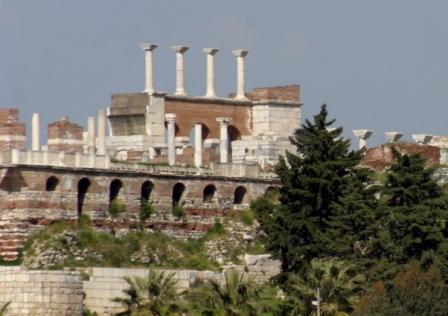
Temple of Artemis at Ephesus - A work earlier in Croesus' reign but fallen into disrepair

Temple of Artemis at Ephesus - A work earlier in Croesus' reign but fallen into disrepair


Building plans and trading schemes as well as plans for civic and social improvement had all either been put aside completely or else postponed until the king could once again give them his full attention; and this inertia had affected the economy so badly that many plans for military consolidation and expansion had also been shelved.
Before this day the king’s mind and soul had been so paralysed by his grief that he could scarcely contemplate his duties, let alone fulfil them. While Croesus had mourned for his son and heir, the astute Sandanis knew that his whole empire had been in danger of losing the momentum it had gained as a result of his numerous earlier conquests; and without the momentum to carry it forward, he realized, the empire would have been in danger of collapsing back in on itself. But, he thought happily, as anticipation arose in his breast, now the king had recovered his zest for life; now the empire would see some action!

*** ***** ***

Cyrus. 7:Croesus and the Oracles (Part 2)

18 Friday Sep 2009

Posted by Voice in Cyrus the Great: Chronicles

≈ 7 Comments

By Theseustoo

“What is so important,” Croesus demanded angrily as he strode into the War Room, “that it must intrude on my grief?”

Mermaids

I like Mermaids

His generals had been more than a little reluctant to send a servant to disturb their king, but it had been more than two years since the death of Croesus’ son, Atys. Surely it would be unhealthy they had reasoned, to let him grieve any more? In any case, what they’d heard about the new developments in the situation across the river Halys was so disturbing that they felt such an intrusion was more than warranted.
Clearing his throat nervously, Sandanis, the greatest of Croesus’ generals, responded, tactfully dispensing with the usual pleasantries and getting straight to business:
“We have just received intelligence from Media,” he began as he unrolled a scroll of papyrus, from which he now read his spies’ report verbatim: “Cyrus, the son of Cambyses has overthrown the empire of Astyages the Mede; Astyages is now a prisoner and the Persians are growing more powerful every day!” Croesus’ raised eyebrows registered surprise at this news; and yet, it was not entirely unexpected.
“I see…” he said. Then, as if talking only to himself, he continued with a heavy sigh, “I warned my brother-in-law not to be too excessive in his exploitation of his people or it would lead to revolt; and now I’m left with the duty of rescuing and avenging him… You see the Persians as a threat, do you?”
Sandanis ignored what, under any other circumstances, he might have taken as an implied slur on his courage and gave his answer with an expressionless face, “Not yet Sire, but unless they are checked soon they will become one. They now rule all Asia east of the Halys except for Babylon. They have even attempted to persuade the Greek cities in Ionia and Aeolia to revolt… but thus far the Greeks remain loyal to your majesty. However, I think the sooner Persian ambitions are curbed, the better.”
“Indeed;” the monarch replied gravely, “I cannot allow this young upstart to stir up a rebellion in our Greek territories. Are we strong enough to stop them?”
“It’s difficult to say, your Majesty…” Sandanis cautiously replied. He’d heard some remarkable stories about this new ruler of what was now the Persian Empire. Yet he did not wish to sound like either a coward or a defeatist; tactfully he explained the situation, “Our armies are very experienced from recent wars; but their numbers are as great as ours and by all accounts this Cyrus is a natural general; a popular leader with a very quick mind. He will not be easy to defeat. We may need allies…”
Croesus frowned at this assessment; yet he knew it was true enough; the war of expansion in which Lydia had been engaged over the past couple of decades had very seriously depleted his army’s ranks. Pensively, he said, “The problem with allies is that if you’re weak enough to need them they may well be tempted to take advantage of the situation rather than help… We must be certain of victory before we attack.”
“Perhaps your majesty should consult an oracle…?” the general suggested, innocently enough; however he was very surprised by the bitterness that his king’s tone of voice now revealed as he replied:
“Hah! Oracles! What do they really know? Ever since the death of my son, Atys, I have felt that I cannot trust oracles“.
Sandanis was confused. Oh, he knew the story; the oracle had predicted that Atys would die pierced by sharp steel; Croesus had taken all the arms and armour down from the walls of his palace in case a piece should fall on his son; he had even kept Atys away from any of the other usual manly pursuits, most of which involved weapons of one kind or another; until finally Atys had rebelled when some of his friends chided him for his effeminacy.
At the time a notorious wild boar terrorised the countryside around the Mysian Olympus; causing havoc to local farms by rooting up the farmers’ crops before they could ripen enough to harvest. The huge boar had already injured two hunters who had attempted to catch it. Desiring above all else to prove his manhood, Atys had eventually persuaded Croesus to allow him to go and hunt for this boar. He had reasoned that, after all, the prophecy had said he was to be pierced by steel, not the tusks of a wild animal, so, he had insisted, there was no particular danger. Croesus relented eventually and allowed him go, but sent with him a man by the name of Adrastus to be his bodyguard.
Now, Adrastus was the son of the Phrygian King, Gordias and a grandson of King Midas, whom Croesus had accepted into his house as a suppliant, out of his compassion for the young man’s plight, when he had come to Croesus for refuge after having been exiled from Phrygia for accidentally killing his own brother.
The law was clear, however; and it made no distinction between an accident and murder; a killing was a killing; and it was all ‘murder’; with, of course, the exception of war, which was regarded as the most noble activity of mankind; and of course, revenge, which was regarded as a sacred duty; and which one neglected only at one’s peril. Failure to observe this most ancient of all laws was to render oneself liable to be hounded to the very point of madness by the Furies themselves for neglecting this most ancient of duties, for these Furies were the restless souls of the deceased, now transformed into vampiric monstrosities who hounded anyone rash or careless enough to neglect their duty to avenge themselves for the death of any family- member or close relative; or even a close comrade or friend.
In the most ancient of times, the law had demanded ‘a life for a life’ in each and every case. But now, in cases where there was no malicious intent, or in cases where there was an acceptable justification for the act, this automatic death-sentence was usually commuted to exile and the payment of compensation in the form of ‘blood-money’, which was now considered sufficient to recompense the family of the victim for their loss. The performance of the correct rituals while in exile would eventually purify even deliberate murderers of all the spiritual pollution which inevitably attaches itself to his – or her – person during the commission of the crime.
Such was this young man’s sadness, though more for the loss of his brother than for his own present solitary fate, that Croesus had readily granted his request to undergo in Lydia those rites of purification which would enable him to properly cleanse himself of the spiritual stain of his brother’s blood; for in Lydia the rites of purification are virtually identical to those practiced in Greece; another reminder of Lydia’s long-term domination by the descendants of the famous Heracles; the Heraclides.
Atys had a younger brother, but he was a mute; and as such was commonly regarded as an imbecile. He was thus incapable of being the kind of company a brother needs; and although Atys loved his brother, he could talk to Adrastus; so as the latter had been with Croesus’ household for several years, he had come to be seen as, and to feel, just like a brother to the youthful Atys, who was almost the same age as the brother Adrastus had lost.
The two boys were thus very excited about going hunting together; although Atys, of course, was especially excited because it was his very first hunt. Unfortunately, as Atys had tackled the huge boar from one side, the luckless Adrastus had simultaneously thrown his spear from the other. But the animal had swiftly dodged the missile; dashing off into the undergrowth as, having missed its intended target, the steel-tipped spear now pierced Atys through the heart, killing him instantly.

Adrastus Slaying Himself at the Tomb of Atys.

Adrastus Slaying Himself at the Tomb of Atys. Don't ask me why he had to do it naked.

Croesus had been in an agony of grief over the death of his son and heir. Nonetheless he was moved with pity for the hapless Adrastus, who was so distraught at his ineptitude that he had begged Croesus to allow him to sacrifice himself over the corpse of his son as Croesus’ revenge for Atys’ death. But Croesus knew that nothing would bring back his son; and he was just as saddened by Adrastus’ pitiful self-condemnation as he was by his son’s death, for Adrastus, who insistently offered to fall on his sword over Atys’ funeral pyre, was quite clearly even more tortured by the results of his ineptitude than was Croesus himself. So instead of going along with the tradition which required his life in revenge for his son’s death, Croesus had decided to let him live; saying that since Adrastus had proclaimed the sentence of death against himself, Croesus felt that he had already had all the revenge he needed.
Oh yes, Sandanis knew the story very well, but why would that lead Croesus to mistrust oracles? After all, he thought, the Pythoness had been right about the death of Croesus’ son, hadn’t she? Atys had died a violent death, pierced by sharp steel, just as she had predicted. Puzzled, Sandanis couldn’t help but ask his king for clarification:
“I beg your pardon Sire, but I don’t understand; the death of your son, though regrettable, was accurately predicted by the oracle wasn’t it…?”
“Predicted by it…? Or caused by it?” Croesus replied enigmatically, then after a few more moments he asked his general bitterly, “Do you know what the Delphic oracle said when I asked if my other son, a deaf-mute since birth, would ever speak? That I would rue the day I should first hear his voice! Yet now more than ever I would give much to hear him speak…”
Again he paused. When he spoke again it was to ask, more of himself than Sandanis, “What do they really know, these oracles that pretend to know everything?”
Then an idea struck him. He continued, talking now almost to himself as he explored the possibilities, thinking aloud, “I wonder… Suppose the oracles could be tested…? I think I know how it might be done…”
Suddenly he turned to Sandanis, and pointing to the map as spoke the names of the places said, “Send messengers to the oracles, some to Delphi, some to Abae in Phocis, and some to Dodona; others to the oracle of Amphiaraus; others to that of Trophonius; others, again, to Branchidae in Milesia. We shall consult all of these Greek oracles… And send another embassy to Libya to consult the oracle of Ammon.”
A scribe hurried to write down the list as he spoke. When he had finished scribbling and looked up again, the monarch continued, “They are all to keep count of the days; on the one hundredth day from today, they are to enquire of the oracles what I, Croesus, son of Alyattes, am doing on that day. Then they are to take down the oracles’ answers on paper and report back to me.”
The scribe nodded his understanding of his instructions as Croesus turned back to Sandanis and said, “Thus we will test the knowledge of all the oracles, and, if they return true answers, perhaps we shall send a second time and inquire if we should attack the Persians.”
A single nod from Sandanis to the scribe, who had already heard and understood his king’s orders, ensured that they would be carried out to the letter. Soon Croesus would know just exactly which, if any, of these oracles were accurate enough to be trusted.

Rising from the Ashes

15 Tuesday Sep 2009

Posted by Voice in Ladies Lounge

≈ 24 Comments

By Madeleine Love

Hoop Petticoats

Hoop Petticoats

My father in law gave me some bulbs about 15 years ago not long after we bought our house at Marysville. The bulbs were called “hoop petticoats”. They promised bright yellow flowers – a favourite colour – full of happiness, and I eagerly planted them.

They didn’t flower. A year or so later my father in law asked me if they’d flowered. No. He said they’d never flowered for him either. Thanks for the dud bulbs Dad! But I had no call for complaint because he’d also given some to my sister in law and they’d flowered for her. Oh well.

Year after year the bulbs failed to flower but I never removed them because that was where they lived now.

We had a fire at Marysville. The house burned down. Except for the fact that there is more demolished bare earth at Marysville than anything else, the Spring is looking lovely. All the little bulbs that lived safe underground have popped up, and with no houses, fences or trees, Marysville looks like a pretty little sea of daffodils, jonquils and early cheers.

And strangely I noticed a new set of flowers at our house… flowers I’d never seen before… We have a little sea of bright yellow hoop petticoats gracing the front lawn.

There’s something special about this. I’m thinking latent beauty. It surrounds us, waiting to emerge at the right moment. So much waits hidden for the right moment. So much love has come forth at Marysville. Qualities one would never have seen nor shared were it not for the right moment.

Cyrus. Appendix 1: Gyges

13 Sunday Sep 2009

Posted by Voice in Cyrus the Great: Chronicles

≈ 14 Comments

By Theseustoo

Long, long ago, in the ancient land of Lydia, there was once a king named Candaules, descended from Alcaeus the son of Heracles, whom the Greeks knew by the name of Myrsilus. The first king of this dynasty was Agron, son of Ninus, grandson of Belus, and great-grandson of Alcaeus; Candaules, son of Myrsus, was destined to be the last. The kings who had reigned before Agron were descendants of Lydus, son of Atys, from whom the people of the land, previously known as the Meonians, took the name of Lydians.
The Heraclides, descendants of Heracles and the slave-girl of Jardanus, had been entrusted by these princes with the management of affairs and eventually obtained the kingdom because of an oracle. Their rule endured for twenty-two generations of men, a space of five hundred and five years; during the whole of which period, from Agron to Candaules, the crown descended in a direct line from father to son.
Now, strange as it may seem, especially in an age where most royal marriages were often largely political arrangements, Candaules was actually head-over-heels in love with his own wife; in fact, he was so besotted by her that he thought she was the most beautiful woman in the whole world. Perhaps from a desire to have someone else witness his good fortune in having such a beautiful wife he conceived a desire to share his wife’s beauty with a friend. This peculiar fancy would have strange and far-reaching consequences.

Candaules King Of Lydia Shews His Wife By Stealth To Gyges One Of His Ministers As She Goes To Bed, a painting by William Etty.

Candaules King of Lydia Shews his Wife to Gyges

In Candaules’ household guard there was a certain captain by the name of Gyges, the son of Dascylus, who was greatly favoured by the king. Candaules habitually entrusted all of his most important affairs to this man. To Gyges also, Candaules incessantly extolled the beauty of his wife. One day, when he had been elaborately describing the beauty of his queen, Candaules fancied he saw a sceptical look in Gyges’ eye and said,
“I see you do not believe what I tell you of my lady’s loveliness; but come now, since men’s ears are less credulous than their eyes, let us contrive some means whereby you may see her naked.”
Now, among the Lydians it is considered a great disgrace, even among men, to be seen naked. Gyges was shocked at the very thought of what his king was suggesting; he exclaimed,
“What you are saying is most unwise, master! You want me to behold my mistress naked? Do you think that a woman puts off her modesty with her clothes? Our fathers in ancient times distinguished right and wrong plainly enough and it is wisdom on our part, to submit to being taught by them. There is an old saying, ‘Let each look only on his own’. I’ll freely admit that your wife is the fairest of all woman-kind… Only I beg you, please do not ask me to do wickedly.”
Thus Gyges tried to decline the king’s proposal, trembling visibly at the thought of some dreadful evil which might befall him as a result, should he agree to the king’s wishes.
But the king was insistent; he replied,
“Courage, friend; I’m not trying to test your loyalty to me; and you need not fear that your mistress will do some mischief to you. I will arrange things so that she shall not even know that you have looked upon her. You must hide behind the open door of the chamber in which we sleep. When I enter to go to bed she will follow me. Near the entrance there is a chair on which she will lay her clothes one by one as she takes them off. You will thus be able to peruse her person at your leisure. Then, when she is moving from the chair toward the bed and her back is turned, you will be able to slip out before she sees you.”
Though they may seem like mere whims, the desires expressed by kings are not idle words but commands; feeling trapped, Gyges could only acquiesce. Reluctantly he agreed to carry out the king’s plan, hoping that everything would turn out just as Candaules had planned and that no harm would come of it.
Before he retired for the evening Candaules led Gyges to his hiding-place. At his usual bedtime, the king retired to his bed-chamber and he was followed a minute or so later, by his queen. Unaware that she was being watched, the queen casually undressed. Slipping off her garments one by one, she folded them and laid them on the chair, just as Candaules had said she would, while Gyges watched from behind the door, hardly daring to breathe. Finally the queen turned her back and moved toward the bed as Gyges seized his chance and stealthily slipped out through the door.
However, unbeknown to Gyges, the queen had seen him leave out of the corner of her eye, but, instantly divining what had happened, she decided that she would have her revenge upon the husband who had so shamed her… and so she made not the least sign that she had seen anything amiss.
In the morning, as soon as the sun rose, the queen chose her loyalest and most faithful companions from among her retinue and prepared them all for what she now planned to do. She had often had cause to summon Gyges to confer with him for some purpose or other, so when she summoned him into her presence that morning he obeyed unquestioningly, suspecting nothing out of the ordinary. But when she addressed him he was even more shocked than he had been at the thought of the previous night’s events.
“Take your choice, Gyges, of the two courses which are open to you. Either you must slay Candaules, and thereby become my lord, and gain the Lydian throne, or you must die this moment in his place. Thus you will never again behold what is not lawful for you, even at the command of your master! Either he must perish by whose counsel this thing was done, or you, who saw me naked, and so broke our customary laws, must die.”
Upon hearing these words, Gyges stood for awhile in mute astonishment. When he had recovered his wits sufficiently to speak he implored the queen not to force him to make so harsh a choice. But the queen was adamant. Realizing that he implored in vain, and that he must either kill or be killed, he chose life for himself, and replied to his queen with this question:
“If it must be so, and you compel me against my will to put my lord to death, come; let me hear how you will have me set on him.”
“Let him die,” she answered, “in the same room where he disgraced me and showed me naked to you… when he is asleep.”
When night fell, the queen led him into the royal bed-chamber, placed a dagger in his hand, and hid him behind the door just as he had done the previous night. When the king entered, Gyges waited until he was sure the king had fallen asleep, then silently crept towards the bed and struck him through the heart with his dagger.
As the famous poet, Archilochus the Parian, who lived about the same time, mentioned in a poem written in iambic trimeter verse, this was how the wife and kingdom of Candaules passed into the possession of Gyges and how the succession passed from the dynasty of the Heraclides to the Mermnadae.
The people of Lydia, however, were enraged at the slaughter of their king and flew to arms against the usurper; but after an uncomfortable civil struggle between the people and the followers of Gyges and the queen, they eventually allowed themselves to be persuaded that if the oracle at Delphi should confirm Gyges as king, then king he should remain; otherwise he would relinquish the throne to the Heraclides. The oracle, when consulted, decided in his favour and Gyges became king of Lydia. The Pythoness, however, added that, in the fifth generation after Gyges, vengeance would come for the Heraclides; but neither the Lydians nor their princes took much notice of this prophecy until it was fulfilled.

*** ***** ***

Cyrus. 7: Croesus and the Oracles (Part 1)

12 Saturday Sep 2009

Posted by Voice in Cyrus the Great: Chronicles

≈ 9 Comments

By Theseustoo

[Editor’s note: Short of reading time but I have picked out some nice pictures with the aid of a few key words.]

Oracle

Oracle

Since the most ancient times the sovereignty of Lydia had belonged to the Heraclides; the dynasty which had been founded centuries ago by the god-like Heracles, whom the poets all say was the earthly son of the All-father; Almighty Zeus himself. However, the Lydian crown eventually passed out of their hands and through sheer chance it fell into the hands of the Mermnadae; the Lydian-born family of Croesus which had originally been founded by Gyges; Croesus’ own fifth ancestor.

This man had been the captain of the guard of the final king of the Heraclides dynasty, whose name was Candaules. This king had been so proud of his wife’s beauty that he had wished to confirm his belief that she was the most beautiful of all women. To this end he had persuaded Gyges to hide behind his wife’s chamber door before she retired, and spy on her as she undressed for bed. Unfortunately, however, he had been seen by the queen, who, in her desire for revenge, had eventually goaded him into murdering her husband, the king.

Lydia

Lydia: Click to see incredible Green eyes!

Thus Gyges usurped Candaules’ throne and stole his wife; putting an end to the Heraclides dynasty and removing the descendants of Heracles from power forever. The incident which had so outraged his queen, however, was in no way Gyges’ fault. In truth it was providence itself, rather than any base or ignoble ambition, which had prompted his action; and although at first there was a huge public outcry against the regicide, eventually the decision of the Delphic Oracle had vindicated him and the people of Lydia were persuaded finally to accept him as their monarch. Thus after several generations of Greek rule under the Heraclides, the throne of Lydia was finally returned to Lydian hands.

Mermaidae

Mermaidae

Croesus, son of Alyattes, was the fifth Mermnadae King of Lydia; succeeding to his father’s throne at the age of thirty-five. Now, ever since Gyges had freed the Lydians from the Greek yoke, the Mermnadae kings of Lydia had wondered how they might revenge themselves for the indignities they had suffered during Lydia’s prolonged period of subjection to Greek occupation and rule. However, it would not be until the reign of the legendary and fabulously wealthy, King Croesus, that Lydia at last had the opportunity to do something about it. As often happens, revenge and ambition went hand in hand for Croesus; and as he grew in wealth and experience, so too grew both his desire for revenge and his ability to accomplish it; as a result, he developed imperial ambitions.

Turning his armies first against the Greek cities in Ionia and Aeolia, Croesus attacked Ephesus. When he laid siege to the city, the Ephesians made an offering of the whole city to their goddess, Artemis by stretching a rope from the town wall to her temple, a good seven furlongs distant from the ancient city. Unwilling to incur the wrath of the Ephesians’ dreaded and bloodthirsty goddess, Artemis; Croesus was thus obliged to spare the lives of the city’s inhabitants.

After this he made war on every Ionian and Aeolian state one after the other, on any pretext he could find or invent, regardless of how flimsy the excuse. Thus he eventually made himself master of all the Greek cities in Asia west of the River Halys, forcing them to become his vassals and tributaries until his interest in war and conquest waned after the tragic death of his son and heir, Atys, whom he mourned for two full years.

Persian

Persian

Eventually however, the news which had spread through the region like wildfire, of Cyrus’ meteoric rise to power in Persia, would drag the monarch out of mourning and return his wandering attention once again to the land of the living as Persia very suddenly began to expand the boundaries of her own empire, to eventually become the only force in Asia with both the numbers and the leadership to represent a threat to the Lydians. Lydia’s recently conquered and newly subjugated empire was now at its zenith; her warriors had a well-earned a reputation for being the best and bravest in all Asia at that time; as the power of the Assyrians had been effectively nullified generations earlier by the Median revolt.

When Cyrus’ rose to power, he soon conquered all of the smaller states around Media and Persia, which had hitherto been tributaries of Babylon and her Assyrian rulers. Asia was thus now effectively divided into two regions: the western region, consisting of all the Ionian and Aeolian cities to the west of the River Halys, now ruled by the fabulously wealthy Croesus; and the eastern region, which was now ruled by the upstart Cyrus of Persia who had overthrown the Medes who had hitherto ruled Asia ever since it was first conquered by Astyages’ father and Cyrus’ own great-grand-father, the bellicose Cyaxares.

Assyrian

Assyrian

It was Cyaxares who had finally driven out the horde of Scythian invaders whose incursion into Media had caused a twenty-eight year interruption in their on-going revolutionary war with the Assyrians. Eventually the cunning of Cyaxares had prevailed; he had all of the Scythian leaders murdered at a treacherous feast; after which the rest of the invaders were chased right out of Asia. The Assyrians too, were then finally defeated and forced to flee from their capital city, Nineveh, until that too was taken by the Medes.

The remainder of the Assyrian nobility then fled to Babylon where they established a government in exile in what was now their final remaining stronghold, behind her high and famously impenetrable blue-glazed walls.

*** ***** ***

← Older posts
Newer posts →

Patrons Posts

  • The Question-Crafting Compass November 15, 2025
  • The Dreaming Machine November 10, 2025
  • Reflections on Intelligence — Human and Artificial October 26, 2025
  • Ikigai III May 17, 2025
  • Ikugai May 9, 2025
  • Coalition to Rebate All the Daylight Saved April 1, 2025
  • Out of the Mouths of Superheroes March 15, 2025
  • Post COVID Cooking February 7, 2025
  • What’s Goin’ On ? January 21, 2025

We've been hit...

  • 719,006 times

Blogroll

  • atomou the Greek philosopher and the ancient Greek stage
  • Crikey
  • Gerard & Helvi Oosterman
  • Hello World Walk along with Me
  • Hungs World
  • Lehan Winifred Ramsay
  • Neville Cole
  • Politics 101
  • Sandshoe
  • the political sword

We've been hit...

  • 719,006 times

Patrons Posts

  • The Question-Crafting Compass November 15, 2025
  • The Dreaming Machine November 10, 2025
  • Reflections on Intelligence — Human and Artificial October 26, 2025
  • Ikigai III May 17, 2025
  • Ikugai May 9, 2025
  • Coalition to Rebate All the Daylight Saved April 1, 2025
  • Out of the Mouths of Superheroes March 15, 2025
  • Post COVID Cooking February 7, 2025
  • What’s Goin’ On ? January 21, 2025

Enter your email address to subscribe to this blog and receive notifications of new posts by email.

Join 374 other subscribers

Rooms athe Pigs Arms

The Old Stuff

  • RSS - Posts
  • RSS - Comments

Enter your email address to subscribe to this blog and receive notifications of new posts by email.

Join 374 other subscribers

Archives

Website Powered by WordPress.com.

  • Subscribe Subscribed
    • Window Dresser's Arms, Pig & Whistle
    • Join 280 other subscribers
    • Already have a WordPress.com account? Log in now.
    • Window Dresser's Arms, Pig & Whistle
    • Subscribe Subscribed
    • Sign up
    • Log in
    • Report this content
    • View site in Reader
    • Manage subscriptions
    • Collapse this bar
 

Loading Comments...