
http://onthecommons.org/fewer-traffic-signs-better-safety
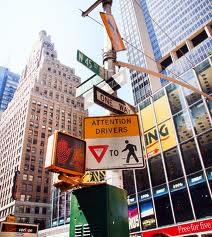
Imagine what would happen if you took down road signs and traffic signals. More accidents would surely result, or at least significant confusion and slower traffic. Or would it? The surprising thing is that a number of cities around the world have actually done this, and experienced dramatic declines in traffic accidents.
The idea is based on an urban design philosophy known as “shared space.” When drivers, pedestrians and bicyclists are forced to develop their own natural ways of interacting with each other, goes the thinking, they work out better social behaviors than the rule-driven behaviors dictated by professional traffic engineers. This does not mean an abandonment of design considerations, but rather a commitment to the larger public space designs instead of overly prescriptive traffic control devices such as traffic lights, signs and road markings.
The Dutch town of Drachten adopted this “unsafe is safe” approach in 2007 and found that casualties at one junction dropped from thirty-six over the previous four years to only two in the two years following the removal of traffic lights. Traffic jams no longer occur in the town’s main junction, which handles 22,000 cars a day. The town is “Verkeersbordvrij,” meaning “free of traffic signs.” (I am grateful to Jonathan Zittrain’s reference to Drachten’s experiment in his new book, The Future of the Internet and How to Stop It, and to Wikipedia for its account of “shared space.” )
What caught my eye was the explanation of why the elimination of strict rules can, in some circumstances, produce better outcomes. Hans Monderman, one of the pioneers of the shared-space approach, said, “When you don’t exactly know who has right of way, you tend to seek eye contact with other road users….You automatically reduce your speed, you have contact with other people and you take greater care.”
The idea is to return public spaces to people in order to encourage them to take greater personal responsibility. Monderman explained, “We’re losing our capacity for socially responsible behavior….The greater the number of prescriptions, the more people’s sense of personal responsibility dwindles.”
http://www.spiegel.de/international/spiegel/0,1518,448747,00.html
A project implemented by the European Union is currently seeing seven cities and regions clear-cutting their forest of traffic signs. Ejby, in Denmark, is participating in the experiment, as are Ipswich in England and the Belgian town of Ostende.
The utopia has already become a reality in Makkinga, in the Dutch province of Western Frisia. A sign by the entrance to the small town (population 1,000) reads “Verkeersbordvrij” — “free of traffic signs.” Cars bumble unhurriedly over precision-trimmed granite cobblestones. Stop signs and direction signs are nowhere to be seen. There are neither parking meters nor stopping restrictions. There aren’t even any lines painted on the streets.
The plans derive inspiration and motivation from a large-scale experiment in the town of Drachten in the Netherlands, which has 45,000 inhabitants. There, cars have already been driving over red natural stone for years. Cyclists dutifully raise their arm when they want to make a turn, and drivers communicate by hand signs, nods and waving.
“More than half of our signs have already been scrapped,” says traffic planner Koop Kerkstra. “Only two out of our original 18 traffic light crossings are left, and we’ve converted them to roundabouts.” Now traffic is regulated by only two rules in Drachten: “Yield to the right” and “Get in someone’s way and you’ll be towed.”
Strange as it may seem, the number of accidents has declined dramatically. Experts from Argentina and the United States have visited Drachten. Even London has expressed an interest in this new example of automobile anarchy. And the model is being tested in the British capital’s Kensington neighborhood.
 Window Dresser's Arms, Pig & Whistle