
Of Dalliances and The Dunnee Men.
………. or how things pan out for Gez

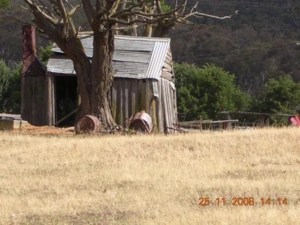 Not having sewerage connected was normal in Australia during the time of European immigration from early days till the 1960’s. The enormous distances between houses and suburbs and the sheer spread of just a few hundred people over many kilometres of land made the provision of infrastructure such as a sewerage system too expensive for many suburban areas at that time. The way out was for the local Council to provide a ‘dunnee pan’. This pan was a heavy metal container coated with pitch or bitumen and actually smelt quite fresh and spicy when just delivered. A bit like an industrial harbour foreshore, with moorings and thick ropes, tarred anchors and pylons. This pan would be used in a small outside room of about a couple of square metres and called the ‘dunnee’. An outside toilet, sometimes politely called by the upper shore, ‘the outhouse’. You have to go sometimes, don’t you?
The dunnee pan would be covered by another outer metal shell with a hinged wooden lid. With some imagination this could then be seen as a toilet. However, when lifting the lid, no matter what it looked like from outside, the smell and darkness from inside was broodingly brutal and left nothing to imagination. Not many would linger reading poetry or Thomas Hardy.
The pan would be collected once a week by burley blokes in blue singlets and verdant armpits, who would come before dawn and summer heat, to heave the sloshing but lidded pan on shoulders and put on the truck with the driver having a Lucky ciggie. Coarse oaths would be renting the still morning air and heavily shod feet would crunch the concrete path along the side of the veranda.
This dunnee pan would be capped by a lid secured on top with a metal band that would lever the lid tightly around the container, not unlike some preservatives such as sour Kraut or apple sauce of the present day. This was a job purely reserved for the dinky-di locals and much coveted. It was well paid and had all sorts of lurks, including dalliances with lonely women and early ‘knock-off’ times when finished. I am not sure if the smell added to their appeal, but rumours had it that many a woman, widowed, single or even married, was left happy after an early visit from the ‘dunnee man’.
Large families were given a ‘special 2 pan treat’, this usually meant giving very generously at Christmas time.( A couple of crates of beer would suffice.) Any large family that were too stingy at Christmas would soon find a lonely single pan again. Those dunnee men were often kind rogues but a law onto their own, revered and respected by many, but feared by some. The ‘dunnee man’ is now part of folklore and Tamworth Country music, but long gone since.
Our family was more than large and dad had to make some adjustments to a down pipe outside the dunnee that would carry rain water from the roof to the open storm water drain at the front of the street. Despite our generosity towards the Shire’s dunnee men at Christmas time, we never had more than two pans a week. For our family this was not enough. I never did find out how our neighbours coped, they had six children as well. We were on friendly terms but not that friendly that you could ask; what do you do with your poo? In any case, their concern was more focussed on the fan tail pigeons’ shit on their shiny new roof tiles, all caused by my brother John’s flock of sixty birds… It would be unwise to mention anything to do with poo!
It was not as if our family were too copious with ‘solid stuff’, no, it was the sloshing around of the liquid waste that was the problem. Of course, being right next to neighbours it wasn’t as if one could go outside at any time and urinate in the garden. This is what happened though. When the height in second pan became critical, and the dunnee man still a day or so away from collecting, that the boys were told to do as much as possible at school or wait till late at night and then in the garden in the dark.
In the summer this caused some olfactory concerns and when this ammonia like stench could no longer be hidden or blamed on Dad’s fertiliser for the veggie patch, that Dad did a piece of engineering that is still admired until this day, alas without his presence.
As I already said before, there was a metal downpipe running on the outside of the dunnee that carried rainwater from the roof to the trench at the front of the house. Dad simply cut a small hole in the fibro on the inside of the dunnee directly abutting the downpipe and conveniently next to the pan. This hole was also made on the inside of the downpipe, accessible now from within. Both holes corresponded and synchronized brilliantly. This hole was then used by all the males (six in total) as a urinal taking the piss straight down the downpipe and to the front of the house in the open stormwater trench. This trench was usually overgrown with weeds. Generous rains would wash it downhill and finally into concrete stormwater and into the Georges River. Council used to come along three times a year to get rid of the weeds and mow the grass around it.
Well, our trench was the most luxurious green and lush looking of the whole street. It would have won a blue ribbon for excellence if that nature strip could have been entered into the Royal Easter Show. It wasn’t till some years later that sewerage was connected and my mother’s dream of ‘own bathroom’ with inside flushing toilet was truly fulfilled.
My father was a genius. With the toilet indoors, the dunnee man receding into history; we were all riding high in the achievements wrought so hard by this migrant family of six children and parents.
 Window Dresser's Arms, Pig & Whistle
In the sixties the now trendy suburb of Doncaster had the outside dunnies, our dunny man got real cross when our dog threatened to take a lump out of his leg…….spilled his load, amid much cursing. We had to tie the dog up on dunny days. I can still remember the smell of the gutters, think Doncaster and the smell is evoked. The neighborhood consisted of mainly pregnant Dutch housewives, my Dutch friends would invite me around after school, the food was very foreign to me. Forgive me Gerard was it Popertjes, a sort of doughnut???? Some kind of pickled fish or eels…so long ago. I remember having to walk through an apple orchard to get to the bus stop, snakes abound, we wore our gumboots through the orchard then donned our normal shoes. Just as the apples were ripening ready to get nicked, they’d all be gone. Now Doncaster is a suburb for the winners of Lotto.
LikeLike
Hello Granny,
The food of those Dutch people in the Duncaster area would have included ‘poffertjes’. They were a kind of dough-nut with lots of caster sugar and rather buttery. As kids we loved them.
Those pickled fish could have been raw salted herrings. I still buy them weekly at Woollies. Helvi loves them too. Smoked eel is a delicacy that is also very popular in Holland. I haven’t seen them here.
The dunnee men were a law on themselves, at least in the Bankstown area were we lived from 1957 till I went to Finland.
LikeLike
Granny, you are right, those poffertjes were horrible, I was never brave enough to taste eel. The one thing i got to like was a herring.
Kids and i missed the vegemate, so we had to with the English Marmite, not quite the same though..
LikeLike
My first house in the trendy inner city suburb of Balmain had an outside toilet, yet the house’s previous owner was a very well known architect.
He obviously did not worry about minor inconviences, the bath was also part of the living room, no screens. Being a modest person, I had to quickly erect some walls…
LikeLike
Your family must’ve lived along my route to school. There was an open gutter that I marvelled over on the long walk to and from school. It had sludge in it, and it was both brown and green. You could throw a stone in without making a spash. The stone would be swallowed by the sludge with a sort of ‘glurp’ and then be vanished in the depth forever. We imagined the sludge was quicksand. And it grew the most magnificent un-mown flora – from sludge grew elegant pussy willows that I could arrange at home. And then it became a concrete gutter.
LikeLike
A nice story! I also like the photo of the old dunnee. Is it a dunnee or just a little old house?Maybe the shearers slept there in olden times.
LikeLike