
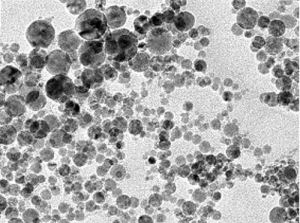
Tiox Nanoparticles
By Madeleine Love‡
Glenda of the Pigs Legs Waxing and Beauty Salon wanted to get some promotional nanotech shampoo samples trialled….
G: Daphne do you want to try this nano shampoo?
D: We’ve already talked nanotech Glenda, and I’ve done my hair anyway. What about you?
G: Is Loretta around?
D: No maybe you need to ask someone else whos tried it. Do we know anyone?
G: What about Julia’s partner?
D: Which Julia?
G: Deputy Prime Minister, Education Minister Julia. Mr Gillard’s a hairdresser. I met him on a styling course a few months ago keen on the red shades.
D: I never like to criticize a woman in public life but I don’t like Julia’s hair colour.
G: Give him a call.
D: Ringing Heres the news: Julia released a nanotech Education package for schools a few months ago – AccessNano. Apparently shampoos covered. Heres the web address: http://www.accessnano.org/teaching-modules
D: Logging on .
[Recommended background music: http://www.accessnano.org/files/teaching-modules/space-elevator/SpaceElevator_Animation.mov ]
D: Look at this PowerPoint module for the year 7s. http://www.accessnano.org/files/teaching-modules/space-elevator/SpaceElevator_Module.ppt#350
What if you could build a stairway to the moon?
What if a path to the stars was paved in carbon?
What if we had an elevator to the space station?
D: They say it would help to fix a broken toilet in the space station. Thats good, isn’t it?
The space elevator is a theoretical concept it would provide a permanent link between earth and space. The cable in a space elevator could only be constructed from an extremely strong flexible and lightweight material, such as carbon nanotubes.
D: Look at the animation Turn the sound up, Glenda
http://www.accessnano.org/files/teaching-modules/space-elevator/SpaceElevator_Animation.mov
D: Freaking Awesome! Nanotech wonder! You and me into space, Glenda.
G: Moving on, wheres Julia’s Shampoo Education package?
D: Scrolling Access Nano Teaching Modules This’ll be it Personal Care Products this ones for the year 9s. That’s a good time for shampoo education, isnt it Glenda? The girls are just getting old enough to earn and spend.
G: This is amazing – I’ve been lobbying to get hair care into the education system for ages.
D: Well go for the solid information in the teachers’ guide notes on this one http://www.accessnano.org/files/teaching-modules/personal-care-products/PersonalCare_GuideGeneral.doc
Section 6: How do you choose a shampoo?
Ask students to give a list of properties they think a shampoo should have.
E.g. It must feel thick or creamy in the hands, and must produce a nice feeling lather. Should smell nice, and not be too expensive.
What sells a shampoo? Herbal extracts, amino acids from exotic proteins such as silk, nano particles?
What is the main purpose of a shampoo?
The prime purpose of a shampoo is to clean the hair, however if the cleaning is over done the protective oils in the hair are stripped out.
D: Glenda, this is quality stuff.
G: I can’t believe how good this is. Read on.
How do we make informed decisions?
What information would you need to know before you would consider buying this shampoo which uses ‘NANO’ directly as its brand and claims to contain titanium dioxide (TiO2) nanoparticles, which could penetrate more effectively into the hair and, thanks to its photo catalytic oxidation characteristics, oxidize the harmful residues after hair perming.
How would you make a decision regarding these claims made by the manufacturer?
D: Are they saying that the nanoparticles can oxidize the harmful residues after hair perming, thanks to their photo catalytic oxidation characteristics, or is that a claim too?
Glenda was eager
G: Look at the link Julia gave the girls http://andrewofftheroad.blogspot.com/2006/10/new-shampoo-movement-toward-nano.html
The bio-safety of nano-technologies or products have become a heated issue in at least US or UK as I know, but in China, there is currently no restriction in this field. If the shampoo really contain nanoparticles, however, I think the first issue woiuld [sic] not be the safety, but the effects of TiO2 as a dye. As a well-known white pigment, TiO2 possesses an outstanding chemical stability. In a country where a black hair is regarded trait of beauty, applying white dye on the hair may hardly be favourable in this case.
G: Its when you read the fine print that you find out about the risk – wouldn’t want a nano-shampoo that changed your hair colour.
D: Thank goodness for Julia. That’s why we need more women in politics.
Glenda looked at the nano shampoo samples and thought about Julia’s hair colour. She decided to ask Loretta to try it.
A nanometre is a billionth of a metre. DNA is a few nanometres wide. Hair is 80,000 nanometres thick. Nanoparticles are generally regarded as anything that has a dimension less than 100 nanometres, but sometimes up to 300 nanometres. There are two principal concerns. One relates to size. Very small dimensions can penetrate cell and nucleus boundaries. The other relates to chemical reactivity. While Big Titanium Dioxide might be relatively inert (it is used as a pigment in paint as well as in pre-made icing in your supermarket), Tiny Titanium Dioxide has altered properties. Nano titanium dioxide is invisible, reflects light, and if Glenda tried the sample her hair may gain ‘luminescence’, but we don’t know if such an effect has been validated.
Typically for the new-tech world, products went into the market place before the safety of the materials were reviewed in a precautionary manner. It escaped existing regulation because ‘titanium dioxide’ was an approved product – there were no regs for the tiny variety. There are nanoparticles on plastic film encasing supermarket products, cooking utensils, sunscreen and beauty products. We understand there are also some nanoparticle products in a few powdered food products.
Carbon nanofibres (space elevator material) have similar properties to asbestos incredibly skinny and can wiggle through anything. The ACTU held a seminar on Feb 6th this year. http://www.actu.asn.au/HealthSafety/Campaigns/ACTUSeminarNanotechnologyTheNextAsbestos.aspx
Steve Mullins’ presentation pointed to regulatory problems:
- No regulatory acceptance that nanomaterials are more hazardous
- No nano specific risk assessment or controls mandated
- No nano specific monitoring equipment
- No nano specific MSDS
- No exposure levels
- No labels
- No requirement to inform
- No health surveillance
- No training
- No nano specific PPE
Where nano specific risk management applied or promoted, end up trying to apply controls designed for larger material anyway.
There is no coordinated approach
There are now many studies coming forward on nanotech fibres and particles. Go into pubmed http://www.ncbi.nlm.nih.gov/sites/entrez , type mesothelioma carbon nanotubes asbestos read the study summaries. Or type in TiO2 titanium dioxide nanoparticle safety.
On April 14th the ACTU went out into the media saying that nanotechnology was the next asbestos. http://www.abc.net.au/news/stories/2009/04/14/2541876.htm?site=news
The world authorities on the safety concerns related to nanotechnology appear to be the Australian branch of the Friends of the Earth. They have complied several documents of studies, as well of lists of products such as sunscreens which are free of nanoparticles. http://nano.foe.org.au/
Apparently we can wipe our benches with our silver-lined anti-bacterial nanotech underpants. http://www.abc.net.au/news/stories/2009/06/12/2596423.htm?site=news
A National Enabling Technologies Strategy is being developed. A discussion paper was released. I got it on 21 July. Submissions are due in on 7 August. http://www.innovation.gov.au/Section/AboutDIISR/FactSheets/Pages/NationalEnablingTechnologiesStrategyFactSheet.aspx
Governments are acting as cheerleaders for industry rather than regulators. GM crops are so last centurty.
‡Glenda, Daphne and the Pig’s Legs Waxing and Beauty Salon are entirely fictional, and our Glenda could thus not have done a styling course with a Mr Gillard in real life.
 Window Dresser's Arms, Pig & Whistle