
by Theseustoo
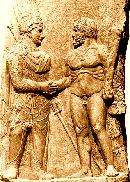
Mitridates
Mitradates was surprised, and not a little frightened, when he received a second summons from the palace. This time, however, it was his ‘son’ Ambares, who was the principal object of the royal summons; he himself was to accompany Ambares only in his capacity as Ambares’ ‘father’ and as such, according to Median law, he knew he might well be held responsible for his son’s behaviour. He also knew that under similar circumstances, almost any other Median father would have already given their offspring a sound thrashing with a birch rod or a leather strap, even before obeying the summons, as a practical demonstration to the king that they were not neglecting their duty to apply parental discipline; and that they were indeed doing their best to bring up their child to be a good and productive citizen.
But except for this one incident Ambares had always been so well-behaved; he was always so respectful and obedient to his elders, especially to his parents; and Mitradates and Spaco both loved him so dearly that they found they could not bring themselves to punish the child before they had heard all the details of his offence, as well as both sides of the story; for Ambares had said nothing to them.
So far, though he loved his parents dearly, he had stoutly refused to tell them the whole story, in case he made trouble for his playmates; especially for those who had helped him punish the rebellious Tembes. Even so they decided not to whip him before his appearance at court; they would wait for the king to decide the outcome of his case and to punish him if he saw fit.
So, uncertain even as to the nature of Ambares’ offence, when Mitradates received the king’s summons to attend the royal court with his son, he was more afraid for Ambares than angry at him; in spite of being also more than a little afraid for his own well-being; for their king Astyages had long been notorious for the highly imaginative cruelty with which he punished those who ever dared offend against any of his extremely harsh, and often arbitrarily-applied laws.
Indeed, Mitradates had also realised very quickly that it was potentially extremely dangerous for him to escort this child especially into the king’s presence. However, he had no choice, for a king’s summons cannot be ignored. In any case he was much more concerned for his young son than he was for himself.
As he contemplated these matters, Mitradates could not help wondering what the king would do to the boy, whom he was supposed to have killed ten years ago, if he were now to be discovered alive. Would Astyages decide to finish the job himself? Would Mitradates and his wife be held responsible? And if so, how would they be punished? He dared think no further than this, but fervently hoped that Astyages would not recognize the boy.
When they arrived at the palace gates, one of the guards escorted them into the throne room and announced them before returning smartly to his post. Overwhelmed by the immensity and great splendour of the palace, Mitradates’ fears mounted even higher as the pair waited silently for King Astyages to notice them and to deign to speak to them.
As the pair approached the throne, the monarch was speaking with the Captain of the King’s Guard, Artembares, who, like Mitradates, was also accompanied by his own son, Tembes; whose puffy red eyes still simmered with obvious resentment at the pain and humiliation he had so recently suffered. Tembes and his father both glowered at them as Mitradates and Ambares stood silently in front of the throne with their heads bowed modestly in the face of such exalted company.
Artembares clutched his son to him protectively as the fearful Tembes cowered from the sight of his adversary. At a nod from the king, Artembares now grasped his son by the shoulders and, turning Tembes’ round so both Astyages and Mitradates could see it, he pulled up his son’s tunic to reveal the wicked red welts that Ambares’ branch had left across the youth’s shoulders. To King Astyages he declared, “Thus oh king, has your slave, the son of a mere cowherd, heaped insult upon my family!”
Astyages descended from his throne to examine the cruel welts on Tembes’ pale-skinned shoulders, and then, turning round to Ambares he demanded, “Is this true?” his voice was incredulous, ”You, the son of so mean a fellow as a cowherd, dared to behave so rudely to the son of one of the highest ranked nobles in my court?”
Perhaps because he was still young and inexperienced, Ambares was nowhere near as frightened as his father. In any case he had already decided that, whatever the king might decide to do with him, he would put a brave face on it. So, with great determination, he looked his king in the eyes, and without flinching answered in a firm, strong voice, “My lord, I only treated him as he deserved.”
The king gave the youth a quizzical look which demanded further explanation; Ambares complied, “I was chosen king in play by the boys of our village,” he began, “because they thought me the best for it. He himself was one of the boys who chose me. All the others did according to my orders but he refused and made light of them, until at last he got his due reward. If for this I deserve to suffer punishment, then here I am, ready to submit to it.”
Astyages now stepped towards the youthful Ambares. He then examined the boy’s face very closely but could find no resemblance at all to Mitradates in it; and yet this face was familiar to him. Indeed he quickly realized that this boy’s face bore a striking resemblance to his own; this young lad had the same sharply angular features and the same hawk-like beak of a nose.
An almost instinctive recognition was suddenly triggered in Astyages’ mind by the natural nobility of Ambares’ reply; that and the courage he even now displayed in front of his king confirmed it; this was no son of a cowherd! And although no further proof was actually necessary, his suspicions were now further reinforced by the calm resignation he read in the youth’s features, and also by the nobility of his bearing and his remarkable self-assurance.
Instantly Astyages divined that this was not the son of Mitradates; and somehow, though he knew nothing at all of the connection between Mitradates and the grandchild he’d ordered destroyed, he nonetheless knew intuitively that this was that very grandson whom he had ordered exposed a little over ten years ago. How he had survived Astyages had no way of knowing at present, but he was determined to find out. Turning once more to the captain of his guard, Astyages said earnestly, “Artembares, I promise you, I will settle this business so that neither you nor your son shall have cause to complain. Now you may leave us…”
Artembares nodded his acquiescence and pulled his son’s shirt back down. Then, forcing his son to copy his obeisance to the king by placing his hand on his son’s head as he did so, he bowed deeply towards their king. Then the pair turned and left the room, both of them much mollified now that it appeared as if an appropriately severe punishment would be inflicted on the transgressor.
When the indignant father and his son had left the room, Astyages turned finally to Mitradates and quietly asked him,
“Where did you get this boy?”
“My lord,” Mitradates replied, hesitantly, “the lad is my own child… The mother who bore him still lives with us in my house.”
Astyages had expected the lie; he made a motion to the guards who stood on either side of the doorway as he said to the cowherd, “You are very ill-advised to bring yourself into such great trouble…”
At the king’s signal the guards stepped forward swiftly, and seized Mitradates’ arms roughly from behind; then they started to drag him away. Realising that he had been caught out in his lie, and that he was about to be dragged away to suffer the most dreadful tortures until he admitted the truth, Mitradates decided instantly that it would be better if he were to admit it now; a swift death would be preferable to a slow and agonizing one; desperately he shouted, “Wait! Forgive me Majesty, I’ll tell you the truth!”
*** ***** ***
(To be continued)
 Window Dresser's Arms, Pig & Whistle