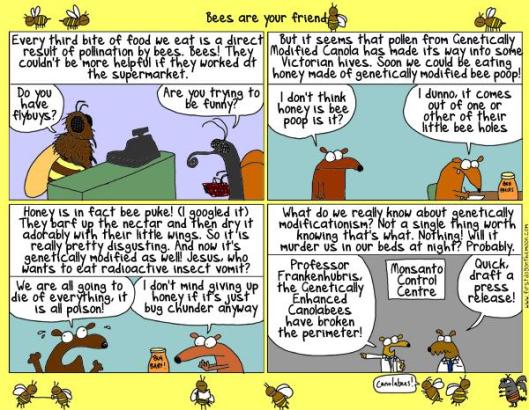
Another Outstanding First Dog Cartoon from Crikey.com.au …… DO subscribe if you can…….

05 Monday Oct 2009
Posted in Ladies Lounge, Politics in the Pig's Arms
Another Outstanding First Dog Cartoon from Crikey.com.au …… DO subscribe if you can…….
 Window Dresser's Arms, Pig & Whistle
Can’t write any more… mother to a duckling.
LikeLike
Agrifood Awareness
Click to access IssuePaper4_GM_Canola_bees_and_honey.pdf
“A one percent threshold, where labelling is not required, exists for the unintended presence of GM material in non GM foods.”
… honey containing traces of pollen that includes the modified genes does not require labelling because honey is not defined by FSANZ as a food produced using gene technology”
LikeLike
Agrifood Awareness is the Australian Public Relations arm of the GM industry. Typically we have experienced their information to be deceptive and inaccurate. They are not to be relied upon Voice.
Read FSANZ Standard 1.5.2, and the User Guide to Standard A18/1.5.2
Find them at http://www.foodstandards.gov.au
FSANZ attempts to exclude honey on the basis of an editorial note in the labelling Standard 1.5.2 – where animals (cows, sheep, pigs, chickens) fed GM have been deemed to be exempt (why? and by who? are two questions that interest us, but the forthcoming labelling review will settle that). Their logic to include bees in the category is spurious and eminently arguable. We expect it to be challenged.
As for the contamination… 4 (1) (f) a food, ingredient, or processing aid in which genetically modified food is unintentionally present in a quantity of no more than 10g/kg per ingredient. ‘unintentionally’ is the key word.
LikeLike
To clarify: Are you saying the bees are not fed with GM food? Therefore honey can’t be excluded from GM labelling laws on this basis?
LikeLike
Let’s get it straight Dog on The Moon. Aparantly pollen is used to create baby bee food, and nectar is used to make honey. The female worker bees suck the nectar into a backpack, and then siphon it off to another bee when it gets back to the hive. Pollen is carried on male(?) worker bees legs and turned into food for baby bees. I know all this because I googled it.
It’s important to make this distinction between ‘eating’ and ‘carrying’ for the saking of FSANZ-deemed GM labelling, viz this letter to The Age in response to Monsanto’s letter of yesterday…. (Hope I got it right from that quick google)
Honey, Honey; GM don’t taste right; Honey, Honey
Mama Mia! To avoid litigation Monsanto claims its GM canola DNA and proteins are safe (Honi McNaughton 6/10), but Australians should be concerned that old tech GM canola was given food regulatory approval without any independent study.
Monsanto claims the GM DNA in honey does not cross labelling thresholds, but “Thresholds” only apply to accidental contamination. The bee industry is fully aware of GM issues and it’s no accident to place a beehive across the road from a canola field without finding out if it’s GM.
Even if the accidental argument stood, it would only apply up to 1%. The honey in the beehive will be created primarily from the GM canola. Like other refined products such as soy lecithin, if there is GM DNA or protein there it must be labelled.
Food Standards (FSANZ) may argue that honey is exempt from labelling since products that are derived from animals fed GM are exempt. However the bees do not eat the nectar and pollen (except for their own energy needs) – they carry and process it leaving GM DNA residues and protein that has never been tested for human safety.
Honey, Honey; GM don’t taste right.
LikeLike
I love these too, they are so cute. I hope this will flush Glenda out…
LikeLike
Safest food in the universe, bee puke
LikeLike
Its happened again. Excuse me while I tidy myself up.
LikeLike