
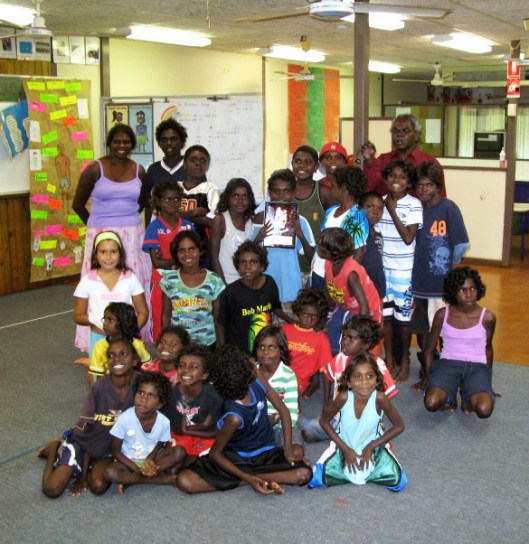
Yirrkarla Primary
By Warrigal Mirriyuula
There’s a kerfuffle going on at the moment up in The Northern Territory and like a lot of things Territorian it seems this one is also a fundamental disconnect between the whitefellas and the blackfellas.
You see, as part of Rudd’s much-spruiked but as yet unseen Education Revolution it has been decided, in consultation with the NT Parliament, that the kids of blackfellas are effectively illiterate because English is their second language and they don’t do so well on standardised tests used to determine literacy in white schools. Hardly surprising you say and of course you’d be right.
Age appropriate tests in their indigenous languages shows the kids to be just as bright and eager to learn as white kids in eastern schools. Funny that.
So what’s the kerfuffle about? Well it’s now been decided that the previous policy of bi-lingual language classes will be scrapped and all indigenous children will be taught in English exclusively for the first four hours of the school day. For those students for whom English is entirely foreign, and that’s lots of NT blackfellas, there will be indigenous interpreters to help students with little or no English skills. Not so radical you might say, given that if those kids want to integrate into the broader Australian society they’re going to need substantial English language skills.
Early indications however are that in those schools where this policy has already been implemented the children are voting with their feet. By the end of those four hours the classrooms are almost empty. In those schools, which are resisting the introduction of the policy, attendance is up
Where the children are taught in their first language and English is only taught after the kids have a sufficient grip on the grammar, vocabulary and narrative development of their own language, the literacy outcomes for both their own languages and English are improved significantly with students fluently using both their own language and English better. Sounds “win/win” to me.
So why, as Professor Charles Grimes and The Australian Society for Indigenous Languages suggest, has this anti intuitive course been charted. Beats the shit outa me, and the good Prof. too. Apparently it also caused Marion Scrygmour, The former NT Education Minister, some trouble. She admitted to Dr. Brian Devlin of Charles Darwin Uni.’s language department that the policy was made too quickly.
She said, ‘Look, I fucked up’,” Dr Devlin reported, but apparently not so badly that this dumb and damaging policy be dumped and the former bi-lingual process be reinstituted.
” I think what she was referring to is that there was a lack of consultation beforehand and that the application of her four-hour English directive of October the 14th had many unintended consequences.”
“It had certainly put her offside with traditional Indigenous people out in the communities.” the good Prof went on to say. Scrygmour is an indigenous woman herself, so this just gets curiouser and curiouser.
There is a groundswell of opinion suggesting that there are many factors not related to education including health and home conditions that affect school results.
“You could say as a ballpark figure that 80 to 90 per cent of the kids at this school would have a hearing impairment of the middle ear, infections or perforated eardrums at some time in their school career,” said the acting principal of the Lajamanu school, John Lane.
“The UN Declaration on the Rights of Indigenous People says that Indigenous people, minority people, have the right to decide the way that they have their own education, including the role of their own language in that.” Says Prof. Grimes. Pity policy makers haven’t read that declaration recently.
As any one who has ever had to learn a language will tell you, learning a foreign language is difficult because you have to understand it by deconstructing your understanding of your own first language. If, however, you have little or no understanding of the structure and dynamics of your own language, learning another will be effectively nearly impossible
At this time there are very few surviving indigenous languages that are used in a traditional cultural and social setting on an everyday basis and most of these are in the NT. Recent studies have shown that at this time indigenous languages are just managing to hold their own against English, but there can be no doubt that if this “English First” policy continues the number of languages and the speakers of those languages will decline.
As well as being comprehensively ill informed, this policy is simply racist. It’s more “pillow softening” and seems to assume that indigenous languages are somehow second rate. It constitutes a fundamental attack on what it means to be indigenous in this country. It is Orwellian in that it seeks to limit and control the language tools available to describe the complex relationships in indigenous society and the relationship between indigenous society and the broader Australian society. Something which their own languages do very well, certainly better than English ever could.
There are many aspects of indigenous life and experience, religion and cosmology, let alone their prodigious understanding of Australian ecology, that simply cannot be translated directly into English without losing depth and complexity. Should the day come when there are simply no indigenous speakers left we will all, whitefellas and blackfellas, be forever and irrevocably separated from that experience and cosmology, that understanding. Its meaning and utility will be lost forever.
The indigenous people of this continent have, over more than 60K years, made Australia penetrable, open to understanding and it is in their languages that the last vestiges of that understanding are to be found. To allow this policy to contribute to the continuing decline of indigenous diversity and self expression would seem an act of the most heartless and stupid “ethnic cleansing by neglect”, and the very people so cleansed would have no means to critique their circumstances, except of course in English.
What would it then mean to be a blackfella, if you had no way of accessing the fundamental tools that make that meaning real and define who you are? By making English the de facto indigenous language we are saying that there’s nothing worth saving and keeping in any of the remaining indigenous languages struggling to be heard against the white paradigm; and that’ll break blackfellas hearts all over again, all over the country.
Like I said, it just beats the shit outa me.
 Window Dresser's Arms, Pig & Whistle
I’m not sure what the answer is. Certainly something needs to be done to preserve local Aboriginal languages, and pretty quickly. The other problem is that English is the lingua franca for world trade, literature, etc, so one would not like to see any Australian child being disadvantaged in their acquisition of English.
Here in Newcastle, the local Blackfellas are Awabakl. There has been a big push from these people to preserve knowledge and language. Children go to their local schools and their education is supplemented by Awabakls who visit the school to teach ‘Blackfella’ stuff. I don’t know whether, or not, this has preserved the language.
It is of interest that this region was one of the only places in Australia where a dictionary of the local language was compiled at the same time as the white invasion. This dictionary was one of the first books available from Newcastle uni library as a pdf on-line.
Please note that ‘Awabakl’ has various spellings, and that local Awabakls do like being called ‘Blackfellas’.
I was in Darwin, recently, listening to discussions by ‘experts’ on birthing practices for Aboriginal women. The current practice is that they are removed from their locality to Darwin, at about 34 to 36 weeks of gestation. They go to hostel-type accomodation where they are forced to mix with women of, sometimes, rival tribes. There is no room for, even one, family member to be with them. they have the baby, stay in hospital a few days, then get sent home on a bus. Having mum away from home for up to seven weeks, with little communication, is intolerable.
This is thought to make birthing safe for the mother and child, and it probably does, on paper. What the statistics don’t account for is the unravelling of the family, and the sense of alienation of the family from the new baby who just appears as a bundle that disembarked from the bus with mum. Surprisingly, the costs of all of this transport and accomodation is about the same as the provision of midwives to local communities.
Whodathunklit??
LikeLike
Of course they should be learning English in Tandem with their own languages. I am not familiar with Australian indigenous tongues, nganhdhaar, pronounced ŋan̪d̪aːɻ -but it seems to me that both should be taught together.
The only problem that I can see is choosing a dialect or patois that can be thought of as ‘the main one’. Because if the people travel around and don’t have much written, they would pick up words that their relatives at home wouldn’t know.
It would make for happier times in the classrooms and enable families to discuss (say) homework together, thereby making a contribution to stability in the home, by that very involvement.
Not to mention restoring some well deserved pride, that has been stripped away by earlier white Australians.
LikeLike
Isn’t attending school compulsory? How come the kids are allowed to leave the school; to vote with their feet…
I always thought the school attendance was compulsory to a certain age. We are talking about primary school children here, aren’t we?
LikeLike
I agree with Atomou,
There was no stopping once I discovered the printed word and books. Jules Verne’s books I also remember as a start to language.
I find the indigenous problem confounding but wonder if the lack of any books or printed words are part of the problem. I know with the Sami of Northern Europe, they are exposed to the printed word both in own and country language from birth
All Governmental paperwork and forms HAVE to be in both the Sami and the nation’s language.
The Northern territory might just not have much public exposure of any language in written down form, either in the Aboriginal languages or English.
The same applies to anyone learning a language. The lack of books or printed words in the family are blamed by many educational experts as being the reason why many remain un-alphabetic.
When the written down word remains a mystery from generation to generation, then it would follow that language skills will suffer.
In Finnish education, joining the library is the first step in learning words and language.
How many libraries do indigenous communities have and how many indigenous people have access to books in own languages?
LikeLike
I might add that it is also extremely common in Australia for kids to be at grade level in their second language (English). Obviously easier the earlier they start. Retention of their native language is problematic. It is far more likely however when they associate with a community of native language speakers. In the case you seem to be talking about, where there is a dominant local aboriginal language and they are learning English as a foreign language, there is no reason why it should displace their native language.
I believe we definitely should give explicit and exceptional school support to retention and development of indigenous languages, even in a Sydney environment where it is particularly problematic. I agree it is a key to indigenous culture and knowledge and that is a valuable asset.
LikeLike
I meant to say ‘development of indigenous language skills’. I don’t usually see the point of correcting your own posts, but in this case it changes the meaning.
LikeLike
I agree wholeheartedly Voice… but it’ll never happen… Makes FAR too much sense!
Nice article Warrigal… though it’s a bit of a rant, I feel your rage… The stupidity of the government’s stance on this is appalling; reflecting as it does, both wilful ignorance and racisem.
😉
LikeLike
Good one, waz.
I had often wondered why our schools don’t take up the teaching of some of the indigenous languages; but, then again, if I had my druthers, there’d be bugger all else taught at least until Year 10 in schools other than languages and literature. Once in Year 10 they can teach Pork Crisping and knitting dog jackets for all I care but until then, teach oral and verbal communication. Touch on as many languages as possible with a greater focus on indigenous languages. With a bit of luck it would stimulate the interest of the kids to look deeper into these subjects.
I can’t believe that this country can’t eradicate every single problem it’s caused to a mere half a million people! Every single problem!
LikeLike
Yes atomou, but with the casual way you make clever use of English language, which would be remarkable even if it were your native language, it is obvious where your interests and abilities lie (not that it precludes you having others).
Surely you wouldn’t want to eliminate Maths. I’d like to see basic logic and reasoning skills taught explicitly too.
LikeLike
Nah, I’d piss maths off as well! Year 10 is a reasonable year to begin it. The students would, by then (having studied languages and Lit) be mature enough to understand abstract notions like binomial equations and the like. No big deal.
The learning of languages and Lit, incidentally, doesn’t exclude the learning of basic arithmetic and basic science, geography etc. Lit will be doing just that: teaching by stories, by poetry and by common, rather than manufactured language. Verne’s “20,000 Leagues Under the sea” for example, could teach a young mind all sorts of subjects, without turning them into Subjects.
I’m thinking of my own intellectual development when I say all this because it was pretty much Lit and language only that gave me the grounding for all the other subjects. Right up until I was, say, 15, all I was doing was reading novels written by the masters of the day. It was only after that, that I began to show some interest in other Subjects, such as Trig, Algebra and the like. Before that, they were a waste of my reading time.
But I certainly agree with your skeptical approach to studies about how young (and old) learn. I still go back to Bordieu and Passeron and Piaget and some others, none of whom had removed my skepticism. Every child I taught, including my own, needed a different, very much tailor-made approach, though the majority could adapt well with variations which had to be made to satisfy the needs of the group.
LikeLike
I am deeply sceptical of studies about how children learn Warrigal.
Fashions come and go in Education. I am convinced this is partly because influential academics take common sense ideas and apply them in extreme ways, and I am further convinced that personal and professional vanity play a significant part in that.
“Learning a foreign language is difficult because you have to understand it by deconstructing your understanding of your own first language. If, however, you have little or no understanding of the structure and dynamics of your own language, learning another will be effectively nearly impossible.”
I’m sorry but this is spectacularly wrong. (The I’m sorry is because I kind of know you and I certainly respect you.) What makes a foreign language so special? Clearly you don’t HAVE to learn one language by relating it to another, for reasons that are so obvious I won’t insult you by stating them.
It is also contrary to my personal experience. My kids learnt French in late primary by immersion in a quite parochial French public school system with, thanks to current educational fashions here, no ability to deconstruct English. Despite the extremely vigorous opposition of Child A1 to learning a second language.
“It has been decided … that the kids of blackfellas are effectively illiterate because English is their second language and they don’t do so well on standardised tests used to determine literacy in white school”
Wrong, wrong, wrong. The problem is not that English is their second language. The problem is that they don’t know it well. It is not at all unusual for a child to be at grade level in their second language though. In many countries it is extremely common.
The question is WHY they are not at grade level in their second language. After all, they didn’t arrive here in late primary. The best way to learn a language is by immersion. Let them do it that way. Four hours is a good length of time for immersion in a foreign language, particularly when they are speaking their native language on the playground and at home. And receiving some school instruction in their native language as well. (At least for those aboriginal kids who speak the local aboriginal language.)
“By making English the de facto indigenous language we are saying that there’s nothing worth saving and keeping in any of the remaining indigenous languages.”
That, my friend, is a related but different issue. I disagree.
LikeLike