
Tags
ironworker(sm)
Story and photographs by Lehan Ramsay
Yamashita#2(sm)
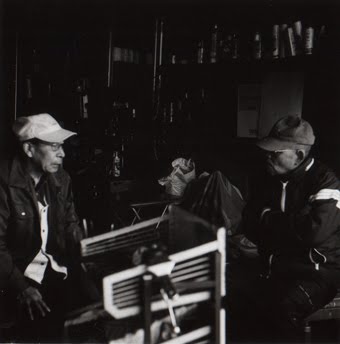
One of the Carpenter Guys took me to take a look at his house. Every inch filled with treasures, enough room to roll down his bed. Stamp album after stamp album, scroll after scroll, gilt covered whatnots, religious icons. Some of these things looked to me like they belonged in a museum. I suspect that the Museum Guys are not nearly as resourceful as the Carpenter Guys.
All the Carpenter guys seem to have a love of old things. They would pop around while the Carpenter Guy was working, look at my recycle-shop tea-room cabinet, say Oh, the doors don’t match, and move on. Any time we came across some old sheets of newspaper they would whip them off. Unwise customers at the markets were impressed by anything wrapped in old newspaper.
murata(sm)
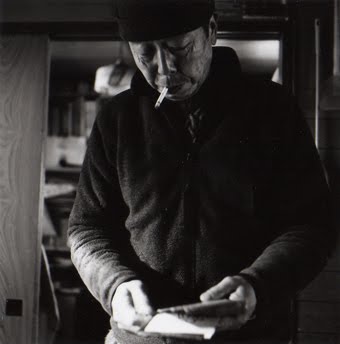
Carpenter guy got half of the scrolls I found in the cupboard. We unrolled them on the floor and his great knowledge all-at-once deserted him. I don’t know anything about scrolls, he said. You choose one, and I’ll choose one, and… I have not yet forgiven him for it.
The Carpenter guys let me have the wood from an old house they were dismantling, dragged it over and dumped it in the yard. Inside the pile I found the black lacquered counter of a sushi bar cut in two. The kind of sushi bar you use your fingers to eat with. I wiped it down and found a shelf for it in the house. I watched them take the house apart until they found an old teabox in the foundations. But I never saw what they found inside the box. And then they quickly brought in the bulldozers and all the rest went off in a truck full of splinters. I saw the tea box still lying there and brought it home for tools.
niwashi(sm)
You can ask the Roof man to fix chimneys, but you can’t ask him to build things, people will be annoyed. You can ask the Concrete man to build a fence at a pinch. But even I know that you can’t ask him to take a look at the floor. The Carpenter Guy has to do that. If you want to put charcoal into the floor you will need the Carpenter Guy’s permission. And then you will need to drive to the Volcano and talk to the Charcoal Burners up there.
But no old house is comfortable without charcoal. When they pulled down the old house built on the old hospital three doors down, I asked for the gates. Everyone who knew anything pulled the charcoal out of the foundations. By the time I learned about it none was left.
 Window Dresser's Arms, Pig & Whistle
After our personal “Bonfire of The Vanities” we had to replace the central staircase at our place. It had been a suspended steel arrangement with Redgum treads that hung from a particularly solid armature hidden in the roof space. Tended to resonate a bit and gave a most satisfying “bong” when ever you dropped anything on it.
After the fire we wanted certain changes to the arrangement of the upstairs spaces so it was no longer possible to use the former suspension system even though it had survived substantially intact. Indeed, apart from a few scorch marks and a few character defining burns, the treads also survived. We simply put them through a “thicknesser”, reoiled them and hey presto.
But the real heart of this yarn is the team of young Lebanese boys who convinced us that paying a small fortune for the new staircase was too much. They’d hand make the staircase for about a third the cost. We thought this was pretty good seeing as the new staircase wasn’t a “rebuild” item under the insurance and we’d be paying most of it from our funds.
They arrived and set to work. Only one of them spoke English and he was the team leader. They assembled a portable forge and proceeded to laminate the main spiral by cutting and twisting thin strips of steel, finally building the laminations up, cutting, twisting, welding, until the spiral was about two inches square. The balustrading and grips where simply added on piece by piece. It was a work somewhere between technical artifice and a kind of art. they built the entire thing in place and then disassembled it to take it away for powdercoating. When they came back for the reassembly it fitted perfectly.
Here’s the thing; apart from a few preliminary and most cursory measurements made at the time of quoting, I never saw another measurement made. Rob the leader directed every aspect of the assembly from a picture in his mind, occasionally adjusting the “turn” or “rise” by hanging sandbags from the steel while it cooled, or propping it up with a kind of custom made “Atlas Jack” of his own devising. As far as I could determine he had no formal training in steel fabrication and no understanding of the geometry of spirals. He saw the thing complete, in his head and just built the real one to look like the one in his head.
The engineer who had to sign off after the job was finished said he’d never seen such a thing. He and I hung off it, swinging wildly and trying to get the thing to move. It simply wouldn’t. It just gave off this indulgent low resonant note.
I asked Rob where he’d learned to work steel and he told me that his grandfather and father had been metalworkers, mainly in copper and brass, and that he had decided on steel simply because there was so much you could do with it, from security grilles to stair cases, box trailers to cattle grates; but his most popular item was a kind of car ramp that you drove up onto and which dropped to level as the car proceeded beyond a tipping point. To him our staircase and the car ramps were all of a piece. They were things you made from steel and he just loved making things with steel. Such a craft based in such an admiration for a material is a laudable thing.
We had him back earlier this year to make a new grate for the fireplace. He’s married now with a baby and his little business is doing very nicely.
LikeLike
These artists in Berlin make mechanised monsters for their courtyard….
LikeLike
For some reason I keep thinking of “Toad of Toad Hall” or that “Crazy Frog”.
I love that thing.
LikeLike
Yes. I’m sorry that I put it together with the intuitive craftsmanship of your story, but the love of metals and construction was what reminded me….
LikeLike
This has nothing to do with the story, but, I was looking at hand tools, on-line the other night. Was amazed that one can still purchase hand made Japanese chisels and knives (which are as dear as poison, as my old Dad would say). These are made in the ‘Damasc’ style where the billet of steel is heated then beaten out by hand, folded on itself, reheated, beaten out again, by hand, about two hundred times. This aligns the grains of iron in the steel making it incredibly strong, and capable of keeping an edge. The Japanese didn’t invent this, but they are the only country that has kept this art alive. These tools come with hand carved ebony handles. Us Westerners would buy them to put in a display case, but the Japanese make them to be used in the workshop (or kitchen).
I can see where the obsession of your Carpenter Guys come from!
LikeLike
Big M,
The writer Alan Bennett inherits two pairs of steel scissors, used for cutting lino and oilcloth in his grandpa’s hardware shop; he keeps them on his desk as he sees that a writer needs them as much as the man in the hardware store; cut, cut, cut…
There nothing in Lehan’s piece that needs cutting off…
LikeLike
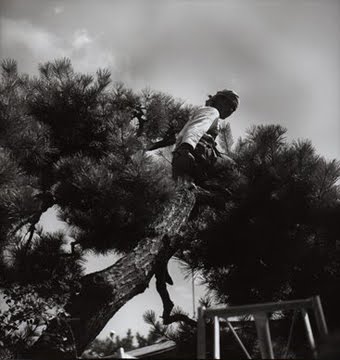
The Concrete guy saw me trimming a pine tree with ikebana scissors, gave me a pair of proper iron and steel gardeners scissors. That’s what got me talking to that Gardener, who then came and wrapped up the pine tree of my rental house for the winter. That’s how I came to buy a house, you see. It’s that slippery road….
LikeLike
I found a box of them at the recycle shop, with chisels and saws and some things I didn’t recognize. The box was about $16. They didn’t have the fancy handles though, very basic. If I ever find an interesting set again I’ll let you know, you can exchange them for something….
LikeLike
Given that the Japanese chisels are about $120 each, and the knives are about $200, a box for $16 is pretty good value, even sans ebony handles!
LikeLike
If they’re that well made, they’re probably worth that. The $16 set would probably be a cheaper kind. Still well worth getting, but not hand crafted.
LikeLike
LOL Lehan. Definitely, most definitely, with you, not AT you. Been there, done that. The more things change, the more they stay the same. Different geography, different culture, but human nature essentially the same, and not always pretty. It seems the first time you do anything you get ripped off, and over there you experienced a lot of firsts and no mentor in sight. You obviously don’t play poker, or the “I don’t know anything about scrolls” might have rung a few alarm bells.
How lovely that Carpenter Guy appreciates beautiful things, but …
LikeLike
It did ring a few bells. But I’m not a poker play; I don’t know what card you’re supposed to pull out next. Still, it was a lesson, I had to respect that!
LikeLike
First thing he suggested was “scissors paper rock”. But you don’t play scissors paper rock with a Japanese person, not unless you’re looking to go second.
LikeLike
Lovely stuff – love building things too and have dismantled the odd construction myself. Discovered way back not to assume that cabinet makers do carpentry.
LikeLike
Just after I started working with some Cabinet Making Guys, I answered the workshop phone, gave the details, said my name, fairly formal and there was an explosive sound of spluttering laughter loud enough to hurt my eardrum. “Eh?” said the caller, “The Boss has got himself a Secree-terry has he?” That followed by more spluttering laughter loud enough to hurt my eardrum. “No!” I snapped before I had any chance to know what I was saying, my teeth set, my voice stee-ee-eely with meaning, “I’m the new Hired Hand.” 🙂
LikeLike
I love Lehan’s story and the layers of effect it has had on me includes suddenly finding my treasured memories of a second hand tool shop in Auckland in New Zealand, where I bought a beautiful jack plane. The wimmin who were the Cabinet Guys came to the airport to see me off from New Zealand to Australia when I left. I carried the plane separately from my luggage to the airport. It was to present it in the middle of the airport departure foyer to Cabinet Guy who on a Friday afternoon with about 20 minutes to knock-off burst into tears because she feared we would not finish a job lot on schedule of railway sleepers we had been consigned on the Monday morning at 8.30 to put through the thicknesser. We did finish, by the way, on the exact second.
🙂
LikeLike
Carpenter guys are kind of funny. They’re so practical, each seems in their first meeting with me to assume I’m an idiot. Then we have to work our way up. We don’t always get very far, and sometimes it’s quite a struggle. The questions of cost and quality seem to be their way of testing. It’s not that they don’t like doing quality work. But they’re only going to do it if you know what you’re talking about. So in a way it’s a measure of their respect if they do something good for you.
One man made me some doors to stop the laundry breezes coming through. Then they charged me more than they had said, and even though they reduced the price when I commented, I didn’t use them again. But the doors are actually made smart, and I think the mistake was mine, not to realize that.
I asked the concrete guy to make me a cat ladder for a window. He came back with a very solid one. Then he said; he thought it was too solid, so he pulled one side of the supports off. That way, if anything heavier than a cat climbed on it, it would fall over. It was very smart. Workmen and women spend their days doing repetitive things, and don’t get a chance to stretch themselves often enough. And they have such good ideas.
LikeLike
I thought that this town was a kind of treasure. It has old houses that are kind of tucked away. In kyoto you can see which houses are old, but here they are covered in aluminium siding and double sets of windows to keep out the cold. There are only a few small features that you can spot from outside the house, as to whether it is worthwhile taking a closer look. Then there are a lot of workmen who are old enough to have decent skills and training, young enough to do heavy work. Then there are still a fair amount of resources. Then there was the custom of building over ceilings, walls, firepits, rather than pulling them out and replacing them. So it’s a rare thing. But nobody seems to care much about it, and some of the places in my photographs have already been pulled down, in these three years.
There are three photographs of three similar buildings on the blog. In the photograph it is easy to see that they have been made at the same time by the same person. One was very attractive, one a little ratty, and one looked forgettable. But that forgettable building was the treasure. It was an old rickshaw business; underneath the siding and coverings it would have been worthwhile devoting some time and labour to.
This was one of the ports that was open when Japan was closed for a hundred years. So there were a lot of traders, missionaries. A strange style of architecture emerged, in which a two story building would be western style on one half and japanese style on the other. There were a lot of Russians. People ate and drank things (coffee, butter) that wouldn’t catch on in the rest of Japan for a long time. It was quite a town, it had a lot of movie theatres. But now it seems to have forgotten all that.
LikeLike
Lehan, I love your short story, it so Japanese, it’s like eating Sushi…but not at some horrid Centro shopping mall but somewhere nice and simple.
You giving us an idea how things are done in Japan, there is the Right way of doing everything; the size of gift to the hostess, beautifully wrapped…not too small but also not too large, just right like Goldilocks bed.
I looked at your blog and I’m most impressed with your photos, I’ll do some more ‘looking’ later on…
LikeLike
This morning I took some time to have a longer look at Lehan’s blog. And quite a lot of the pieces in my fragmented world fell into place. Particularly the stories – for me, still awaiting my attention.
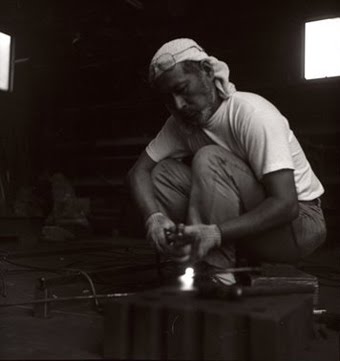
When I scrolled through the pictures, I felt that I would prefer to replace the first pic in this, the Collectors story (Ironworker) with something from the lumber yard. Or maybe something of the house itself.
But I like the ironworker picture. The composition and the fall of light evoke in me a deep sense of focus and tranquillity – and a memory of photographs from Balmain artisans and craftspeople published in the 1970s – shortly before the suburb rocketed into gentrification and stockbrokers and media giants began to invade and push out the less well-heeled. Many of the old timers would have frequented the Pig’s Arms.
Curious sense of the photograph – since one might need to be deaf to imagine that ironwork and tranquility go hand in hand; the furnace heat, the beating of plough shares into armour, the hammering of rivets.
To the patrons of the Pig’s Arms who have not already done so, I say “Take the time to visit Lehan’s amazing blog”.
http://lehanwinifred.blogspot.com/
Kind regards,
Emm
LikeLike
He was making me a security door, you can see it in the blog photographs, it’s covered in icicles. He drew it on the floor with chalk and then he built it there, with his bare hands, not using any gloves. He made another one for the window, put in a design we found on an old box in the house. He was also supposed to make a rain water tank but he suddenly disappeared. I still have to chase him up about that one….I don’t know if he doesn’t like making rain water tanks or wasn’t sure how to do it. I’m thinking that I’ll have to pay him another visit toward the end of winter.
Thanks emmjay.
LikeLike
Notice the little girl finally caught up with the little boy (taller than her).
LikeLike
Vivienne, I am wondering what you were referring to. 🙂
LikeLike
…me too, sandshoe…who are they, Viv?
LikeLike