
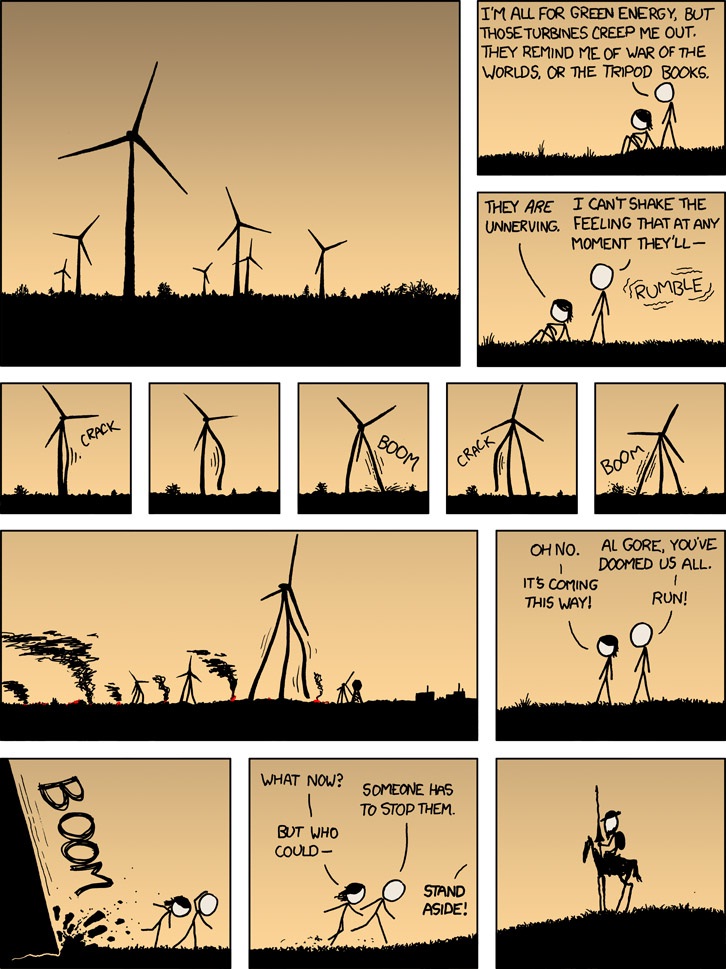
 © XKCD (I borrowed this cartoon from: http://xkcd.com/556/)
Story Edited by Warrigal
It’s been a matter of some perplexity to me that governments and industry the world over have failed to pick the low hanging alternative energy fruit. While solar rebates and subsidies for domestic solar cell installation have enjoyed mixed success here in Australia and similar schemes operate globally, there seems to be a general blindness to the full potential of these existing technologies.
So if I said that a recent paper from no less august an institution than Stanford sets out a clear path to an alternative green energy future that would save perhaps as many as 3 million lives a year and simultaneously halt global warming, reduce air and water pollution and develop secure, reliable energy sources; nearly all with existing technology, and at costs comparable with what we spend on energy today you’d have to be pretty interested wouldn’t you. Further we can achieve all that according to this study by converting the world to sustainable and renewable energy sources and completely obviate the need for burning fossil fuels.
The new study co-authored by Stanford researcher Mark Z. Jacobson and Mark A. Delucchi sets out a scheme for achieving exactly that.
“Based on our findings, there are no technological or economic barriers to converting the entire world to clean, renewable energy sources,” said Jacobson, a professor of civil and environmental engineering. “It is a question of whether we have the societal and political will.”
Jacobson and Delucchi, of the University of California-Davis, have written a two-part paper in the publication Energy Policy, in which they assess the costs, technology and material requirements of converting the planet, using the plan they developed.
The world they envision would run largely on electricity. Their plan calls for using wind, water and solar energy to generate power, with wind and solar power contributing 90 percent of the needed energy.
Geothermal and hydroelectric sources would each contribute about 4 percent in their plan (70 percent of the hydroelectric is already in place), with the remaining 2 percent from wave and tidal power.
Vehicles, ships and trains would be powered by electricity and hydrogen fuel cells. Aircraft would run on liquid hydrogen. Homes would be cooled and warmed with electric heaters — no more natural gas or coal — and water would be preheated by the sun.
Commercial processes would be powered by electricity and hydrogen. In all cases, the hydrogen would be produced from electricity. Thus, wind, water and sun would power the world.
The researchers approached the conversion with the goal that by 2030, all new energy generation would come from wind, water and solar, and by 2050, all pre-existing energy production would be converted as well.
“We wanted to quantify what is necessary in order to replace all the current energy infrastructure — for all purposes — with a really clean and sustainable energy infrastructure within 20 to 40 years,” said Jacobson.
One of the benefits of the plan is that it results in a 30 percent reduction in world energy demand since it involves converting combustion processes to electrical or hydrogen fuel cell processes. Electricity is much more efficient than combustion.
That reduction in the amount of power needed, along with the millions of lives saved by the reduction in air pollution from elimination of fossil fuels, would help keep the costs of the conversion down.
“When you actually account for all the costs to society — including medical costs — of the current fuel structure, the costs of our plan are relatively similar to what we have today,” Jacobson said.
One of the biggest hurdles with wind and solar energy is that both can be highly variable, which has raised doubts about whether either source is reliable enough to provide “base load” energy, the minimum amount of energy that must be available to customers at any given hour of the day.
Jacobson said that the variability can be overcome.
“The most important thing is to combine renewable energy sources into a bundle,” he said. “If you combine them as one commodity and use hydroelectric to fill in gaps, it is a lot easier to match demand.”
Wind and solar are complementary, Jacobson said, as wind often peaks at night and sunlight peaks during the day. Using hydroelectric power to fill in the gaps, as it does in our current infrastructure, allows demand to be precisely met by supply in most cases. Other renewable sources such as geothermal and tidal power can also be used to supplement the power from wind and solar sources.
“One of the most promising methods of insuring that supply matches demand is using long-distance transmission to connect widely dispersed sites,” said Delucchi. Even if conditions are poor for wind or solar energy generation in one area on a given day, a few hundred miles away the winds could be blowing steadily and the sun shining.
“With a system that is 100 percent wind, water and solar, you can’t use normal methods for matching supply and demand. You have to have what people call a supergrid, with long-distance transmission and really good management,” he said.
Another method of meeting demand could entail building a bigger renewable-energy infrastructure to match peak hourly demand and use the off-hours excess electricity to produce hydrogen for the industrial and transportation sectors.
Using pricing to control peak demands, a tool that is used today, would also help.
Jacobson and Delucchi assessed whether their plan might run into problems with the amounts of material needed to build all the turbines, solar collectors and other devices.
They found that even materials such as platinum and the rare earth metals, the most obvious potential supply bottlenecks, are available in sufficient amounts. And recycling could effectively extend the supply.
“For solar cells there are different materials, but there are so many choices that if one becomes short, you can switch,” Jacobson said. “Major materials for wind energy are concrete and steel and there is no shortage of those.”
Jacobson and Delucchi calculated the number of wind turbines needed to implement their plan, as well as the number of solar plants, rooftop photovoltaic cells, geothermal, hydroelectric, tidal and wave-energy installations.
They found that to power 100 percent of the world for all purposes from wind, water and solar resources, the footprint needed is about 0.4 percent of the world’s land (mostly solar footprint) and the spacing between installations is another 0.6 percent of the world’s land (mostly wind-turbine spacing), Jacobson said.
One of the criticisms of wind power is that wind farms require large amounts of land, due to the spacing required between the windmills to prevent interference of turbulence from one turbine on another.
“Most of the land between wind turbines is available for other uses, such as pasture or farming,” Jacobson said. “The actual footprint required by wind turbines to power half the world’s energy is less than the area of Manhattan.” If half the wind farms were located offshore, a single Manhattan would suffice.
Jacobson said that about 1 percent of the wind turbines required are already in place, and a lesser percentage for solar power.
“This really involves a large scale transformation,” he said. “It would require an effort comparable to the Apollo moon project or constructing the interstate highway system.”
“But it is possible, without even having to go to new technologies,” Jacobson said. “We really need to just decide collectively that this is the direction we want to head as a society.”
Jacobson is the director of Stanford’s Atmosphere/Energy Program and a senior fellow at Stanford’s Woods Institute for the Environment and the Precourt Institute for Energy.
Story Source:
The above story is reprinted (with editorial adaptations) from ScienceDaily.
Source materials provided by Stanford University. The original article was written by Louis Bergeron.
Journal References:
1. Mark Z. Jacobson, Mark A. Delucchi. Providing all global energy with wind, water, and solar power, Part I: Technologies, energy resources, quantities and areas of infrastructure, and materials. Energy Policy, 2010; DOI: 10.1016/j.enpol.2010.11.040
2. Mark A. Delucchi, Mark Z. Jacobson. Providing all global energy with wind, water, and solar power, Part II: Reliability, system and transmission costs, and policies. Energy Policy, 2010; DOI: 10.1016/j.enpol.2010.11.045
 Window Dresser's Arms, Pig & Whistle
You wonder with our silly Westminster method of governing how anything gets done at all. All parties are busy demolishing each other and consensus to get things done is usually at the bottom of the list of priorities. The slogan in our method of governing is” to keep the government to account” which is then married with opposing everything under the sun’ ferociously’.
While the political parties are busy being “ferociously” engaged in doing nothing, what can the individual do to reconcile our lives with the alarming news that earth might soon move into some kind of environmental death throe? The world is slowly carking it, we are told by the best of available science and their practitioners.
Well, this is the good news, we can do a lot. Just look at Andy Ridley who happens to be a friend of our son and who started Earth Hour. Who would have thought that would take off so enthusiastically by the whole world? He started an environmental group in 2007 with just Sydney switching off the lights. In 2010 Sydney was joined by 127 countries. The 27th of March, this year, Earth Hour will be on again bigger and better than ever.
In the Oosterman family we thought of at least doing as much as possible to try and reduce our own impact of spewing CO2 into the Southern Highland’s sky. Our latest electricity bill is a triumph over the inevitability of not being able to do anything about climate change.
The art is in consuming the minimum and using power grid electric energy as frugally as possible, or not at all. Not long ago, people lived good lives without electricity.
I wouldn’t go that far, but aiming for using zero grid generated power is not a bad idea.
LikeLike
Gez, I garee totally. That’s just one reason for Tony Abbott STILL not being able to win. No effing ideas – just halfwit carping negativity. Notice how the same strategy will probably work for Fatty O’Barrel.
Do you have a story for us about how you worked this electronic miracle ? I’m thinking of turning off Tim the Cabin Boy’s lights……..
LikeLike
Gez and I must be doing something right; our electricity bill for 72 days was ONLY $87.-!
The boss-man can tell you how this was achieved 😉
LikeLike
http://www.iwcp.co.uk/news/environment/huge-tidal-energy-scheme-unveiled-37331.aspx
Everyone’s doing their bit!
LikeLike
One thing I’ve been searching for is solar air conditioning. Lot’s of engineers say it can be done. CSIRO have a research facility here, in Newcastle. They eagerly tell us that we’re less than five years away from solar cooling. A brisbane company advertises that they’re about a year away from commercial solar cooling. I recently discovered that a company from the Nordic countries and Ireland have been selling solar cooling/heating/hot water systems for about a year. Their system smooths out variations in solar irradiation by storing cold (in summer0 or hot ( in winter) water in insulated tanks. I’m waiting for them to give me an estimate for my house.
The CSIRO has already developed a hybrid solar cell that generates electricity and hydrogen gas.
I suspect that it will be us little people who’ll lead the way with embracing these technologies. My 15 year old son has been involved in a project building an ‘eco-house’. A small, energy efficient structure, built from steel, bamboo and Hebel panel, with it’s own water storage, solar panels, etc. I’ve been trying to get him to write a story for the Pig’s Arms, but he reckons that sounds too much like school work!!
LikeLike
I have a new author room waiting – “Little M”
LikeLike
Thanks, Emmjay. I’ll give him another nudge.
LikeLike
Big M, look through the archives on the New Inventors. I recall seeing a system that uses solar power to remove heat from you home thus keeping the inside air temperature down.
LikeLike
Hung, I’ve looked at that system. It aims to bring the roof temp down at night, to give the occupants some respite from the heat. Our problem, as in many parts of the great, brown, vast, red land is that it gets to 47 degrees, on occasion, and over 85 % humidity. We both still work a rotating roster, so there is someone trying (me right now) to sleep during the day.
It’ amazes me that most of the research on solar power, heating and cooling is done in countries like Germany and Denmark, where Mr Sun only pokes his head out now and then!
If I manage to get this Kingspan system installed I’ll give you all some feedback.
LikeLike