
Tags
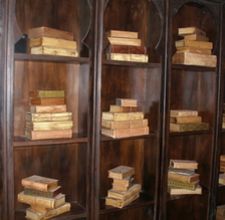
The wandering book searcher had in the meantime surveyed the rag-tag of books on the shelving. He cast his eyes over the titles, holding his head askew this way and that way trying to read as much as was still visible on the torn covers. He munched approvingly on his rotating burger which was now almost eaten to its core.
His usual modus operandi was to exchange his quarry inside the back-pack for any unread ones. He mainly succeeded in that, especially if he traded two books for just one. Depending on his limited finance he would just sometimes buy a book, a reckless splurge of the moment which so far he had never regretted. His need for books was till now still unrequited dating back to childhood, deprived of letters and words printed on pages by an uncaring culture and not made better by a bookless neighbourhood. He would never fill the void but made up the deficit as good and as diligently that he was still capable of. He was lucky to have been taught reading in the first place. He knew that if he was to catch up with books and the reading of them he could never waste time working for a living and money. He wanted to understand more of the world that he lived in. Time was of the essence, and because of that he could not afford wasting time in working for anything, let alone just money whose value could never be read.
His reading skill had been installed when very young and in a far away country of which he still had some vague memories. He also remembered fondly that a distant uncle, rumoured to have emerged from a Tsarist Russian background and nobility, had taught him to play the mouth organ. He now had a small ‘Hohner’ organ with a button on the side for half-notes. His early childhood training had stood him in good stead despite the deprivations later when circumstance had transferred him to the relenlessly hot and dusty world he now resided in. When he arrived at a place that, through no intent of him, featured a market he would put down his belongings, told Bluey to ‘sit’ and start to play his mouth organ. He would only play long enough for people to provide him with enough coins for some future food and a frayed but un-read book. He knew that by following a certain repertoire the coins would be dropped in his hat, especially during his playing of the very popular ‘When the Saints come marching in’. The combination of the music with Bluey’s mournful looking eyes, cast upwards towards the audience; many would not walk past without chucking a couple of pennies.
When the hamburger had finally been eaten and the last of the tea been squeezed and scored from the tea bag our searcher stood up and paid for the food including a couple of Spam-ham cans, making sure the cans still had the keys attached at the top. He already knew that there was yet an unread book on the shelves that he badly wanted. He took a book from his back-pack. It was a well thumped ‘The Brothers Karamazov’. He asked the large breasted shop-owner if he could swap this for the maroon coloured hard cover book on the top shelve. He also offered to top his offer up with a tuppence coin. She agreed and offered him the use of the outhouse for a shower; that’s if you want to shower, she asked? He, for a split second thought there was something in the furtive way she looked sideways as she made the offer, away from his open gaze.
She knew the rule for wanderers with swags and cattle dogs. Itinerants, ringbarkers, fencers and shearers, they were the ones that she still managed to eke a living from. Some she befriended and even loved for a night or so, snatched away from the uncompromising hard fist of an otherwise solitary life, a life not unlike those that she sold her wares to. She hardly remembered her husband who had vanished without a grunt of a good-bye years ago. A hopeless drunk of piss-pot, he was. That’s the most she recalled. Her solemn but generous giving of relief to the itinerant wanderers and flotsam of those on endless dirt roads cut both ways and she preferred that to her previous marital mishap. Besides, it did give her business a chance to limp on.
To be continued.
 Window Dresser's Arms, Pig & Whistle
Voice:
Surely you have read or heard that the noun (or verb) ‘quarry’ has also been used away from its strictest or singular definition of the Oxford dictionary? I am the last person to involve a dictionary when writing, if I did it would lose everything creative.
The story is not about strict investigation of every word or pedantic correct grammar. I am expressing my creativity here, whatever it might be worth.
LikeLike
The Oxford dictionary defintion is netiher singular nor strict. It is effectively the same as the one you referred me to, only organised differently. Plus the Oxford includes an additional meaning not included in your source, no doubt because it is a very specialised and technical meaning.
This is not a grammatical point.
I appreciate that you are expressing your creativity though.
LikeLike
Sorry gerard, but you simply cannot carry quarry in your backpack, at least not knowingly. Quarry ceases to be quarry once you’ve caught it.
LikeLike
Sorry Voice:
You might indeed be incapable of carrying a quarry of any kind. The Restless Booksearcher could. Since those time quarries of every kind have sprung up everywhere. Here is one,
http://www.quarrybooks.com/
quick, catch it before I find another one.
LikeLike
He might have sincerely believed that he could. But that would have been before he found the dictionary.
LikeLike
Not so fast Governor: http://www.audioenglish.net/dictionary/quarry.htm
Sense 2 quarry [BACK TO TOP]
Meaning:
Classified under:
NOUNS DENOTING MAN-MADE OBJECTS. Is a book not man-made?
Also :prey and object of attack as well as a stone pit or mine.
LikeLike
That’s a really interesting reference gerard; thanks for that. Interesting idea to have their own dictionary.
Comparing the definition of quarry with that of the Online Oxford, the immediately obvious difference is that the Oxford groups the definitions differently. Closer inspection reveals that this is a consequence of audioenglish having a separate entry for the noun definition for each of their noun classifications, and of having classes for nouns denoting man-made objects and nouns denoting people. Not sure what the point of this is, but if it is a general case thing, they might believe that this makes it easier for learners of English as a foreign language. That could well be correct.
I can’t see the relevance of this reference vis-à-vis our discussion above though.
This might be more relevant. Note that the same Dutch word can be used after the quarry is caught. But the English words change.
http://lookwayup.com/lwu.exe/lwu/toEng?s=f&w=prooi&lang=Nld
LikeLike
Booksellers and Book searchers have always been in our genes.
Cop this:
Our History from 1812
The story of Berkelouw Books begins in Kipstraat, Rotterdam, Holland, in 1812. Solomon Berkelouw traded in vellum-bound theology books which were en vogue in the early nineteenth century. Publishers of the period were certain of selling publications as long as they dealt with theology. Solomon peddled his wares on Rotterdam Quay and his clients were mainly owners and skippers of the barques that brought grain and other agricultural products from the provinces of Zealand and Zuid Holland to Rotterdam. The owners of barques were well to do citizens with a growing interest in education. Not much is known of Solomon Berkelouw except that his bookselling career came to a sudden and unfortunate end. On a late winter’s afternoon, with snow falling thickly all around, Solomon attempted to cross an icy plank that connected a customer’s ship to the wharf. Halfway up, he lost his footing and fell into the freezing water. Before anyone could fetch help he drowned, his jute-bag full of books sinking with him to the bottom of the icy harbour.
Solomon’s young son Carel was determined to carry on his father’s trade. He put the business on a more stable footing by opening a bookstore at the Niewe Market in Rotterdam. Under Carel’s direction Berkelouw Books prospered and he later moved to a larger premises at Beurs Station, also in Rotterdam.
Carel’s son Hartog Berkelouw continued to expand the family business. After serving an apprenticeship with his father in the Beurs Station store, he opened a new shop at Schoolstraat, Rotterdam. It was Hartog who first began issuing the catalogues that gained Berkelouw an international reputation. In 1928, the firm was granted membership to the prestigious International Antiquarian Booksellers Association. Business subsequently increased and Hartog’s children, Sientje, Leo, Carel and Isidoor, all became involved in the book trade. However, the Second World War intervened, introducing a dark chapter into the history of the Berkelouw family. During the siege of Rotterdam, Berkelouw Books’ premises were bombed and its entire stock destroyed. Amongst the lost books was a collection of antique bibles thought to be the most valuable in all of Europe. Further tragedy followed – Sientje and Carel became casualties of the war. As Leo had left the firm many years earlier, the once thriving business was brought to a standstill – the work of four generations of Rotterdam booksellers virtually wiped out in just a few years.
Immediately after the war, Isidoor Berkelouw began to re-establish the firm. He set up business in Amsterdam and began conducting successful book auctions. However, Isidoor was keen to move the business out of Europe. The Berkelouw collection had already been destroyed once and he did not want to see it happen again. In 1948 Isidoor liquidated his company and made the long journey to Australia. Shortly after arriving in Sydney, Isidoor issued a catalogue, generating immediate interest amongst book collectors around the country. He set up shop at 38 King St, Sydney and conducted book auctions on a regular basis. As Berkelouw’s clientele and stock expanded, headquarters was relocated to 114 King St and Isidoor began to share the management of the business with his two sons, Henry and Leo. By 1972 the Berkelouw collection had grown to such a size that it was forced to change premises once again. The firm made a brief move to Rushcutters Bay, then in 1977 took a quantum leap relocating entirely to ‘Bendooley’, an historic property just outside the beautiful village of Berrima in the Southern Highlands of NSW.
In 1994, the sixth generation, Paul, Robert and David Berkelouw, returned to Sydney, opening its now landmark store in Paddington. Five years later another Sydney store was opened in the cosmopolitan suburb of Leichhardt. Since then, Berkelouw Books has opened further stores in Sydney, Melbourne and Eumundi on the Sunshine Coast of Queensland. All our stores offer an extensive, interesting and eclectic new book selection covering all interest areas with a special interest in Children’s Books, fine stationery, as well as a hand-picked display of rare books. Our Paddington, Leichhardt, Newtown and Eumundi stores have a vast selection of secondhand books. Adjoining many of our stores are the Berkelouw Cafes, a great place to relax and enjoy ambience.
Today Berkelouw Books is Australia’s largest rare and antiquarian, secondhand, and new bookseller. We have an overall stock in excess of 2 million books, many of which are listed and available for purchase here via the Internet.
LikeLike
Very interesting. I imagined the family members’ collective knowledge of books.
LikeLike
Lovely! Brothers Karamazov in one hand and a woman with sexalgia in the other!
There must be something in this combo.
You might recall the email I’ve got not long ago, which elicited Voice’s aid. A young man taking his girlfriend to restaurants where they read my translations of ancient plays on his iPad!
Good books. Are they as good as good sex?
LikeLike
I read a book by the Australian author, Geraldine Brooks, called ‘March’. Young Mr March travels from New England to South to peddle books. He got a good collection, poetry by Wordsworth, something by Locke, Johnson and even some books suitable for kids.
Interestingly he reads them first before selling them. Gerard’s restless Booksearcher does the same, and,no, Gez has not read Geraldine’s book…
LikeLike
Interesting. I had a small trade happening in vinyl records some years ago and obsessively listened to every recording before making it available on my market stalls. I suppose Geraldine’s Mr March is driven by the same ideals of wanting to discuss the sale item to the satisfaction of the customer. An interactive relationship about the item rather than the sale. I wonder if Mr March priced the book according to his knowledge of it or his opinion of it. I look forward to finding a copy of ‘March’.
LikeLike
Y’ll have to hang in there Big M. A nail biting finish tomorrow with the shelve to delve into the soul of the svelte selve.
LikeLike
The story is taking a salacious twist. Love the bookshelve’s, are they yours?
LikeLike
No ,not ours Big M, but I like them…so tidy too, mine are a mess..
LikeLike