• The Pig’s Arms
  • About
  • The Dump

Window Dresser's Arms, Pig & Whistle

~ The Home Pub of the Famous Pink Drinks and Trotter's Ale

Window Dresser's Arms, Pig & Whistle

Tag Archives: books

Apollo Mission 1

05 Monday Oct 2026

Posted by Mark in Mark

≈ 1 Comment

Tags

Belinda, books, Father O'Way, fiction, Gordon O'Donnell, humour, RUDOLPH, Sandy, short story, Space travel, travel, writing
A Place For Us—A melancholy musical episodic intro to the Father O’Way Chronicles

FATHER O’WAY
Apollo Mission I
Space.
There are words which improve considerably when somebody else is involved.
Space is one of them.
I had no objection whatsoever to space.
I thought space was magnificent.
I supported space.
I had looked at photographs of it.
I had watched documentaries about it.
I was entirely in favour of other people going there.
“I’m not going,” I said.
Gordon nodded.
“That’s understandable.”
“Good.”
“You’ll need to bring some clothes.”
I looked at Billy.
“He does this a lot?”
“Constantly.”
Gordon put his fingers to his mouth.
He did that whenever he was thinking.
Unfortunately he thought quite a lot.
“I suppose three shirts would be enough.”
“I said I’m not going.”
“And underwear.”
“Gordon.”
“Probably more underwear than shirts.”
Billy nodded.
“Sensible.”
“You can both bugger off.”
Merv placed another beer in front of me.
“Travelling, Sandy?”
“No.”
“Right.”
He put a second beer beside it.
Merv had known me for some time.
The following morning Gordon was sitting at my kitchen table.
I had not invited him.
Belinda had.
This was disturbing.
More disturbing was the fact that she appeared to like him.
Gordon had covered the table with papers, diagrams, notebooks and something with flashing lights which was occupying the space normally reserved for toast.
Belinda put tea in front of him.
“Thanks.”
“You’re welcome.”
I looked at her.
“You made him tea?”
“Yes.”
“He wants to send me into space.”
“I know.”
“And you made him tea.”
“He asked nicely.”
This was how betrayal entered the modern home.
I sat down.
“All right. Explain.”
Gordon brightened.
This was a mistake.
Never tell an academic to explain.
They take it personally.
“I’m studying the universe.”
“Yes.”
“For my PhD.”
I waited.
“That’s it?”
“Essentially.”
“You’re God.”
“Gordon.”
“Your initials are G.O.D.”
“That’s unfortunate.”
“You apparently come from another dimension.”
“Yes.”
“You can appear and disappear.”
“Within limits.”
“You know things that haven’t happened yet.”
“Sometimes.”
“And you’re doing a PhD?”
Gordon looked mildly offended.
“One needs qualifications.”
“For what?”
“Academic credibility.”
I stared at him.
Somewhere in the universe, apparently, there was a university prepared to tell God that his understanding of creation required peer review.
I found this enormously reassuring.
“What’s the thesis?”
Gordon shifted some papers.
“Well…”
There was the word again.
I looked at Belinda.
“That ‘well’ always costs me money.”
Gordon produced a graph.
Across the bottom were numbers.
Up one side were more numbers.
A red line wandered through the middle without displaying any obvious desire to arrive anywhere.
“This,” he said, “represents the relationship between cricket and the fundamental structure of the universe.”
I looked at it.
“No, it doesn’t.”
“It may.”
“That’s different.”
“Yes.”
“What relationship?”
“I don’t know yet.”
“Excellent thesis.”
“Which is why I need data.”
He pulled out another sheet.
“This is the average score in one-day cricket.”
I looked again.
“And?”
“This is the average number of baked beans in a four-hundred-and-forty-gram tin of baked beans in tomato sauce.”
Silence.
Belinda leaned over my shoulder.
“There’s a difference.”
“Yes,” said Gordon.
“How much?”
“That’s what I’m trying to establish.”
I looked from one to the other.
“Has anybody considered simply counting the beans?”
Gordon stared at me.
Belinda stared at me.
I had apparently said something scientifically naïve.
“You can’t just count them,” Gordon said.
“Why not?”
“Sample error.”
“Buy another tin.”
“Brand variation.”
“Buy several.”
“Regional variation.”
“Buy them in different places.”
Gordon smiled.
“Exactly.”
I realised what had happened approximately three seconds too late.
“No.”
“I need a field researcher.”
“No.”
“Someone capable of travelling.”
“No.”
“Observing local customs.”
“No.”
“Collecting samples.”
“No.”
“Writing reports.”
“No.”
“And understanding cricket.”
I hesitated.
Belinda sighed.
Gordon saw it.
“There.”
“There what?”
“That.”
“What?”
“You hesitated.”
“I like cricket.”
“Excellent.”
“It does not mean I want to spend the rest of my life travelling around the universe counting baked beans.”
“We may count other things.”
“That doesn’t help.”
Belinda picked up the graph.
“What am I doing?”
I turned to her.
“You’re doing nothing.”
Gordon said, “I was hoping you’d come too.”
“No.”
Belinda ignored me.
“As what?”
“Research assistant.”
“No.”
“Logistics.”
“No.”
“Documentation.”
“No.”
“And Sandy management.”
Belinda considered this.
“What does that pay?”
“BELINDA.”
She looked at me.
“I’m negotiating.”
“There is nothing to negotiate.”
Gordon pushed another piece of paper towards her.
Belinda read it.
Her eyebrows rose.
“Accommodation included?”
“Yes.”
“Meals?”
“Yes.”
“Travel?”
“Obviously.”
She looked at me.
“We’re going.”
“No, we are not.”
She tapped the paper.
“Free accommodation.”
I stopped.
Gordon knew his audience.
The bastard.
Three days later I was standing in a field.
I had expected Cape Canaveral.
I had expected rockets.
I had expected gantries, technicians, enormous tanks of fuel and somebody called Houston.
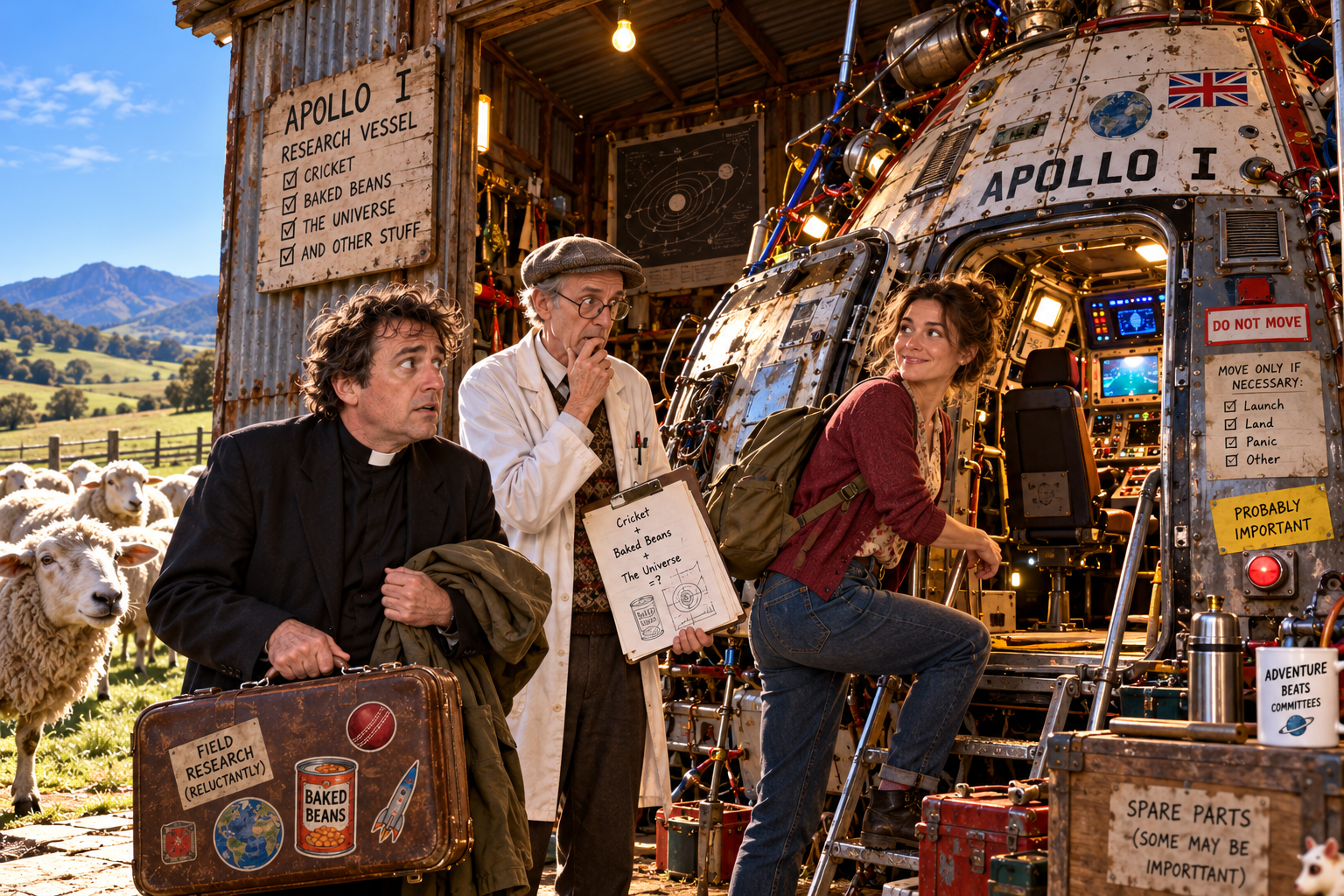
Instead we were outside Inner Cyberia beside a shed.
There were sheep.
One of them looked at me in a way I considered unnecessarily judgemental.
“Where’s the spacecraft?” I asked.
Gordon pointed at the shed.
“No.”
“Yes.”
“That’s a shed.”
“It looks like a shed.”
“It has CORRUGATED IRON on it.”
“Camouflage.”
“Against what?”
“Council inspectors.”
That made considerably more sense.
Gordon opened the doors.
Inside was a spacecraft.
I would like to describe it accurately.
I can’t.
Partly because I am a priest and not an engineer.
Mostly because Gordon seemed to have designed it during several unrelated periods of enthusiasm.
Bits of it were smooth and futuristic.
Other bits looked as though they had been purchased from an electrical wholesaler on a Friday afternoon.
There were lights.
Screens.
Switches.
Dials.
A lever marked DO NOT MOVE.
Another marked MOVE ONLY IF NECESSARY.
And one small switch labelled:
PROBABLY IMPORTANT
Belinda climbed aboard.
“It’s bigger inside.”
Gordon smiled.
“Yes.”
I remained outside.
“No.”
Belinda leaned back through the hatch.
“Oh, come on.”
“No.”
“You’ve travelled further for worse reasons.”
“Name one.”
“France.”
Fair point.
Gordon stood beside me.
“You’ll enjoy it.”
“Have you ever noticed that everybody who says that is standing somewhere safe?”
He climbed aboard.
I looked at the field.
The sheep.
The blue sky.
Inner Cyberia.
Earth.
Earth had faults.
Quite a few.
It contained bishops.
Committees.
Television advertising.
Religious conferences.
People who stopped suddenly in supermarket aisles.
But it had gravity.
I was very fond of gravity.
“Sandy!” Belinda called.
I climbed aboard.
The hatch closed behind me.
I immediately wanted it open again.
Gordon sat at the controls.
Belinda was beside him.
I was strapped into something which resembled an airline seat designed by a chiropractor with a grievance.
“Where are we going?”
Gordon checked several instruments.
“Initially?”
I disliked that word.
“Yes. Initially.”
“The Moon.”
I relaxed slightly.
“The Moon?”
“Yes.”
“That’s not too bad.”
“It’s quite close.”
“Exactly.”
“Relatively.”
I stopped relaxing.
“How relatively?”
Gordon flicked a switch.
Something deep beneath us began to hum.
“Gordon.”
“Yes?”
“One final question.”
“All right.”
“Have you done this before?”
He thought about it.
“With this spacecraft?”
“Yes.”
“No.”
I reached for the straps.
Belinda was already tightening hers.
“Gordon.”
“Yes?”
“Why is this called Apollo Mission One?”
He smiled.
“Tradition.”
“Whose?”
“Yours.”
The humming became a roar.
The shed disappeared.
The field disappeared.
The sheep disappeared.
For one remarkable moment I could see the entire curve of the Earth beneath us.
Blue.
White.
Beautiful.
Silent.
I forgot Billy.
I forgot baked beans.
I forgot cricket.
I forgot that the man at the controls was an interdimensional postgraduate student who had never flown his own spacecraft before.
I simply stared.
Belinda took my hand.
Neither of us said anything.
Then Gordon looked at the instrument panel.
“Oh.”
I turned slowly.
“What does ‘oh’ mean?”
“Probably nothing.”
A red light began flashing.
PROBABLY IMPORTANT
I looked at Gordon.
He looked at me.
Belinda looked at both of us.
And somewhere behind the wall, something said:
“Good afternoon.”
I froze.
“Gordon.”
“Yes?”
“Who was that?”
Gordon smiled nervously.
“Ah.”
The voice spoke again.
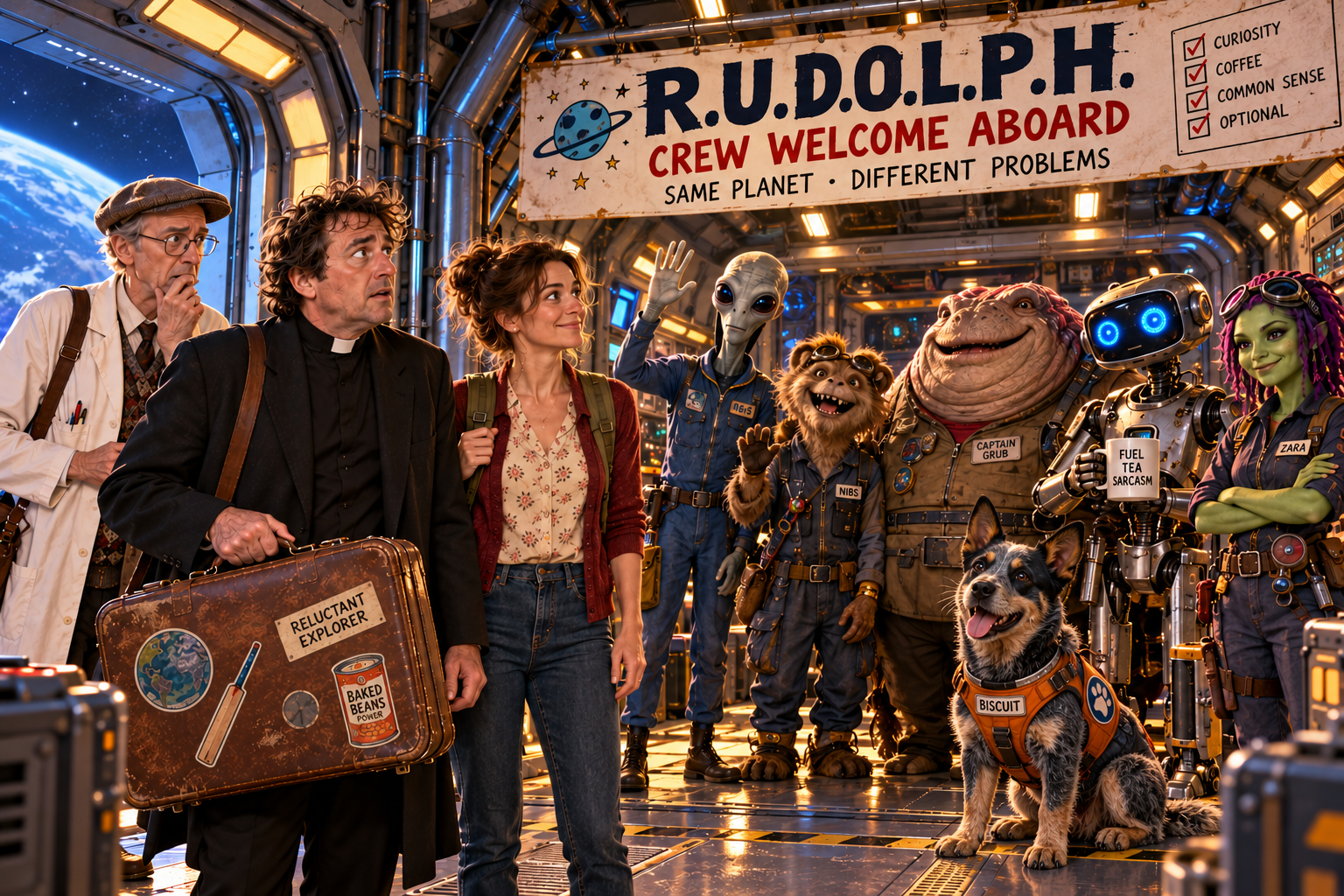
“Would the new passengers like to meet the crew?”
I looked out at the Earth rapidly getting smaller behind us.
Then at Gordon.
Then at Belinda.
Then at the wall.
Apparently we had a crew.
Nobody had mentioned a crew.
And that was how Apollo Mission One began.
Not with one small step for man.
Not with the triumph of human exploration.
But with me strapped into a spacecraft built by God while travelling towards the Moon to count baked beans.
In retrospect, the warning signs were quite clear.

Good Luck With That – Space Travel and How Boring It Really Is

02 Friday Oct 2026

Posted by Mark in Mark

≈ Leave a comment

Tags

books, fiction, Gordon O'Donnell (GOD), humour, Life, short story, writing

RUDOLPH — Relativistic Universal Dimensional Operations, Logistics, Propulsion & Habitat

GOOD LUCK WITH THAT
Space Travel and How Boring It Really Is


Episode One — The Beginning of Time, More or Less


I was staring out the window when I suddenly realised that the window was staring at me.
This was unusual, even by the standards of Rudolph.


Rudolph had opinions about most things. He disliked parking, distrusted comets and had once refused to enter a wormhole because, in his words, “it looked damp.” But until that moment I had not known he was capable of judging me through reinforced neuroplastic transparency.


“You’ve been looking at the same star for forty-three minutes,” said Nick.
Nick was the ship’s SANTA — Sub Atomic Neuroleptic Transparent Android — which was the sort of acronym people invent when they have far too much intelligence and absolutely no adult supervision.
“I’m thinking.”
“You are sulking.”
“I am contemplating existence.”
“You are sulking about existence.”
There was no point arguing with a navigation computer that could calculate six million routes across four dimensions and still remember where you had left your socks.


Outside the window, space continued.
It did this very well.
Space is often described as vast, majestic, awe-inspiring and full of wonders.
This is because the people describing it are usually standing on a planet.
From inside a spaceship, space is mostly black.
Occasionally something twinkles.
Very occasionally something explodes.
The rest of the time it is the astronomical equivalent of waiting for a bus that is three light-years late.


I am Gordon O’Donnell.
Initials G.O.D.
Yes, I know.
No, I didn’t choose them.
My parents did.
They thought it was funny.
My parents were academics.
Academics should not be allowed to name children.
I came from Meup, a perfectly respectable planet orbiting the sun Star T.
Star T. Meup.
Again, not my fault.
I grew up on the island of Never Stop, whose capital city was Running Hot, beside the broad and unnecessarily dramatic river Grown Men Cry.
If these names sound suspiciously familiar, there is a reason.
Many years later, on a small blue planet in a minor galaxy, I met a musician called Mick. We drank. We talked. I told him about home.
Some time afterwards he released a song.
There are moments in life when one learns something important about copyright.


Meup was old.
Very old.
So old that mountains had retirement plans.
Its oceans had been there long enough to become cynical.
The sky was a deep violet in summer and a slightly annoyed mauve in winter. Great silver forests covered the northern continents, their leaves turning to face the twin magnetic poles every afternoon with a faint metallic hiss, like billions of teaspoons being rearranged in a drawer.
People on Meup did not hurry.
There was little point.
We lived, for practical purposes, forever.
Accidents happened, of course. Falling masonry remained surprisingly committed to tradition. But age itself was considered more of a scheduling issue than a terminal condition.
I entered university when I was five hundred and twelve.
My mother cried.
My father said I was too young.
My grandmother said she had always suspected I was impulsive.
The University of Meup was built on a plateau above Never Stop, overlooking the river and, on clear days, the King’s Dome on Heaven.
Heaven was our moon.
The King’s Dome was the largest cricket ground in our part of the dimension.
This caused considerable confusion among later civilisations, particularly after several of my early translations were copied badly.
People began talking about the Kingdom of Heaven.
Close enough.
The Dome itself seated two hundred thousand people, although crowds of three hundred thousand were common because Meupian mathematics had a relaxed attitude to fire regulations.
Cricket mattered on Meup.
Religion came and went.
Empires rose and fell.
Entire branches of theoretical physics were disproved before lunch.
But cricket remained.
The final of the Inter-Island Test Championship could stop wars.
Usually because both armies wanted to watch it.


I studied Astrophysics 101 under Professors T.D. Schnitzel, C. Chips and G. Salad.
They were serious people.
This was unfortunate.
My classmates were Gees Ass and Holly Ghost.
We were not serious people.
This was also unfortunate.
Our first major assessment was to create a universe.
Nothing elaborate.
Just matter, energy, space, time, a few laws of physics and enough uncertainty to keep future scientists employed.
We were given a black box.
Later it became a shoebox.
University budgets are mysterious things.
Into the box we introduced a compressed singularity, three contradictory equations, a jar of dark matter and something Gees Ass found in the back of a laboratory refrigerator.
There was a flash.
Then another flash.
Then an expanding cloud of incandescent matter began producing galaxies at an alarming rate.
Professor Schnitzel looked inside.
“Promising,” he said.
Professor Chips adjusted his glasses.
“Untidy.”
Professor Salad asked whether we had filled in the risk assessment.
We had not.
Thus began the universe.
Not with a divine command.
Not with cosmic intention.
Not even with a particularly good plan.
It began because three students were trying to pass a subject.


For several million of your years we forgot about it.
This is easier than it sounds.
Universes are very small from the outside.
Eventually I checked the box and discovered that planets had formed.
Some had life.
One had developed cricket.
This changed everything.
I leaned closer.
Tiny creatures in white clothing were standing on a green field, hitting a red ball with pieces of wood.
I called Gees Ass.
I called Holly Ghost.
We watched for six hours.
Professor Salad found us.
“What are you doing?”
“Research.”

He stared into the box.
A batter drove through cover.
Professor Salad sat down.
My thesis was approved the following morning.
Cricket in the Milky Way.
There remained one difficulty.
I had to go there.
You cannot simply step into a universe you have created.
Scale becomes a problem.
Also gravity.
Also exploding.
So the university constructed the Schnitzeliser, a machine designed to reduce a Meupian body to a size compatible with the internal dimensions of the experiment.
Professor Schnitzel assured me it was safe.
Professor Chips said, “Probably.”
Professor Salad left the room.
I regarded this as a mixed review.


Then came Rudolph.
Built by the Reindeer Company of Meup, he was silver, sharp-nosed and vastly over-engineered, with a sub-atomic wind drive, dimensional transit core, observation dome, cricket bay and a forward sensor array contained inside a glowing red nose.
The nose was not decorative.
It glowed because of relativistic particle compression.
The fact that it also made the ship look like a festive animal was, according to the engineers, “an unfortunate branding convergence”.


Nick(a.k.a SANTA) came with the ship.
He appeared as a translucent blue figure when he felt theatrical, which was often.
“Destination?” he asked.
I looked down at the little universe in its box.
Somewhere inside it, stars burned.
Planets turned.
Civilisations argued.
And on one particular planet, eleven men had just appealed for leg before wicket.
“Earth,” I said.
Nick paused.
“Good luck with that.”
The Schnitzeliser began to hum.
Rudolph’s red nose lit.
The laboratory stretched away from me.
Or perhaps I fell into it.
There was a moment of extraordinary light, followed by a noise like the universe clearing its throat.
Then silence.
Real silence.
Space silence.
The sort of silence that makes you aware of your own heartbeat and immediately suspicious of it.
I opened my eyes.
Ahead lay billions of stars.
Behind me lay another dimension.
Nick appeared beside the console.
“Well,” he said.
“Well what?”
“You wanted space travel.”
“Yes.”
He gestured towards the window.
“There it is.”
I stared.
For ten minutes nothing happened.
Then twenty.
Then thirty.
A tiny star moved slightly to the left.
I began to understand something nobody had mentioned in the university brochure.
Space travel was going to be incredibly boring.
The window stared back at me.
And, this time, I was fairly certain it was laughing.

Further O’Way

21 Monday Sep 2026

Posted by Mark in Mark

≈ Leave a comment

Tags

Art, Bali, books, China, Father O'Way, Gordon O'Donnell (GOD), humour, Lords, Lourdes, photography, travel

What me worry, I'm on a mission from GO'D.
What, me worry, I’m on a misson from GO’D.

A Place For Us—A melancholy musical episodic intro to the Father O’Way Chronicles

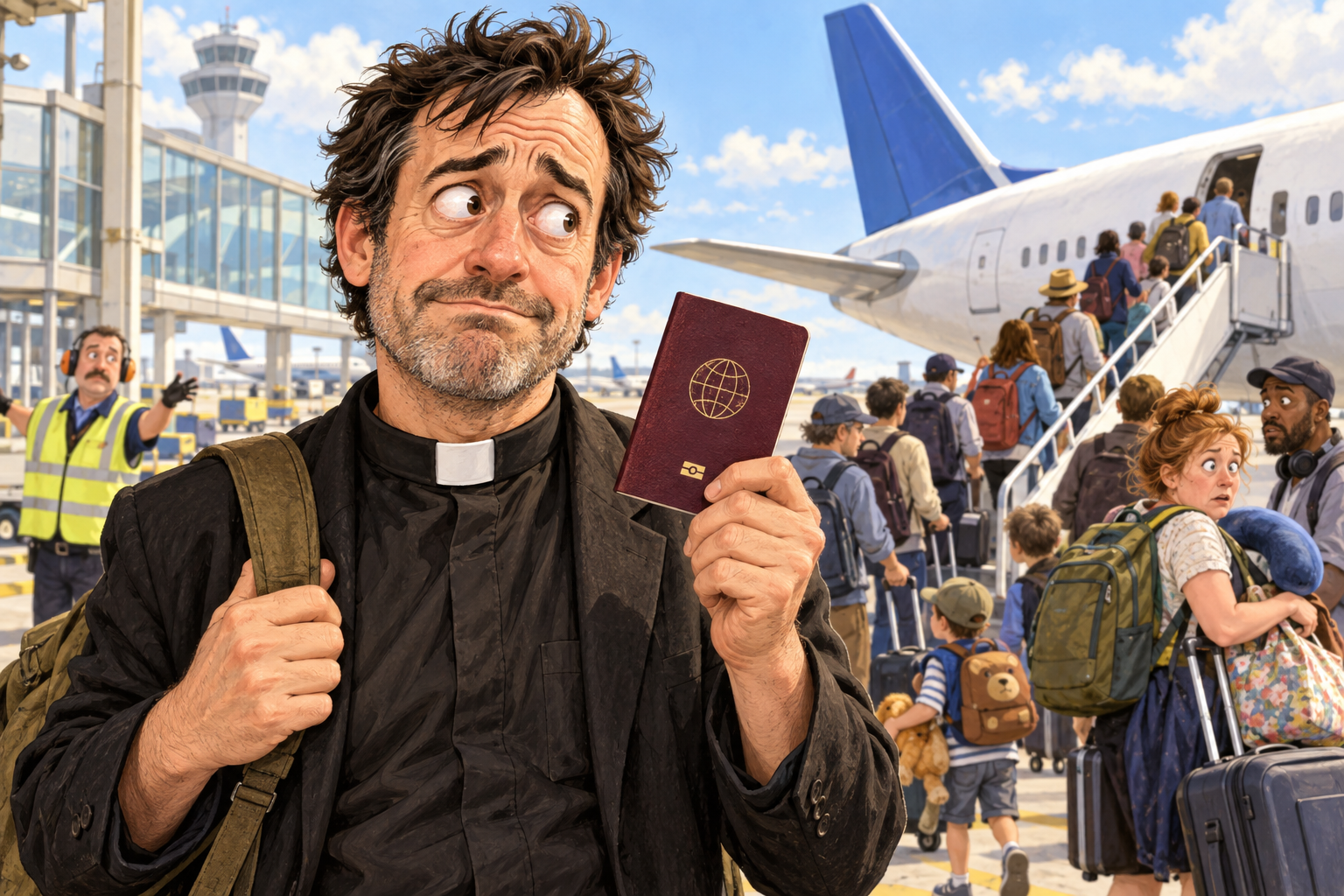
Owning a passport was the worst mistake I ever made.

At the time it seemed harmless.

A small blue booklet.

Photograph.

Date of birth.

Several pages apparently provided so that foreign governments could record the precise order in which I made a fool of myself.

I kept it in a drawer at St Generic Brand and thought no more about it.

Then Billy became Bishop Bishop.

Promotion did not improve him.

It gave him a larger office, a secretary who disliked him professionally, and access to a drinks cabinet he regarded as a sacrament.

The Bish had also taken up herbal medicine.

At least that was what he called it.

I called it smoking dope with the window open.

One afternoon I was summoned to the diocesan offices.

Billy was behind an enormous desk wearing purple robes and holding a glass containing something the colour of furniture polish.

A thin cloud hung above him.

“Incense?” I asked.

“Medicinal.”

“What’s wrong with you?”

“Administration.”

Fair enough.

He poured me a drink.

I declined.

He looked hurt and poured it for himself.

“Sandy, how would you like to travel?”

“I wouldn’t.”

“Excellent.”

Billy had retained an irritating habit from childhood of interpreting any answer he disliked as agreement.

“The Pig’s Arms needs a foreign correspondent.”

“Why?”

“Merv says international affairs are becoming important.”

“Merv is a barman.”

“He has a television.”

This was apparently sufficient qualification.

I knew the Pig’s Arms well. Officially it was the Window Dresser’s Arms Pig and Whistle, but language exists to communicate efficiently and life is too short.

“What does this have to do with me?”

Billy opened a folder.

Inside was a photocopy of my passport.

I stared at it.

“How did you get that?”

“God moves in mysterious ways.”

“You took it from my desk.”

“Mostly through unlocked drawers.”

“I’m not a journalist.”

“You can write.”

“I can write sermons.”

“No one reads those either.”

He had me there.

Billy pushed an airline ticket across the desk.

“Kerobokan.”

“Where?”

“Barley.”

“Bali?”

“That too.”

“What am I supposed to do?”

“There’s an Australian woman in jail. Shappy Corebee.”

“For what?”

“Smuggling thugs.”

“Drugs.”

“That’s what I said.”

“No, you said thugs.”

Billy looked at the file.

“Either way, Australia has plenty. Get her out.”

“And if I don’t?”

“You’re fired.”

“You can’t fire me.”

“I’m a bishop.”

“That doesn’t answer the question.”

“It usually does.”

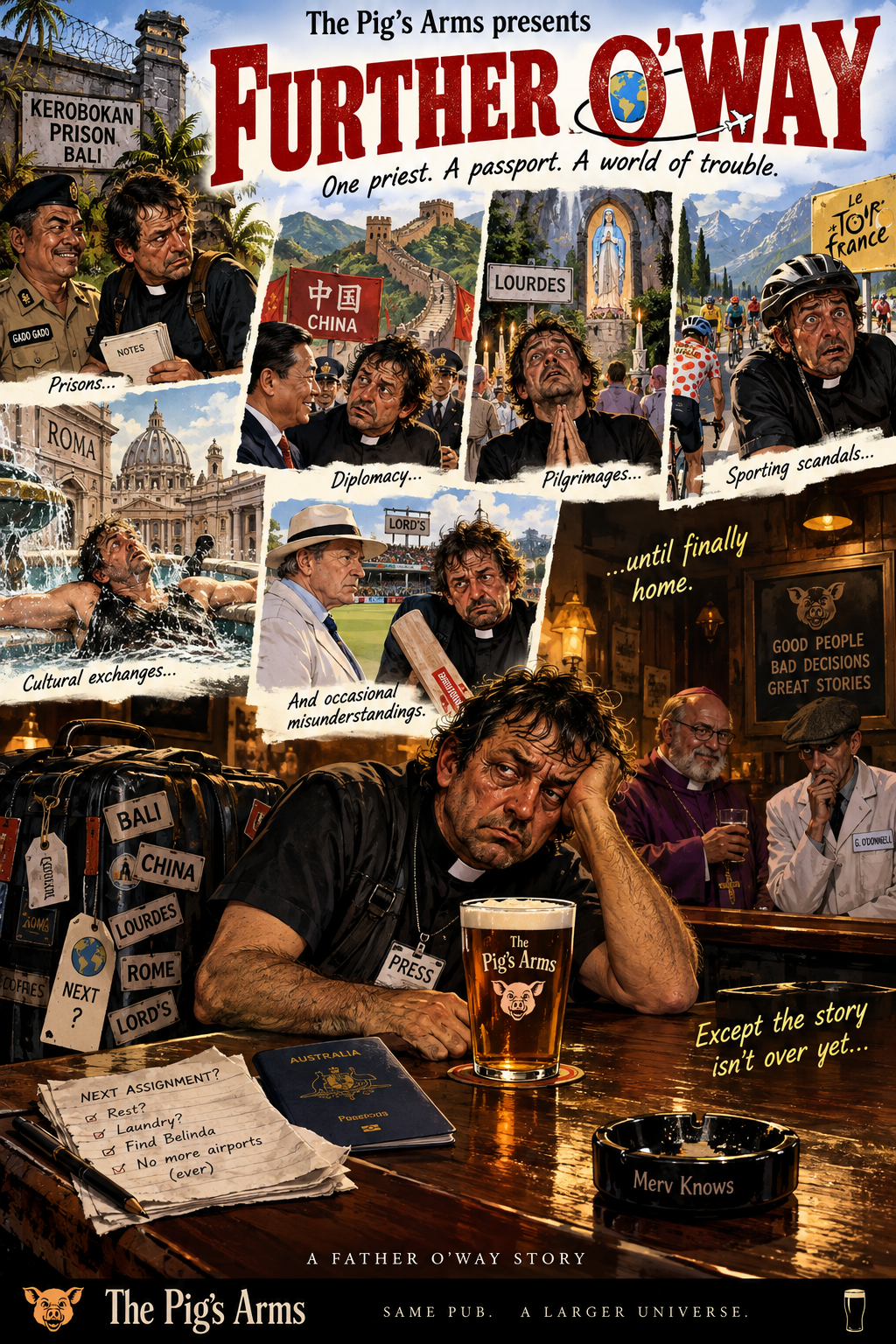
And that was how the international career of Father Alexander Leonard Lyndhurst O’Way began.

Not with a calling.

Not with a revelation.

With a return economy ticket and a threat to my accommodation.

• • •

Barley was an island in Donesia.

Donesia had once been voted one of the most corrupt countries in the world, narrowly defeating several sporting organisations and a municipal planning department.

I landed at Nazi Goering Airport.

[Author: Sandy.]

[Sandy: What?]

[Author: You know perfectly well what.]

[Sandy: It was called that in the original.]

[Author: Carry on. I’m merely establishing an alibi.]

My instructions from the Bish gave me the names of two private investigators.

Beef Satay and his brother Chicken.

Their office was above a restaurant.

This caused confusion at lunchtime.

Beef was short and serious.

Chicken was taller and nervous.

Both came with peanut sauce.

“The Bish says you know the island,” I said.

Beef nodded.

“We know everybody.”

“Good. I need information about the prison.”

“We can get information.”

“Excellent.”

“Cost extra.”

Naturally.

The following morning Beef telephoned my hotel.

“We have uncovered high-level criminal activity, hookers, corrupt officials, money changing hands and inappropriate reporting procedures.”

“Beef, I asked you to investigate the prison, not an Australian trade union.”

There was silence.

“Ah.”

“Anything useful?”

“The governor likes money.”

“That’s hardly intelligence.”

“In Donesia it is a national philosophy.”

Eventually I arranged to meet the prison governor, Berguling Gado Gado.

His secretary answered the telephone.

“Name?”

“O’Way. Sandy O’Way.”

“Thank you, O’Way Sandy O’Way.”

“No. Just Sandy O’Way.”

“Very good, Just Sandy O’Way.”

“No, my name isn’t Just—”

I stopped.

Experience has taught me there are moments when language becomes a hole and the wisest course is not to continue digging.

Governor Gado Gado greeted me warmly.

I decided to get straight to the point.

“Governor, what would it take to have Shappy released?”

“Certainly.”

That was easier than expected.

He opened a diary.

“I can offer 27 July 1965, 8 February 1982 or 1 August 2003.”

I stared at him.

“Those dates have already happened.”

“Yes.”

“She wasn’t in prison then.”

“Correct.”

“So how can you release her?”

He smiled.

“You asked for a release date. You did not specify future.”

This was my first serious exposure to international diplomacy.

I began to understand why wars lasted so long.

We negotiated.

I pleaded.

I threatened ecclesiastical consequences, which impressed neither of us.

Finally Gado Gado leaned across the desk.

“You are priest?”

“Administratively.”

“You believe in God?”

“No.”

He blinked.

“Then why priest?”

“Accommodation.”

He considered this.

“Very sensible.”

We had found common ground.

Shappy was not released.

But I returned to Inner Cyberia with several jars of satay sauce, a wooden carving I could not identify and a receipt for expenses which the diocesan accountant refused to process because Beef and Chicken Satay appeared under “catering.”

Billy called the mission a success.

“Shappy’s still in jail.”

“You came back alive.”

“Is that the new standard?”

“It gives us room to improve.”

Then he handed me another ticket.

• • •

China.

Billy wanted me to interview a senior official named Hu.

“Who?”

“Exactly.”

“Who am I interviewing?”

“Hu.”

“That’s what I’m asking.”

“No, Hu is who you’re interviewing.”

“I know that. Who?”

“Hu.”

This continued for some time.

Belinda eventually entered the room carrying tea.

She listened for approximately thirty seconds.

“Would either of you like me to hit the other one?”

We stopped.

Belinda had become my housekeeper some years earlier.

Housekeeper was still technically accurate in much the same way that the Titanic was technically a form of transport.

She organised the rectory, organised me and had begun displaying disturbing signs of having opinions about my continued survival.

“You only just got back,” she said.

“I know.”

“And now you’re going to China?”

“Apparently.”

“Why?”

“Hu.”

She closed her eyes.

“Don’t.”

China went surprisingly well.

This worried me.

Whenever one of Billy’s assignments went well, it generally meant I had misunderstood the assignment.

I met Hu.

Or possibly Wu.

There were translators.

At one point seven officials conferred for ten minutes over whether I had asked about human rights or the correct way to cook noodles.

The answer I received appeared to cover both.

I filed six hundred words to the Pig’s Arms.

Merv published twenty-three of them beside the meat raffle results.

My career in international journalism was flourishing.

• • •

I had been home four days when the telephone rang.

“Sandy. Bish.”

“I recognised the slurring.”

“I need you in Lourdes.”

“France?”

“Yes.”

“Why?”

“Religious story.”

“No.”

“I’ve already booked you.”

This time I took precautions.

I wrote LOURDES — FRANCE in large letters.

I put the note in my pocket.

I checked it before leaving the rectory.

I checked it in the taxi.

Then I met a cricket enthusiast at the airport.

Several hours later I was standing outside Lord’s Cricket Ground in London.

I telephoned Billy.

“I’m at Lord’s.”

“Good.”

“There’s a match on.”

“What?”

“Cricket.”

There was a pause.

“Sandy, I sent you to Lourdes.”

“That’s where I am.”

“No. LOURDES.”

“Exactly. Lord’s.”

“In France.”

I looked at the cricket ground.

“Parts of the MCC are fairly conservative, Billy, but I don’t think they’ve actually annexed it.”

The line went quiet.

Then I heard him pouring something.

“Stay there.”

“Why?”

“Find a religious angle.”

I watched an opening batsman leave three deliveries outside off stump.

“I’ve just witnessed a man place enormous faith in something he cannot see.”

“Perfect. File six hundred words.”

Merv printed forty-one.

Progress.

• • •

The Tour de France assignment occurred because Billy had discovered package fares.

He rang while I was still in England.

“You’re already in Europe.”

“I’m already regretting Europe.”

“Tour de France.”

“I don’t own a bicycle.”

“You won’t be riding.”

“That’s the first good thing you’ve said.”

My journalistic brief was to investigate allegations that professional cyclists were using artificial means to improve performance.

I interviewed a rider.

“Do you take performance-enhancing drugs?”

“No.”

“Have you ever taken performance-enhancing drugs?”

“No.”

“Would you tell me if you had?”

“No.”

This was refreshingly efficient.

I sent the interview to Merv.

He published the final answer.

It became one of my most widely read pieces.

• • •

Rome followed.

I don’t remember agreeing to Rome.

I have subsequently come to believe Billy simply redirected my luggage.

The Vatican was hot.

Very hot.

My clerical shirt stuck to me.

I discovered that centuries of theological scholarship had failed to produce an adequate doctrine regarding perspiration.

There was a fountain.

I looked at the fountain.

The fountain looked at me.

[Author: Fountains don’t look.]

[Sandy: You weren’t there.]

[Author: Neither was the fountain, once you’d finished with it.]

The important thing is that I cooled down.

The less important thing is that a Swiss Guard objected.

The even less important thing is that somebody photographed it.

By the time I returned to my hotel, the photograph had been transmitted internationally under the headline:

AUSTRALIAN PRIEST TAKES REFRESHING APPROACH TO ROME

Billy rang.

“You’re on television.”

“Good television?”

“There is no good television involving a priest without trousers.”

“I had trousers.”

“Not according to Channel Nine.”

“They were wet.”

“That distinction has not survived editing.”

Back home, Belinda kept the newspaper clipping.

She claimed this was for legal reasons.

For several months it appeared mysteriously whenever we had guests.

• • •

My next assignment involved cricket.

This cheered me enormously.

Geoffrey Boycott was involved.

This cheered Geoffrey Boycott considerably less.

I had been sent to discuss batting.

I like batting.

Batting is one of the few activities in human civilisation where avoiding danger while somebody else does all the work is considered technically correct.

Boycott and I understood one another immediately.

He believed in occupying the crease.

I believed in occupying the rectory.

Neither of us saw any reason to leave voluntarily.

We talked for hours.

Mostly Geoffrey.

At some point a coat hanger became involved in a demonstration of the forward defensive.

There was an accident.

The headline said Boycott had been “hung up by Father O’Way.”

This was inaccurate.

He was not hung.

He was caught temporarily.

There is an important difference in both cricket and criminal law.

Billy congratulated me.

“You’re developing a profile.”

“I’m developing extradition problems.”

“Same thing in journalism.”

• • •

Between trips I came home.

Or, more accurately, I returned to Belinda’s supervision.

The rectory changed while I was away.

Belinda had moved things.

She called it cleaning.

I called it destruction of navigational landmarks.

“Where’s my blue shirt?”

“Wardrobe.”

“It was on the chair.”

“That’s why I put it in the wardrobe.”

“How am I supposed to find anything if you keep putting things where they belong?”

She stared at me.

Belinda was very good at staring.

Eventually she asked, “How long are you home this time?”

“I don’t know.”

The telephone rang.

We both looked at it.

“No,” she said.

“It might not be Billy.”

It was Billy.

“Sandy—”

“No.”

“The Oval.”

“No.”

“Cricket.”

I hesitated.

Belinda pointed at me.

“Don’t you dare.”

“What sort of cricket?”

She walked out.

This is how relationships develop.

• • •

The Oval assignment was different.

I noticed that almost immediately.

For one thing Billy’s instructions made even less sense than usual.

I was supposed to locate something called a Stat-o-matic.

“What is it?”

“No idea.”

“What does it do?”

“No idea.”

“Who wants it?”

Billy paused.

“A friend.”

This was new.

Billy’s friends generally wanted money, bail or access to the diocesan cellar.

“Which friend?”

“You’ll know him when you see him.”

This statement is universally made by people who have failed to provide useful information.

I went to the Oval.

There was cricket.

There were statistics.

There were men who could tell you the batting average of someone who had played two Tests in 1927 on Tuesdays following rain.

Eventually I found the Stat-o-matic.

Or it found me.

That part remains unclear.

And then I saw the man in the flat cap.

White laboratory coat.

Fingers near his mouth.

A face that tugged at something very old in my memory.

A Mintie wrapper.

A boy.

A conversation that could not possibly have happened.

The man smiled.

“Hello, Sandy.”

I stared at him.

“Do I know you?”

“Yes.”

“Should I?”

“Eventually.”

I disliked him immediately.

Not personally.

I simply dislike people who answer questions as though time is optional.

“You’re Billy’s friend?”

“He knows me.”

“That wasn’t the question.”

“No.”

That was somehow worse.

He took the Stat-o-matic.

“What do you want with it?”

“Research.”

“What sort?”

“Cricket.”

This was the first sensible thing he had said.

Then he added:

“And the universe.”

There it was.

I knew we’d been getting along too well.

“What’s your name?”

“Gordon.”

“Gordon what?”

“O’Donnell.”

He waited.

I did the arithmetic.

“G.O.D.”

“Yes.”

“Oh, piss off.”

Gordon smiled.

Then, in a manner I still cannot adequately explain, he did.

• • •

After that I went home.

Properly home.

Back to Inner Cyberia.

Back to St Generic Brand.

Back to Belinda.

Back to the Pig’s Arms, where Merv put a beer in front of me without asking.

I sat at the bar.

No airports.

No prisons.

No governors.

No bishops.

No bicycles.

No Swiss Guards.

No Geoffrey Boycott.

For the first time in months nobody required me to solve an international incident.

“This,” I told Merv, “is the life.”

Merv polished a glass.

“You reckon?”

“I am never leaving Inner Cyberia again.”

“Fair enough.”

“I mean it.”

“Good.”

“I’ve travelled enough.”

“Right.”

“I’ve seen the world.”

“Yep.”

“I’m staying home.”

Merv looked towards the door.

“Oh dear.”

“What?”

Bishop Bishop had just walked in.

He was followed by Gordon.

Billy looked delighted.

Gordon looked worried.

Gordon always looked worried.

Billy sat beside me and ordered a whisky.

Gordon declined one, accepted tea, changed his mind and asked for a whisky.

I looked from one to the other.

“No.”

Neither had spoken.

“I don’t care what it is. No.”

Billy grinned.

“Sandy, I’d like you to meet an old friend of mine.”

“We’ve met.”

Gordon nodded.

“At the Oval.”

“Unfortunately.”

Billy looked surprised.

Then pleased.

“Excellent. Saves time.”

“Billy, whatever you are about to ask me—”

“I’m not asking.”

“Even better.”

“Gordon is.”

I looked at Gordon.

Gordon put his fingers to his mouth.

“I need someone to do some field work.”

“No.”

“You haven’t heard where.”

“I’ve learned from experience.”

Gordon glanced upward.

Not towards Heaven.

Further.

Much further.

I followed his eyes.

Then I looked at Billy.

Then at the whisky.

Then back at Gordon.

“Absolutely not.”

Gordon smiled.

Billy raised his glass.

And Merv, who had been listening to the entire conversation, quietly put another beer in front of me.

I should have taken that as a warning.

Because after Kerobokan, China, England, France and Rome, Bishop Bishop had finally found somewhere further O’Way to send me.

Space.

The Restless Booksearcher (number 3)

30 Thursday Jun 2011

Posted by gerard oosterman in Gerard Oosterman

≈ 15 Comments

Tags

books

The wandering book searcher had in the meantime surveyed the rag-tag of books on the shelving. He cast his eyes over the titles, holding his head askew this way and that way trying to read as much as was still visible on the torn covers. He munched approvingly on his rotating burger which was now almost eaten to its core.

His usual modus operandi was to exchange his quarry inside the back-pack for any unread ones. He mainly succeeded in that, especially if he traded two books for just one.  Depending on his limited finance he would just sometimes buy a book, a reckless splurge of the moment which so far he had never regretted.  His need for books was till now still unrequited dating back to childhood, deprived of letters and words printed on pages by an uncaring culture and not made better by a bookless neighbourhood. He would never fill the void but made up the deficit as good and as diligently that he was still capable of. He was lucky to have been taught reading in the first place. He knew that if he was to catch up with books and the reading of them he could never waste time working for a living and money. He wanted to understand more of the world that he lived in. Time was of the essence, and because of that he could not afford wasting time in working for anything, let alone just money whose value could never be read.

His reading skill had been installed when very young and in a far away country of which he still had some vague memories. He also remembered fondly that a distant uncle, rumoured to have emerged from a Tsarist Russian background and nobility, had taught him to play the mouth organ. He now had a small ‘Hohner’ organ with a button on the side for half-notes. His early childhood training had stood him in good stead despite the deprivations later when circumstance had transferred him to the relenlessly hot and dusty world he now resided in. When he arrived at a place that, through no intent of him, featured a market he would put down his belongings, told Bluey to ‘sit’ and start to play his mouth organ. He would only play long enough for people to provide him with enough coins for some future food and a frayed but un-read book.  He knew that by following a certain repertoire the coins would be dropped in his hat, especially during his playing of the very popular ‘When the Saints come marching in’. The combination of the music with Bluey’s mournful looking eyes, cast upwards towards the audience; many would not walk past without chucking a couple of pennies.

When the hamburger had finally been eaten and the last of the tea been squeezed and scored from the tea bag our searcher stood up and paid for the food including a couple of Spam-ham  cans, making sure the cans still had the keys attached at the top.  He already knew that there was yet an unread book on the shelves that he badly wanted. He took a book from his back-pack. It was a well thumped ‘The Brothers Karamazov’. He asked the large breasted shop-owner if he could swap this for the maroon coloured hard cover book on the top shelve. He also offered to top his offer up with a tuppence coin. She agreed and offered him the use of the outhouse for a shower; that’s if you want to shower, she asked?  He, for a split second thought there was something in the furtive way she looked sideways as she made the offer, away from his open gaze.

She knew the rule for wanderers with swags and cattle dogs. Itinerants, ringbarkers, fencers and shearers, they were the ones that she still managed to eke a living from. Some she befriended and even loved for a night or so, snatched away from the uncompromising hard fist of an otherwise solitary life, a life not unlike those that she sold her wares to. She hardly remembered her husband who had vanished without a grunt of a good-bye years ago. A hopeless drunk of piss-pot, he was. That’s the most she recalled. Her solemn but generous giving of relief to the itinerant wanderers and flotsam of those on endless dirt roads cut both ways and she preferred that to her previous marital mishap. Besides, it did give her business a chance to limp on.

To be continued.

Bee Boxes and Dove Tails

23 Tuesday Nov 2010

Posted by gerard oosterman in Gerard Oosterman

≈ 18 Comments

Tags

books, dove tails


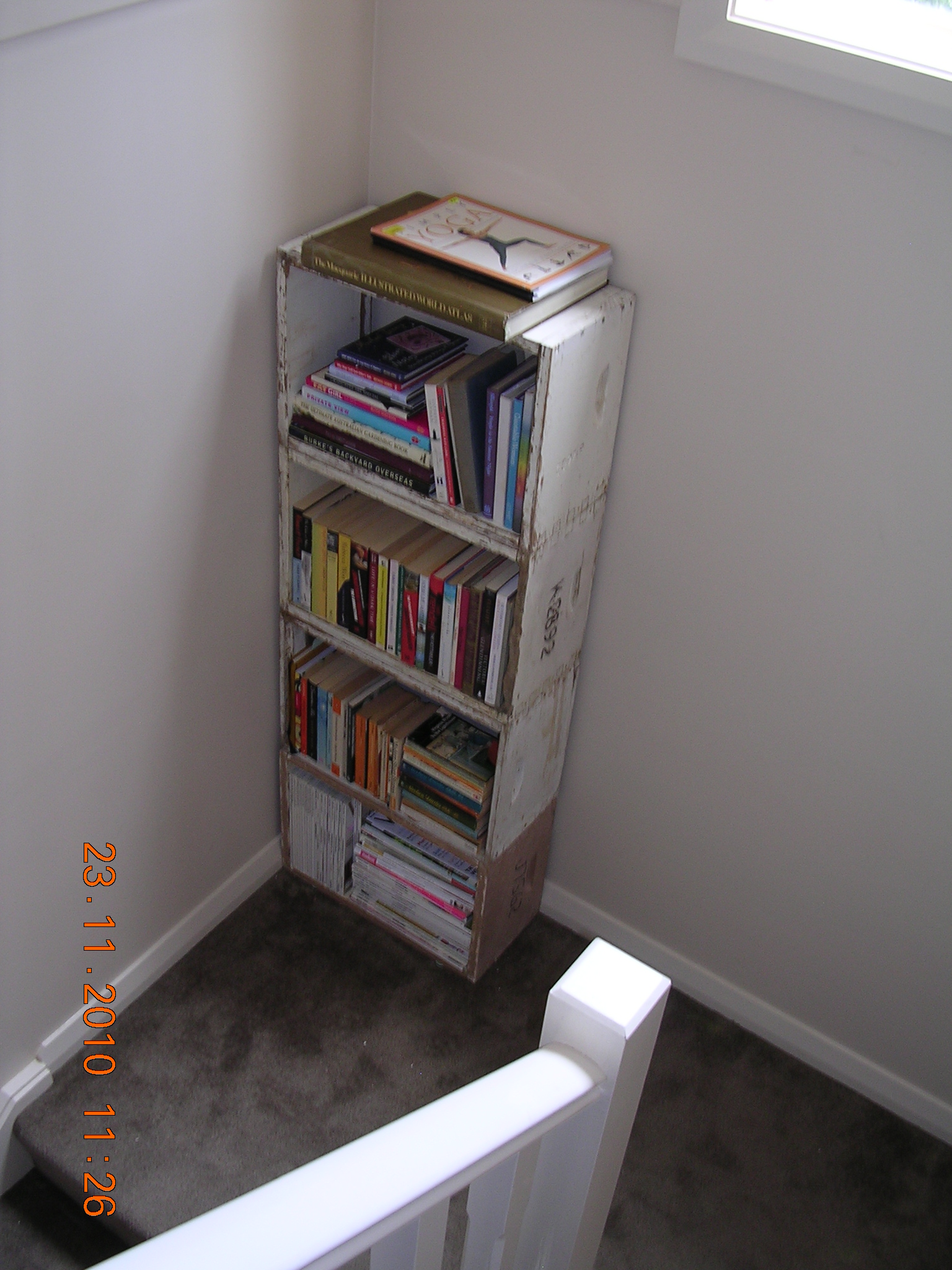
The plight of adequate shelving inside homes is generally solved by buying shelving from shops. I will never understand architecture that supplies multitude toilets but no shelving. We, after our move from a place where the owner had installed so many shelving one could almost have sub-let to small Turkish families all the space taken up by it. Acres of book shelves!

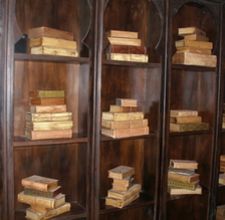
After initially storing most of our books in milk crates, finally got some second hand antique bookshelves. Take the antique with a grain of salt, merely some dark stain applied to a light coloured background giving an aged look where perhaps only about thirty years might have passed. None the less, many books were hopefully shelved on those during its history and I have no reason to believe that only Car magazines or Playboys ever adorned those wooden surfaces. Here and there an attempt at patching the framework showed up, further proof that they had been used and that at least some time had passed.  This is a great consolation and a good omen when buying book shelves.

After many hours by Helvi of unpacking the milk crates, many books now found a more substantial, and hopefully final resting place. The milk crates were also a remnant of past history when I used to roam the Inner West, at the crack of dawn, for milk crates when I was making home brew beer in the garage.

The space for books on those shelves was still somewhat scarce and we went for another hunt. This time we drove again to ‘Dirty Jane’ where we had secured the previous shelving.

I noticed a couple of boxes that had a ticket written and pinned to them, ‘bee boxes, and kauri pine’ and ‘dove tailed’, thirty dollars each. I suppose, the bees, not in their wildest dreams, could ever have thought that their homes would end up shelving books. There you have it though. No more honey just books.

Of Proust and Penguins

19 Saturday Sep 2009

Posted by gerard oosterman in Helvi Oosterman, Ladies Lounge, The Public Bar

≈ 35 Comments

Tags

books, Herman Hesse, moving, Patric White

By Helvi Oosterman.

I’m standing in front of our floor to ceiling book cases and I don’t know where to start my weeding; we are moving to a smaller place and I have to select which books to take and which not. I have three milk crates on the table: one for daughter, one for charity and one for the cottage. The ones I want to keep can stay until we actually move.

I take books out at random. ‘The End of Certainty’ by Paul Kelly is the first one. It was a birthday present from Allan, who passed away far too young at fifty. His beautiful hand writing makes me choke at the loss of a dear friend and I want to keep the book. ‘In the box’, says the boss who hasn’t even read it. The next one happens to be a slim volume by Marguerite Duras, a French writer who used live in Vietnam when it was still Indo-China. I start reading ‘Practicalities’; beautiful short essays about life, love, writing, Paris and wasting time. I feel I’m not wasting a minute re-reading this and not sticking to the task at hand: I have to keep this one;  it’s only a slip of a book.

On the bottom shelf, out of sight are my yearly diet books; I have bought one every January, new year, new me. Easy goodbyes to all; from Atkins to Scarsdale to South Beach. I count only seven;  many of them have already left the house to end up fattening girl friends’ book shelves. Then I pick a stack of yellowed old Penguins, Mishima, Kawabata, Hermann Hesse and Böll, which have escaped the previous throw-out. They are like very old friends now;   I put them back on the shelf.

I’m not doing too well, and I decide to take a break and walk to check the cottage collection. I find that most of them are results of previous culls, books that I had not chosen myself. Even so I managed to bring back an armful: a book on Finnish art, a long lost one of V.S. Naipaul and ‘By Way of Sainte-Beuve’ by Marcel Proust.

I have spent some hours by now and not much to show for; maybe the best thing to do is to tackle one shelf daily until the job is done. We have time;  we haven’t even put the house on the market yet. Husband walks by and looks at the empty boxes, he can see that I’m getting a headache and am close to tears: Maybe I can help tomorrow? This is not what I want;  he’ll only leave his Patrick Whites and some boring stories about Aussies migrating to Paraguay and maybe George Perec’ s  ‘Life, the User’s Manual’. ‘You can help with the cook books and the gardening ones’, I say as I have already promised to give them to family members; I have enough recipes in my head by now and my new garden will  be very small.

Oh no, I have totally forgotten about dictionaries and other language and reference books in the office and all my favorites in the bed room!

Patrons Posts

  • Apollo Mission 1 October 5, 2026
  • Good Luck With That – Space Travel and How Boring It Really Is October 2, 2026
  • Further O’Way September 21, 2026
  • The Middle Ages September 15, 2026
  • The Early Days September 14, 2026
  • One More Mile August 31, 2026
  • God versus Satan August 24, 2026
  • Man on the Street August 21, 2026
  • Gordon blinds Foodge with science. August 18, 2026

We've been hit...

  • 870,557 times

Blogroll

  • atomou the Greek philosopher and the ancient Greek stage
  • Crikey
  • Gerard & Helvi Oosterman
  • Hello World Walk along with Me
  • Hungs World
  • Lehan Winifred Ramsay
  • Neville Cole
  • Politics 101
  • Sandshoe
  • the political sword

We've been hit...

  • 870,557 times

Patrons Posts

  • Apollo Mission 1 October 5, 2026
  • Good Luck With That – Space Travel and How Boring It Really Is October 2, 2026
  • Further O’Way September 21, 2026
  • The Middle Ages September 15, 2026
  • The Early Days September 14, 2026
  • One More Mile August 31, 2026
  • God versus Satan August 24, 2026
  • Man on the Street August 21, 2026
  • Gordon blinds Foodge with science. August 18, 2026

Enter your email address to subscribe to this blog and receive notifications of new posts by email.

Join 372 other subscribers

Rooms athe Pigs Arms

The Old Stuff

  • RSS - Posts
  • RSS - Comments

Enter your email address to subscribe to this blog and receive notifications of new posts by email.

Join 372 other subscribers

Archives

Website Powered by WordPress.com.

  • Subscribe Subscribed
    Window Dresser's Arms, Pig & Whistle
    Join 278 other subscribers

    Have a WordPress.com account? Log in now.

  • Window Dresser's Arms, Pig & Whistle
    View site in Reader
    Manage subscriptionsSign upLog in
    Report this content
    Collapse this bar
Loading Comments...