
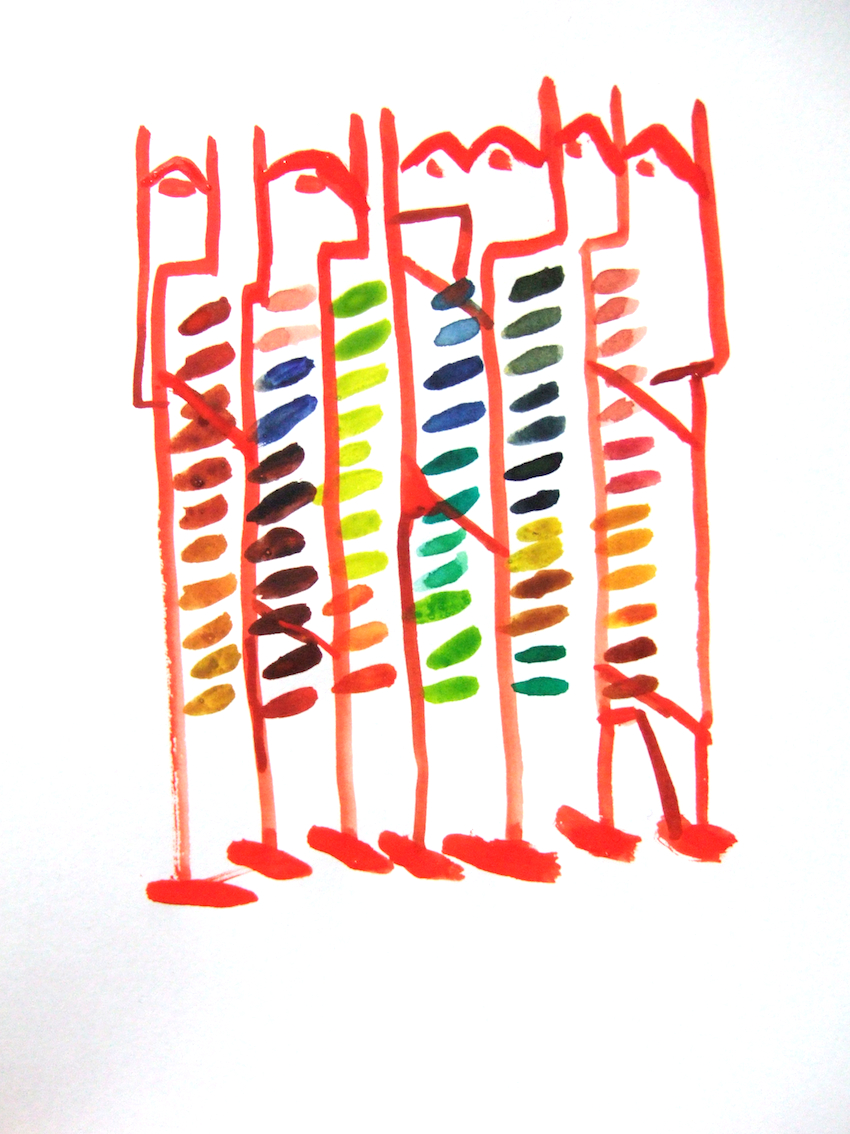
Genomino
Story and painting by the Pig’s Arms Osaka Correspondent – Lehan Winifred Ramsay
Recently I read in The Washington Post an article called “Walking Wounded: 20 genes down and still good to go”. It described a research project on human genetics that is being developed by 50 scientists around the world. What caught my eye was the comparison made between this genetic code and language.
The researchers described the genetic material (the human genome) as “our species 3-billion letter instruction manual for self.” Which has an attractive resonance for me, a person with little knowledge of biology but an interest in manuals. In the study, the article said, the researchers “carefully read a book – an individual’s genome – in which some of the sentences – a single gene – have suffered a typographical catastrophe. Words have been changed, or whole phrases have been dropped. Whatever the cause, the result is a sentence that no longer makes sense.”
The researchers point out that the absence of genetic material appears to be as important as the presence of material. Perhaps then, rather than the result being “a sentence that no longer makes sense”, it would be more accurate to say “the result is a sentence that no longer makes the same sense.” A sentence that does not make the same sense still has something to tell us.
I found myself thinking a lot about this. Do these researchers really feel a strong correlation between the genome and language, or is this merely a way of making the subject easier for us to understand? I’m fascinated with the possibility that there is some connection between the genome and the development of language; that we may be involved in a long process of finding the words to describe our selves as a mirror describes our that the compulsion to develop language itself may have been for this very reason – but I can’t tell if this is what these researchers mean, and it might simply be my own flight of fancy. No doubt their mission is not to compare our genes to our words; an instruction manual can have many uses, and they have not explained what they mean to use it for. To make one…to fix one…to search for one…or to just own the manual. To input that “manual” into a computer and have a painting come out?
It is my first day back in Japan, after an absence of nine months. I had only limited reasons to speak to people yesterday, and I have been wondering what effect the absence of the language would have had on my ability. Today I had some challenging negotiations, for phones and contracts and rearranged delivery schedules. I had been expecting that I would have lost vocabulary, but there was not one time that I struggled to find a word. Or even struggled. The words were fine, but what I had to say was very rough. Listening to people explain things I noticed I was having more trouble with nuance and meaning; with “common sense”.
It was more a problem with why things were as they were. Why did I need a phone number to get a phone number, when my reason for getting one was that I did not have one? Because it was a dilemma that Japanese people were unlikely to have, with an unbroken existence in Japan, and therefore not an unreasonable request for a Japanese person. And why were those celebrities on the television commercial for the mobile phone running, only running, during the commercial, and would I have found that as baffling before I left?
When people on the phone requested information from a form, why did they ask for it in a different order to the form itself? Seeing it was their form, wouldn’t it make sense to have the information in the order it was needed? I seem to be having a cultural disorder….I know how things should work but it still takes some to put the pieces together so that they make sense. Anyway, big cities have complex repetitions; the trains, for example, are numbers of networks laid over each other, each with their own ticketing and movements, and it is at first difficult to separate one network from the others. But I am accustomed to adjusting, and my cultural dis-order will neaten itself within a few sleeps.
I am reminded of when I was five and the words in a book suddenly flipped and became reading. Has that happened to our friends the researchers, or is that what they are working on still. Why hasn’t it happened to me? Is this what I must do; sift through the words, understand how they work, identify the errors, and wait for the repetitions? For recognition to catch my eye, as it has my ear.
I want to know how reading works. This is a culture that prefers its foreign languages in reading. A culture with an extremely complex and difficult system for reading. Reading is assumption, because when we begin reading we do not understand all the words, all the sentences. But if each gene is a sentence, in language a sentence contains many genes. I could imagine researchers here taking that same 3-billion genes and coming up with a very different reading, an instruction manual with its own internal logic that disagreed with many of the assumptions of the other. Still, authorship is ownership; they would have quite a battle to make even the simplest changes. Perhaps the essence of this research is: who will be authority with the right to read our genes.
 Window Dresser's Arms, Pig & Whistle
Hi. I:m without the internet, frequenting internet cafes. No, I don:t know my way around osaka, voice. I know nothing, just making links at each place I have to go. The other night, studying one train map, a man insisted on helping, and led me through the system back to my station. I didn:t have to think. But mostly I go to the wrong place, find myself at the wrong platform, am convinced that I must be taking the longest route. It is always the way of signage – there will be clear signs and clear signs and suddenly there is not, and at that point you stray from the path, make assumptions that turn out to be wrong. Assumptions generally work better if you already know more than you need to know.
LikeLike
Oh well, getting lost is a better way to develop a feeling for the overall system than if you’d just taken the most direct route. Only a genuine problem if you have time constraints.
I feel for your setting up experiences with phone, forms etc. All bureaucracies are flawed for people that have to interact with them, but each bureaucracy is flawed in its own way; though perhaps you’ve moved enough times now so you’re beginning to notice some overlap. Wish I’d kept notes; they make good anecdotes.
Petty French government bureaucrats are renowned for demanding that you have one more supporting document on your first visit; regardless of what you’ve brought. You just factor that in to your expectations and have a laugh about it. Sometimes queuing up again with the same documents but speaking to someone different can work if you feel someone has been particularly antipathetic towards you.
LikeLike
So if you kept some documents back, Voice, and then produced them at different stages of the interview, would that work? Or would they just keep asking for more?
LikeLike
Oh no, that wouldn’t work at all. Was warned about the fonctionnaires in advance by some French people. Able to have a laugh then. Would have been far more stressful if you turned up actually expecting to get the document or whatever that you needed at the first visit.
I had a good experience at the NSW Art Gallery the other day. Finally got to the Picasso exhibit with the latest group of interstate visitors. Was picking up the tickets at the counter and my daughter had left her concession card at work. When the guy behind the counter asked for it, I just told him that and rolled my eyes. He handed the ticket over. Only $7 difference, but nice when people are human.
LikeLike
Lehan’,we had the same problem when we went to live in Holland, after living in Australia…we did not have any of this or that to show, we are coming from Australia…do you hear us 🙂
Also when we had to rent something after selling the farm and before moving into our new home, we had to show references from previous rental places…we had none as we had always been owners…finally we offered to pay six months rent in advance…that fixed them. 🙂
Good to hear from you, keep us informed.
LikeLike
So excellent. Then she goes…she goes…she goes…
You write so well, Lehan. For someone of my interests and notebooks mostly only you are a companion out there somewhere, but deep within. Looking for the language map.
LikeLike
Nice painting. Do you know your way around Osaka already?
——————————
11/10 for the title.
LikeLike