How do we feel?
March 13, 2012
 How does it feel?
We all know that how we feel depends on many factors. One of those factors is how we react to the visual things that surround us. It would be an extremely dour person if not uplifted by a walk up the steps of our Opera House. On the other hand, walking past some of Sydney’s ugly roads would surely try even the sanest of us. Where to find the courage to go on? Kilometer after kilometer are those yawning car yards waving those sad little flags. Dante’s inferno couldn’t be worse and we worry about tourism being slack!
Why is that so?
Why can the visual be so important in shaping our moods? Does it matter how things look? Perhaps much of our way of reacting is that genetically we are disposed to feeling happy or not depending on how we have surrounded ourselves by the man made visual world. I am speaking of the world of how we have shaped things, how we have designed the visual and how we have given form to the everyday object, experienced and absorbed through our eyes. It is surely much better to look at something that is pleasing to the eyes than to view ugliness.
The world of pure nature cannot be blamed for any of the ugliness because in nature there simply isn’t any. (Ugliness) If nature deals us a rainy day or a drought, it generously and without fail, makes up for it in sunshine or abundant rains later on. If nature is ugly, it is because we made it so. Therefore, if all ugliness is man-made it makes sense to learn not to make things ugly by better and more beautiful design.
I often wonder why in some countries good design comes almost naturally and yet in other countries one searches with great difficulty and often in vain to find beauty in the everyday man-made world. I wonder why good design is not taught at all levels in our education system. Design in education? Well, many schools spent time teaching sport so why not design? Are we going through life without eyes?
I don’t want to bang on about the advantages of the Scandinavian world and in particular about Finland but it seems hard to avoid those Nordic countries and not be impressed by good design. Was our own Opera House not designed by one of them?
Good design might well come from good problem solving. Design on the run or ad hoc never results in good outcomes. Is this why the way we house ourselves is often mediocre if not outright depressing? I am not even talking about the architecture of our houses.
Why does it take driving large cars to take kids to schools or to go shopping? Why are our lives so tied up in isolation away from social infrastructures? How come we do not walk to work or catch the local transport? Could it be a result of bad problem solving and hence, bad design? Inexhorably our lives are tied to having to drive a car. We live in order to please the car. The car doesn’t please us.
How solid is good design embedded in our lives? Design in our lives is everywhere from paper clip to airplane. It’s found, in our education, public services, transportation, arts and culture, in sport and policymaking. It’s there even if we don’t always see it. Good design equals innovation in good problem solving which in turn can create happiness.
Does Australia have good designers? I am sure there are some but can we name just one that is truly outstanding? Ask a Finn and he will mention Alvar Aalto, Aino Aalto, Maija Isola, Tapio Wirkkala, Eero Aarnio, just to mention a few. They are all household names around the global design community. Good design in Finland is simply a way of life that kids appreciate from birth and carry with them for the rest of their lives. Good design is the driver behind all cultural, social and economic development of a country.
Is that our way as well?
Going back to how we house ourselves. Is it not just a matter of divvying up parcels of land in an ever increasing circle, devouring farm land put in a sewer and a nice asphalt ribbon and then build houses on it? Housing is a huge part of our economy and it is very often part of animated social conversation we have. Prices are keenly watched and newspapers come out with the latest suburbs that are ‘in and up’ and those that are ‘dropping and down’. We thrive on their monetary value but don’t give it much thought on how we can improve housing to fulfill social needs rather than just worry about the stats on rising or dropping values. How do we feel walking through our front door?
Coming to the aesthetics and workability of our cities, and at best we might get polite murmurs of ‘lovely harbour’ and ‘nice views’ from any overseas visiting city planner or design architect.
How embedded is our concept of design to our goods and services, finding solutions to people’s needs through innovation and user-driven perspective? Of course, the best of design is also joined to sustainability, re-usability, desirability and its greenness.
It’s hard to see how our present laissez faire attitude to design and planning is making for the ‘best’. How are we shaping lives in our cities for our children, our grandchildren and their grandchildren?
Tags: Aino Aalto, Alvar Aalto, Dante, Eero Aarnio, Finland, Maija Isola, Sydney Opera House, Tapio Wirkkala
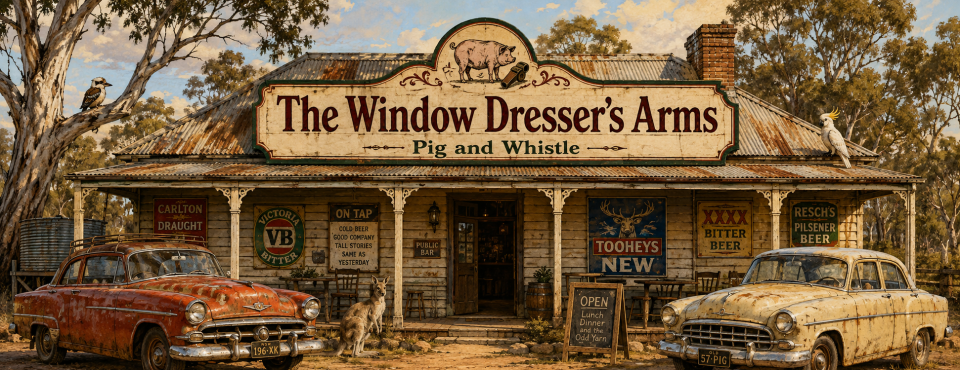
 Window Dresser's Arms, Pig & Whistle
O, what would I know about paying no heed, about pushing products using the worn cliches, about seeking to generate the 7-second sell, what would I know about gloss and colourful ‘grabs’ of paving bricks and kitchen sinks.. What would I know about how to sell a cleat, a cleat, a cleat, a cleat or a cleat.
Who recalls the Lufthansa ads isolating attention to the micro-world of design and designers. I liked them when I was a small child.
LikeLike
I wrote a whole page and it disappeared. What kind of design was that ?
Summary: I love good design – especially motorcycles and cars – I can see, feel, hear and smell it. The trend towards retro simple elegant lines built on 21st century high tech ultra reliable and cheap technology is a joy to behold. I’m fond of my new kevlar lined jeans – in case I attempt accidental flat side down travel – I get to keep my skin, if not my bones intact.
Give me a new Tesla battery-powered sports car now. It looks great. It can do a Ferrari – and it runs on several thousand mobile phone batteries. Sadly costs over $120,000 – if you can get in a very long queue. Shit I bet the Telstra bils are enormous. What ? I’ve misunderstood ?
Maybe I’m not as good at appreciating design as I thought.
LikeLike
I spent yesterday designing the computer so that my H could continue posting her charming responses. WordPress must have re-designed something even more tortuous than before. She was told she was logged in at WordPress but when she posted was advised to ‘log-in again. We logged in thousands of times, changed pass words, re-submitted user names, did the lot. It seemed it came good, finally. Don’t ask me what was changed. The design of internet must still be in its infancy. I know many that are not bothered learning internet usage. I am not surprised.
I am back at my old Nokia, have given the swipe up and down gadget the flicks. Compare the simple paper clip with the LG or Samsung touch screen!
It’s a no contest!
LikeLike
So you have given up gliding through life. Have a rest Gerard, you must be buggered after all that fiddling and arranging to sort out Helvi’s logging in issue with Word Press. I used my gravatar password and that was accepted.
LikeLike
They do design and technology at High Schools now – at least here they have for about 20 years. There is good design and planning but not enough of it. Town planning has a low priority in too many parts of the country. We have some brilliant suburbs in Albury Wodonga thanks to the AWDC (now killed off, just flogging the last of its land bank). Integrating town planning and education and transport and shopping just seems too hard for some councils and then when they do try to do the right thing the state govt comes in and rides rough shod over them. Later, when it is too late, people complain. Buggered if I know how to change the thinking.
LikeLike
Hi Viv:
Glad to hear they teach design in your area.
Part of housing design problem is that it has to make money, especially for the developers. It is not seen as a social need nor in the context of other needs such as transport, health, communal heating and cooling of housing estates, car parking, education, libraries, cinemas, other social structures. There is no overall plan. I am not sure local councils are in the right place either. Shires date back to small communities whereby local people were put into charge of the community. That worked well in the days of horse and carts but not now with large towns and much larger communities.
The best way, if we can’t design ourselves, to study countries where it is done better.
LikeLike
You need a large planning authority with good planners, including social planners. We had that with the AWDC and council fought them tooth and nail. The work done by the AWDC fortunately lives on but all planning went back to councils. Layout of subdivisions, orientation of houses on the blocks (envelopes), tree planting, traffic control by design etc tends to be too hard to achieve when you have ad hoc development done by developers who are in it for the money as no. 1 priority. When you start with englobo land you can do it right. Then you have the consolidation policies which come and go. The AWDC got more houses per hectare and still managed to have open space, bicycle paths, houses which are not crammed close together. Yet for most of the time they were despised. Probably because it was Gough’s idea in the beginning yet Fraser continued with it. Some more recent development approved by local govt has been in line with AWDC principles and some has been the complete opposite (and in all cases here it is bloody awful).
I have a lot of experience with the old Shires and with amalgamations. There are good amalgamations and then there are very bad ones. We copped a very bad one where I live. Lost the good bits to the Albury City and Corowa and then got put in with two decrepit councils nearby. We were stripped of assets and what was left of the old shire now supports the other two decrepit ones – an expensive exercise. The old shire fought against going with the City (not me though) and what they got is a botched up affair. Too many silly old fools around who can’t see the big picture.
LikeLike
Viv:
Too many silly old fools. Some silly young fools too. I reckon that we either give up the fight and hand all to our cars or follow what the car industry is telling the whole world; give up on us and catch communal transport and start living like you used to, all closer together. There is hardly room left over for living space when roads and bridges are reaching the use of space almost equal to our living space.
They did a study in Los Angelos and they put green on the map of LA where cars had taken up space. It included all parking stations, petrol stations, roads, bridges, home garages, driveways. The area was almost equal to living space.
Trying to live without the need for a car is now almost impossible. Even where we are, car sales yards are closer to the shops and rail station than housing. The car industry is almost universally subsidised just in order to ‘make more cars’.
Here is something to ponder about:
At the cash register of the store, the young cashier suggested to the older woman that she should bring her own shopping bags because plastic bags weren’t good for the environment.
The woman apologized and explained, “We didn’t have this green thing back in my earlier days.”
The cashier responded, “That’s our problem today. Your generation did not care enough to save our environment for future generations. You didn’t have the green thing.”
She was right — our generation didn’t have the green thing in its day.
Back then, we returned milk bottles, soft drink bottles and beer bottles to the store. The store sent them back to the plant to be washed and sterilized and refilled, so it could use the same bottles over and over. So they really were recycling. We refilled writing pens with ink instead of buying a new pen, and we replaced the razor blades in a razor instead of throwing away the whole razor just because the blade got dull.
But we didn’t have the green thing back in our day.
We walked up stairs, because we didn’t have an escalator in every shop and office building. We walked to the grocery store and didn’t climb into a 300-horsepower machine every time we had to go two blocks.
But she was right. We didn’t have the green thing in our day.
Back then, we washed the baby’s nappies because we didn’t have the throw-away kind. We dried clothes on a line, not in an energy gobbling machine burning up 220 volts — wind and solar power really did dry our clothes back in our early days. Kids got hand-me-down clothes from their brothers or sisters, not always brand-new clothing.
But that young lady is right. We didn’t have the green thing back in our day.
Back then, we had one TV, or radio, in the house — not a TV in every room. And the TV had a small screen the size of a handkerchief, not a screen the size of the Melbourne Cricket Ground. In the kitchen, we blended and stirred by hand because we didn’t have electric machines to do everything for us. When we packaged a fragile item to send in the post, we used wrapped up old newspapers to cushion it, not Styrofoam or plastic bubble wrap. Back then, we didn’t fire up an engine and burn petrol just to cut the lawn. We used a push mower that ran on human power. We exercised by working so we didn’t need to go to a health club to run on treadmills that operate on electricity.
But she’s right. We didn’t have the green thing back then.
We drank water from a tap when we were thirsty instead of demanding a plastic bottle flown in from another country. We accepted that a lot of food was seasonal and didn’t expect that to be trucked in or flown thousands of air miles. We actually cooked food that didn’t come out of a packet, tin or plastic wrap and we could even wash our own vegetables and chop our own salad.
But we didn’t have the green thing back then.
Back then, city people took the tram or a bus, and kids rode their bikes to school or walked instead of turning their mothers into a 24-hour taxi service. We had one electrical outlet in a room, not an entire bank of sockets to power a dozen appliances. And we didn’t need a computerized gadget to receive a signal beamed from satellites 2,000 miles out in space in order to find the nearest pizza joint.
But isn’t it sad the current generation laments how wasteful we old folks were just because we didn’t have the green thing back then?
LikeLike
‘Keep it simple’ is my advice to designers, simple and funktional…no silly ‘features’, add-ons to make things look ‘interesting’. This goes for houses gardens, cups, dog-houses, cars, clothes, flower arrangements…I even dislike the idea of ‘arranging’ flowers….
LikeLike
Helvi, I have eccentric sensitivities about ‘arranging’ flowers, primarily I don’t like cut flowers.
I thought when I was younger I didn’t ‘arrange’ flowers. Methought arranging was elaborate constructions of elegant lilies alongside curlicues of exotic ferns. So remote from the idea of design was I. I did not understand even the instinctive ‘grab’ an astute eyes makes before the ‘grabbed’ flowers are decorously ‘tossed together in a vase to attract some young male long hair. Speak of the naive ‘flower’ child.
Until recently I haven’t had reason to think on flower arranging… when I was involved in the aesthtics of the local Show and edited the Handbook. I noticed some descriptions to exhibitors regards presentation needed rewriting. 5 Varieties of flowers (one of each) in a vase and 5 of the same in a vase interested me in particular. What would competitors create in these categories? I imagined art in rows of vases, flowers cut to length, perhaps held in decorative positions with inserts in the vases.
Flower ‘arranging’ as a concept still didn’t figure until I heard someone comment they had thought the competitors would ‘arrange’ the flowers which they didn’t. There was I imagining ‘art’. But neither ‘arranging’ nor anything but the word ‘display’ appeared in the text describing to exhibitors how to present their flowers for judging. I just mention this.
O, and i still truly don’t “like” the idea of flower ‘arranging’.
LikeLike
Just lately I’ve been appreciating some classic cars. Not fancy ones, innovative ones, like the Citroen DS, designed, not by an engineer, but by a sculptor, or the Citroen SM (maserati engine saloon). I wanted to buy one but, Mrs M tells me they look like ‘puppet cars’ from Thunderbirds, and won’t be seen dead in one.
The other designs I really like are the Danish bicycles, with shaft drive, or the Dutch Flevobikes, recumbents with underseat steering, all a bit outre, but interesting and innovative. Of course, in many European countries everyone from president to dunny cleaner happily rides some sort of contraption from Dutch bike, to leaning recumbent trike, to recumbent tandems! Likewise their cars are likely to be smaller (General de Gaul was driven around in a Citroen DS), more ecofriendly, and interesting!
LikeLike
Simplicity is what seems to be so difficult. The temptation to add ‘features or decorations’ is what is in essence an Anglo way of embellishing objects that hides bad design.
LikeLike