• The Pig’s Arms
  • About
  • The Dump

Window Dresser's Arms, Pig & Whistle

~ The Home Pub of the Famous Pink Drinks and Trotter's Ale

Window Dresser's Arms, Pig & Whistle

Monthly Archives: May 2012

Surviving an Economic Depression

18 Friday May 2012

Posted by gerard oosterman in Gerard Oosterman

≈ 10 Comments

Surviving an economic Depression

May 18, 2012

Surviving an economic depression.

As a survivor from the last turmoil between 1940- 1945, I wonder what one could do in case of another downturn. How would people react when there is an economic collapse whereby the norms of a working society go askew?

The banks have gone broke. The rush to withdraw all savings turned into a stampede. The next day there were chains and padlocks on all the banks doors. There was a curt little notice that the bank would be closed till further notice. People queued up and small groups formed outside staring at the bank’s doors as if by magic they would somehow open up again. It was a strange and discomforting diversion from the norm.

The housing investment market started to wobble a few years earlier. Houses took a long time to sell and soon they reverted to dwellings that people lived in. With the banks closed, mortgage payments became superfluous. Roofs over one’s head became again what houses were originally, it kept the rain out. Keeping the rain out became what the homeless now needed more than ever. The government or what was left of it tried to arrange public buildings for sheltering the homeless.

The huge Ernest & Young multi storey building now housed seventeen thousand homeless spread out over all the floors. People did not mind climbing the emergency fire-escape stairs. The generators just supplied emergency power for some lights but excluded the lifts. The toilets still flushed but for how much longer? Rumours were going around that the Myer’s store were distributing food brought in by the Salvation Army and so far no reports of looting were heard about.

Neighbours, who previously kept themselves apart and much to themselves, very private, now introduced themselves and offered help. People started to be drawn together with sharing common needs. Fear and instinct for survival made for instant communication. “Have you got enough food” was a common question and concern for sharing became necessary. “One can get ten kilo bags of flour from the Town-Hall” someone told the neighbourhood.  Another one offered to pick up tins of powdered milk from somewhere else. It became a scramble to just see the next few days out. The closure of banks meant that money was scarce and bartering became the norm.

During cold weather fires were soon lit in public areas. People were seen huddling together talking and sharing the latest news. Some suburbs had no electricity and generators were hard pushed to find fuel for. The little fuel that was available was being kept for emergency driving only. Hospitals were still going on with caring for the sick and the government was issuing warnings that people ought to stay away from rioting youth and street fighting which had broken out in front of the Center-Link offices which had closed down as well. The police was kept busy.

Of course, the above is just one scenario that could happen. With the sort of survival methods that became necessary during the last war in Europe I can’t remember too much detail. I know more from what my parents told me than from memories. I do remember hunger though. That is something that doesn’t easily go away.

So, in short; food is the most essential part for survival. Shortage of food is still the norm amongst hundreds of millions of people around many parts of the world to-day. They experience economic depression as something that seems to last forever during their entire lives. How would we cope?

Tags: Economic depression, Ernst&Young, Generators, Myers, Police, survival, World war Posted in Gerard Oosterman | Edit |   Leave a Comment

Reuben Brand’s Guide to Australian Politics

17 Thursday May 2012

Posted by Therese Trouserzoff in Reuben Brand

≈ 14 Comments

Tags

Australian politics, cartoon, sad state

The sad state of Aussie politics by Reuben Brand

My Boyhood Gave Me Cancer

17 Thursday May 2012

Posted by Therese Trouserzoff in Warrigal Mirriyuula

≈ 36 Comments

Tags

cancer, carbon tet, carbon tetrachloride

Cleanliness – really next to Godliness

Story by Warrigal Mirriyuula

For reasons which one day may yet be explained in greater detail, it came to pass that some time toward the end of my eleventh year I found myself attending a new school for the third term of the year. I fell in with a group of new friends who befriended me on the basis that we all lived within a few hundred metres of one another. This demographic cluster centred on an unprepossessing little byway called Dora Street and I was the most recent addition to, (ominous minor chords played under!), The Dora Street Gang.

Mine was an associate membership because I lived in William Street at the western terminal of Dora Street.

Next to that house in William Street was a laneway that accessed the rear of a number of commercial properties on the main highway through town. One of these premises housed a dry cleaner and they used the rear yard of the property to store 44 gal. drums of dry cleaning waste. This waste was composed of the lint and fibre left over from the cleaning process. It was saturated with residual Carbon Tetra-chloride which was commonly used as a dry cleaning fluid in those days.

To cut to the chase; one day it occurred to one of our number that this waste may provide a suitable plaything for a group of idle youths to mess about with. He called the stuff “Burning Dirt”. He’d obviously done a little discovery and experimentation before he introduced us to the material. In pretty quick order we discovered that you could hold a burning ball of the stuff and, soon after that we discovered that we could throw it at one another and when the burning handful of CCl 4 saturated lint hit the target it would explode in a ball of cold fire with an odd blue to green tinge to it.

I knew nothing of organic chemistry then; not that I know a lot now; but I do now know that the Carbon Tet acted as an inhibitor on the propagation of the flame through the lint and when the ball burst on impact, the instantaneous availability of all that extra oxygen overcame this inhibition and the lint literally exploded in flame. Theoretically the burning dirt was a kind of low energy, low temperature thermobaric bomb.

I suggested that we might rename ourselves as “The Brotherhood Of The Burning Dirt”, thereby obviating any confusion as to members’ addresses by sticking with the Dora Street appellation. The idea didn’t stick. Maybe it was a little too wordy.

Later at high school I studied a little organic chemistry and was surprised to learn that burning Carbon Tet at low temperatures is reasonably safe, but if the temp gets up, burning CCl 4 produces COCl 2 which goes by the name of Phosgene. Another molecule produced in a similar way is called Dioxin. Need I say more.

When I had finished with high school and was looking forward to joining the sodality of scholars at university, I took a job in the local Email plant. I was what used to be called a process worker; I had no particular experience or skill at the job they put me to. I was just another employee on the refrigeration line.

The job with which I was tasked revolved around a big gas fired oven. My job was to inject a two part foam solution into a mold and then send the mold through the oven. When it came out “cooked” I pried the finished foam from its mold, dipped the front edge in an industrial wax solution and stacked it for later removal and inclusion in the Westinghouse brand refrigerators that rolled down the line. I can to this day remember all the design designations of all the cabinets and doors.

After cleaning the mold, wiping the interior with a non stick solution, akin to baking spray, and then purging the injection tubes and gun with Methylene Chloride, the whole thing started again. The waste from the gun purge was stored in an open 44 gal. drum immediately adjacent to the foam booth. There were three of us worked in that booth and it was considered a cushy number because our rate of production wasn’t set by the speed of the line. We could produce as many foam molds as were required on the line, and then go on to produce “stock” for later line assembly. We worked with the engineers and apprentices on new mold designs and foam formulations, and most importantly, we got lots of over time.

I worked at Email for three months, finishing just before university started. I managed to save around a thousand dollars against my books and other costs not covered by my scholarship and felt pretty good about myself. I was being independent, looking after myself.

That was a long time ago and while I still fondly remember those earlier friends, I’d almost completely forgotten that job.

That was then. This is now.

I’ve had to have a second round of treatment for my cancer and this occasioned another visit to my oncologist who took no time getting down to tin tacks. He was a little discommoded at my having to have a second treatment and so he thought it prudent to grill me regarding any exposure I may have had to aniline dies, did I ever work in a tannery or paint making plant, in fact had I ever been exposed to any mutagenic or carcinogenic substance?

I wracked my memory. I couldn’t think of anything that fitted the exhaustive list he’d presented me with. The closest I got was having sat a saddle at various times in my life.  Leather being a tanned product, I thought, maybe.

No he said that’s not it. It must be something else. I reminded him I had been a smoker most of my life. He said he was becoming leery of smoking as a risk factor. Not that it wasn’t a risk for my kind of cancer but rather he said he was looking deeper these days because the association of smoking and this kind of cancer is highly statistically correlated in epidemiological studies but there is yet to be a demonstrated causative effect.

Bugger, I thought. Just like me to get a cancer with a mystery modality.

Then all that forgotten organic chemistry came back to me.  It occurred to me that the Carbon Tetra-Chloride in the burning dirt and the solvent Methylene Chloride are cousins in the chain of organochloride production.

Keen to get to the bottom of my disease, I blurted a quick history of my adventures with the Dora Street Gang and our discovery of the amusement value of burning dirt. I filled him in on my industrial experience at Email and the fun we had intentionally inhaling the methylene fumes for the buzz. This last confession seemed to horrify him, but it did ease his mind too. He now thinks that my cancer was probably caused all those years ago by my boyhood cavorting with chlorine compounds.

So now I have an answer. It was the burning dirt and the buzz that did it. My boyhood gave me cancer.

But my oncologist says I’m still not allowed to smoke.

Rebekah Brooks and the English love for Privacy

17 Thursday May 2012

Posted by gerard oosterman in Gerard Oosterman

≈ 22 Comments

English Privacy and Rebekah Brooks.

May 16, 2012

Rebekah Brooks and Phone Hacking

While the tentacles of Rupert Murdoch’s media empire stretches well beyond Britain, the phone hacking and intrusion of ‘privacy’ seems to be mainly concentrated in the Anglo world. Why, one could reasonably ask?

Well, one answer might well be our obsession with deliberately living lives that are hidden. This wanting to be hidden dates back hundreds if not thousands of years. Perhaps the pillaging, raping and burning by the Vikings on our soil left its inedible and indelible mark on our proud British heritage.  Our home is our castle and if it wasn’t for lack of money, everyone  of us would want to be surrounded by moats and drawbridges. We compromise and have blinds, thick curtains and 6 feet high fencing instead.

We like our privacy. It is the first word of preference when asked how we would like to live. Where is my privacy? This is often the primary requirement when moving into a new home. When neighbours apply permission to extend or build something next door, the possible invasion of privacy is often the reason for councils objecting to the development application. I sometimes wonder why we build houses with windows.

We like our gardens but don’t want to be seen in them. When do the Anglos do their gardening, at night perhaps? We put in outside furniture and giant turbo driven 8 burner stainless steel gas barbeques but, by and large, we stubbornly want to remain hidden and prefer to have all that in the back yard and not at the front, risking fully exposing snags and ourselves to the dangers of the outside world.

Now, with this almost universally well known need for the Anglos wanting to remain hidden, unknown, unseen and ‘private’ till the grave, it is baffling what we are so keen about in wanting to remain hidden. What goes on behind those curtains of privacy? What lurks behind that wall or fence? Are dastardly acts of the most hideous and perverted nature  happening? Are the Anglos whipping themselves into a frenzy of orgiastic delights unknown to the rest of us?

Phone hacking outside the British Empire would never have that attraction to readers because everyone knows that the French Prime Minister has affairs or that the Italian President has a penchant for rubbing coconut oil on nubile young girls. Continentals live their lives in the open and rely on openness and community values in keeping an eye out over each other. In fact, the scandals that the Brits so delight in would at best elicit a yawn amongst most of the rest of the world.

Of course, the neuroses to remain hidden don’t mean that we are not curious in finding out what others are doing. It is a double edged sword. Make something hidden and we will inevitably want to snoop around, if only to find out if others are like us as well. This is why people were paid to do all this phone hacking.

Finally it becomes an addiction, hence those awful Anglo Sunday papers revealing who is doing the latest stint in a re-hab., or who is looking suspiciously pregnant and not even married to boot. That close up, is it proof of a Brazilian wax, surely not?  Gee, doesn’t Andrew Beiber look a bit pale; I am sure he is back on the crack-ice again, is he?

For the Murdoch Empire it was a colossal and monumental opportunity of money making. It worked while it was going on. And now, the spectacle of Rebekah Brooks in Court with her lovely tousled red hair will be another one of those continuing sagas, raking in even more money. Go for it boys.

Tags: British, French, Italian, Phone hacking, Rebekah Brooks, Rupert Murdoch, Vikings

Idealism in Chaos ( A Greek Tragedy)

15 Tuesday May 2012

Posted by gerard oosterman in Gerard Oosterman

≈ 18 Comments

Idealism in Chaos ( A Greek Tragedy)

May 15, 2012

χάος

Another big fall in world markets, billions will be wiped off and Greece is tottering on the brink of total economic collapse. Good morning!

Some European countries which were supposed to be examples of how society ought to distribute wealth more equitable are now being lined up to fall like a row of dominoes set up on the dining table of good and well intentioned but un- equitable sharing of the rich Euro baked pork dish with crackling good social security till the grave.

What went wrong? Was it the apple sauce?

The answer might well come from the dining table itself. The excessive ladling out of all those goodies without balancing it to an equal generous increase in taxation revenue was always dodgy. The expenditure didn’t match the income. A classic case of economic delusion that one can live beyond means was always a premier lesson at the kindergarten of economics. If you keep scooping the sand out, the sandbox will finally be empty.

The lure of getting more with less income seemed to have overtaken the world of capitalism. Election after election the sound economic principles of setting expenditure to income was eroded away. The voters swallowed it like marsh-mellows on a stick held above the fire of greed and avarice. Right wing governments took over with the promise of more for less and we were all seduced by this ugly Judas kiss. And look at us now? Will there be blood on the streets once again?

With Portugal and Spain queuing up after Greece with youth unemployment at a staggering fifty percent it seems to be hovering on a similar precipice into economic collapse.

In Australia we keep rubbing hands together with glee in how we seemed to have escaped the GFC turmoil with our scooping up of mineral resources. In the process we seem to forget that this is due to luck much more than sound economics. Take out China, and we too would be lining up at soup-kitchens.

Are we too taken in by the lure of more for less? Notice the upheaval in the suggestion of raising taxation on our resource mining companies. Notice how the Three hot headed Musketeers of our resource companies have taken on Australia and its citizens daring to utter getting paid a fair share of the economic resource pie. Notice too, how the principal of taxing those that defile our environment is fought against tooth and nail. Millions are being spent in advertisement opposing this very sound and principled way of making the environment spoilers pay for it. We too are cruising for a bruising being taken in by the fairy floss of more for less.

At least in Europe there seems to be a return to the left with new governments willing to find a solution in bringing the rich back to the kitchen table of give and take.  In France, the rich will have to pay much more tax and many are questioning how anyone should have more than they can possibly need. Capitalism has gone berserk and the masses are paying for the sins of the rich. The poor, for too long have been denied a share for which they have worked just as hard as the rich, which, in the majority of cases inherited the wealth enabling them, with the regimes of lower and lower taxation, to keep on exploiting handy taxation loopholes and fattening themselves on the pork crackling of lenient taxation laws.

It is not for nothing that the collapsing economic capitalist world is looking anew at Scandinavia. They were always looked at askance and with suspicion. How could a taxation regime of over fifty percent continue to thrive giving its citizens a world of social welfare that would sooner or later end in total collapse and disaster? Well, the Scandinavians did not and now seem to own the only beacon of light and insight in perhaps having a solution for those countries on the brink of economic disaster.

We should perhaps look anew at those prophets of lower taxation being the only way forward. Just look how, with the new budget, we have delayed Foreign Aid? We have the top three wealthiest in our society owning over 30 billion. Or is it 40 billion now?

How just is our society and how moral when we can’t support foreign aid anymore and at the same time support not raising taxation for the obscene wealthy?

Tags: Australia, China, France, Greece, χάος, Kaos, Portugal, Scandinavia, Spain

Words of Endearment

14 Monday May 2012

Posted by gerard oosterman in Gerard Oosterman

≈ 23 Comments

Words of Endearment

May 13, 2012

Words of Endearment.

“Can you pick up your jacket, please?”  “Yes dear, but my right hand feels cold, even feels a little numb.”  “Yes, but use your warm hand then, you’ve got two you know, and while you’re getting up – take your cup to the kitchen- sink as well-, it has been sitting there all morning.”

“Yes, but can I warm my hand up a bit first?   “It’s not as warm to-day as it was yesterday”.  “Ah, you are always cold”. ..Why did I marry you?”  “I don’t know. It was a long time ago.”

Here are snippets of love words that can be heard in hundreds of languages and millions of households at any given time and all over the world. It is the araldite of common marital language that binds couples and relationships together. Now-a-days one daren’t use the word ‘marital’ without qualifying it further, because, at least here in Australia, it implies man and woman couples hitched together through an official certificate of proof. It still excludes same sex or odd sex couples. Sorry folks, just hang in there. It won’t be long now but keep up the same sex coupling anyway. Your certificate of marriage is coming soon

Savvy writers try and avoid pigeon holing with too many definitive descriptions of things, risking the wrath of readers. That’s why I, thoughtfully, added ‘relationships’, thereby including the whole gamut of possible mixtures of relationships. You can’t be too careful, even a full stop sometimes gets taken for being racists or homophobic, unless followed by at least a space.

“What are you taking out of the fridge?”  “Ah, just a plate, dear.”  “A plate of what?”  “Last night’s risotto, dear.”  “Ah, yum, can you heat it up?  I want half.”  “Yes, of course,” “I’ll put some water in the saucepan”.  “Use the non-stick fry-pan, you know, the round one.”  “I was going to use the non-stick one, I always do. You know that (Testily).”  “I meant to put in the baby peas.”  “You did put them in; have a good look inside the risotto.”   “Oh, you are right, I can see them now.”  “I thought there were more peas.”  “Well, I didn’t count them.” “Do you think I stole them?” “The peas have shrunk a bit, that’s why they were hard to see.”  “Yes, that’s because they have been in the fridge overnight.” “They just dried out a bit, that’s why.”

Again, later at night going to bed.

“I can’t find my pyjamas.”  “Try looking under pillow dear. They are always there.”  “I thought they were in the drawer”.  “No, I changed that system months ago and I told you.”  “Sorry, I’ve forgotten.”  “You forget because you don’t listen.”   “I do listen but I can’t do everything at once.” “Looking for pyjamas under your pillow is hardly rocket science.”  “No, but I am beginning to get indigestion from the peas in the risotto as well.”  “Oh, you are busy now, aren’t you?”  “Hope you’re not going to do strange things all night.” “I’ll try not to”. “I’ll take some Mylanta just in case.”

Good night-good night.

While some might well think the above is just useless and mundane natter, for many, especially the au courant and well posted in couple bliss, it will be seen for what it really signifies; proof of a well nourished and deeply involved couple. While its first frenetic rush of love might have subsided or settled with pausing passions and intimate familiarity there is still an enormous amount of involvement with each other. Take the issue of the peas in the risotto for instance. Twice the subject of peas are lovingly being mulled over and instead of those peas being found to be boring as many of you might well have come to expect, it remained significant enough to be mentioned at length by the couple.

Surely, this wasn’t just mundane natter for the couple. This is the very essence of long established and thoroughly involved loving couple. They care enough to keep talking.

Talk is the araldite of good relationships. (It comes in two parts; Part A and Part B and when mixed together hardens with age.)

Tags: Araldite.Love., Peas, Risotto Posted in Gerard Oosterman | Edit |   Leave a Comment »

Researchers Believe…

14 Monday May 2012

Posted by Therese Trouserzoff in Lehan Winifred Ramsay

≈ 19 Comments

Tags

Fukushima, Japan, monkeys, nuclear falloput, Painting, research

Trunk

Painting and Story by Lehan Winifred Ramsay

Researchers believe they can get more detailed data through wild monkeys

I was reading yesterday about a plan to attach collars to wild monkeys in the countryside somewhere around Fukushima. These collars will have devices attached that collect data about the radiation levels in the area. The argument on the appropriateness of such an experiment appears to be that as the monkeys move around a lot through this terrain, the devices will be able to monitor the radiation levels randomly and perhaps gain a more accurate reading. No comment was given regarding the monkeys’ interest in IT or being adorned with chokers, however we do learn that these chokers can be controlled by remote control.

In another story hitting the press, the ABC’s drum today carries a story on how other countries are getting the advantage on Australians because their children are put in schools earlier. Dr Oberklaid of the Royal Children’s Hospital reports: “…it’s like building the foundations of a house. “If you take shortcuts, like using cheaper cement, everything that follows is potentially at risk.”” According to a quoted source, a Dr Einstein, “no problem can be solved by the same thinking which created it.”

http://www.japantimes.co.jp/text/nn20111211a3.html

http://www.abc.net.au/news/2012-05-14/alberici-early-childhood-education/4008962

Playlist for Mother’s Day

12 Saturday May 2012

Posted by Therese Trouserzoff in Algernon

≈ 16 Comments

Tags

Mother's Day

Playlist by Algernon

http://www.youtube.com/watch?v=KXsyXjZPvGU

Mother and child reunion – Paul Simon

http://www.youtube.com/watch?v=WQlImg2bm28

Momma Said – The Shirelles

http://www.youtube.com/watch?v=eDVkkwl6aJo

Mother – John Lennon

http://www.youtube.com/watch?v=jAdyXR2BNFU

A Mother’s Love – BB King

http://www.youtube.com/watch?v=unfzfe8f9NI&ob=av3n

Mamma Mia – ABBA

http://www.youtube.com/watch?v=sonYFxHHvaM

One Love – Bob Marley

http://www.youtube.com/watch?v=_WaVv874DfE

Where I stood  – Missy Higgins

http://www.youtube.com/watch?v=2hlMi6PvUDE

Your momma don’t dance –  Loggins and Messina

http://www.youtube.com/watch?v=N_a4BU09GrU

Momma don’t let your babies grow up to be cowboys –Waylon Jennings and Willy Nelson

http://www.youtube.com/watch?v=dvNXF7aGP2s&ob=av2n

Mama I coming home – Ozzie Osbourne

http://www.youtube.com/watch?v=UPrixYOTNHw

Sylvia’s Mother – Doctor Hook

http://www.youtube.com/watch?v=4E2qg6bRu6M

Mama look at Bubu – Harry Belafonte

http://www.youtube.com/watch?v=H9NOK5C-_KY

Mother – Cyndi Lauper

http://www.youtube.com/watch?v=R9cS7LaEAYY

Mothers talk -Tears for Fears

http://www.youtube.com/watch?v=Y9P9kf4QZ2E

This is to mother you –  Sinead O’Connor

http://www.youtube.com/watch?v=MOyvYnkdEcc

You make me feel like a natural woman – Carol King


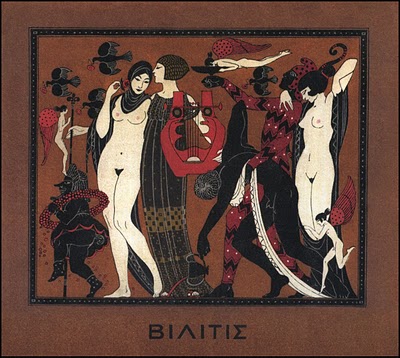
The Life of Bilitis by Astyages

12 Saturday May 2012

Posted by astyages in Astyages

≈ 14 Comments

Some time ago Atomou felt the need to tell me what qualities he thought were necessary before one should ever attempt to translate anything from any other language into one’s own. I did not agree at the time, and still don’t. Since then I have briefly explained my disagreement, which is essentially the same as my disagreement with the orthodox dogma of the roman catholic church… the rigidity and inflexibility of orthodoxy is too limiting and rigid in itself at the same time as it refuses to allow the possibility of new interpretations. I did not, however, offer a full critique of what I referred to then (and still refer to) as his ‘diatribe’ on the art of translation; and I shall still refrain from doing so, however, as it’s been a long time since I’ve contributed anything, and as I’ve already ‘threatened’ to post my own translation of Bilitis, (which is the ONLY thing I have ever claimed to actually translate); it seems an appropriate time to post it; even though it risks being labelled ‘presumptuous’ or worse. You will note that I have not translated it from the Greek, but from the French language; the language of its author, who pretends instead to be the ‘discoverer’ of this ‘ancient’ text. I invite any and all piglets who feel interested enough to do so, to comment on my translation and the quality of my interpretation.

Perhaps, if I’m lucky, I may even draw Atomou back to the pub, if only to critique my work.

This first installment is my translation of Pierre Louys’ introduction to the ‘Songs of Bilitis’; I hope you will all enjoy

The Life of Bilitis

By

Pierre Louys

Translated from the French

by

David L Rowlands

THE SONGS OF BILITIS

A Lyrical novel

This little book about ancient love is dedicated respectfully to the young girls of the society of the future. (Pierre Louys)

Introduction: THE LIFE OF BILITIS

Bilitis was born at the beginning of the sixth century before our own era, in a mountain village situated on the border of Melas, to the east of Pamphylia. This country is dangerous and melancholy, darkened by deep forests, dominated by the enormous mass of the Taurus mountain ranges; petrifying springs emerge from the rock into large saltwater lakes; the heights and the valleys are full of silence.

She was the daughter of a Greek father and a Phoenician mother. She seems not to have known her father, because he is not mentioned anywhere in the memories of her childhood. Perhaps he was even dead before she came into the world. Otherwise one could hardly explain how she came to bear a Phoenician name, which only her mother could have given her.

In this nearly deserted land, she lived a peaceful life with her mother and her sisters. Other young girls, who were to become her friends, lived not far from there. On the wooded slopes of the Taurus range, shepherds grazed their flocks.

In the morning, at cockcrow, she rose, went to the stable, to water and milk the animals. During the day, if she wished, she could stay in the women’s quarters and spin wool. If the weather was fine, she could run in the fields and play with her friends the thousand games about which she tells us.

Bilitis had an ardent piety regarding the Nymphs. The sacrifices she offered were almost always for their spring. Often she even spoke to them, but it seems that she never saw them, to the degree that she recounts with veneration the memories of an old man which otherwise would have been surprising.

The end of her pastoral existence was made sorrowful by a love affair which we know a good bit about because she spoke of it at length. She stopped singing about it when it became unhappy. Having become the mother of a child whom she abandoned, Bilitis left Pamphylia, under mysterious circumstances, and never dreamed again of the place of her birth.

We find her again at Mytilene where she had come by the sea route along the beautiful coast of Asia. She was scarcely sixteen years old, according to the conjectures of M. Heim, who plausibly established some dates in the life of Bilitis, taken from a verse which makes allusion to the death of Pittakos.

Lesbos was then the center of the world. Halfway between beautiful Attica and the ostentation of Lydia, she had as her capital, a city more enlightened than Athens, and more corrupt than Sardis: Mytilene, built on a peninsula in sight of the coast of Asia. The blue sea surrounded the town. From the height of the temples one could distinguish on the horizon the white line of Atarnia, which was the port of Pergamus.

The streets, narrow and crowded by the resplendent multitude dressed in multi-colored fabrics, tunics of purple and hyacinth, cyclases (a kind of sleeveless surcoat)of transparent silks, bassaras (a type of mantle or great-cloak) dragging in the dust stirred up by yellow shoes. The women wore large golden rings strung with rough pearls in their ears, and on their arms massive bracelets of silver roughly carved in relief. Even the men had shining heads of well-coiffed hair. Through the open doors could be heard the joyful sounds of instruments, the cries of the women, and the noise of the dances. Pittakos, who wanted to give a bit of order to this perpetual debauch, even passed a law which forbade flute-players who were too tired being employed in the nocturnal festivities; but this law was never severe.

In a society where the husbands are so busy at night with wine and the dancers, the women were inevitably forced to reconcile themselves to find among themselves some consolation for their solitude. with the result that they softened to those delicate amours, to which antiquity has already given their name, and which they maintain; what they thought of men was more true passion than faulty research.

Sappho was still beautiful. Bilitis knew her, and she speaks to us about her under the name of Psappha which she used in Lesbos. Undoubtedly this was what made this admirable woman, who taught young Pamphylians the art of singing in rhythmic phrases, preserve for posterity the memory of these dear beings. Unhappily Bilitis gives little detail about this figure which is today so poorly known and this is cause for regret because the least word touching the great Inspiratrice is precious. In revenge she has left us some thirty elegies, the history of her own friendship with a young girl of her own age who she names Mnasidika, and who lived with her. Already we know the name of this young girl from a verse of Sappho’s where her beauty is exalted; but the name was doubtful, and Bergk was near to thinking that she was simply called Mnais. The songs one reads further prove that this hypothesis must be abandoned. Mnasidika seems to have been a small girl, very sweet and very innocent, one of those charming beings who have for their mission to let themselves be adored, so much more cherished are they that they make less effort to merit that which is given them. Love without reason lasts longest; this one lasted for ten years. We shall see how it was broken off through Bilitis’ fault, whose excessive jealousy failed to understand the least eclecticism.

When she felt that nothing was left for her in Mytilene except unhappy memories, Bilitis made a second voyage: she went to Cyprus, a Greek and Phoenician island like Pamphylia herself and which must have often reminded her of her native country.

So it was that Bilitis recommenced her life for the third time and in a way of which it would be more difficult to make admission if one has not yet understood at which point love became a sacred thing among the ancient peoples. The courtesans of Amathonte were not like our own, creatures in disgrace, exiled from all worldly society; they were girls from the best families in the city, and who thanked Aphrodite for the beauty which she had given them, and consecrated in service to her cult this recognized beauty. All the towns which possessed, like those of Cyprus, a temple rich in courtesans had in the regard of these women the same respectful care.

The incomparable history of Phryne, which Athena has transmitted to us, will give some idea of a real veneration. It is not true that Hyperidas needed to go naked to persuade the Areopagus and nevertheless, the crime was great: she had killed. The orator only tears the top of his tunic and reveals only his breast. And he supplicates the Judges “not to put to death the priestess and those inspired by Aphrodite”. On the contrary the other courtesans went out wearing clothing of transparent silk through which may be seen all the details of their bodies. Phryne was costumed so that even her hair was enveloped in great pleated vestments whose grace the figurines of Tanagra has preserved. No-one, if it were not her friends, ever saw her arms, nor her shoulders, and never would she be seen in the public baths. But one day something extraordinary happened. This was the day of the feast of Eleusis, twenty mule persons, who came from every country in Greece, were assembled on the beach, when Phryne advanced close to the waves: She removed her clothing, she undid her girdle, she even removed her under-tunic, “she let down her hair and entered into the sea”. And in this crowd there were Praxiteles, who after this living goddess drew the “Aphrodite of Cnidus” and Apelle who half-lived in the form of his “Anadyomene”. Admirable people, in front of whom beauty could be displayed nude without exciting laughter or false shame [fausse honte].

I would like this history to be that of Bilitis, because, in translating her Songs, I was seized by a love for the friend of Mnasidika. Without doubt her life was also totally marvellous. I regret only that I have not spoken further and that the ancient authors, those at least we have surveyed, are so lacking in information about her. Philodemus, who plundered her twice, doesn’t even mention her name. In default of pretty stories, I pray that one would really like to content oneself with the details which she gives us herself on her life as a courtesan. She was a courtesan, that is undeniable; and even her last songs prove that if she had the virtues of her vocation, she also had its worst weaknesses. But I do not wish to know only her virtues. She was pious, and even practicing. She lived faithfully at the temple, such that Aphrodite consented to prolong the youth of her purest worshipper. The day she ceased to be loved, she stopped writing, she says. Nevertheless, it is difficult to admit that the songs of Pamphylia were written in the period they were about. How was a little shepherdess from the mountains able to learn how to scan her verses which depended on the difficult rhythms of the Aeolian tradition? It seems more plausible that, on growing old, she could no longer sing for herself the memories of her distant childhood. We know nothing about this last period of her life. We do not even know at what age she died.

Her tomb was rediscovered by M G Heim at Palaeo-Limisso, beside an ancient road, not far from the ruins of Amathonte. These ruins had virtually disappeared for over thirty years, and perhaps the stones of the house where Bilitis lived today pave the quays of Port Said. But the tomb was underground, according to Phoenician custom and it escaped tomb-robbers [voleurs du tresor]. M. Heim penetrated a narrow shaft, filled with earth, at the bottom of which he encountered a walled door which he had to demolish. The cavern, spacious and low, paved with flagstones of marble, had four walls lined with a veneer of black amphibolite, where there were graven in primitive capitals all the songs which we are about to read, as well as three epitaphs which decorated the sarcophagus.

It was there where reposed the friend of Mnasidika, in a large coffin of baked earth, under a cover modeled by a delicate statuary which was figured in potters clay, her death-mask: her hair was painted black, the eyes half-shut and lengthened with pencil as if she were living and the cheeks artfully adorned with a light smile which emphasized the lines of the mouth. Nothing more would ever be said by these lips, at once clear and well-defined, soft and fine, united the one with the other, as if they had drunkenly come together. The celebrated traits of Bilitis were often reproduced by the artists of Ionia, and the Louvre Museum possesses a baked-earth tablet from Rhodes which is her most perfect monument, after the bust by Lanarka.

When the tomb was opened, she appeared in a pose with one hand piously arranged, twenty-four centuries previously. Vials of perfumes were hanging from earthen pegs, and one of these, even after such a long time, still smelled sweet. The polished silver mirror in which Bilitis saw herself and the stylus which had traced the blue on her eyelids were discovered in their proper places. A little nude statue of Astarte, a relic never so precious, keeping perpetual vigil over the ornate skeleton and all her jewels of gold and white, like snow-laden branches but so soft and fragile that at the moment they were gently touched they turned to dust.

PIERRE LOUYS

Constantine, August 1894.

My old ‘Stamping’ ground at Revesby (Selamat Makan)

11 Friday May 2012

Posted by gerard oosterman in Gerard Oosterman

≈ 7 Comments

My old ‘Stamping’ around Revesby (Selamat Makan)

May 11, 2012

The old ‘Stamping’ will never stop. (This NOT from le salon des ABC refuses)

Isn’t it sweet and proof of the conviviality of the readers including those ‘Pigs Arms’ patrons that my writings are never purely judged by its spelling? There I was happily ‘stamping’ away at my old ‘stamping’ grounds of Revesby being haughtily dismissive of lawns and petunias. And yet, with the dawning of another day and with more words urging me on, I remain humbled, (doing a Rupert Murdoch)  by the kindness and tolerance of the readers, not only allowing me to dwell on these pages, but also being presumptuous enough in thinking those words worth reading, including the ‘stamping’ around.

Perhaps this stamping around in suburban Revesby has some basis in happenings at earlier times.

I was given a stamp album for Christmas in 1948. I have kept it ever since but no stamps have been added since 1956, the year of our arrival in Australia. I started saving postage stamps as soon as I could walk (my mother told me). They used to include stamps from all over the world. It became far too complicated and I decided with my new album to concentrate on The Netherlands and its colonies instead. The colony of Indonesia (former Dutch East Indies) was then tottering on the edge of becoming independent under Sukarno and I remember tens of thousands arriving in Holland taking with them the world’s finest cuisine and different cultural habits. Many could not hack the colourless Dutch climate and its relentless damp weather and moved onto Australia. This eventually resulted in many Indonesian restaurants popping up in Sydney and elsewhere. One of those was called Selamat Makan in Victoria Street, King’s Cross.  Much later another one opened up in King Street, Newtown ‘The Safari’. I can sometimes still taste the spicy ‘Rendang’.

The date of this Christmas gift stamp album from my parents of 1948 is written on the front page in lovely long- hand writing. Do kids still learn long-hand or has that gone overboard as well? The world of the abbreviated language is now much in vogue, with C U LTR or LOL with ROLFING being bit more expansive. I remember in the late fifties the start of texting with the 4 SALE signs arrivals in front of second hand car sale yards stretching mile after ugly mile on Parramatta Rd, Sydney.

Going back to my album,   I used to get a yearly stamp catalogue specifying and updating the latest stamp issues and, more importantly, the value of stamps. The value of some stamps, depending on the numbers issued, would drastically increase as the years went by. I kept a little book with their updated values. Sadly, while I still have the album somewhere, the book of updated stamp values has gone, disappeared. Perhaps my parents chucked it out or left it behind in our house at The Hague together with the lovely tropical fish aquarium and all those Neon-Tetras.

Now, with the likelihood of more years past then coming still, the inclination to dwell on what has been, have to be resisted somewhat. The temptation to finish up being called ‘a boring old fart’ by many will surely become the incentive to look afresh at the ever changing world and its many colours. There is no other way and so many words might still be queuing.

Tags: abc., Indonesia, revesby, Rupert Murdoch, Selamat Makan, Stamping, Sukarno Posted in Gerard Oosterman | Edit |   Leave a Comment »

← Older posts
Newer posts →

Patrons Posts

  • The Question-Crafting Compass November 15, 2025
  • The Dreaming Machine November 10, 2025
  • Reflections on Intelligence — Human and Artificial October 26, 2025
  • Ikigai III May 17, 2025
  • Ikugai May 9, 2025
  • Coalition to Rebate All the Daylight Saved April 1, 2025
  • Out of the Mouths of Superheroes March 15, 2025
  • Post COVID Cooking February 7, 2025
  • What’s Goin’ On ? January 21, 2025

We've been hit...

  • 766,453 times

Blogroll

  • atomou the Greek philosopher and the ancient Greek stage
  • Crikey
  • Gerard & Helvi Oosterman
  • Hello World Walk along with Me
  • Hungs World
  • Lehan Winifred Ramsay
  • Neville Cole
  • Politics 101
  • Sandshoe
  • the political sword

We've been hit...

  • 766,453 times

Patrons Posts

  • The Question-Crafting Compass November 15, 2025
  • The Dreaming Machine November 10, 2025
  • Reflections on Intelligence — Human and Artificial October 26, 2025
  • Ikigai III May 17, 2025
  • Ikugai May 9, 2025
  • Coalition to Rebate All the Daylight Saved April 1, 2025
  • Out of the Mouths of Superheroes March 15, 2025
  • Post COVID Cooking February 7, 2025
  • What’s Goin’ On ? January 21, 2025

Enter your email address to subscribe to this blog and receive notifications of new posts by email.

Join 374 other subscribers

Rooms athe Pigs Arms

The Old Stuff

  • RSS - Posts
  • RSS - Comments

Enter your email address to subscribe to this blog and receive notifications of new posts by email.

Join 374 other subscribers

Archives

Website Powered by WordPress.com.

  • Subscribe Subscribed
    • Window Dresser's Arms, Pig & Whistle
    • Join 280 other subscribers
    • Already have a WordPress.com account? Log in now.
    • Window Dresser's Arms, Pig & Whistle
    • Subscribe Subscribed
    • Sign up
    • Log in
    • Report this content
    • View site in Reader
    • Manage subscriptions
    • Collapse this bar
 

Loading Comments...