
Bye Bye
By Susan Merrell
It’s known as the ‘Land of the Unexpected’ – a character-defining phrase worn as a badge of honour by Papua New Guineans.
‘Expect the unexpected’ is the catch-cry of the PNG Tourism Authority – but he didn’t !
Belden Norman Namah had high expectations that a combination of unharnessed power, bullying, self-serving, rushed legislation that would nobble his political opponents and buckets of money ($AU15 million alone spent on his election campaign) would mean certain success in his quest to become the Prime Minister of what would be, after the June 2012 elections, the indisputably legal government of Papua New Guinea. The expectations remain unfulfilled.
Political Ascendancy
When newly-elected MPs walked into the parliamentary chamber for the first time since the election last Friday (August 3), it had been almost a year to the day since Namah had led a political coup and become Deputy Prime Minister of Papua New Guinea in a legally-disputed government
A self-confessed “Multi-billion-dollar logger” who was not only Deputy Prime Minister but also Minister for Forestry (after having held the portfolio in the previous government of Sir Michael Somare – tell me the irony hasn’t been lost) he had expended much cash and energy to bring about the coup. He was widely touted as the possible saviour of PNG. He promised PNG a new “young and vibrant” leadership.
PNG got far more than it had bargained for.
Ruthless and arrogant, not for Belden Namah the niceties of diplomacy. A military man, Namah takes no prisoners, leaves no bridge unburned. His raw ambition was palpable and no one would stand in his way – his fortune guaranteed that – or so he thought as he bulldozed his way through the next twelve months. Prepared to do whatever it took to hold onto power, he seemed unstoppable.
Namah’s errors of judgment and decency (and this list is not exhaustive)…
Namah’s lack of diplomacy extended to his coalition partners (government is always a coalition in PNG – the party system being weak.). Public humiliation was a well-used weapon in his arsenal. Within months, for example, on national radio, he called for the resignation of the Prime Minister to whom he was deputy. It was the first Prime Minister O’Neill had heard of Namah’s displeasure. The rift was quickly patched up but it left scars.
To Don Polye, the former Deputy Prime Minister under the Somare regime, then a Minister in the O’Neill/Namah government, Namah gave the command in earshot of journalists at a National Executive Council (NEC) meeting to”…f**king shut up”, when Polye had the temerity to disagree with Namah. In fact, it is widely reported that Namah would, without mincing words, remind the members of the NEC who it was that had put them there.
He was no less outrageous in how he dealt with the people of his electorate.
For while Namah eventually won his seat this election, he was initially trailing badly in some districts – before his final romp home on preferences. In his victory speech he acknowledged the districts that didn’t vote for him by telling them of his intention to represent, in parliament, only the districts that had voted for him – not the whole electorate. Those that hadn’t could look forward to”…five years of suffering” (five years is the parliamentary term).
Internationally, and during his tenure, the man had embarrassed the people of PNG and his government when a previous drunken, debauched episode at Sydney’s Star Casino made headlines in Australian newspapers.
It wasn’t confined to Australia either: tensions between Indonesia and PNG were manifest when a private jet flying Namah and a coterie of ‘hangers on’ was buzzed by Indonesian fighter jets. It is widely suspected that it had something to do with large amounts of cash that was on board (literally millions) and an Indonesian fugitive suspected to have been on the flight. No one has told the truth behind this incident – not Indonesia, not Namah.
Back home in Port Moresby, in May of this year, Namah violated the sanctity of the PNG courts in his vendetta against the Chief Justice (who had ruled the government formed after the coup as illegal – twice). Namah stormed into the Supreme Court, interrupting the court while it was in session leading a contingent of soldiers and police.
From the back of the court Namah pointed at the Chief Justice and shouted: “Arrest him. Arrest him”.
Namah’s henchmen hesitated, recognising the enormity of what they were about to do, giving Sir Salamo Injia, Chief Justice of Papua New Guinea a window of opportunity to leave via a side door and avoid the ignominy of being arrested in his own court. This action was condemned both nationally and internationally.
But it was a timely onslaught as Sir Salamo Injia was scheduled to preside over a charge of Contempt of Court charge against Namah later that day. He never did.
…proves his downfall
Under the circumstances, why Namah expected that the top job was going to be his for the taking is anyone’s guess. But he did.
During the ‘horsetrading’ period after the elections, (between when seats have been declared and government is formed) when alliances and coalitions are moulded and where the stronger parties do the necessary to attract numbers, doubt had obviously crept in as Namah’s PNG Party took out a full-page advertisement in the national newspapers inviting newly-elected members to join the party. Namah stated that he would be amenable to giving away the Prime Ministership – as if it were his to give.
It was desperation.
Namah’s previous coalition partner and former Prime Minister Peter O’Neill held prime position with his party winning most seats, (hence would be invited to form the government by the Governor-General). In fact O’Neill had three times more winning MPs than Namah whose party had fared particularly badly, including losing one of his deputies.
O’Neill’s coalition would not be entertaining Namah making it almost certain that Namah would not be in government at all. O’Neill had the numbers approx. 80/10.
Yet Namah’s supporters held to the futile hope that he would produce an 11th hour upset – such a figure of legend had he become.
On Friday 3 August 2012, on the floor of the parliament, Namah’s rejection for Prime Minister of Papua New Guinea was manifest. The newly sworn in MPs voted 94-12 in favour of O’Neill as Papua New Guinea’s next Prime Minister. Namah’s arrogance had not served him well. A pathetic figure, he sat amongst 11 other men in a field of 111 (that, happily, included two women on the government side).
In this I played my part
This writer has spent 9 months waging a media campaign against this man in the PNG social media pages and the blogosphere, I’m extremely pleased with the outcome for PNG and am proud of any small part I may have played in his downfall.
In the immediate aftermath, in the social media, I posted.
“On 1 August 2011, Belden Namah was Leader of PNGs Opposition. Almost a year to the day, 3 August 2012, he is, once again, Leader of the Opposition.
In the interim he’s spent probably upwards of 50 million kina on a political coup (only partially successful) and an election campaign that gave him back his seat and not much else.
In the interim he has decimated a political party who went into the elections with 25 sitting members which is now reduced to around nine.
This is probably the most spectacular failure I’ve ever witnessed. ”
“A failure well deserved”
 Window Dresser's Arms, Pig & Whistle
Dear Susan,
I know you won’t read this as you are so engrossed with tour own ego you will pass this off. Once upon a time at the Pigsarms you were distraught at the fact that your lover died. A man you had sex with while you were married. You are simply a cheat, a fraud and a phony. Any view that you hold is treated with a splash of your own distrustful view. I for one will never rate anything you say.
Goodbye and never come back.
Delete this is you like Michael but I for one cannot stand people with a double standard.
Good riddance
Hung
LikeLike
Feel free not to read anything I write ‘Hung one on’. I, at least, have the courage of my convictions and publish under my own name. Someone influential once said “Let he who is without sin cast the first stone.” That would be you, then would it HOO?
LikeLike
Susan, I loved the piece on your lover, I appreciate anyone writing with courage and heart, your article on your dad was also very much appreciated, many thanks.
LikeLike
Always nice to hear from you Susan, but particularly so when it is in regard to the demise of such an awful despot! Sadly, however, the chances are that his replacement will be no better, and may even be worse… Is there any real hope on the horizon for PNG, do you think? Anyone who truly cares more about their country than they do themselves? Or do you think Papuan ‘democracy’ will remain a chaotic battle of all against all in the struggle to control the swill-trough? (Hmmm… seems to me we might ask ourselves the same question here in Oz too!)
😉
LikeLike
Most of the PNG politicians are tainted by corruption in some way – and if they’re not, they will be soon.. However, this man was a particularly nasty piece of work. I had come to the conclusion that he had some mental pathology (ie madness). Many politicians past and present have lined their own pockets and not delivered service to their people but it was a passive oppression – he was going to elevate it into an active one. I could see him becoming the Idi Amin of the Pacific. I was fearful that no one in PNG would have it in them to stop him, he was throwing around a lot of money and a lot of threats – but they did. You’ve got to admire that. If you’re not totally sick of the subject by now, I will put up another article I wrote in the battle to expose the foibles of this man outlining his madness.
LikeLike
Please do, Susan… I must confess such people fascinate me… I mean, they excite my anthropological interest. I find it strange how easy it is for such people to rise to the top; but it’s obvious really: all they have to do is pander to the worst of people’s desires; play on their greed; their hatred and suspicion of each other; set them against each other… divide and rule; it really is the oldest trick in the book! Provided one has no scruples the path to the ‘top’ can be remarkably easy.
But as Kipling suggests in his novel, ‘The Man Who Would Be King’, perhaps what they find when they get there may not be quite what they expected… even when motivations are noble.
🙂
LikeLike
I find it grating that Australia, and many other countries, donate millions in aid, only to have blokes like Namah throw cash around like lollies.
Good on you Susan Merrell for bringing him down!
LikeLike
Well done Susan. You should be proud of yourself, having had a hand in the demise of this nasty character. I wonder if you could do something here, especially in Queensland where in order to save money the premier literature prize was abolished.
PNG seems to be forever in some kind of turmoil or having warring factions throwing spears. How did they go at the Olympics?
LikeLike
Not good, Gerard. They’re not really into many sports in PNG except rugby league – that’s a religion. People get killed regularly in the violence that follows Australia State of Origin games. Pity about the literary prize – writing’s becoming a dying art. We need to popularize it. Perhaps an X factor, where people read out their stories. I was speaking to an ABC journalist on the weekend who is doing a radio project involving people telling stories on a theme. You and Helvi would be good at this and she’s looking for contributors. I’ll send you some details.
LikeLike
That would be a nice experience, Susan.
I sometimes wonder how things are in Former Dutch NG with its capital Hollandia. Lots of the former Dutch Nationals moved to Brisbane and Cairns after its move over to Indonesia. The White Australia Policy was in full swing. Tricky when some of the Dutch were clearly coloured. I used to help some to get through the immigration maize.
The previous Drum editor Jonathan Green moved to ABC radio now. I haven’t been able to get one word in since, it must be my writing or my age. Same with Bob Ellis who spend the night writing a piece on Gore Vidal, all to no avail.
LikeLike
Well articulated Susan. Namah deserves the fruit of his stupidity.
LikeLike
So very nice to see you here, Susan, I miss the old commentators from the Unleashed…the Drum/Opinion is not quite the same…the personal is missing.
Now to your article.
LikeLike
Thanks Helvi. Nice to be back amongst friends. I’ve expended much energy on the aforementioned campaign and become the white woman the more strident PNGeans (especially Namah supporters) love to hate. I thought the Unleashed commenters could be brutal. They’re nothing compared to the PNGeans who inhabit the PNG facebook pages and whose remarks are unmediated. I now have the hide of a rhinoceros. Namah had hired many people to counter my message and discredit me with things like writing that I own a ‘gentleman’s club’ in the Cross. LOL.
LikeLike
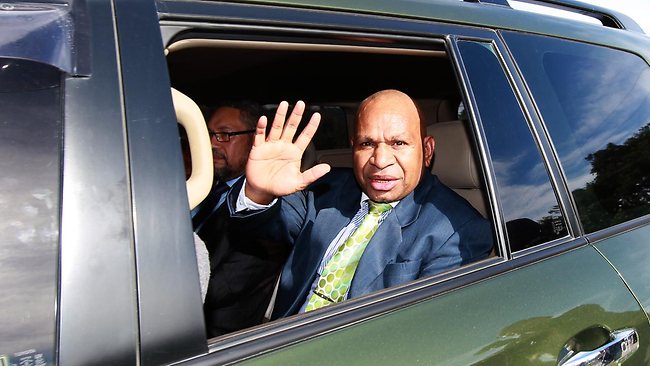
Emmjay’s at it again. I laughed aloud when I saw his choice of photo (which is an oft-used one in PNG) and the caption underneath. He probably doesn’t realise but the caption is even more apt because riding in the car next to Namah is his party Deputy and former Minister for Health Jamie Maxtone-Graham (a sycophant, if ever there was) who failed to win his seat. Another well-deserved failure.
LikeLike