
Tags
Architecture, ASIO Headquarters, Australian Academy of Science, Curtin School Of Medical Research, Heart Of Darkness, James Weirick, John Andrews, Joseph Conrad, Lyons Architects, Richard Francis-Jones, Scientia Building, The Cameron Offices, Walter Burley-Griffin, Whited Sepulchre
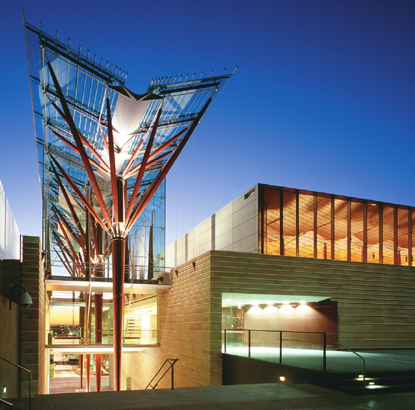
Scientia Building UNSW
Story by Warrigal Mirriyuula
A few years ago I attended an architecture conference at UNSW. It was being held in “The Scientia Building”, a striking building from Richard Francis-Jones that manages to appear much bigger than it is in both concrete and abstract ways.
But that’s not what I want to talk about, as interesting as that building is and the conference was.
What I want to tug on your coat about is some reflections on some comments made at that conference by James Weirick. The venerable James is a world authority on Walter Burley-Griffin and his remarkable wife Marion Mahony
He said that Canberra was a failed vision if WBG’s original plan was the benchmark. He regretted this, saying that Canberra had “become a whited sepulchre”, that it was now “a place where ideas came to die”. A resonating metaphor for fans of Conrad’s “The Heart Of Darkness” and a cynical analysis certainly, but they were the Howard years after all.
Weirick’s comment was in the context of a critique of the then current level of “planning” in Canberra and what he suggested was a deleterious impact on the quality of the built environment in our nation’s capital. The comment hardly raised an eyebrow. Indeed I’d say that most there that day probably agreed. But then you’ll always get takers when you offer a chance for one architect to critique the work of another.
So if no less august a body than the membership of the Royal Australian Institute of Architects is of the consensus that Canberra is a failed attempt at expressing nationhood then who am I to say they are wrong.
Then, a few months ago, the actor Guy Pearce weighed in to the debate on Craig Ferguson’s Late Show, suggesting that there was “a lot wrong with Canberra.” Well of course he was pilloried by the opinionati back home, and the local blog responses soon turned up to the usual “hysterical PLUS” setting with Pearce being slagged off left, right and centre. It wasn’t long before his freely offered opinion was being described as, (ssshiivverr), unAustralian. Pearce spent several days apologising.
And in that last I find something deeply disturbing.
Why shouldn’t Pearce say what’s on his mind with respect to our nation’s capital?
Well it may be all of a piece with the other major problem we have in Canberra. The place is swarming with, absolutely pullulating with politicians and their attendent creatures. They infest the restaurants, besmirch the footpaths and stuff the hotels, not to mention worrying the sex workers something fierce. And to what end? Good government? (Pshaw!!!)
It seems that at the same time as our ability to critique the actions and policies of the political caste and their unholy coven of sectionally interested campaign contributors, media advisers, spin doctors and lobbyists is being comprehensively compromised by the actions of human dross like Murdoch, and even our much vaunted national broadcaster has decided, for reasons never actually placed in the public domain, that partisan stupidity sells better than considered and probative comment; we are being asked to constrain our personal opinions as to whether or not Canberra is actually a city of any note at all.
Is it unAustralian to have an opinion that isn’t set in stone by one or some combination of media proprietors? If we don’t gulp down the constantly regurgitated cant of the political parties, are we necessarily plotting the downfall of Australia? What is wrong with having a negative opinion towards the place where those elected to the great privilege of representing their electorates go to avoid any responsibility to those constituents? Why is it that once in Canberra, policy and promises can be massaged almost into non-existence by the weasel speaking words of the “inner ring”?
Canberra bashing has been a national sport since the day they announced the willow choked, swampy valley of the Molongolo would one day be a bright and shining beacon of antipodean democracy, let alone a showcase of the new Australian vernacular architecture. In it’s more than 100 years of existence Canberra has managed to miss both those trains, again and again and again.
So here’s another piece of Canberra bashing, proudly presented in the “unAustralian” tone of the deeply disappointed and disillusioned.
The place is little more than a dull dormitory for public servants and political hacks. Since WBG’s departure the built environment of our national capital has become a hotch potch of bad planning, incompetent competition winners and half arsed attempts at “saying something” architecturally. Which is not to say that that there aren’t gems to be found. They’re just far fewer and farther between that the Canberra Tourist Bureau would have you believe.
Seriously, if it weren’t for both Parliament Houses, The National Gallery and Library, and the exciting and sometimes bizarre National Museum, which are for the most part worthy examples of the architecture of their time, you wouldn’t be caught dead in the place. I also particularly like the Carillon, and I suppose if I’m honest, there are other examples of interesting architecture dotted here and there, but few of them rise to the level of type specimens for an Australian vernacular architecture.
Why did the promise of such gems as the 1950’s Academy of Science fail to materialise? This Chesley Bonestell-esque futurist dream was the first building anywhere I ever noticed for itself. At that time, if I thought about it at all, I would have seen an exciting and innovative future for both Canberra and Australia.

Australian Academy of Science
So what’s up with the built environment in Canberra?
As an example of the twist Canberra is in architecturally I offer the brouhaha over the demolition of a building in Belconnen. You’d have thought someone had suggested tearing down St Pauls Cathedral.
Instead of letting the ugly decaying pile be pulled down, the cognoscenti, including the RAIA it has to be said, got all hot under the collar over plans to deconstruct the Cameron Offices. A 1970’s study in brutalist beauty, if such expression isn’t actually an oxymoron.
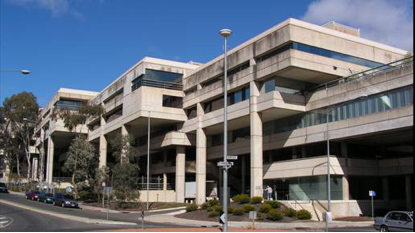
The Cameron Offices, Belconnen
In its last days before the ball and chain, when hysteria was the common modality on both sides of the argument, the building had come through time to look like nothing so much as one of those commercial shop/factory unit developments in say Mascot. The sort of place you might turn up at to buy and fit a car music system, or buy some cane furniture.
It may have been considered ground breaking when John Andrews designed the place nearly forty years ago, indeed several commentators said so at the time; but riddled with concrete cancer and described by those that had to work there as “cold and unfriendly”, it was just like a sepulchre; a concrete grey, rust stained sepulchre; and housing, as it did, the offices of The Prime Minister and Cabinet it richly earned my own nomination as one of the many whited sepulchres that dot the Canberra landscape.
These buildings represent the graves of good architecture. Strangled in the planning process and boxed by constant political interference, these dead monuments to committee based planning dot the capital landscape like great beached whales, putrefying in the hot Australian sun. Many are post Corbusier brutalist exercises in concrete display but lack Corbusier’s design finesse.
The education sector has had to bear a disproportionate amount of this stuff. Look at the Canberra School of Music, which seems somehow to entirely dispel the notion of harmony, unless Daryl Jackson and Evan Walker’s design was meant to look like an intimidating industrial laundry.

The Canberra School of Music Building
The University of Canberra’s student accom is much the same. John Andrews again managed to make “home” look like an industrial pig farm.
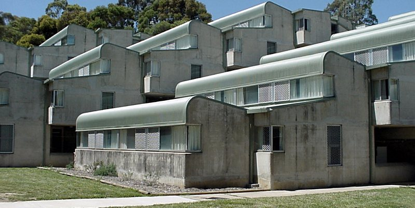
UC Student Accommodation
Sorry John; I loved it then, and I still find it fascinating, but these days I just can’t see humans living there.
Brutalism is going through a reassessment at the moment. Many still like it, some even have a kind of nostalgia for these buildings, and I don’t want to suggest that the architects I’ve named aren’t up to snuff. This is all just my opinion, and everyone’s got one of those.
But there may be change in the wind. At last there may be some quality in the built environment of the educational sector in Canberra.
With the opening of the John Curtin School of Medical Research at ANU, we see a striking and adventurous design by Lyons architects that somehow survived the planning process.
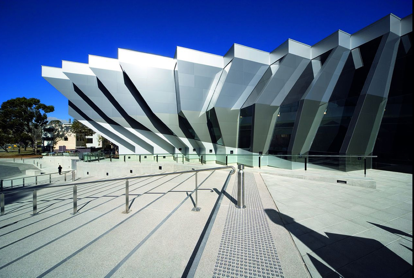
John Curtin School Of Medical Research
However, lest you think this “spring” heralds better days ahead for building in Canberra, I offer the cautionary tale of another building that appeared to have gotten over the planning hurdles only to stagger after construction began. ASIO’s new headquarters, currently being built down by Lake Burley-Griffin, is another “Francis-Jones Morehen Thorp” design. (Richard Francis-Jones really packs an awful lot of design punch for a little bloke!)
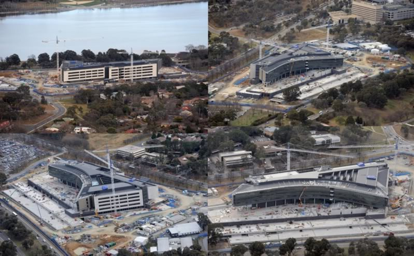
New ASIO Headquarters
There’s been nothing but trouble since they turned the first sod. If it’s not budget problems it’s trespassing teenagers seriously injuring themselves “site-seeing”, or glass falling off the facade endangering workers, or perhaps more embarrassing for Richard and his associates, Romaldo Giurgola, formerly part of the practice that became Francis-Jones Morehen Thorp, has come out strongly against his former partners and the design of the building citing no less an authority than Burley-Griffin himself. Like I said, you’ll always get takers for one architect to critique another.
“Canberra residents and the Burley Griffin society believe the building will be a, “barbed wire city in the heart of Canberra”. ACT senator Gary Humphries is also against the design: “I just can’t see that this is going to be compatible with the concept of what was designed by Burley Griffin and which has recently been reinforced with the Griffith Legacy concept which has been affirmed by the National Capital Authority.”
On his website , Humphries calls for a two storey reduction as the building is over-sized for its context. “I am deeply concerned that the size of the building will interrupt the vista from the War Memorial through to the Parliamentary Triangle… It would create a wall-like effect along Constitution Avenue, separating the area to its north from the lake precinct.”
The honourable Senator from the ACT may have a point but you’d think things like overall height would have been worked out already, but then this is Canberra and you never have to go far to find a shitfight.
So I guess while the powers that be continue to wrangle, we can all continue our love/hate relationship with Canberra, its politicians and its built environment for some time to come. I wonder what James Weirick thinks of this latest design brouhaha. Perhaps he can’t say for fear that ASIO might come knocking.
Keywords: Architecture, Walter Burley-Griffin, Scientia Building, Richard Francis-Jones, James Weirick, John Andrews, Joseph Conrad, Heart Of Darkness, Whited Sepulchre, The Cameron Offices, Australian Academy of Science, ASIO Headquarters, Curtin School Of Medical Research, Lyons Architects.
 Window Dresser's Arms, Pig & Whistle
http://www.canberratimes.com.au/act-news/canberra-centenary/smartarsed-fun-at-canberras-expense-out-of-order-20121129-2aj4p.html
Who was it said here recently that “political correctness is the notion that it is entirely possible to pick up a turd by the clean end?”
Ms. Archer seems to be labouring under the delusion that there is a way of looking at and describing Canberra that doesn’t involve disappointment at some level.
Her contention that a “frighteningly large” number of young people don’t value our democracy is little more that stating the blindingly obvious. Youth engagement in politics in this country has been on the decline for some years.
Who can blame them when day after day, month after month, we are treated to politics pure and simple while policy debate and the national discourse are used and abused for short term political gain. Neither side is above this ongoing spectacle of ersatz outrage and concomitant faux aplogy. How puerile! How pointless! Young people know when they’re being fluffed. They’re hip to it, having grown up in the age of fluffing. They see politics as bad TV. It doesn’t make them think and it doesn’t make them laugh; and sadly Ms. Archer looks like just more of the same.
To her it would seem more important to create and maintain the illusion that Canberra “means” something than engage in any substantive discussion as to why it is that young people seem to believe that it “means” nothing.
LikeLike
I think this kind of iconization of things as mundane as the seat of government is probably a relic from Oz’s strongly catholic past… it seems that to some extent ‘nationalism’ (sadly of the most jingoistic form only!) has come to replace religion for many, if not most, Australians. Thus, some things are deemed to be ‘national heritage’ and hence, as such are holy relics; sacred; and as such they will brook no critique; much like catholicism, along with several major world religions…
We also still carry on a lot of mystical and religion-oriented ritual surrounding the process of government; much more than I think is healthy.
‘Un-Australian’ is the new ‘Heretic’… Now, in the Australian tradition that I learned when I got here, ‘heretic’ would simply have been ‘speaks his mind’ and ‘unaustralian’ was still just a word bigots used; seems that things have changed! Now the bigot’s favorite trope, ‘unaustralian’ will be used to bully anyone and everyone who does not conform to a certain predetermined stereotype; someone’s idea of what it is to be ‘australian’… It’s a sign of the times; next thing you know we’ll have gangs of vigilante thugs on the street and a lot of social scapegoats to keep ’em busy; it’s the way religions work; through ‘sacrifice’… funny thing though, is it’s alway the same people who end up doing all the ‘sacrificing’…
Perhaps Canberra is actually the perfect setting for our government: all that glass and huge open spaces (following the influence of Frank Lloyd Wright, I believe) make it fantastically impractical in this modern age because it must be a nightmare to heat and cool effectively; it reflects a freedom we once thought we had to be profligat with energy use which the government still doesn’t appear to have grown out of… Just as well it’s the government getting that bill, eh? And not us poor folks! Not to mention what it says of the gummint’s commitment to reducing greenhouse emissions…
You watch; it’ll soon be ‘unaustralian’ to whinge about the size of our electrickery bills!
😉
LikeLike
“Oz’s strongly catholic past” doubt it Asty. Catholicism was frowned upon in the early days of the colony. It would have 33 years before they acquired land for St Marys cathedral its first church. There were more who identified as protestants until they were passed by those identified as being catholic in 1986 and most of that was by immigration.
LikeLike
Well… I guess I just shouldn’t have been quite so specific… catholic or protestant really doesn’t make any difference to the point that I was trying to make: a culture with a cosmological which includes scapegoat rituals and human sacrifice will inevitably practice scapegoating and other forms of human sacrifice.
LikeLike
‘cosmological PROCESS which includes etc…’
😐
LikeLike
An interesting, and very welcome, essay. I think we can all cite examples of absolutely, artless, and heartless, architecture in every city and town in Australia. Most, however, have some building/s that one remembers, or even finds inspiring. It sounds corny, but I still love the Sydney Opera House. There are a number of older houses and buildings which I think are gorgeous.
Canberra seems to be bereft of these. In fact, it seems that designers (probably not architects) went out of their way to erect the worst of the 70’s. No wonder our pollies are all crazy!
BTW welcome back, Waz!
LikeLike
Yes, you are right. The Opera House never dates and each time it surprises and delights. It lifts the spirit and makes you feel better. Compare that with a drive along our main highways, the blight of Parramatta Road between Parramatta and Central. Yet around Leichhardt- Glebe there are still some little jewels about.
Just imagine driving along Pmatta Rd and then start work. What could you possibly do except strangle something or chuck the whiteboard through the window with a quiet sob in the loo afterwards.
LikeLike
Just wait until Fat Barry builds the large gutter down the middle of it. Just imagine if we have a huge storm, might turn into a canal.
LikeLike
Finally, the eye for giving good form to something is perhaps inborn and passed on from generation to generation. When the ferry I had taken from Stockholm to Turku Finland in 1965, a new world appeared as soon as I got off the boat. From the small village Post Office to peoples interiors, it all had a simplicity and ‘undesigned’; look about. Function and brevity combined usually makes it difficult for something to end up ugly.
We seem to be plagued by wanting things to feature so much. It is all so deliberate and hotch-potch as if our eyes are superfluous and design irrelevant. Too much sparkle and glitter and attention seeking. I don’t know. There are some things that come about almost by accident. Near us some double storey doctor’s accomodation has been built. I imagine the architects to have been government employed. The brickwork is tuckpointed and of a rather soft grey brown colouring, The corrigated roof and overhanging gable fitted above balconies with unassuming panels protecting the balcony from anyone falling off. Simple garden with large square pavers with tea-tree plantation and native grasses. Milo likes it, always sniffing about and cocking his leg. I like it as well. It doesn’t jump out and fits the landscape.
LikeLike
http://www.fjmt.com.au/index.html
I’ve just spent a rewarding few minutes looking through the FJMT Architects site. Richard Francis-Jones, mentioned above in WM’s piece, is the design director of this practise and there’s a lot to be said for the “philosophy” of the partnership.
I was unaware of the scope of their work even though one of their projects is almost certainly going to lead to a significant rise in my local rates. Though that can be slated to the delusions of grandeur of the local councilors when the project was green lighted just in time to be hit by the GFC.
Francis-Jones seems to be able to make large masses “float” in a framework of steel and glass, interacting with one another, taking the eye here, there, before settling, usually on an edge. Very dynamic and yet always in balance. I particularly like his active glass facades and his fondness for ending these often flowing ribbon-like planes with a blade. Very thrusting, forward looking. He’s a talented man.
http://www.archdaily.com/58651/business-school-and-teaching-complex-fjmt-archimedia/
This link is to a site with many images of a representative project which embodies all the basic elements of Richard Francis-Jones’ current design palette and regime. If you’re interested.
LikeLike
Reading the text on the website was amazed I was. Thank you for the chat and link, Googlehoover. I immediately found myself in familiar territory knowing the lay of the land, and with a thought, that I wondered how the structure would fit. Funny we don’t expect to necessarily have any invested emotion in a presentation. I do from a number of viewpoints. I worked in a once stand-out pink building, the Westpac building on Symonds Street, Auckland which provided an all-round view and I was particularly fond of the view over the Domain referred to as here being the outlook of the project. As well Auckland University was so crowded those days it is crazy seeing something of the size here. One wants it all to be wonderful. I really would like to see more of this project than I can determine from the website, Googlehoover. I wandered the streets of Auckland taking photographs of buildings a few short years ago now as well.
FYI, my attention was drawn to the following link by a relative in Taiwan who works at this college where they are anticipating a new campus. The spatial arrangement of the buildings is very different by the nature of the site (is a given ). It interested me the way the design is presented in video.
LikeLike
So good to see a piece from you Waz, hope all is well with you.
I must agree that without the National Art Gallery and the other parts of the precinct there would be bugger all go their for. Frankly there’s more life in Quenbeyan than Canberra.
What were they thinking with the student accommodation, they look like stalls for a agricultural society. Then that could be said of most of the buildings in Canberra.
LikeLike
I never got the handle on Canberra, something very artificial about the place, endless round-abouts and buildings that don’t relate to each other in a harmonious way…
You see some odd cyclist, but it is not a city of people. Maybe they are all having a siesta when I visit the place; when we were there to see the Fred Williams exhibition, we were just about the only people at the National Gallery.
Sorry folks, but I have to give good marks for the Finnish Embassy building, simple, modest, and blending in with the landscape, but may I most modestly say that the Finns know about architecture 🙂
UC Student Accommodation looks like it’s put together using aged containers, and the National Museum is indeed bizarre, but kind of inviting with its sloping walls, kids liked it…
LikeLike
PS. when I think of Canberra now, I think of those endless Alpaca Society meetings at some club or another, and Fish and Chips lunches…plus a lonely salad.
LikeLike
It’s not really a place I ever think of going for the jollies, for a picnic, for a week-end away come to think on it and my lasting impression is of there being absolutely nobody about.
LikeLike
I have been there a few times as an adult. Amazing I have never thought of returning there for a visit.
LikeLike
I went to Canberra first in the late fifties on my Lambretta scooter and was blown over by the science academy building. It looked so modern and seemed just right. Since then I have visited the place many times but usually try and avoid it. The best thing is the hope by Lake George to fill up with water again, and the background for the vista to remain complimented by the dozens of wind-mills whirring about.
The last time we were there I was surprised at the Finnish Embassy which came into vision just before I abandoned all hope having driven past so much desolate ugliness. It is not a city for living, but then again, which Australian city is? Perhaps, a bit pessimistic. There are nooks and crannies here and there. The problem might be the Torrens Title Act whereby all the bits are owned by different people. This means that any development is usually staggered over years and individually built without an idea for something to relate overall to each other. (if you know what I mean).
Perhaps a trip by planners and architect to Helsinki might be helpful?
LikeLike
Land is held by leasehold in Canberra not Torrens Title.
I was amused once when visiting Canberra once to go bushwalking with friends. Bimberi Peak from memory. As we were driving to the state of the walking we drove through the southern suburbs then past the new subdivisions. Once passed that possibly 5 minutes later there it was in the middle of nowhere a children’s playground complete with new playthings. It appeared that it would be a few years before the subdivisions got to this playground, but planning dictated that the playground needed to be built and so it was.
Now this glorified Local Government Area is a quasi-state.
LikeLike
Stunning.
LikeLike
Great piece Warrigal.
LikeLike
http://www.canberratimes.com.au/national/letters/stanhopes-response-to-planning-criticism-demeaning-20120607-1zz6b.html
The beat goes on………
LikeLike
You are probably right. I have only really been there twice for a look and then only saw the good bits. Got lost on the circular roads – no not lost, I said to daughter, just taking a sight seeing tour !
LikeLike
Waz, it’s great to see you back in electronic print.
I recall my first visit to Canberra. I was 8. My Dad took me to see mainly the War Memorial, but also the Martian Embassy. It was apparently closed, but I walked around the outside several times. This is easy to do since there is no side in the traditional sense. I still wonder what it might be like on the inside.
LikeLike
Martian Embassy! Priceless!
LikeLike
Result as follows of a childhood impression gleaned from peering out the window of the family car in Canberra being told we were viewing “the American embassy”…I lived a number now of years ago next door to a red brick residence decorated with curlicue lace work like a cake, a place I described when asked where I lived “next door to the American embassy”,
As a deterrent against the previous tenants and my address the neighbours had grown a pest of a bougainvillea they let run riot, equivalent of an enormous tangle of barbed wire. Their address on the other hand was a site of a planned garden of clipped shrubs and niceties, the comings and goings of Asian home stay students who were gushed over. I delivered one peace entreaty in the form of a surplus of apricots and was told the story-again – about the bougainvillea being a blessing. Hearts and minds. “The American embassy”. Architecture influences. Compels. 🙂
LikeLike