• The Pig’s Arms
  • About
  • The Dump

Window Dresser's Arms, Pig & Whistle

~ The Home Pub of the Famous Pink Drinks and Trotter's Ale

Window Dresser's Arms, Pig & Whistle

Category Archives: Cyrus the Great: Chronicles

Cyrus: A Persian Classic Cocktail

Cyrus Bumper Grande Finale Edition!

27 Wednesday Oct 2010

Posted by Therese Trouserzoff in Astyages, Cyrus the Great: Chronicles

≈ 63 Comments

The Final Battle: The Massagetae

By Theseustoo

The crossing went ahead with no problems and the army had marched as far into the Massagetae territory as the remaining daylight allowed them before they set up camp for the night. Just before dawn Cyrus awoke with a start. Such a dream he’d had! Into the darkness he called out, “Slave! Bring me Hystaspes!” “At once majesty!” a slave’s voice answered sleepily in the darkness. It was this slave’s nightly habit to sleep across the entrance to Cyrus’ bedchamber, for the sake of his security, whether he was at home in his palace in Agbatana, or in his tent on an expedition with his army. The slave quickly rose and lit a waxed taper from a fire which it was also his duty to keep alight in a large brazier which stood in the centre of Cyrus’ tent; above which a large hole in the centre of the tent allowed smoke to escape. With the taper, the slave then lit a small oil-lamp for his master, who had roused and dressed himself, and then ran off quickly to obey him.

While Cyrus waited for his slave to bring him Hystaspes, he washed his hands and face in a bowl of water which he poured from the golden ewer he kept for the purpose on a stand beside his bed. As he dried his face and hands with a small towel from the same night-stand, the slave returned with Hystaspes. “You sent for me, Lord?“ the Prince of the Arizanti asked with a worried look upon his face. His mind was racing as he tried to think why he had been called to the king’s tent at such an hour. Surely spirits and daemons were all that moved at this hour, he thought to himself, as Cyrus turned first to the slave who had woken him from his sleep and brought him here.

“Leave us!” Cyrus ordered and waited for the slave to do so before he turned to the general and quietly said, “Hystaspes, your son is discovered to be plotting against me and my crown…” Hystaspes gasped in astonishment as his monarch swiftly continued, “I will tell you how I know it so certainly. The gods watch over my safety and warn me beforehand of every danger. Last night, as I lay in my bed, I saw in a vision the eldest of your sons with wings upon his shoulders, shadowing Asia with one wing and Europe with the other.” Again Hystaspes gasped, as Cyrus concluded, “From this it is certain, beyond all possible doubt, that he is engaged in some plot against me.”

As he spoke, Cyrus had been watching the general very closely for his reactions to see if he could discover whether or not Hystaspes was also involved in the plot, whatever it was. He decided however that Hystaspes’ astonishment at hearing Cyrus accuse his son was quite genuine and truly spontaneous as the startled general replied, “Heaven forbid, sire,” Hystaspes protested vehemently, “that there should be any Persian living who would plot against you! If such a traitor does exist, may a speedy death overtake him! You found the Persians a race of slaves and you have made them free men: you found them subject to others and you have made them lords of all. If a vision has announced that my son, Darius, is practising against you, lord, I resign him into your hands to deal with as you will.”

Such readiness to resign his own son to Cyrus’ judgement pleased the king; who had been expecting the general to beg for his son’s life whether or not he himself were implicated in the plot; it said much about Hystaspes’ loyalty to his king and emperor.

“Thank you, Hystaspes” Cyrus responded gratefully, and quickly added, “Your own loyalty to me is beyond question; which is why I’m sending you back to Persia.” Again the general raised his eyebrows in surprise, and then instantly he frowned; he was as puzzled as he was surprised at this latest turn of events; if Cyrus trusted him, why was he sending him back to the capital? Recognizing the cause of his confusion, Cyrus explained, “You are to return at once and ensure that when I return from conquering the Massagetae that you have your son ready to produce before me, so I may examine him. Now inform Pactyas to prepare the army for the day’s march…” Grateful for the chance he realized was being given to him to see for himself whether or not there was any substance to his king’s suspicions, Hystaspes bowed deferentially as he answered, “Yes Sire! At once sire!

*** ***** ***

By sunset of the first day on the enemy’s side of the river, the Massagetae had fallen back a considerable way, and they were followed at a distance of approximately half a league by the Persian army. As the sun started to sink below the horizon both armies stopped and made camp, erecting their tents and pavilions and lighting the usual sentinel and cooking fires. Just as the lower arc of the sun’s disc touched the horizon the expedition was called to a halt. With the familiar ease which comes of many years of practice the wagons were unpacked, tents erected and the cooking and sentinel fires lit; and all before the shrinking upper arc of the sun’s disc at last became a bejewelled sliver before finally disappearing below the horizon; and while they prepared their camp for the evening, the colours in the twilight sky gradually changed from blues tinged with magenta, through pinks and golds to fiery oranges, which darkened to a deep blood-red, tinged with purple; and finally to the deepest shades of indigo as the sky darkened and night began.

By the time darkness was complete the army’s priests had performed the evening sacrifice; and the entire carcasses of the victims were slowly roasting on spits which were turned by slaves over the cooking fires. Wine had been mixed in huge bowls and then placed on the tables which surrounded the cooking fires, while wineskins full of the finest of Persia’s wines were laid out ready nearby to refill them; large golden and silver goblets were already filled and placed on trestle-tables, waiting to be drunk. Soon the evening meal would be ready.

Everything proceeded as normal; all those who were privy to Cyrus’ plans were extremely careful to behave as if this were just an ordinary evening’s camp just like any other. Cyrus had previously instructed Pactyas to oversee the selection of those who were doomed to remain in camp to guard the feast himself. These now waited patiently in their ignorance, while the majority of the army fell back towards the river after Cyrus had suddenly emerged from his tent and loudly proclaimed that his scouts had discovered an attempt by the treacherous Scythians to circle around behind them and strike at their rear.

After a short while, one of these guards grew impatient for the army’s return so they could begin to eat the feast which was spread so deliciously and so invitingly before them. But it was not only his appetite which prompted his impatience; looking around him, he could not help but feel somewhat exposed. They had camped so close to the enemy camp that he realized quickly that their delicious and oh-so-tempting evening meal could not only be seen, but also smelled very easily, by the enemy. Whatever the size of the force the enemy might have sent to outflank them, he realized that the main body of their host were most certainly still in their camp, which was down-wind of the Persian camp; and only a few hundred paces away. As time wore on and the cooking progressed, the tempting aromas gradually became almost irresistible; the proximity of the enemy made him increasingly nervous.

Turning to one of his fellow guards he said, “I know Cyrus is a great general, and if he says he has discovered an enemy plan to attack our rear, then of course he must pull back toward the river to protect us, yet I can’t help feeling just a little bit exposed with so few of us here to guard the army’s meal for their return.” “I know what you mean.” his comrade responded with a brief laugh, “But I don’t think there’s much to fear; Cyrus has never been wrong yet!” The first guard just looked at him, and said cynically, “It’s truly touching how much faith you have in your king!”

*** ***** ***

Less than fifty paces away, hidden behind a large bush, was a Massagetae spy, who, as soon as he witnessed the Persian army’s withdrawal, ran back to his own camp to inform his queen of the Persian army’s curious behaviour. He found Queen Tomyris in counsel with her officers. “It makes no sense, Mother!” Spargapises, Tomyris’ only son, was quite perplexed by his spy’s curious reports, “This man says that Cyrus’ army spent the whole day marching forward, following us as we agreed. Then they prepared a feast… Yet instead of sitting down to eat it, most of the army appears to have withdrawn again towards the river, leaving only a small section to guard their food and supplies; they must surely be planning to return for their meal…”

Tomyris thought for a moment then said, “Perhaps they fear an attack from their rear! They must think we’ve sent a detachment to encircle them and surprise them while they were eating! Hah! These Medes trust no-one! They think everyone else is as devious as they are!”

“Hmmm…” Spargapises said, thoughtfully, “Perhaps we should not disappoint them… If we attack their camp now we can deprive them of their supplies and their meal; by the day after tomorrow, when we have agreed to do battle, they will all be so weak from hunger they will be easy to defeat!”

Tomyris could not help laughing aloud at the thought of thus turning the tables on an enemy who was famous for winning his battles as much through his cunning as through his courage. “An excellent idea, Spargapises…” Tomyris said, “But take no chances, my son; make sure you take a large enough detachment with you to raid the Medes’ camp…”

*** ***** ***

Time passed and the darkness soon deepened to the inky blackness of a moonless night; an effect not alleviated, but if anything, rather heightened by the flickering light given off by innumerable campfires. Paradoxically, while this made the camp itself almost as bright as day, beyond a very limited range outside their glow they only seemed to deepen the inky darkness into which the Persian guards now peered. As the guards continued to peer blindly into this Stygian gloom they began to wonder what was keeping the rest of their army.

Before a full double-hour had passed, however, they heard the sounds they had been waiting for: straining their ears into the darkness they heard the unmistakeable sounds of a large army of booted, marching feet, advancing towards them at the double from the direction of the river. This squadron however had been especially chosen by Pactyas himself; its individual members were recommended to him by their own company’s commanders, who knew the whole of Croesus’ plan. These commanders also knew very well just exactly who the weakest links in their own chains of command were. Thus chosen for it, they were an extremely ill-disciplined lot. As time passed they had very soon broken discipline by sampling the food and wine; so not only were they soon distracted from their duties, but their wits, such as they ever were in the first place, were not presently at their sharpest anyway.

Coupled with this was the cunning of the enemy. In order to minimize his own losses by maximizing the element of surprise as much as he could in his own favour Spargapises’ had his army silently circle round behind the Persian camp just beyond the horizon, so as to approach from the direction of the river. As they finally turned again towards the Persian camp, they made no further attempt to muffle their steps, for they knew they would most probably be mistaken for the Persian army returning to camp; and indeed this is exactly how things turned out. Thinking these footsteps must belong to Cyrus’ army the Persian guards were thus completely taken by surprise. Ill-disciplined and befuddled by wine as they were, they had not even challenged the owners of these rapidly-approaching footsteps; and the darkness hid their identity until the very last moment.

Spargapises’ attack was so swift, so sudden, so unexpected and so ferocious, that it was all over in a few minutes; the guards were slaughtered to a man before they even knew what hit them and Spargapises now had control of the Persian camp. Even the slaves who had been turning the roasting carcases on spits over the fires were butchered.

As he surveyed his handiwork, a Massagetae soldier walked up to Spargapises carrying a platter of food and a large goblet of wine, which he offered to his Prince. “It seems a shame to waste all this food and drink Lord.” the soldier said, “If Cyrus is looking for us to his rear, he will probably go all the way back to the river before he realises there is nothing to fear from that direction…”

Spargapises stared at the young spearman with a puzzled expression on his face, silently demanding further elucidation, “he is not likely to get back until late tomorrow morning at the earliest!” the soldier finished, once again offering the plate and goblet to the prince. “You are right!” Spargapises said, accepting the soldier’s thoughtful offerings, “This little battle has given me quite an appetite… and a thirst! And this Persian food smells so wonderful!”

He tasted a tempting morsel from the plate, and then continued, almost gleefully, “Very well then, we may as well enjoy the feast that our enemies have so generously provided for us!“ In a louder voice he addressed the rest of his army, “Help yourselves to food and drink men; the enemy will not return before morning and we’ll be gone long before then.” His men did not need a second invitation but fell to with a will. The delicious aromas of so much roasting meat, which until the Massagetae invasion had been slowly turned on spits by slaves, were now very nicely cooked; and these tantalizing aromas, delicately flavoured with fragrant and exotic herbs and spices had been tormenting them the whole evening; whetting their appetites ever since sunset; and as it had with their prince, the battle too, had given them all an appetite.

But, just as Croesus had told Cyrus, the Massagetae were completely unfamiliar with wine and its effects, and because after a battle they customarily ate and drank in quantities they felt were appropriately proportional to the victory they had just won, they soon became drunk; and then, deciding they enjoyed the sensation, they became even drunker. Eventually, one by one, they all started to nod off, or, more accurately, to pass out. Even Spargapises was so severely affected by this unusual alcoholic beverage of his enemies, that when the Persian army returned as planned, neither he nor his men were in any position to put up any effective resistance to the near-silent Persian marauders.

Cyrus’ spies had closely watched the movements of the Massagetae from the moment this plan had been decided upon. They had seen the Massagetae spy watching their camp and from their own hidden positions they had observed him run to Tomyris when the Persians retreated. Then they had kept Cyrus informed about Spargapises’ movements and the progress of his attack on Cyrus’ camp as they waited for the right moment. Cyrus had ensured that his men marched back with their footwear muffled with rags for the last few furlongs; and, when the moment was ripe and the Massagetae were all either asleep, passed out, or else too drunk to fight, they silently attacked from out of the shadows. So completely unexpected was their attack that, although a great many of the Scythians were slaughtered, a great many more were taken prisoner as they slept.

*** ***** ***

As Cyrus expected, before noon the following day a herald arrived from Queen Tomyris, the colours of her own royal standard now supplemented by a white flag of truce. “Great lord,” the herald began, “my queen, Tomyris, has sent me to you with these words: ‘Bloodthirsty Cyrus, do not pride yourself on this poor success: it was the grape-juice – which, when you drink it, makes you so mad, and as you swallow it down brings up to your lips such bold and wicked words – it was this poison with which you ensnared my child, and so overcame him, not in fair and open fight. Now listen to what I advise, and be sure I advise you for your own good. Restore my son to me now and leave this land unharmed, triumphant over a third part of the host of the Massagetae. Refuse and I swear by the Sun, the sovereign lord of the Massagetae, that bloodthirsty as you are, I will give you your fill of blood.’”

Cyrus ignored the queen’s threats; they were only to be expected; but he was a bit surprised at this demand for the queen’s son, “So!” Cyrus chuckled with delight, “We have captured the son of Tomyris!” Turning immediately to his general, Pactyas, Cyrus said, “Pactyas, have Spargapises found and brought here to me… “ Then, as Pactyas strode off to obey him he turned back to Tomyris’ herald and said, “Herald, you may inform Tomyris that we have no intention of leaving this country until we have defeated all of the Massagetae! As for her son, I will decide what to do with him after I have spoken with him.”

Presently, Pactyas returned, followed by two large soldiers dragging between them a handsome, well-muscled and long-haired young man in his early twenties. The now-congealed blood on the Massagetae prince’s dark-skinned head and the goose-egg sized yellowish purple lump it failed to hide were his only visible wounds; like many others who had been too drunk to fight, he had simply been clubbed unconscious and then enchained. The hangdog manner in which Spargapises hung his head informed Cyrus of the terrible shame the prince now felt at having been so easily tricked and captured. Such men as this do not make good hostages, Cyrus thought to himself, all too often they either escape or suicide. Either way he realized he was unlikely to be able claim a ransom for this prince, no matter how aristocratic he was, nor how much his mother desired his return.

Instantly Cyrus decided that the best thing to do would be to send him back to Tomyris as a gesture of goodwill and respect for his enemy. “Well then Spargapises,” he said to his captive, “what have you to say for yourself?” Spargapises looked up briefly, but would not meet Cyrus’ gaze, as he shamefacedly admitted, “Great King, you have captured me and made me your slave; but I cannot bear the shame of wearing these fetters! I beg you to have them struck off me and in return I give you my word of honour that I will make no attempt to flee…”

Cyrus was moved with pity for the man’s shame. In any case, he reminded himself, he had already decided to send him home to his mother… “Very well then,” he said, “I shall grant your request… guards, remove his chains.”

The guards obeyed their king immediately, removing the heavy iron fetters from their captive’s hands and feet. But Spargapises had a surprise in store for his captors; as soon as his hands and feet were freed, he snatched a sword from one of the guards and without hesitation stabbed himself with it through the heart. All who were present were stunned by the swiftness and the total unexpectedness of this self-slaughter; but of course, they all now realized that Spargapises had only given his word not to escape; he had said nothing about not harming himself; so he had not lied, but had indeed kept his word. This desperate act, though noble, was not only brutal and futile but also extremely unfortunate; as it took from Cyrus any possibility he may have had of accepting the peaceful retreat which Tomyris had just offered. Whether Spargapises had intended to do so Cyrus could not say; yet his suicide had effectively locked the Persians and the Massagetae on a collision course.

It had nevertheless been an honourable act, Cyrus felt, as he turned once again to the Massagetae herald; and with genuine sadness in his voice, he now said, “Herald, you may inform Tomyris that although I was considering returning her son safely to her, I was prevented from doing so because as soon as I released him from his fetters he destroyed himself. This was not my intention, but regretfully, what is done cannot be changed.” The herald, seeing that there was nothing further to be gained here, bowed respectfully to Cyrus from the saddle and allowed himself to be escorted once more out of the Persian camp.

*** ***** ***

The following morning Tomyris gathered together all of her forces. This time she would show the Persian invaders that they had made a mistake in ever turning their greedy eyes towards the land of the Massagetae. This, of course, was exactly what Cyrus had been expecting; yet although the Massagetae even now outnumbered the Persians by at least two-to-one, he had refrained from harassing the enemy before their battle-lines were ready. It would never do, thought Cyrus, to have it said that the Son of Heaven had won his title with a cowardly or ignoble act; Tomyris’ insult had stung him. But now, he thought to himself, the enemy will learn the meaning of courage! For the Massagetae even now outnumbered him by almost two to one. But by taking on and defeating a much larger and stronger foe, he would thus demonstrate to the whole world not only that he was indeed the Son of Heaven, but also that the Son of Heaven was lacking neither in martial skills nor in courage.

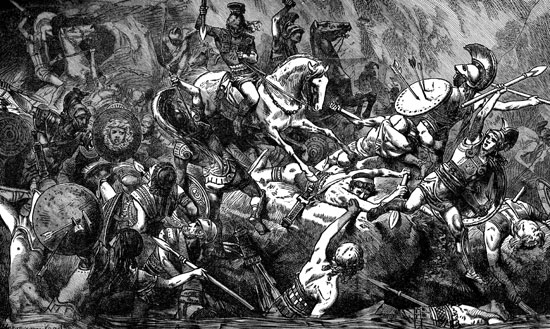
Bronze-tipped arrows fell like rain upon both sides as the two armies approached each other, the missiles gradually thinning out the ranks of both sides until the quivers of the archers were empty and the two hosts closed to fight hand-to-hand with spears and daggers. Of all the battles he had taken part in during his long and exceedingly eventful life, Cyrus had never yet seen one quite as bloody as this. For several hours the fighting continued, with neither side willing to give even an inch of ground; but eventually the superior numbers of the Scythians began to tell as the tide of battle swung slowly in their favour. All too late the Persians realized their predicament as the tide of battle turned against them; it was too late now to do anything but try to withdraw with whatever men could escape, as the Massagetae now attempted to encircle the rapidly-dwindling remnant of the Persian host, which suddenly broke and ran. Massagetae cavalry, armed with brass-tipped lances, now chased down their fleeing foes as they took their revenge for their fallen prince and his comrades; almost all of Cyrus’ remaining troops were slaughtered as they ran; although the Great King himself refused to run and died nobly, facing the enemy bravely and fighting to the last.

When the battle was finished, Tomyris had some of her men search the battlefield for the body of Cyrus. While she was waiting for their return, she constructed a wooden frame from which she suspended skins, which she then greased to make them waterproof; thus forming a sort of leather basin. This she then filled with human blood taken from the corpses of her dead enemies; and when the body of Cyrus was finally discovered she had it beheaded, and, holding the head of her enemy by its long dark hair in her right hand, she dipped it in the blood-filled leather basin, saying as she did so, “Well then Cyrus! I live and have conquered you in battle, and yet by you I am ruined, for you took my son by guile; but thus I make good my threat, and give you your fill of blood.”

THE END

Leave a Comment

“Cyrus” by Theseustoo: Chapter 20, Part 2

09 Saturday Oct 2010

Posted by Therese Trouserzoff in Astyages, Cyrus the Great: Chronicles

≈ 40 Comments

Tags

Cyrus, Cyrus the Great, Massagetae, Tomyris

A herald brings word from the Scythian Queen, Tomyris...

CHAPTER 20, Part 2:

Cyrus had quickly inspected the territory of the Getae and then pushed on towards the Araxes, where he had made camp and settled down to wait for Tomyris’ response to his proposal. He did not have to wait long; indeed, he was surprised by how soon the baggage train returned to him. He had not been expecting to hear from this particular herald again for several weeks at least, while the herald, in his role as matchmaker, paid court to the Massagetae’s monarch for him. Yet here he was already, Cyrus thought with surprise as he watched the herald dismounting from the lead wagon of his baggage train. The herald then immediately strode through the camp to find Cyrus as usual, in conference with his officers around the campfire in front of his pavilion… 

“Well now! What’s this?” Cyrus demanded as he saw the herald approach, “Why have you returned from your mission so soon? Is Tomyris so eager to accept my proposal?” 

“I’m afraid not, your majesty.” The messenger replied in sorrowful tones, “Tomyris said that she is aware that it is her kingdom, and not herself, that you want. She forbade us to approach and told us to return with your gifts.” 

“Unfortunate;” Cyrus said, with genuine remorse, “I had hoped that with her aid we could gain useful allies among the other Scythian tribes. But it seems as if the unity I seek can only be won by force.” He turned to his generals, “Pactyas! Have carpenters build towers on the boats so our archers may give cover to our men as they build a bridge across this river; we shall make Tomyris regret her coldness towards me! A king is not to be spurned so easily!” 

Although he had said nothing of it earlier, there was one other reason he had wanted to be near the river Araxes, which formed the border of the Massagetae territory: should Tomyris fail to accept his offer of marriage and alliance, he would be in a good position to seize control of the Scythians’ territory with his armies. His search for a queen could wait awhile; and who knows, he thought optimistically, perhaps Tomyris may change her mind eventually. Once conquered, he knew; for he had seen it happen; even dire enemies sometimes turned into the best of friends in spite of themselves. His friendship with Croesus bore witness to this truth; and Cyrus hoped that this might also turn out to be the case with Tomyris, as even this would make his rule over the Massagetae easier. Cyrus knew that, in the eyes of her people, it would give his sovereignty much more legitimacy if he were to marry their queen, even if he did so after he had conquered her; and that would not only make them much easier to govern; but would gain him allies, rather than enemies, among the other Scythian tribes. Otherwise he knew he would have to kill her; and any offspring she may have. 

*** ***** *** 

Soon after the return of Cyrus’ matchmaker another herald arrived, this time bearing the banner of Tomyris, Queen of the Massagetae. The guards realized instantly that Cyrus would most certainly wish to speak with this new emissary, and let him pass immediately; one of the pair politely escorted him through the labyrinthine chaos of their camp and into the presence of the Persian king; then waited to escort him back out again. 

“Well then herald,” Cyrus said, recognizing the colours of Queen Tomyris on the standard the herald bore, “has your queen seen the folly of refusing my proposal and changed her mind? Does she now see the wisdom of accepting the alliance I offered her?” 

“No, great Lord,” the herald replied, “but she bids me to give you these words: ‘King of the Medes, cease to press this enterprise, for you cannot know if what you are doing will be of real advantage to you. Be content to rule your own kingdom in peace, and allow us to reign over the countries that are ours to govern. However, as I know you will not choose to listen to this counsel, since there is nothing you desire less than peace and quiet, come on then, if you are so eager to meet the Massagetae in arms, leave your useless toil of bridge-building; we shall retire three days’ march from the river bank so you may come across with your soldiers; or, if you prefer to give us battle on your side of the river, retire yourself an equal distance.’” 

“A spirited message, herald!” Cyrus replied, showing no indication of having taken offence, “Your queen has many admirable qualities. It is truly a pity she has chosen to resist us when she could have ruled the world by my side. You may go now; I will discuss Tomyris’ offer with my chieftains and decide upon which side of the river we shall give her battle. Presently I shall send a herald with our answer.” 

“Very well, great Lord; farewell.” The herald nodded a curt bow to Cyrus from the saddle of his horse and then deftly turned his animal around and followed the guard back out of the camp. 

“Well then,” Cyrus said, addressing his officers when the herald had left, “you all heard Tomyris’ response to my proposal… What say you? Shall we give them battle on their side of the river… or on ours?” 

His officers were quiet for some moments as each man present considered the situation; eventually it was Hystaspes who finally looked up and said, “Sire, it seems to me that it is better to fight them on this side of the river, where we are at least familiar with the terrain… We know nothing at all of the terrain on the other side of the river…” This was a good point, thought Cyrus; this was the first time any Persian or Mede had conquered territory as far east as the land of the Getae. Even on this side of the river their familiarity with the terrain was only recently acquired and still incomplete. No-one liked the thought of fighting an unknown enemy on their own ground with no advance knowledge of the terrain. 

What Hystaspes had said made a great deal of sense. As Cyrus was considering his words, Pactyas spoke up in support of the general, “Hystaspes is right, your majesty! We know nothing at all about the other side of this river. Let us fight here, on ground we know!” At this there were shouts of “Hear, hear!”, “Aye!”, and “Fight them here!” from all of the officers present. When Cyrus saw that all of his officers were unanimously agreed, he said, “Very well! Since we are all agreed, we shall retire three days distance and allow the Massagetae to cross! Herald!” 

A messenger quickly stepped forward and, with a smart bow, instantly prepared his mind to memorise any message with which his king might honour him. But just as Cyrus was about to give him his instructions, a voice interrupted him. It was Croesus; as a slave, he had held his tongue while the officers considered the king’s question and until they had said their piece. Now he stepped boldly forward however and with a deep bow of apology to the officers for his interruption, addressed Cyrus, “My king! I promised you long ago that, as god has given me into your hands, I would protect your house from danger to the best of my ability.” 

The king nodded his acceptance not only of the truth of this proposition but also of the implicit reassurance that what Croesus was about to say would be both truthful and in Cyrus’ own best interest. Croesus continued, “The bitterness of my own sufferings has taught me always to be keen-sighted of dangers. If you deem yourself an immortal, and your army an army of immortals, my advice will doubtless be wasted upon you.” Here Cyrus rolled his eyes impatiently at this gentle reminder not only of his own humanity; but also of the humanity of his thousand-strong regiment of personal bodyguards whom he’d recently given the nickname, ‘the Immortals’. 

Yet, although Cyrus was by now persuaded that he was indeed the Son of Heaven, he was nonetheless still perfectly well aware of his physical mortality; this needless reminder irritated him; although it did remind him of one task which needed attending to before he finally engaged the Scythians. 

Observing his irritation Croesus continued quickly, “But if you feel yourself to be a man, and a ruler of men, then first lay this to heart, that there is a wheel on which the affairs of men revolve, and its movement forbids the same man to be always fortunate.” Again Cyrus silently nodded his agreement as again he recognized the wisdom of Croesus’ statement. From his own experience he knew that a slave could become a king; and from his own part in Croesus’ sad history, he also knew that a king could just as easily become a slave. Even the Son of Heaven could not afford to completely throw caution to the winds. 

Encouraged once more, Croesus continued softly, “Now, my judgment runs counter to the judgment of your other counsellors.” Here he waited for an instant; almost expecting objections from Cyrus’ officers; but they remained silent and waited to hear what Croesus had to say, for they were all as convinced as Cyrus was of this man’s wisdom and holiness; as Croesus continued, “For if you allow the enemy into your country, consider the risk you run! Lose the battle, and your whole kingdom is lost; for assuredly, the Massagetae, if they win, will not return to their homes, but will push forward against the states of your empire.” 

Cyrus had not thought about it that way; he imagined what he would do if he were in the Massagetae queen’s situation. He decided that Croesus; this king who had now become his own personal slave, and who had already shown himself to be the wisest of all mortals and his best advisor; was once again perfectly correct. 

“There is much sense in what you say, Croesus…” Croesus saw his advantage and pressed his point, “Even if you win the battle, you gain far less here than if you were across the river, where you can follow up your victory.” 

Cyrus’ eyes widened as the truth of this statement struck him; his mind already working rapidly; conceiving just how he might take advantage of such a situation, even as Croesus described it to him, “Rout their army on the other side of the river, and you may push at once into the heart of their country.” The holy man looked Cyrus in the eye as he added, with something of a sparkle in his own eyes, “Besides, would it not be an intolerable disgrace for Cyrus, the son of Cambyses, to yield ground to a mere woman? My advice therefore, is that we cross the river, and push forward as far as they fall back, then seek to get the better of them by stratagem.” 

Cyrus was again astounded by the wisdom of Croesus’ words. Again he was absolutely correct; of course it would do his reputation irreparable damage if it should ever be said about him that he, the Son of Heaven, retreated from a mere woman’s threats. 

“Croesus,” he said, his growing admiration for the old man showing clearly in his tone of voice, “Once again your words are filled with wisdom! And I’ve no doubt you already have a plan…?” 

The old man did not disappoint him, ”Sire,” he said, “I hear the enemy are unacquainted with the good things on which the Persians live and have never tasted the great delights of life.” Cyrus nodded; he had heard this from his own spies too. Croesus continued, “Let us prepare a feast for them in our camp; let many sheep be slaughtered; let the wine-cups be filled and let all manner of exquisite dishes be prepared and then, leaving behind us our worst troops to make a show of defence, let us fall back towards the river. Unless I am very much mistaken, when they see all the good food and drink set out they will forget everything else and fall to. Then all that remains is for us to do our parts manfully.” 

Again the king was delighted with Croesus’ suggestion. Smiling at the old man with genuine affection, he said, “Croesus, I am so happy that I spared your life and that I now have you with me… and I’m glad that you’re on my side, for I would not wish to fight another enemy such as you!” Then he turned to a nearby herald and said, “Herald, you are to inform Queen Tomyris that we shall accept her offer; she may retire while we cross the river.” Then, as the herald left to obey him, Cyrus turned once more to Croesus, and said, “Croesus, my friend, I have decided that you are far too valuable an asset to risk in this engagement, so I’m sending you back to Agbatana with my son Cambyses.” 

This was the other task of which Croesus’ quip about his humanity had also reminded him. Tomyris had been quite correct; he was really more interested in her territory than in her; yet he would have been willing to make her his wife, as the mother of his son had died some years ago, and now he sorely missed having a partner who could deal with all those things which would only yield to a woman’s touch. Especially he thought, a little ruefully, where those things concerned a son who was nearing manhood. Indeed, Cyrus had brought the young prince with him on this expedition to show him something of the world and to give him some first-hand knowledge of the territory he was destined to rule. 

Turning now to this son, Cambyses, who was present at all Cyrus’ staff-meetings with his officers on this expedition, he took a large golden signet ring from his left hand and, looking solemnly into his son’s eyes, gave him the ring, saying, “Cambyses, my son; in front of these witnesses, I make you my heir; I cannot afford to risk losing you in this battle either; you are to go with Croesus to Agbatana… and if anything should happen to me in this coming struggle you are to respect him as you would your own grandfather, and treat him well, for we already owe much to his sound advice!” 

Cambyses nodded obediently, and then, smiling broadly, he turned to Croesus, delighted with this opportunity to learn more about the world by spending time in this wise old man’s company. What stories he would be able to tell! Like most children of his age, Cambyses virtually lived for stories. The pair took their leave of their king to prepare for their journey back to Agbatana, and then Cyrus ordered his generals to prepare to cross the river. 

*** ***** ***

Cyrus by Theseustoo

12 Sunday Sep 2010

Posted by Therese Trouserzoff in Astyages, Cyrus the Great: Chronicles

≈ 17 Comments

Chapter 19, Part 2:

Cyrus receives Tomyris' herald...

Cyrus had quickly inspected the territory of the Getae and then pushed on towards the Araxes, where he had made camp and settled down to wait for Tomyris’ response to his proposal. He did not have to wait long; indeed, he was surprised by how soon the baggage train returned to him. He had not been expecting to hear from this particular herald again for several weeks at least, while the herald, in his role as matchmaker, paid court to the Massagetae’s monarch for him. Yet here he was already, Cyrus thought with surprise as he watched the herald dismounting from the lead wagon of his baggage train. The herald then immediately strode through the camp to find Cyrus as usual, in conference with his officers around the campfire in front of his pavilion…

“Well now! What’s this?” Cyrus demanded as he saw the herald approach, “Why have you returned from your mission so soon? Is Tomyris so eager to accept my proposal?”

“I’m afraid not, your majesty.” The messenger replied in sorrowful tones, “Tomyris said that she is aware that it is her kingdom, and not herself, that you want. She forbade us to approach and told us to return with your gifts.”

“Unfortunate;” Cyrus said, with genuine remorse, “I had hoped that with her aid we could gain useful allies among the other Scythian tribes. But it seems as if the unity I seek can only be won by force.” He turned to his generals, “Pactyas! Have carpenters build towers on the boats so our archers may give cover to our men as they build a bridge across this river; we shall make Tomyris regret her coldness towards me! A king is not to be spurned so easily!”

Although he had said nothing of it earlier, there was one other reason he had wanted to be near the river Araxes, which formed the border of the Massagetae territory: should Tomyris fail to accept his offer of marriage and alliance, he would be in a good position to seize control of the Scythians’ territory with his armies. His search for a queen could wait awhile; and who knows, he thought optimistically, perhaps Tomyris may change her mind eventually. Once conquered, he knew; for he had seen it happen; even dire enemies sometimes turned into the best of friends in spite of themselves. His friendship with Croesus bore witness to this truth; and Cyrus hoped that this might also turn out to be the case with Tomyris, as even this would make his rule over the Massagetae easier. Cyrus knew that, in the eyes of her people, it would give his sovereignty much more legitimacy if he were to marry their queen, even if he did so after he had conquered her; and that would not only make them much easier to govern; but would gain him allies, rather than enemies, among the other Scythian tribes. Otherwise he knew he would have to kill her; and any offspring she may have.

*** ***** ***

Soon after the return of Cyrus’ matchmaker another herald arrived, this time bearing the banner of Tomyris, Queen of the Massagetae. The guards realized instantly that Cyrus would most certainly wish to speak with this new emissary, and let him pass immediately; one of the pair politely escorted him through the labyrinthine chaos of their camp and into the presence of the Persian king; then waited to escort him back out again.

“Well then herald,” Cyrus said, recognizing the colours of Queen Tomyris on the standard the herald bore, “has your queen seen the folly of refusing my proposal and changed her mind? Does she now see the wisdom of accepting the alliance I offered her?”

“No, great Lord,” the herald replied, “but she bids me to give you these words: ‘King of the Medes, cease to press this enterprise, for you cannot know if what you are doing will be of real advantage to you. Be content to rule your own kingdom in peace, and allow us to reign over the countries that are ours to govern. However, as I know you will not choose to listen to this counsel, since there is nothing you desire less than peace and quiet, come on then, if you are so eager to meet the Massagetae in arms, leave your useless toil of bridge-building; we shall retire three days’ march from the river bank so you may come across with your soldiers; or, if you prefer to give us battle on your side of the river, retire yourself an equal distance.’”

“A spirited message, herald!” Cyrus replied, showing no indication of having taken offence, “Your queen has many admirable qualities. It is truly a pity she has chosen to resist us when she could have ruled the world by my side. You may go now; I will discuss Tomyris’ offer with my chieftains and decide upon which side of the river we shall give her battle. Presently I shall send a herald with our answer.”

“Very well, great Lord; farewell.” The herald nodded a curt bow to Cyrus from the saddle of his horse and then deftly turned his animal around and followed the guard back out of the camp.

“Well then,” Cyrus said, addressing his officers when the herald had left, “you all heard Tomyris’ response to my proposal… What say you? Shall we give them battle on their side of the river… or on ours?” His officers were quiet for some moments as each man present considered the situation; eventually it was Hystaspes who finally looked up and said, “Sire, it seems to me that it is better to fight them on this side of the river, where we are at least familiar with the terrain… We know nothing at all of the terrain on the other side of the river…”

This was a good point, thought Cyrus; this was the first time any Persian or Mede had conquered territory as far east as the land of the Getae. Even on this side of the river their familiarity with the terrain was only recently acquired and still incomplete. No-one liked the thought of fighting an unknown enemy on their own ground with no advance knowledge of the terrain. What Hystaspes had said made a great deal of sense. As Cyrus was considering his words, Pactyas spoke up in support of the general, “Hystaspes is right, your majesty! We know nothing at all about the other side of this river. Let us fight here, on ground we know!” At this there were shouts of “Hear, hear!”, “Aye!”, and “Fight them here!” from all of the officers present. When Cyrus saw that all of his officers were unanimously agreed, he said, “Very well! Since we are all agreed, we shall retire three days distance and allow the Massagetae to cross! Herald!”

A messenger quickly stepped forward and, with a smart bow, instantly prepared his mind to memorise any message with which his king might honour him. But just as Cyrus was about to give him his instructions, a voice interrupted him. It was Croesus; as a slave, he had held his tongue while the officers considered the king’s question and until they had said their piece. Now he stepped boldly forward however and with a deep bow of apology to the officers for his interruption, addressed Cyrus, “My king! I promised you long ago that, as god has given me into your hands, I would protect your house from danger to the best of my ability.” The king nodded his acceptance not only of the truth of this proposition but also of the implicit reassurance that what Croesus was about to say would be both truthful and in Cyrus’ own best interest.

Croesus continued, “The bitterness of my own sufferings has taught me always to be keen-sighted of dangers. If you deem yourself an immortal, and your army an army of immortals, my advice will doubtless be wasted upon you.” Here Cyrus rolled his eyes impatiently at this gentle reminder not only of his own humanity; but also of the humanity of his thousand-strong regiment of personal bodyguards whom he’d recently given the nickname, ‘the Immortals’. Yet, although Cyrus was by now persuaded that he was indeed the Son of Heaven, he was nonetheless still perfectly well aware of his physical mortality; this needless reminder irritated him; although it did remind him of one task which needed attending to before he finally engaged the Scythians. Observing his irritation Croesus continued quickly, “But if you feel yourself to be a man, and a ruler of men, then first lay this to heart, that there is a wheel on which the affairs of men revolve, and its movement forbids the same man to be always fortunate.” Again Cyrus silently nodded his agreement as again he recognized the wisdom of Croesus’ statement. From his own experience he knew that a slave could become a king; and from his own part in Croesus’ sad history, he also knew that a king could just as easily become a slave. Even the Son of Heaven could not afford to completely throw caution to the winds.

Encouraged once more, Croesus continued softly, “Now, my judgment runs counter to the judgment of your other counsellors.” Here he waited for an instant; almost expecting objections from Cyrus’ officers; but they remained silent and waited to hear what Croesus had to say, for they were all as convinced as Cyrus was of this man’s wisdom and holiness; as Croesus continued, “For if you allow the enemy into your country, consider the risk you run! Lose the battle, and your whole kingdom is lost; for assuredly, the Massagetae, if they win, will not return to their homes, but will push forward against the states of your empire.” Cyrus had not thought about it that way; he imagined what he would do if he were in the Massagetae queen’s situation. He decided that Croesus; this king who had now become his own personal slave, and who had already shown himself to be the wisest of all mortals and his best advisor; was once again perfectly correct. “There is much sense in what you say, Croesus…” Croesus saw his advantage and pressed his point, “Even if you win the battle, you gain far less here than if you were across the river, where you can follow up your victory.” Cyrus’ eyes widened as the truth of this statement struck him; his mind already working rapidly; conceiving just how he might take advantage of such a situation, even as Croesus described it to him, “Rout their army on the other side of the river, and you may push at once into the heart of their country.”

The holy man looked Cyrus in the eye as he added, with something of a sparkle in his own eyes, “Besides, would it not be an intolerable disgrace for Cyrus, the son of Cambyses, to yield ground to a mere woman? My advice therefore, is that we cross the river, and push forward as far as they fall back, then seek to get the better of them by stratagem.” Cyrus was again astounded by the wisdom of Croesus’ words. Again he was absolutely correct; of course it would do his reputation irreparable damage if it should ever be said about him that he, the Son of Heaven, retreated from a mere woman’s threats. “Croesus,” he said, his growing admiration for the old man showing clearly in his tone of voice, “Once again your words are filled with wisdom! And I’ve no doubt you already have a plan…?”

The old man did not disappoint him, ”Sire,” he said, “I hear the enemy are unacquainted with the good things on which the Persians live and have never tasted the great delights of life.” Cyrus nodded; he had heard this from his own spies too. Croesus continued, “Let us prepare a feast for them in our camp; let many sheep be slaughtered; let the wine-cups be filled and let all manner of exquisite dishes be prepared and then, leaving behind us our worst troops to make a show of defence, let us fall back towards the river. Unless I am very much mistaken, when they see all the good food and drink set out they will forget everything else and fall to. Then all that remains is for us to do our parts manfully.” Again the king was delighted with Croesus’ suggestion. Smiling at the old man with genuine affection, he said, “Croesus, I am so happy that I spared your life and that I now have you with me… and I’m glad that you’re on my side, for I would not wish to fight another enemy such as you!” Then he turned to a nearby herald and said, “Herald, you are to inform Queen Tomyris that we shall accept her offer; she may retire while we cross the river.” Then, as the herald left to obey him, Cyrus turned once more to Croesus, and said, “Croesus, my friend, I have decided that you are far too valuable an asset to risk in this engagement, so I’m sending you back to Agbatana with my son Cambyses.” This was the other task of which Croesus’ quip about his humanity had also reminded him. Tomyris had been quite correct; he was really more interested in her territory than in her; yet he would have been willing to make her his wife, as the mother of his son had died some years ago, and now he sorely missed having a partner who could deal with all those things which would only yield to a woman’s touch. Especially he thought, a little ruefully, where those things concerned a son who was nearing manhood. Indeed, Cyrus had brought the young prince with him on this expedition to show him something of the world and to give him some first-hand knowledge of the territory he was destined to rule. Turning now to this son, Cambyses, who was present at all Cyrus’ staff-meetings with his officers on this expedition, he took a large golden signet ring from his left hand and, looking solemnly into his son’s eyes, gave him the ring, saying, “Cambyses, my son; in front of these witnesses, I make you my heir; I cannot afford to risk losing you in this battle either; you are to go with Croesus to Agbatana… and if anything should happen to me in this coming struggle you are to respect him as you would your own grandfather, and treat him well, for we already owe much to his sound advice!” Cambyses nodded obediently, and then, smiling broadly, he turned to Croesus, delighted with this opportunity to learn more about the world by spending time in this wise old man’s company. What stories he would be able to tell! Like most children of his age, Cambyses virtually lived for stories. The pair took their leave of their king to prepare for their journey back to Agbatana, and then Cyrus ordered his generals to prepare to cross the river. *** ***** ***

Cyrus

28 Saturday Aug 2010

Posted by astyages in Astyages, Cyrus the Great: Chronicles

≈ 13 Comments

Babylon 


CHAPTER 19: The Massagetae  

Wasting no time, Cyrus quickly and firmly established his rule in Babylon. The Babylonian king, Labynetus and all of his family were quietly but efficiently killed; he could not risk the chance of an heir to the throne gathering local sentiment and rising against him. Labynetus’ most senior officers were also executed; but those of lower ranks were given a similar choice to the one which Pactyas had been given. Although they had not been given the choice, King Labynetus and his executive officers, even if they had, would most certainly have chosen to die rather than to live as slaves in the land they had once ruled. Most of his lower-ranked officers, however, chose to live; and immediately swore fealty to Cyrus with the most sacred of blood oaths in the most sacred temple in the land; the temple on the very top of their tower; where they sacrificed their own blood by cutting their upper arms and offering it to Cyrus to drink; and besides this sacrifice they also sacrificed a dozen of every kind of sacrificial animal. Most of them were even allowed to continue in their previous offices.  

By thus using the Assyrians’ own bureaucracy and official institutions, Cyrus saved much time and effort and greatly facilitated the management of the general populace; having reasoned that they would respond to the instruction of their own bureaucrats and officials more readily than they would to a foreign authority. Essentially, from the perspective of an ordinary Babylonian citizen, all that had changed, apart from the fact that Persians now guarded and policed the city, was that their own bureaucrats and city officers now reported to supervisors placed over them all by Cyrus.  

To ensure that none of his new Babylonian subjects rebelled against him he immediately installed a large permanent garrison of sufficient Medes and Persians to ensure that any such attempt would be swiftly and thoroughly suppressed. As soon as he had established order in his new capital Cyrus received a messenger from Harpagus. At the same time a second messenger arrived from the land of the Getae, who were currently being quickly assimilated into the rapidly-expanding Persian Empire in the east. These messengers were escorted into the war-room of the Great King’s palace, which Cyrus had taken, along with the title of Great King, for himself, following the tradition of Babylon’s previous rulers. This would be his new centre of operations, he decided as he surveyed, with great satisfaction, the most magnificent palace he had ever seen.  

“So, what news is there from Harpagus?” Cyrus asked the herald, “How goes it in Ionia and Aeolia?”  

“Your majesty’s devoted servant, Harpagus, sends word that all has gone as you would wish,” the herald began, with an ingratiating smile and a deep bow. “The Prienians who revolted against your majesty have been taken and sold into slavery;” Pactyas reddened slightly at this reminder of his own rebellion against Cyrus, but the king said nothing and the messenger continued, “the Phocaeans he defeated by building earthen mounds to overtop the walls the Tartessian king Arganthonius had built for them, but the Phocaeans fled the city in their ships before they could be captured; in spite of the mild terms Harpagus had offered them; and the people of Teos did the same.”  

Cyrus merely nodded his appreciation of this news; the strategic position and the territorial expansion represented by these two coastal cities, as well as the access their ports now gave him to their shipping lanes and trade routes was, he decided, of more use to him than their inhabitants, whom he regarded as no great loss. Taking a deep breath the herald continued, “When the men of Xanthus were finally overpowered, they gathered all their women, children and slaves together within the citadel and burned them all to death, rather than yield; then they fought to the death and were all slaughtered.”  

The news of this massacre saddened Cyrus; he felt that the Xanthians were an ancient and very noble people; they had really deserved a better fate; he had even harboured some hope that they might join him voluntarily. He had little time to dwell on this sad thought however, as the herald was still speaking, “Thus continental Ionia was again reduced to servitude; and when the Ionians of the islands saw their brethren upon the mainland thus subjugated, they too surrendered to your majesty, dreading the same fate. After he subdued Ionia and Aeolia, Harpagus forced them to serve in his army; then he defeated the Carians, the Caunians and the Lycians.”  

“Wonderful!” Cyrus declared, elated by such tremendous successes. Persian territory now stretched all the way to the eastern coast of the Aegean Sea and right around that coast from Troy as far as the Sinai. He was even beginning to contemplate overrunning the Sinai and invading Egypt; but first he wanted to secure his frontiers from the wild, nomadic Scythian tribes to the north and east of his realm. If he could win over the Massagetae, he thought, it could gain him many important allies among the other Scythian tribes and this, he knew, would save him many troublesome years. Cyrus’ plans for the expansion of his empire seemed to happen perfectly naturally in an uninterrupted flow, one after the other; just as his military victories had.  

Now that he had a vision of a united world, he was perfectly prepared to do whatever was necessary to achieve it. With this latest news from Harpagus; on the verge of subduing both the Scythians on the eastern and the Egyptians on the western extremities of his empire; Cyrus felt that his most precious goal was at last in sight. His general had achieved far more even than Cyrus had either ordered or expected and still remained his true and faithful servant; his tribute wagons arrived punctually every year just after harvest-time, together with a complete record of Harpagus’ own accounts, continually replenishing Cyrus’ granaries and the royal treasury. Overall, Cyrus decided, when the herald fallen silent, that he was quite delighted with Harpagus’ progress. Now, he thought, would be the perfect time to give him his reward.  

Keeping Harpagus happy would not only reward his best friend and most trusted ally, but it would also ensure the safety of his western region, Cyrus thought, while I subdue the east. Harpagus already acted as Cyrus’ viceroy in the western region, but Cyrus decided that now was the right time to make his authority permanent. Handing the herald a small purse full of coins as a reward for his services, Cyrus said, “When you return, you may tell Harpagus that he may now choose a capital for himself and use the title of Satrap of Ionia and Aeolia…”  

Then, turning to the second messenger, who had just returned from the land of the Getae, he asked, “Now, what news from the east?”  

“Bactria, the Sacae and the Getae have been completely subdued, majesty.” the messenger reported, “We now hold all the territory east of Babylon as far as the Araxes. Across this river is the land of the Massagetae. Lord, we have heard that their king died some months ago; his widow, Tomyris has ascended their throne…”  

Cyrus was intrigued, “Indeed? Interesting…” he said pensively; a few moments later he asked, “What is this queen like?”  

“Scythian women are as fierce as their men, Lord…” the herald responded, “And the Massagetae are among the most warlike tribes of their race; but it is said that she is a great beauty.”  

“The territory of the Massagetae is vast; and rich…” Cyrus mused, almost to himself, “…and I have need of a queen…” After a few moments of thoughtful silence, he turned to the messenger once again, ”You are to take generous gifts of gold, silver and purple to this queen and, acting as my go-between, you must court her for me.” The herald nodded as the king continued, speaking now primarily for the benefit of Pactyas, Hystaspes and the other officers who were present, “If possible, I’ll marry this queen and win her territory peacefully!” Then he turned again to the herald, to give him his final instructions, “Inform Tomyris of my victories and tell her that it is my destiny as the Son of Heaven to unite all the tribes and nations of the whole world into one vast empire which she may rule beside me!” For a very brief moment a dreamy look glazed Cyrus’ eyes and his voice almost faltered as he dared finally to give voice to his greatest ambition.  

The generals too were awed at the magnificence of the vision which had just been revealed to them. The moment passed quickly, however, and the vision was gone and Cyrus and his generals were all businesslike once again as he continued, “In the meantime, Hystaspes; have the army prepare to march; I wish to inspect the Getae territory and I have a desire to see the Araxes.” Then, almost as an afterthought, he added, “And if Tomyris accepts my proposal, I want to be close at hand, so that I will not seem tardy; like a reluctant suitor!”  

*** ***** ***  

Cyrus: Chapter 19

31 Saturday Jul 2010

Posted by Therese Trouserzoff in Cyrus the Great: Chronicles

≈ 9 Comments

Babylon

Cyrus stood on a hill which overlooked his own most recent excavations. The huge basin dug by Nitocris had all but drained by the time Cyrus arrived in Babylonia; the lake was now just a huge grassy basin with a reedy marsh in its bottom. Cyrus took advantage of this and, following Queen Nitocris’ example, excavated a channel from the river into the near-empty basin thus turning the course of the river so that it flowed into the emptied lake once more.

“Your majesty’s plan must have been divinely inspired!” Pactyas enthused, as he surveyed Cyrus’ latest excavations with the monarch, “We have turned the Euphrates into the basin; the river has now sunk so low that the stream is now easily fordable. Your armies will now be able to enter the city Lord, and surprise the enemy!”

Cyrus was pleased; the praise was not undeserved; using only the unwarlike part of his host, he had turned the very strength of Babylon’s own defences against her. Cyrus was also pleased with Pactyas, who, with his quick and adaptable mind had proven to be as excellent a supervisor for Cyrus’ building projects as he was an efficient leader of the military forces which Cyrus had placed under his command.

“Thank you Pactyas; you have done very well.” Cyrus responded; giving Pactyas due credit for the organizational skills he’d displayed working out the logistical requirements for Cyrus’ earthworks. Then with an amused look on his face he added, “I wonder what the Babylonians will think when they realize that they have been defeated in part by the earthworks of their dead queen, Nitocris; for had she not dug the basin for this lake, we would not have been able to divert the river so easily!”

Pactyas appreciated the irony,

“Indeed, your majesty! It is as if the gods themselves have prepared your path and everything you need to accomplish your purposes in advance!”

In Pactyas’ mind, this latest plan not only revealed Cyrus’ military genius; it also confirmed Pactyas’ growing certainty that his new master could be none other than the Son of Heaven; the living incarnation of Merodach.

“Ea be praised for his wisdom!” Cyrus exclaimed piously, “We shall sacrifice generously to him and to his consort, Enlil, as soon as we have taken the city!”

Just as Cyrus had planned, the water-level had dropped sufficiently now for Hystaspes and his men to wade along the riverbed and directly into the heart of the city. Hystaspes knew that the smaller brass gates which opened onto the river were the city’s weakest points; and he had anticipated having to fight hard for control of these points of entry into the city. He was absolutely astonished to discover that they were not only unguarded, but also unlocked, thus making it even easier than they had expected to get inside Babylon’s much-vaunted walls and into the very heart of the city. The guards who would normally have been on duty had been so eager to attend the city’s religious festival that they had not only left their posts; they had also forgotten to secure them.

When Cyrus had first assaulted the city, so confident were the Babylonians in the strength of their city’s defences that they had all simply withdrawn behind the inner wall and into the centre of the city where they carried on life more or less as normal. As the winter progressed, however, Cyrus’ army was having a hard time living off the land in the surrounding region while they waited for supply lines to be established between them and Persia.

By way of amusing themselves, occasionally Babylonian guards or other members of the citizenry would appear at the top of the walls, and, behaving rather like the rudest of the tourists who came to climb Babylon’s famous tower, they would gaze out at the besieging army and taunt them by flinging occasional items of food down at their enemy. Then, laughing hysterically at what they invariably considered to be their own remarkable wit, they would disappear back into the city’s interior; quite certain that these foolish Persians would be starved, frozen to death, or else gone by the time they should next choose to venture out again to mock them. But most of the time they stayed deep inside the city’s interior, where they felt completely safe; protected by height and strength of their city’s impregnable walls.

Throughout the siege the Assyrians deep inside the city had remained blissfully ignorant of Cyrus and his earthworks. Even when the final breakthrough between the river and the basin was achieved and, the water level in the river started to be drop visibly and rapidly, there were no Assyrian guards there to observe the phenomenon or to wonder at its nature.

As it happened, on the day that Cyrus’ earthworks were finally completed and the river was finally turned into Nitocris’ basin; when the water-level in the river had finally sunk low enough to allow the army to walk along the riverbed; the Assyrians were deep in the heart of the city celebrating the largest and most important religious festival of their ritual year; the week-long annual grand sacrifice to Baal-Ammon known as the Feast of the Dead.

So intent were they upon celebrating their feast that no-one even realized that the water level of their own river had dropped severely. Nor did anyone realize that the guards, not anticipating any kind of approach whatsoever from the river, had forgotten to lock the low brass gates which gave access to and from the river; until it was far too late. When Hystaspes’ forces thus caught the enemy unarmed in the midst of their celebrations, they were all taken completely by surprise and easily defeated.

*** ***** ***

Cyrus, by Theseustoo

18 Sunday Jul 2010

Posted by Therese Trouserzoff in Cyrus the Great: Chronicles

≈ 5 Comments

Tags

Cyrus, greek philosphy

Cyrus

by

Theseustoo

Chapter 18, Part 2:

Bablyonian Soldiers

Babylon is an ancient city which has, over the course of centuries been invaded and inhabited by several peoples, including the Sumerians, the Chaldaeans and more recently, the Assyrians. Each in their own turn, these various peoples and their sovereigns contributed successively to the building of Babylon’s walls and to the adornment of her temples. Among the most famous builders of all these monarchs were two queens. The first of these queens, Semiramis, reigned five generations before Nitocris, the later princess; who was also the mother of the current Assyrian king, Labynetus.

Semiramis raised certain very famous embankments in the level plain near Babylon to control the river, which before her time used to overflow its banks; often causing serious floods throughout the region. This taming of the Euphrates by Semiramis had ensured that crops would not be damaged by floods; ensuring good harvests from all the farms in the region. This had laid the foundation for the wealth and self-sufficiency Babylon now enjoyed.

But the later of these two queens, Nitocris, was even wiser than her predecessor. Observing the great power and the restless enterprise of the Medes, who in their revolt against their Assyrian overlords, had captured many Assyrian cities, including Nineveh, Nitocris anticipated that she too, would be attacked in her turn, and immediately she had spared neither herself nor her Babylonian subjects in the effort to strengthen her empire’s defences.

Originally the River Euphrates, which flows through the very heart of Babylon, had run in a straight course toward the city, but by excavating a series of looping channels some distance upstream, Nitocris made it wind so much that, as a vessel sails along the river it comes in sight of the village of Ardericea in Assyria three separate times on three different days. Then she dug a huge basin for a lake far upriver from Babylon right beside the stream. This basin was so broad that its circumference measured four hundred and twenty furlongs. The soil she had excavated from this basin was then used to build the broad and high embankments which lined the waterside in Babylon along both sides of the Euphrates.

When Nitocris had finished her excavations, she brought a great many large stones and bordered the entire margin of the reservoir she had thus created with them. The combined effect of these excavations was that, as the river was made to twist and turn, its current was considerably slowed. By this means, however, not only had she tamed the river, but she had also rendered any river-borne invasion too circuitous to be practicable. Such a slow-moving fleet would be ‘sitting ducks’ for artillery attacks from the riverbanks.

The only alternative to a naval invasion was an overland approach across the broad plains through which the river Euphrates now flowed so circuitously that it would have to be bridged – for it was still too swift and deep to be forded – at who knew how many points? And either way, even at the end of the voyage it would be necessary to skirt the lake and thus any invader would be forced to take a long and circuitous route before approaching the city itself. Such a route would give great advantage to the skirmishing style of warfare practiced by the Assyrian horse-archers. By Cyrus’ time, however, these had been mostly destroyed by the Median spearmen of Cyaxares and Astyages.

By now, what precious few horse-archers Labynetus still had left he kept with him in the heart of the city; safely inside their city barracks. Until Cyrus had determined to seize this ancient stronghold for his own capital, however, they and a relatively small complement of infantrymen had successfully deterred any Median incursion; relying mostly on their city’s own defences for their security. Now, however, Babylon was not only the Assyrian’s final stronghold; it was indeed all that now remained of the once-great Assyrian Empire.

The main purpose behind Nitocris’ excavations had been to prevent the Medes having contact with the Babylonians and thus to keep them in ignorance of her affairs. She feared that if they saw the fabulous wealth of Babylon they would most certainly want to take it for themselves; for the province of Babylonia lay in the most fertile region in the whole world, locally called the Land between the Rivers: Mesopotamia. For this reason all of Nitocris’ excavations had been dug on the side of Babylon which faces the passes through the mountains, where lie the shortest roads to and from Media.

While the soil from these excavations was being thus used to build up the city’s defences, Nitocris also engaged in a simultaneous project, although this one was on a somewhat smaller scale than those already mentioned:

Because Babylon was divided by the Euphrates into two separate parts; before Nitocris, anyone who wanted to pass from one of these divisions to the other had to cross in a boat; and the citizens found this very inconvenient. While she was excavating the lake above the city, Nitocris thought how she might simultaneously eradicate this inconvenience and also enable her to leave another monument of her reign.

She gave orders for immense blocks of stone to be hewn and transported to Babylon, and when they were ready, and the basin had been excavated, she turned the entire stream of the Euphrates into the cutting, and thus for a time, while the basin was filling, the natural channel of the river was left dry in the city itself.

Immediately she set her builders to work, first lining the banks of the stream within the city with quays of blue-glazed brick. She also bricked the landing-places opposite the river-gates, adopting throughout the same fashion of brickwork which had been used in the town wall. After this, using the hewn stone blocks which she had already prepared, she built a series of pylons to form the basis of a bridge, as near the middle of the town as possible. The blocks of these pylons were then bound together with iron and lead to resist the current once the lake was filled and the river was once again returned to its previous course. From Nitocris’ time onwards, during the daytime, square wooden platforms were laid, from pylon to pylon, on which the inhabitants could now cross the stream; at night they are all withdrawn to prevent criminals from crossing from one side to the other under the cover of darkness to commit robberies or other crimes.

Apart from building all of these famous monuments and defences Nitocris also planned a unique deception: She had her tomb built in the upper part of one of the main gateways of the city, high above the heads of the passers by, with this inscription engraved upon it:

“If there be one among my successors on the throne of Babylon who is in want of treasure, let him open my tomb and take as much as he chooses – not, however, unless he be truly in want, or it will not be for his good.”

This tomb continued untouched and the gate unused by Nitocris’ son until Cyrus came to Babylon. He too respected the tradition which had been established by Labynetus long ago, when his mother had died, and refused to either use this gate or to open Nitocris’ tomb. Indeed no-one would use this gate for fear of inviting upon themselves the event which they felt was symbolized by having death thus ‘hanging over their own heads’, so to speak, were they to walk underneath Nitocris’ mummified corpse. In any case, Cyrus was not so short of wealth that he felt it worth the risk of invoking the curse which the inscription implied would be cast upon any ruler who should be impious and unscrupulous enough to rob the dead.

The tomb of Nitocris would remain thus undisturbed until Darius III should ascend the Persian throne. To him it would seem monstrous that he should be unable to use one of the gates of the town, and even more monstrous that a large sum of money should be lying idle. Worse, this treasure would actually seem to be inviting his grasp and yet he was unable to seize it. Finally he would claim that because he was unable to use the gate, since driving through it meant having the dead body over his head, he would insist that thus he would eventually be obliged to open the tomb in order to remove both the corpse and its treasure. Instead of money, however, all he would find would be the desiccated remains of the cunning Queen Nitocris and an engraving on her stone sarcophagus which said:

“Had you not been insatiable for gold and careless about how you acquired it, you would not have broken open the sepulchres of the dead.”

***   *****   ***

Cyrus: Chapter 18, part 1

28 Monday Jun 2010

Posted by Therese Trouserzoff in Astyages, Cyrus the Great: Chronicles

≈ 17 Comments

Tags

ficton, greek philosphy

Cyrus breaks the power of the river god, Gyndes.

CHAPTER 18: Babylon

The Persian forces sat down outside Babylon, ensuring a complete embargo on all possible roads into the city. When the Assyrians saw this, at first they came out to offer battle, but seeing that Cyrus’ forces heavily outnumbered their own, they quickly withdrew back into the city, where they were prepared to withstand even a very lengthy siege. Indeed, Labynetus’ quartermaster had estimated that Babylon had supplies enough to last many years. Although Cyrus’ army attacked them immediately, most of the Assyrian forces made it back inside the huge brass gates of the fabled city.

As the last of the retreating Assyrians withdrew inside their city walls, and her huge brazen gates clanged shut behind them, Hystaspes rode up to Cyrus to give him his report on their first encounter with the Assyrians.

“Hah! These cowardly Assyrians!” he exclaimed, with utter contempt, “Knowing they would be completely defeated in an open fight they have withdrawn inside their city walls, where we cannot get at them! It looks like we are in for a long siege your majesty…”

“Perhaps…” Cyrus said enigmatically, “But there are more ways than one to skin a rabbit, Hystaspes!”

The general was again astounded at Cyrus’ apparent lack of concern; although once again he was relieved to see that his king had some kind of plan in mind, as Cyrus continued giving the general his instructions,

“Divide your army into two sections” he said. Pointing to the break in the walls where the river flowed into the city, he continued, “Put one section there… Where the river enters the city; and the other section on the other side of the city, where it leaves. I shall take the camp-followers and all of the unwarlike part of the host with me… You are to wait for the right moment and when you see the river become shallow enough, use it as a pathway into the city!”

“Yes, your majesty!” Hystaspes responded with a broad grin, for now he could see what was in Cyrus’ mind. Filled with admiration for his king’s cleverness and cunning, he added, “To hear is to obey!” Then he bowed deeply and left to carry out his king’s orders.

*** ***** ***

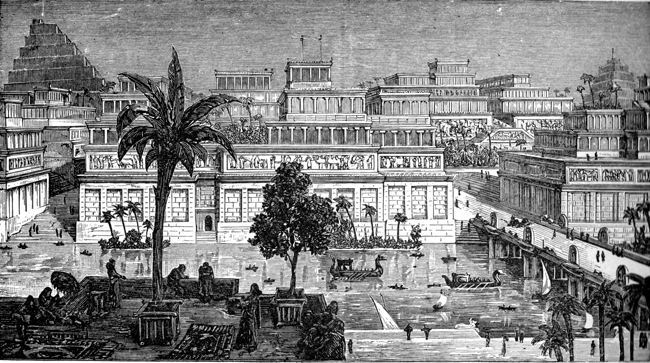
The city of Babylon stands on a broad plain and is an exact square a hundred and twenty furlongs on each side; so the entire circuit of her perimeter is four hundred and eighty furlongs. While Babylon’s size is impressive, no other city even comes close to rivalling her magnificence. The city is surrounded by a broad and deep moat, filled with water from the Euphrates, behind which rises a massive midnight-blue wall of glazed bricks, fifty royal cubits wide and two hundred royal cubits in height (the royal cubit being longer by three fingers breadth, than the common Persian cubit).

The soil which was excavated from the moat had been used to make the famous glazed bricks, their colour a blue as deep as midnight, which not only lined the moat itself, but from which Babylon’s fabled cobalt-blue walls were built. But their incredible size and strength and the fabulous deep blue colour of the glazed bricks were not the only marvellous features of these walls.

At regular intervals along their whole length they were decorated with enormous bulls, lions, chimerae and other animals, some real and some mythical, which were depicted in raised reliefs, which had been created in huge moulds using the clay from the moat. While the clay was still wet, these huge moulds were then cut into individually-numbered bricks and painted with the characteristic ceramic glaze which gave Babylon’s walls their famous deep blue colour; except of course where the moulded reliefs required other glazed colours. Finally the bricks, each of which was thus shaped and numbered to fit a very specific place in the wall, were then baked in huge kilns which had been specially built for the purpose. The reliefs were then reassembled as they were built into the walls as their outer course; their places in the walls already encoded in the individual numbers of each brick; which could then be exactly reassembled as the walls were built.

In this fashion, as fast as the soil from the moat was dug, it was moulded and made into bricks and then baked in the kilns. Then they started to build, first lining the moat with bricks and then constructing the wall itself, using hot bitumen for cement throughout; interposing a layer of wattled reeds at every thirtieth course of bricks. The bitumen used in the work was brought to Babylon from the River Is, a small tributary of the Euphrates far to the north of Babylon, where there also stands a city by the name of Is. This city is eight days’ distant from Babylon and lumps of bitumen are easily found in great abundance in this river.

Undoubtedly the tremendous amount of bitumen required for the mortar in Babylon’s walls were ferried down the river in the same huge rafts, made of skins stretched over a huge, wickerwork frame, which even now constantly ferried huge loads of grain and straw as well as other goods into the city.

These rafts varied in size but sometimes reached a diameter of a hundred and fifty cubits or more; and each carried at least one donkey; the larger rafts carrying several donkeys. When they arrive in Babylon, their cargoes are sold and then the rafts are disassembled and packed on the donkeys, which were used for the return trek upstream as the current was too strong for them to use the rafts for the return journey; and besides, they only carried two large oars, one on either side, which they used only to steer with down the middle of the river’s broad channel.

The walls of Babylon are so thick that along their tops, at regular intervals are small buildings to house sentries and guards; each has a single chamber and they face each other across the breadth of the wall, leaving enough room between them still for a four-horse chariot to turn. The circuit of the walls is so great that there are one hundred huge gates, equally spaced along the whole length of the wall, all made of brass, and with enormous brazen lintels and side-posts.

The city is, however, divided into two portions by the River Euphrates, which runs through it. This river is a broad, deep, and swift stream, which rises in Armenia, and empties itself eventually into the Erythraean Sea. The city wall comes right down on both sides to the very edge of the stream: and from the corners of the wall a high fence of burnt brick runs along either bank.

The houses in the city are mostly three or four stories high and the streets all run in straight lines, both those which run parallel to the river and those cross streets which lead down to the riverside. At the ‘river’ end of these cross streets there are low brass gates in the blue-brick fence that skirts the stream, which open onto the water and which, like the great gates in the outer wall, are also made of brass.

The outer wall is, of course, the city’s main defence. There is, however, a second inner wall, not quite as thick as the outer wall, but very nearly as strong. Each division of the town had a fortress at its centre. In one stood the palace of the kings, surrounded by a wall of great strength and size: in the other stood the sacred precinct of Ea the War-Maker; this was a huge square enclosure, two furlongs on each side, with gates of solid brass. In the middle of this precinct stands a tower of solid masonry, a furlong in length and breadth at the base, upon which was raised a second tower; and on top of that a third; and so on up to the eight level.

The ascent to the top is made on the outside by a path which winds up and around all the towers. About half-way up there is a resting-place with seats where religious pilgrims and tourists from every part of the known world habitually sit for some time to rest and meditate on their way to the top.

At the top of the topmost tower there is a spacious temple; inside this temple there stands an enormous richly-decorated couch with a huge table of pure gold beside it. There are no statues of any kind in this chamber and at night it is occupied a single native woman, who; so the Chaldaean priests of this god solemnly affirm; is chosen by the deity for himself out of all the women of the land.

These priests also declare that the god comes down in person into this chamber, and even sleeps upon the couch, in a similar manner to what the Egyptians say happens in Thebes, where a woman habitually spends each night in the great temple of the Theban god, Ammon. In either case the woman is a virgin and forbidden any contact with men. This practice is also similar to the custom in Patara, in Lycia, where the priestess who delivers the oracles is shut up in the temple every night.

Below, in the same precinct, stands a second temple, in which there is a seated figure of Ea-Zeus-Baal-Ammon in solid gold. Before this figure stands an immense golden table and the throne on which it sits and even the base on which it stands are all made of gold. Inside this temple there is also a figure of a man, twelve cubits high, entirely of solid gold. The Chaldaeans who serve in this temple boast that the total weight of all the gold in these items is eight hundred talents.

Outside the temple there are two altars, one of solid gold, on which it is only lawful to offer sucklings; the other is a common altar, but it is of great size, on which full-grown animals are sacrificed. It is also on the great altar that the Chaldaeans who serve as priests in these temples burn offerings of frankincense to the amount of one thousand talents’ weight, every year, at the festivals of the God. It was said that if the wind was in the right direction, the scented aroma of Babylon’s festivals could be smelled in Ephesus.

*****     *******     *****

Cyrus: Chapter 17

10 Thursday Jun 2010

Posted by Therese Trouserzoff in Cyrus the Great: Chronicles

≈ 20 Comments

Tags

Assyrian Empire, Babylon, chariot, Cyrus

CYRUS

by

Theseustoo

CHAPTER 17:

The Assyrian Empire

An Importunate Deity

The progress of Cyrus’ expedition towards Babylon was slowed considerably when they came to the River Gyndes, a broad and deep river with a very strong current; which would clearly require either boats or a bridge to cross, for it could clearly not be forded. As Cyrus’ army drew gradually to a halt beside the riverbanks a sudden commotion arose from the van. One of the six sacred white stallions which pulled Cyrus’ great chariot, as soon as it had been released from its harness, had refused the restraining commands of its groom and had suddenly plunged into the river and attempted to swim across on its own. The current, however, was far too strong and the beautiful snow-white beast was quickly swept away downstream and drowned.

Thankfully, Cyrus had not been in the chariot at the time; he had been scouting the banks with Pactyas for fordable places; although as it turned out they had done so in vain. Distressed at the loss of one of his sacred charges, the groom immediately sought his master to inform him of the loss. He found Cyrus just as he and Pactyas returned from their search.

“My king,” the groom said with a deep bow, “I have terrible news to report…” Nervously he looked up at Cyrus, who merely stared at him silently, the intensity of his gaze now silently demanding further information. Even more nervously the groom continued, “As you can see, Lord, this river, the Gyndes, is both too wide and too deep to be crossed without boats, nevertheless, one of your sacred white horses tried to cross it on it’s own as soon as it was un-hitched from your chariot…” here the groom broke off to wipe away a tear which had sprung unbidden from the corner of his eyes, for he had loved his charges very dearly, “Such a courageous creature! But it did not succeed, Lord; it was swept away downstream and drowned. The god of the river has claimed it as a sacrifice!”

Cyrus' Chariot

Had it been any other horse, it would probably have been simply regarded as one of the inevitable losses any large armed force was bound to suffer on a major expedition; but as it was one of Cyrus’ own pure-white sacred horses, he took it as a personal insult. Another man might well think twice before complaining about such a sacrifice claimed by the river-god, but Cyrus was no ordinary man. His advisors had constantly insisted that his was no ordinary birth; it was foreshadowed with omens and portents they had said; the Magister had even said he had found Cyrus’ name in an old and obscure Hebrew prophesy which had suggested that he might well be the ‘Anointed One’; the Messiah whom the prophecy said would seize Babylon and destroy the Assyrian empire forever; and in doing so, unify the whole world. The manner of his accession to the throne, the Magister insisted, itself proved that it was certainly his destiny to rise from total obscurity to supreme power.

Babylon

At first Cyrus had wisely shrugged off such suggestions as fanciful, but as his empire had expanded, and victory piled upon victories were laid at his feet; often accomplished with remarkable ease, even in what were otherwise extremely difficult situations; that finally even Cyrus was persuaded that there may, after all, be some supernatural being guiding or even orchestrating his successes. The manner in which the path had been found which had given his soldiers the access they needed to Sardis and which had enabled them to take the city with little resistance, for example, had seemed even at the time like a gift from the gods.

The most ancient of all traditions held that a warrior who was victorious over all of his enemies; who thus subjugated them all to his own will, could only be the earthly incarnation of the son of the highest gods, Ea and Enlil themselves. Such a noble, indomitable and all-conquering warrior would eventually came to be recognized as the earthly incarnation of Merodach, their divine son; the Son of Heaven. Heracles, Cyrus had believed, was the last incarnation of such a demi-god, and before him, Perseus. But that he had been referred to as such even by his defeated enemies, he felt, was the final confirmation he had been waiting for before he allowed himself to be persuaded to believe in his own divinity.

So by the time Cyrus had reached the Gyndes, it was no longer any mere mortal whom the river-god had thus insulted with this involuntary sacrifice, but the Son of Heaven; a living demi-god, whose own status as the son of the highest god and goddess gave him superiority over any mere river-god. The insult to his dignity was thus, Cyrus decided, too much to bear.

“By all the gods!” he declared, “I cannot tolerate this insolence! The god of this river has overstepped his proper bounds with this theft! Have I not been called the Son of Heaven even by my defeated enemies? The god of this river must be punished! I shall break his strength so that in future even women will be able to cross it easily without wetting their knees. Divide the army into two parts, half on one side of the river, half on the other; I shall mark out trenches on either side of the river for the army to dig.”

***   *****   ***

Digging the channels which had been marked out by Cyrus cost him the whole summer and most of autumn; and now the first frosts of early winter gave the fresh morning air a crispy bite. Even so it was with evident satisfaction that Cyrus now surveyed his army’s handiwork, as he inspected the river’s depth with Hystaspes.

True to his word, the pair was able to wade across the river easily; the water coming only midway up their calves; and the current was considerably slowed; their knees were not even wet, Hystaspes noticed, as they climbed up the other bank, the gradient of which had been adjusted on both sides to facilitate the army’s crossing.

“Well then Hystaspes,” Cyrus crowed enthusiastically “we have shown this river, Gyndes, who its master is!”

Hystaspes, however, though pleased at his king’s success nonetheless felt that it had been something of a distraction from the main purpose of the expedition; and one which had cost them much valuable time.

“Yes my Lord;” he replied, a little wearily, “but we’ve lost the whole of the summer season digging the three hundred and sixty channels it took to do it!”

“Yes…” Cyrus drawled, thoughtfully. He could understand Hystaspes’ frustration; his general was eager to get at the enemy; like a hunting-dog, straining at the leash in its keen-ness to chase its prey, he thought. What Hystaspes doesn’t yet understand, Cyrus realized, is that by demonstrating my control over the natural elements like this, I have also just successfully completed my first act as a god. But somehow he felt that for him to say anything of this would still, he felt, have been rather immodest, so instead he simply ignored the implied criticism and changed the subject, “It looks like we shall have to winter here; we can raid the country-side for our supplies through the winter… we’ll attack in spring.”

“Yes your majesty,” Hystaspes said obediently, then, just a little hesitantly, he added, “but the disruption this will cause to the Assyrians’ economy will warn them of our intent to take Babylon.”

For such a great general, Cyrus thought to himself, the prince of the Paretacenae could certainly be obtuse at times. He found himself missing the quick, agile and subtle mind of Harpagus. Harpagus, he thought, would have been most amused by Hystaspes’ obtuseness. Patiently, Cyrus turned towards him, looking Hystaspes right in the eyes, so that he could see the twinkle that sparkled in his own, as the king laughed and said, ”Hystaspes, they know that much already! Their king, Labynetus, will be waiting for us even now, I’m sure.”

Hystaspes frowned; he was a little relieved that at least Cyrus was aware that his attack on Babylon would be no surprise to her current Assyrian occupants. Yet he was a little taken aback by what, to him, looked like Cyrus’ carefree attitude to their expedition. After all, he thought to himself, until Cyrus’ own great-grandfather, Cyaxares had evicted them from their capital city of Nineveh, thus forcing them to retreat to Babylon, the Assyrians had for centuries been the most powerful state in the world; Hystaspes could not help but feel that they were about to grab a tiger by its tail.

“Indeed your majesty;” he responded grimly, “the taking of Babylon will be no easy matter; her walls are of baked brick and they are very high and very strong…“

“Hmmm“ Cyrus hummed thoughtfully; mentally reminding himself that it was his extremely cautious nature which made Hystaspes such an efficient general. And he was right about the Assyrians taking a defensive position behind Babylon’s reputedly invincible walls; he was quite sure that will be exactly what they would do. What neither they nor Hystaspes knew, however, was that Cyrus had already learned of a weak spot in her defences. He had said nothing of this to anyone, fearing that if the enemy should get wind of what he was planning they would simply take steps to circumvent it. But, just to put the poor puzzled Hystaspes out of his misery; at least to some degree; he said enigmatically, “That’s true Hystaspes. But perhaps their very strength may prove to be their undoing!”

Now Hystaspes was genuinely relieved; he had no need to know what Cyrus’ plan was for the taking of Babylon; he merely needed to know that his king actually had a plan. And although he could make little sense of this, his king’s latest utterance, yet he was quite confident that it made perfect sense to Cyrus, at least; and that was all that mattered. Indeed, Hystaspes now thought that his king and emperor certainly seemed to know exactly what he had in mind; and if he said nothing further about it, Hystaspes knew now that this was because of the need for secrecy and not for want of a plan.

***   *****   ***

Cyrus: Chapter 16, part 3

01 Thursday Apr 2010

Posted by Therese Trouserzoff in Cyrus the Great: Chronicles

≈ 11 Comments

Cyrus

by

Theseustoo

Chapter 16, part 3 (I think!)

Cyrus and Croesus strode purposefully across the palace courtyard towards their horses, which had already been saddled and were waiting for them together with Harpagus and an honour-guard of fifty of his very best cavalrymen. Cyrus gave his final instructions for the care of Lydia and its capital to the young general to whom it had been entrusted, who kept pace with them as they walked:

“Tabalus, I’ve sent the army back to Agbatana; I’m leaving you here in charge of Sardis. Croesus will come with me to Agbatana. Ionia and Aeolia can wait a while; I have bigger fish to fry… I must take Babylon; if I don’t the Assyrians may strike at our rear. After Babylon I’ll take Bactria and the Sacae and then… Egypt! I’ve instructed Pactyas to collect Croesus’ treasure and follow me to Media. I know… I know… He’s a Lydian, but from all accounts he’s an honest man and I want to show the Lydians that I mean to treat them fairly; they are an honourable people. Be firm with them, Tabalus… as firm as you need to be… but be fair!”

“Yes Lord! I will.” Tabalus said. Then, as his king reached his horse, he added, “but I still think it’s dangerous to trust a Lydian with so much…”

The youthful Prince of the Busae was voicing exactly the concern Cyrus had been expecting from him. Indulgently the monarch smiled; then he gripped Tabalus’ shoulder with his right hand and, shaking it gently, said, “Tabalus, you worry like an old woman! Sometimes it is necessary to take a chance and trust people… If we can rely on Pactyas’ honesty we’ll gain a great deal; if not, we’ll find out who the traitors are…”

Tabalus was only slightly reassured, but although he still felt nervous at least he no longer felt that he needed to worry too much about these newly-conquered Lydians rebelling against their new overlord. In fact, he now felt that his king was virtually inviting a rebellion to start during his absence in much the same manner that one ignores a boil as it erupts and grows and only when the time is right and not before, one lances it. Cyrus’ wisdom was transcendent, Tabalus thought, astounded at his king’s sagacity, as he replied with a sharp salute, “Yes your majesty! Farewell your majesty! May the gods go with you!”

Cyrus nodded his thanks for the officer’s blessing as he and Croesus mounted their steeds and, joining Harpagus at the head of the cavalry column, cantered smartly out of the city gates.

***   *****   ***

Only a few days later Tabalus found himself experiencing something like ‘deja-vu’ as he escorted the Lydian, Pactyas, across the same courtyard towards a baggage train which was waiting along with its guard for its leader.

Although the surviving Lydians had been allowed to keep their own property, all of the wealth they had possessed in the form of precious metals such as copper, bronze, brass and iron had been collected together as a tribute to their conqueror and was now about to be taken away by Pactyas to Agbatana, which Cyrus had been using as his own capital ever since he had defeated Astyages.

“I’ve provided you with an escort of twenty armed guards;” Tabalus was saying to the Lydian, “they’ll see you safely to Agbatana.”

Privately he wished that he could spare more than a mere twenty guards for this particular detail; there were several hundred talents of precious metals in the five huge wagons, each drawn by a team of a dozen oxen, which comprised the baggage-train. But Cyrus had sent most of the army back ahead of him to Agbatana, and twenty men were all that Tabalus could spare.

He consoled himself with the thought that no-one in his right mind would dare to hijack this caravan; one does not rob the Son of Heaven with impunity. And at least he’d made sure the guards were all either Medes or Persians; and that their loyalty to their king was beyond question.

“Thank you Tabalus!” Pactyas replied smoothly. But as he added, “Very thoughtful of you; fare you well until I return…” Tabalus could not help but feel that the Lydian was being disingenuous. Had Pactyas emphasized the word ‘return’, just a little? And if so, was he attempting to lull Tabalus into a false sense of security with this subtle emphasis, that he would, after all, return? Was that mockery he could see in the Lydian’s eyes he wondered; or was it merely his own imagination?

With mounting trepidation Tabalus watched as the far too cheerful Pactyas nonchalantly mounted the lead wagon and led it out through the city gates. As the baggage-train pulled away from the city, with its load of miscellaneous metal items rattling and creaking; and the oxen bellowing their protests at the enormous load they had to shift, Tabalus could not help but wonder how he could manage to be quite so cheerful with such a burdensome responsibility.

***   *****   ***

The baggage train had only travelled a few dozen stades when, due to the mountainous nature of the whole region, they were obliged to travel through a narrow defile between the two sides of a very steep and darkly-wooded valley. The guards, however, were alert to the presence of danger as they marched along. Two guards, well-armed with bows, swords and spears, were seated on a high bench at the front of each wagon; one driving, holding the leather traces which were used to steer the beasts that pulled the massive load, and a long bullwhip to encourage them to greater efforts as and when required. Another guard marched along on either side of the rear axles of each wagon; their eyes constantly scanning the dense forest which covered the high ridges above them on either side for the slightest sign of an enemy.

They saw nothing; for the ambushers had planned well; they did not attack immediately they saw the wagon-train but remained well hidden until they’d allowed the whole wagon train pass by below them, while they patiently waited for exactly the right moment. Only when the last wagon’s rear wheels finally passed their secret marker; a large stone which they had carefully placed beside the road prior to the baggage-train’s arrival; did they finally attack.

But as soon as the last wagon’s rear wheels passed this marker, with exquisite marksmanship, the ambushers first shot the guards and drivers of the rear wagon and then proceeded up the whole column wagon by wagon, as, silently, the dead and dying guards fell unnoticed into the dust. The noise of the oxen bellowing and tramping along, the creaking of the great axles turning and the huge, heavily-laden wagons constantly groaning with even the slightest bump or deviation in the deeply-rutted track, as their contents, much of which was comprised of gardening tools and kitchenware, constantly rattled with every jolt and creak, effectively hiding whatever small, surprised gasps or moans may have escaped their lips as the guards fell dying or dead in the dust.

The noises of the wagons and beasts also covered the small noises made by the archers as, advancing in a broad row behind their quarry, they ran up behind the column and, at their captain’s signal, with great discipline, let fly not singly, or as individuals, but in volleys of arrows; each man having his own predetermined target. At each of the five wagons there were only four targets; and there were fifty raiders; although only twenty ran behind the wagons while the others still hid along the ridges on either side right above them, just in case anything went wrong.

Nothing did; for the team had rehearsed their ambush several times until everyone knew exactly what to do and exactly what was expected of them. Wagon by wagon, their crews were all slaughtered in turn. At each wagon the crew all died in the same instant, each fatally pierced by five bronze-tipped Lydian arrows. Before any of the guards had time to warn the others, they were all dead and lying in the dust, bristling like pin-cushions with the Lydian arrows with which they had been silently slain.

During the whole attack, which in all had taken less than two minutes, Pactyas had remained perfectly calm in his position in the leading wagon; simply maintaining the wagon-train’s slow but steady pace. But, when he saw that the last of the Persian guards; those in his own wagon; had all fallen and realized that the arrows had finally stopped flying, he halted his wagon; and the oxen in all of the other wagons instinctively followed suit. Pactyas then cheerfully descended from the lead wagon to greet the ambushing archers as they now greeted him with their cries of victory and jubilation. He had personally hand-picked these men for their speed and accuracy with the bow as well as their discipline and stealth, as the thirty men still on the ridges now came openly running down the sides of the gorge to meet their leader.

“Well done men!” He exclaimed, congratulating them all enthusiastically. “Now fall in beside the baggage-train; the fishing village of Priene is not far from here; the people there have no love for Cyrus! With their ships and the wealth we have captured they’ll help us to hire mercenaries; many Prienians will also join our cause; and Phocaea will help us too, I’m sure! Cyrus will not hold Sardis for long!”

***   *****   ***

Cyrus: Chapter 16, Part 2

08 Monday Mar 2010

Posted by Therese Trouserzoff in Cyrus the Great: Chronicles

≈ 21 Comments

Cyrus addresses Lacrines

Cyrus

by

Theseustoo

Chapter 16, Part 2

Of all the Greek city-states, Boeotia alone thought to send ambassadors to the court of Cyrus to attempt to negotiate a peaceful treaty with him, which would allow trade to continue peacefully, as it always had between Boeotia and the newly-captured country of Lydia. Cyrus had accepted the embassy in friendship and in good faith. He personally thought it was a pity Aeolia and Ionia had not rebelled against Croesus as he had earlier demanded of them; for in truth he felt that trade with these nations was infinitely preferable to war with them.

Miletus had more than willingly accepted a treaty on the same terms exactly as those Cyrus had demanded of Aeolia and Ionia and now enjoyed increased trade and wealth as a result. He really had no intention of carrying out his threats; he had just wanted to make the Greeks sweat for a while before he finally granted them the alliances they sought, with perhaps a slightly increased rate of tribute; but Cyrus was always willing to negotiate.

And of course, now that Cyrus had conquered Sardis and her neighbouring Asian Greek cities, this gave him access to their trade routes, which would now allow Cyrus’ Medes and Persians to import an endless variety of Greek goods, such as wine, olive oil, and many other famous delicacies. It was with this in mind that Cyrus turned to the ambassador and asked, “I hear that Boeotia is famous for its eels… are they really as delicious as they say?”

The question was indeed innocent enough, for Cyrus did not realize that although it was indeed true that Boeotian eels were a very tasty delicacy, they were also used locally as a metaphor for a certain part of the male anatomy; and thus the eating of them was frequently used as a metaphor for certain sexual practices of which Cyrus was completely unaware.

The ambassador however, realizing that Cyrus was quite evidently ignorant of his accidental double-entendre, tactfully said nothing, contenting himself merely with exchanging a meaningful glance with his fellow Boeotians who both smiled stiffly as they tried hard to restrain their nervous amusement, while their ambassador replied, even more nervously,

“Hehehe… er… Yes your majesty; I can honestly say…“

Just at that moment, however, he was saved from further embarrassment by a sudden loud disturbance in the throne-room’s ante-chamber. The imposing figure of a tall and well-muscled Spartan suddenly burst into Cyrus’ throne-room, ignoring the still-protesting Lydian guards as they followed him in from the ante-chamber; still trying vainly to prevent the intruder from interrupting their king’s meeting. Cyrus noticed immediately that both guards, to their credit he thought, now sported serious black eyes; and through the open doors he also noticed their broken spears; this man was evidently not one to be trifled with.

The household guards, who stood on duty in this and all of his official chambers; posted at regular intervals around their walls; instantly moved forward and presented arms, thereby surrounding the intruder with a ring of spear-points; holding him at bay while they awaited further orders from their king. The intruder’s aging and well-worn scarlet cloak was thrown back over both his shoulders as he held up both of his hands to show that he was unarmed. Cyrus immediately recognized that although he carried no arms; he was obviously a very determined man with a very specific purpose. Since he had come unarmed he was obviously no assassin. The least he could do, Cyrus thought, was to listen to what this bold fellow had to say. With a gesture he ordered the guards to return to their posts as Lacrines started to speak:

“Cyrus, my name is Lacrines” the Spartan said grimly, “I am sent by the Lacedaemonians to give you this warning: Sparta prohibits you from turning your imperial ambitions on any Greek cities,” here he paused briefly for maximum effect before continuing emphatically “whether on the Peloponnese or here in Asia; Ionia and Aeolia must not be molested!”

Cyrus was astonished by the man’s rudeness. This man, he thought, must be afraid of nothing in the world if he could speak like that to him, the king of what had now become the greatest empire the world had ever known. Yet such a bold and deliberate display of bravado intrigued Cyrus; arousing his curiosity more than his anger. He turned to the Boeotian ambassador with whom he had just been speaking before Lacrines had so rudely interrupted them:

“Who are these Lacedaemonians?” he asked, “And what is their number that they dare to send me such a notice?”

The ambassador was immensely relieved that he was no longer required to give his personal opinion on the gourmet qualities of Boeotian eels, metaphorical or otherwise. Where he had been verging on hysteria just a moment before, now the ambassador’s face took on an almost unnatural gravity, as he soberly answered Cyrus’ query:

“Lord, the Lacedaemonians are the very toughest of all the Spartans; and the Spartans are by far the bravest and most valorous warriors in all Hellas. And though their numbers do not exceed ten thousand, it is said that the only walls their cities require are the spears of their young men!”

Cyrus raised his eyebrows in surprise. He had not been expecting their numbers to be quite so low; less than ten thousand men! And yet the ambassador had said their cities needed no walls, only the spears of their young men; these must be fierce warriors indeed. But Cyrus was determined not to allow himself to appear intimidated by anyone; not even this Lacedaemonian! He took a few steps forward, to stand directly in front of the intruding Spartan as, looking him levelly in the eye, the king said:

“I have never yet been afraid of any men who have a set place in the middle of their city where they come together to cheat each other and forswear themselves… If I live, the Spartans shall have troubles enough of their own to talk about, without concerning themselves with the Ionians.”

Though he was angered by the unfortunate reference to what he knew were common practices in virtually all Greek marketplaces, Lacrines restrained himself; refusing to allow his attention to be diverted from his mission by rising to the bait. Nevertheless he instantly recognized this manner of straight-talking from a fellow warrior who clearly would not be cowed; attempting to push him would do no good. Lacrines immediately realized that Cyrus was not going to be scared or intimidated into postponing whatever plans he had for the Asian Greek cities.

If Cyrus decided to postpone the attack, Lacrines realized it would not be out of fear of Sparta, but perhaps he might do so out of respect for her. Cyrus had not even indicated what his plans were; perhaps he didn’t even have any, Lacrines realized, feeling suddenly a little foolish; in which case, he decided, there was nothing at all to be gained by demanding what they were; and in any case, to do so now would seem weak. His ultimatum delivered; there was nothing more for him to do here. Of course, Lacrines thought to himself as he turned on his heels and left, Cyrus has to maintain a cool front; only time will tell whether or not my mission here has been successful.

***   *****   ***

← Older posts

Patrons Posts

  • The Question-Crafting Compass November 15, 2025
  • The Dreaming Machine November 10, 2025
  • Reflections on Intelligence — Human and Artificial October 26, 2025
  • Ikigai III May 17, 2025
  • Ikugai May 9, 2025
  • Coalition to Rebate All the Daylight Saved April 1, 2025
  • Out of the Mouths of Superheroes March 15, 2025
  • Post COVID Cooking February 7, 2025
  • What’s Goin’ On ? January 21, 2025

We've been hit...

  • 713,785 times

Blogroll

  • atomou the Greek philosopher and the ancient Greek stage
  • Crikey
  • Gerard & Helvi Oosterman
  • Hello World Walk along with Me
  • Hungs World
  • Lehan Winifred Ramsay
  • Neville Cole
  • Politics 101
  • Sandshoe
  • the political sword

We've been hit...

  • 713,785 times

Patrons Posts

  • The Question-Crafting Compass November 15, 2025
  • The Dreaming Machine November 10, 2025
  • Reflections on Intelligence — Human and Artificial October 26, 2025
  • Ikigai III May 17, 2025
  • Ikugai May 9, 2025
  • Coalition to Rebate All the Daylight Saved April 1, 2025
  • Out of the Mouths of Superheroes March 15, 2025
  • Post COVID Cooking February 7, 2025
  • What’s Goin’ On ? January 21, 2025

Enter your email address to subscribe to this blog and receive notifications of new posts by email.

Join 373 other subscribers

Rooms athe Pigs Arms

The Old Stuff

  • RSS - Posts
  • RSS - Comments

Enter your email address to subscribe to this blog and receive notifications of new posts by email.

Join 373 other subscribers

Archives

Website Powered by WordPress.com.

  • Subscribe Subscribed
    • Window Dresser's Arms, Pig & Whistle
    • Join 279 other subscribers
    • Already have a WordPress.com account? Log in now.
    • Window Dresser's Arms, Pig & Whistle
    • Subscribe Subscribed
    • Sign up
    • Log in
    • Report this content
    • View site in Reader
    • Manage subscriptions
    • Collapse this bar
 

Loading Comments...