• The Pig’s Arms
  • About
  • The Dump

Window Dresser's Arms, Pig & Whistle

~ The Home Pub of the Famous Pink Drinks and Trotter's Ale

Window Dresser's Arms, Pig & Whistle

Category Archives: Astyages

Cyrus – part the sixth aka Chap 3 Part 1

07 Friday Aug 2009

Posted by Therese Trouserzoff in Cyrus the Great: Chronicles

≈ Leave a comment

by Theseustoo

Mitridates

Mitridates

Mitradates was surprised, and not a little frightened, when he received a second summons from the palace. This time, however, it was his ‘son’ Ambares, who was the principal object of the royal summons; he himself was to accompany Ambares only in his capacity as Ambares’ ‘father’ and as such, according to Median law, he knew he might well be held responsible for his son’s behaviour. He also knew that under similar circumstances, almost any other Median father would have already given their offspring a sound thrashing with a birch rod or a leather strap, even before obeying the summons, as a practical demonstration to the king that they were not neglecting their duty to apply parental discipline; and that they were indeed doing their best to bring up their child to be a good and productive citizen.

But except for this one incident Ambares had always been so well-behaved; he was always so respectful and obedient to his elders, especially to his parents; and Mitradates and Spaco both loved him so dearly that they found they could not bring themselves to punish the child before they had heard all the details of his offence, as well as both sides of the story; for Ambares had said nothing to them.

So far, though he loved his parents dearly, he had stoutly refused to tell them the whole story, in case he made trouble for his playmates; especially for those who had helped him punish the rebellious Tembes. Even so they decided not to whip him before his appearance at court; they would wait for the king to decide the outcome of his case and to punish him if he saw fit.

So, uncertain even as to the nature of Ambares’ offence, when Mitradates received the king’s summons to attend the royal court with his son, he was more afraid for Ambares than angry at him; in spite of being also more than a little afraid for his own well-being; for their king Astyages had long been notorious for the highly imaginative cruelty with which he punished those who ever dared offend against any of his extremely harsh, and often arbitrarily-applied laws.

Indeed, Mitradates had also realised very quickly that it was potentially extremely dangerous for him to escort this child especially into the king’s presence. However, he had no choice, for a king’s summons cannot be ignored. In any case he was much more concerned for his young son than he was for himself.

As he contemplated these matters, Mitradates could not help wondering what the king would do to the boy, whom he was supposed to have killed ten years ago, if he were now to be discovered alive. Would Astyages decide to finish the job himself? Would Mitradates and his wife be held responsible? And if so, how would they be punished? He dared think no further than this, but fervently hoped that Astyages would not recognize the boy.

When they arrived at the palace gates, one of the guards escorted them into the throne room and announced them before returning smartly to his post. Overwhelmed by the immensity and great splendour of the palace, Mitradates’ fears mounted even higher as the pair waited silently for King Astyages to notice them and to deign to speak to them.

As the pair approached the throne, the monarch was speaking with the Captain of the King’s Guard, Artembares, who, like Mitradates, was also accompanied by his own son, Tembes; whose puffy red eyes still simmered with obvious resentment at the pain and humiliation he had so recently suffered. Tembes and his father both glowered at them as Mitradates and Ambares stood silently in front of the throne with their heads bowed modestly in the face of such exalted company.

Artembares clutched his son to him protectively as the fearful Tembes cowered from the sight of his adversary. At a nod from the king, Artembares now grasped his son by the shoulders and, turning Tembes’ round so both Astyages and Mitradates could see it, he pulled up his son’s tunic to reveal the wicked red welts that Ambares’ branch had left across the youth’s shoulders. To King Astyages he declared, “Thus oh king, has your slave, the son of a mere cowherd, heaped insult upon my family!”

Astyages descended from his throne to examine the cruel welts on Tembes’ pale-skinned shoulders, and then, turning round to Ambares he demanded, “Is this true?” his voice was incredulous, ”You, the son of so mean a fellow as a cowherd, dared to behave so rudely to the son of one of the highest ranked nobles in my court?”

Perhaps because he was still young and inexperienced, Ambares was nowhere near as frightened as his father. In any case he had already decided that, whatever the king might decide to do with him, he would put a brave face on it. So, with great determination, he looked his king in the eyes, and without flinching answered in a firm, strong voice, “My lord, I only treated him as he deserved.”

The king gave the youth a quizzical look which demanded further explanation; Ambares complied, “I was chosen king in play by the boys of our village,” he began, “because they thought me the best for it. He himself was one of the boys who chose me. All the others did according to my orders but he refused and made light of them, until at last he got his due reward. If for this I deserve to suffer punishment, then here I am, ready to submit to it.”

Astyages now stepped towards the youthful Ambares. He then examined the boy’s face very closely but could find no resemblance at all to Mitradates in it; and yet this face was familiar to him. Indeed he quickly realized that this boy’s face bore a striking resemblance to his own; this young lad had the same sharply angular features and the same hawk-like beak of a nose.

An almost instinctive recognition was suddenly triggered in Astyages’ mind by the natural nobility of Ambares’ reply; that and the courage he even now displayed in front of his king confirmed it; this was no son of a cowherd! And although no further proof was actually necessary, his suspicions were now further reinforced by the calm resignation he read in the youth’s features, and also by the nobility of his bearing and his remarkable self-assurance.

Instantly Astyages divined that this was not the son of Mitradates; and somehow, though he knew nothing at all of the connection between Mitradates and the grandchild he’d ordered destroyed, he nonetheless knew intuitively that this was that very grandson whom he had ordered exposed a little over ten years ago. How he had survived Astyages had no way of knowing at present, but he was determined to find out. Turning once more to the captain of his guard, Astyages said earnestly, “Artembares, I promise you, I will settle this business so that neither you nor your son shall have cause to complain. Now you may leave us…”

Artembares nodded his acquiescence and pulled his son’s shirt back down. Then, forcing his son to copy his obeisance to the king by placing his hand on his son’s head as he did so, he bowed deeply towards their king. Then the pair turned and left the room, both of them much mollified now that it appeared as if an appropriately severe punishment would be inflicted on the transgressor.

When the indignant father and his son had left the room, Astyages turned finally to Mitradates and quietly asked him,

“Where did you get this boy?”

“My lord,” Mitradates replied, hesitantly, “the lad is my own child… The mother who bore him still lives with us in my house.”

Astyages had expected the lie; he made a motion to the guards who stood on either side of the doorway as he said to the cowherd, “You are very ill-advised to bring yourself into such great trouble…”

At the king’s signal the guards stepped forward swiftly, and seized Mitradates’ arms roughly from behind; then they started to drag him away. Realising that he had been caught out in his lie, and that he was about to be dragged away to suffer the most dreadful tortures until he admitted the truth, Mitradates decided instantly that it would be better if he were to admit it now; a swift death would be preferable to a slow and agonizing one; desperately he shouted, “Wait! Forgive me Majesty, I’ll tell you the truth!”

***   *****   ***

(To be continued)

Cyrus Part the fifth….

05 Wednesday Aug 2009

Posted by Therese Trouserzoff in Cyrus the Great: Chronicles

≈ Leave a comment

By Theseustoo aka astyages

Merodach Baladan

Merodach Baladan

A few weeks later Mandane went into labour; it was not an easy birth. Even from his own personal quarters, Astyages could hear his daughter’s screams of pain as she fought to bring her child into the world. And while he waited for his grandchild to be born, Astyages threw an offering of incense onto a small brazier which stood in front of a statue of the god Merodach, which formed the central feature of a small shrine the king kept for private worship in his chamber. As the dark, sweetly scented smoke rose heavenward from the burning frankincense, the king lifted his eyes towards heaven and prayed fervently:

“Ea! Enlil! Merodach, and all you gods in Heaven! Hear my prayer; I do not wish to kill my daughter’s child; therefore let it be a girl and no threat to me. Thus may I hope to keep both my kingdom and my daughter’s love.”

He kept mentally repeating his prayer over and over again to himself as he listened intently to his daughter’s screams echoing throughout the palace. Finally the monarch heard the unmistakeable sound of a baby’s first cries as it greeted the new world in which it now found itself. Astyages poured himself a large goblet of wine and drank deeply. After a few minutes, Harpagus entered the chamber, carrying with him Mandane’s newborn baby, wrapped in swaddling clothes.

Astyages looked heavenward again, but this time there was not devotion, but rather a look of recrimination on his face. Though he knew the answer even before he asked, the question came unbidden to his lips anyway.

“Well Harpagus? What news?” he asked, terrified of the answer he already knew, as, with great sadness in his voice, Harpagus replied, “It is a boy my Lord…”

Astyages let out a deep sigh and said, “Harpagus, you must now do exactly as I say…” The servant nodded as his king continued, “I beseech you do not betray the interests of your lord for anyone else’s sake, lest you bring destruction on your own head. Take Mandane’s child; carry him with you to your home and slay him there. Then bury him as you will.”

Though horrified to hear it, Harpagus had been more than half-expecting this command and had prepared himself for it. He replied in a voice which, he fervently hoped, displayed more firmness of purpose than he actually felt, “Oh! My king; never in the past have I disobeyed you in anything, and you may be sure that I never will; if it is your will that this thing be done, rest assured that I will serve you with all diligence.”

Relieved only slightly by his servant’s apparent readiness to obey him, even in such a horrifying matter as this, the desolate Astyages now addressed the newly-born infant in Harpagus’ arms and, while silent tears began to roll down his craggy face, he said gently, “Forgive me my grandson; but I cannot allow you to bring upon me the ruin of which the gods have warned me in my dreams…”

Astyages

Astyages

With a curt nod Astyages dismissed his servant. Harpagus bowed silently, turned and left, gently carrying the helpless infant with him as he went; hoping desperately that nothing in either the expression on his face nor his bodily demeanour revealed anything of the turmoil which now churned inside him at having to perform such a task as this. But hiding his feelings was something Harpagus was very good at; for, as the king’s minister he had frequently been obliged to hide his own distaste and personal displeasure at some of the things his king had made him do.

***   *****   ***

Harpagus’ wife greeted him sleepily at the door when he returned home, even though it was in the early hours of the morning. Dutifully she had waited up for her husband’s later than usual return.

“Welcome home, husband!” She greeted him cheerfully; then, catching sight of the bundle he carried in his arms, she inquired, “Well then, what is this bundle you have brought with you?”

Harpagus said nothing but carried the bundle indoors and laid it on a table; as he did so his wife noticed the doleful expression on his face; alarmed, she exclaimed, “But you look so sad! Husband, won’t you tell me what’s wrong?”

In tones of infinite sadness, Harpagus replied in a whisper,

“My wife, you must tell no-one of this; this is the grandchild of our King, Astyages… I have been ordered by him to kill this child and bury him as I see fit; I cannot disobey my king.”

The look of absolute shock on her face revealed the horror Harpagus’ wife felt at this revelation as she asked him, “But what will you do?”

Harpagus sighed deeply; all the way home he had been asking himself exactly the same question; he had still found no answer. Yet with growing determination he replied, “Not what Astyages wants me to! No! Even if he were much madder and more frantic than he is now, I will not be the man to do his will, nor lend a hand to such a murder as this!”

He paused for a while; then, searching for a reason to justify his rebellion – to himself more than anyone else – he continued, “Many things forbid me from slaying him. For a start, this child is my own kith and kin;” this was quite true; though the relationship was not exactly a close one, thought his wife, as Harpagus went on, “and Astyages is old, and has no son… If, when he dies, the crown should go to his daughter, whose child he now wishes to slay by my hand, what remains for me but the most fearful danger? For my own safety’s sake, indeed the child must die; but someone belonging to Astyages must take his life, not I or mine.”

As Harpagus was explaining his woeful predicament, his wife brought him a plate with some flat bread and cold meat and a few figs for his supper, with a large goblet of wine to wash it down. As he ate, the couple turned their minds to the problem in hand; it seemed such a pity that such an innocent creature as this babe should have to die. Yet there was no way out of this terrible situation; if the child did not die, they knew that Harpagus would probably be killed in his stead; what else could Astyages’ pointed warning to Harpagus not to risk bringing destruction down on his own head, possibly have meant?

After giving the matter a great deal of thought, Harpagus’ wife eventually spoke, “There is a herdsman I know of who belongs to Astyages’ household, who lives in the mountains. Perhaps you should send for him to take the child and have him expose it on the mountainside where many wild beasts roam?”

“An excellent suggestion, wife…” Harpagus replied with a heavy sigh; sad though it was, at least he would not have the child’s blood-guilt on his hands, “Have one of the servants fetch him to me at once.”

***   *****   ***

(to be continued…)

Cyrus Part the fourth

02 Sunday Aug 2009

Posted by Therese Trouserzoff in Cyrus the Great: Chronicles

≈ Leave a comment

CHAPTER 2:  Born to Die

Harpagus

Harpagus

“Curse you all for fools!” Astyages bellowed furiously. His advisors cowered fearfully as he berated the Magi from the throne, “Less than a year since you advised me to marry my daughter to Cambyses and the gods have sent me another dream; and this one is even more worrying than the first… Now you’d better tell me what it means and be sure you tell me the truth or, by all the gods, I’ll make sure none of you is troubled by dreams ever again!”

The Magister paled visibly as the blood instantly drained from his face in fear; he bowed deeply as he fearfully replied, “Your majesty, we will do our utmost; tell us, what is the nature of this new dream?”

Calming down only slightly, Astyages said, “I dreamt that from Mandane’s womb there grew a huge vine, which first filled the whole city and then grew to over-shadow the whole of Asia. Now, tell me what you think this dream means?”

Terrified, the Magus answered, “Lord, this dream is very similar to your first dream; if your daughter should give birth to a child, that child would grow strong enough to rule over all Asia…”

“As I thought…” Astyages mused darkly, the furrows of his forehead deepening as he frowned and finally asked, “And is there nothing I can do to prevent this?”

The Magi looked at each other desperately; each hoping to find some kind of inspiration in the others’ eyes; only to discover there was nothing there but the reflection of their own terror of what their king might do to them should they fail to find a satisfactory answer. Although they said nothing of it, the Magi had to a man instantly realized that this new dream suggested Mandane was already pregnant; just as quickly, they had also realized that the only way to avoid the future which now threatened them would be to either kill Mandane before she gave birth, or else to kill the baby as soon as it was born.

None of the Magi dared to even remotely suggest either of these desperate courses of action; yet they knew they must find an appropriate response; Astyages was already looking at them impatiently. The Magister took his courage in both hands and looked his king in the eyes, frankly revealing to the monarch the terror that was in his own, as he answered, “Sire, it is not for us, nor for any man, to tell you what you must do with your own family; this must be for you alone to decide…”

As the Magister had hoped, Astyages was astute enough to understand what this reluctance to answer him signified; indeed, it was much as Astyages himself had expected. His expression turned from anger to misery and then finally to determination, as he finally turned to his servant, Harpagus, who was standing beside the throne, and said quietly to him, “Harpagus, send a herald to Persia to fetch Mandane!”

The servant bowed respectfully as Astyages continued, “She is to come home at once! Say nothing of why; no-one is to hear about this dream. Is that understood?”

Harpagus bowed again deeply and said, “Of course, your majesty; at once, your majesty!” With an obedient bow, Harpagus quickly left the room.

Once he had gone, Astyages turned once more to the Magi and barked at them, “Now get out of my sight before I have your useless heads removed from your bodies and displayed on spikes at the city gates!”

As the Magi backed out of the throne-room, bowing and scraping even more deeply than Harpagus had as they went, they each said silent prayers of thanks to the gods that they still lived; to suggest that a man sacrifice his own grandchild is a very delicate thing; to suggest that a king should do so, unthinkable!

***   *****   ***

Astyages realized that he would not have been sent this second dream if Mandane were not already pregnant. Even so, he felt the need to observe his daughter’s condition for himself, but he feared that if he were to meet her, his face might reveal the darkness of his intentions. He decided that it would be wiser not to greet her in person; he instructed a slave to greet the couple for him, with apologies that the king could not personally attend their arrival due to the pressures of state business. As soon as these slaves informed him that his daughter’s carriage had been sighted in the distance, Astyages climbed up onto the battlements which overlooked the gatehouse with Harpagus and the Magister so they could observe her arrival unseen.

The same enormous wagon, drawn by its team of a dozen oxen, which had taken them to Persia less than a year ago, now brought them back; pulling up noisily just inside the city gates. As her maids helped Mandane to descend, Astyages observed that she was indeed heavily pregnant. With a woeful expression which reflected the utter misery he now felt, Astyages turned to the Magister as, grasping the latter’s shoulder in a strong grip with his right hand and shaking him roughly, he said,

“Pregnant! By the gods, this news should fill me with joy, but all I feel is dread! Well Magus, what do you advise now?”

The Magister’s’ response was darkly enigmatic, “My Lord,” he said softly, “it is not for me, nor for any man to advise you how best to manage your own family affairs; if there is still some way to avoid the disaster foretold by your dreams, you alone must find that path…”

The consistency with which the Magister had insisted on refusing to answer this question, merely repeating his earlier response, underlined for Astyages that there was no way to escape the horror that appeared to be the only way he might possibly avoid catastrophe; yet the alternative horrified him even more. But whatever it cost him; regardless of what, or even whom he must sacrifice to do so, he was absolutely determined that his sovereignty must be preserved.

“Well then, now I know what I must do! Out of my sight, worthless dog!” he said, dismissing the Magister and waiting for him to go, before he turned to address his minister,

“Harpagus, escort Mandane to the women’s quarters; she is to stay there until she delivers her child; if it’s a boy, you are to bring it to me as soon as it is born.”

(to be continued…)

Cyrus – Part the third

30 Thursday Jul 2009

Posted by Therese Trouserzoff in Cyrus the Great: Chronicles

≈ Leave a comment

By Theseustoo

Astyages

Simulated Astyages

Mandane’s wedding-feast was magnificent; even the oldest of the old women agreed that it was by far the most wonderful spectacle anyone in Agbatana had ever witnessed.  The ceremony was held within the city’s gold-covered innermost wall; beyond which no-one other than the king’s own family and servants ever ventured unless he was on official government business.  Only guards, government officials, and the Magi were ever allowed within the six walls which surrounded the city in concentric circles; each wall a different colour; and built around a low hill so the battlements of the inner walls overtopped those of the outer ones.

This was the first time since Deioces built the city that the common people had been allowed a glimpse of the immense wealth and splendour in which their king lived.  Within this innermost wall was a wonderful golden palace set in a fabulous landscaped garden; a multicoloured jewel set in gold.

The wedding was attended by what seemed like the entire population of Media.  Even the herdsmen had left their cattle in the care of their elder sons, or with a trusted slave, so they could attend the feast. The guests all sang and danced and feasted with genuine pleasure, for Mandane was both pretty and popular. For many this was the most fabulous day of their lives; never again would they see such splendour or experience such a wonderful and elaborate feast.

Everyone, from the King’s minister down to the humblest field-hand, wore their best and most colourful garments.  The crowd was a rainbow-coloured sea of goodwill as the dancers gracefully ebbed and flowed within the golden wall as, for this one day, the people forgot even the toils and hardships of their own lives and put aside all care to help their young princess celebrate this happiest of occasions. And the bride certainly looked happy, for even though her husband was unknown to her, Astyages had hired a matchmaker to describe him to her in the most flattering of terms, so that, just as Astyages had hoped, Mandane was quite excited at the prospect.

Hundreds of cattle, sheep and goats were sacrificed and roasted whole over huge bonfires to feed the guests; while thousands of flat, freshly-baked loaves of unleavened bread and honey cakes filled with figs and other delectable fruits, together with an endless variety of delicacies and sweetmeats, were constantly produced in the huge clay ovens of the palace kitchens.

Astyages was resplendent in purple, white and gold.  Even wearing only a modest circlet of gold, tastefully adorned with a single large and flawless blood-red ruby, upon his noble brow to indicate his royal status, he looked every inch a king.  He wore an ankle-length white robe, intricately edged with delicate golden embroidery, over which he wore a vivid purple surcoat, also heavily embroidered with depictions of lions and elephants. Even his sandals were covered in gold.

His pale-skinned and shaven-headed Magi advisors, enveloped from head to foot in their voluminous black silk robes of office, solemnly performed the ceremony, orchestrated by the magister himself.

Cambyses, dressed in a silken robe of a deep emerald green, trimmed with gold, held his bride’s hand as the Magister raised his eyes and extended his hands heavenwards to invoke Ea and Enlil, the Father and Mother of Heaven; calling upon them to witness the ceremony and accept the sacrifices which Astyages now offered to them in the name of his daughter and his new son-in-law.

Ten years younger than her groom, the lovely Mandane wore a simple though very elegant high-waisted white dress, tastefully decorated with designs of leaves, trees and various flowers embroidered in gold thread. Her head was covered with a cunningly-wrought headdress of gold which modestly hid her luxuriant, ebony-coloured hair; while the sultry, dark-eyed beauty of her lovely face was modestly, if thinly, disguised by a white veil of the sheerest silk.

As the Magister intoned his prayer for the future well-being of the young couple, Astyages scrutinized Cambyses carefully, mentally comparing the Persian to his own men. The Magi had not lied about him; he was a handsome young man of about twenty-five summers and average height. His skin seemed unusually pale; as if he spent little time out of doors. Cambyses also had a smooth and unblemished olive complexion; the complexions of Astyages and his Medes, however, were tanned to a tough, leathery texture by their constant exposure to the elements; and their faces were often disfigured with old battle-scars.

Though not exactly fat, this Cambyses seemed remarkably soft; his skin and musculature had a soft roundness to it, like a baby’s; a plumpness which seemed to reflect a life of luxury and indolence; quite unlike the hard and sinewy musculature of the Medes, including Astyages himself, who like every Median man over the age of fourteen, was no stranger to the hardships and rigours of war. But no matter how hard he tried, he found he could not imagine this Cambyses in any kind of warlike situation; the thought was ridiculous; such softness would be entirely out of place on a battlefield, Astyages thought; he would not last ten seconds.

The king shook himself out of his reverie as the Magister eventually reached the culmination of the ritual and asked Mandane the age-old question, “Do you Mandane, daughter of Astyages, King of the Medes, take this man, Cambyses, Son of Cyrus, to be your lawfully-wedded husband?”

The young bride solemnly replied, “I do!”

The Magus repeated his question to the groom, “Do you Cambyses, son of Cyrus the Persian, take this woman Mandane, to be your lawfully wedded wife?”

Cambyses had not seen his bride before the wedding, having accepted Astyages’ offer partly for political reasons and partly because he really had no choice; one does not insult a tyrant like Astyages by refusing to marry one of his daughters when this is offered. But when he saw his bride; her beauty clearly visible in spite of her veil; he could not help himself, but fell truly and instantly in love with her. It was fate, he decided, that had brought them together. Gazing lovingly into Mandane’s beautiful brown eyes, Cambyses gently lifted his brides’ left hand and slipped a plain golden ring onto its third finger, as he replied with equal solemnity,

“I do!”

“Then I pronounce you man and wife! You may now kiss the bride.”  The Magister smiled indulgently as the young couple kissed, with perhaps just a little more passion than either he or Astyages might have expected.

Well, the match appears to be popular at least, Astyages thought to himself, as the crowd cheered wildly at the top of their lungs, enthusiastically applauding Cambyses and his bride as the groom helped her into a large, ox-drawn carriage for their journey to their new home in Persia.  As the carriage left the courtyard the crowd ran noisily after it, following it out of the city for some distance to ‘see the young couple on their way’.

Astyages sighed deeply. Then, turning to the Magister, he said, “Well, he certainly looks soft enough; indeed I’d be surprised if this Cambyses is man enough even to father a daughter. Indeed, it’s fortunate that they seem to like each other at least…” The king laughed, obliquely amused by the thought; and all three Magi nervously echoed their king’s laughter, hoping desperately that everything would turn out as they all hoped.

(To be continued)

Cyrus part the second…….

28 Tuesday Jul 2009

Posted by Therese Trouserzoff in Cyrus the Great: Chronicles

≈ Leave a comment

By Theseustoo

Simulated Magus

Simulated Magus

The Prophecy

Astyages had a dream one night which troubled him so much that he sent for his advisors to interpret it. These men were from the Median tribe known as the Magi, which was famous for its knowledge of both the heavens and the earth, and for their ability to interpret dreams. Over the course of centuries the Magi, realizing that knowledge was power, had collected, compiled and categorized all that was known of the earth and the heavens. As a result of their ever-increasing knowledge-base the Magi came to dominate the bureaucracies of first the Sumerian and then the Assyrian Empire. So powerful were they, that the Magi alone, of all six Median tribes, were exempted from providing an army for the defence of the kingdom. When Assyria finally fell to the Medes, their new masters too were obliged to continue to allow this immensely powerful tribe to continue to function in their traditional manner, for they were indispensable as the primary source of the state’s officials, educators, astrologers, historians and encyclopaedists.

Astyages glared down at them sternly from his throne. Still in his thirties, Astyages was a tall and darkly handsome man with the characteristic high cheekbones and craggy features of the Medes; his angular face dominated by a thin, fiercely hooked nose, which gave him the appearance of an eagle about to swoop on its prey. This effect was enhanced by the bright glint in his coal-black, deeply intelligent eyes, which shone out from under the bushy, black eyebrows which delineated his heavily-lined forehead. His darkly-tanned, leathery complexion reflected a man used to the outdoors; a man of action, rather than some cosseted princeling who ruled from a distance while sitting on a comfortable throne inside a palace.

The Magister, the principal Magus, unlike the hereditary princes of the other Median tribes, had not inherited, but rather had earned his title and position after more than thirty years of study, service and internecine political intrigue. He realized that Astyages was in a particularly dark mood this morning. Stepping forward nervously, he asked, “What troubles your majesty?”

Astyages replied, “I had a strange dream last night; I can’t get it out of my head; I want you to tell me what it means.” Again he paused, reluctant to trust anyone with the contents of his dream. Slowly he began to speak: “I dreamt that from my daughter Mandane’s womb came forth a great stream of water which filled not only my capital, Agbatana, but even the whole of Asia… can you tell me what it means? You may speak freely, without fear of my displeasure… if you will only answer me honestly.”

To the Magister the dream’s meaning was perfectly clear; yet he was stuck for words as he wondered how to phrase it so that Astyages would not take offence and have him executed. His voice quavering just a little, he began to speak,: “From your daughter’s womb will come someone whose strength will flood over Agbatana and fill all of Asia; Majesty, Mandane’s child is destined to be a king. I fear this child may one day usurp your Majesty’s own rule…”

“Indeed; it is as I suspected.” the king said, as if to himself. Then he fell silent for a while, embarrassed by the inescapable need to ask the Magi for their help; it made him look weak, he thought, to admit that he needed anyone’s help. But he realized only too well that he did need them; so, gazing directly into the Magister’s eyes he demanded, “What would you advise me to do to prevent this?”

The Magus was reluctant to suggest that the king’s dream might indicate some flaw in either the king’s character or his policies; and even more reluctant to suggest that a change of dynasty, foretold like this in the dream of a king himself, was unavoidable; nevertheless it was clear to him that, because of Astyages’ notorious cruelty, the harshness of his rule and the extreme nature of his excesses, heaven’s mandate had been revoked. Slowly, he said, “Majesty, if the gods will it, nothing can prevent it… yet perhaps they do not wish this to happen and have sent this dream to warn you…”

Astyages rounded on him impatiently, “Don’t prevaricate with me you fool! Just tell me what I can do about it!”

“Yes Majesty! Of course!” the Magister blustered, bowing obsequiously. Put on the spot like this, his mind churned rapidly; long years of patient study had made him intimately familiar with all of the meanings of the symbols which the gods encoded in dreams and sent to men in their sleep. Even so, this did not help him to formulate the plan of action he needed now. Grasping at straws the Magister improvised desperately, “It is well known that sons take after their fathers, majesty; you must make sure that Mandane does not marry a warlike man but a gentle one.”

The king considered this suggestion and decided it seemed sound, but for one minor detail. He asked the Magister, “But where can I find such a man? To a man, the Medes are all fearsome warriors; the terrors of all Asia! They have known nothing but constant warfare ever since this Kingdom was founded by my great-grandfather.”

The Magister had anticipated the king’s question and responded immediately, “Your Majesty, when your grandfather Phraortes wanted to expand the kingdom he first conquered the Persians; one of our own Medes is worth at least five of their fighting men; perhaps you may find among them a man so gentle that no warlike offspring could possibly come from him?”

Astyages could find no fault with this plan. “Hmmm…” he said, “Do you have anyone in mind?” As the king seemed content with his plan so far, the Magister briefly conferred with his fellows. After a few moments; and ever so delicately; he put forward the name that they had decided upon, “Majesty, there is one Persian known to us, by the name of Cambyses, who is very fond of music, women and poetry; he is soft and gentle… and has never taken part in any warfare; indeed, he has a personal abhorrence of any form of physical violence. Majesty, this man could never father a warrior strong enough to subdue all Asia. If the Princess Mandane were married to this man we think your majesty could put his mind at rest.”

Astyages recognized the name; although this Cambyses was a Persian; subject to Median rule; and thus technically a slave, he was descended from a wealthy and noble Persian family. This man had such a reputation for effeminacy that Astyages had felt an instant shock of anger rise in his breast that such a man should be suggested even in jest as a potential suitor for his daughter. In any other circumstance such a proposition may well have proven fatal to its originator. But, although he was still somewhat reluctant to have such a notorious weakling as this Persian, Cambyses for his son-in-law, after a moment’s consideration, he heaved a heavy sigh and in a resigned tone, said, “Very well; your advice seems sound enough; let all be done as you have suggested… and let it be done as soon as possible; my daughter, Mandane, is already of marriageable age; I shall ensure that she is kept in the women’s quarters until the wedding can be arranged.”

(To be continued)

Cyrus – the Prologue

27 Monday Jul 2009

Posted by Therese Trouserzoff in Cyrus the Great: Chronicles

≈ Leave a comment

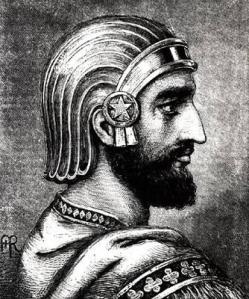
Cyrus the Great (Persian First XI)

Cyrus the Great (Persian First XI)

by  Theseustoo

Prologue

A Brief Overview of the History of the Median Empire:

The first king of Media was Deioces, who was chosen for his wisdom, honesty and judgment after the Medes revolted from their Assyrian overlords,. He built the city of Agbatana and established himself firmly on his throne, being careful always to display the same kind of wise and impartial judgment in his dealings with the people now that he was king, as he always had.

Deioces was succeeded by his son, Phraortes, who extended the kingdom significantly, conquering first Persia, and then all of Asia east of the River Halys, with the exception of Babylon. Phraortes even laid siege to the Assyrian capital, Nineveh and would most certainly have taken the city, had it not been for the sudden invasion of a horde of nomadic Scythians, who were following a band of Cimmerians whom they had chased out of Europe. These Scythians tyrannized and oppressed Asia for the next twenty-eight years spreading waste and destruction throughout the entire region until finally all of their leaders were slain at a treacherous feast planned by Cyaxares, the son of Phraortes.

Cyaxares, the third king of Media, finally drove the Scythian invaders out of Media, thus returning to her the dominion over Asia which had originally been won by his father; and which he saw as his birthright. Cyaxares finally conquered Nineveh, and thus subjected the Assyrians, who had formerly ruled all of Asia, to the dominion of their former subjects, the Medes, with the exception of the remnant of the Assyrian aristocracy, who had fled to Babylon, the final stronghold of the Assyrian Empire, to establish a government in exile.

When Cyaxares died the throne passed to his son, Astyages, who was thus absolutely determined that the fledgling kingdom of Media would never again fall so easily to invading foreigners…

(to be continued)

In the next thrilling instalment of ‘Cyrus’, hear all about the prophetic dream which threatens Astyages’ kingdom and how Astyages decides to deal with it.

Newer posts →

Patrons Posts

  • The Question-Crafting Compass November 15, 2025
  • The Dreaming Machine November 10, 2025
  • Reflections on Intelligence — Human and Artificial October 26, 2025
  • Ikigai III May 17, 2025
  • Ikugai May 9, 2025
  • Coalition to Rebate All the Daylight Saved April 1, 2025
  • Out of the Mouths of Superheroes March 15, 2025
  • Post COVID Cooking February 7, 2025
  • What’s Goin’ On ? January 21, 2025

We've been hit...

  • 735,413 times

Blogroll

  • atomou the Greek philosopher and the ancient Greek stage
  • Crikey
  • Gerard & Helvi Oosterman
  • Hello World Walk along with Me
  • Hungs World
  • Lehan Winifred Ramsay
  • Neville Cole
  • Politics 101
  • Sandshoe
  • the political sword

We've been hit...

  • 735,413 times

Patrons Posts

  • The Question-Crafting Compass November 15, 2025
  • The Dreaming Machine November 10, 2025
  • Reflections on Intelligence — Human and Artificial October 26, 2025
  • Ikigai III May 17, 2025
  • Ikugai May 9, 2025
  • Coalition to Rebate All the Daylight Saved April 1, 2025
  • Out of the Mouths of Superheroes March 15, 2025
  • Post COVID Cooking February 7, 2025
  • What’s Goin’ On ? January 21, 2025

Enter your email address to subscribe to this blog and receive notifications of new posts by email.

Join 374 other subscribers

Rooms athe Pigs Arms

The Old Stuff

  • RSS - Posts
  • RSS - Comments

Enter your email address to subscribe to this blog and receive notifications of new posts by email.

Join 374 other subscribers

Archives

Website Powered by WordPress.com.

  • Subscribe Subscribed
    • Window Dresser's Arms, Pig & Whistle
    • Join 280 other subscribers
    • Already have a WordPress.com account? Log in now.
    • Window Dresser's Arms, Pig & Whistle
    • Subscribe Subscribed
    • Sign up
    • Log in
    • Report this content
    • View site in Reader
    • Manage subscriptions
    • Collapse this bar
 

Loading Comments...