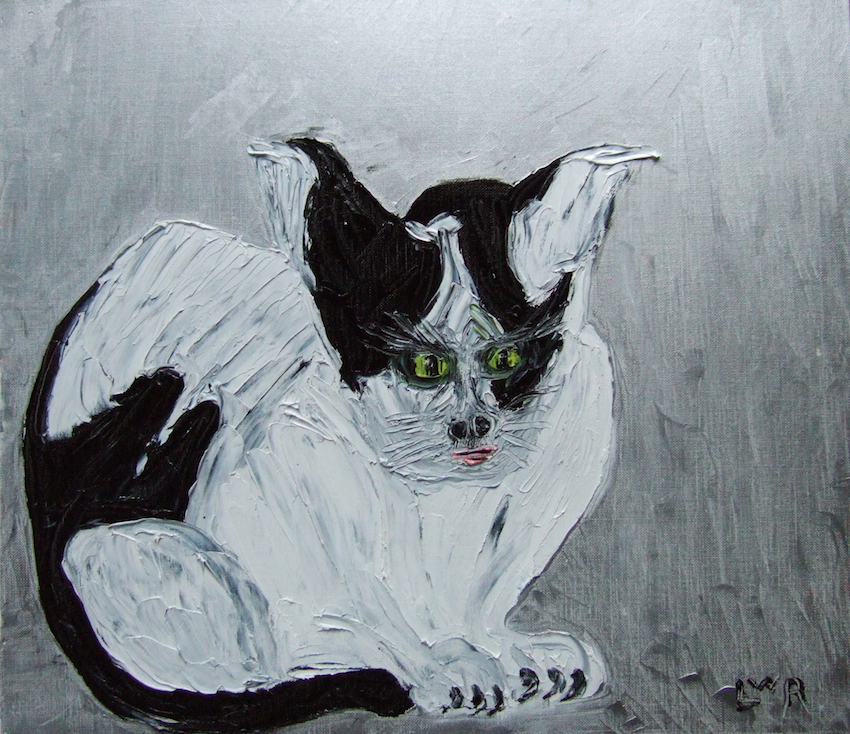
George is disappointed again. The big black dog has caught him and put his jaws around his neck and shaken him, and George is lying on the ground waiting for him to stop. Some pieces of black fur have been caught up by the wind and are flying away. George has unblinking eyes and a limp body. He is not injured, just a tiny bit, but he is very disappointed. I have never seen a cat express such disappointment as George.
He wasn’t much bigger than George when he arrived, this dog. Now he is ten times bigger. George started the play but now it hurts him and the dog doesn’t understand that. The dog likes George. He thinks that’s what you do with cats you like. George likes the dog. That’s not why he lies there though.
When the dogs eat their breakfast George goes to the back door and prepares for the walk. He watches out the window and considers which direction we will be walking in. If he is confident he goes to the left or the right and waits there. He is not always right. George wanders along with us, sometimes ahead and sometimes behind and if a car comes he lingers in their path so they have to stop, and when he is happy with the way things have gone he moves to the side of the road. Every day during the walk I scold him, and every day after the walk I thank him for being still alive.
I made my first painting with a palette knife. It is not a picture of George. Actually I think it is a picture of me. It looks much more like me than it does a cat. Hunched up, claws out, frowning in concentration.
I really don’t want George to look disappointed. I don’t want his neck to be broken by the dog, or for him to die under a car. But it’s not my ability to change what might happen. All I can do is remember to look into George’s unblinking eyes every day and say thankyou.
Then of course, having spent seventeen years of my life in Brisbane and then eleven in Hakodate, I can tell you this. Small towns have little enclaves of scorching eccentricity. Small towns are where otaku are germinated. Here in Hakodate there are roving hordes of african drummers. Small hives of animation geeks. More classical artists slogging away at their craft than you can put pins on a map. All tucked away quietly where no tourist program would ever think to go.
Small towns are breeding grounds for obsessive excellence. It’s just that you don’t see them, don’t hear of them. These days you’re more likely to know about them if you live in another small town in a completely different part of the world. Tapping signals at each other through the electronic waves.
In Hakodate they have a certificated course about squid, culminating in an examination. It’s called the “Squid Master Course”, or something like that. It’s very popular. But it’s a novelty thing. Anyone who really cares about squid enough to know a squillion things nobody else knows is going to be keeping their heads down, contemptuous of the Squid Master Course’s low standards, known only to the people who know a squillion things about octopus or flounder.
I hardly remember any more what people knew about in Brisbane. But like Adelaide, Canberra, crazy incredible feats of theatre and music and art flickered intermittently, and if they had enough power to turn into a steady light those people would be sucked up out of the town and find themselves on a street in Sydney or Melbourne, New York or Berlin or London. Where they too would either flounder or learn to suck up to funding bodies.
In small towns people stick to simple rituals. Actually it was one of my colleagues at the university; a blind professor, who taught me that. Small towns have mostly simple things to do, more practical things, and if one starts to want more, one will leave. So it’s a kind of choice when people start to crave more. They generally leave. Those that stay must abide by the nature of a small town and keep their hopes small.
So it’s a bit tricky to start a school here. People have been on my back. This will not work, people don’t do that, they don’t do this, why not change that and you’ll get more students. Call it English Conversation, for goodness sake! For a few weeks I thought I was just being proud. But whilst talking to someone I realized that I was just being stubborn. Of course things are difficult when they are new. Of course it would be easier to do what everyone recognizes. That’s why things stay the same, and that’s why my university backed down on its vision for the future and settled for a safe and steady past. But that’s also why I am here, doing this.
I have a lot of time to think about what I’m trying to do. It isn’t easy to get a picture; one pixel at a time, one conversation at a time, it falls into place. I am making a school for people to become stronger people.
It’s a simple school, and very cheap – ten dollars for an hour, and you can come if you want with no reservation and if you don’t come next week nobody will say a thing. A nice idea but if I don’t find an awful lot of people who want to do that I’m sunk. Still it’s worth a try. Here, where high rents and expensive lifestyles are not going to get in the way of a simple idea. I’m trying to find teachers to fill up three rooms four afternoons a week. People can come in and decide on the spot what they want to do, or they can come with one thing in mind and stick to that. Alongside my courses, which are english and art based, there is one on history and one on presentation. Now I am looking for more classes and more teachers. I want a simple course on philosophy. A simple course on psychology. Voice training. Education, especially a class on how people learn. An introduction to Complex Systems, and another on systems theory. One on management, one on leadership. High level reading and writing in Japanese. Business writing. Meditation. Book keeping. Local Ecology. New Media. Local architecture. See? Simple.
There is not much I can do at the moment to solve my problem of having no students. So I am taking a bunch of flyers with me every time I walk a dog, and putting them in the letter boxes of apartment blocks. This semester runs till the middle of February. The one from the middle of February might just be a really good one.
Most Japanese will say “bye-bye” when they depart; it’s one of those cutesy english things that has crept into the ritual. Baibai actually means “buy and sell”. I know that because I’ve bought houses and the word comes up all the time and annoys me with its inability to stick in my brain next to it’s meaning. I had to look it up again.
Baibai is what I’ve begun again this morning. I asked my friend to ask his friend the real estate agent to come and talk about putting my house on the market. My friend has told me that I stand to be sued for bankruptcy pretty soon if I don’t. So my friend has called his friend and his friend has come and made photocopies of the fat envelope of documents I can’t read about my house. He says that unlike America (and probably Australia), a loan default isn’t going to result in my having to move to a trailer park. Not for a while anyway.
Here companies are a little less bureacratic about things. People usually have families, and families usually pay in the end, so it’s a system built over the sticky system of family responsibility. The idea that eventually I should come up with the money applies even in my case, and so what I have to do is call the insurance company man responsible for my loan, and tell him that my friend the real estate agent is now working to sell the house. The house is the reason I took the loan, and my solution to the problem will be to sell that house and repay that loan. That’s all good. But how much is the house worth?
In matters of real estate I am still Australian down to the last floorboard. I figure that I’ve put a lot of money into the house. Done a lot of work on the house. It has a lifestyle. Sadly this does not have a translation into Japanese; lifestyle rarely sells houses unless it is rich and famous lifestyle. For the rest of us it is about units of land. Mr Real Estate Agent feels that we could get what I paid to buy it. I want to double that to cover what I really paid for it. I understand that I am being foolish, I want to do it anyway. Mr Real Estate Agent thinks I will lose the people who first glance at the for-sale story. He is right.
It’s an interesting thing for me. I’ve been daydreaming my way through real estate sites for Kyoto. Should I move back there into a steamy shoebox in the warm South? Or stay here in the arctic and battle on. In Kyoto there are now many internet sites for real estate that look like they’re selling cleaning products for modern young couples with one small child and a lot of allergies. It’s a sign that Kyoto is being gentrified, in its own peculiar way. Nothing like that here in Hakodate – here we have the most sensible real estate of a whole country of sensible real estate.
You don’t sell old houses; there are rarely advertisments for houses over 40 years. You sell the land that those houses sit on, with the price reduced to allow for demolition, and they are listed under “Land”. You can’t get a loan to buy an old house. Land; yes. Old houses, no. If you’re young you won’t even get a loan for the land. That’s what families are for. I suspect that loans might secretly be calculated by the number of children you have in school and parents you have in nursing homes – no risk of you voluntarily leaving your job then.
I have locked into a small security. Probably the insurance company will now wait for me to find a solution to their problem. I am glad to have found the way to solve their problem. Now I just have to find a solution to my problem, which it seems is not going to be solved alongside theirs. If this works I will be debt-free, but penniless and homeless. Even then it will be a trailer park because they will want a deposit. Then I guess it will be – Matsumae.
There’s a little office on the corner of the train street and somebody’s got some boxes of vegetables for sale. I slow down to take a look, I’m always curious about that little office. It’s the flea market lady. She comes out and starts talking about my house. With no introduction, like she’s been expecting me to come along. It’s got bad luck, very bad luck because it’s at the bottom of a lane and the good spirits won’t go there cause they can’t get through. So she’s going to come round this week and take a look.
She comes on Friday afternoon at 6. She looks around, it’s a nice house, a big house, there are nice things, though they are old and contain distressed spirits, she needs the floor plan. I’m smoking a cigarette trying to remember which box in which part of the house I’ve put it. It’s going to take a long time to find it, I don’t think…but maybe the fat blue folder…I find a copy. She starts drawing lines through it with a pencil and two rulers, takes out a lot of little plastic cards covered in diagrams in red and blue and green. When she’s finished she shows it to me. Even before the explanation it looks troubling. There are good places in the house, but I’ve got baths and sinks in them and all the good fortune is washing away. There are so-so places; I have my bed in one of them and although it’s a place of death (blanch) it’s not bad for healing. And then there are a lot of bad places. The entrance is in a bad place. If I put my feet out of bed in the morning I am immediately in a bad place. Anyway, the whole house is a disaster, and that’s why things are so bad for me.
She shuffles all the photocopied instructions she has. Amongst them is one picture of a plastic PET bottle of water standing on a hillside. My heart sinks. I smoke a cigarette. I decide to bring it on. Okay, what do I need to do to make things better? Of course, it’s the Magic Water. This magic water comes from the slopes of Mt Fuji and is incredible; even when it is standing still it moves. It is full of IONS. Possible even some MAGNETIC FORCES. With this water strategically placed around the house all my troubles will come to an end. Actually the moment that I decide that I’m going to resolve this problem and buy the water, things are going to get better for me. It’s only….let’s see, you have to buy two boxes of it, so…about $170. You dig a hole in each corner of the yard, and bury the bottle with the cap at the top. Unless of course it’s likely that the house will be seized, in which case you would put it in a planter. Immediately the snow will start to melt more quickly. Then, one in the centre of the house, and a few under the bed. Some in a spray bottle, and you can drink the rest. Voila.
It seems to me that this plan is not failsafe if we are talking about a possible need for planters.
The Japanese have this word: amaeru. It describes a kind of behaviour in a relationship, it’s sometimes described as love-dependancy.
If your kids always call you up from the middle of nowhere asking for a ride when they know you’re busy, you could describe that as amaeru behaviour. If a friend is constantly involving you in their squabbles with other people, that could be amaeru. If someone in your family is always using the last of the milk knowing that they are supposed to get some more and just not doing it, if someone at the office always slips off early when the work is not done because you always let them get away with it, you could describe that as amaeru. Usually it’s someone pushing acceptable behaviour in a relationship, and more often someone who is in the less strong position. And someone who lets them get away with it.
But turn it around. Amaeru can tell us a lot about our relationships. Given that a relationship is the kind of stickiness, the glue between two or more people, which of your relationships is sticky, and which are a little more tenuous? Imagine that you are busy doing a number of things for different people, all about the same importance. Which of those things would you do first, which would you be more likely to forget about? Amaeru behaviour can tell us how close we sense the relationship to be, and how durable. Amaeru is most easily seen between parents and children, or lovers, or people working in a group.
We sometimes have quite different relationships to what we assume or to how they appear, and only realize it when we’ve pushed things too far. Amaeru is about that pushing; it’s a test – an unacknowledged attempt to see how far we can go.
I just read a piece of…um, journalism…over at unleashed about China. I usually feel annoyed when I read stuff about China. Interesting to me is that stories about China often remind me of stories of Murdoch. “It’s big, it’s cruel, we hate it” often appears to be the crux of the story. This one I just read appeared to have been written in Starbucks after a few nights of, ah, chasing leads. Sweet Chinese girls who answer the phone with a hello.
I’ve never been to China. Only Hong Kong, not the same thing. Only guest houses and hotels, not the same thing. Even a hotel in China is not the same thing. I think it would take about as long to get a story on China as it takes to get one on Japan, and I’m thinking that’s a minimum of 18 years. The same length of time as it would take a person to get through the school system.
One thing that caught my attention about China was the Olympic Opening Ceremony. Partly because it was the first time I ever noticed the Language of Olympic, seeing more than anything else in that great extravaganza a New Improved Version of the Sydney Olympic Opening Ceremony.
But what did impress me were the fields of people making something out of almost nothing. Brushing drums to create immense music. Small gestures animating that entire field. I think China might be the only country left with that kind of concentration and discipline. So when I hear these stories of Chinese might, and as always that might rests in the cruelty and calculation of the Chinese Leaders, I think they’re stupid.
We underestimate the population of China. We count only the gazillion inside the country. How many Chinese blooded people have been born outside China? To be always somehow Chinese. It’s that invisible population that gives China the appearance of a Murdoch. China is itself a World Wide Web. It’s maybe the only country that parallels the Internet.
The giant poodle barrels into me head on, smashing my glasses into my face. I’m in pain, I can feel dripping down my face into my eye, and I’m sopping up blood with tissues waiting for the flow to subside. There is a two centimetre cut above my eye where my glasses have stuck into the flesh. I was about to take the dogs for a walk and the carpenter is next door preparing to work on my floor, so I go up to the corner and see him, tell him what has happened, ask if he doesn’t mind walking one of the dogs and I’ll leave the door open for him. The taxi company says it’ll be fifteen minutes, but when I say I’ve had an accident a taxi arrives almost immediately. I’ve dragged the garbage bag outside, even with the sting of my face I’m irritated that I won’t get the garbage out.
The taxi driver calls in to find out where the hospital is. It’s a public holiday and I was not aware of that, and I’m relieved to hear that all the things I had planned to do I couldn’t have done anyway. We drive off to the hospital, it’s really an orthopaedic clinic. The driver is preparing to drive off, but the cleaner at the door says they don’t open until 9, I can sit and wait. I don’t want to sit there until 9. I could just as well sit at home and finish the coffee on the table, smoke a cigarette. So the taxi driver takes me home again. It was an expensive way to find out which hospital I needed to go to, but at least I know now. It’s a hassle to find these things out.
I drive back to the hospital, walk in. But I’m still upset that the emergency list for hospitals has me arriving at one that isn’t open, and I’m unhappy. The gasp when I walk up to the counter in my shoes, having missed the signs, to go back and take them off and return to the counter and be told to go back and get the slippers. And then there’s a questionnaire on a clipboard, and then a fuss about my health care card, it’s expired and I haven’t noticed. You have to pay the full amount in cash they say, and I storm back to the door and put my shoes back on and shout at them that this is not the way to behave when this is an emergency patient! I go home and dig through drawers, find the envelope with the card in it, drive back to the hospital again. They were going by the book, they didn’t expect me to walk out, and they also didn’t expect me to return. This time they’re very efficient, I’m very efficient, they’re sorry and I’m sorry and we’re all apologetic in a professional kind of a way and completely synchronized in our determination to reach a satisfactory conclusion together. I get taped up, bandaged up, and we part on warm terms.
The taxi driver says that everyone calls an ambulance these days. The hospitals don’t pay a lot of attention to people who turn up in taxis. So people call ambulances, even for small things, and the ambulances are over-stretched and not coping. I don’t like the idea of taking an ambulance. I wouldn’t have gone at all except it’s my eye and I wouldn’t like to damage it. I’m bothered to be dragged into the medical system.
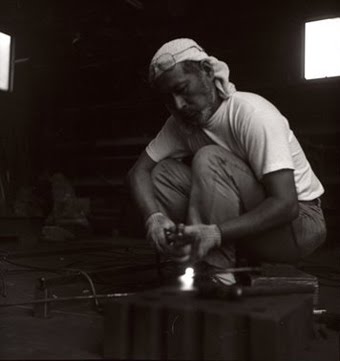
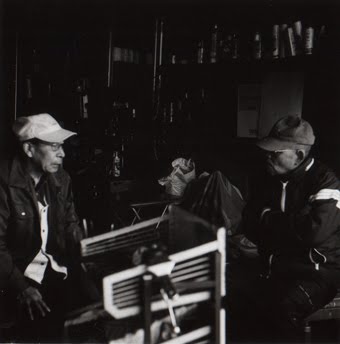
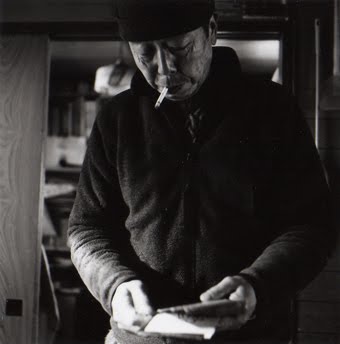
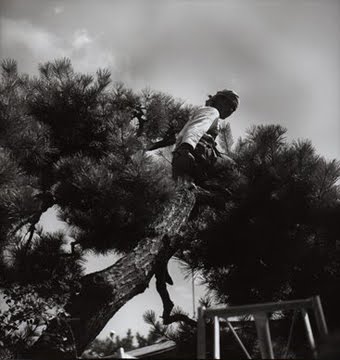
One of the Carpenter Guys took me to take a look at his house. Every inch filled with treasures, enough room to roll down his bed. Stamp album after stamp album, scroll after scroll, gilt covered whatnots, religious icons. Some of these things looked to me like they belonged in a museum. I suspect that the Museum Guys are not nearly as resourceful as the Carpenter Guys.
All the Carpenter guys seem to have a love of old things. They would pop around while the Carpenter Guy was working, look at my recycle-shop tea-room cabinet, say Oh, the doors don’t match, and move on. Any time we came across some old sheets of newspaper they would whip them off. Unwise customers at the markets were impressed by anything wrapped in old newspaper.
murata(sm)
Carpenter guy got half of the scrolls I found in the cupboard. We unrolled them on the floor and his great knowledge all-at-once deserted him. I don’t know anything about scrolls, he said. You choose one, and I’ll choose one, and… I have not yet forgiven him for it.
The Carpenter guys let me have the wood from an old house they were dismantling, dragged it over and dumped it in the yard. Inside the pile I found the black lacquered counter of a sushi bar cut in two. The kind of sushi bar you use your fingers to eat with. I wiped it down and found a shelf for it in the house. I watched them take the house apart until they found an old teabox in the foundations. But I never saw what they found inside the box. And then they quickly brought in the bulldozers and all the rest went off in a truck full of splinters. I saw the tea box still lying there and brought it home for tools.
niwashi(sm)
You can ask the Roof man to fix chimneys, but you can’t ask him to build things, people will be annoyed. You can ask the Concrete man to build a fence at a pinch. But even I know that you can’t ask him to take a look at the floor. The Carpenter Guy has to do that. If you want to put charcoal into the floor you will need the Carpenter Guy’s permission. And then you will need to drive to the Volcano and talk to the Charcoal Burners up there.
But no old house is comfortable without charcoal. When they pulled down the old house built on the old hospital three doors down, I asked for the gates. Everyone who knew anything pulled the charcoal out of the foundations. By the time I learned about it none was left.





 Window Dresser's Arms, Pig & Whistle