• The Pig’s Arms
  • About
  • The Dump

Window Dresser's Arms, Pig & Whistle

~ The Home Pub of the Famous Pink Drinks and Trotter's Ale

Window Dresser's Arms, Pig & Whistle

Category Archives: Lehan Winifred Ramsay

A p p L E D

11 Wednesday Apr 2012

Posted by Therese Trouserzoff in Lehan Winifred Ramsay

≈ 37 Comments

Tags

Apple, Education, LED, School, Technology

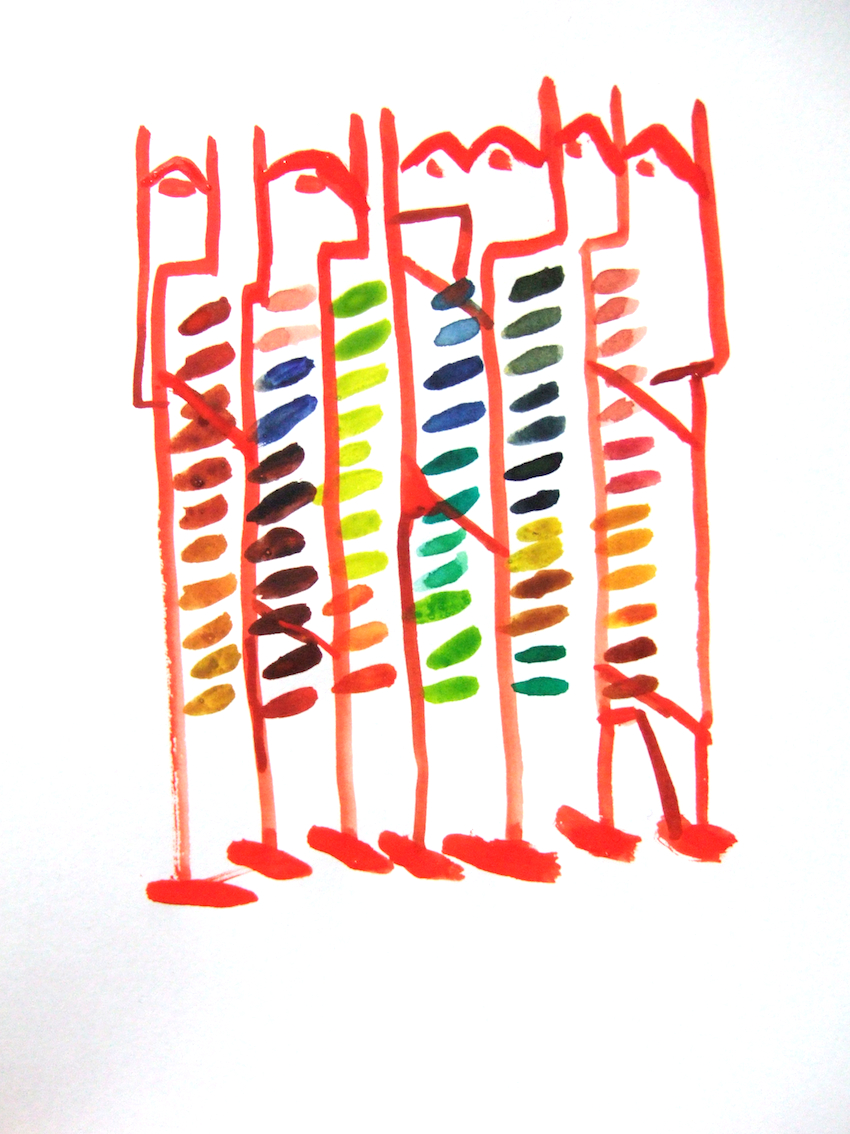
Our Lady

Painting and Story by Lehan Winifred Ramsay

Where does education come from? The shop. The shop where the applications come from, the tablet comes from. But not where the school comes from, nor the teachers. We might say that the technological corporations will become the institution, and the teachers and schools will become the software and hardware for distributing them.

Technology’s best trick is always to change the way we understand things to be. An invisible cloak? This does not mean that it is invisible, it just means that we can’t see it. The same trick with education, which is getting pushed and pummelled over a degree or too until it means “access”. Is it such a big difference, that while access used to be the ability to get into a school, it now means the ability to have an internet connection and a device for looking? Is it possible for me too to change my thinking about this, to consider that schools have for too long had control of education, that freeing it up might just give us something new?

But I find education about technology to be a little shallow, more of a review than a critique, more instruction than reflection, and I wonder if education through technology will be more of the same. Not surprising then, that RMIT is leading the way in Teacher re-education by introducing its new Behaviour Capability Framework; guidelines for the way one should present oneself as an RMIT employee. But can we really blame short-attention-spanned HR/PR practices for this? Surely we could have foreseen the moment that technology took on education and won?

We are all heading for the clouds. Up in the clouds is everything we do, deliberately and absentmindedly, and that everything is becoming us. We don’t need to know everything any more. We just need to know how to find it. We can review it, we can critique it and it’s not even possible any more to edit it. Soon it will be difficult to critique it too, as criticism turns itself ever-so-slightly and becomes a negative behaviour, and we will stop that, forgetting we ever had the power to do so. Technology’s second best trick, after all, is to quickly replicate itself, removing a feature here or there, that we quickly forget we ever had.

Education is heading toward becoming a search engine. Not, though, until search engines are superseded by the next big data retrieval system. Leaving us always a little behind in our capabilities. We need to know how to find things. Technology needs to know what we can find. So sadly, though we might dream of education breaking from its archaic bonds and becoming a revolutionary force, it’s unlikely to happen.

I don’t dream of that. Education breaking from its archaic bonds. I like technology. I like it because it babysits me when I am bored and at the boundaries of my physical environment. I like to read, and write, and think. Technology gives me crayons and scraps of paper, and when I am bored, something pink or flashing. It helps me to remember that I am a Lifelong Learner, and it tells me where and how to get my education. This education is very nice to me, it encourages me to start and doesn’t get strict with me when I stop. Oh, that’s okay. Pick it up when you feel like it. It lets me pick and choose and move on if I’m bored, and best of all it lets me feel like I am really smart. Not like education used to be. I found it difficult! Even, at times, a struggle!

But we have a good relationship now, technology and me, and I can be who I am. Who I am is a little limited, of course. I am a dilettante, a dabbler, a jack-of-all-trades. I now have a motivational quotation for everything. A bit like a specialist in HR/PR, I now have at my fingertips the wisdom of the world’s greatest thinkers. And what did Einstein say about that? Something inspirational, I’ll just go look it up.

I don’t have to rely on myself any more. I think that has made me a better person. Other people seem to have done and said things that where much smarter than I would. So it makes sense to draw upon their experience, instead of having to do whatever I am doing again. And again, till I get it right. And again, till I bloody understand it.

I like those tablets. I am hoping that they will soon make one that I can swallow. Pictures of cheap shoes will appear in my eyeballs, and my fingers will twitch to touch something, shooting sensory memory-like data back into my nerve endings which I will recognize only as inherent knowledge – my own wisdom, my own intuitions. Isn’t that where we’re going with tablets? Or have I got the technology industry confused with the medical industry? I’ll just check. Oh. It’s Moses. Not Pfizer. Anyway I like them, though I wish they would make them as small as my Smart Phone, so I can hang them both around my neck.

In FACT I want to be able to hook them together, my tablet and my Smart Phone. If you put them together, they would give you TWICE the screen size! That would be very, very cool. Perhaps I could get them to argue with each other about what I should do next. Though probably only if they were products from each of the two rival groups. Being Smart, though they would probably resort to trickery, an attempt to discredit each other’s information, until I was well and truly confused. What would I do then? I would put them on the ground, take a stick, stand it up, and choose the device it fell toward.

Education comes from the shop. It has always come from the shop. It’s not a small thing, to remember that. Shops are nothing new. All those pithy quotes by our world leaders are Shop Talk of old. Nothing new there, HR/PR people.

You Might Call it Lucky (but I call it Genius)

09 Monday Apr 2012

Posted by Therese Trouserzoff in Lehan Winifred Ramsay

≈ 10 Comments

Tags

Apple, Electropolis, faith, future, luck

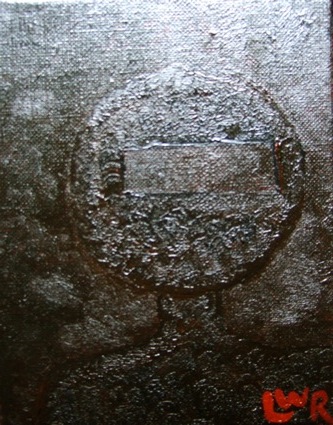
Peace

Story by Lehan Winifred Ramsay

I want to talk about faith. I’ve thought a lot about it these last months. It was my niece who got me thinking. We were painting together, some mistake turned out unexpectedly well. “Lucky!” I exclaimed. “You might call it lucky”, she said. “I call it God’s help”. Thus clearing up for me something I had never been able to understand. How does faith WORK?

Faith is like a reprogramming, so that instead of noticing the things that are going wrong, you start to take notice of what is going right. And it has one brilliant feature. Once you start to notice how many things are going right, you start accumulating fortune. Because you don’t take any of those fortunate things off your list, you just keep adding to them. All that success makes you stand taller, smile more, be more assertive, and if you are more confident and assertive, you will be more successful. So whatever it is that you have chosen to have faith in – whether it is your own luck, or the hand of God, or the course you have started, or some kind of guru – is going to look good, very good. The better it looks, the more faith you’re going to have.

But speaking of gurus, the proclamation of all the online newspapers I’ve seen today that The Future is Tablet. These days we could be talking about another medical breakthrough, but it is of course The Hand of Jobs of which we speak. I have total faith that anyone who can get that much publicity for their product is speaking with the authority of a Higher Being anyway. But I note that Apple didn’t declare their faith in this Future until the goal was well within sight. Thankyou, all the companies that contributed, and all the consumers that bought, all the people who wanted an easier format, for making it possible for Apple to rule the Electropolis.

Shenzi/Banzai

08 Thursday Mar 2012

Posted by Therese Trouserzoff in Lehan Winifred Ramsay

≈ 29 Comments

Tags

Painting, Shenzi/banzai

Shenzi/banzai

Painting and Story by Lehan Winifred Ramsay

Sometimes I wake up at 3am. I’m not sure if I’m just waking up, or if some kind of racket is waking me. This is an apartment block full of people who work in the district, and the district is entertainment. So they could be getting home around 3. I know that in the next door apartment lives a woman who appears to have a vacuuming fetish, and a loud man who drinks a lot. Sometimes she vacuums at midnight, the whine of the machine and the thump of it hitting the wall, over and over. Then she’ll vacuum again about 7. That surprises me a little, I can’t really see the need for such regular vacuuming. I don’t mind so much because it mitigates my own noise making. The squeaking floor, the chair pushing away from the table, the ads between lame youtube movies.

People take their bicycles up in the elevator and park them in the hallway. The woman opposite pushes a pram out her door, and in it sits the fattest little dog, quivering. On the floor below or above is an old man on a respirator, he has tubes in his nose and drags the machine along with him. And there are mamasans from the bars downstairs, who seem bent on dragging some of their customers out of their beds for a singalong. Someone vomited in the lift before I went out this morning, that wasn’t so nice. I edged around the newspaper somebody had placed over it, and on my way back tried not to look to closely at the contents of the ashtray on the first floor.

The garbage is thankfully simple. There are no special taxed bags, that’s for the countryside. You can just put out your grocery bags. Monday and Thursday for burnables, Wednesday for plastics, Friday for cans and bottles. They have to go on a neat pile across the road, not the night before and not after 9am. It’s relatively easy compared to some of my garbage experiences – and believe me, garbage can be the breaking point of any neighbourly relationship.

I don’t mind this apartment. It’s a bit small, and drying canvases is going to be a challenge. Not nearly as much as no garden and no pets. This morning I found three cats outside the convenience store, fluttering their eyelashes at people coming out of the shop.

Genomino !

22 Wednesday Feb 2012

Posted by Therese Trouserzoff in Lehan Winifred Ramsay

≈ 7 Comments

Tags

genetics, genome, language

Genomino

Story and painting by the Pig’s Arms Osaka Correspondent – Lehan Winifred Ramsay

Recently I read in The Washington Post an article called “Walking Wounded: 20 genes down and still good to go”.  It described a research project on human genetics that is being developed by 50 scientists around the world. What caught my eye was the comparison made between this genetic code and language.

The researchers described the genetic material (the human genome) as “our species 3-billion letter instruction manual for self.” Which has an attractive resonance for me, a person with little knowledge of biology but an interest in manuals. In the study, the article said, the researchers “carefully read a book – an individual’s genome – in which some of the sentences – a single gene – have suffered a typographical catastrophe. Words have been changed, or whole phrases have been dropped. Whatever the cause, the result is a sentence that no longer makes sense.”

The researchers point out that the absence of genetic material appears to be as important as the presence of material. Perhaps then, rather than the result being “a sentence that no longer makes sense”, it would be more accurate to say “the result is a sentence that no longer makes the same sense.” A sentence that does not make the same sense still has something to tell us.

I found myself thinking a lot about this. Do these researchers really feel a strong correlation between the genome and language, or is this merely a way of making the subject easier for us to understand? I’m fascinated with the possibility that there is some connection between the genome and the development of language; that we may be involved in a long process of finding the words to describe our selves as a mirror describes our that the compulsion to develop language itself may have been for this very reason  – but I can’t tell if this is what these researchers mean, and it might simply be my own flight of fancy. No doubt their mission is not to compare our genes to our words; an instruction manual can have many uses, and they have not explained what they mean to use it for. To make one…to fix one…to search for one…or to just own the manual. To input that “manual” into a computer and have a painting come out?

It is my first day back in Japan, after an absence of nine months. I had only limited reasons to speak to people yesterday, and I have been wondering what effect the absence of the language would have had on my ability. Today I had some challenging negotiations, for phones and contracts and rearranged delivery schedules. I had been expecting that I would have lost vocabulary, but there was not one time that I struggled to find a word. Or even struggled. The words were fine, but what I had to say was very rough. Listening to people explain things I noticed I was having more trouble with nuance and meaning; with “common sense”.

It was more a problem with why things were as they were. Why did I need a phone number to get a phone number, when my reason for getting one was that I did not have one? Because it was a dilemma that Japanese people were unlikely to have, with an unbroken existence in Japan, and therefore not an unreasonable request for a Japanese person. And why were those celebrities on the television commercial for the mobile phone running, only running, during the commercial, and would I have found that as baffling before I left?

When people on the phone requested information from a form, why did they ask for it in a different order to the form itself? Seeing it was their form, wouldn’t it make sense to have the information in the order it was needed? I seem to be having a cultural disorder….I know how things should work but it still takes some to put the pieces together so that they make sense. Anyway, big cities have complex repetitions; the trains, for example, are numbers of networks laid over each other, each with their own ticketing and movements, and it is at first difficult to separate one network from the others. But I am accustomed to adjusting, and my cultural dis-order will neaten itself within a few sleeps.

I am reminded of when I was five and the words in a book suddenly flipped and became reading. Has that happened to our friends the researchers, or is that what they are working on still. Why hasn’t it happened to me? Is this what I must do; sift through the words, understand how they work, identify the errors, and wait for the repetitions? For recognition to catch my eye, as it has my ear.

I want to know how reading works. This is a culture that prefers its foreign languages in reading. A culture with an extremely complex and difficult system for reading. Reading is assumption, because when we begin reading we do not understand all the words, all the sentences. But if each gene is a sentence, in language a sentence contains many genes. I could imagine researchers here taking that same 3-billion genes and coming up with a very different reading, an instruction manual with its own internal logic that disagreed with many of the assumptions of the other. Still, authorship is ownership; they would have quite a battle to make even the simplest changes. Perhaps the essence of this research is: who will be authority with the right to read our genes.

Cultural Appropriation

14 Tuesday Feb 2012

Posted by Therese Trouserzoff in Lehan Winifred Ramsay

≈ 22 Comments

Tags

Cultural appropriation, Ned Kelly, SBS

Red Ned 3

Story and Paintings by Lehan Winifred Ramsay

This week by chance I found myself thinking that SBS was kind of unpleasant. I’ve always avoided feeling any unpleasantness about SBS; it was a given with me that SBS was tainted with no ambiguity.

It was an advertisment about a cooking show; some guy from an asian background going back to the land of his ancestors to experience their food and to show them his own. I speak the language of food, he said. I was disturbed. That’s what idiot cooks say when they go to a country and pretend to be really communicating with the natives. Not only communicating, but teaching them something.

I don’t like to say this, but sometimes I feel that the way multi-culturalism is represented on SBS is a bit like cultural imperialism, cultural pornography, cultural shopping. We own that, we say. We may be Australian but look here! We have one of those too. And so this – all this – is ours too!

Red Ned 4

I sometimes feel uncomfortably like a thief. Looking at the travel guides, the food travel guides, the interior and exterior travel guides for tips to do up my home. As if other countries existed to fill in some little stylish detail that would give me the edge. We often call it “appropriation”. But another word for it, just as ambiguous, is stealing.

It is still making me feel uncomfortable that I found myself not liking SBS. Has it changed so much? There’s a strange sense of ownership of culture these days, I don’t remember it being there before. Perhaps it was simply there in a different way. In the past we seemed to look at these foreign countries as being “them”. Now, sometimes it feels like we’re sitting on the couch with a glass of cold something in our hands saying “Oh yes, we got some of that just the other day!” And what they’re talking about is “foreignness”. But then you see them introduce “one of us” into the mix. And then it doesn’t feel like stealing, so much as it feels like completely nullifying the situation. It’s not even foreign any more. Weird.

But I’d be curious to know what you all thought about this. Does SBS ever make you feel uncomfortable ?

On Design

13 Monday Feb 2012

Posted by Therese Trouserzoff in Lehan Winifred Ramsay

≈ 22 Comments

Tags

Apple, design, durability

Dry

Story and Painting by Lehan Winifred Ramsay

Lately I have been thinking about the effect that Apple had on design. On the one hand, Apple has introduced a very strong kind of design that is immediately recognizable, not only for being Apple but also for being GOOD design. But inside of that, Apple threw away some of the important core meanings of GOOD design. They threw away durability (with products that have to be replaced too often), they threw away heritage (with products that can NOT be kept) and they threw away flexibility (with products that can not be re-used.

I have always thought that Apple design was very Japanese, and it is interesting to use Apple as an example of “Japanese Design”. It is very beautiful, it has an other-worldly quality about it, it’s sometimes as if the design is enough to justify its existence, no function needed. That brief, slick, cute and eerily perfect product? Before Apple, it was Japanese Design.

But after the earthquake of March 2011, in a time of new understanding of the frailty of our environment and our responsibility to it and ourselves to care for it, it may be time for a re-think. Part of re-thinking is about changing perception. If we consider that Apple is the world’s most successful example of “Japanese Design”, and we look at those problem areas – durability, heritage and flexibility – can we make a blue-print for a new definition of GOOD design?

Land Rush Land Script

06 Monday Feb 2012

Posted by Therese Trouserzoff in Lehan Winifred Ramsay

≈ 32 Comments

Tags

Painting, technologys and society

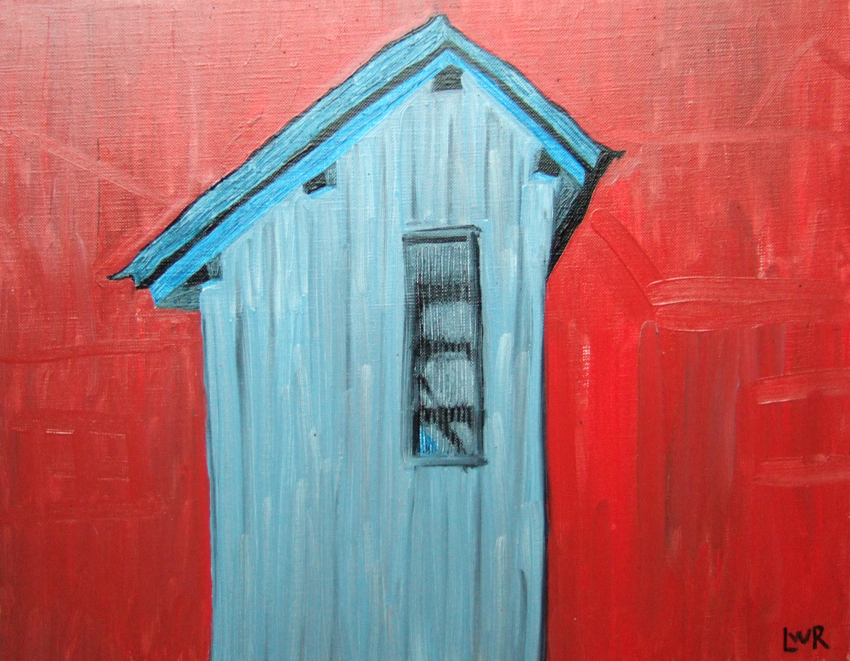
The Shed

Painting and Picture by Lehan Winifred Ramsay

It is my belief that we have not been led by technology; rather, technology has been led by us. I do not know how to explain or to prove this, and so this piece of writing explores a very simple and naïve attempt to explore this is a possibility. I do this for one reason. It seems to me that a great many of these corporations of innovation and technology that I have been speaking about have been making business plans for our future and then rushing us toward those plans. And I do not believe that they are entitled to do this, but are simply taking advantage of the natural confusion we feel in the face of sudden and powerful change.

Those business plans appear to include the intellectual property of those futures and the power to restrict us to those futures. This is not such a naïve idea. Recently Apple announced its new educational future. Apple’s Future of Education is hardware that will govern the way information will be accessed (ipads), software that will govern what this information will look like (apple text-developing software), service that will governs the accessibility of this information (the apple store) and permission that will govern who is able to make it. It’s not a small thing. This is the first time that education worldwide can be centrally controlled. Whether it will be or not is not up to us, but to Apple. Should Apple choose, for example, to provide the hardware free for the initial setup, the offer will be accepted by a large majority of institutions. Locking them into a relationship with Apple for equipment replacements and upgrades, software and upgrades, educational texts and upgrades, and ongoing entry to the system.

I’m trying here not to go back to a discussion of specific technological examples, but it is difficult. It may seem, as Emmjay pointed out, “driven by the interplay between innovation and consumption in what we loosely call an “open market””. But the “interplay between innovation and consumption” can still be considered a technological interchange, and what I am trying to argue is that any kind of technological interchange is being quickly claimed as intellectual property by corporations. Not just that, but our very behaviour and characteristics are being claimed as intellectual property – and by projection, our future is being claimed as intellectual property. Which might also lead to the deliberate narrowing down of the possibilities of our future. And it seems to me that before we find ourselves in legal quicksand we – the human race – might want to re-establish our ownership of these things.

I’m going to introduce the idea of 3Media. The combination of the news media, the social media, and the search and archive media. It’s a rough picture of the large institutions that are now working so hard to gather up all the data that makes us. I believe that one of the reasons that 3Media is able to rush us so hard, introducing us not only to information in a state of transformation but also to completely new concepts at such a rapid pace, is because of the resourcefulness of our brains. And I believe that that resourcefulness is a sign that we already understand those new concepts and information. We have had a collective conscious since we began to communicate with each other, and Jung spoke of a collective unconscious, some pool of knowledge that resided inside our brains. Perhaps now there is a third, the accumulation that is not situated inside of us but within the electronic information network. It cannot be called conscious or unconscious, for it is neither and both. Perhaps we can call the artificial intelligence. After all, we know that not all life begins with intelligence, but many are able to develop it. So why not accept that our attempts to create an artificial intelligence is well on its way.

Shed 2

Then, not only would I say that we have developed an artificial intelligence, but I would say that we did so because we ourselves had already learned how to make one. Personally I believe that the line between “humanity” and “something new” has already been crossed, and we ourselves have artificial intelligence rather than human intelligence. The difference being that an artificial intelligence is capable of transforming itself. And, again, I don’t believe that the 3Media corporations can claim ownership of that, no matter what they contributed to it.

If we have become artificial intelligence, then how, why, when did it happen? Was it the transformation from horses hoof to mechanical wheel? Was it the photograph or the moving image, the printed page or the footprint on the moon and the man looking over his shoulder, back at us. Was it the electronic transmission of data – the telegram. Was it the fundamental abandonment of heritage and heritance?

Who would ever know. That’s where 3Media should be useful – to tell us about ourselves. Rather than to tell us what they want us to become. All that information – our intellectual DNA, and we cannot get a correct reading of it because they insist on manipulating the readings. Not that we shouldn’t be capable of putting together a new set of DNA to read, but like Wikipedia there will always be people in there messing about with it. But perhaps one day we will get to the point where we can make that complete reading from the brain of any individual. We will have learned from the 3Media how to filter out the individual variation.

So there it is. My grandiose theory of artificial intelligence. Unfounded, unprovable and no doubt already shot into pieces. We have already made it, and we could make it because we had already become it. Some small change, looking insignificant, that long after can be recognised as an actual evolution. That lays the way open for the kinds of speedy transformation that we are seeing now. That speedy transformation that we are told by the 3Media corporations is due to them, but which are nothing essentially more than silly toy gadgets, a few useful but limited innovations, and a gold-rush of intellectual property grabs.

Read the Small Print on Everything

04 Saturday Feb 2012

Posted by Therese Trouserzoff in Lehan Winifred Ramsay

≈ 8 Comments

Tags

Painting

The Garden

Painting and Story by Lehan Winifred Ramsay

I don’t believe that technological innovation has been as profoundly important to us as we have been to it. It was we who had the idea that we wanted our horses to go faster, and no doubt it was also we who first thought to put those wheels on them. And then we wanted better typewriters, and fewer filing cabinets, and calculators that didn’t have to start each time from nothing. We wanted it, and we talked about it, and it was our words and our ideas that were taken up by people with ideas themselves on how to do it.

But let me get this straight. Am I saying that these people were not geniuses, not inventors, not the owners of these ideas? Clearly they were intelligent, at least in a few areas, and they were great engineers of those ideas. Personally I would say that they were not the owners of these ideas. But they likely have copyrights and patents: intellectual property.

Societal regulations for unique ideas and products may say differently. Societal regulations are, like us, unable to think of everything.

Societal regulations have never been interested in how taking note of how quickly and how strongly a product takes hold. Given that people appear to be naturally cautious, could that not be an indication of how strongly the idea was rooted to begin with? The fact that Facebook takes off in Harvard University, for example. It is clear that Harvard University was a good environment for producing Facebook. Might it also have been a particularly alienating and lonely environment, and might that have caused a lot of people to talk about needing friends, talk about what kinds of friends they wanted? Might it also have been a community of particularly systems-oriented people, particular about the conditions they needed for friendship, wanting simple procedures and choices?

The news media and the social media and the fishing (storage and search) media have spent a lot of time telling us that they had provided us with a service and did not know how to make money from us. They spent several years in this state, oh poor us, oh poor us. They first collected up our data. Used it to give us advertising. Sold the data on. Used it to develop new versions of their technology. Launched “business class” preferential paid options. Made business collaborations with hardware and software producing companies.

Pushed out competition. Finally some came to us cap in hand. We must ask you for a service fee. And we gave it to them, feeling guilty that we had got so much from them without paying for it. It is important to remember that the value of a free product is particularly high.

It is so often the case these days that you can access your subscription news media if you log in to your Facebook account. There is no longer a question of conflict of interest – once you get inside you will find your Facebook all over the place. The relevance and importance of news is measured by how many people access it, access increases toward the top of the site, the top of the site is where important news is, the more important the news the more people will access it, the organisations with access to the most information are the social media and fishing media sites. Press releases and product reviews sounding like a long lunch date.

And you will go to another newspaper and find the same story. My assumption is always that they are simply sharing stories. But I consider that I might be wrong here: they may not be sharing anything. Good news media needs good networks. It may simply be that behind every good news media editor is a press release. A well written and informative – even entertaining press release that needs no editing. For what is editing? “nonsensical sentences, remarks without interest or importance, banalities mistaken for profundities, ordinary “points” confused with singular “points”, badly posed or distorted problems…”1 a press release will contain little to correct.

We’ve recently found ourselves reassessing the business ethics of Rupert Murdoch’s media conglomerate. It had become increasingly clear that Murdoch’s media was crossing the line between ethical and unethical business, but we learned that the line between ethical and illegal business had also been crossed. A great opportunity to go back and look at the ways in which we became accustomed to and accepting of misbehaviour. What is more surprising is the liberties that our online masters can take with our information, our data.

Publicly announcing it, constantly shifting the rules, and then putting out a press release about just how much money they expect to make from it. It’s awesome.
Awesome too is how much bad business creep there is in the media world. Apple products have constant problems with cables, for example. They have been designed to death, but at the expense of durability, they have very short lives and they generally can’t be kept for the next model. The Apple phones, another example, are built not only for a short physical life but also for a short desirability life, until the next sexy model (no co-incidence there) appears on the stage and catwalk (no co-incidence there) in the hand of the boss (sigh).

Design has been revolutionised by Apple. It has been stripped of “durable” and “sensible”, and “makes economic sense”. However did they do that, it’s simply brilliant. sigh.

Considering our strong views on environmental issues we are really quite circumspect about our own wastefulness. But then, considering our strong interest in technological advancement we are incredibly unaware of just how much it is led by us. It is maybe time to get a little more arrogant, strut around like a Startup CEO, start acting like the boss, make the big decision not to buy the product that gives you an erection, read the small print on everything, and talk back to the media. All of it.

1 Marks: Gilles Deleuze: Vitalism and Multiplicity, 23.

The Boys in the Backroom are Dividing up their Spoils. Again.

03 Friday Feb 2012

Posted by Therese Trouserzoff in Lehan Winifred Ramsay

≈ 9 Comments

Tags

Painting

Landscape with Souvenir

Painting and Story by Lehan Winifred Ramsay

Technology and innovation, that’s all we seem to hear about in the online newspapers, the “news media”, particularly their value and societal worth. That’s not surprising given that these online newspapers are constructed from technology and constantly being innovated. They would have us believe that their presence is newsworthy. They had profitability in their paper media until they went online – they went online with a business model that at first was not successful, and so their profitability and the success of online commercial business are tied together.

In the meantime, “social media” also became socially successful whilst still struggling with commercial success, and so the two media joined up.

One of the characteristics of electronic information is speed, and speed is what we are being dealt. Technology and innovation interests – the makers of technology, assisted by the news media and the social media – try to speed us up. Rushing us toward an evolved life, changing our perception in tiny but very fast increments. Any social issue or social change that is now “in the news” is one that has a strong backing of people with the ability to get into the news, to make the news, to write the news and to re-write the news to fit in their issue. Which means that media people, and tech and innovation people, and social media people, are indeed extremely powerful at present.

They can run their issues like campaigns, and they do. One method that we are being particularly assaulted with at present is using the data on our online habits to feed us with a kind of information that you could almost call “familial”. It is no secret that the news and social organs of the web would like to lead us to things we want to buy. So if we put the word cow online, cows will appear online. And if we are being particularly naïve, innocent or careless, we will not hold some scepticism about the presence of all these cows but will merely accept them happily. So we have the impression that we have choice, and that our online environment is familial. Really we are being manipulated in a particularly silly and obvious way, by our online hosts and their magic tricks.

Of course, news media have always disguised promotion, advertising and press releases as news. Social media is doing nothing that is more exploitative than what dating companies or dodgy motivational products have always done. Technology and innovation businesses appear to have better designed and valued products than in the past.

There is a creep, a slow but insidious drip, a flooding, a dividing up of the internet. At present it is in the interests of those businesses to smother you in attention. Once they have your commercial measure there will be no great reason to continue with this. Once they have the measure of you you are not going to change substantially and require more attention. Once the “online DNA” has been figured out, there will be no courting of your information. There will be formulaic and systematic programming. And it is likely that our online world will suddenly and shockingly slow down. But that’s not much of a guess.

That’s pretty normal business practice.

Not much is new, a great deal of this technology and innovation is smoke and mirrors, very simple ideas cloaked in DESIGN and EXPENSE. A great deal of it is semantic change; the same as before, but given a different meaning. Because it is cased in technology and innovation, in a box or a program or a service, it can be licensed, it can be patented and copyrighted, it becomes intellectual property. Not our property, though. I believe we will have less ability to ask for change, in the online world, once it gets through this frenzied adolescence.

What I start to feel as I read and read through this fast-paced activity online, is that we are being fooled. And foolish. I don’t believe that technological innovation has been as profoundly important to us as we are told. It’s true that we have changed; our perceptions and understandings and capabilities have changed. But I don’t believe that technology and innovation caused our perceptions and understandings and capabilities to change. I believe that our perceptions, understandings and capabilities caused the technology and innovation.

We love people who Think Different. And we know where Thinking Different is supposed to lead us. To Apple. Apple, in its Think Different campaign, used people like Mother Theresa and Ghandi to express its meaning of “Thinking Different”. Now after the death of Steve Jobs we can understand that included in that lineup is Jobs himself. But I don’t believe that Jobs changed us. I believe that we changed Jobs. It was us that he used, after all. It is we who created Gates, and Zuckerberg, and all our self-made Visionaries of the New World. We had already changed, that’s why they were able to make all that money from us.

I don’t agree with the way corporations are dividing up our Online world amongst themselves. I don’t agree with the open discussion of how those same corporations plan to divide up our Moon amongst themselves. I believe that we are being a little too polite here, and a little too accepting of the press releases that pass for intelligent discussion. I don’t want to have to go to them and ask them to stop what they are doing. I would like them to figure it out for themselves.

Don’t you wish that too?

Many Such Helpful Friends

02 Thursday Feb 2012

Posted by Therese Trouserzoff in Lehan Winifred Ramsay

≈ 40 Comments

Tags

helpful freinds, Painting, Robots

Quilted Robot

Painting and Story by Lehan Winifred Ramsay

I remember reading about how Australians began to embrace investment after they were made to keep superannuation funds. And then every Australian seemed to become a real estate junkie. Now if they are reading anything at all they are every day becoming well-trained specialists in recognizing that opportunity that will change their lives. Technology, education, age management, management… never ending self-improvements.

I think that facebook is training us on how to make our friends into assets. Useful, useable, tradeable commercial assets. We are learning to think about them differently, to understand the rules governing successful management of friend assets, to understand the financial potential in them. One of the rules of Asset Management of Friends is: never lose one.

It seems to me that the next thing to be “assetted” will be love. Sex, sexual relationships, marriage, partnership. We are so good at learning now, we will be excellent students. But I doubt the Asset Management of Lovers will say “never lose one”. It is clearly financially beneficial to have a marriage system that allows you to move up and up through relationships, gathering assets. So we will need to learn how to do that properly, and our marriage system will need adjustment to make it work for us, rather than against us.

If you’ve ever read one of those motivational (self help for the “activity” disability) books you’ll probably remember all the categories that you need to do a little in at a time. Things like planning, relating to people, negotiation, investment, time management. 

Now take the time to read through The Age, or The Sydney Morning Herald. They seem to have reformed themselves into daily motivational trainers for us. Is that what we are, now? People whose single desire is to improve, in clearly recognisable steps? Like the steps in a flower arrangement school, each with its own certificate (TAFE approved, RPL available).

It’s curious. At the moment there’s an article about air travel. Get over it and get on with it, they say. Another view might be: actually you’ve been SOLD travel as one of the ultimate rewards for your endeavours. And often it’s not fun at all! It’s actually a time where you get even more marketed and under-rewarded than normal! In fact, it could be argued that it is neither attractive NOR desirable! It’s just that it’s such a great little money-maker, and for you, a great way to learn how to stick to a goal.

One time I deliberately took a bad holiday – planned it from beginning to end and stuck with it. Why would I do that? I think it’s because I’m a particularly good learner.
Did you ever notice that you used to have interest in the dumbest, most unsharable things? And now there’s an online shop for it. Chewing match heads. Go do your research.

Weirdly, it all looks much the same until you take a look in another country. Ebay, for example. Who are all these scammers, you think. And then, once you’ve got the picture, you see it all over the place, right here in your own place. Stop telling me about those match heads, you think. I just used to like them, that’s all. And now those scammers won’t let it go.

Yesterday I went to a Vinnies and they had a skirt there for $25. It was a lovely skirt. Can you make this a little cheaper, I said, because I’m unemployed. No. We can’t. Someone came out from out the back and said: oh, we had to put that price on there, it was brand new. Yes I understand that it was brand new. I can see it is such good quality. But I am unemployed. Can you make this a little cheaper? No. We can’t. We get this high price so we can run our charity programs for the poor. Yes, I can understand that you get the money to run programs to provide charity for the poor. But I am poor. And I am asking you for help by going into your charity shop and buying the clothes that you have received for nothing. And I am now not even able to be your customer. Only your client. I am too poor for a Vinnies shop.

Newspapers read more like the kind of newsletters you can subscribe to. Which is important, because that’s what their business plan is, to make little tailor made newsletters for each and every one of us. So if you’ve noticed that, you’re with the program.

I write about Vinnies, it is snatched upon by the Facebook Fairies (oh look! a Product!) there is a “Vinnies Vogue” story in my personalized AGE within a few minutes. Sadly, they do not recognize that I am too poor to shop at Vinnies. Perhaps this is the aspirational lesson plan.

I am a little sad about newspapers, reading them was one of my great passions. It was nice when they came on sheets of paper. If you got up to go to the toilet, the same story would be on the page when you came back. It’s those trivial things that we become nostalgic for.

And BOOM! A nostalgia section! Being sad is now flagged as a super-potential marketing opportunity. So my disappointment is of great interest. Perhaps having something interested in me will help that sadness anyway? My own personalized self-investment manager. I cannot lose. I am being supported by my personalized media, and my success is their profit. As a human success contributes to a healthy condition. So success is what I will have. See how helpful and loveable robots (a pretty name for technology) are?

Oddly, there have been some reversals in strategy. Arts Hub Australia used to refuse me their newsletter unless I subscribed. Now they send it to my email box, although we never agreed on such a relationship. They have come to learn that in the world of motivational newsletters, you have to be there to find a money-making opportunity. We will find that we have many such helpful friends now.

← Older posts
Newer posts →

Patrons Posts

  • The Question-Crafting Compass November 15, 2025
  • The Dreaming Machine November 10, 2025
  • Reflections on Intelligence — Human and Artificial October 26, 2025
  • Ikigai III May 17, 2025
  • Ikugai May 9, 2025
  • Coalition to Rebate All the Daylight Saved April 1, 2025
  • Out of the Mouths of Superheroes March 15, 2025
  • Post COVID Cooking February 7, 2025
  • What’s Goin’ On ? January 21, 2025

We've been hit...

  • 713,950 times

Blogroll

  • atomou the Greek philosopher and the ancient Greek stage
  • Crikey
  • Gerard & Helvi Oosterman
  • Hello World Walk along with Me
  • Hungs World
  • Lehan Winifred Ramsay
  • Neville Cole
  • Politics 101
  • Sandshoe
  • the political sword

We've been hit...

  • 713,950 times

Patrons Posts

  • The Question-Crafting Compass November 15, 2025
  • The Dreaming Machine November 10, 2025
  • Reflections on Intelligence — Human and Artificial October 26, 2025
  • Ikigai III May 17, 2025
  • Ikugai May 9, 2025
  • Coalition to Rebate All the Daylight Saved April 1, 2025
  • Out of the Mouths of Superheroes March 15, 2025
  • Post COVID Cooking February 7, 2025
  • What’s Goin’ On ? January 21, 2025

Enter your email address to subscribe to this blog and receive notifications of new posts by email.

Join 373 other subscribers

Rooms athe Pigs Arms

The Old Stuff

  • RSS - Posts
  • RSS - Comments

Enter your email address to subscribe to this blog and receive notifications of new posts by email.

Join 373 other subscribers

Archives

Website Powered by WordPress.com.

  • Subscribe Subscribed
    • Window Dresser's Arms, Pig & Whistle
    • Join 279 other subscribers
    • Already have a WordPress.com account? Log in now.
    • Window Dresser's Arms, Pig & Whistle
    • Subscribe Subscribed
    • Sign up
    • Log in
    • Report this content
    • View site in Reader
    • Manage subscriptions
    • Collapse this bar
 

Loading Comments...