
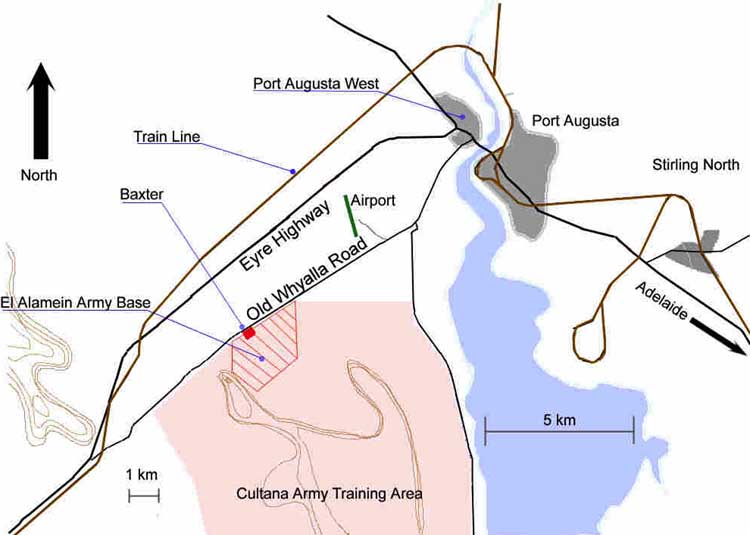
Map of the site of the now closed Baxter Detention Centre...detainees were moved to other locations.
By Sandshoe.
Baxter sprawls on a plain of searing heat. Nothing stirs in sight of the novitiates getting out of their vehicles. The travellers scan the dirt around their transports they stay close to at first because the impact of it seeming they are the only people in this place confuses them. Some are hesitant in their cars. Behind the heavy gate and fences ahead of them, imposing blank walls are clear evidence there is choice and choicelessness in coming to this place.
Guarded in this detention centre are women and men whose lives are forever compromised by incarceration profiled as ‘not punishment’.
Grit that is a fine gravel and a scuff of red sand trace a narrow concrete path. Cardboard cartons of apples and salad vegetables are unloaded out of vehicles and carried into the shade of a fledgling tree. They are set on the ground in the red sand and dirt. Around them, plastic containers of dessert sweets, cream puffs and flat breads with accompaniment savouries, pickles and spreads are balanced besides lavender sprigs in a large basket surrounded by a pink, purple and white satin ribbon bow – and 25 kilos of bananas packed in newspaper in banana boxes. A box of white disposable plates, plastic bags of disposable forks (no knives), spoons and cups are rested on the top of the boxes of bananas and alongside a large cake box, a box of programs bound with ties of gold, pink, apricot, blue and cream satin ribbon. There is a bag of lemons and a weighty one of sweet jujubes and apricot delights. Large bottles of lemonade, fruit juices and chilled spring water are hefted along a further path on instruction from the bride. She indicates to waiting bystanders to bring the items in the shade of the tree along the same path to where she begins to build a second stack adjacent to a barred gate in the outer perimeter fence until nothing is left in the shade of the tree and the new stack is a stark sunlit clutter.
The stack will be returned to and its family of boxes and paraphernalia carried further again after the the visitors announce themselves and the formalities of signing in are concluded at Reception.
Advice they are to deviate (backwards) to a reception building set in bush obscurity at the entry way to the car park inspires a series of manoeuvres between the gathered guests. Each consults another to verify the instruction.
The area inside the small building through a glass sliding door is reminiscent of a temporary office for road workers alongside an isolated road in rural Australia. It becomes crowded and its atmosphere tense as the wedding party becomes a composite and knowing organism expressive of fearful need. The guests shuffle and startle.
A flare of agitation feels as might the tip of the blade of a serrated knife to the heart.
A guest is challenged her name is not on the list of visitors who are the invitees. She is the bridesmaid in a princess line maroon satin under-dress and voile overhangs her shoulders to an elegant full length. The tips of her flat black slippers show daintily from under the hem of her garment as she stands in grievous anticipation of being refused entry to her place of honour. The uniformed officer on duty is barely patient. She has to telephone repeatedly to senior officers that the bridesmaid does not have photo ID.
Everyone in the room is struggling. The guests other than the frozen bridesmaid cope with their survival tasks to secure their own entry and clear the confined space in close jostle, transferring forbidden valuables such as mobile phones, wallets, sunglasses and car keys into lockers they secure with keys on metal rings with blue metal tags that are circular and stamped with the number of their locker.
Guest who have filled out their names, addresses, telephone numbers, occupations and reasons for visiting on duplicate forms, and signed their accceptance of responsibility for their own entry are checked against a list as bone fide visitors whose names and details have been provided to the administration of the Centre-Baxter as it is called on the street-the week before. Some guests will say weeks later when interviewed each is asked in turn to extend their right arm so that a red plastic band can be attached with a number written on it in heavy black pen. Others will only say their fist is stamped with a number and some the stamp is invisible.
People who do not have pockets ask people they have never seen before to accept their locker key for safe keeping and begin a passover of emblematic trust. The bridesmaid is allowed entry.
The guests retrace their steps to the food, soft drink refreshments, juice, cartons of water and paraphenalia left in the stack by the barred gate where another duty officer looks through from its other side until the entire party is grouped to enter. The gate opens into a narrow cage set over a two person-wide path that is the cage floor and leads around 10 metres in length to a heavy metal door that is painted green and has the words printed in red on a large sign on it-WARNING DOOR OPENS OUTWARD.
Five of the wedding guests at a time will be allowed through the door to be searched, but not until the attendees are secured in the cage and the gate closed and barred behind them. One door or gate will not open if another is opened. The processing of the bridesmaid and consideration of her entry has taken long enough that the heat of the fierce sun burning down on the first guests assembled waiting for the cage gate to be opened has clearly taken its toll and there is no canopy to retreat beneath.
Sweat is soaking skins that prickle in wedding finery. The floor of the cage is an elevation of concrete on the red dirt around it.
Shepherded into the cage, each guest bends to grasp as many as they can carry of the boxes and other items from the stack at the entrance. The outer barred metal gate closes behind the last and the officer assigned to guide and lock the visitors in the cage disappears with the first group of five admitted through the heavy metal door to the next stage of their processing.
Through the bars of the cage and another perimeter of fencing, a path to an entrance door in the wall of the detention centre is discernible. It leads across a stretch of moatlike and sparsely vegetated dirt. That ground is almost bare. Motion detectors track any human presence and the two perimeter fences are electrified.
As each group of five is ushered out of the caged queue, its participants bend to lift and carry their share of the load forward. The cage is exposed to the sun’s full beat on its bars as the sun climbs towards noon. Guests disguise their anxious fear with talk they are pleased they have worn clothing no heavier than they have on. Mary, Margaret, Margaret, and Maryanne are identified getting to know who is who in the crush. A young woman in a light pink cotton shirt and fawn slacks rocks a routinely admired baby in a pusher. The handsome Persian father coochies the baby to smile.
The sense of the sun’s oppression blends in a gathering haze with the factor of their caged imprisonment as the guests succumb to a quiet preservation of their strength to endure the heat and their containment. Beside the cage, the mechanism of the entry gate for a vehicle accessing the compound begins to grind with a lurching sound of sliding metal joints that are parting.
Higher than can be imagined a towering gate glides ungraciously open to a sickening event that is its ultimate clang and the vehicle accelerates slowly through its giant maw. The slow grind of metal reverses the gate against the expanse it has opened until that eventual status is returned to closed and secure.
Time passes. No one is left in the cage. The final group of would-be celebrants is directed through the green metal door. They find there is a holding chamber beyond the inner cage door large enough for no more than one or two people to move comfortably through it and an access blank cream metal door. The clutter of individuals filing through the door looks towards instruction what to do next. Two men in uniforms flank an x-ray machine monitoring an erratic flow of boxes and wedding items. Guests are directed to place miscellany out of their pockets onto the black surface of the conveyor belt rolling behind its flapping rubber curtain.
The bridesmaid is among the last applicants. She has been rejected. She was not supplied with an ID number, a correspondent number that is recorded on a log sheet, along with the locker key in another column and in respective others, full names and signatures. The bridesmaid is told to stand and wait. She does until the other members of the group are processed by abandonment of their property onto the conveyor belt and each on command steps through a security screen in a neighbouring cubicle. A guard waves a metal detector the full length of their body and advises his colleagues he is finished.
The responsible guard will come and return with the bridesmaid to the reception building proximate to the car park, back through the cream door, holding chamber, green door, the cage, its outer barred door and across the distance to the office in the patch of scrubby bush that flowers as if by bitter brandishment. She is either not pleased with her employment, is contemptuous of the visitors or fails to disguise contempt for herself for having neglected protocol. She beseeches the bridesmaid to hurry. The door to be opened into the cage to begin the journey back cannot be opened if any successive door is open. The last of the guests to be processed has been ushered to wait in front of another door of heavy metal. Another cage imprisons another concrete path. At the end is another barred metal gate.
After clearance by walkie-talkie that the bridesmaid has been escorted the complete return journey, the guard directs the visitors to follow him through the door and along the path. The guard unarms the barred gate. The celebrants are directed to take the path alone across the spread of daunting open ground exposed to their uninterrupted view as a barren moat. The visitors say nothing a guard can hear that communicates the current of ill-ease gathering its momentum and shoaling against bars and souls locked in these premises in this red semi-desert. Any recall of the presence of the wild beauty of natural attraction and the tourist mecca of the coast where they had camped the night before and watched the fishing boats sail into the evening light is a cloy of consciousness that struggles in the disorienting heat to make geography, patterning, natural botany, fauna meld to fit the knowledge of cruel experience.
There is nothing we can know from a briefing or written text that properly prepares us for any circumstance until we experience its sounds, the nature of its silence and appearance.
The smells are harder to define. The guests’ bodies are secreting adrenalin, the hand maiden of fear and their armpits course in sweat and blend the assortment of perfumes in the confine of the holding chamber and small room they are directed into through the door in the wall.
Two guards are their receptionists, a makeshift theft of any last expectation of niceties. The list that without the bridesmaid’s name on it has isolated her is checked in replica.
The community room visible through a wall of observation glass is peopled by detainees and guests who are under surveillance like reality television at a wedding party. On the wall at the far end of the room is a banner of felicitation heralding the names in English of the groom and his bride:
H A P P Y W E D D I N G
The faces of the people in the room are turning as word spreads the last arrivals are visible through the glass. In the beaming face of the groom among his friends is the warmth of hospitality of a man at ease with his companions and visitors he is greeting. The bride is talking to a shining gentleman in a stand-out gold thread matinee jacket, the Master of Ceremony, whose face is grave. He is regarding his duties according to the bride’s advice and reassurance.
Mild applause sets up at the last arrivals being sighted, They manipulate their share of boxes and bags into a holding chamber and out through a second. The last almost of the guests are delivered safe and the bridesmaid in the chaperone of an isolated guard has returned the trek.
The bridesmaid is a competent interviewer. On the walk she has negotiated a conversation with her escort. The guard has ‘just started’. She is ‘a country girl’ she replied to the bridesmaid’s cunning enquiry of where she is from. From a local farm, her parents urged her when they learned of the employment opportunity to apply for position at the facility. After a long period of unemployment after finishing school, she regards herself as ‘doing something’ for her country, the bridesmaid tells her [the bridesmaid’s] mother who is one of the wedding party. The guard’s brothers are on the farm and she did not want to stay there herself, neither was encouraged. Times are hard in the drought.
The wedding programmes are distributed. Printed on a decorated utilitarian dark cream paper, they are distinguished by a fine quality white striped paper dust cover that has no printing or illustration. The stripe on the cover has a pleasant raised texture to feel and look at. Inside on the first page is the simple announcement of the marriage of the couple who are Baha’i followers, the date and a stylised rose illustration. Beside two entwined miniature roses at the bottom of the page is a quote selected by the designer from the writing of the Baha’i leader and philosopher, Baha’u’llah.
O, friend! In the garden of thy heart, plant nought but the rose of love, and from the nightingale of affection and desire loosen not thy hold.
The guests seat. The Master of Ceremony indicates to the program and delivers the opening address in English. The groom reads the prayer in the Persian language of Farsi. The young son of the bride reads a prayer in Farsi and its translation in English includes:
I will no longer be sorrowful and grieved.
I’ll be a happy and joyful human being.
O, God I will no longer be full of anxiety nor will I let trouble harrass me.
The Baha’i Marriage Tablet, the writing of the philosopher Abdul Ba’ha is read by a stalwart Australian friend of the bride who has travelled with the group of social workers to attend the wedding. The reading is in the style of a moral teaching of considerable beauty unlike any experience of a Christian marriage. The principles of loyalty, jealousy, seeking counsel, fellowship and amity are introduced, and aspiration to spiritual thought, extension to others through hospitality and nourishment, by example and through a union of harmony and rapture:
Walk in the eternal rose garden of love. Bathe in the shining rays of the sun of love. Be firm and steadfast in the path of love. Perfume your nostrils with the fragrance from the flowers of love. Attune your ears to the soul enhancing melodies of love.
Baha’i marriage is defined for the couple in a reading from the writing of the same author. The selected reader is another Australian friend of the bride who is as pretty as a rose herself:
Their purpose may be this: to become loving companions and comrades and at one with each other for time and eternity.
The marriage celebrant conducts the marriage and the celebrant statement is reproduced on the second to last page of the programme for guests who wish to follow. It is a simple presentation that adds the Baha’i wedding vow places their God in the very most centre of the couple’s relationship:
That by his Bounty your marriage will become “a fortress of wellbeing”.
The bridesmaid reads a prayer in English that is a reaffirmation of the belief in God and supplication that through that wise watch and intervention the couple will enjoy harmony and unity:
Confirm them in Thy servitude and assist them in Thy service.
The bride and groom exchange gifts and each speaks to the assembly of guests in turn on invitation extended them by the Master of Ceremony. Each expresses their love for their spouse and their appreciation and love for their family in Iran and guests. The guests are thanked for their support and attendance and invited to join the bride and groom at the wedding reception, to partake of food and the refreshing drinks the bride and guests who have travelled to the Centre have carried with them the length of their journeys.
Each of the pages of the programme is illustrated with a small single rose and decorative leaf printed in blacks and greys and repeated in descending, although irregular sequences alongside the paragraphs of text. The same rose designed into a frieze illustrates the top of the first of a series of blank pages included at the end of the programme to encourage the guests and residents to write their impressions or add a personal reminiscence in the form of prose or a poem.
*****
About three months ago when I moved out of the city to live in rural South Australia, among my papers I came across most of this foregoing text written on the blank pages of such a wedding programme.
I was the designer commissioned by a bride-to-be to produce the programme (the booklet) and I began by researching Baha’i wedding customs. I searched for sample booklets and was loaned a selection. I shopped for paper for the programmes to offer the bride her choice, conceived and accomplished the layout, graphic illustration and delivered the printed copies bound in craft ribbon tied through two eyelet holes into twisted and curled bows.
In time presenting to me in these past three months, I have been editing and rewriting The Wedding Party. Progress has been slow. Other commitments and distractions intervene.
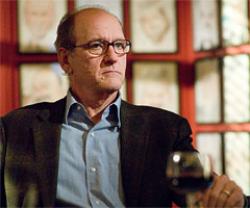
Richard Jenkins in 'The Visitor'
Until last week when I was inspired to finish The Wedding Party …I happened in my local library on a DVD of ‘The Visitor’, a movie about such a person as I whose placement in a situation they cannot anticipate leads to a life changing experience and more out of it from which they cannot return in the special sense of learning and loss, happiness and grief, love gained and compromised love. Richard Jenkins whose role as the lead male seems in retrospect a wonderful prop around which Richard himself knowingly allows the story to affect, entrap, engage and change him has my undying admiration. The actor who supports him, the female lead Hiam Abbas is talented and beautiful.
And Haaz Sleiman in his role of Tariq, an illegal immigrant, brought me to believe in the closeness of the shared experience of the street, he as Tariq so believably a model of an idealistic streetie I spent time busking with on the streets of Auckland simply because of his creative talent as a singer-songwriter.
So too I have been inspired by Danai Jekesai Gurira in the role of the brilliantly fearful, literally startling girlfriend of Tariq who Richard Jenkins as Walter Vale, college professor, eventually visits in a detention centre and there is the nub, Richard Jenkin’s riveting performance of a climactic speech.
I have worked since on ‘The Wedding Party’ to present it because ‘The Visitor’ is an ultimate inspiration combined with Australia’s shameful continuing abrogation of responsibility to its past and this current disgrace is sickening … of making treaty to trade humans for humans with Malaysia where detention on the strength of belief a crime has been committed or will be committed is allowed without charge or trial and breaches of civil rights include flogging and caning.
Had the wedding programmes served in 2004 no purpose other than the paper on which where I could find no other I scrawled ‘The Wedding Party’ in rough draft I am content my story is told as a contribution. I wrote it in the early hours of a sleepless night in a share accommodation traveller’s house in Port Augusta, South Australia-having attended such a wedding.
Image Source Page: http://www.mediasearch.com.au/film/filmreviews/thevisitor-filmreview
 Window Dresser's Arms, Pig & Whistle