• The Pig’s Arms
  • About
  • The Dump

Window Dresser's Arms, Pig & Whistle

~ The Home Pub of the Famous Pink Drinks and Trotter's Ale

Window Dresser's Arms, Pig & Whistle

Tag Archives: Bess Stafford

Bess Stafford Investigates #7

15 Friday Mar 2019

Posted by Therese Trouserzoff in Warrigal Mirriyuula

≈ 5 Comments

Tags

Bess Stafford

Story by Warrigal Mirriyuula

Zero Sum

07 Out of The Fiery Furnace (1962)

The Humber Super Snipe purred up Barrenjoey Road from Newport, taking the climb over the headland in its smooth stride. Inside the car it was warm and comfortable. ABC radio was playing Alfred Hill’s Symphony No 8, “The Mind of Man”, and William Stafford was idly musing on the piece as he drove, noting similarities in the voicing of the orchestration that had an affinity with Arnold Bax’ “Tintagel”. Being contemporaneous composers probably explained that. Even high art has its fashions.

Catherine Stafford was sleeping in the passenger seat, her head resting on a small rough velvet cushion against the door pillar. There was the intimation of a smile on her sleeping face and William, taking a quick glance at his wife, felt that same old urgent twinge so often mistaken for the butterflies of anxiety, but which is nothing less than a visceral reaction to, and a physiological manifestation of the unexpected apprehension of love. William thought that Catherine was simply the most beautiful person he had ever known and believed himself unbelievably lucky that she had chosen him. 

Catherine had been very popular with the other young men at Sydney University. So much so that William, a very reserved young man from the country, had thought he didn’t stand an earthly chance. This sense of foregone failure must have seeped into his facial expressions giving William the caste of a poet lost in love.

He would see her in the Union, The Pleasaunce garden; always surrounded by eager young men and young women besotted with her beauty; but what William didn’t know was that Catherine, whilst charmed certainly, flattered of course, was not exactly bored, but certainly not interested in allowing these attentions to bloom into anything with the scent of spring. She had her eye on a young man with whom she had never even spoken. A physics student with the face of a sad poet.

She often spied him from the corner of her eye, and if their eyes met, it was only ever briefly. The young physics student would shuffle away as if suddenly remembering something he had to do. 

The truth was William just shattered every time he saw Catherine. How could he approach her? “I’m such a dummy!” he would tell himself. He began to believe that it was an impossible dream and, with First Year sliding towards examinations, he had better get down to the books or this “star crossing” might be the end of his University career. 

He made a point to avoid the places where he might see Catherine. If she so much as popped into his mind; something that happened unbidden several times a day; he would think of complex differential equations, hoping that the cognitive power required to mentally drive these calculations would leave little left for the winsome intrusions of Catherine’s beautiful face. 

So it was that for all of second and third year they hardly laid eyes on one another. They had no lectures in common. Catherine was studying Fine Arts. Her head was in Michelangelo’s clouds searching for the numinous. Across campus William’s head was in a cloud chamber searching for tiny evanescent particles that screwed themselves out of existence almost as soon as they had appeared. In his bleaker moments William equated these short-lived particles with his own chances with Catherine.

But just as absence is said to make the heart grow fonder; (perhaps in this case the archaic “fond” was more accurate. William certainly felt like a fool, and this programmed avoidance just made his yearning that much harder to bear); William tried but could not succeed in moving on from his infatuation with Catherine; who, in her turn, found that she spent a great deal of her time wondering and speculating about William Stafford.

Sublimation had seen them both do spectacularly in their Honours program and they were both contemplating what might be next when they both, separately, received invitations to a ball to be held at St Paul’s College to celebrate the end of the academic year.

William wasn’t going to go. He didn’t really get on with the Rugger Rowdies from the colleges. It wasn’t really him. Not that William was antisocial; it was that he was socially awkward to the point of embarrassment, and the prospect of having to make small talk, or worse, dance with a girl, filled him with dread. Besides, he assumed that Catherine wouldn’t be there so what was the point? “My God! What would be the point even if she was going to be there?” he found himself saying out loud. He’d never be able to overcome his shy diffidence to so much as even cross the floor in her general direction.

The world turns no matter the pressing concerns of the love lost; and so, in the week before the ball he had unexpectedly seen Catherine in the Quad resulting in the usual sudden sense of weightlessness such sightings brought forth in him. A friend with him at the time noted the look of confusion that swept across William’s face at the sighting, and quickly turned to spy the cause. The young woman coming out of the Nicholson vestibule was absolutely gorgeous, and he turned back at his friend with a look of respect, impressed that William had set his sights so high.

“You never know, Billy Boy; faint heart and the fair maiden, what?” His friend always affected silly British locutions, but William had to admit he was running out of opportunities, and excuses. He was going to take Lady Macbeth’s advice and screw his courage to the sticking place, and then hope like hell that things turned out better for him and Catherine than it did for the Macbeths. That was the problem with these old literary saws. They often came from places that didn’t really support their contemporary usage; a different world. 

William nodded to his friend, a gesture of both confirmation, and parting. He strode down the cloister on the western side of the quad towards the MacLaurin stairs. He had to go to the library anyway. He could fake a meeting he thought. Just run into her. It was a clumsy plan and didn’t take into account the fact that Catherine would almost certainly see right through it; and what would he say anyway?

As it turned out Catherine had seen him coming and planned her own cute meeting. She would call out to him and open with a question about X-Rays and their application in certifying the authenticity of old masters. Catherine had discovered that William was fast eclipsing his professors in the area of x-ray diffraction. 

One of William’s tutors, no doubt hoping to ingratiate himself with the beautiful Catherine, had let on that no less a person than Sir Lawrence Bragg, Australian head of the Cavendish Laboratory at Cambridge, youngest recipient of the Nobel for physics and world expert in X-ray crystallography, had offered William a position at that prestigious lab.  

Catherine had been working on “the first question” for some months. She wanted something that could combine their two separate interests and after receiving the intelligence on William from his tutor, she had finally settled on x-rays as the key to open the lock on William’s sociability. She hoped that it might help her see inside the diffident young man, draw him out so she could engage him in conversation.

So, like two of Williams accelerator particles, each with their own energy, each with their own purpose, they collided at the bottom of the MacLaurin stairs and something new was created between them. It had been just a light bump, followed immediately by hurried apologies and innocent smiles. William of course was then simply struck dumb, so Catherine piled up her courage and asked William about x rays and old masters. William, feeling on more solid ground here, burst into a speech giving Catherine all that he knew about x-rays and x-ray crystallography. 

It would have been obvious to any observer that Catherine was only understanding a tiny fraction of the information that flowed from William’s babbling lips. Yet she seemed to maintain a look of earnest interest; her eyes moving all over his animated face. She was trying to see through the young intellectual palimpsest. To see the William that only this morning she had admitted to herself, she loved. She knew it was silly. How can you love someone you’ve never really spoken to; but she was certain this was love none the less. 

She loved the way William spent a great deal of his time alone with his head in a book, occasionally looking up, as if to speculate on his reading, before looking back down and carrying on. She loved the way he walked around campus, his confident stride, his expressive face, curious and alive to all that was happening around him, but most of all she loved him for his version of “The Arab’s Farewell to His Steed” which she had seen him perform at a Victoriana night held in The Great Hall. 

His spoken performance had been accompanied by sentimentally sad piano; the accompanist dressed in full evening togs. William had on brown face and suitably draping Arab costume with a keffiyeh on his head. His rendition was full of hammy emotion fully appropriate to the Arab’s loss; his arms wide, his face to heaven, a picture of that loss; and as he spoke the lines, “I could not live a day, and know that we should meet no more!” Catherine had felt a powerful shiver move through her leaving her quite excited. She knew the line referred to the Arab’s steed, but my goodness! it had started something in her. Even her girlfriend noticed.

“Are you alright Cat? You aren’t feeling feint?”

“Oh, yes. A little.” Catherine let out a slow nasal breath. “No. It isn’t that. I’m alright. I’m fine.” A broad and quite frank smile took up post on Catherine’s face.

She was still reliving William’s performance, and its affect on her, when she realised that William had finished rattling on about x-rays and was looking at her with a certain expectation of response. She just smiled at him and that turned out to be the end of their beginning.

Side by side, they’d climbed the MacLaurin stairs to the library and made their way down to a table in the back, for privacy; where they had spent the next several hours just talking, very quietly of course. 

William had found it surprisingly easy to talk to Catherine and his reserve was gradually replaced with an eager, almost boyish enthusiasm; and she had found, confirmed at last, that he was more than just a handsome young physicist with a yen for bad Victorian poetry. He was blindingly bright, sharper, more incisive than a microtome. He seemed knowledgeable on a wide range of subjects, but he was also gentle and kind hearted, he was empathic and seemed most concerned that Catherine should be comfortable with him, that she thinks well of him. He need not have worried on that account. 

In the course of their peripatetic talk they covered an enormous amount of territory between them, finding commonalities and likenesses, shared tastes, values and similar aspirations for the future; and they discovered that they had both received Paul’s Ball invitations. So it was that when the librarian came to tell them it was closing time and they’d have to leave, both William and Catherine had begun to make certain basic assumptions about each other and their shared future. They didn’t discuss these assumptions. They didn’t need to. They had found one another.

At the ball they had sat alone and talked, they had laughed together, made silly intimate jokes together, even danced to some of the slower tunes played by the small orchestra. It had all turned out to be so simple, so easy. 

William was surprised how quickly he picked up the steps and by the end of the evening he had begun to think that he didn’t mind dancing at all. It wasn’t so hard and his occasional clumsy missteps were soon forgotten holding Catherine in his arms, the couple seemingly existing inside their own bubble of young love. It was a Champagne night that William and Catherine had toasted to the dregs.

As the night drew to its inevitable close, they picked their way through the debris of the ball, the tired orchestra playing a ragged “God Save The King”. Stepping over inebriated undergraduates they both realised they too were a little tiddly, but neither wanted the magic evening to end. It was late and they thought they might go into town, perhaps a bite and a glass of Frontignac at Lorenzinis. In its turn, but only after a few Frontignacs, more talk and long pauses where they simply looked at one another, even Lorenzinis closed.

William and Catherine found themselves sobering as the sun rose. They’d walked and talked their way down Elizabeth Street and finally to the Quay where the early ferries were steaming up, the warming morning air filling with sooty smuts as the boilers came to pressure.

The day shift was just coming on at the Maritime Services site as William and Catherine, leaning over the sea wall, looked down into the water filled with flashing and darting juvenile Yellowtails and sinuous swaying sea weed. William was trying to model the chaos of the water as it slapped against the slimy seawall while Catherine saw only the beauty of the fish and their weedy resort.  

They must have looked a sight amongst the early hurrying workers, William in his tailed dinner suit and Catherine in a ball gown and short cape. Some of the Maritime Services workers, noting the line of Catherine’s bottom as she leant over the sea wall, showed their appreciation of Catherine’s beauty with shrill wolf whistles; and when Catherine turned to acknowledge the men with a beautiful smile and a wave, they had spontaneously erupted in applause. William, at first put out, then awkward, relaxed and acknowledged that the men probably had no choice, just as he William felt he had no choice. Catherine was simply that beautiful.

William had not taken up the PhD offer from the Cavendish, instead he had taken up a late offer from a private philanthropic trust that had offered William a free hand and an open bank account to study Folded Space Time. It wasn’t what William had been working on but the offer, made by the man who would be his supervisor, and the possibilities the research program offered, sounded absolutely fascinating and so William had accepted. It would be a new adventure befitting William’s increasingly adventurous bent.

Catherine had decided that she wouldn’t pursue an offer from the Coulthard Institute in London. It had been very flattering that they had thought so highly of such a young woman; but if William was staying in Sydney, so would she.

They had married soon after in a local magistrates’ chambers. A small affair; just the happy couple, her parents, and Catherine’s great aunt Primula Gilfilian, or Mrs. G; as the family always called her. William’s father had not been able to attend. He was dealing with flooding on the family property. He sent his best wishes to them both and hopes that he’d be able to see them soon. He came a few months later, to much fanfare and feasting.

Mrs. G let go a bombshell over coffee at the end of the first family dinner, a kind of second wedding feast with William’s father as special guest. Given who they were the discussion, prior to Mrs. G.’s bombshell, had been lively and at times humorous, was none the less serious.

They’d been talking about education spending and discussing the Education Minister, Bob Heffron and his plans to establish more universities, particularly in the country. The general consensus had stabilised at “Good Thing” when Mrs. G, ’til now not really having much to contribute, piped in.

“Education is so important.” said Mrs. G in her brogue. “In no time you’ll be havin’ to make decisions aboot the wean.” Mrs G was looking at Catherine’s tummy. Catherine’s mouth was hanging slightly open. She still managed to make her way to Mrs. G’s meaning.

The rest of the table just looked from Mrs G to Catherine and back again.

“You didn’t know…, none a ya?” Mrs G asked the table. Catherine, her face moving from speechless immobility to a slow shake, mouthed “No.” The others just seemed stunned though smiles were beginning to crack across the faces.

“Oo, I am sorry to let the cat out of the bag like that; but y’are.” Mrs G took a sip of her soda water. She never drank alcohol.

William took his left hand off the Humber’s wheel and pushed it through the already greying hair at his temple. That was nearly ten years ago.

He looked at Catherine again and saw that she had been looking at him.

“We’re nearly home.” he said and smiled.

“Mmmmhmmm…..” was all Catherine said as she wriggled herself up straight in the seat.

They pulled into the drive of their home at Whale Beach. William turned off the ignition and took the key out. He was about to open the door when he saw someone in the shadows of the front veranda idly sitting on the swing seat there. William couldn’t make out who it was.

“I think we have a visitor.” he said to Catherine with an uncertain tone in his voice. “Strange time to come calling.”

Catherine, becoming a little more alert after her snooze during the drive home, looked in under the veranda. “Mmmmmm…” she said. Not committing to any particular feeling for their late night visitor.

William came round to Catherine’s side of the Humber and opened her door, offering is hand. She stepped out of the car and straightened her gown with a few brushes of her hands on the folds of the skirt. She kissed William briefly, a perfunctory kiss.

“You’d better see who it is.”

“Hhhmmmmm….”

William stepped up onto the veranda, still not able to make out who it was that was sitting on the swing. Suddenly the light came on and the front door opened. It was the babysitter, Mrs. Morrow.

“I thought it was you two.” she whispered, “Ssshhh, I’ve only just managed to get Bess off to sleep.” Mrs. Morrow then spied the man on the swing. A look questioning his presence crossed her face. She gestured to Catherine to come in, mistrusting this late night assignation. Catherine, with a look like she should know the man but just couldn’t place him, followed Mrs. Morrow inside leaving William on the veranda.

“Hello Will. Long time no see. I don’t think Catherine recognised me.” He didn’t get up.

“Eric…,” William turned to look for Catherine but she had already gone inside with Mrs. Morrow. “This is an unexpected surprise. I thought you were out of the country.”

“Just got back earlier this evening.” Eric’s tone was unusually serious, so William would be serious too.

“Well hello, Eric. To what do we owe the pleasure of your nocturnal presence. It must be more than five years….”

“Too long between drinks, I’ll grant you; and I wouldn’t normally dream of intervening in Catherine’s and your domestic idyll if it weren’t of the most immediate and urgent importance. There’s nasty work afoot Will and I’m afraid I need the Stafford family, and your very particular talents, to see us through to tomorrow; but first there’s some very difficult and confronting things we have to deal with.” Now he stood up, straight.

“Cup of tea….?” William had been hooked on the mystery of the thing.”

“Something stronger, perhaps…..” 

The mystery thickening as William, his hand in the small of Eric’s back, took them both inside.

Bess Stafford Investigates – continued …..

02 Wednesday Jan 2019

Posted by Therese Trouserzoff in Warrigal Mirriyuula

≈ 5 Comments

Tags

Bess Stafford

Zero Sum

The First Death (1985)

Story by Warrigal Mirriyuula

Bess finished reading the forty odd pages of text she’d printed from the work file found open on the desktop of a new Macintosh Computer sitting on an “L” shaped work bench that filled the centre of the room. She sucked her lips onto her teeth and made a smacking sort of sound, followed by a long “Hhhmmmmm…” as she spun slowly on the chair taking in the arrangement and content of the room.

Three of the walls were covered with floor to ceiling book cases assembled from recovered timber. They were full of an eclectic variety of fiction, history, science and philosophy. There were many literary novels and there was also a great deal of science fiction and some fantasy, though heavily biased to the literary end of those genres, as Bess took a cursory glance along the shelves. 

Here and there, sitting between books, in front of books, pinned to the bookcase timbers, were postcards, bits and pieces of pottery, small ornaments in china or glass, cheap souvenirs, even some fine pieces of brass trench art, certificates, old school pennants; for hockey, Bess noticed; and there was a proliferation of Kookaburra iconography. He liked Kookaburras. 

So the subject was well read, a bit of a Womble, and apparently had literary ambitions of his own; even if the subject matter of those current ambitions, hanging loosely from Bess’ hand, seemed bizarre and somewhat confronting.

The body of the young man had been taken away before Bess had arrived at the scene and the SOCO’s were now going through the rest of the house on Keegan Avenue in Glebe. She could hear them moving about at the back of the single story terrace.

They were talking quietly to one another as they worked; about ordinary things, mundane things, as though their professional task here was secondary to the social opportunity, as though it was everyday that they confronted the death of a perfectly healthy young man. Which of course, quite often, it was. Though generally speaking the subject was less well presented than in this case. 

This body had apparently looked like it had just put its head down for a quick power nap before forging on with the writing now printed out and hanging from Bess’ hand. The file’s metadata showed that he had applied the last full stop and saved the file at 10:09AM this morning. Liver temperature said that he had died shortly thereafter, though the coroner had been reluctant to make even a suggestion as to what had caused the young man’s demise. He’d expired in the chair she was sitting in. 

Bess stood up and folded the printed pages in half, pushed them into the back pocket of her trousers; she’d read the whole thing again later. 

Bess had wondered why she’d been taken off her current work and told to, very quickly, fly across town and take part in the investigation of this suspicious death; though, at this stage it was the man’s life that seemed suspicious rather than his death. 

“You’re gonna wanna see this Bess.” the Chief Super had said. 

Now she knew why; but this was just the beginning, there was going to be more. Bess knew that too.

For now it was time to go and see what, if anything, had turned up in the rest of the house.

It was a simple single story terrace in a street of identical terrace houses sitting atop a sandstone cliff above Pyrmont Bridge Road. There was no street frontage. Keegan Avenue was just an eroded, broken bitumen pathway that provided access to the front of the houses, enclosed on the cliff side by a rusting shoulder height steel fence.

The young man had turned the front room, with its obscured view of the city skyline over Harold Park, into his work room. He slept in the second bedroom, and the back of the house included a lounge room, kitchen, small bathroom and a laundry which doubled as an entry vestibule. The sort of home an artisan tradesman and his family would have enjoyed in the late 19thcentury. A modest house of modest proportions, perfectly fitted to its current modest literary life.

Bess walked up the short hall, glancing into the bedroom where a forensic officer was taking photographs and bagging and tagging evidence that they might later rely on. 

“Find anything? Bess asked casually.

“Yeah there’s a number of letters to and from various persons. They might be good background to his recent activities, give some insight into what might have happened here.” The SOCO turned in place and pointed to a collection of a dozen or more photo albums. “Lots of photos, but from a quick look, very few of him.” 

“Hhmm, well, put them aside I’ll look at them all later. Nothing else?”

“Nothing out of the ordinary. Its a bedroom with all you’d expect in a bedroom, though he obviously had a thing for shoes.” the officer pointing to the bottom of an open wardrobe from which spilled multiple pairs of shoes in a spectacular variety of shapes, colours and uses. 

Bess smiled inwardly. A proto-novelist with a shoe fetish. Add a few more cute conceits and you’ve got the beginnings of a novel. Though how it might develop she had no idea of at the moment.

Bess walked through into the small lounge room. There was a high end sound system powered by a professional looking Crown amplifier which pushed a pair of bulky Tannoy monitors. There was a direct drive turntable and a seemingly brand new CD player. There was a large collection of LP’s and some CD’s; a copy of Bobby Bland and BB King’s “Together Again” on the turntable. 

“The thrill is certainly gone here.” Bess thought darkly. “So he valued his listening experience quite highly,” Bess thought to herself. “I wonder what else he listened to.” 

She flipped though the LP’s. There was some rock and pop, but he apparently had a preference for 20thcentury composers. He liked the Brits. There was Walton, Williams and Britten, Elgar of course, interestingly Bax; but there was even more of the Europeans, Hindemith, Shostakovich, Sibelius, Ravel and many others including Berg and Stravinsky. Eclecticism once again. 

There was some jazz, mostly great solo artists who played sax, trumpet or piano, Roland Kirk, Charlie Parker, Miles Davis of course, but also Oscar Peterson and Bill Evans trios, even one that Bess had herself. Bill Evans and Tony Bennett doing picks from the standard catalogue. Bess sang quietly as she looked through the rest of the albums. 

“Just when the fun is starting, Comes the time for parting. Lets just be glad for what we had, and what’s to come…” Bess was going to catch up with this young man “Some Other Time.” 

Bill Evans accompanying Tony Bennett on that singular album was often all Bess needed after a long day. A glass of Wolf Blass Colombard Cruchen Chardonnay and Tony singing just for Bess. So she had something in common with her unlucky subject, though the wine rack in the fire place had mostly reds, notably a Henschke 1976 “Hill of Grace”. “Top drop.” Bess thought.

There was no television but the walls were covered with art reproductions from dog eared post cards to full size prints, John Olsen’s “Five Bells” filling most of one wall. Bess had seen the original at the SH Ervin gallery in the rocks some years ago. It was an impressive piece.

A telephone sat atop a small sculpture made from zinc galvanised steel sheet held together with pop rivets. It was all odd twists, planes intersecting, a topological nightmare to cut. There was also a notepad and pen; the top page of the pad, while blank, showed the imprint of numbers and notes scribbled on the previous pages, and then torn off the pad.

“Can someone be sure to get the impressions off this note pad.” Bess asked the room.

“On my “to do” list.” a SOCO answered. 

Blue-tacked to the wall just above the phone was a post card of Pope Paul VI. Someone had defaced the image with blue biro; a discrete but erect penis tentatively emerging from the pontiff’s cassock, and a thought bubble, “Goonders! I Fink I got a Stiffy!”

Childish certainly and probably nothing, but it was funny in an embarrassing way. An absurdist foil for the great art covering the rest of the room. Bess smirked a little and admitted she liked this young man, or would have, if things were different. 

“Who found the body?” Bess asked no-one in particular.

“Woman next door. He was still warm. The Boss has just gone in there.” a SOCO replied without looking up from his work. He was carefully collecting ash from a small frog shaped ashtray with a rest forming part of the frog’s bottom lip. Bess noted that there were two rollies already safely ensconced in an evidence bag.

“Dope?” Bess asked as she fiddled with the printed pages in her back pocket.

“Yeah. Looks like it.”

“Hhhmmmm…..,” Bess consciously pulled her hand away from the pages. “I’m just off next door, if anyone needs me.” Bess walked out through the laundry vestibule and went next door.

As Bess swung open the neighbour’s back gate she noticed that the mailbox was stuffed with post. She grabbed the bundle of mail and walked inside.

The house was exactly like its neighbour except it was mirrored and Bess found the Senior Investigating Officer sitting with the neighbour in her lounge room. They both looked up as Bess came in.

“Please don’t let me disturb you. Just carry on. I’ll listen in if you don’t mind.”

The officer turned to the woman and made the introduction. “This is Inspector Bess Stafford. She’ll be providing some psychological assistance on this one. Bess, this is Wilhelmina Kinnane. She found the body.”

“Please, call me Billy.” The woman nodded a greeting and smiled absently as Bess handed her the post. “Bess, did you say? Bess Stafford?”

Bess nodded.

The woman gave Bess a closer look. She obviously didn’t understand why “psychological assistance” might be necessary; but more particularly, it seemed that the mention of Bess’ name had triggered something in her memory. She fidgeted with the mail.

“I think he may have mentioned you once or twice,” her tone suggesting this was an uncertain recollection but that there was definitely something about Bess’ name.

The SIO, an Inspector from the Glebe station, seemed surprised at that and looked from the neighbour to Bess and back again, hoping that something more illuminating might pass between them.

‘Hhmmm,” Bess responded, and said to the Glebe Inspector, ‘You didn’t see his computer then?.” The inspector shrugged a no. “So you have no idea why I’m here, do you, really?” The Inspector gave a more nuanced shrug no. Bess smiled softly at the Glebe Inspector and mouthed “I’ll fill you in later.”

She turned to the woman. “Regarding him knowing me; yes, he seems to have known me, or more accurately a version of me, a possible me; but I don’t know him from Adam. Curiouser and curiouser….” Bess shrugged elaborately and smiled at the woman, who smiled back, as if to say it was all a riddle, wrapped in a mystery, tucked inside an enigma.  

Bess was thinking that “psychological assistance” as a job description was a bit vague, perhaps even obscurantist, but there was certainly something psychological going on.

While the SIO continued the interview, collecting the boilerplate answers that every investigation needs, Bess looked around the room. The hall door was open and Bess could see the hallway rainbow illuminated through what she assumed to be coloured glass in the front door. There were bookshelves running down the party wall of the hall.

Back in the lounge room there was an upright Ronisch piano, some Mozart on the stand and other music books and manuscripts stacked higgledy-piggledy across the top of the upright. It had intact candle holders fitted with white wax candles, burned about halfway down. A tall narrow bookcase sat next to the piano, groaning under the weight of what appeared to be the entire Oxford Reference Set and a collection of well thumbed paperbacks.   

Along the wall, and on which Bess and the SIO sat, was an elaborate nineteenth century cane swooning divan with worn silk damask upholstery and cushions; “call me Billy” sat in the only other chair, fifties Scandinavian minimalism. In front of the closed fireplace sat an old AWA “Deep Image” black and white TV on a low table, a ragged looking tortoise shell cat asleep on top.

There were two professionally framed prints, both Pre-Raphaelites. One was the ever popular “Ofelia” by John Everett Millais; that Shakespearean heroin lying half submerged in the water, her red hair spread and drifting around her while her posey slipped from her loosening grip. Bess remembered a Fine Art lecture from her days at uni that had enumerated the flowers and their meanings. A mix of metaphors jumbled together, Millais had added additional blooms to those mentioned in Shakespeare’s text, creating a sort of semiotic density more suited to viewing than reading.

The other print was “Elegia di Madonna Fiametta” by Rosetti; Boccaccio’s heroine looking not unlike a younger version of the neighbour being interviewed; long red hair, noble nose and large widely-set blue-grey eyes, full lips. Bess tuned in to their conversation.

The mantle over the TV had a collection photos, one of which showed the dead man’s neighbour in cricket whites, padded and holding a bat. She was standing with a young man similarly attired, his trousers held up with a knotted tie.

“…..and he was quite bright, but he didn’t fit in at Sydney. I think it was the first time he’d ever really been free to think for himself. He is.., was, very self possessed and seemed to pursue his own curriculum which, increasingly, diverted from the curriculum he would be examined on. He tried first year twice and failed to complete on both occasions.” 

“How did he support himself? Did he work?”

“He always seemed to get by but he was never flush. To be frank I’m not really sure what he did to earn a living but I know he often wrote advertising copy for print ads. Just print ads. He told me once that he’d got them all fooled at McCann Erickson. Half a dozen lines of semiotic hooks and unconscious memes and hey presto a cheque. He seemed to be always working the edge of something and rarely showed any interest in the core of a matter.”

“Could you elaborate on that?”

“Well, look I could be completely wrong about this but he seemed always to be in a sense, in hiding, but also…, “questing”. The woman had put an uncertain tone to the word as though she were unsure whether that was exactly the right way to describe her neighbours daily life. “He was a nibbler.., at things. If the taste was not to his liking, he moved on to something else He bought the house ten years ago; just before his second attempt at first year. In that time he’s only held one job, you know, a regular job, and that was in the public service. It lasted less than a year. He’s worked with pop bands, on films, TV, that sort of pop cultural stuff. I liked him. I liked him a lot. He was good company, a good friend. I’ll miss him….” 

The neighbour’s recollections tailed off and she looked out the window. Bess noted the look of loss and confusion. She had been genuinely fond of her neighbour.

The Glebe Inspector looked over at Bess, and shrugged, his eyes asking whether or not Bess had any further questions. Bess nodded.

“Sorry to have to keep at this.” The woman blinked a few times, then gave them her attention. Bess continued, “Did he have many visitors, particularly in the last few days?”

“No,” the woman looked absently through her mail, “he never was all that much of a host. There was more activity when he first moved in. The occasional dinner party, sometimes just a group of people around to have a drink and talk. 

I sometimes have friends over to play poker. He became a regular and popular player. He introduced his favourite form of the game to us, 5 Card Hi Lo Screw Your Buddy. Absolutely cut throat game. We all loved it, win or lose.”   

“So no-one in the last few days, that you know of?”

“No, I’ve not seen anyone recently, and certainly no-one this morning. I’ve been in the back garden since just after breakfast, tidying up and wrangling my sweet peas back onto the trellis after the winds yesterday. I’d have seen anyone this morning. No one ever arrives at any of these houses by the front path.” This last sentence trailing off to a murmer. 

The neighbour was looking at a piece of her mail, a look somewhere between concern and confusion.

“This one’s for you. It’s his writing.” She said, awkwardly handing Bess a standard, white, DL envelope, no window, inscribed with her name in a clear hand, no rank, just her name.

A shiver ran through Bess as she took the envelope and opened it. There was a single white, unlined page; in the centre of which, in the same plain hand, was written, “It wouldn’t have been any good.” Bess handed the page to the Glebe Inspector. He read the note, looked at Bess, turning the note so that the message was towards her, his head tilted slightly, his eyes wide with enquiry.

“I have absolutely no idea what it means.” she said quietly, her mind racing through possibilities, probabilities and getting nowhere. Her hand went to the folded printout in her back pocket. “I suppose he’s trying to tell me something, but not knowing what “it” is that wouldn’t “be any good”, I’m afraid I’m clueless.”

The neighbour had turned to look out the window again. The Glebe inspector looked at Bess and kicked his head to the side as if to say, “let’s get out of here.”

Bess pulled her lips back, nodded and let out a short nasal huff. They thanked Ms. Kinnane for her time and said they might be back if they needed more from her. Bess touched the woman gently on the shoulder. She turned from the window and Bess said, “I’m very sorry about your friend. Sudden death is hard to come to grips with. If you need to talk…” Bess gave the woman her card. Bess smiled softly at the woman again, which seemed to perk her up a bit; and then followed the Glebe Inspector out through the back of the house.

When they were out in the lane Bess asked if she might take the computer with her, as well as the photo albums and letters.

“Take whatever you need, just be sure to maintain the integrity of the chain of evidence.” He gave Bess a searching look. “What was on the computer?”

“It looks like the beginning of a novel about me, but its set thirty years from now, just before my retirement.” Bess said flatly.

“Really! How’s that?” Incredulity all over his face. “But you say you don’t know him. How the hell does he know you?”

“At the moment I have absolutely no idea. Maybe his notes and working files will turn up something. I started the day working on a forensic psychiatry report for the Chief Super and ended up here. You now know as much as I do. Look, this is your investigation and you’ll have to carry it. My part seems to be of another order of weirdness entirely. It may be nothing or it may be everything, but right now, I can’t say.”

Bess and the Glebe Inspector went back into Number 5 and he helped Bess gather up the photo albums, letters and the computer and put them in Bess’ car. It was going to be a long night.

Bess Stafford Investigates – 04 Bess Disappears (2019)

14 Wednesday Mar 2018

Posted by Therese Trouserzoff in Warrigal Mirriyuula

≈ 5 Comments

Tags

Bess Stafford, Zero Sum

04 On The Scent

On the Scent

Story and maybe also photograph by Warrigal Mirriyuula

Zero Sum

It was Constable Hourigan who raised the alarm. After his shift he’d gone down to The Riverside hoping to catch up with Bess. It was a punt but he’d enjoyed their few brief encounters and he was hoping for more of the same.

Narelle, the young Barkindji receptionist at the Riverside, told him she hadn’t seen Bess since she drove off in the Landcruiser at about seven o’clock last night. Which was odd because Bess had sent Hourigan a text at about the same time saying that she was going out to the old Hansen place for a recce and would contact the station in the morning.

Bob had checked with the Duty Sergeant several times during the day but there had been no contact with Bess at all.

Bob asked Narelle if he could take a quick look at Bess’ room and sure enough the bed had not been slept in, her pack was lying open on the floor with more of the same practical clothing she’d been wearing, all the towels and toiletries were untouched and there was the full compliment of tea, coffee and biscuits.

Narelle mentioned that Bess liked her tea and biscuits and had called for additional stock, as well as a proper tea pot and leaf tea.

They were there, the pot was cold and empty with a pad of stewed leaves sitting in the bottom, an empty cup with with a few drops left sitting nearby on the table, its saucer covered in biscuit crumbs.

At Bob’s prompting Narelle rang the lady that made up the rooms to ask what time she had done Bess’ room. She said that she’d tidied and made up the room about three o’clock. Bess had been in the room, drinking a cup of tea, they’d chatted for a while as she vacuumed and wiped. “She was a lovely lady.” the woman had said, and they’d left the room together. She said that the last thing Bess had said to her was that she was going to walk over to The River Gum Lodge to see someone there.

“Who would Bess know at The River Gum?” Bob wondered.

The River Gum Lodge was an aged care facility run by The Masons and a committee of locals. It had been under threat of closure about ten years ago until the Masons stepped in and ensured its long term survival. It was a small place. Only a dozen or so places and Bob thought he’d go there next.

The young policeman began to feel uncomfortable, as though he were intruding. There was something about the absence of Bess from the room while he poked through her few things that made him decidedly uncomfortable. It dawned on him that this was one of those moments in a young copper’s life when the next thing he did might determine the direction and outcome of his time in Bourke. There in that room at The Riverside young Bob Hourigan grew up a little, and, in that moment, slipped unconsciously into his career.

Gone was the boyish pride in the uniform, the camaraderie and childish sense of service; to be replaced by a harder edged, more thoughtful, more adult and interrogative mental frame.

Narelle, standing quietly by, noticed the change as a firming of his face, a focussing of his eyes. It wasn’t something that she would, or could, verbalise, but she was strangely impressed and she would find herself looking out for Bob around town in the weeks and months ahead.

Bob had raced round to The River Gum but it was dinner time and the residents were all in the dining room. He hadn’t stayed to try and find out who Bess had spoken to there. He was becoming increasingly anxious and, as is often the case with agitated young men, he sublimated his agitation with action.

Later Bob Hourigan would be unable to say what it was that caused him to become so concerned for Bess so quickly. All evidence pointed to her being quite able to handle herself in tricky situations. She had a reputation for going alone, she had advanced firearms training and was a brown belt in some unpronounceable martial art. Her CV had any amount of situations in which she had confounded expectations, overcome adversity, to triumph against the odds. She’d been “missing” for less than 24 hours and yet Bob Hourigan knew there was something wrong.

Call it intuition, call it guesswork, call it inspired analysis of the few facts available, but when Bob rang the Super on his mobile his tone, urgent with just an edge of alarm, was enough to convince the Boss that they really should get out to Hansen’s “toot sweet”.

It wasn’t the evidence that had convinced the Superintendent, it wasn’t really the tone in young Bob’s voice. It was because this was Bess and both men knew that Bess was special, precious in a way, and she was “missing”. Of course neither would ever admit to this as being the primary driver in their breakneck rush to get out to the old Hansen place.

Having picked up the Boss and one of the station Landy’s, Bob drove through town and out to the crossing over the Darling at North Bourke. He put the hammer down and pushed the Landcruiser to top speed along the Hungerford Road.

Neither man spoke. Indeed Bob was now quite nervous and he fidgeted his grip on the wheel as he drove, chewing on his bottom lip. The occasional look at the Boss showed that he was worried too. His face was slightly flushed, he was sweating even though the AC was operating flat out, and he kept snapping his head from position to position and rubbing his face, first with one hand and then the other as if trying to wipe away the fear rising in his mind. It was obvious that he resented this time that it would take to get out to the old place.

In half an hour they reached the overgrown dirt turn off leading to the abandoned farm and Bob only slowed enough to get the Landy off the bitumen without too much oversteer in the dust and gravel of the turnoff. When the Landy straightened under Bob’s hand over hand on the wheel, he dropped a gear and floored the accelerator again; his driver training paying off and his control over the speeding four wheel drive leaving a lasting impression on the Boss, who was hanging on, one hand white knuckling the grip on the window column while his other tried to hang on to the the webbing of the seat belt. It was ballsy driving by any standard.

As they pushed up the track at speed, bouncing and jouncing, following the flattened Gidgee and saltbush, they came upon the place where Bess had moved the rocks. Bob hit the anchors and they slid to a rough stop. Both men got out to take a look. What had happened here?

They both noted the boulders now situated at the base of the berm on one side of the track. The salt bush and other plants had been mashed from berm to berm for a distance of about 20 metres on the track. The red earth had been torn up and turned over by the removal of the rocks. The tracks left as Bess had manoeuvred the Landcruiser where still quite fresh. Bob and the Boss both silently acknowledged Bess’ practical abilities as they wondered about the rocks, but there was no more to see here and so they both got back in the Landcruiser and pushed on, though now they were more careful, their progress slower.

It was getting on for eight o’clock and the last orange ochre light of the day was dimming along the horizon as they followed Bess’ tracks toward the house. Above them, the Milky Way was blazing in all its glory; so beautiful, distant and indifferent.

Ahead in the blue-white light of the spots they could make out the low rise leading up to the house, which appeared first as a black silhouette on the horizon, then suddenly illuminated; the swinging beams of the spots flashing back off the broken glass in the collapsing window frames. Bob gently eased the truck up the last of the rise toward the house.

Bess’ Landcruiser was parked at an angle to the dilapidated building, about ten metres from a couple of precariously leaning old tank stands, the tanks having fallen off and rusted where they fell.

Bob slowed to a crawl and stopped well away from the house, not wanting to disturb the scene too much before they knew what they were dealing with.

The Boss was out of the truck immediately and calling out, flashing his torch about, “Bess, you here? Its Phil and Bob from the station.” There was no response. “You there Bess?” then louder, with his hands cupped to his mouth, a bellowing “Beeessss”. Still nothing.

The two men stood together, each looking out into the darkness, listening. There was the soft susurration of the breeze and insect song, nothing more.

“OK, Bob, you check the truck and I’ll have a look about the outside. We’ll go in together when we’ve “cleared” the outer area.”

“Right” Bob nodded, pulled some gloves from the side pocket of the door and, pulling the gloves on, trotted over to the Landcruiser, approaching the open driver’s door from the rear quarter. Bob had changed into his civvies to visit Bess at The Riverside so he wasn’t armed but he could see the Boss moving cautiously in a half crouch around the side of the house. He looked a little silly until Bob noticed he had a two handed grip on his police issue Glock.

“Jesus!” young Bob exclaimed silently, his hands beginning to shake thinking the Boss might be right. This could be that serious. Bob had been thinking “injured” but he could be wrong. He got himself under control, pushed down the fear, took a few good deep breaths. He really had no idea what to expect.

The cabin of the Landcruiser was empty except for a couple of crushed plastic water bottles and some empty biscuit wrappers. The keys were gone. Bob cantilevered himself over the gear change and opened the glove compartment; nothing, except the usual police fleet papers and vehicle ID. She’d taken the torch he surmised.

Bess’ hat sat upside down on the passenger seat, her sunglasses folded inside. Seeing these two very ordinary but personal items just sitting there like that filled Bob with a kind of dread he had never before experienced.

“She’s not here”, Bob sang out anxiously as he backed over the transmission bulge and, bum first, out the driver’s door. He opened the rear door. Again, nothing, except a fat old manila file full of dog eared pages, photos, print outs. He didn’t touch the file just in case. He went around to the back and swung wide the doors. There appeared to be nothing missing from the usual compliment of equipment and tools such vehicles routinely carried and Bob noted the red dust on the floor and pushed into the outer webbing of the spansets Bess had used to move the rocks. She’d apparently just dumped the lot, shackles, chain and the spansets, after she’d finished. Bob pondered the rocks for the first time. “Why were they there, who put them there?”

The Boss appeared around the other side of the house emerging out of the almost complete gloom now descended on the spot. He’d holstered the Glock, and, looking about into the deepening gloom, came over to Bob.

“I don’t think there’s anyone else about. Not a sign of Bess.” he said quietly then looked about nervously and sang out Bess’ name a few more times. There was still no response.

“OK, lets get inside, but first get a couple of the QI’s out and set up so we can see what we’re doing.” The Boss was in charge now and operating straight out of the manual.

Bob grabbed two of the lamps and stands out of the back of their truck and promptly set them up so that they brightly illuminated the entire frontage of the house, the bright lights penetrating into the house through the broken timbers and window frames

Now that the area was well lit they could see that Bess had exited the truck and immediately moved straight to the broken boarded front verandah and apparently gone inside. Her boot prints clearly marked her path. Apart from the prints left by the men they were the only fresh tracks visible. It appeared that no-one else had been walking over the area at least since the last significant rain about a month ago. In Bourke all good rain was significant, and memorable. Both men made sure not to disturb the dusty track.

They made their way to the verandah and, avoiding Bess’ dusty foot falls, entered through the front door.

There was a short hall with a room off to either side. Continuing to avoid disturbing the footprints they shone their torches into the rooms, nothing. The footprints didn’t enter either of the rooms so it was a perfunctory look, and they exited the hall into what had been the living room.

Under the ubiquitous dust there was a rotting overstuffed couch and two matching armchairs which had been colonised by various small creatures, the stuffing bursting out around well formed entries into the interior of the cushions and stuffed frame, there was an old style bakelite radio on the mantel; Bob absently wondering whether it still worked. There was all you’d expect and nothing out of place. Except for Bess’ phone and the truck keys sitting on the top table of a nest of three tables beside one of the armchairs. Bess’ footprints moving that way and indicating that she had sat in the chair before moving off to the kitchen further to the rear of the house.

Bob and Phil both looked at the phone and keys for quite a while before saying anything.

“She wouldn’t leave her phone, would she?” Bob was looking at the Super hoping he might offer some explanation for the presence of the phone and the absence of Bess.

“No she wouldn’t.” was all the Boss replied; his face showing very real concern.

The two men moved into the kitchen. It was darker here, the light from the QI’s not penetrating this far into the building, the beams from their torches taking visual “quotes” of the room as they swung them about trying to light on something, anything that might provide a clue as to the whereabouts of Bess.

Once again the room was as expected. Everything covered in dust, there was an old cast iron stove sitting in its nook. There was even a small pile of kindling and firebox sized wood, but no-one had lit this fire in decades. There was an old style ice box but it had been used to store bits and pieces of broken tools, old knives and various broken bits of bric-a-brac. There was a an ancient Frigidaire, the door hanging open, that explained the icebox. There was a 30’s vintage dresser with leaded glass filled with a motley collection of mismatched plates and other crockery and glasses. The heavy concrete sink had collapsed to the floor bending its attached lead piping, the one big tap barely managing to hang on the wall above it.

In the centre of the room, looking like it probably had after the last police investigation had left decades ago, was an old aluminium and formica table and its matching vinyl covered chairs, though the vinyl had shredded and blown away in the relentless summer heat of years of abandonment. Most of the stuffing had been robbed away by animals intent on making a nice comfy nest for themselves elsewhere. One of the chairs was lying on its side.

The men moved on again into the laundry under the skillion roofed lean to out the back. There was an old copper with ash still in the hearth under the brick containment, and a mangle over a double tub; in one of which was a collection of desiccated, rotted clothing. There state showing that they had been soaking, probably prior to mangling, but they’d been abandoned too, the water evaporating away and the clothes now just an undifferentiated mass of rotten cotton. There was the remains of a shirt collar sticking out of the mass with no tag in the back of the neck.

Satisfied that there was nothing to see in the laundry lean to they moved back into the kitchen for a better look.

“Bob, go out the back way and get one of the big LED battery lanterns, we need to get some more light in here so we can see what’s happened.” The Super was a proper copper and though he was feeling at a loss as to what had happened and was growing fearful of what they might find, he was going to run this thing straight down the line.

As Bob scooted out the back to get the lamp the Super looked around the kitchen taking his time to look for any disturbance of the dust that might indicate recent activity. There was Bess foot falls walking into the kitchen from the living room. It looked like she’d stepped into the room and then stopped a pace or two into the space, shuffled a little at that spot and then gone and stood near the table. Perplexingly it appeared as though she hadn’t moved from that spot. There was an indication that she had stood there for at least a few minutes. There was a lot of shuffling and a few short steps this way and that, but nothing to indicate that Bess had ever left the area adjacent to the table. If the evidence was to be believed she should still be there, standing by the table. But she wasn’t.

Bob came back through the rear of the house carrying the heavy battery lamp and its stand. He got it set up and looked at the Boss for direction.

“She’s not here Bob,” the Boss said to the young copper, “and take a look at this.” Pointing his torch to the footprints on the floor around the table.

Constable Bob Hourigan looked at the foot prints illuminated in the circle of blue white light shone by the Boss’ xenon torch. His face lost all tone.

“That can’t be right.” he said looking at the Boss.

“No it can’t, this is all beginning to feel very wrong.” The Boss lifted the torch and shone it on an ashtray on the table, more a pointer now that space was fully lit by the LED lantern. “Now have a look at this.”

Bob saw the ashtray and the two “roll your owns” that had been left to burn down on its lip.

Making sure not to disturb any of the footprint evidence, which was what it had become in Bob’s mind, he moved in closer to the table so that he could bend over and smell the ashtray; there being no dust on the ashtray meant that it had to have been used recently and seeing as Bess had apparently been the only visitor to the place, must have been used by her.

Bob took a deep sniff and jerked his head back.

“Its dope!” He couldn’t have been more surprised if Timothy Leary had suddenly materialised and offered him acid.

“Does Bess smoke?” Bob asked, incredulous.

“Not that I know of and she certainly isn’t the type to arrange mysterious meetings just so she could toke on a little weed.

“Meetings…..?

The Boss indicated the two burnt down joints. “She either smoked them both herself or she had company.”

“But there’s no sign of anyone else.”

“No, but there are two joints. Which scenario seems more plausible to you?”

Bob took a while to develop an answer to that question. “Neither.” he finally said flatly.

By nine o’clock the following morning the Super had arranged a full forensic response to the abandoned farm. It was a full court press sanctioned and paid for out of headquarters in Surrey Hills.

The Super had already taken two calls from the Commissioner making sure that he had all the resources he needed, manpower, logistics, did he need a chopper. “I’ve got the dog squad on its way and I’ve got a number for a tracker in Brewarrina if it comes to that.” The commissioner taking a personal role confirming the power of Bess biography.

“She’s the best of us Phil. Don’t you lose her.” The Commissioner’s voice revealing how much he personally cared about the outcome. “I know you think there’s something screwy about the evidence you’ve found Phil, but that’s always been the case with Bess. Just do a thorough job, leave nothing out, and let’s hope that the evidence leads us back to her.”

“Yes Sir.” Superintendent Phil Kaloutis, feeling completely at a loss as to what to do next, closed the call and rubbed his stubbly chin. He was tired, running on nervous energy, he needed sleep but he wasn’t going to leave the scene until he had something, anything concrete.

The forensic team had taken over the house and the immediate surrounds, moving about in their white paper coveralls, poking through everything, selecting this object, that sample, for later analysis. The photographer pointing his big Nikon at anything and everything, the flash capacitors squealing before each loud “pop” of blinding light.

Phil began to poke his home number into his phone. He needed to hear his wife’s voice, her practical and pragmatic voice, he needed her calm; but he put the phone away as he realised he’d lost track of the time, she’d be at school by now. Phil’s wife was a teacher at the local high school.

He sighed and looked about the busy scene. The forensic collection phase was always difficult for investigators. Each new sample, each piece of evidence, leading to speculation and theorising; but Phil knew that nothing concrete would emerge until the totality of collected evidence had been categorised and analysed. That picture wouldn’t emerge for days, possibly weeks, as the results came in according to their own analytical timetables.

“She’s the best of us Phil. Don’t you lose her.”

Bob had fallen asleep in the back seat of the Landcruiser he and the Boss had arrived in but was woken when the dog squad pulled up next to him, the dogs barking in the back of the ute keen to get out and get at it as their handlers got their harnesses together and sorted out their kit.

They’d need something to go on and Bess’ hat seemed like the best bet. Bob got out of the truck and went over to Bess’ Landcruiser. Her hat was still sitting on the seat as a forensic officer brushed the dash area for prints.

“Have you finished with the hat? The dogs need a scent.”

The woman extracted herself from the truck holding the fat black powder brush rather daintily in one hand and the bag of black fingerprint powder similarly in the other.

“Yes, I’ll just bag it and sign it over to you. When you let the dogs at it just open the bag. Try not to let the dogs touch the hat. They might contaminate any evidence on it; though I suppose that the hat wasn’t any part of what went on inside, but you never know.”

“Yeah, no, of course.” Bob waited while the SOCO bagged and tagged the hat and sunglasses, handing him the lock sealed bag with Bess’ hat inside.

He took the hat over to the senior dog handler and reiterated the SOCO’s warning about contamination. The handler gave him a rather old fashioned look, “We’ve done this before son.” His face softening as he noted the look of loss and confusion on the young copper he added, “We all know Bess. We’ll do all we can”. He opened the bag and let the three dogs get a good nose full of the hat.

“Yes, of course. I didn’t mean…., Sorry.” Bob was feeling completely lost. He was tired, he was confused, and he was fearful. He didn’t think the dogs would find anything as they fanned out into the rough scrub round the old house, there noses down, tugging their handlers as they applied their keen sense of smell to the task of finding the scent of the person to whom the smell on the hat belonged.

Bob was convinced that whatever happened had happened inside the house. The Boss and he had gone over every square inch of the place during the long small hours of the night, taking photographs with their phones in case anything might happen before the crew arrived. They were both convinced, screwy or not, that Bess had entered the house and disappeared from inside shortly thereafter. The evidence said so.

—ooo—

Bess Stafford Investigates – 3 Back O’ Bourke

12 Monday Mar 2018

Posted by Therese Trouserzoff in Warrigal Mirriyuula

≈ 10 Comments

Tags

Bess Stafford, Hansen

Exif_JPEG_PICTURE

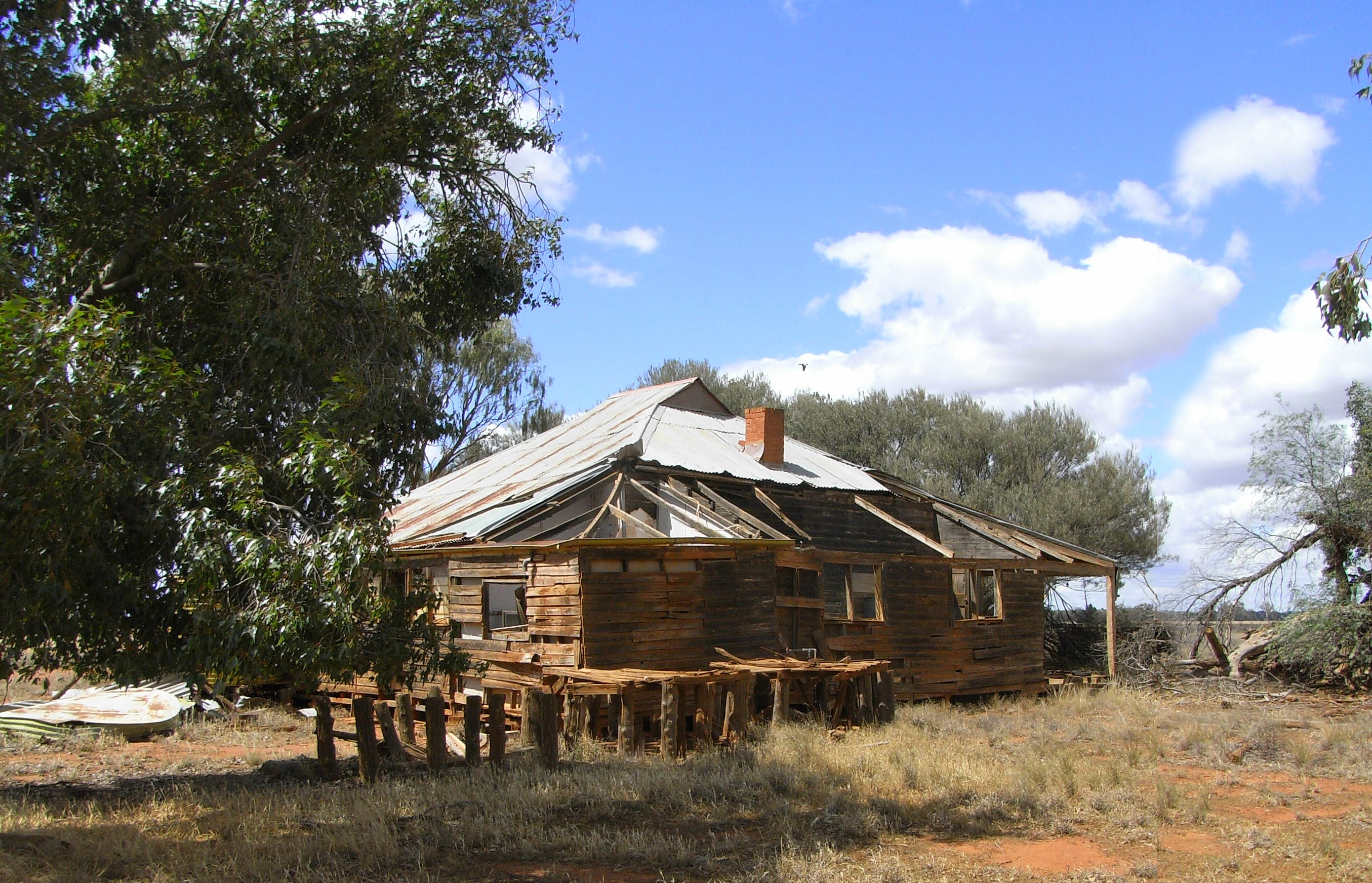
The old Hansen place

Story and photograph by Warrigal Mirriyuula

Zero Sum

Bess cautiously nosed the Landcruiser up the over gown track. It was past dusk and the last feeble glow on the western horizon heralded a dark moonless night. It was still hot but Bess had left the AC off and had all the windows down. Her senses were all on alert for any sight, sound, smell or change in the air. She wasn’t quite sure what she was reaching out for and the deepening evening seemed all too perfectly normal.

The lights and spots on the bullbar illuminated the surrounding scrub. Saltbush was well established across the twin ruts of the old track to the house, a few spindly Gidgee saplings were also trying their luck among the grass tussocks. Apparently no one had come up this way for a least a few years. The track was almost obscured and was now more recognisable as a narrow depression snaking its way across the flood plain. The growth was very thick in places so Bess was gently pushing the Landy slowly along the track when suddenly the underside of the bullbar banged and rang as the truck rode up onto something lurking in the rough scrub that had been disappearing under the front of the Landcruiser.

When she got down out of the truck Bess discovered that there were three fairly large rocks effectively blocking the track. She’d run up onto the first. Bess soon decided that the arrangement wasn’t random. They had obviously been placed this way to bar further progress towards the house. Their size and layout would make it impossible for any vehicle, even a powerful four wheeler, to ride up over the rocks; a Unimog might have done it, but nothing smaller, and the way erosion and flooding had deepened the line of the track meant it would have been impossible to back out and try to get up out of the track and go around the rocks. All in all, Bess had to admit it was a well thought out barrier; effective for most contingencies.

Besides, what was there that might have pushed the rocks to their current positions? Too big to be moved by wind or rain, Bess finally decided that they must have been specifically brought in and placed here on purpose. They had obviously been in place for some time having settled well into the trackway and showing the usual thickening of plant life around their bases. The rocks were local stone but there were no outcrops nearby.

Bess got out the xenon torch from the glovebox and checked the underplate for damage. It was banged in but still serviceable. Nothing else seemed damaged, the tie rods were still straight, hoses and lines OK, nothing had been holed or bent.

It was the work of an hour or so to rig a few spansets round each of the rocks in turn, and using the power of the truck in low range/low gear, to drag them out of the way. The Landcruiser complained and spun its wheels in the mashed plants, the dust and gravel at the base of the track, but it got the job done. It was all the confirmation Bess needed.

Why would someone go to the trouble of trucking in these three stones; and there were just the three, there were no others lurking off the track; to block access to an abandoned house? Abandoned, by all local reports, since the early sixties.

Having cleared the track and thrown the rigging into the back of the truck Bess didn’t move off straight away. She just sat half in the truck, one foot in the drivers well the other on the running plate and looking out into the dark distance. In her mind she wandered through the evidence for a moment.

The last owner of this block, name of Eric Hansen, had lived on the property for as long as any old local could remember. He had died in the house and not been discovered for some time. Bess had gone through the Police reports and Coroners investigation from the time with a fine tooth comb. She’d intended to speak to any person named in any of the paperwork that was still alive only to discover that there was only one left; a young constable from the Bourke station who had been assigned to the Coroners Investigator, pro tem.

He was now an old man, retired from the force after a burnished if not brilliant career that had seen him reach the rank of Sergeant and receive a citation for rescuing a teenager from a flood swollen Darling. He did have something to say about the death that hadn’t been in the reports. It was similar information, but the old boy viewed it from an entirely different perspective.

He’d told Bess, when she caught up with him at The River Gum Lodge around 3:30 that afternoon, that he’d been a fresh young constable, still quite wet behind the ears, and was a bit hesitant to really involve himself in the matter for fear of cocking something up. The old hands seemed on top of the task and just went about it in a methodical and professional way. He gladly helped when asked but not having anything pertinent to actually add or do at the scene, he had taken the time to take a good look around the place including the few outbuildings.

“Y’know, when I look back on it now, after all these years, it seems to me that there was much about that death that wasn’t normal.” the retired policeman looked into Bess’ eyes, “They said he died in summer, yet he was dressed for winter. He was wearing moleskins and a tweed jacket over a jumper. Not exactly Bourke in summer is it?” He paused to collect his thoughts and a look of concentration came over his old face. “There were no labels in the clothing, yet it was all good stuff, y’know, quality stuff. And no flies. The body wasn’t blown at all, not a mark on it as far as I can recall. How does that happen?”

Bess shrugged; the old boy pursed his lips then pushed on.

“At first we thought, the local cops that is, thought that he must have died as a result of a heart attack or something similar, ya know, sudden like; he was pretty old; although his body was slumped at the kitchen table as if he had just fallen asleep.”

Bess had nodded in encouragement. She’d read similar details in the report she had ferreted out of central records when a body had disappeared from a locked cooler at the morgue. Bess saw that the old man had discerned the outward expression of her inward recollections. He looked at her hoping she might be able to reveal some of the mystery but she just nodded, indicating for him to go on.

“His head was resting on his crossed arms. People said that he must have been in his nineties and had always lived in the house alone. but no-one really knew him. He was considered a loner, a bit of a throwback to the early days of the river settlement at Bourke. A birth certificate turned up, 1870, you’d have seen that in the file, and would have made him 92 when he died; that is if he was the Eric Hansen on the certificate. We could never fully confirm that he was.”

A flock of yellow green budgies had circled and descended onto a pond in the garden of the retirement village. It was already occupied by several pairs of Corellas. There was a flurry of colour and sound as they all began squabbling, whistling, flapping and screeching, the late sun sparkling in the water droplets thrown up by the dispute over occupancy. The old boy watched the birds, smiling at their antics.

“Hansen used to grow hemp until the late 20’s when it was outlawed.” he was still watching the birds, but then turned back to Bess with a puzzled and slightly worried look on his face, “Apparently both industrial hemp and the whacky baccy kind.”

“I only found that out about fifteen years after his death. Kids were turning up stoned in town and so of course in the end we rounded them up and they all told the same tale about recognising the plants growing wild by the side of the Hungerford Road just beyond the turn off to the old Hansen place. It was the first time the cops in Bourke had to confront the new hippy order. Not that these kids were hippies. They were just local teenagers getting stoned on free weed. The Bush Fire Brigade got sent out and put the lot to the flame. There were some red eyes back at the shed that night, I reckon. I don’t know whether anyone else made the connection to Hansen though.”

He pursed his lips again and lowered and tilted his head a little, looking kinda sideways at Bess.

“I can understand the hemp. He had rope making machinery he’d knocked up in one of the sheds and apparently he sold locals bailing twine, string and some rope to the steamers on the river, when there were steamers on the river, but what did he do with the exotic stuff that early on in the piece?”

“I don’t know.” was all Bess could reply. Though she had some small idea of what he might have done with a bit of his crop. She remembered the coronial photos from the 1962 case. In the full shot of the body she had noticed, a little out of focus out on the edge of the image, an ashtray on the table. It was clean except for a few small tubules of unbroken ash and the burnt remains of a roll your own cigarette that must have been laid on the lip of the ash tray and left to burn down to nothing. A possible half smoked joint. She could never know for sure. The ashtray and its contents had simply never risen to the level of evidence and so had never been analysed. It was another possible, odd confluence lurking in the disparate evidence.

“Look, there’s one thing I noticed but I never said anything at the time because it seemed so odd and I didn’t want to look foolish, and in the end they never looked in the outbuildings anyway. It just didn’t seem necessary at the time, they all said there was no suspicious  circumstances; but in the shed with the rope making machinery there was a lot of dust all over the floor, all over everything actually. Blown in through the doors I s’pose, and a lot of it was just pulverised hemp dust.

When I first went in there were footprints in the dust all over the floor and around the machinery. I didn’t think much of it at the time. I thought, y’know, that’s natural, footprints in the dust, but then I notice that there was one set of prints that walked away from the machine over to a spot near a bench he had set up with various tools, but they didn’t walk back. There was no return or ongoing track. It was like he must have walked over there and then just disappeared, or floated away. I was a bit knocked back by that so I had a proper look at the footprints, but this one set of tracks, like I said it just appeared out of the confusion of other prints and made a straight line for the bench, and never came back”

“You didn’t get a photograph did you?” Hope springs eternal.

“No. Like I said, the real investigation never got into the shed” The retired copper shook his head. “Those prints though, well they…; look, all the other prints showed normal movement about the space. What you’d expect, steps over other steps, tracks crossing, places where he must have spun on a foot. Y’know, normal moving about, but not this one.” He shook his head again.

“In all honesty, after all these years, I couldn’t really say I’ve kept it straight in my head but that is how I remember it.”

Bess had stayed on with the retired copper, just talking, reminiscing, until the sun had begun to descend toward the distant horizon. They’d talked about his career; he’d only served in two stations, Bourke and later Wellington, and had retired back to Bourke because his wife’s Mum was a local and was getting on at the time. His wife was gone now and his only son was a solicitor in Nyngan; small time, but he visited regularly, and his wife always brought a batch of freshly baked honey oat cakes. Too many just for him, the honey oat cakes made him popular with the other residents in the common room.

The old boy said he’d led a charmed life really, but that business right back at the beginning had always puzzled him and he asked Bess, as she stood to leave, that if she did find anything, he’d be really grateful if she could let him know.

Bess promised she would and left him, still sitting in his chair looking out over the penumbral garden as the evening air began to cool, just a little.

As Bess had walked back to the Riverside she recalled the meeting some weeks ago when she had managed to track down the security guard on duty the night the body in the library was discovered. It turned out that he’d also been the one that went to investigate the reported “disturbance” on L6 some time later, though Bess had to deploy a very special smile to winkle the truth of events that night out of him. Bess had pressed the guard on the description of the man that he knocked into and as she had half suspected, he described a tall thin man “dressed like a farmer at The Royal Easter.”

Pushing deeper Bess had finally gotten him to remember the fleeting smell of burning; “Like burning compost really, but y’know, really faint. Ah, look, it might’a just been the pong of the books. It wasn’t anything really.”

She had the fingerprints and DNA of the dead academic but unfortunately the circumstances surrounding the discovery of the Bourke corpse back in ’62 meant that no-one had bothered to fingerprint the body, there having been no suspicious circumstances. DNA analysis was still more than twenty five years in the future.

The Pathologist’s report from 1962 had been interesting. That document suggested that Hansen had died in summer and the body had rapidly desiccated in the closed house. Strangely, as the retired Sergeant at The River Gum Lodge had mentioned, there was no indication of insect attack. The state and age of the body had made determining cause of death very difficult. Eventually it had been impossible, so the Coroner, probably on the Pathologist’s advice, had simply put “Senescence” down as the cause of death. “Old age” might have sounded a bit weak from a state coroner. And after all, the man was very old, he was dead, and his cells had stopped dividing and growing. Senescence it was.

Except that he’d turned up again 44 years later researching perfectly incomprehensible physics, written an impossible note only half deciphered; Bess still had no clue why “it wouldn’t have been any good”; and then popped his clogs. But the most impossible thing was the disappearance from the morgue. How does a dead body remove itself from a locked cabinet leaving no trace on the CCTV, let alone on the stainless steel of the tray? No-one had any idea specifically when the body had upped and left. It had been there for one check and gone at the next, one month later.

Bess got fully into the truck ands started it up. Pushing a little slower now, she made her way up the track hoping there were no other traps.

When Bess finally came up the low rise to the house it seemed to be just as she had expected. Captured in the headlights and spots, the old weatherboard place showed all the signs of neglect such old buildings assume after years of abandonment. The stumps had settled into the dirt and the frame had warped and skewed in the heat; the weatherboard, sun dried and shrunk, in some places had simply fallen off its nails. All the remaining window glass was broken and some of the window frames had fallen out as the timber surrounding them had dried and shrunk.

There were two big corrugated steel tanks lying bent and rusting where they had fallen from their stands. Those stands now so many short thick piles standing at odd angles to one another, only held up by the few heavy planks that made up the platform from which the tanks had fallen.

There didn’t seem to be any one about, but then what was she expecting? If she was right about the date on the library note nothing would happen until after midnight at the very earliest, after midnight being February 15. That’s if anything happened at all. Bess looked at her watch. The display showed it was getting on for 10.

She pulled up just short of the collapsed tanks, killed the engine and pulled the keys, got the torch out and stepped down out of the Landcruiser. “In for a penny..” Bess said under her breath and walked directly over to the house, up onto the verandah and went inside.


—ooo—

Bess Stafford Investigates – 2

04 Sunday Mar 2018

Posted by Therese Trouserzoff in Warrigal Mirriyuula

≈ 3 Comments

Tags

Bess Stafford

OLYMPUS DIGITAL CAMERA

Story by Warrigal Mirriyuula


Zero Sum

02 An Open Investigation (2019)

It had been a long, hot, 5 hour drive out from Wellington as Bess Stafford finally nosed the  Landcruiser into a parking spot outside the Bourke Police Station. She threw it out of gear, pulled the handbrake and killed the engine.

The sudden, simultaneous silence of the diesel, the air-conditioning and Patsy Cline’s “Walkin’ After Midnight” on the audio system, felt more a palpable presence, than a sudden absence. The early afternoon heat immediately began to broil the interior of the truck.

Bess took up the song under her breath, “I go out walking after midnight”, undid her seatbelt and gathered up her phone and hat. “I’m always walking, after midnight, searching for you”. She looked at the thick old manila and paper file sitting on the passenger seat, decided she didn’t need it and just gave it a pat as if to say, “I won’t be long”. She opened the door and stepped out into the hard light.

The heat was like a smack in the face. She pushed her phone into the thigh pocket of her trousers, adjusted her aviator style sunglasses and pushed her Akubra onto her head, tugging the front brim down low.

The heat was intense, the display in the truck had said 45; hot, even for Bourke. The air was incredibly dry, Bess ceased singing as she looked about, up and down the main thoroughfare. Her drill cotton shirt began to cling as the sweat started to run on her body.

There was no-one out on the street. Not a bird in the sky, not even the occasional dog bark. Even the insects were quiet. It was too bloody hot!

A few hundred metres down a B Double cattle truck rumbled through an intersection kicking up a low, translucent cloud of dust in its wake. The heavy growl of the engine, the spit and hiss of the air brakes died away and the dust just hung in the hot still air, suspended in the heat plume rising off the tar. The street went quiet again, the silence seeming to intensify the heat.

Bess walked over to the station and under the low verandah that surrounded the old colonial building. Glad to be back in the shade, even after so short an exposure to the early afternoon sun, she pushed through the heavy single government-green wooden door into the reception area. The high ceilinged, cool interior exerted a quick chill on Bess. She smiled and shivered delightedly as she took off her hat and wiped her brow and the interior band of the hat with an old hankie she kept wadded in a pocket for just this purpose.

It was quiet inside the station too. The whir of a ceiling fan and the occasional crackle and unintelligible bit of yak on the LAC frequency in the com.’s room off a corridor to the side was all that disturbed the peace and quiet of the station interior.

A ruddy faced young constable with a fresh haircut was behind the counter sorting a sheaf of papers into some kind of order. He held the sheets like a hand of oversized cards and deftly pulled a page out and inserted it higher in the order. The tip of his tongue was just visible between his lips.

He noticed Bess and hurriedly, self consciously, put the papers down and ran his left hand over his hair. He smiled his best public service smile.

“Yes missus, what can we do for ya t’day?”

Bess removed her sunglasses, “That’s Detective Superintendent “Missus” to you young constable,” Bess smiled as she flipped her warrant card at the young officer.

The young constable leaned over to take a look at the card and badge. “Yes Ma’am, sorry Ma’am”, the now straightened junior replied, “What can I do for you? Who do you want to see?”, he asked hurriedly, now at attention.

“This your first posting?” Bess asked fondly. She had a soft spot for embryo coppers and smiled warmly at the young bloke, “You can relax. I’m just here as a courtesy. I’m passing through to a place over the river. An old open case and I thought, before my retirement, I might just give the whole thing the once over again, you know, just in case.” Bess’ eyes brightened and focused on the constable’s face.

“You weren’t born round here were you?” she asked him directly, “You might be able to help with some background.” There was a little hope in the question but these days young constables were placed all over.

“Nah, I grew up round Hexham just out’a Newcastle.” The young constable visibly relaxed and leant on the counter, “You’re right, this is my first posting.” He smiled back.

“Well good luck to you Constable Hourigan.” offered Bess generously, spying the young man’s light blue name badge. “Keep it tidy, play a straight bat and you’ll do alright;” Bess smiled again, “but as I said this is just a courtesy to say I’m in the area and I might like to drop in some time in the next few days to go through your intelligence files and old case notes.”

O’ yeah,” he nodded, “well that shouldn’ be a problem.”

“If you could let the Boss know I’m about. I’m not sure where I’ll be staying but I’ll call once I’ve booked in and let you know. In the meantime here’s my card with my mobile and email details.” Bess had opened her wallet and taken out a standard police card. She handed it over as she flipped and clipped her wallet and stuffed it back in the right rear pocket of her worn desert camo trousers.

“Righto. No worries.” The constable looked at the card. Except for the details it was the same as the ones in his own wallet.

“I’ll let the Super know when he gets back in later. He’s down at the town hall with some councillors. We’ve had some trouble lately with bloody kids going joy riding and then torching the stolen ride. Its a real bastard, if you’ll excuse my French.” The young constable was trying to give the impression that he was intimately involved with the matter. “We’ve had three of them so far.” he said shaking his head.

“Bloody kids, eh?” Bess said shaking her head too. “Not a lot else for them to do, I suppose. Well I’m sure you’ll sort it out in the end,” Bess offered indulgently, “but right now I have to get on, so I’ll say hoo-roo until next time.” Bess gave the young bloke her best smile, turned and walked out the door.

The sudden heat felt like a pressing iron, as she stepped out again into the hard hot light. Pulling her brim down and pushing her sunglasses up her nose, she walked over to the Landcruiser, got in and lit it up, pushing the AC to maximum.

“…I walk for miles along the highway, Well, that’s just my way”, Patsy sang as Bess reversed out, and headed down Oxley Street, turning right on Sturt and driving through to the old Bourke Dock on The Darling.

Back inside the station young Hourigan entered Bess’ visit in the log and put her card front and centre on the counter so he could pass it over to the Super immediately he returned. He didn’t go back to sorting the papers. Instead he thought about Detective Superintendent Stafford and her brief visit.

She was an odd stick, he thought. She said she was nearing retirement but she looked quite vigorous. She was short, only about 165cm, and had a little barrel of a body, big arms and thick legs, big bum and bust. “Solid”, was how young Hourigan thought of her, “but nice with it.”, he added in his mind. She had a thick head of unruly salt and pepper curls, cut short and allowed its own way; and really bright green eyes. When she smiled her chubby cheeks dimpled.

She’d been dressed for Bourke he noted. All hardwearing practical fabrics, strong boots, good hat, and it all looked like it had a working life before the visit. He’d noted that her watch had one of those old fashioned bands that included a leather cover for the watch face. Hourigan’s grand dad had one like that.

But it wasn’t what Bess looked like that fascinated him, it was that he’d felt she was special in some way he couldn’t put his finger on. Like that smile hid some kind of knowing that he was yet to understand.

It had been a very brief visit and she’d been nice enough, she hadn’t really pulled rank on him, she seemed to understand who and what he was. She’d known he was new. That could’ve been just sharp observation or maybe it was the way he’d reacted when she’d pulled her warrant card. For a moment he felt like an arse, and then he thought that she wouldn’t have seen it that way. In the end he just stopped at the fact that the brief encounter had lifted his spirits. He felt good and she’d smiled so nicely.

He went back to sorting the papers and didn’t think of Bess again until the Super came through the door about an hour later.

When young Hourigan handed over the card and gave a brief report of the visit, the Superintendent took one look and stopped, still, staring at the name on the card. Slowly a vague smile began to form at the corners of his mouth as he just looked at the card.

“Bess Stafford, ay? Well I’ll be buggered. I wonder what she wants.” he muttered, scratching his sunburned chin as his smile broadened to light up his entire face. He looked at the younger policeman. “You’ve never heard of D.Supt. Stafford have ya Bob?” The Super had never used Hourigan’s first name, let alone the familiar diminutive.

“No sir.”

Young Hourigan could see that even though his commanding officer hadn’t been about for the visit, just the mention of D.Supt. Stafford had a similar effect on the Boss as her visit had on him.

“You’ve been in the presence of greatness, young Bob, You’ll never forget her.” the Super said, then drawing his breath in and looking at the young Constable. “She’s one of the best investigators I’ve ever met and I don’t know of any better when it comes to interview technique. Mind like a steel trap, that woman.”

The Super warmed to his theme and drew in to lean in on the counter with the young constable before continuing in an almost conspiratorial tone.

“I saw a video once of her interviewing a Serbian war criminal. It had the transcript running over the picture at the bottom, you know, like the news.”

She was on secondment to the International Warcrimes Tribunal in the Hague. She got a complete confession from this evil bastard; entirely against his will. It was breathtaking to watch. She remained completely calm throughout, but pushing his buttons mercilessly, smiling that smile of hers all the while. The rage in him as he admitted his crimes to her was unbelievable. It cost him every time he uttered a word, and when she finally broke him and he let it all go, I swear, if he wasn’t restrained he’d have killed her with his bare hands, and all the while he’s spitting and shouting chapter and verse as though his crimes were actually grand final wins. He was a bad bugger.

Well Bess, she just sat back out of the range of most of the flying spit, an impassive, smiling face, a quiet reasoning voice occasionally prompting him to greater revelations of his bastardry. When he’d finished threatening and raging at Bess he just sat there, shackled in that sad little cell with a look of triumph, like he ruled the world; only realising as Bess got up to leave, that he’s just confessed to multiple rapes and mass murder!”

“For Christ’s sake Bob, she speaks fluent Serbian! I can’t even remember my school boy French!”

“Wow….” slowly, was all young Hourigan could muster.

The super looked at the card again, and again shook his head slowly. “I don’t know how she did it.” A look of uncertainty flitted across the Super’s face but then, just disappeared.

“She’s got a fabulous smile though, hasn’t she?. Did she give you one of her smiles?” the Super asked, still looking at the card. He didn’t wait for the answer. He just wandered down the corridor to his office, went in and closed the door, leaving young Bob Hourigan to wonder just what it was, apart from speaking Serbian, that constituted the “greatness” that the Super had alluded to.

He sat down behind the reception desk and Googled “Detective Superintendent Elizabeth Ruth Stafford” on the station computer. She’d had a storied career apparently and after futzing through the results, catching a paragraph here, an image there, he finally settled on a YouTube ENG video of Bess back when she was a Sergeant.

She had been involved in the search for a child missing for several days in rugged terrain. The video showed the parents, and Bess dressed much the same as she had been earlier, with the little boy on her knee clinging to her as if she were life itself, Bess telling the assembled media pack that apart from being very hungry and sporting some bruises and scratches, the little bloke was as right as rain.

“Aren’t you little mate?” she’d asked the boy, who smiled a huge smile and hugged Bess even harder. Bess had then looked directly into the lens of the camera and smiled too.

It was a great smile. Young Bob Hourigan hit pause and “full screened” the image, pushing himself back on his chair, he raised his hands up behind his head, laced his fingers and leant all the way back, his eyes never leaving that smile.

Bess was down at the river. It was a few degrees cooler by the water. The Darling was its usual sluggish low muddy self. A bit of good rain in southern Queensland a month ago had sent a of pulse of water flowing down the course, but as Bess stood at the rail of the old Bourke Dock she could see that the water today was now barely up to where the thick wooden piles drove into the dry bank just above the low water level.

She made her way down to the slack brown water by way of the stairs under the dock. With water levels in the river so unreliable the dock had been built with several landings at different levels that made it possible for passengers to get on and off the river steamers no matter the level of the river.

Down by the water Bess sat down on one of the worn wooden steps, pulled out her phone and went to the folder of case notes and images. She slowly swiped through, pausing on some, passing through others, trying to let her imagination take up the mental slack and begin to focus.

Bess had picked up the case when the body of the an unidentified “academic” had vanished from its locked cooler at the morgue, leaving no evidence that it had ever been there. The stainless steel of the tray was absolutely clean, not a trace of the frozen body that had been lying there for years.

She noted again as she had so many times since she’d been engaged in this investigation, that the face of “Eric Hansen”, a Bourke local who died over fifty years ago and her reason for being in Bourke, was just like the face of the dead man at Sydney University; biometrics confirmed through a friend in the AFP; though showing the wear of thirty odd years of additional life in the relentless arid environs of Bourke.

Problem was, Hansen 01 had been dead over forty years before the putative Hansen 02 had shuffled off his mortal in the stacks of Fisher Library, and then had the temerity to disappear completely from the morgue a few years later. It was all very confusing and not a little contradictory.

That curious alphanumeric string was the ticket to the two Hansens connection. At first impossible to decipher without a “key”, it was now revealed as a publicly available Geohash of a location which turned out to be Hansen’s abandoned place over the river from Bourke. That had led to the State Archives and the file on the earlier death in that location. Which facts were interesting in themselves in that the Geohash system had not been released for public use until 2008, fully two years after the discovery of the Library body. Maybe that body had known the young Brazilian Geohash inventor Gustavo Niemeyer, Bess had thought.

She’d contacted Niemeyer in Brazil and he had very graciously thanked her for the fascinating contact. He’d never been involved in a police investigation, but his response to the mortuary portraits Bess had emailed was “No, I don’t know this man, and I’ve asked amongst colleagues that worked with me in developing the Geohash system and none of them remember an Australian being in touch prior to release.”

Then there was the assumed date at the end of the string. A geohash doesn’t have or need a date, usually.

So how did the dead man know about Geohash and be able to provide the location of a spot several kilometres outside of Bourke a few years before that system was even available? And the date, or assumed date, would have been 13 years in the future at the time the unknown man inscribed it on the pad found with the body at the scene. What could a future date mean to a dead man?

There were too many impossibles and precious few probables and the whole process had taxed the oft repeated investigative maxim, keep an open mind and follow the evidence. Problem here was, as Bess thought on the crazy and the curious, the evidence was leading her to cloud cuckoo land. Not a place Bess had ever felt comfortable in, though she had to admit, she’d been there often enough in her peripatetic career.

Bess continued to swipe through the gallery until she came upon the historical images she’d gathered at the State Library from the late 19th century and early 20th century when the Port of Bourke was one of the busiest ports in Australia. She wanted the images for backgrounding, to get the feel of the place.

As she interrogated the images she found herself mentally “falling” into them, their irresolved, grainy, black and white transmuting to the blown out light and sun bleached colours of reality in early Bourke. Bess relaxed and let her imagination expand.

Soon she was seeing the old time paddle-steamers and barges tied up at the dock and along the river bank. All shallow draft vessels, their broad flat decks piled high with bales of wool and corded wood for the boilers. The wharf labourers shouting to one another as the steam cranes lifted bales of wool, farm machinery, even horses and other live stock, onto or off the craft moored at the dock. In Bess imagination the dock was a maelstrom of noisy activity and from out of the dust and smoke walked a tall thin man, a “roll your own” hanging from his lip. The man stopped and looked directly at her. She noted a look of anticipation, and maybe, just a hint of trepidation.

Bess snapped back to the now. Had she just seen the face of Hansen, the man, in life? Was that him? It couldn’t be. It was just her imagination playing tricks in the heat; but the figment had looked directly at her, in her own imaginings. What was her unconscious trying to say? Bess let that question hang for the moment. Her unconscious had a way of revealing itself according to its own imperatives. Sometimes Bess even thought that below her conscious life there was another life playing out by a completely different set of rules.

Bess climbed back up the stairs and walked back to the Landcruiser. She’d check into the Riverside just up the road. She liked its old Bourke feel and all that beeswaxed woodwork she’d seen on the internet.

After checking in she had taken a shower and put on some fresh clothes before ordering sandwiches and a pot of tea. “Real leaf tea please, brewed in a pot with boiling water, and can you bring me lots of biscuits. I love biscuits”

She called the station to let them know she had checked in and she had another brief chat with Constable Hourigan. Young people always opened up to Bess and she enjoyed their youth and enthusiasm, their innocence and ernest commitment. They had yet to see what she had, do what she had, and dealt with the personal consequences.

They’d spent a few pleasant minutes chatting about his experience at the training college in Goulburn. He’d asked her what she was after, but she had deflected that line of questioning, not really being able to say just how she had arrived in Bourke for fear of being thought soft. Her reasons were compelling to her but she wasn’t sure she could explain that reasoning without it sounding like a science fiction fantasy. She’d cut the conversation short as she realised just how much revision and reading she had to do before tonights exploratory excursion.

By the time the tea and sandwiches arrived she had opened the old manilla file and spread its contents across the floor. She ate one of the sandwich quarters whole and then grabbed another. She was quite hungry. She poured herself a black tea and sipped the tea and chewed on the sandwiches as she stood in the middle of the spread documents, slowly turning to take in the material arrayed about her.

In Bess’ mind these original and photocopied documents, images, handwritten notes, scraps and bits and pieces of “evidence” all represented data points in a developing cloud of points from which she hoped would emerge a discernible pattern or picture. The problem with this case, or rather these cases, was that there were precious few reliable data points to map. As she had pondered on the matter her mind had thrown up all sorts of speculative points, possible points yet to be observed, confirmed, but which had a persuasive resonance that found a mesmeric harmony with the real, but that didn’t make them real. Bess had to admit this wasn’t like any other case she had ever had to work on and she further realised, now she was in Bourke, she was in for both the penny and the pound. The problem had her by the mind and it wasn’t letting go.

Bess Stafford Investigates

02 Friday Mar 2018

Posted by Therese Trouserzoff in Warrigal Mirriyuula

≈ 3 Comments

Tags

Bess Stafford

Unsub in the morgue

Story by Warrigal Mirriyuula

Zero Sum

01 A Confounding Death and an Impossible Disappearance (2006 and 2009.

The note found at the scene simply read, “It wouldn’t have been any good.”, under which was an alphanumeric string of 9 characters, a hyphen, and then five more characters, “r4xw28n6w-15f19”, all written in a clear blue biro hand with minimal embellishment in the middle of the top page of a plain A4 paper pad. There was no explanation as to what “it” may have been, or why “it” wouldn’t have been “any good”, or what the alphanumeric string signified.

There had been no doubt that the body found slumped over a desk in the stacks of Fisher Library at Sydney University was dead; though it looked as if in life it had just put it’s head down for a quick nap. Perhaps “lifeless” would have been a more accurate descriptor.

In time the Coroners Report read, “Cause of Death: Undetermined” and that seemed to be an end to it. There’d been no missing person fitting the corpse’s description, no one had claimed the body and there had been no identifying documents, not even a tag or brand on any of the clothes; which were all clean, of good quality if somewhat rural in style, and had been brought to that comfortable softness that characterises well worn favourite clothes.

The wallet had no driver’s license, credit cards, membership or security cards, no health-fund or Medicare card, in fact no cards, not even a Fisher Library card; which alone begged many unanswerable questions. It was empty except for a fat wad of cash, almost $2,000, all in crisp new non sequential 50’s and 100’s, but chasing that trail also led nowhere. The notes had been distributed to ATM’s all over the country and there was no telling how they had all ended up in the same wallet having apparently not suffered any visible wear and tear.

There were no marks on the body suggesting violence or some final paroxysm or fit. Indeed the body seemed to be that of a tall lean, unusually healthy late middle-aged man. The toxicologist found nothing out of the ordinary and, also unusually for a person of an age finally agreed as “early to mid sixties”, there was no trace of the usual drugs often found in such investigations. No statins for cholesterol, no agonists or antagonists for various problems associated with senescence, no mood modifiers, nothing, not even aspirin. Traces of THC were found but it was impossible to say how it had been taken. Besides, it couldn’t have contributed in any way to the death.

The contents of the gut indicated that the man had last ingested porridge, orange juice, tea and a piece of vegemite toast. A modest breakfast, but apparently no lunch or dinner.

In the end no cause of death could be determined. Privately the pathologist had admitted to colleagues that the body was a mystery. It had simply stopped, all systems simply shut down and the body heat fading to room temperature, but there was none of the usual indicators of sudden death. Indeed, if not for the palpable fact of the body’s lifelessness, it seemed that if some animating force could be applied in some way, the body would wake up, perhaps shake its sleepy head and get back to its calculations.

The note made no sense without context, but if it hadn’t been for that cryptic missive there’d have been no speculation about suicide at all, and being unable to determine the identity of the body meant that it was impossible to pursue that line of enquiry in any event. Suicide was possible but it would take further evidence as to how the body had self terminated to support that proposition, and that evidence was completely lacking.

Besides, was the note a suicide note? It seemed a little ambiguous. The alphanumeric string was worked on by cryptographers but to no avail. They just couldn’t crack it, though they assured the investigators that if they had the “key” they’d have it deciphered in no time.

The pens and pad on the desk were common brands you could buy at the Co-Op or The Union, and while a few of the librarians said that they recognised the man, none of them had seen him on the day he was found in the alcove. None of them knew his name or what he had been doing in the stacks. He’d been coming to the library for a few weeks, regularly at 10 AM each morning, and always occupied the same alcove on level six, head down over the books or working assiduously, manipulating data on a laptop.

That laptop had been of great interest to the forensic IT people until it was determined that there was something about the way the operating system and the internal programming worked that just produced nonsense when the device’s higher functions were accessed by the investigators. That operating system, they said, was similar to Linux, but that it did things that Linux couldn’t do, and they were sorry, but they couldn’t work out how. Their investigations had to stop when the device finally ceased working altogether after they’d opened it up to try and get a look at the motherboard. There was no brand on the laptop, nor on any of the internal components. The spooks at ASIO and The ONA were contacted, but while they were more than happy for a copy of the data stored on the laptop to come to them, they uncharacteristically claimed unequivocally that the dead man was not one of theirs, nor did they have anything that might add to the investigation. None the less they did demand that the laptop be forwarded to them immediately the police investigation of the device was concluded. They had sent an agent to personally accompany the device to their Canberra lab where the device dissolved into the miasma that is “national security”. Shhhh…, not a word.

The files cached in the memory indicated that the man had been working on calculations to do with gravity waves and dark energy in the Zero Point Field, but some of the mathematics and many of the algorithms were entirely novel. It wasn’t that they were wrong, it was that no-one the police or coroners investigator had contacted for an insight into the work could provide anything other than a shrug and the suggestion that the work was obviously brilliant but unfortunately incomprehensible beyond a certain point in the calculations. Curiously, when the body was discovered there had also been an old, well worn bamboo slide rule in the body’s left hand, the cursor marking a solution for which the problem remained a complete mystery.

As time passed and the investigation ground down for want of good information; the body went from being that mystery, to a conundrum, and finally a simple curiosity. As no one had come forward to claim the body and it had remained unidentified and the cause of death remained unknown; the body went into refrigerated storage and there it stayed, waiting on further information before its final disposition could be determined.

After almost twelve months of fruitless investigation everyone involved in the matter had moved on to other more pressing and tractable problems and the death in the alcove on Fisher level 6 slipped from memory.

That was until a graduate student working late in the stacks one night had been disturbed by a lone voice in a nearby alcove remonstrating with itself over a number problem. The student had been researching an academic paper she was to present at a conference on Jane Austen so the mathematical mumblings from the other alcove made no sense to her literary sensibilities, but it was disturbing to her concentration so she determined to say a word or two to her noisy neighbour.

When she looked all the alcoves were empty. She looked again at the next alcove on each side. Still nothing, in fact she determined that she was the only person on level six as far as she could tell.

The experience was a little unnerving and had put an end to her study. As she left the library she stopped at the front desk and told the sole librarian on late shift what she thought had happened. As she told the story to an obviously bored student librarian, a security guard, who had up to this point been watching his favourite cop drama on a nearby portable TV, his big booted feet up on the desk, eating from a Chinese takeaway container, put down his food and turned to look at the student.

“Alcove 4 on level six did you say?” He fixed her with his best narrow eyed, rent-a-cop stare.

Somewhat surprised by the man’s intervention in the conversation, her reply, “ er, yes…”, was as uncertain as the guard seemed cryptically interested.

Not taking his eyes off her and obviously looking for a reaction, he said, “That’s were that guy died a few years ago. I don’t think they ever worked out how or why.”

“Oh…, well then…,” was all the academic offered.

A little disgruntled that the mystery of the thing seemed to have failed to light the literary academic’s imagination, the guard’s face briefly assumed a caste of disappointment and he reluctantly decided, “Well, I better go and take a look then I s’pose.”

He brushed some crumbs and scraps of noodle off his shirt, swung his legs down and got up out of the chair, leaving the cop drama to play out unwatched.

Making great show of adjusting the various tools on his utility belt; his few symbols of empowerment; twirling, then pushing his heavy MagLite into its ring holster and adjusting his radio, he set off across the lobby to the lifts.

Level 6 was silent and the air still, filled with the faint smell of slowly decaying paper and old ideas slumping into a forgotten superannuation. The guard moved down the aisles checking all the alcoves, leaving 4 till the last.

When he finally turned into number 4 he was surprised to be confronted by a man hurriedly exiting the alcove, his arms full of paper files. They crashed together and the files went everywhere. Both stooping to pick up the scattered papers, their heads cracked together in a continuing comedy of collision.

The man, rubbing his head with one hand was sweeping up his papers with wide swings of his other arm, muttering annoyedly about “being late” and gathering the scattered papers to his chest while the guard picked up the outliers.

Over in the lift lobby a bell rang indicating the arrival of a lift on L6. The guard pivoted to the lobby, absently handing the papers he’d collected to the man now behind him. The lift doors opened but no-one alighted. After a moment the bell rang again and the doors closed. The level display indicated that the lift was returning to the ground floor The guard turned to comment to the man expecting him to still be gathering the scattered papers.

The aisle was entirely empty; no man, no scattered files, nothing.

The guard, his mind spinning in place wondering where the man had disappeared to, extended himself cautiously up to his full height, hitched his utility belt for courage and hesitantly entered the alcove. It too was entirely empty, except for the faint whiff of something just managing to hang in the air; not smoke, nothing to really get your nose into, just a burnt, composty smell that seemed to fade as he sniffed for it, to be overlain once more with the musty fragrance of old books.

The guard was not a man of great imagination and he soon exhausted the possible answers as to where the disappearing academic had gone, and he was definitely gone. A quick further check showed that L6 was unoccupied. He’d thrown a “hoy” into the fire-stairs. There was no reply. He laughed nervously and shook his head. The bloke must have found some other way out, maybe…

In the lift on the way back to the ground floor the guard determined that he wasn’t about to put himself on offer for the ridicule of his workmates. Disappearing academics in the stacks would make him a joke. He would say nothing, and it wouldn’t be entered in the night’s Incident Log.

When the bell rang and the lift doors opened on the main lobby he strode confidently out of the lift, across the floor and took up his former position, feet up on the desk, Chinese food, now cold, back on his paunch. The Austen academic had gone. The junior librarian was playing a game on his phone and barely noticed the guard’s return.

The guard re-committed himself to shovelling the cold food into his mouth, “Nuf’thin…’ere.”, he finally said over his shoulder to the librarian, the words finding their way around a mouthful of cold Hokkien noodles and fried rice.

The librarian, who had never been interested anyway, grunted; a minimalist, non-committal response. They both relaxed with their seperate entertainments and their seperate thoughts, and again the matter of alcove 4 on level 6 just slipped back into the mist of library memory.

That night, at the morgue across Parramatta Road from the Uni, something related but totally unprecedented had happened. A body in cold storage had disappeared from its assigned space in the locked long term cooler. Those bodies were only checked once a month and the last check had only been three days ago.

Patrons Posts

  • The Question-Crafting Compass November 15, 2025
  • The Dreaming Machine November 10, 2025
  • Reflections on Intelligence — Human and Artificial October 26, 2025
  • Ikigai III May 17, 2025
  • Ikugai May 9, 2025
  • Coalition to Rebate All the Daylight Saved April 1, 2025
  • Out of the Mouths of Superheroes March 15, 2025
  • Post COVID Cooking February 7, 2025
  • What’s Goin’ On ? January 21, 2025

We've been hit...

  • 713,805 times

Blogroll

  • atomou the Greek philosopher and the ancient Greek stage
  • Crikey
  • Gerard & Helvi Oosterman
  • Hello World Walk along with Me
  • Hungs World
  • Lehan Winifred Ramsay
  • Neville Cole
  • Politics 101
  • Sandshoe
  • the political sword

We've been hit...

  • 713,805 times

Patrons Posts

  • The Question-Crafting Compass November 15, 2025
  • The Dreaming Machine November 10, 2025
  • Reflections on Intelligence — Human and Artificial October 26, 2025
  • Ikigai III May 17, 2025
  • Ikugai May 9, 2025
  • Coalition to Rebate All the Daylight Saved April 1, 2025
  • Out of the Mouths of Superheroes March 15, 2025
  • Post COVID Cooking February 7, 2025
  • What’s Goin’ On ? January 21, 2025

Enter your email address to subscribe to this blog and receive notifications of new posts by email.

Join 373 other subscribers

Rooms athe Pigs Arms

The Old Stuff

  • RSS - Posts
  • RSS - Comments

Enter your email address to subscribe to this blog and receive notifications of new posts by email.

Join 373 other subscribers

Archives

Website Powered by WordPress.com.

  • Subscribe Subscribed
    • Window Dresser's Arms, Pig & Whistle
    • Join 279 other subscribers
    • Already have a WordPress.com account? Log in now.
    • Window Dresser's Arms, Pig & Whistle
    • Subscribe Subscribed
    • Sign up
    • Log in
    • Report this content
    • View site in Reader
    • Manage subscriptions
    • Collapse this bar
 

Loading Comments...