• The Pig’s Arms
  • About
  • The Dump

Window Dresser's Arms, Pig & Whistle

~ The Home Pub of the Famous Pink Drinks and Trotter's Ale

Window Dresser's Arms, Pig & Whistle

Tag Archives: greek philosphy

Cyrus, by Theseustoo

18 Sunday Jul 2010

Posted by Therese Trouserzoff in Cyrus the Great: Chronicles

≈ 5 Comments

Tags

Cyrus, greek philosphy

Cyrus

by

Theseustoo

Chapter 18, Part 2:

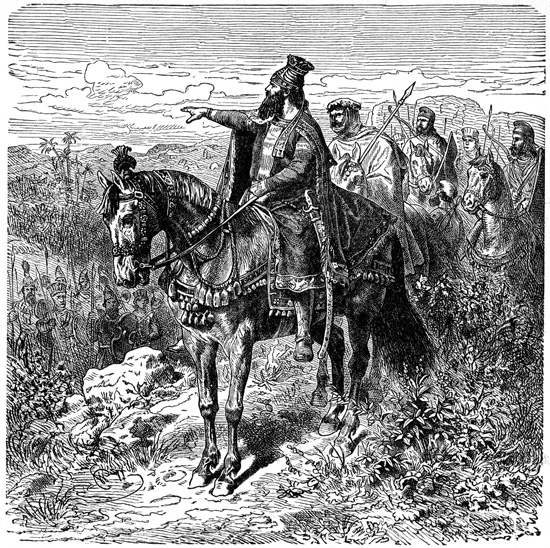
Bablyonian Soldiers

Babylon is an ancient city which has, over the course of centuries been invaded and inhabited by several peoples, including the Sumerians, the Chaldaeans and more recently, the Assyrians. Each in their own turn, these various peoples and their sovereigns contributed successively to the building of Babylon’s walls and to the adornment of her temples. Among the most famous builders of all these monarchs were two queens. The first of these queens, Semiramis, reigned five generations before Nitocris, the later princess; who was also the mother of the current Assyrian king, Labynetus.

Semiramis raised certain very famous embankments in the level plain near Babylon to control the river, which before her time used to overflow its banks; often causing serious floods throughout the region. This taming of the Euphrates by Semiramis had ensured that crops would not be damaged by floods; ensuring good harvests from all the farms in the region. This had laid the foundation for the wealth and self-sufficiency Babylon now enjoyed.

But the later of these two queens, Nitocris, was even wiser than her predecessor. Observing the great power and the restless enterprise of the Medes, who in their revolt against their Assyrian overlords, had captured many Assyrian cities, including Nineveh, Nitocris anticipated that she too, would be attacked in her turn, and immediately she had spared neither herself nor her Babylonian subjects in the effort to strengthen her empire’s defences.

Originally the River Euphrates, which flows through the very heart of Babylon, had run in a straight course toward the city, but by excavating a series of looping channels some distance upstream, Nitocris made it wind so much that, as a vessel sails along the river it comes in sight of the village of Ardericea in Assyria three separate times on three different days. Then she dug a huge basin for a lake far upriver from Babylon right beside the stream. This basin was so broad that its circumference measured four hundred and twenty furlongs. The soil she had excavated from this basin was then used to build the broad and high embankments which lined the waterside in Babylon along both sides of the Euphrates.

When Nitocris had finished her excavations, she brought a great many large stones and bordered the entire margin of the reservoir she had thus created with them. The combined effect of these excavations was that, as the river was made to twist and turn, its current was considerably slowed. By this means, however, not only had she tamed the river, but she had also rendered any river-borne invasion too circuitous to be practicable. Such a slow-moving fleet would be ‘sitting ducks’ for artillery attacks from the riverbanks.

The only alternative to a naval invasion was an overland approach across the broad plains through which the river Euphrates now flowed so circuitously that it would have to be bridged – for it was still too swift and deep to be forded – at who knew how many points? And either way, even at the end of the voyage it would be necessary to skirt the lake and thus any invader would be forced to take a long and circuitous route before approaching the city itself. Such a route would give great advantage to the skirmishing style of warfare practiced by the Assyrian horse-archers. By Cyrus’ time, however, these had been mostly destroyed by the Median spearmen of Cyaxares and Astyages.

By now, what precious few horse-archers Labynetus still had left he kept with him in the heart of the city; safely inside their city barracks. Until Cyrus had determined to seize this ancient stronghold for his own capital, however, they and a relatively small complement of infantrymen had successfully deterred any Median incursion; relying mostly on their city’s own defences for their security. Now, however, Babylon was not only the Assyrian’s final stronghold; it was indeed all that now remained of the once-great Assyrian Empire.

The main purpose behind Nitocris’ excavations had been to prevent the Medes having contact with the Babylonians and thus to keep them in ignorance of her affairs. She feared that if they saw the fabulous wealth of Babylon they would most certainly want to take it for themselves; for the province of Babylonia lay in the most fertile region in the whole world, locally called the Land between the Rivers: Mesopotamia. For this reason all of Nitocris’ excavations had been dug on the side of Babylon which faces the passes through the mountains, where lie the shortest roads to and from Media.

While the soil from these excavations was being thus used to build up the city’s defences, Nitocris also engaged in a simultaneous project, although this one was on a somewhat smaller scale than those already mentioned:

Because Babylon was divided by the Euphrates into two separate parts; before Nitocris, anyone who wanted to pass from one of these divisions to the other had to cross in a boat; and the citizens found this very inconvenient. While she was excavating the lake above the city, Nitocris thought how she might simultaneously eradicate this inconvenience and also enable her to leave another monument of her reign.

She gave orders for immense blocks of stone to be hewn and transported to Babylon, and when they were ready, and the basin had been excavated, she turned the entire stream of the Euphrates into the cutting, and thus for a time, while the basin was filling, the natural channel of the river was left dry in the city itself.

Immediately she set her builders to work, first lining the banks of the stream within the city with quays of blue-glazed brick. She also bricked the landing-places opposite the river-gates, adopting throughout the same fashion of brickwork which had been used in the town wall. After this, using the hewn stone blocks which she had already prepared, she built a series of pylons to form the basis of a bridge, as near the middle of the town as possible. The blocks of these pylons were then bound together with iron and lead to resist the current once the lake was filled and the river was once again returned to its previous course. From Nitocris’ time onwards, during the daytime, square wooden platforms were laid, from pylon to pylon, on which the inhabitants could now cross the stream; at night they are all withdrawn to prevent criminals from crossing from one side to the other under the cover of darkness to commit robberies or other crimes.

Apart from building all of these famous monuments and defences Nitocris also planned a unique deception: She had her tomb built in the upper part of one of the main gateways of the city, high above the heads of the passers by, with this inscription engraved upon it:

“If there be one among my successors on the throne of Babylon who is in want of treasure, let him open my tomb and take as much as he chooses – not, however, unless he be truly in want, or it will not be for his good.”

This tomb continued untouched and the gate unused by Nitocris’ son until Cyrus came to Babylon. He too respected the tradition which had been established by Labynetus long ago, when his mother had died, and refused to either use this gate or to open Nitocris’ tomb. Indeed no-one would use this gate for fear of inviting upon themselves the event which they felt was symbolized by having death thus ‘hanging over their own heads’, so to speak, were they to walk underneath Nitocris’ mummified corpse. In any case, Cyrus was not so short of wealth that he felt it worth the risk of invoking the curse which the inscription implied would be cast upon any ruler who should be impious and unscrupulous enough to rob the dead.

The tomb of Nitocris would remain thus undisturbed until Darius III should ascend the Persian throne. To him it would seem monstrous that he should be unable to use one of the gates of the town, and even more monstrous that a large sum of money should be lying idle. Worse, this treasure would actually seem to be inviting his grasp and yet he was unable to seize it. Finally he would claim that because he was unable to use the gate, since driving through it meant having the dead body over his head, he would insist that thus he would eventually be obliged to open the tomb in order to remove both the corpse and its treasure. Instead of money, however, all he would find would be the desiccated remains of the cunning Queen Nitocris and an engraving on her stone sarcophagus which said:

“Had you not been insatiable for gold and careless about how you acquired it, you would not have broken open the sepulchres of the dead.”

***   *****   ***
Cyrus: Chapter 18, part 1

28 Monday Jun 2010

Posted by Therese Trouserzoff in Astyages, Cyrus the Great: Chronicles

≈ 17 Comments

Tags

ficton, greek philosphy

Cyrus breaks the power of the river god, Gyndes.

CHAPTER 18: Babylon

The Persian forces sat down outside Babylon, ensuring a complete embargo on all possible roads into the city. When the Assyrians saw this, at first they came out to offer battle, but seeing that Cyrus’ forces heavily outnumbered their own, they quickly withdrew back into the city, where they were prepared to withstand even a very lengthy siege. Indeed, Labynetus’ quartermaster had estimated that Babylon had supplies enough to last many years. Although Cyrus’ army attacked them immediately, most of the Assyrian forces made it back inside the huge brass gates of the fabled city.

As the last of the retreating Assyrians withdrew inside their city walls, and her huge brazen gates clanged shut behind them, Hystaspes rode up to Cyrus to give him his report on their first encounter with the Assyrians.

“Hah! These cowardly Assyrians!” he exclaimed, with utter contempt, “Knowing they would be completely defeated in an open fight they have withdrawn inside their city walls, where we cannot get at them! It looks like we are in for a long siege your majesty…”

“Perhaps…” Cyrus said enigmatically, “But there are more ways than one to skin a rabbit, Hystaspes!”

The general was again astounded at Cyrus’ apparent lack of concern; although once again he was relieved to see that his king had some kind of plan in mind, as Cyrus continued giving the general his instructions,

“Divide your army into two sections” he said. Pointing to the break in the walls where the river flowed into the city, he continued, “Put one section there… Where the river enters the city; and the other section on the other side of the city, where it leaves. I shall take the camp-followers and all of the unwarlike part of the host with me… You are to wait for the right moment and when you see the river become shallow enough, use it as a pathway into the city!”

“Yes, your majesty!” Hystaspes responded with a broad grin, for now he could see what was in Cyrus’ mind. Filled with admiration for his king’s cleverness and cunning, he added, “To hear is to obey!” Then he bowed deeply and left to carry out his king’s orders.

*** ***** ***

The city of Babylon stands on a broad plain and is an exact square a hundred and twenty furlongs on each side; so the entire circuit of her perimeter is four hundred and eighty furlongs. While Babylon’s size is impressive, no other city even comes close to rivalling her magnificence. The city is surrounded by a broad and deep moat, filled with water from the Euphrates, behind which rises a massive midnight-blue wall of glazed bricks, fifty royal cubits wide and two hundred royal cubits in height (the royal cubit being longer by three fingers breadth, than the common Persian cubit).

The soil which was excavated from the moat had been used to make the famous glazed bricks, their colour a blue as deep as midnight, which not only lined the moat itself, but from which Babylon’s fabled cobalt-blue walls were built. But their incredible size and strength and the fabulous deep blue colour of the glazed bricks were not the only marvellous features of these walls.

At regular intervals along their whole length they were decorated with enormous bulls, lions, chimerae and other animals, some real and some mythical, which were depicted in raised reliefs, which had been created in huge moulds using the clay from the moat. While the clay was still wet, these huge moulds were then cut into individually-numbered bricks and painted with the characteristic ceramic glaze which gave Babylon’s walls their famous deep blue colour; except of course where the moulded reliefs required other glazed colours. Finally the bricks, each of which was thus shaped and numbered to fit a very specific place in the wall, were then baked in huge kilns which had been specially built for the purpose. The reliefs were then reassembled as they were built into the walls as their outer course; their places in the walls already encoded in the individual numbers of each brick; which could then be exactly reassembled as the walls were built.

In this fashion, as fast as the soil from the moat was dug, it was moulded and made into bricks and then baked in the kilns. Then they started to build, first lining the moat with bricks and then constructing the wall itself, using hot bitumen for cement throughout; interposing a layer of wattled reeds at every thirtieth course of bricks. The bitumen used in the work was brought to Babylon from the River Is, a small tributary of the Euphrates far to the north of Babylon, where there also stands a city by the name of Is. This city is eight days’ distant from Babylon and lumps of bitumen are easily found in great abundance in this river.

Undoubtedly the tremendous amount of bitumen required for the mortar in Babylon’s walls were ferried down the river in the same huge rafts, made of skins stretched over a huge, wickerwork frame, which even now constantly ferried huge loads of grain and straw as well as other goods into the city.

These rafts varied in size but sometimes reached a diameter of a hundred and fifty cubits or more; and each carried at least one donkey; the larger rafts carrying several donkeys. When they arrive in Babylon, their cargoes are sold and then the rafts are disassembled and packed on the donkeys, which were used for the return trek upstream as the current was too strong for them to use the rafts for the return journey; and besides, they only carried two large oars, one on either side, which they used only to steer with down the middle of the river’s broad channel.

The walls of Babylon are so thick that along their tops, at regular intervals are small buildings to house sentries and guards; each has a single chamber and they face each other across the breadth of the wall, leaving enough room between them still for a four-horse chariot to turn. The circuit of the walls is so great that there are one hundred huge gates, equally spaced along the whole length of the wall, all made of brass, and with enormous brazen lintels and side-posts.

The city is, however, divided into two portions by the River Euphrates, which runs through it. This river is a broad, deep, and swift stream, which rises in Armenia, and empties itself eventually into the Erythraean Sea. The city wall comes right down on both sides to the very edge of the stream: and from the corners of the wall a high fence of burnt brick runs along either bank.

The houses in the city are mostly three or four stories high and the streets all run in straight lines, both those which run parallel to the river and those cross streets which lead down to the riverside. At the ‘river’ end of these cross streets there are low brass gates in the blue-brick fence that skirts the stream, which open onto the water and which, like the great gates in the outer wall, are also made of brass.

The outer wall is, of course, the city’s main defence. There is, however, a second inner wall, not quite as thick as the outer wall, but very nearly as strong. Each division of the town had a fortress at its centre. In one stood the palace of the kings, surrounded by a wall of great strength and size: in the other stood the sacred precinct of Ea the War-Maker; this was a huge square enclosure, two furlongs on each side, with gates of solid brass. In the middle of this precinct stands a tower of solid masonry, a furlong in length and breadth at the base, upon which was raised a second tower; and on top of that a third; and so on up to the eight level.

The ascent to the top is made on the outside by a path which winds up and around all the towers. About half-way up there is a resting-place with seats where religious pilgrims and tourists from every part of the known world habitually sit for some time to rest and meditate on their way to the top.

At the top of the topmost tower there is a spacious temple; inside this temple there stands an enormous richly-decorated couch with a huge table of pure gold beside it. There are no statues of any kind in this chamber and at night it is occupied a single native woman, who; so the Chaldaean priests of this god solemnly affirm; is chosen by the deity for himself out of all the women of the land.

These priests also declare that the god comes down in person into this chamber, and even sleeps upon the couch, in a similar manner to what the Egyptians say happens in Thebes, where a woman habitually spends each night in the great temple of the Theban god, Ammon. In either case the woman is a virgin and forbidden any contact with men. This practice is also similar to the custom in Patara, in Lycia, where the priestess who delivers the oracles is shut up in the temple every night.

Below, in the same precinct, stands a second temple, in which there is a seated figure of Ea-Zeus-Baal-Ammon in solid gold. Before this figure stands an immense golden table and the throne on which it sits and even the base on which it stands are all made of gold. Inside this temple there is also a figure of a man, twelve cubits high, entirely of solid gold. The Chaldaeans who serve in this temple boast that the total weight of all the gold in these items is eight hundred talents.

Outside the temple there are two altars, one of solid gold, on which it is only lawful to offer sucklings; the other is a common altar, but it is of great size, on which full-grown animals are sacrificed. It is also on the great altar that the Chaldaeans who serve as priests in these temples burn offerings of frankincense to the amount of one thousand talents’ weight, every year, at the festivals of the God. It was said that if the wind was in the right direction, the scented aroma of Babylon’s festivals could be smelled in Ephesus.

*****     *******     *****

Patrons Posts

  • The Question-Crafting Compass November 15, 2025
  • The Dreaming Machine November 10, 2025
  • Reflections on Intelligence — Human and Artificial October 26, 2025
  • Ikigai III May 17, 2025
  • Ikugai May 9, 2025
  • Coalition to Rebate All the Daylight Saved April 1, 2025
  • Out of the Mouths of Superheroes March 15, 2025
  • Post COVID Cooking February 7, 2025
  • What’s Goin’ On ? January 21, 2025

We've been hit...

  • 713,908 times

Blogroll

  • atomou the Greek philosopher and the ancient Greek stage
  • Crikey
  • Gerard & Helvi Oosterman
  • Hello World Walk along with Me
  • Hungs World
  • Lehan Winifred Ramsay
  • Neville Cole
  • Politics 101
  • Sandshoe
  • the political sword

We've been hit...

  • 713,908 times

Patrons Posts

  • The Question-Crafting Compass November 15, 2025
  • The Dreaming Machine November 10, 2025
  • Reflections on Intelligence — Human and Artificial October 26, 2025
  • Ikigai III May 17, 2025
  • Ikugai May 9, 2025
  • Coalition to Rebate All the Daylight Saved April 1, 2025
  • Out of the Mouths of Superheroes March 15, 2025
  • Post COVID Cooking February 7, 2025
  • What’s Goin’ On ? January 21, 2025

Enter your email address to subscribe to this blog and receive notifications of new posts by email.

Join 373 other subscribers

Rooms athe Pigs Arms

The Old Stuff

  • RSS - Posts
  • RSS - Comments

Enter your email address to subscribe to this blog and receive notifications of new posts by email.

Join 373 other subscribers

Archives

Website Powered by WordPress.com.

  • Subscribe Subscribed
    • Window Dresser's Arms, Pig & Whistle
    • Join 279 other subscribers
    • Already have a WordPress.com account? Log in now.
    • Window Dresser's Arms, Pig & Whistle
    • Subscribe Subscribed
    • Sign up
    • Log in
    • Report this content
    • View site in Reader
    • Manage subscriptions
    • Collapse this bar
 

Loading Comments...