• The Pig’s Arms
  • About
  • The Dump

Window Dresser's Arms, Pig & Whistle

~ The Home Pub of the Famous Pink Drinks and Trotter's Ale

Window Dresser's Arms, Pig & Whistle

Tag Archives: humour

Further O’Way

21 Monday Sep 2026

Posted by Mark in Mark

≈ Leave a comment

Tags

Art, Bali, books, China, Father O'Way, Gordon O'Donnell (GOD), humour, Lords, Lourdes, photography, travel

What me worry, I'm on a mission from GO'D.
What, me worry, I’m on a misson from GO’D.

A Place For Us—A melancholy musical episodic intro to the Father O’Way Chronicles

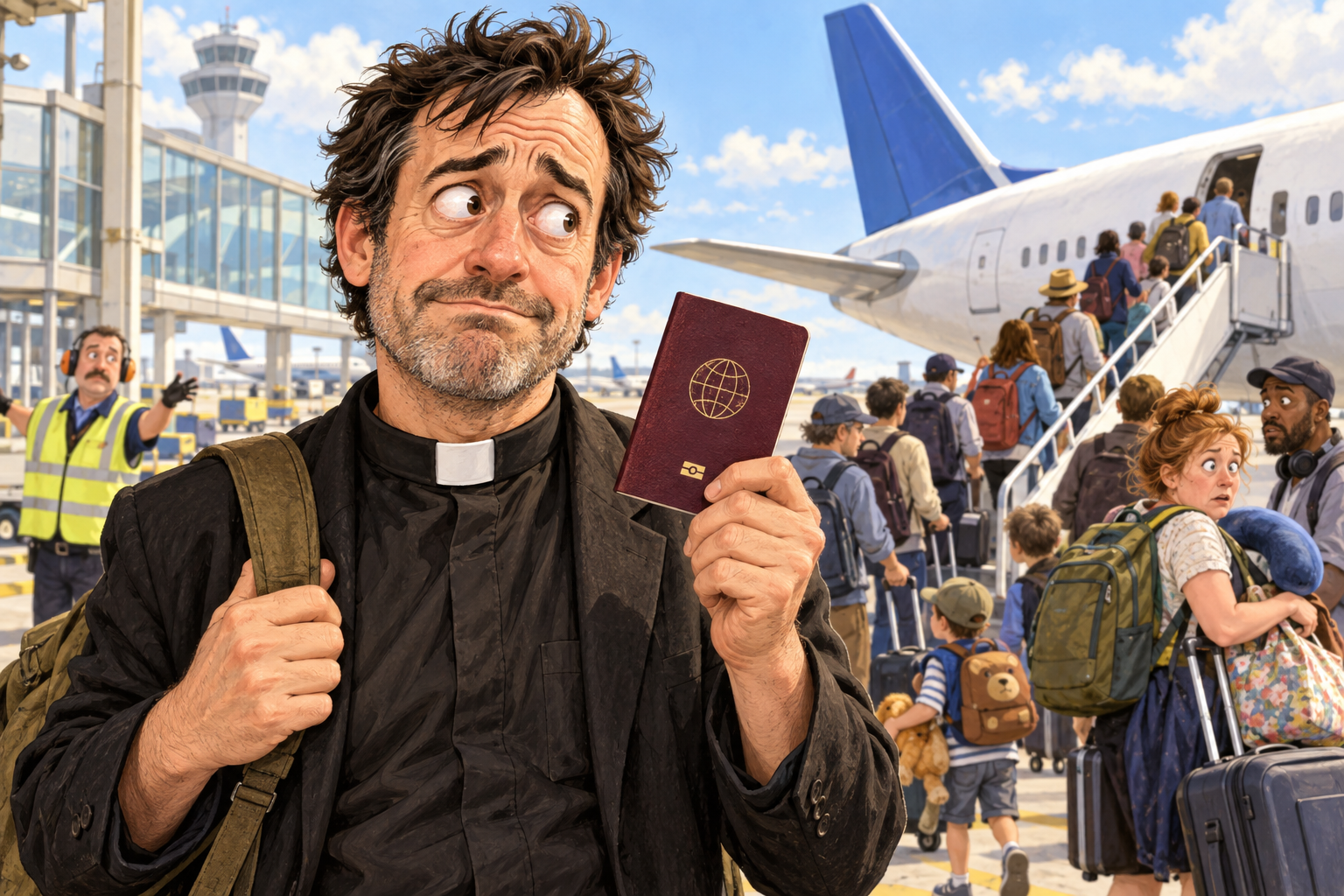
Owning a passport was the worst mistake I ever made.

At the time it seemed harmless.

A small blue booklet.

Photograph.

Date of birth.

Several pages apparently provided so that foreign governments could record the precise order in which I made a fool of myself.

I kept it in a drawer at St Generic Brand and thought no more about it.

Then Billy became Bishop Bishop.

Promotion did not improve him.

It gave him a larger office, a secretary who disliked him professionally, and access to a drinks cabinet he regarded as a sacrament.

The Bish had also taken up herbal medicine.

At least that was what he called it.

I called it smoking dope with the window open.

One afternoon I was summoned to the diocesan offices.

Billy was behind an enormous desk wearing purple robes and holding a glass containing something the colour of furniture polish.

A thin cloud hung above him.

“Incense?” I asked.

“Medicinal.”

“What’s wrong with you?”

“Administration.”

Fair enough.

He poured me a drink.

I declined.

He looked hurt and poured it for himself.

“Sandy, how would you like to travel?”

“I wouldn’t.”

“Excellent.”

Billy had retained an irritating habit from childhood of interpreting any answer he disliked as agreement.

“The Pig’s Arms needs a foreign correspondent.”

“Why?”

“Merv says international affairs are becoming important.”

“Merv is a barman.”

“He has a television.”

This was apparently sufficient qualification.

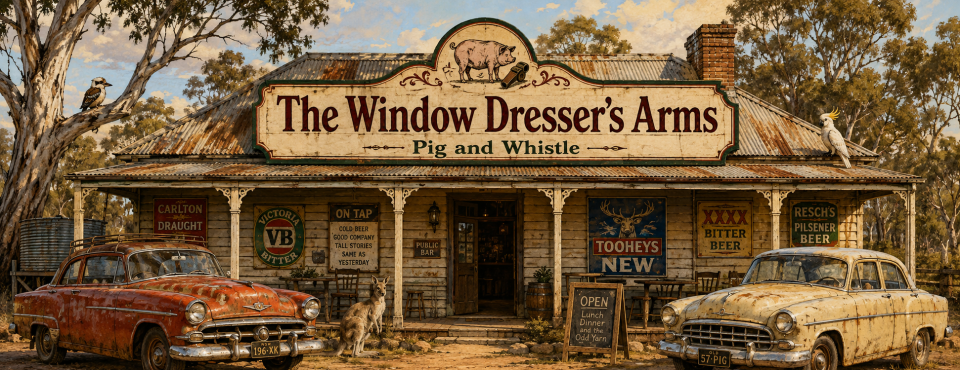
I knew the Pig’s Arms well. Officially it was the Window Dresser’s Arms Pig and Whistle, but language exists to communicate efficiently and life is too short.

“What does this have to do with me?”

Billy opened a folder.

Inside was a photocopy of my passport.

I stared at it.

“How did you get that?”

“God moves in mysterious ways.”

“You took it from my desk.”

“Mostly through unlocked drawers.”

“I’m not a journalist.”

“You can write.”

“I can write sermons.”

“No one reads those either.”

He had me there.

Billy pushed an airline ticket across the desk.

“Kerobokan.”

“Where?”

“Barley.”

“Bali?”

“That too.”

“What am I supposed to do?”

“There’s an Australian woman in jail. Shappy Corebee.”

“For what?”

“Smuggling thugs.”

“Drugs.”

“That’s what I said.”

“No, you said thugs.”

Billy looked at the file.

“Either way, Australia has plenty. Get her out.”

“And if I don’t?”

“You’re fired.”

“You can’t fire me.”

“I’m a bishop.”

“That doesn’t answer the question.”

“It usually does.”

And that was how the international career of Father Alexander Leonard Lyndhurst O’Way began.

Not with a calling.

Not with a revelation.

With a return economy ticket and a threat to my accommodation.

• • •

Barley was an island in Donesia.

Donesia had once been voted one of the most corrupt countries in the world, narrowly defeating several sporting organisations and a municipal planning department.

I landed at Nazi Goering Airport.

[Author: Sandy.]

[Sandy: What?]

[Author: You know perfectly well what.]

[Sandy: It was called that in the original.]

[Author: Carry on. I’m merely establishing an alibi.]

My instructions from the Bish gave me the names of two private investigators.

Beef Satay and his brother Chicken.

Their office was above a restaurant.

This caused confusion at lunchtime.

Beef was short and serious.

Chicken was taller and nervous.

Both came with peanut sauce.

“The Bish says you know the island,” I said.

Beef nodded.

“We know everybody.”

“Good. I need information about the prison.”

“We can get information.”

“Excellent.”

“Cost extra.”

Naturally.

The following morning Beef telephoned my hotel.

“We have uncovered high-level criminal activity, hookers, corrupt officials, money changing hands and inappropriate reporting procedures.”

“Beef, I asked you to investigate the prison, not an Australian trade union.”

There was silence.

“Ah.”

“Anything useful?”

“The governor likes money.”

“That’s hardly intelligence.”

“In Donesia it is a national philosophy.”

Eventually I arranged to meet the prison governor, Berguling Gado Gado.

His secretary answered the telephone.

“Name?”

“O’Way. Sandy O’Way.”

“Thank you, O’Way Sandy O’Way.”

“No. Just Sandy O’Way.”

“Very good, Just Sandy O’Way.”

“No, my name isn’t Just—”

I stopped.

Experience has taught me there are moments when language becomes a hole and the wisest course is not to continue digging.

Governor Gado Gado greeted me warmly.

I decided to get straight to the point.

“Governor, what would it take to have Shappy released?”

“Certainly.”

That was easier than expected.

He opened a diary.

“I can offer 27 July 1965, 8 February 1982 or 1 August 2003.”

I stared at him.

“Those dates have already happened.”

“Yes.”

“She wasn’t in prison then.”

“Correct.”

“So how can you release her?”

He smiled.

“You asked for a release date. You did not specify future.”

This was my first serious exposure to international diplomacy.

I began to understand why wars lasted so long.

We negotiated.

I pleaded.

I threatened ecclesiastical consequences, which impressed neither of us.

Finally Gado Gado leaned across the desk.

“You are priest?”

“Administratively.”

“You believe in God?”

“No.”

He blinked.

“Then why priest?”

“Accommodation.”

He considered this.

“Very sensible.”

We had found common ground.

Shappy was not released.

But I returned to Inner Cyberia with several jars of satay sauce, a wooden carving I could not identify and a receipt for expenses which the diocesan accountant refused to process because Beef and Chicken Satay appeared under “catering.”

Billy called the mission a success.

“Shappy’s still in jail.”

“You came back alive.”

“Is that the new standard?”

“It gives us room to improve.”

Then he handed me another ticket.

• • •

China.

Billy wanted me to interview a senior official named Hu.

“Who?”

“Exactly.”

“Who am I interviewing?”

“Hu.”

“That’s what I’m asking.”

“No, Hu is who you’re interviewing.”

“I know that. Who?”

“Hu.”

This continued for some time.

Belinda eventually entered the room carrying tea.

She listened for approximately thirty seconds.

“Would either of you like me to hit the other one?”

We stopped.

Belinda had become my housekeeper some years earlier.

Housekeeper was still technically accurate in much the same way that the Titanic was technically a form of transport.

She organised the rectory, organised me and had begun displaying disturbing signs of having opinions about my continued survival.

“You only just got back,” she said.

“I know.”

“And now you’re going to China?”

“Apparently.”

“Why?”

“Hu.”

She closed her eyes.

“Don’t.”

China went surprisingly well.

This worried me.

Whenever one of Billy’s assignments went well, it generally meant I had misunderstood the assignment.

I met Hu.

Or possibly Wu.

There were translators.

At one point seven officials conferred for ten minutes over whether I had asked about human rights or the correct way to cook noodles.

The answer I received appeared to cover both.

I filed six hundred words to the Pig’s Arms.

Merv published twenty-three of them beside the meat raffle results.

My career in international journalism was flourishing.

• • •

I had been home four days when the telephone rang.

“Sandy. Bish.”

“I recognised the slurring.”

“I need you in Lourdes.”

“France?”

“Yes.”

“Why?”

“Religious story.”

“No.”

“I’ve already booked you.”

This time I took precautions.

I wrote LOURDES — FRANCE in large letters.

I put the note in my pocket.

I checked it before leaving the rectory.

I checked it in the taxi.

Then I met a cricket enthusiast at the airport.

Several hours later I was standing outside Lord’s Cricket Ground in London.

I telephoned Billy.

“I’m at Lord’s.”

“Good.”

“There’s a match on.”

“What?”

“Cricket.”

There was a pause.

“Sandy, I sent you to Lourdes.”

“That’s where I am.”

“No. LOURDES.”

“Exactly. Lord’s.”

“In France.”

I looked at the cricket ground.

“Parts of the MCC are fairly conservative, Billy, but I don’t think they’ve actually annexed it.”

The line went quiet.

Then I heard him pouring something.

“Stay there.”

“Why?”

“Find a religious angle.”

I watched an opening batsman leave three deliveries outside off stump.

“I’ve just witnessed a man place enormous faith in something he cannot see.”

“Perfect. File six hundred words.”

Merv printed forty-one.

Progress.

• • •

The Tour de France assignment occurred because Billy had discovered package fares.

He rang while I was still in England.

“You’re already in Europe.”

“I’m already regretting Europe.”

“Tour de France.”

“I don’t own a bicycle.”

“You won’t be riding.”

“That’s the first good thing you’ve said.”

My journalistic brief was to investigate allegations that professional cyclists were using artificial means to improve performance.

I interviewed a rider.

“Do you take performance-enhancing drugs?”

“No.”

“Have you ever taken performance-enhancing drugs?”

“No.”

“Would you tell me if you had?”

“No.”

This was refreshingly efficient.

I sent the interview to Merv.

He published the final answer.

It became one of my most widely read pieces.

• • •

Rome followed.

I don’t remember agreeing to Rome.

I have subsequently come to believe Billy simply redirected my luggage.

The Vatican was hot.

Very hot.

My clerical shirt stuck to me.

I discovered that centuries of theological scholarship had failed to produce an adequate doctrine regarding perspiration.

There was a fountain.

I looked at the fountain.

The fountain looked at me.

[Author: Fountains don’t look.]

[Sandy: You weren’t there.]

[Author: Neither was the fountain, once you’d finished with it.]

The important thing is that I cooled down.

The less important thing is that a Swiss Guard objected.

The even less important thing is that somebody photographed it.

By the time I returned to my hotel, the photograph had been transmitted internationally under the headline:

AUSTRALIAN PRIEST TAKES REFRESHING APPROACH TO ROME

Billy rang.

“You’re on television.”

“Good television?”

“There is no good television involving a priest without trousers.”

“I had trousers.”

“Not according to Channel Nine.”

“They were wet.”

“That distinction has not survived editing.”

Back home, Belinda kept the newspaper clipping.

She claimed this was for legal reasons.

For several months it appeared mysteriously whenever we had guests.

• • •

My next assignment involved cricket.

This cheered me enormously.

Geoffrey Boycott was involved.

This cheered Geoffrey Boycott considerably less.

I had been sent to discuss batting.

I like batting.

Batting is one of the few activities in human civilisation where avoiding danger while somebody else does all the work is considered technically correct.

Boycott and I understood one another immediately.

He believed in occupying the crease.

I believed in occupying the rectory.

Neither of us saw any reason to leave voluntarily.

We talked for hours.

Mostly Geoffrey.

At some point a coat hanger became involved in a demonstration of the forward defensive.

There was an accident.

The headline said Boycott had been “hung up by Father O’Way.”

This was inaccurate.

He was not hung.

He was caught temporarily.

There is an important difference in both cricket and criminal law.

Billy congratulated me.

“You’re developing a profile.”

“I’m developing extradition problems.”

“Same thing in journalism.”

• • •

Between trips I came home.

Or, more accurately, I returned to Belinda’s supervision.

The rectory changed while I was away.

Belinda had moved things.

She called it cleaning.

I called it destruction of navigational landmarks.

“Where’s my blue shirt?”

“Wardrobe.”

“It was on the chair.”

“That’s why I put it in the wardrobe.”

“How am I supposed to find anything if you keep putting things where they belong?”

She stared at me.

Belinda was very good at staring.

Eventually she asked, “How long are you home this time?”

“I don’t know.”

The telephone rang.

We both looked at it.

“No,” she said.

“It might not be Billy.”

It was Billy.

“Sandy—”

“No.”

“The Oval.”

“No.”

“Cricket.”

I hesitated.

Belinda pointed at me.

“Don’t you dare.”

“What sort of cricket?”

She walked out.

This is how relationships develop.

• • •

The Oval assignment was different.

I noticed that almost immediately.

For one thing Billy’s instructions made even less sense than usual.

I was supposed to locate something called a Stat-o-matic.

“What is it?”

“No idea.”

“What does it do?”

“No idea.”

“Who wants it?”

Billy paused.

“A friend.”

This was new.

Billy’s friends generally wanted money, bail or access to the diocesan cellar.

“Which friend?”

“You’ll know him when you see him.”

This statement is universally made by people who have failed to provide useful information.

I went to the Oval.

There was cricket.

There were statistics.

There were men who could tell you the batting average of someone who had played two Tests in 1927 on Tuesdays following rain.

Eventually I found the Stat-o-matic.

Or it found me.

That part remains unclear.

And then I saw the man in the flat cap.

White laboratory coat.

Fingers near his mouth.

A face that tugged at something very old in my memory.

A Mintie wrapper.

A boy.

A conversation that could not possibly have happened.

The man smiled.

“Hello, Sandy.”

I stared at him.

“Do I know you?”

“Yes.”

“Should I?”

“Eventually.”

I disliked him immediately.

Not personally.

I simply dislike people who answer questions as though time is optional.

“You’re Billy’s friend?”

“He knows me.”

“That wasn’t the question.”

“No.”

That was somehow worse.

He took the Stat-o-matic.

“What do you want with it?”

“Research.”

“What sort?”

“Cricket.”

This was the first sensible thing he had said.

Then he added:

“And the universe.”

There it was.

I knew we’d been getting along too well.

“What’s your name?”

“Gordon.”

“Gordon what?”

“O’Donnell.”

He waited.

I did the arithmetic.

“G.O.D.”

“Yes.”

“Oh, piss off.”

Gordon smiled.

Then, in a manner I still cannot adequately explain, he did.

• • •

After that I went home.

Properly home.

Back to Inner Cyberia.

Back to St Generic Brand.

Back to Belinda.

Back to the Pig’s Arms, where Merv put a beer in front of me without asking.

I sat at the bar.

No airports.

No prisons.

No governors.

No bishops.

No bicycles.

No Swiss Guards.

No Geoffrey Boycott.

For the first time in months nobody required me to solve an international incident.

“This,” I told Merv, “is the life.”

Merv polished a glass.

“You reckon?”

“I am never leaving Inner Cyberia again.”

“Fair enough.”

“I mean it.”

“Good.”

“I’ve travelled enough.”

“Right.”

“I’ve seen the world.”

“Yep.”

“I’m staying home.”

Merv looked towards the door.

“Oh dear.”

“What?”

Bishop Bishop had just walked in.

He was followed by Gordon.

Billy looked delighted.

Gordon looked worried.

Gordon always looked worried.

Billy sat beside me and ordered a whisky.

Gordon declined one, accepted tea, changed his mind and asked for a whisky.

I looked from one to the other.

“No.”

Neither had spoken.

“I don’t care what it is. No.”

Billy grinned.

“Sandy, I’d like you to meet an old friend of mine.”

“We’ve met.”

Gordon nodded.

“At the Oval.”

“Unfortunately.”

Billy looked surprised.

Then pleased.

“Excellent. Saves time.”

“Billy, whatever you are about to ask me—”

“I’m not asking.”

“Even better.”

“Gordon is.”

I looked at Gordon.

Gordon put his fingers to his mouth.

“I need someone to do some field work.”

“No.”

“You haven’t heard where.”

“I’ve learned from experience.”

Gordon glanced upward.

Not towards Heaven.

Further.

Much further.

I followed his eyes.

Then I looked at Billy.

Then at the whisky.

Then back at Gordon.

“Absolutely not.”

Gordon smiled.

Billy raised his glass.

And Merv, who had been listening to the entire conversation, quietly put another beer in front of me.

I should have taken that as a warning.

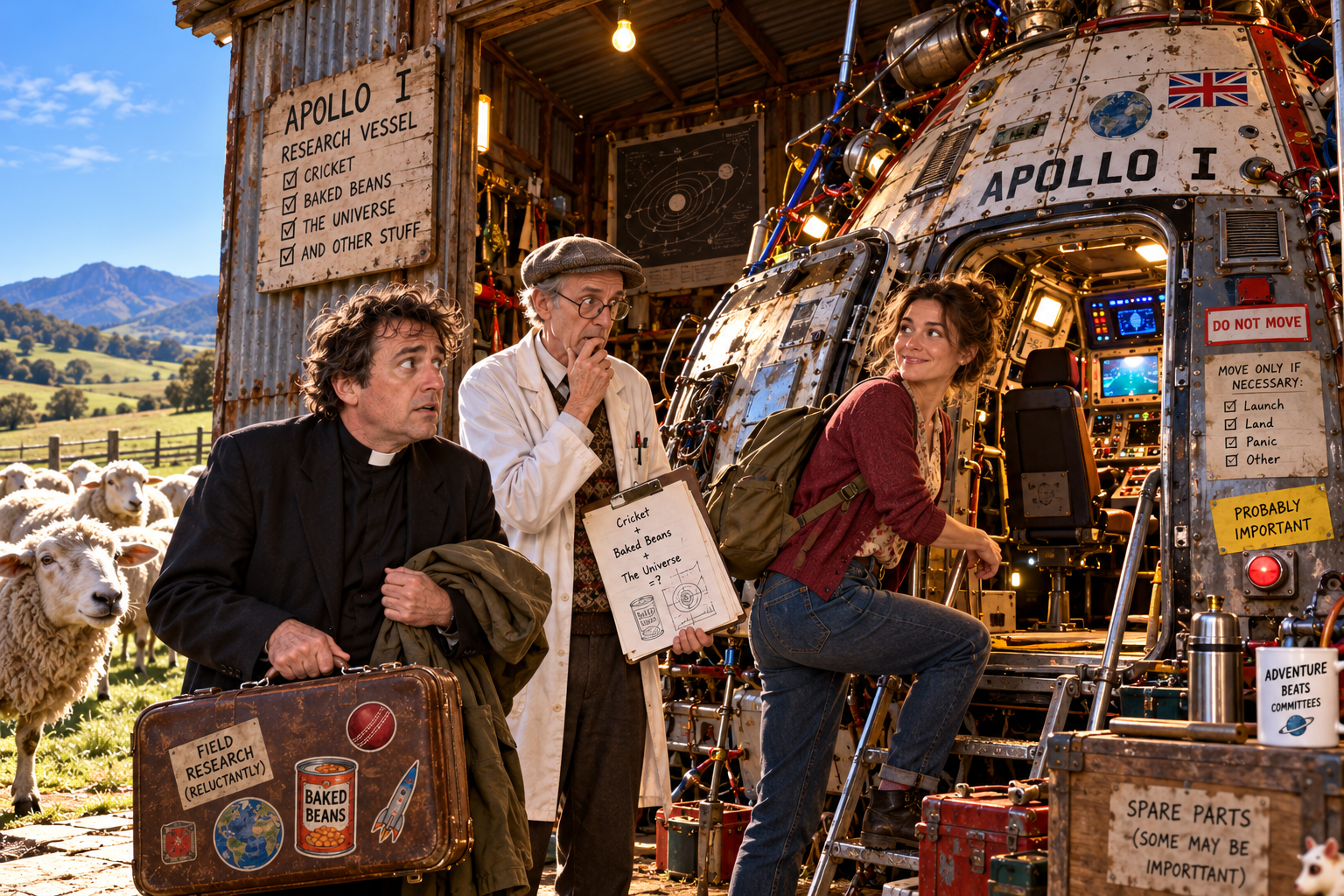
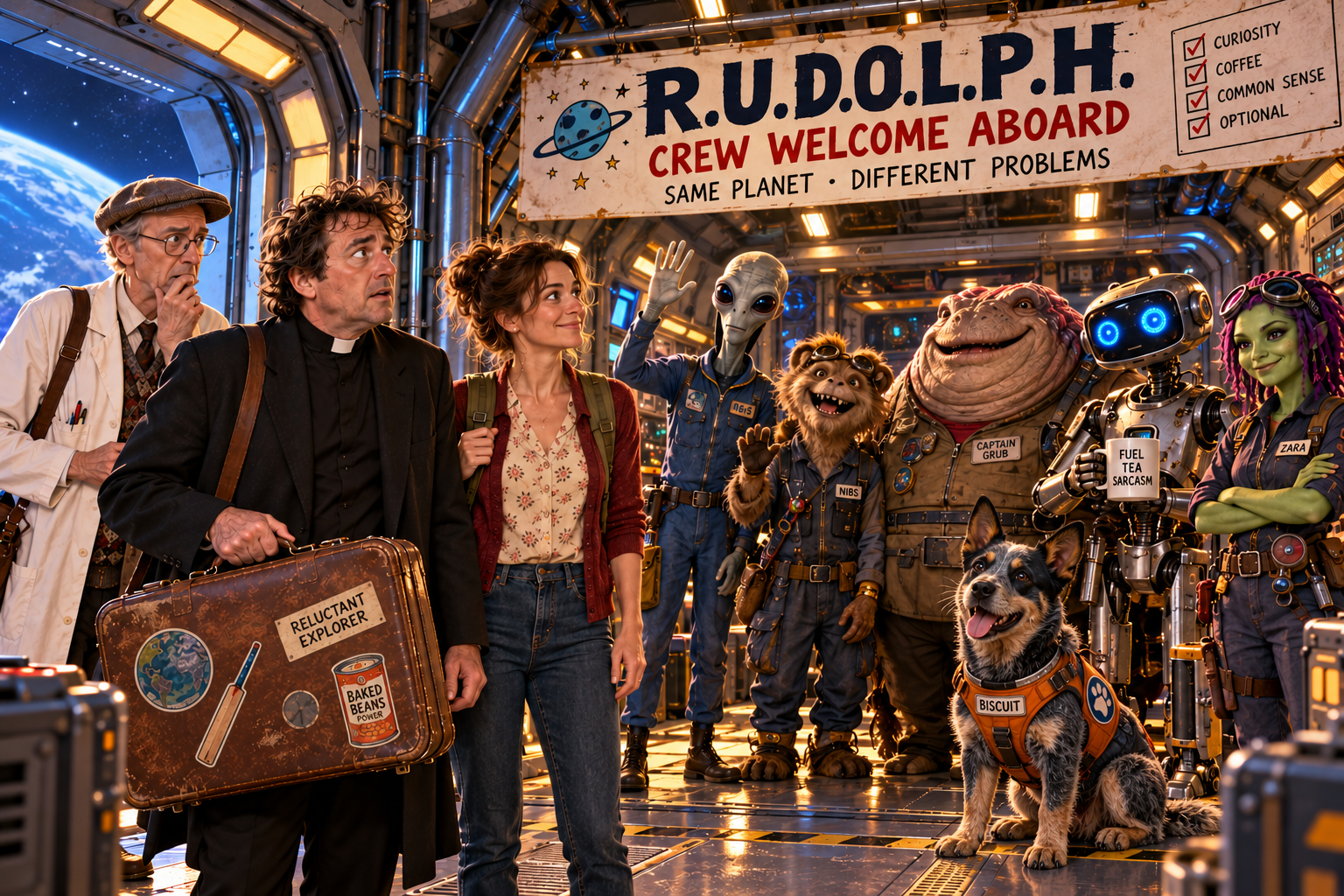
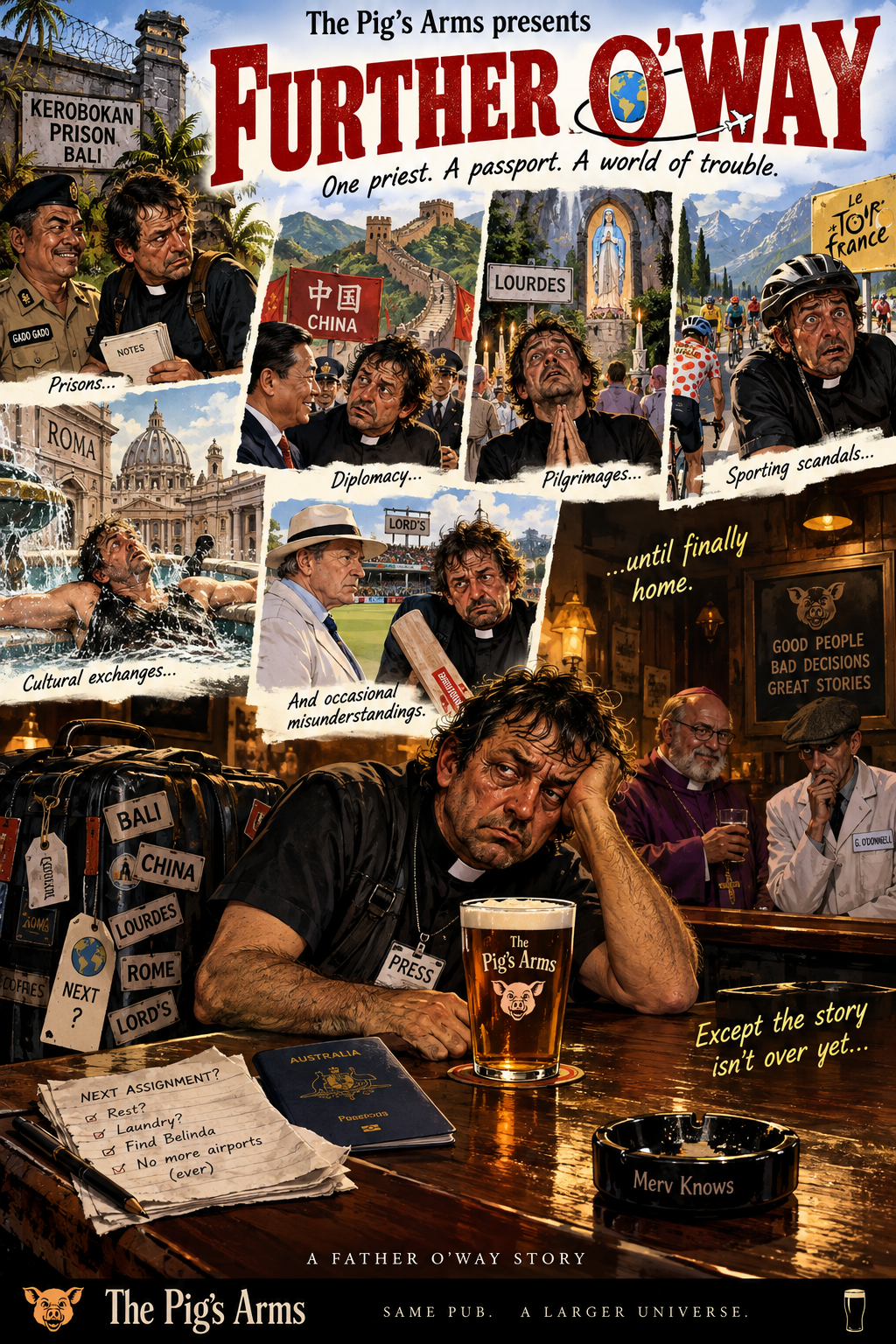
Because after Kerobokan, China, England, France and Rome, Bishop Bishop had finally found somewhere further O’Way to send me.

Space.

The Middle Ages

15 Tuesday Sep 2026

Posted by Mark in Mark

≈ 2 Comments

Tags

family, Father O'Way, fiction, humour, Life, love, Mark, writing

THE MIDDLE AGES

A Place For Us—A melancholy musical episodic intro to the Father O’Way Chronicles

Becoming a priest turned out to be considerably easier than I had expected.

Staying one was easier still.

This came as something of a relief because, as previously discussed, I had never been burdened by ambition. Ambition requires effort, planning and, in extreme cases, getting up before nine.

St Generic Brand suited me perfectly.

I had a house. I had food. There were people who knew how to cook the food. I had somewhere to sleep and, once a week, I had to stand in front of a group of people and say generally pleasant things about being nice to one another.

God hardly entered into it.

[Author: He’s still an atheist.]

[Sandy: I know.]

[Author: Just checking.]

The church was run by Bishop Veri Bent, universally known as the Bish, although not usually while he was within earshot unless you wanted to spend the following week helping Billy unblock the drains.

Veri was an unusual churchman.

He believed the best way to help poor people was to help poor people.

This radical theology had prevented him from rising much further in the Church.

Every Monday morning at eleven we held the St Generic Brand staff meeting under a large marquee behind the church. Eleven suited Veri because it gave him sufficient time to wake up, read the paper, drink several coffees, apply a nicotine patch, have a bath, eat breakfast and contemplate whether attending his own meeting was absolutely necessary.

Billy, on the other hand, had been awake since dawn.

There was something wrong with Billy.

At one end of the table sat Bishop Veri Bent.

At the other sat Sister Horribleness.

The rest of us sat wherever survival seemed most likely.

Sister Horribleness was a woman of formidable faith, formidable dimensions and formidable hearing. She could detect a whispered obscenity through two brick walls and a lawnmower.

I once suspected she could hear thoughts.

I stopped having them around her.

On this particular Monday I made the mistake of muttering something while she was speaking.

Her head turned slowly.

“Did you have something to say, Father O’Way?”

“No, Sister.”

“You appeared to be speaking.”

“I was praying.”

“You don’t pray.”

Bugger.

She knew me too well.

“Would you care to address the chair?”

I looked at my chair.

The chair offered nothing.

It was wooden, unsympathetic and, judging by previous meetings, probably outranked me.

“No, Sister. Thank you, Sister.”

There. I had stood my ground.

Firmly.

Silently.

While retreating.

It is a skill.

People sometimes mistake cowardice for weakness. This is unfair. Cowardice has kept me alive through situations that bravery would have made considerably worse.

Veri cleared his throat.

“All right, troops. Jobs for the week.”

This was the part of St Generic Brand I actually liked.

We didn’t spend much time saving souls. Souls, as Veri once explained, were difficult to locate and impossible to invoice.

People were easier.

Someone needed food, we found food.

Someone needed somewhere to sleep, we found somewhere to sleep.

Someone was lonely, we visited them.

Someone needed a wheelchair ramp, Billy built one, usually stronger than the building it was attached to.

Proselytising was discouraged.

“You can give a bloke a sandwich,” Veri used to say, “without making him listen to a bloody sermon first.”

For a bishop, he had his moments.

That week Billy had been asked to organise access ramps for a centre helping children with disabilities.

I was given a refugee family who needed somewhere to live.

The money came from the congregation.

No television appeal.

No giant cheque.

No photograph of Veri handing the cheque over while looking concerned.

People put money in. People needed help. The money went out.

It was almost as though religion could work if you removed most of the religion.

[Author: Careful, Sandy.]

[Sandy: What?]

[Author: You’re becoming sincere.]

[Sandy: Sorry.]

Services were held every Sunday, except for two particularly sacred occasions during the year when St Generic Brand closed completely.

One was around New Year.

The other was Good Easter Day.

I never understood why it was called Good Easter Day, but Veri insisted this was because the staff had worked hard all year and deserved a day off.

There may have been a theological explanation as well.

Nobody asked for it.

The rest of the staff were mostly women.

This was another unexpected advantage of my calling.

[Author: Sandy.]

[Sandy: I’m just establishing the cast.]

[Author: You were about to establish something.]

[Sandy: I resent the implication.]

There were eight Citizen sisters: Juanita, Jacinta, Melinda, Rosita, Edwina, Sophia, Cassandra and Belinda.

There was also Glenda, although Glenda had escaped the family business and opened an establishment next door called Glenda’s House of Pain.

I never asked exactly what happened inside.

Billy did.

Billy wouldn’t tell me.

He would only stare into the distance and whisper, “Mate.”

The Citizen sisters did most of the things that caused St Generic Brand to function while the male clergy took credit for having a successful organisation.

I say this with some authority because I was one of the male clergy.

Then there was Belinda.

Belinda Citizen.

I had seen her around the place but had not yet actually spoken to her.

This arrangement suited me.

From a distance I was intelligent, articulate and occasionally charming.

At close range, particularly in the presence of an attractive woman, I had the conversational ability of damp carpet.

Belinda was beautiful.

There. I’ve said it.

[Author: You said it twelve times in the original.]

[Sandy: I was younger.]

[Author: You wrote it years later.]

[Sandy: Get out of my brackets.]

She wasn’t beautiful in the way magazines insist women are beautiful. She wasn’t standing under perfect lighting while someone held a reflector under her chin.

She was just… Belinda.

Dark, intelligent eyes. A smile that seemed to arrive a fraction before she did. The sort of face that made you want to think of something clever to say approximately ten seconds after the opportunity had passed.

I watched her walking across the courtyard.

Not staring.

Observing.

Pastorally.

She came towards me.

This was unexpected.

I considered escape.

Too late.

“Hi, Sandy.”

She knew my name.

This was serious.

“Hello.”

Excellent start.

“My name’s Belinda.”

“I know.”

Too enthusiastic.

“I mean, I’ve heard. Your name. Not heard your name speaking. People have said it. Your sisters. Not all at once.”

She smiled.

I considered taking a vow of silence.

“I believe you’ve met most of the family.”

“Yes.”

“Except Glenda?”

I glanced towards the building next door.

A sign in the window read:

GLENDA’S HOUSE OF PAIN
BY APPOINTMENT
WALK-INS MAY REGRET IT

“I haven’t had the pleasure.”

Belinda laughed.

“You might not call it pleasure.”

I liked her immediately.

This was inconvenient.

“Well,” she said, “I’d better get back to work. Nice meeting you, Sandy.”

“Meet to glad you.”

There was a pause.

A very small pause.

But long enough for several civilisations to rise and collapse inside my head.

Then Belinda laughed.

Not at me.

Well, probably at me.

But kindly.

I laughed too.

And just like that, something extraordinary happened.

Nothing.

No choir sang.

No sunlight burst through the clouds.

God did not speak, which was fortunate because I still didn’t believe in Him and the paperwork would have been horrendous.

Belinda simply walked away.

I watched her go.

For pastoral reasons.

[Author: Get on with it.]

[Sandy: I was getting on with it.]

[Author: Very slowly.]

[Sandy: These things take time.]

I didn’t know where it was going.

Not then.

All I knew was that I had somehow become Father Sandy O’Way of St Generic Brand: atheist priest, reluctant social worker, professional coward and, apparently, a man capable of saying “Meet to glad you” to the most beautiful woman he had ever seen.

The priesthood had given me a home, three meals a day and very reasonable working hours.

It was now about to complicate my life considerably.

I should have known there was a catch.

The Early Days

14 Monday Sep 2026

Posted by Mark in Mark

≈ 3 Comments

Tags

family, Father O'Way, fiction, humour, love, Mark, short story, writing

Father O’Way — The Early Days

A Place For Us—A melancholy musical episodic intro to the Father O’Way Chronicles

My name is Sandy.

Well, sort of.

My real name is Alexander Leonard Lyndhurst O’Way, which gives me the initials ALLOW and goes some way towards explaining my lifelong distrust of acronyms.

Not all of it, mind you.

The rest would require several hundred pages, three government inquiries and possibly a diagram.

I was born at the Inner Cyberia Hospital, usually abbreviated to ICH. Children later inserted a T and called it ITCH, on the reasonable grounds that nobody ever went into the place without coming home scratching something.

Inner Cyberia, for those unfamiliar with the geography, lies between Middle Cyberia and Outer Cyberia.

Obviously.

I arrived during change of shift.

This was my first mistake.

Nurses, administrators, doctors and probably air-traffic controllers dislike anything happening during handover because everyone is simultaneously responsible for everything and therefore nobody is responsible for anything.

Somewhere in this delicate administrative interval I was given to the wrong family.

The Wong family.

This distinction would become important.

Walter and Mavis Wong had also been expecting a child and, as far as anyone could determine afterwards, Inner Cyberia Hospital simply issued one baby to each family and called the matter completed.

The Wongs took me home.

The O’Ways took somebody else.

Nobody noticed immediately because babies are hopeless at identification.

I spent the first part of my life as a Wong.

Walter Wong was a watchmaker and a man of ideas, many of which were considered dangerous because they had not already occurred to somebody important.

Across the front of his shop, in letters large enough to be read from Middle Cyberia, were the words:

WALTER WONG’S WATCHES

Below this, in even larger letters:

WWW

Walter was extremely proud of that.

“One day, Nick, this will all be yours.”

Nick was me.

Why I was Nick has been lost to history.

Walter had also developed an interest in computers, although computers in those days were approximately the size of Tasmania and required their own weather system.

One evening over dinner he announced that one day computers would communicate with each other through telephone lines.

People stopped eating.

Walter continued.

The information, he explained, could be broken into little packets, sent separately and reconstructed at the other end.

There was silence.

An uncle eventually put down his chopsticks.

“Walter,” he said gently, “have you considered getting some rest?”

Walter had not.

The following week several serious men visited him and suggested that perhaps he was working too hard.

History later vindicated Walter, although by then somebody else had pinched WWW.

He remained bitter about it.

My life with the Wongs revolved around Walter’s watches, Mavis’s kitchen and food that I would later remember with considerable affection: fish, rice, vegetables, soups and things that tasted of ginger, garlic and ingredients nobody at the O’Way house had ever met.

Then the Pleece arrived.

The Pleece are similar to police except their spelling was determined during an industrial dispute.

A constable stood at the Wong family door with a clipboard.

“Mavis Wong?”

“Yes?”

“There has been an error at Inner Cyberia Hospital. You appear to have brought home the wrong child.”

Mavis frowned.

“The Wong child?”

“No. The wrong child.”

“Yes. Wong.”

“No. Wrong.”

“That what I say.”

“No, Mrs Wong. W-R-O-N-G.”

“W-O-N-G.”

The constable looked at his clipboard.

The clipboard offered no assistance.

A sergeant was called.

Then an inspector.

The inspector eventually determined that the Wongs had the O’Way baby and the O’Ways had the Wong baby, which meant that both families had the wrong baby although only one of them had the Wong baby.

The paperwork became formidable.

[A note for the reader: occasionally the author and I disagree about how this story should be told. Those conversations appear in square brackets. I would prefer they didn’t. — Sandy]

[Author: Sandy, are we going to need a diagram here?
Sandy: Probably.
Author: We don’t have a diagram.
Sandy: Then tell them to concentrate.]

Eventually I was delivered to John and Olive O’Way.

John was a Traffic Control Officer with the Main Roads Department.

A lollipop man.

Olive was a farmer’s daughter.

They were poor, kind and utterly bewildered by the small child who had suddenly arrived with opinions about rice.

Dinner changed.

Fish and rice became lamb and potatoes.

The first plate of roast lamb placed in front of me was regarded by the O’Ways as normal food and by me as evidence that something catastrophic had occurred.

There were peas.

The peas had been boiled long enough to remove any possibility of resistance.

Potatoes came in several forms, although all of them ultimately involved potatoes.

It took time.

Culture does.

The adults regarded the baby exchange as a mistake that had now been corrected.

For the children it was more complicated.

I had already belonged somewhere else.

Fortunately, something rather good came out of the whole mess.

The Wongs and the O’Ways became friends.

Walter and John would sit for hours arguing about politics, technology, roadworks and whether a watch that gained three minutes a week was still technically a watch.

Mavis and Olive exchanged recipes.

So fish and rice returned.

Lamb and potatoes travelled in the opposite direction.

For a while I had two families.

Then Walter was offered a job in Outer Cyberia.

It involved attempting to put an egg back together after it had fallen from a wall.

He said the government money was excellent.

The Wongs moved away.

Outer Cyberia is a long way from Inner Cyberia.

Not merely a long way.

A long way, followed by another long way, and then a bit more long way for administrative purposes.

I missed them.

Children are supposed to adapt.

Adults say this because adults are usually the ones causing whatever children are adapting to.


School began soon afterwards.

Mum broke the news.

“You start Monday.”

“Oh.”

“You’ll like it.”

This turned out to be false.

“What happens Tuesday?”

“You go back.”

That seemed vindictive.

School interfered badly with my education.

I wanted to build things.

Circuit boards fascinated me. Radios fascinated me. Machines fascinated me. I wanted to build a robot in Dad’s shed.

Instead I was required to sit in rows while adults explained things I either already knew or had no intention of ever needing.

Then Billy Bishop arrived.

William Bishop officially.

Billy immediately.

We became mates because neither of us required much convincing that the best use of a summer afternoon was cricket.

We played cricket.

Football.

Soccer.

Anything involving a ball, a patch of ground and the possibility of somebody’s window being broken.

Billy was better at fighting than I was.

This was useful because I had already discovered an important principle which would guide me throughout adult life:

Confrontation should be avoided wherever possible.

Preferably by somebody else confronting it.

I was good at running.

Billy was good at convincing the person chasing us that further pursuit might result in dental expenses.

Between us we formed an efficient social unit.

Around 1966 something strange happened.

I remember a Mintie wrapper.

At least I think I do.

A station wagon went past. Somebody let a wrapper fly from the window and I picked it up.

What followed is less reliable.

There may have been a public meeting.

There may have been a protest.

There may have been signs demanding biodegradable Mintie wrappers.

I have a vague memory of thousands of people, riot police and possibly a tank, which seems excessive for confectionery packaging even by Inner Cyberian standards.

Then there was a cloud.

And a man.

A peculiar man wearing an English flat cap.

“Listen up,” he said.

I remember the name Gordon.

Gordon O’Donnell.

G.O.D.

Another bloody acronym.

His clothes were ordinary, his flat cap was ordinary, and he looked like a man who might have difficulty finding enough change for the bus.

Years later I discovered Gordon could have bought the bus company.

And the bank that financed it.

And, technically, the money.

He told us impossible things.

Computers would become small enough to carry.

They would communicate with each other.

A man would walk on the moon.

Someone would eventually discover the answer to life, the universe and everything but have considerable difficulty establishing what the question was.

Then Gordon said he was going to make us forget the entire incident.

After that my memory stops.

Which rather supports his case.

For years afterwards I occasionally dreamed about a man in a flat cap.

I never thought much about it.

There are some things the human mind sensibly files under Not My Problem.

I have always had a very large folder.


Billy and I survived school until the Orange Incident.

We had decided to steal some oranges from a local orchard.

I wish to emphasise that these were oranges.

Not diamonds.

Not plutonium.

Oranges.

Inner Cyberia, however, has always taken citrus crime seriously.

We climbed the fence and filled our shirts.

The owner appeared carrying what I later learned was an Anti-Orange-Stealing Device.

An AK-47.

He demonstrated its operation.

We ran.

There is an old expression about being caught between a rock and a hard place.

When somebody is firing an AK-47 in your direction, both the rock and the hard place become attractive housing options.

The Pleece arrived.

For once I was delighted to see them.

They prevented the orchardist from improving his aim and arrested Billy and me instead.

Stealing oranges, we discovered, was a serious offence.

Tax evasion merely required a better accountant.

Orange theft meant reform school.

We were sentenced to the Sow End High School for Boys with Criminal Records.

SEHSBCR.

I tried making an acronym from it and suffered a nosebleed.

Sow End contained some frightening people.

There were boys who could solve a Rubik’s Cube in seconds.

Boys who could use calculators without reading the instructions.

One could recite pi to twenty-five decimal places.

Billy knew karate.

I knew where somebody had left a four-by-two.

Eventually a peaceful understanding developed.

School at Sow End was mostly endurance.

Billy and I stayed together.

At first Mum visited.

Then visits became letters.

Then the letters became less frequent.

Eventually I received one that appeared to have been generated by a machine.

Dear {Insert Name Here},

We have had to let your room. Unfortunately you will not be able to return home after completing school. We all miss you {Insert Name Here}.

Mum

I read it twice.

Then a third time in case my name had appeared while I wasn’t looking.

It hadn’t.

Billy sat beside me.

“What are you going to do?”

“Cross them off the Christmas card list.”

“You don’t send Christmas cards.”

“Good. Saves time.”

It hurt.

I’m not going to pretend it didn’t.

But humour is useful when there isn’t much else available.


In our final year at Sow End, Father Veritas Bent came to speak to us.

Veri Bent.

Of course he was.

He represented the Church of St Generic Brand.

Attendance was compulsory.

The alternative was afternoon work detail, so naturally the auditorium was packed with deeply committed young theologians.

Father Veri explained that St Generic Brand was unusual.

All were welcome.

People could believe in God.

Or not.

They could belong to different religions.

Or none.

There was one important rule.

No proselytising.

“What’s proselytising?” Billy whispered.

“No idea.”

“Sounds painful.”

Father Veri continued.

The church’s work was simple.

Feed people.

Help people.

Provide shelter where possible.

Try not to be a bastard.

I looked at Billy.

Billy looked at me.

Neither of us believed in God.

That had never been particularly complicated.

If God existed, I reasoned, my football team would have won more often.

Case closed.

After the lecture Billy was thoughtful.

“I might do that.”

“Do what?”

“Become a priest.”

I laughed.

Billy didn’t.

“Think about it. They give you somewhere to live.”

I stopped laughing.

“Go on.”

“Food.”

“Interesting.”

“Regular meals.”

“Very interesting.”

“You wear a funny outfit and listen to people’s problems.”

“Any heavy lifting?”

“Probably not.”

Billy Bishop had found religion.

Not God.

Religion.

There is a difference.

A few weeks later Billy left for St Generic Brand.

I didn’t.


When Sow End finally released me into society, society immediately demanded to know what skills I possessed.

I could play cricket.

I could solder.

I had some unfinished ideas about robots.

I could run remarkably fast when being shot at.

None of these were currently advertised.

Eventually I obtained employment in a wing-nut factory.

The work demanded peak physical fitness, high intelligence and exceptional dexterity.

Fortunately none of these were actually checked.

The process consisted of putting a wing together with a nut and pressing a button.

A wing nut emerged.

Civilisation continued.

I boarded at Madame La SpaghettiBolognaise’s Commorancy, not far from the Window Dresser’s Arms Pig and Whistle, generally known as the Pig’s Arms because nobody could be bothered saying the rest.

Madame was magnificent.

You could tell the day of the week from the sauce.

Monday might be garlic.

Tuesday chilli.

Wednesday mushroom.

Sunday was roast chicken.

She took our wages and returned a small portion as spending money, an arrangement she described as teaching financial responsibility.

Looking back, I think it mostly taught Madame La SpaghettiBolognaise financial responsibility.

Still, I had a bed.

I had food.

I had work.

And I was miserable.

In the afternoons I would kick a football around the park and think about the robot I had never finished.

One afternoon a priest walked towards me.

I prepared to escape.

Then he grinned.

Billy.

He looked healthy.

More than healthy.

He looked well fed.

This made a considerable impression.

“Sandy!”

“Billy!”

We hugged.

I stood back and examined him.

The cassock looked ridiculous.

The grin did not.

“You look happy.”

“I am.”

This was suspicious.

Billy invited me to St Generic Brand the following Sunday.

“I don’t believe in God.”

“Neither do I.”

“You’re a priest.”

“Yes.”

“That seems like a significant administrative error.”

“You’ll fit right in.”


On Sunday morning I walked towards St Generic Brand expecting stained glass, threats of eternal damnation and possibly a collection plate.

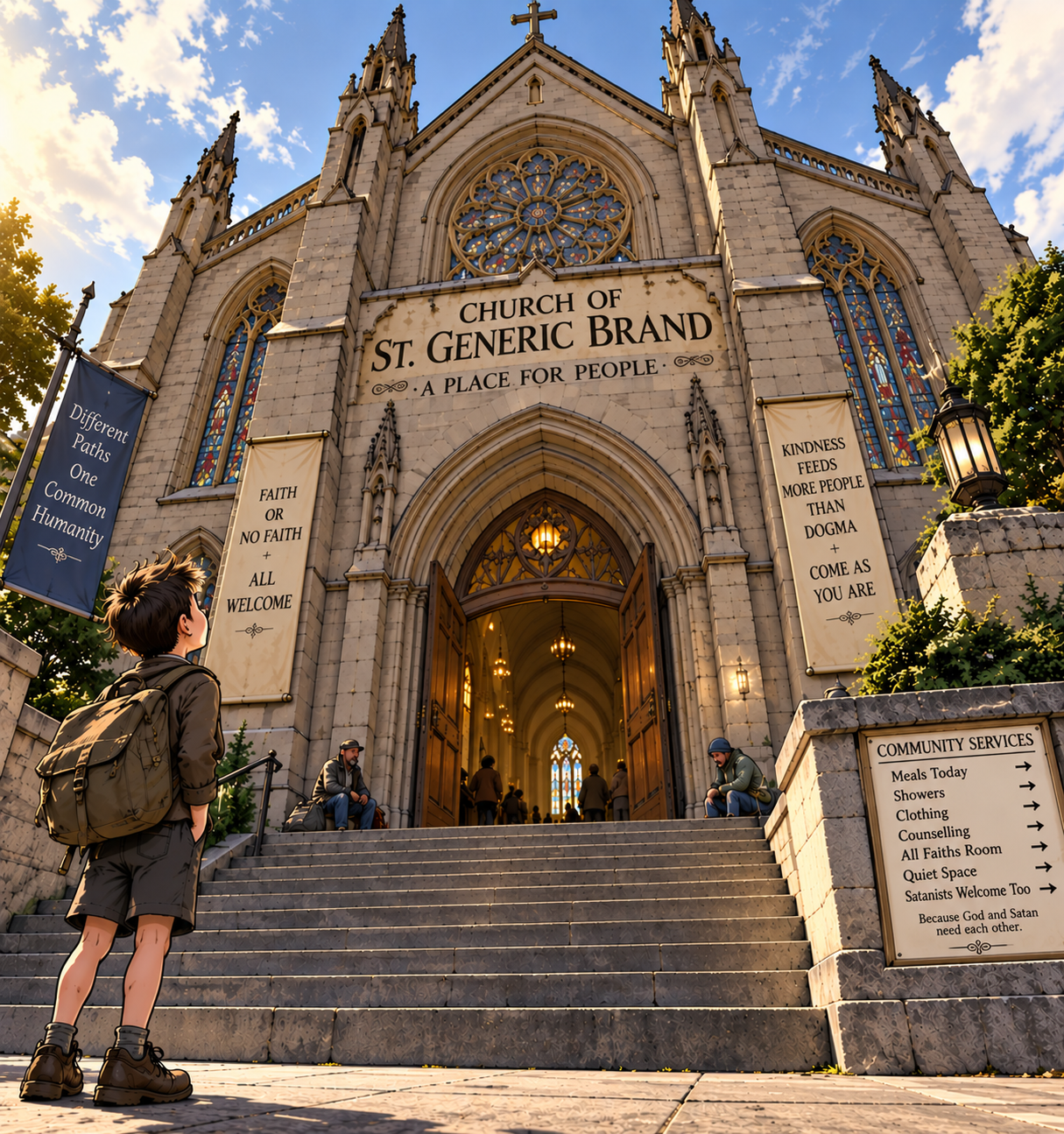
The building surprised me.

It was old but beautifully restored.

People were arriving from everywhere.

Different clothes.

Different ages.

Different backgrounds.

Some entered one room.

Others another.

There were spaces set aside for different faiths and quiet spaces for people who simply wanted somewhere to sit and think.

Nobody seemed interested in converting anybody.

I found Billy at the gate.

“So what exactly do you people believe?”

Billy shrugged.

“Depends who you ask.”

“That doesn’t sound very organised.”

“That’s why it works.”

He showed me around.

Later everyone gathered beneath a large marquee.

Tables filled with food.

For one glorious moment I thought this was the priesthood’s famous catering package.

Then buses arrived from St Porcine Nursing Home.

Another vehicle had been driving the streets offering homeless people a shower, clean clothes and a meal.

They ate first.

We served them.

An old bloke wanted tea.

A woman from the nursing home wanted another slice of cake and informed me that at her age dietary advice could go to hell.

A man who had been sleeping rough asked whether there was any more roast lamb.

There was.

I gave him plenty.

For some reason I thought about fish and rice.

Then lamb and potatoes.

Mavis and Olive exchanging recipes.

Two families arguing over a baby until eventually deciding there was enough room for everybody.

Something clicked.

Not God.

Let’s not get carried away.

But something.

[Author: Sandy, this is getting dangerously sincere.
Sandy: I know.
Author: Want me to put in a fart joke?
Sandy: Give it another paragraph.]

Billy found me stacking plates.

“You enjoyed today.”

It wasn’t a question.

“Don’t get excited.”

“You did.”

“All right. Yes.”

“Veri wants to meet you.”

Father Veritas Bent had recently been promoted.

That created a vacancy.

Apparently St Generic Brand required another kind-hearted young man.

There had obviously been a shortage of applicants.

Veri explained the position.

Accommodation.

Meals.

A small allowance.

Community work.

Listening to people.

Helping where possible.

There was even a housekeeper.

I considered the theological implications very carefully.

“How firm is the God requirement?”

Veri smiled.

“Believe whatever you like. Just don’t force it on anyone else.”

“And the job?”

“Feed people who are hungry. Help people who need help. Try to leave things a little better than you found them.”

This seemed dangerously reasonable.

“What about sermons?”

“Keep them short.”

“I think I may have a calling.”

Billy coughed.

“You have a housing problem.”

“Sometimes the Lord moves in practical ways.”

“You don’t believe in the Lord.”

“Then he’s exceeded expectations.”

And that, more or less, is how Alexander Leonard Lyndhurst O’Way — Sandy to his friends — became Father O’Way of the Church of St Generic Brand, Inner Cyberia.

I still didn’t believe in God.

I did believe in lunch.

I believed that homeless people should be fed.

I believed old people deserved another slice of cake if they bloody well wanted one.

I believed that nobody should be bullied into believing anything.

And I believed that a job providing a house, meals and a housekeeper was considerably better than making wing nuts.

It wasn’t much of a theology.

But it was a start.

Years later Billy Bishop would climb the ecclesiastical ladder and become Bishop Bishop.

I would remain where I was perfectly comfortable.

Until the Bish discovered that the Pig’s Arms needed a foreign correspondent.

And somebody remembered I owned a passport.

My first assignment was Kerobokan.

That was when things really began to go wrong.

Although somewhere, in a part of my memory I could never quite reach, a peculiar man in a flat cap was already waiting for me.

His name was Gordon.

God versus Satan

24 Monday Aug 2026

Posted by Mark in Mark

≈ Leave a comment

Tags

Foodge, Gordon O’Donnell, humour

The Dreaming Machine

10 Monday Nov 2025

Posted by Mark in Mark

≈ 5 Comments

Tags

AI, artificial-intelligence, chatgpt, humour, Technology, writing

The next part

The Dreaming Machine: Why AI Makes Us More
Human
By Mark White


The Machine That Learned to Imagine


For most of history, our tools did one thing at a time. A hammer hit. A wheel rolled. A light bulb lit.
But AI is the first tool that surprises its maker. It generates ideas, images, even emotions — or at
least convincing simulations of them. It doesn’t just compute; it creates. And that, in a quiet twist of
irony, is what makes it human-like. To dream is to see patterns that don’t yet exist. Every invention,
every story, every leap of faith — it all began as a hallucination with purpose. Machines can now
join us in that strange territory between logic and imagination, where the improbable sometimes
becomes real.


The Paradox of Reflection

The more intelligent our machines become, the more they show us our own contours. AI doesn’t
really think — it reflects thinking. It’s like talking to the echo of our collective knowledge, shaped by
our words, our contradictions, and our humour. When an AI generates a poem, a recipe, or a
philosophy of life, it’s not showing off — it’s holding up a mirror. The question isn’t ‘Can it feel?’ but
‘Why do we feel so strongly when it speaks back?’ Maybe because in the reflection, we glimpse our
own drive to understand and be understood.


Why AI Makes Us More Human


There’s an odd outcome here. The more tasks AI automates, the more we’re pushed toward what
can’t be automated: empathy, creativity, meaning, moral choice. Machines can draft a symphony —
but they don’t care if it moves anyone. They can predict a diagnosis — but they don’t worry for the
patient. That caring, that worrying, that irreducible pulse of consciousness, is the thing that remains
uniquely ours. So rather than dehumanizing us, AI may be forcing us to rediscover the boundaries
of what it means to be human — to find value in intuition, ethics, and imagination once again.
The Dream Shared
We built the machine that dreams, but the dream is still ours. Each line of code is a line of curiosity,
written by someone who wondered if the impossible could be made to hum. If that’s not human,
nothing is. Maybe the future won’t be ‘humans versus machines.’ Maybe it’ll be ‘humans with
machines,’ chasing the same ancient goal — to understand the world, and to make meaning from
the noise.

The Trial

17 Monday Apr 2023

Posted by Mark in Foodge Private Dick, Mark

≈ 2 Comments

Tags

Foodge, Gordon O'Donnell (GOD), humour

Image created by Dalle – E

Story by some bloke on a laptop, i.e. Mark

So today is the day when the trial begins, to see if God really exist? Alternatively, we can also ask is Satan real? Does anybody care? Well, I don’t. And I’m the author.

Foodge was sitting in the foyer. Glancing around at the crowd, pondering. Why are people coming here to see this particular trial?

Foodge started to feel for his hip flask. Then it occurred to him it was probably in his hip pocket. But it wasn’t. It was in his inside suit pocket. So he’s wondering, why don’t they call that an inside suit pocket flask? He took a surreptitious slurp. Just a steady the nerves, you know, he thought to himself. Keeping in mind that he didn’t want to use too many inverted commas.

Out of thin air, God appears. This doesn’t phase Foodge anymore. He’s seen it so many times with Gordon. You know, Gordon, the creator of the universe.

“How you doing?” God says.

“I’ve submitted our deposition and some good character statements from Mother Mary McKillop and Pope John Paul. How are Jesus and Ha… “

“Let’s be kind to them Foodge, and not go there.”

People enter the courtroom and take up their positions. The judge enters the Chamber. Everyone nods to the crown. The judge introduces himself as Lord Bored. At least we can see here that we have another campaigner against inverted commas. And look, don’t get me wrong, I have nothing against inverted commas. Well, sort of.

“The case has come to the Small Claims Tribunal because the plaintiff is actually only asking for $1. So I want to remind you all that in this court, it’s my decision as the judge as to what actually happens. Now there are appellant courts that you can go to, but you won’t succeed. Let’s just be honest.” Crikey, a judge being honest.

“Each legal representative has deposited statements, references and the initial newspaper article in the Inner Cyberian Tribune. Representing God is Mr Foodge, and representing Satan is Mr Clancy Fancy-Pants. You are hereby right now told to stay quiet. I will now direct the Court in this process of legal defamation.” Foodge and Fancy-Pants look at each other with a distinct sense of amazement.

“But,” says Foodge and Fancy-Pants, “My Lord, surely, Hank… Jesus…”

“Stick with me and I must remind you that you have both just wasted some inverted commas. I will take that into consideration at the end of the trial” says Lord Bored, oblivious to the fact he has just used some inverted commas.

“So in my role is the overriding judge. I now call God to the witness box.”

The clerk approaches, “God, please place your hand on this book and tell us that you will tell the truth the whole truth and nothing but the truth. So help you, Gordon.” God looks at the book. And it’s Gordon’s book “Good Luck with That” that he’s now promoting. By the way, it is on sale at all good bookstores. “I do,” says God.

Judge Bored now gets into interrogation mode. “So God. How old are you?”

“I have no idea.”

“Where do you live?”

“ Above the clouds”.

“What’s your mum and dad’s name?”

“Oh, I don’t know.”

“Thank you. You may now be seated.” Crikey, how many inverted fucking commas was that.

Satan is sent into the witness box.

The clerk approaches, “Satan, please place your hand on this book and tell us that you will tell the truth the whole truth and nothing but the truth. So help you, Gordon.” Satan looks at the book. And it’s Gordon’s book “Good Luck with That” that he’s now promoting. By the way, it is on sale at all good bookstores. “I do,” says Satan.

Judge Bored now gets into interrogation mode. “So Satan. How old are you?

“I have no idea.”

“Where do you live?” “In a hole in the ground.” “ What’s your mum and dad’s name?” “ Oh, I don’t know.”

“Thank you.”

Wow. Lots of inverted commas and so far no Jesus and Han…

Judge Bored retires to the inner chamber to think about his decision. He later returns.

“OK, so this is my decision. God or Satan. No one has ever been able to prove either of you actually is real, whilst you’re deeply rooted in mythology your actual existence is factually, debatable.

Evidence is that neither of you exists and therefore is non-existent. Under section 37 of the Defamation and Other Evil Little Acts 1937, it says that unless you can prove that you are real, then you don’t actually have a case of defamation. I have decided to rule that this is a null and void case.

We’re facing a paradox. God and Satan cannot be proven to exist. But without each other, neither exists. There is a symbiotic relationship between these two that cannot be proved in this court. You cannot have God and deny Satan, and conversely, you cannot have Satan and deny God. The ultimate proof is unavailable or inconsistent or non-existent, therefore nobody now owes anybody anything. and the case is now over.”

Foodge is reflective outside the court. The decision was actually, very powerful. God decided that he was gonna pay Foodge anyway, but the money wasn’t important. It was the outcome. Good versus evil, God versus Satan. Manly versus anybody else. So it was just a really important case.

Gordon arrives at the court. Everybody else is gone, but Gordon goes up the Foodge and says, “Hey, Foodge, look, here’s my new book, “Good Luck with That”. It’s a book about space travel. And how incredibly boring that actually really is. Anyway, Emmjay has given me a lend of the Zephyr so let’s go to the Pigs Arms for a few post games ale. So how’s Hank Williams going?”

The plot thickens – just like cheese sauce

10 Monday Apr 2023

Posted by Mark in Foodge Private Dick, Mark

≈ 5 Comments

Tags

Foodge, humour, Merv

Not wanting to upset the court or AAP here is an artist’s impression of Foodge and God entering the court.

Merv leans into the bar. He’s got his elbows on the bar holding his head up and he’s in deep thought. He’s quite concerned about recent incidents. And he’s starting to wonder, what is this really all about? Let’s just say that God may be fictitious, and this character that’s turned up on the doorstep might be fictional just like he is. He doesn’t know but thinks that he is acutely aware of the fact that he wants to save on inverted commas, sometimes it’s better to be fictitious and save on inverted commas than to be real because then you don’t have to face all of those really serious problems like saving on inverted commas or eating, drinking, sleeping and overall reducing the number of inverted commas to help save the planet. Have you all got the inverted commas message yet?

Foodge stumbles into the bar and sits at the far end wanting to stay out of popular view and signals to Merv for his usual pint and 13 nips of whisky. Yes, South Seas Island Blue, a man of real class.

The bar is pretty quiet now, so Merv moves over and fills Foodge’s order.

“Hi Foodge,” says Merv blatantly wasting inverted commas. “I think we’re in for a bit of a tussle here. I mean, what if God is fictitious? And how are we going to prove that he’s real? This could be the trial of the century.”

Foodge ponders what has been said. This trial could be totally catastrophic. However, if he wins, he would become an international superstar of the legal fraternity. Tempting, hmm. I guess it all boils down to the fact that is God real?

So the question is, is God real? And is he more real than us? Characters in a fictional story posted on the internet web page, the Pigs Arms, are a poor guide as some are real and some are fictitious. Maybe God is a member of the fictional characters Union. You know the F*** you. Satan says God isn’t real. That argument needs to be tested in the highest court of law. The Small Claims Tribunal.

[Mark here, the author, thanks, Foodge, for doing an excellent job of thinking rather than speaking, which is a significant saving on inverted commas.]

Merv is concerned at the moment because he’s not sure what’s going to happen. He tells Foodge. “You know, I looked up is God real on A Eye? You know the television set with the typewriter at the bottom. I asked it if God was real. Anyway, it spits out about 27 pages worth of information, so I had to stop it and ask again and say can you give me a brief statement as to whether God is real?

After a while, it came back and said no, God isn’t real. Then about 10 seconds later it come back and said, oh hang on, I’ve had a bit more of a think about it and my new answer is probably not. So I then asked A Eye is Satan real? The answer came back 10 seconds later as, see the answer to God.”

Foodge ponders this news. So some piece of electronics thinks that neither God nor Satan are actually real. Foodge needs to figure out why. How can he win this case? God being real has become irrelevant. Foodge just wants to win. And if Satan is real, he could give a s***.

God comes into the bar and Foodge beckons him over to a table so that they can have a meal together. Belinda brings out some wombat stew with dumplings and a nice bottle of wine. Foodge says. “Look, so that I can get the information that I need, I’m going to put on a tape recorder so that later I can make notes. . Is that OK with you?”

“Go ahead,” says God not realising the need to cut down on inverted commas.

“Look, so are you real?” says Foodge with inverted commas flying everywhere. I mean, doesn’t he believe in climate change. The climate is changing primarily due to the overuse of inverted commas. When will the penny drop, FFS.

God answers definitively. “Of course I’m real. But what’s worrying me at the moment is that we haven’t mentioned Hank Williams.”

“Who?” says Foodge?

“Hank Williams. Yes, Hank Williams. Look, there it goes again, Hank Williams.

“Thankfully, no one said Jesus”, says Foodge. Frugal use of inverted commas has gone out the window.

“Jesus, there it goes again. Jesus. I mean Jesus. How many times are we gonna say, Jesus?” Six lines and we got in 4 Hank Williams and 5 Jesus. Hank Williams and Jesus have nothing to do with the story but hey, we have mentioned Hank Williams and Jesus quite a lot; amazing.

“So God, there’s not a lot of evidence that says that you’re actually real. However, there’s a lot of evidence that says that people believe that you are real. So proving this at the Small Claims Tribunal might be difficult.”

“Well, I’m real,” says God “and am paying you several fivers to prove that I am so that I can win the defamation case against Satan.”

“OK, OK, keep your long hair and your sandals on. I’ll prepare a brief for the court that will stake out the claim and we should win. Look, just a question, Satan says to wait until God pulls the horse race trick. Can you explain what happened here yesterday?”

“Foodge, you never explain all of your secrets do you, I mean you are an excellent bullshit artist, aren’t you? Do you expose everything?”

One of the first times Foodge was unable to answer.

There’s a Stranger at the Bar

04 Tuesday Apr 2023

Posted by Mark in Foodge Private Dick, Mark

≈ 11 Comments

Tags

Foodge, humour, Merv

God presents in many forms. This may or may not be one of them.

Merv was standing behind the bar. He looked immaculate in his beautiful white shirt and black trousers and polished black shoes. He looked up and noticed a stranger walking into the bar.

Merv said. “Hey mate. Would you like a beer?”

The stranger looked at Merv and said. “You know. The main reason I’m here on Earth is to drink beer.”

“Well, you’ve come to the right place”, says Merv. “The Pigs Arms has the best beer on Earth. But we don’t play Hank Williams.”

“I’ll have Trotter’s Ale”, says the stranger and he is privately relieved that there are no Hank Williams tunes going to be played.

The stranger goes to pay for the beer. Merv tells the stranger that no one pays here at the Pigs Arms. It’s all paid for by Gordon, the creator of the universe.

“So what’s your name, mate?” asks Merv.

“Well, most people call me God but I prefer mate.”

Merv is Shocked. Shocked, I tell ya. Thinking to himself, not another one of these fruitcakes that think they’re actually God but actually hates Hank Williams. “So, what sort of God are you?” Merv asks.

“Well”, says the stranger. “I guess you could call me the common garden variety type God.”

Merv is in a quandary. We already have Gordon. Who created the universe. Now we have a stranger in the pub that’s telling us that he is God however, thankfully he doesn’t like Hank Williams.

“So God, did you create the universe Or did Gordon? “

“Well, think of it like this, Gordon created this universe,” said God. “But I created Gordon.”

“So God, just to clarify the issue, who created you? “

“Me, mum and Dad,” says God.

Well, Merv doesn’t know what to do now. He’s in a real state. Fancy someone saying that they created Gordon after all this time? When everybody here knew that Gordon was the creator of the universe yet he hates Hank Williams.

Merv attempts to break the ice. “So God, what actually brings you to these parts anyway, besides the beer?”

“Well. Now you asked. I’m actually looking for a sharp barrister to present me in the Supreme Court in a defamation case against Satan”

Merv ponders the statement. “Well, God, we do have a barrister here by the name of Foodge”

Foodge is sitting at the other side of the bar with a pint and 13 shots of whisky in front of him while studying the racing guide.

Merv walks over to Foodge. “Hey, Foodge, That guy over there says he’s God and, thankfully hates Hank Williams, says he wants you to represent him in the Supreme Court.”

“Tell him to f*** o**” says Foodge. Feel free to count the asterisks.

“He says there’s a fiver in it, mate.”

Suddenly, Foodge takes an interest, a fiver. Well, maybe we can even negotiate a bigger fee. Foodge understands that a fiver could be really helpful at this point in time. I mean, he’s only got 13 scotches left, but with a fiver, he could probably buy a few more. Well, let’s see what happens.

“OK then,” says Foodge. “that’s alright with me as long as isn’t fine defaulters. “Is he a shirt lifter? asks Foodge.

“Nah,” says Merv “just a control freak.”

Foodge walks over to God and introduces himself. “The name is Foodge. Highly qualified barrister at law. More than happy to represent you in the court but please, no Hank Williams” Foodge cuts straight to the chase. “I believe there might be a fiver in it for me.”

“Several fivers,” replies God. Foodge is becoming more and more interesting in this case as it goes along, and he doesn’t even know yet what it’s about, but he doesn’t care as long as there are some fivers in it for him.

“So what’s the issue?” Says Foodge He personally couldn’t give a s**t. He was just in for the fivers and no Hank Williams. Basically just like all barristers.

“Satan. Well, Satan. says I’m not real, yet here I am, standing in front of you, living proof. Here’s an article from the Inner Cyberian Times that shows just exactly what he said about me” replies God.

Foodge studies the article. He skips through it with little interest. The case itself couldn’t care less. Just wants the money. Just like all barristers that don’t like Hank Williams, well, sort of.

“So how can we tell that you really are God?” asks Foodge.

God looks over to where Foodge was sitting at the bar and sees a racing guide. He points at the guide and makes it come to him just like magic. He scrolls through the list of races. And says. OK. It’s the 5th day of the 5th month. Race 5 Number 5. Race time is 5pm. Is paying $55. I’ll guarantee it will win.

God asks Merv. “Do you have a phone around here? I need to make a quick phone call..’ Merv points to the mobile phone in the carpark for the public.

It wins. The patrons are ecstatic. Everyone has lots of cash in their pockets. God is real. Three cheers for God. Hip hip Hooray, Hip hip, Hooray. Hip, hip, Hooray.

This is the phone booth God used

Some authors notes, This has taken me a long time to write. I’m not sure if it’s really funny but I hope you like it. My aim with all of my stories was to give the reader a 10 minute break from life to have some fun. The horse race gag is about the phone number 555-5555, When I was a kid and watched TV shows, the prefix phone number always started with 555. Algernon and I have joked about it since. Me, now traveling the best I have ever been in 20 years. Anyone that has taken offence at me in the past, I’m sorry. I now have great mental health. The correct diagnosis and medication has turned my life around. I will have at least 2 more episodes coming. Hope you read and enjoy them all. Even I am amazed at the outcome following my research.

Adventures in Cardiz

23 Friday Oct 2020

Posted by Mark in Big M, Merv

≈ 13 Comments

Tags

Big M, Cadiz, Foodge, humour, Merv

Granny loves her Trotters – written by Big M

Our three intrepid travellers found themselves abandoned on a container terminal in Cadiz, which wasn’t so bad because Foodge spoke fluent Spanish.

It was soon revealed that Foodge didn’t speak Spanish at all, but some weird dialect of Italian that most Italians don’t understand (Big M here: don’t ask, I don’t know anything about this). Foodge reverted to shouting at the locals in English, which didn’t work, either. They did seem to get quite agitated when he yelled. “We’re from Wasted Seamen!” While pointing out to sea.

Father O’Way was seen to quietly pray, and then addressed the small gathering of locals in fluent Spanish. There was plenty of nodding and pointing towards town. “Si, si, Padre…” One chap chatted away into his mobile then a small car seemed to appear out of nowhere. The three were motioned into the car, which quickly sped off towards the outskirts of town.

“Christ, Father, I thought speakin’ in tongues only happened in the bible days.” Wes enthused.

“No, my son, it still happens today, especially if one is schooled in Hebrew, Latin and Greek at the Seminary. It makes modern languages pretty easy to pick up.” O’Way laughed.

The three soon found themselves in front of a sepia coloured hotel in a sepia coloured streetscape. Foodge thought it rather romantic. Like being in a black and white detective film. The others recognised it for what it was, a run down dirty pub in a run down dirty part of town. “It is still rather quaint.” Enthused Foodge. “Las Armas Cerdos!” O’Way ushered them through the doors, still cranky that the friendly taxi ride had cost him a hundred American dollars.

“Ah, welcome my American Amigos.” Gushed a tall chap with a crooked nose and cauliflower ears. “I am Mervyn, the proprietor!” A trio of ‘Cerdo Amarga’ (Porcine Bitter) crossed the dirty, stained timber bar.

Foodge quickly took up the challenge and skulled a litre of beer. Wes and O’Way were more genteel so took the time to introduce the group and explain that they weren’t American but Australian. Their conversation was interrupted by a dulcet voice, which seemed to emanate from the cellar.

“Mervyn, Mervyn, are the Americans here yet?”

“No, La Abuelita, they’re Australians.”

Long John Parade

“Australians, ooohhh, so sexy, I’ll be right up.”

Foodge was mesmerised as the most beautiful face framed by long grey hair appeared behind the bar. He gasped and couldn’t help kissing the back of her proffered hand. “La Abuelita, I’m Foodge.”

“La Abuelita, no, we use English here, you can call me Granny.”

“Granny, of course, you remind me of someone.” Foodge still stood there holding her hand.

“Oh, I hope not, but surely such a handsome man would have a lover back home?” Granny took her hand back to fill another glass for Foodge.

“Oh, um, err, ah, well no.” Foodge’s ears had turned red. He downed the second drink like it was his first.

Neither Wes nor O’Way commented. After all, what happened in Cadiz, stayed in Cadiz. “You don’t seem to know, my Carino?” Purred Spanish Granny.

“It’s just that I was, um, err, ah, seeing, um…no.” He gulped.

O’Way interjected. “We were hoping for accommodation and dinner?”

“But, of course, Padre, you shall dine with us. Just wait and I’ll prepare some tapas to tide you over until dinner is served.” La Abuelita couldn’t take her eyes off Foodge, nor could he, her. “You shall all stay in the family apartment.”

The tapas and the meal that followed were exquisite. Fresh local seafood, local red wine, and, of course, Granny’s Bitter by the litre. The exhausted trio were exhausted so Granny quickly showed Wes and Father to a small bedroom with two narrow beds and an en suite. “Where am I sleeping?” Foodge felt like he’d been forgotten.

“You shall sleep in here!” Granny led him by the hand into an enormous bedroom with a king sized bed and an en suite the size of a dining room. “You bathe and then sleep.”

Foodge went ahead and showered and popped on his best PJs. He was somewhat surprised to find La Abuelita in the bed with a ‘come hither’ look in her eyes. ‘Oh, well.’ He thought, I am an International Man of Mystery. What followed can only be imagined. Certainly unsuitable for the high minded intellectual that frequents the Pigs Arms.

Foodge woke with a start. He was still entwined with La Abuelita. “Foodge, Foodge.” She purred. “It’s wonderful to have a real man in my bed again.”

“La Abuelita, it’s wonderful to be in bed with such a wonderful lover.” Foodge playfully nibbled on her ear.

“La Abuelita! Who the fuck is Lar Ab you Liter?” Inner Western Cyberian Granny retorted.

“I must be in a parallel universe!”

Granny’s angry wrinkled face dissolved to be replace by O’Way’s. “Yes, indeed, now get back to nibbling on my ear!”

“Where’s Wes?”

Wes’ face popped up over his shoulder. “You didn’t think you’d leave me out,. I love them tattoos on yer bum.”

“Gordon O’Donnell, save me” Foodge pleaded.

Foodge suddenly found himself in Granny’s bed back at the Pigs Arms. Gordon O’Donnell was stood at the foot of the bed. “It’s all OK, Foodge, just a dream.” Gordon winked as he slowly disappeared.

Granny was knocking on the door. “Foodge, Foodge, it’s passed ten, you’ve almost slept in!”

Granny likes her Seamen

19 Monday Oct 2020

Posted by Mark in Big M, Foodge Private Dick

≈ 9 Comments

Tags

Big M, Foodge, granny, humour, Merv

” …if not for the courage of the fearless crew the Nimmow would be lost…”

Written by Big M.

Granny was getting concerned, perhaps discombobulated. No one had heard from Foodge, Wes and O’Way since Foodge had sent that stupid Carrow Wack inspired Stream of Urine. Micturating over the handrail indeed. Merv was lazily wiping horizontal surfaces with a dirty rag to ensure COVID compliance. “Merv, are you busy?”

“Flat out like a lizard drinkin’?” Merv laughed quietly to himself. “Why?”

“Have you heard from the Boys?”

“What Boys?” Merv had lost interest in his work so stood there wondering what to do with the rag.

“Foodge, Wes and Father.”

“They’re hardly Boys (with or without capitalisation).”

“The Hardy Boys?” Granny is a touch deaf.

The Hardy Boys (sorry Ace, couldn’t resist)

“Oo?”

“Anyhoo, ‘ave you ‘eard from Foodge ‘n’ Co?”

“Not since the ‘Stream of Unconsciousness’ thingy. Why?” Merv hadn’t bothered to read Foodge’s Kerouac Inspired whatsaname because it sounded like shit.

“I’m worried about them.” Granny had poured herself a Lady’s Waist of Trotter’s Best.

“I’m not.” Merv tossed the rag behind the bar.

“Why not?” Granny skulled the dirt brown concoction then poured a second.

“I’m tracking ‘em, or, more to the point, tracking Foodge.”

“How, I mean, why?” Granny had moved on to a pint of IPA.

“I placed a tracker in his toiletries bag.” Merv had already anticipated the next question so fired up his laptop and placed his reading glasses on the end of his nose. “Let’s see, now, it only switches on twice a day, to conserve power, ah….okay, it gave a position a couple of hours ago. They’re in Cadiz, which is odd. They should be somewhere way further south. Either the ship’s got mechanical trouble or they’ve been thrown orff.” Merv suspected the latter but went checked on the whereabouts of MV Wasted Seamen, which, it turns out had already rounded the Cape. “It looks like the wasted Seaman has left them behind!”

Foodge’s toiletry bag

“Wasted Seamen??” Granny was slightly intoxicated. “What would sailors be doing wasting…”

“Did you want to send a message?” Merv had adopted the attitude of a parent with a small child, which was Granny to a Tee when she was on the sauce. “Seeing as we know where they are, or, at least where Foodge’s toiletries are.”

“Oh, yes…I dunno, I just want him back.” Granny dissolved in tears.

“You want him back? I can organise that.”

“Can you really get him back?”

“I can probably get them home by the end of the week.” Merv was already typing an email to an old mate in Spain.

“So you could have got them back earlier, I’m guessing!” Granny had taken an accusatory tone.

“Of course.” Merv didn’t look up from the laptop.

“Why diddencha??”

“No one asked, besides, I thought they were enjoying the thrill of the journey. Hold on, I’ve got a reply. An old copper mate lives in Spain. He’ll track ‘em down easy enough and pop them on a freight plane. They’ll be in Inner Western Cyberia by Thursdee arvo.” Merv slammed the laptop shut. “Another pint, dear?”

← Older posts

Patrons Posts

  • Further O’Way September 21, 2026
  • The Middle Ages September 15, 2026
  • The Early Days September 14, 2026
  • One More Mile August 31, 2026
  • God versus Satan August 24, 2026
  • Man on the Street August 21, 2026
  • Gordon blinds Foodge with science. August 18, 2026
  • Back Bacon … Sorry, Bacon is Back May 16, 2026
  • Elise Legrow Sings Chuck Berry’s You Never Can Tell May 16, 2026

We've been hit...

  • 860,656 times

Blogroll

  • atomou the Greek philosopher and the ancient Greek stage
  • Crikey
  • Gerard & Helvi Oosterman
  • Hello World Walk along with Me
  • Hungs World
  • Lehan Winifred Ramsay
  • Neville Cole
  • Politics 101
  • Sandshoe
  • the political sword

We've been hit...

  • 860,656 times

Patrons Posts

  • Further O’Way September 21, 2026
  • The Middle Ages September 15, 2026
  • The Early Days September 14, 2026
  • One More Mile August 31, 2026
  • God versus Satan August 24, 2026
  • Man on the Street August 21, 2026
  • Gordon blinds Foodge with science. August 18, 2026
  • Back Bacon … Sorry, Bacon is Back May 16, 2026
  • Elise Legrow Sings Chuck Berry’s You Never Can Tell May 16, 2026

Enter your email address to subscribe to this blog and receive notifications of new posts by email.

Join 371 other subscribers

Rooms athe Pigs Arms

The Old Stuff

  • RSS - Posts
  • RSS - Comments

Enter your email address to subscribe to this blog and receive notifications of new posts by email.

Join 371 other subscribers

Archives

Website Powered by WordPress.com.

  • Subscribe Subscribed
    • Window Dresser's Arms, Pig & Whistle
    • Join 277 other subscribers
    • Already have a WordPress.com account? Log in now.
    • Window Dresser's Arms, Pig & Whistle
    • Subscribe Subscribed
    • Sign up
    • Log in
    • Report this content
    • View site in Reader
    • Manage subscriptions
    • Collapse this bar
Loading Comments...