
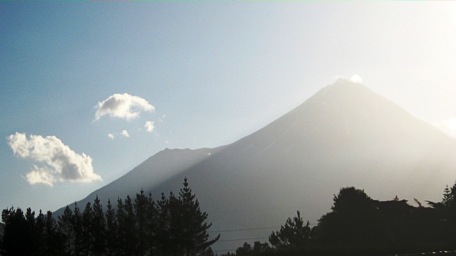
Images and Story by Sandshoe
I was visiting within clear sight of Mt Taranaki and the closest township to there is Inglewood, the regional centre Mt Plymouth.
One version of Maori history claims Te Maunga o Taranaki (Mount Taranaki) once lived in the centre of New Zealand’s North Island with the mountain gods: Tongariro, Ruapehu and Ngauruhoe.
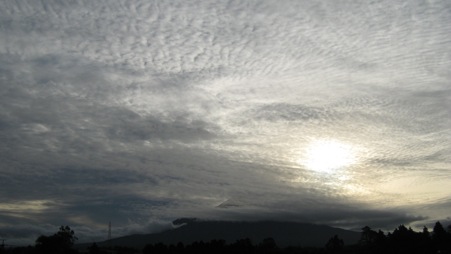
Pihanga, another mountain, is incriminated at this other location, called ‘a lovely maid’ who was desirable to all the mountain gods.
A great conflict arose with geophysical consequences.
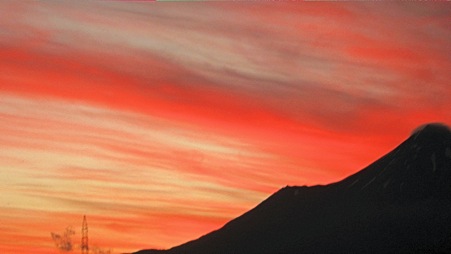

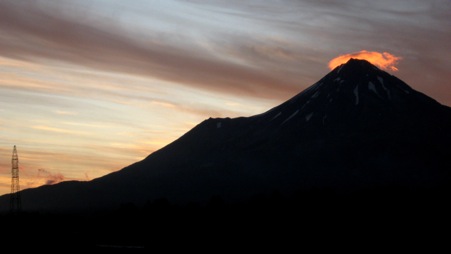
The face of the earth was pretty well re-arranged and changed.
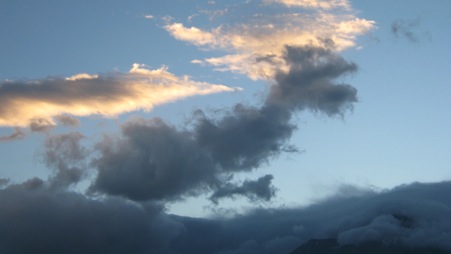
There be dragons. Watch a dynamic skyline day and night and the centricity to culture of mythological creatures that appear in transitional forms. I knew of the taniwha from previous experience living in New Zealand where its importance as a powerful element to maintain order is paramount in children’s literature and written in the history of the British invaders who were told of of places of its alleged presence by Maoris exploiting superstition.
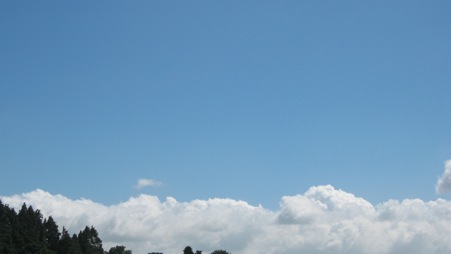 I became childish and disingenuous intellectual texts had ever been published in my excitement observing these beasts and faces of leering gods as if they were entirely a matter of my new discovery.

Pihanga gathers her mists and veils around her and I observed that occurs in many forms. Taranaki is veiled and weeps.

Taranaki is cast as masculine gender.
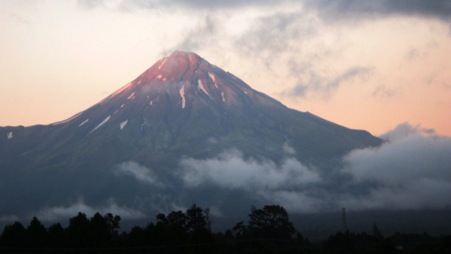
Taranaki seems all things rather than an imagined monotheme and masculine.

Taranaki, a living god but the mountain as a natural phenomenon of geoscience has been made by subsequent explosions each separated by many years, but a great upheaval that fell into itself and caused a depression before it rose again on its momentum. I looked out to the saucer-like rim caused at its surround when I walked across farmland made available to my use and to not be conscious of the living god, Taranaki, is to be unaware.

The story of the mountain is displayed in the museum in New Plymouth, Puke Ariki, where nothing else was I found other than the local dilemma of the Occupation. The attempt by the British to degrade the Maori and Maori history is its story.

Around this corner of Marsland Hill once a British garrison I have walked to by a bitumen road, now descending in the footsteps of the redcoats I eerily recognise, I find Charles Brown, mentor and friend of Keats laid to rest in this perfect place.
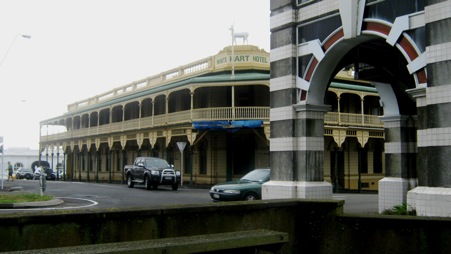
New Plymouth was once gated. The view of the White Hart Hotel is taken from the base of the New Plymouth clock tower.
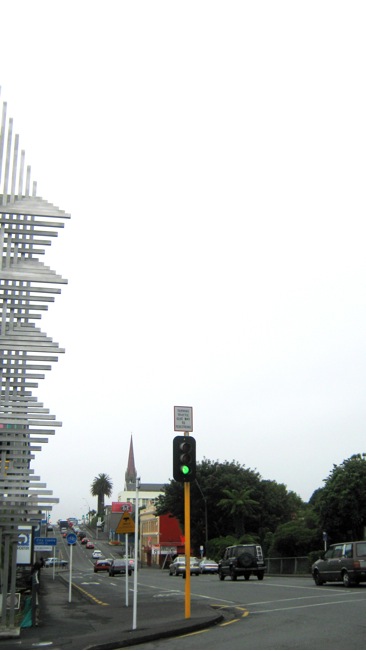
I visit places, see sculptures New Plymouth seems practised at installing as if possessed of infinite will to display sculpture or perhaps the environment with its blue sea not far from any point is ideal.

The façade of the City Council is magnificent stainless steel.
I return to where I was living to reach again to the mountain. It was hard to concentrate on anything in its vicinity, but the interrelationship of clouds and light through them and on the peak of the cone that begs the story of a dramatic yearning for unity and rejection. The lyrical balletic dancing of clouds that scud and their shade come from the mountain; it governs weather.
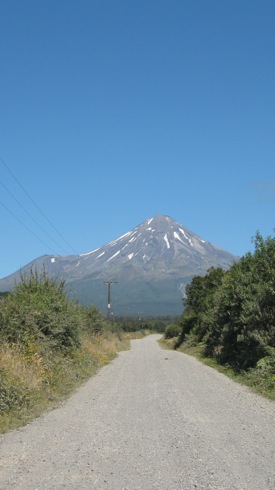
A blue sky and a hot day and I went walking to the mountain.

This dinner trout seems fierce, menacing. It was fished from the stream that sourced in Mount Taranaki flowed through the property where I stayed.

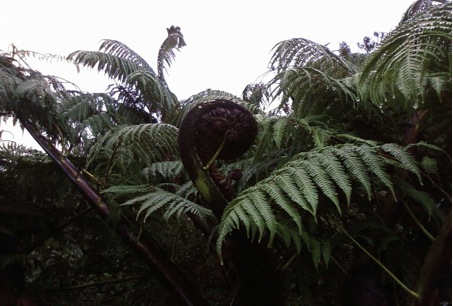
I photographed on a day Taranaki was crying creeks with dark places I could look into over their bridges and coils of the great fern, the cyathea dealbata, the ponga; it is the silver fern in pockets of sunshine and its full shine that causes a characteristic shimmer of silver in roadside verges and fields it has hold over. Everywhere I look I see Taranaki, the living god of an ancient regime of story telling.
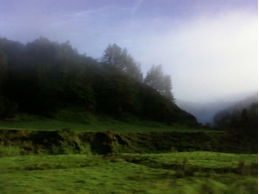
I saw the foregoing image through the window on my way from New Plymouth to Auckland on an early morning bus. The bus slowed to accommodate traffic and the corridor of the mist – as I saw it – was Pihanga whose presence between the mountains of Taranaki and Tongariro is still said to dissuade people from the locale lest the rumble start up between these jealous and aggrieved suitors.
I supposed conflict between the environment and dairy farming.
 Window Dresser's Arms, Pig & Whistle