• The Pig’s Arms
  • About
  • The Dump

Window Dresser's Arms, Pig & Whistle

~ The Home Pub of the Famous Pink Drinks and Trotter's Ale

Window Dresser's Arms, Pig & Whistle

Tag Archives: Runt

16 Mongrel and the Runt

30 Sunday Dec 2018

Posted by Therese Trouserzoff in Warrigal Mirriyuula

≈ 19 Comments

Tags

Butterfly Cakes, Molong, Mongrel, Runt, Victa

Just Another Weekend in Molong

Story by Warrigal Mirriyuula

Harry was in the shop holding the fort for Saturday morning while Porky did the deliveries in the little Anglia van. The Runt, in the passenger seat, paws up on the dash, was eagerly enjoying the adventure. Of course he never went further than the front gate while Porky dropped off the customers’ meat, anxiously circling and sniffing, awaiting Porky’s return and the resumption of the drive. 

Back at Shields Lane, Algy’s head was feeling much better and his vision had cleared. He hadn’t had a headache for a few days and, although the stitches itched like the dickens, he felt he was well on the mend. Mongrel had been by his side all week and Algy had begun to feel like the dog was a real friend.    

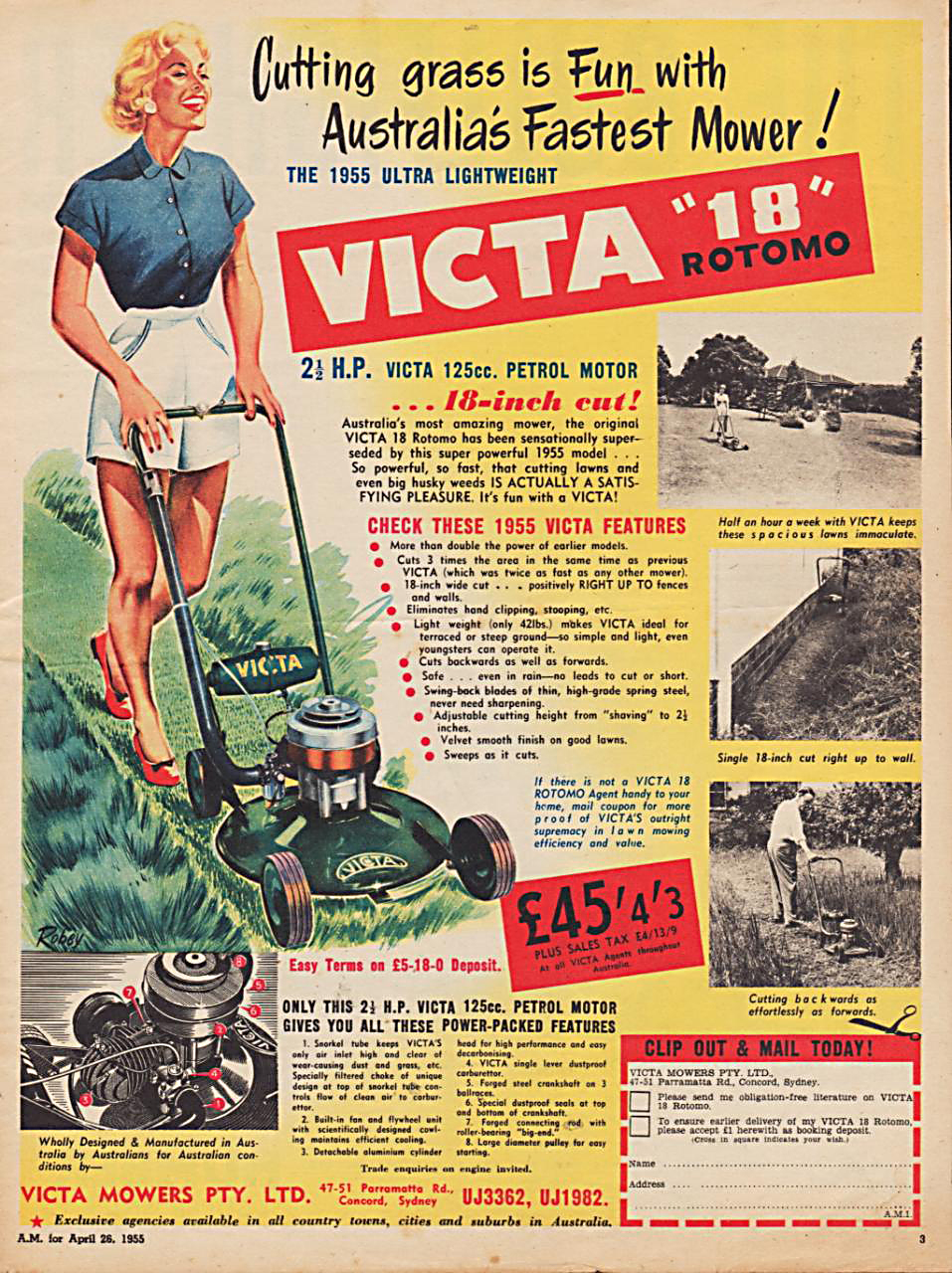
Having done his Saturday jobs and helped out at The Pantheon during the lunch trade, young George Cassimatty proudly pulled his Dad’s new Victa Rotomo out of the shed. It was brand new, all shiny green with a big silver “VICTA” on the red boomerang badge, and his dad had said he was only letting young George use it after he’d been taught all about its safe operation.  

It was pretty easy really. You just turned the petrol on, pulled the choke out, put the knotted end of the rope in the hole, wound the rope around the crank wheel and pulled. Simple really, and the only bit George took away from the lesson, as he pushed the mower around to Mrs Bell’s house, was his father’s stern warning. “Keep your feet away from the back of it. This thing‘ll have your toes off in a trice.”

Hearing this Yaya had said the mower was the work of the devil and warned young George that taking the easy way was the beginning of a slippery slope. He should take the old push mower. It would make a man of him.

“Yaya, this is the future.” George’s father said, so very proud of his new mower, and so very proud of his son, “George is going to be that future, he’s got to learn some time.”

Yaya remained unimpressed and while mother and son worked out their differences in the usual Greek way, George had set off for Mrs. Bell’s house to cut her grass and maybe have some more of those lime iced butterfly cakes.

After a rushed greeting from Mrs. Bell, who had said that she had forgotten that young George was coming, George set to the task at hand, making sure he kept his feet well back. 

He’d thought it a little odd that Mrs Bell hadn’t invited him in, but he hadn’t thought much more about it until he was raking up the grass clippings and barrowing them down to spread under the nectarine tree by the school fence. He stopped to wipe his brow and had looked back up to the house. He was surprised to see one of the lace curtains in the sleep-out suddenly pulled closed. The mystery had deepened a little when George, having finished, knocked on the back door. Maybe now Mrs. B would offer the lime iced butterfly cakes.

Instead she had stopped in the doorway, hurriedly thanked him and pressed a shilling into his hand. George had protested, saying he hadn’t done it for the money, but Mrs. Bell wouldn’t hear of it. If George didn’t want the shilling he should donate it to a worthy cause or put it in the plate on Sunday, but she was going to pay him for his work. Mrs. Bell was adamant that she was not a charity case.

George reluctantly accepted that donation was a good idea and left off trying to give the shilling back. His dad was always saying, “If you’ve a spare ‘bob’ or two in your pocket and can help somebody in need, do it.” But George would have preferred the butterfly cakes. 

Perhaps sensing George’s disappointment, Mrs. Bell promised cakes and cordial next time. She just couldn’t manage it today. George thought she sounded a little disappointed too. She was a likeable old stick when all was said and done. George thanked Mrs. Bell and asked her to say g’day to Tinker for him, he’d be back in a few weeks.

As he was pushing the mower up the side of the house George would have sworn he heard Mrs Bell inside, talking with someone, another old lady it sounded like; and though he couldn’t make out what they were saying, it sounded urgent and intimate, the way George’s parents sometimes sounded when the house had gone quiet and they thought they were the only ones awake. George always found his parent’s murmuring reassuring at home, but here, today, in the bright Saturday sunshine, this just sounded mysterious.

Who did Mrs Bell have with her? And why had she not wanted George to see her?

By the time George got the mower home, cleaned off the matted grass, paying special attention to the white walls on the wheels, and was giving the machine a quick rub down with light mineral oil like his dad had said, the mystery was all but forgotten, evaporating away with the 2 stroke fumes and the smell of mashed grass. George had more pressing concerns. He and a mate were going yabbying down on Molong Creek.

It was a quiet afternoon at The Telegraph, just a few punters in. Clarrie was catching up on the news in The Sydney Morning Herald, its broad sheets spread out across the bar. The ABC was broadcasting the Sheffield Shield from Adelaide Oval, the Crow Eaters versus the Sandgropers. The smart money was on WA to win, but SA’s slow left armer, Johnny Wilson, looked dangerous. A casual game of darts started up and every now and then Clarrie had to pull the odd schooner for one of the patrons. 

Beryl and Jenny were upstairs in the flat enjoying some mother and daughter time together, doing sewing repairs on the dining room linen and gossiping. Little Bill had taken off with Porky to the baths for his first swimming lesson. 

When Porky had called to pick him up, young Bill proudly told his Mum he was going to swim in the Olympics and bring her home a gold medal. Beryl and Porky had to laugh at the little bloke’s earnest conviction. Little Bill didn’t like them laughing at him and, putting his tiny fists on his hips, said, “You see if I don’t!”

Porky, deciding that having a big dream wasn’t such a bad thing, got down on his haunches and said to Bill, “Well little mate, first you’re gonna have to float before ya can swim, so whaddaya say? Let’s get cracking.”

It was like any other Saturday on Bank Street. The morning had been busy with shoppers, the street parked out with farm utes, most with a dog in the back; and the locals’ sedans, a few of which also had dogs on the rear parcel shelf. Not real dogs of course, the nodding kind. Not much of a guard dog but certainly able to nod an affirmative to anybody following behind, though what they were affirming would forever remain a mystery. 

Round at Terry Perks’ garage the big AMPOL tanker was pumping fresh fuel into the underground tanks. Terry’s Rottweiler Ronnie was making up to the driver, playing feint and hide round the trucks rear dual bogie, barking his silly head off. Just another Saturday.

As the sun reached over into the west Bank street cleared of cars, excepting the clusters round The Telegraph and The Freemasons, the occasional customer at Hang Seng’s. The day wained quietly, peacefully.

In a small country town there are few rules and regulations. Most everybody knows everybody else, who’s up who and who hasn’t paid, and its just courtesy to keep out of other people’s business.

There are homes, and institutions, businesses and services that are the machine of the town, the mechanism whereby the town supports itself and grows into the future and they represent what the people are, what they do and how they feel about life every day. 

There are also a few places in every town that are different. They represent the hopes of the town and how the people feel about themselves, their families and friends and the future. These are special places, approached with a kind of reverence, or what passes for it in a country town.

These are the places where the entire town comes together to speak and act as one, to seek inclusion and identification, create consensus and the sense of belonging to a place; and it’s fair to say these places represent the heart and soul of the town. 

Molong was no exception to this apparent rule. The town was proud of its churches and its faith, it supported its schools and hospital and while the council chamber was often in heated uproar, none the less the people believed in their local institutions. 

But perhaps there is no more defining place, no more important venue for determining how a town looks to the future, than its sporting facilities and the membership of the community sporting clubs that use those facilities. 

Even in the midst of drought water will be found for the cricket pitch, when wool and wheat prices are low and club coffers are empty, the town will still reach into its already depleted pockets.

So it was that after church on Sunday morning the focus in Molong turned to the Memorial Grounds for the continuing titanic battle between The Molong Cricket Club, known locally and without a hint of irony as the MCC, and their closest rivals in the local competition, The Bushrangers from Canowindra. Ben Hall would have been proud of the Canowindra team. They played like outlaws and were never more daring than during their attempts to bail up Molong.

The sides were pretty evenly matched and both teams saw their encounters as being outside the normal run of the competition, more like slanging and sledging matches really, and that always guaranteed a big turn out of locals.

Algy and Harry had used the Anglia van to transport the barbecue over to the oval and then got all the kids, who were always keen to be involved, collecting up the fallen wood from under the trees. By about 10:30 the sticks were crackling and the hot plate smoking as Harry did a bit of last minute butchery and enjoyed a weak shandy. Harry wasn’t a drinker.

The players were out on the field for the toss. Up went the Florin, glinting in the sun, arced over and fell to the ground. It was Molong’s call and they had elected to bat. 

More people were gathering now, the early arrivers snatching the best shady spots and setting themselves up for a good day of cricket.

The Bushrangers got their field sorted as Algy and Chook took to the crease, padded and gloved. The Umpire gave the nod and the game commenced.

The pride of Canowindra’s quicks loped in for the first delivery of Molong’s innings. It had all the speed and intimidation he could put into it.  The ball flew from his hand and he had trouble keeping his balance without falling flat on the pitch, his flailing recovery not distracting Porky though, even for a moment. 

Porky’s eye never left the ball and in the fraction of a second it took to arrive, Porky had smoothly stepped forward, tipped onto the back foot and walloped a masterful pull shot away over behind deep square leg; it was all speed and air, away for a six. The clapping started even before the ball skidded onto the grass just the other side of the boundary rope. 

It was the beginning of a great innings for Porky and, feeling a bit cocky, he acknowledged the crowd with a twist of his lofted bat. Even a couple of the Canowindra blokes in the outfield joined the applause. 

At the non-striker’s end, Chook threw his head back and laughed, thinking Porky just a little full of himself. Looking over at the Molong supporters lounging in the shade round the pavilion, Chook pointed at Porky as if to say, “Did you see that?” and shaking his head, he wondered if he could do as well against his first delivery. 

He soon had his chance to find out. Porky had blocked a short delivery away for a quick single.

Chook’s first shot, a low sweeper, lacked the athletic brilliance of Porky’s six but it had a certain homely shine on it and looked like it might go for four.

The ball was running away to the boundary at Deep Third Man, chased by two determined Canowindra fieldsmen. Mongrel jumped up from beside Algy and went after it too, like his life depended on it; The Runt, jumping out from under Harry’s empty deck chair, set off in hot pursuit. He couldn’t match Mongrel’s speed but he gave it his best.

The Canowindra fieldsman, running from Deep Cover, got to the ball first, diving for it as it neared the rope. He just managed to stop the four but couldn’t get up and return the ball before Porky and Chook had run three, getting Chook on the board.

There was some desultory applause from the crowd and Mongrel and The Runt joined in, directing some canine sledging, a quick mouthful of happy snappy barking, at the Canowindra fieldsman who’d stopped the ball. He turned and barked back at the dogs, sitting a surprised Mongrel on his bum, but setting The Runt off yapping and growling. The fieldsman laughed at the little dog and that just seemed to make it worse. Mongrel, perhaps enduring the dog equivalent of embarrassment, stood up and shook himself off. 

He barked at the fieldsman’s back, just one bark, pitched somewhere between anger and uncertainty, before returning to the pavilion and Algy via the outfield, The Runt trotting beside him with the occasional growling look back.

As Porky’s and Chook’s opening partnership beat the bowlers and rolled inexorably over the Canowindra fieldsmen, the discussion round the keg under the trees turned to the story of the week, the dead bloke found out at MacGuire’s last Monday. 

As will happen when these matters crop up in a small country town, the bush telegraph had somewhat embellished the tale and by the time discussion under the trees began in earnest it ranged from an outrageously overblown tale of neo Nazi’s dealing with one of their own, to a huge sheep duffing conspiracy that encompassed the entire Central West. 

It was supposed that the neo Nazi theory was based, in some small part at least, on the simple fact that Gruber had become involved. It was completely implausible, “I mean, sure, Gruber’s German, but an abo Nazi…? Nahhhh!” It was just unbelievable and was peremptorily dismissed as the product of an over fertile imagination. Sheep duffing however was much more plausible, even likely; particularly with the rain green pastures filling up with spring lambs gambolling the days away. “They’re just there for the taking.”

Chook’s innings came to an end, caught behind for 36. There was no shame in that as Chook walked off and joined the rest of the team around the pavilion. The new batsman, Jimmy Hang Seng, joined Porky in the middle. 

“Look out, its Foo Manchu!” sledged a Bushranger, but Jimmy just smiled and gave him the two finger salute. Within a few deliveries he had settled in and he and Porky continued slamming the Bushrangers.

Off field, discussions around the dead man had reached a kind of impasse with proponents of differing theories unable to proceed without further information. Two delegates from the main theoretical teams were chosen and they made their way over to Chook. They wanted the guts and Chook was the only one with the knowledge. The Express had a Front Page Special planned for Monday, so for the time being it had been gossip and confabulation. Only Chook had what they needed.

The two delegates surreptitiously gestured for Chook to join them around the side of the pavilion. These were matters best discussed under cover.

Chook joined them with a look of enquiry, “What’s up? You blokes look like a coupla B Grade film villains, lurking for no good purpose.”

“Yeah, well, this dead bloke.” It was one of the men who worked at the limestone quarry on the ridge at the back of the town. Not usually one to let on that he wasn’t fully clued in to everything that was going on about; his left eye, which had a flickering tick when he was stressed, confirmed the importance of their purpose today. 

“What’s the guts Chook? “What’s it all about mate. I mean, we hear that this bloke’s dead and there’s somethin’ hooky about the thing, and what about the wives? Are they safe? I mean, Chook, it’s a public safety thing see?”

“Oorrr, calm down pally!” Chook had to smile at the two of them. They’d obviously blown the thing up and now Chook had to administer the pin to burst their bubble. “I can’t tell you anything. Its an ongoing enquiry; an’ anyway, if you can wait until t’morra The Express has got all that I could tell ya. But I will say this. The wives and daughters are perfectly safe. We’re all perfectly safe. The incident seems to have nothing to do with anything here in town.”

“Somebody said the stiff was an abo. That right…?

Chook snorted with irritation, then shook his head. “The Express, tomorrow. That’s all I can say, really.” He gave them his copper’s stern look. Somewhat taken aback they turned and ambled off, muttering to one another; the quarry worker looking back at Chook briefly, uncertainly. 

Chook turned to rejoin the rest of the team lounging around the front of the pavilion. As he did so he spied someone sitting on a chair in the deep shade of the trees way over on the eastern side of the oval. Chook felt a twinge of uncomfortable unconscious curiosity and looked more closely. He couldn’t quite make out the person, or the scene, so deep was the shade. He tried to  clear his vision, shading his eyes with his hand; and then he recognised who it was, and the easel, and the box of pens and brushes. 

Chook just lost it again. It was Miss Hynde from The Pines, and while Chook had certainly spent the early part of the week unable to get her out of his mind, he had managed to keep the insistent memories of his brief visit last Monday evening to a minimum for the last couple of days; and now here she was again and Chook was just as discombobulated as he has been at their first meeting. He goosebumped remembering the gentle grip of her hand on his forearm as he had departed the glowing cottage. He saw again the two lithe statuettes and the screaming man in her shed, and the way she had smiled at him. Full of knowing. Deep down inside of himself he knew she knew who he was, probably better than he knew himself. Well, maybe not; but she knew something.

Chook walked a few awkward steps in Miss Hynde’s direction, then suddenly lowered and shook his head, turning back, and then turning back again to look over to the shade under the trees. A few of his mates were watching him. They could see that he was distracted, confused, maybe even distressed….

“You right Chook?” one asked in a tone that implied that whatever was going through Chook’s mind, it must be foolishness. Chook had a reputation as a rock, not easily displaced.

Chook snapped back to look at the bloke. “Yeah….., yeah I’m orright. I just…., look, yeah look….,I’ll be back in a bit. I just gotta go over ……, back soon….”

As the blokes looked at one another shrugging, Chook made off around the oval fence in the direction of Miss Hynde; each step increased his uncertainty as surely as each step found him more ridiculously happy. Chook had it in mind to tell Miss Hynde exactly what she did to him. 

13. Mongrel and The Runt

03 Saturday Sep 2011

Posted by Mark in Warrigal Mirriyuula

≈ 27 Comments

Tags

fiction, Mongrel, Runt, Warrigal

13 Mongrel and The Runt by Warrigal Mirriyuula

Chook went to see MacGuire as evening fell, but found him absent on a business trip to Sydney. He wouldn’t be back for a few days.

His wife mentioned that Bagley had told her of the loss of the prize Merino rams. Chook asked her to ask her husband to call the station as soon as possible. Mrs. MacGuire, ever the charming hostess, had offered Chook tea, but he’d declined, siting pressure of work and many a mile to travel before the night was through.

Mrs. MacGuire thought this a little cryptic, but she wished Chook the best of fortune with the investigation. He was leaving when he paused on the verandah steps. He turned, Mrs. Macguire was standing in the verandah light.

“What do you think of Bagley? Chook asked directly.

At first she seemed somewhat taken aback. “Well, I don’t know. I don’t really have much to do with the man. He’s my husband’s creature.” She pulled her cardigan tighter around her and twisted, just slightly, adding, “My husband does rely on him a good deal.”

She paused as if deciding whether to go further.

“Actually, the truth is I don’t like him much.” She pronounced with a pout. “In fact I don’t see much to like. He seems filled with anger and belligerence. I try to have as little as possible to do with the man. His wife is sweet though, in a heavily put upon sort of way.” Mrs. MacGuire paused again, then added in a low conspiratorial tone, “I don’t think she likes him much either.” Nodding to confirm the powerful truth of this last opinion.

“Mmmmm,” was all Chook said. He turned and left Mrs. MacGuire standing in the porch light watching him go. He was halfway to the gate before the light went out.

His next call was on Miss Hynde at The Pines. The visit was more out of curiousity than a need to cross all the “t”’s and dot all the “i”’s on the incident report. The old bird was often gossiped about in Molong but she was seldom seen. Indeed Chook had never laid eyes on her, but she was known around town as “that crazy artist lady”. She was known for having strong opinions and offering them at the drop of a hat. She argued with men, often besting them, and lived by herself in a world of dottery weirdness, painting pictures and sculpting objects more at home in a mental institute, or so the local legend went.

When Chook pulled up out side the picket fence surrounding the little white weatherboard cottage it was getting on for full dark. All the verandah lights were on, as were all the interior lights as far as Chook could tell.

The place was aglow again, just as it had been this afternoon when Chook had first laid eyes on it. The glow gave Chook a warm welcoming feeling. She couldn’t be that hard to get along with.

Then there she was, suddenly striding down the path, her long grey hair falling out as she pulled away a scarf. She shook her head and scratched through the tangled hair.

“Police ey?” she challenged, but Chook was just gobsmacked.

“What do you want with the mad woman of Molong Sergeant?” She was carrying a number of big brushes, wiping them with an oily cloth. “Come on man,” She slid the brushes in the hip pocket of the spattered bib and braces she was wearing, “spit it out!”

“Ah, Miss Hynde? I, ah, um,…” Chook just couldn’t get back to an even keel.

“My god man! We’ll all be murdered in our bed’s if you’re our protection.”

She smiled, amused by Chook’s discomforture.

“Yes I’m Miss Hynde, though why the yokels insist on the “Miss” is a continuing mystery to me,” She openly appraised Chook like a stud master might look over a stallion, “And you’re the local plod, so I imagine at some point you’ll be able to form a coherent question, hmm?”

Chook finally pulled himself together to ask, a little too formally, like a boy might play a policeman in a school play, “I need to talk to you about the fire you reported on MacGuire’s place.”

“Yes, I’d already worked that out Sergeant.” She gave him a smile that sent a shiver of dread and at the same time a thrill of excitement through him. He fervently hoped none of this was intelligible to her.

“Come on…” She grabbed Chook by the arm using both hands to hang onto his bicep. She pulled in close and dragged him up the path. There was an urgency and an intimacy in her grip that just added to Chook’s confusion. “What a funny fellow you are.” She said with a lilt in her voice as though she was encouraging a reluctant child to accept a fundamental change.

Chook silently allowed himself to be dragged into the chaos and confusion of the cottage. In his current state he fitted right in.

Miss Hynde wasn’t a mad old lady at all. In fact Chook wouldn’t have put her past about thirty, thirty five tops, and maybe that was just because of her thick, wild, salt and pepper grey hair, and her face had both such strength and beauty, her eyes penetrating, dark and knowing.

Chook was all at sea, from the moment he entered the house with her. Just when he thought he had himself under control she would smile at him, or ask a perspicacious question regarding some as yet unconsidered aspect of the fire, or she would just look at him, almost daring him to be himself in front of her. He thought. Perhaps.

She had no other helpful information about the fire other than that which was already contained in the report he’d had from the fireys, but it still didn’t occur to Chook that he might leave her, there in the glowing cottage in the pines.

He realised he had been waiting for a kind of permission, like a note from a senior officer, something. She made him feel so not himself, there in her glowing house surrounded by things that just made Chook’s brain spin; confronting paintings of sides of beef, mixed with what looked like aboriginal designs; the dead meat oddly full of colour and life; plaster and bronze sculptures of tortured, animalistic things that none the less appeared full of potential, as though they might suddenly explode, shattering the cottage.

Then Chook saw two small lithe bronzes of a naked woman in impossible poses. He couldn’t take his eyes of them. It dawned on him that they were of her, Miss Hynde; younger, but the face was unmistakable.

“These..,” his hand flapped at the sculptures, “They’re of…., that’s to say, they’re… you….” Chook tried to say how much he appreciated the two sculptures but couldn’t work out a form of words that didn’t make him sound like a simpleton making some boorish observation about her nudity.

He knew nothing of art but Chook knew he liked the artist, he felt the power of her work slowly unmanning him. He smiled boyishly at her, and she laughed unselfconsciously back and grabbed him.

She has mistaken my confusion for intelligent interest he thought, as she dragged him, again, out the back to the converted shed she used as her foundry, there to reveal with a stagey flourish from beneath a stained dust cloth, a huge bronze statue of a man anchored at the hips to the stony ground, his burnished torso a twisted exposition of human anatomy in tension, the head thrown back, mouth at full gape as if screaming, the arms were upraised to the rough rafters of the shed, the fingers both pointing in righteous accusation and pleading in humility. Chook had thought it simply awesome; his mind was stunned; and she had imagined and realised all of this.

“I call it “Terra Nullius”.” She said matter of factly.

Did he actually black out? He thought not, but he couldn’t remember how exactly, but she must have walked him to the ute at some point. He didn’t really come back to earth until he found himself turning the key in the ignition. He rested his arm out the window, she softly placed both her hands on the bare skin of his forearm. Gripping him lightly and crinkling her nose, she said, “You’ll work it out,” she paused, kissed him softly through the open window, “You must come again.”

She had then smiled sweetly, an unexpected softness she had not shown before, that sent him tumbling again. She turned and walked briskly back into the house.

It was too much. Chook had never met a woman like her. In fact he would have denied that women might behave this way, until a few minutes ago that is. Now he couldn’t understand why all women didn’t think that way, behave that way, be that way; but it was still all too much.

Chook shook is head, his face still immobile as his mind raced on the subject of Miss Hynde.

He hadn’t got her Christian name.

“Shit Chook, pull yourself together!” he said aloud to himself as he put the ute into gear and set off to see Bagley. He probably should have gone earlier, but Bagley was such a pain that Chook had simply put it off, and now he wondered if he was in any fit state to hold up against the fusillade of withering abuse that was Bagley’s usual style.

Miss Hynde had rattled him he realised, but his policeman’s pride, indeed his manly pride, would not allow that he’d had his heart bushwacked, his mind turned over like a Spring sod, and the deed and title to all that was Chook was already on its way to its new owner.

“That way madness lies.” Chook found himself unexpectedly remembering his schoolboy Lear, “No more of that.”

Old Jack Enderby would be proud after all these years. But then it occurred to Chook that the quote mightn’t be “ap-po-site”. He chuckled happily. That was another of old Enderby’s words, kept for special occasions; occasions that were “ap-po-site”, Chook chuckled.

As Chook turned off the main drive to the MacGuire homestead, Bagley’s cottage ahead, caught in the swinging headlamps, he steeled himself for what he imagined would come; but Chook wouldn’t let the bastard get the better of him tonight. In fact, disregarding the maddening siren song of Miss Hynde, Chook was feeling pretty good. He was filled with a light-hearted confidence he realised. He felt younger, that was it. He was fit for it. He just wouldn’t let Bagley get up his nose.

The house was in darkness. One of the dogs chained up at the side set off barking as Chook got out of the ute and walked up onto the verandah. The house was silent.

Chook knocked heavily. At first there was no reply, then he heard movement. A light went on inside, then the verandah light. Chook heard Bagley say from inside, “So ya back, I knew you….,” then the door opened and Bagley saw it was Chook.

Bagley didn’t finish. He seemed disappointed and just said, “Oh its you Fowler. Well you better come in; and wipe ya bloody boots man.” Bagley was ever the most reluctant host

Chook didn’t discover what it was that Bagley thought he knew, or who he thought had come back; but it was obvious Bagley was in a foul mood.

From there the encounter had gone as expected. Chook’s upbeat manner had harried and harassed Bagley’s abusive assault until Bagley had simply been sullenly silenced. Not that Bagley had provided any information of any substance. He seemed, just as earlier, only concerned with the sheep and their value, and the insurance report. He seemed very concerned with the insurance report.

Except to deny any knowledge of the body, he didn’t mention it at all throughout the interview, which was conducted by Bagley with a terse uncooperative economy that Chook at last interpreted as founded in an almost complete distraction. Bagley’s mind was somewhere else entirely. He gave the impression that if Chook simply disappeared in front of him, it wouldn’t have happened soon enough.

“Is Mrs. Bagley home? I’d like to speak to her too please.”

“Well you can’t. She’s not here.” Bagley paused to lick his lips nervously. “She’s gone to her sister’s to stay for a few days.”

It was obvious to Chook that this fragment of information was a lie and it had cost Bagley dearly to utter it. He was now openly enraged, barely able to contain his anger.

Chook had all he needed and it seemed all he was going to get at this time. He warned Bagley again about not going near the ruin. It was still a crime scene until Chook said otherwise. Bagley issued the same belligerent statement in response; that he would do whatever, go where ever was necessary, but Chook had stopped listening. He just turned and walked out on the still blustering Bagley.

Chook drove home and poured himself a whiskey before sinking in his favourite chair. He was weary but still felt all abuzz after the evening’s events, and now that his time was his own again, his mind slowing a little, he found that pleasant buzz tuning back to Miss Hynde and her paintings and sculptures, and her knowing, and her hands on his arm…..

She was on his mind again as Chook jounced the Police ute over the cattle grate into the station yard next morning.

He’d stayed long enough out at the scene to see the body removed and to ensure that all the evidence he and Inspector Beauzeville thought pertinent was recorded, photographed and put into the coroner’s vehicle for transport to Orange.

Young Molloy had had a long sleepless night and was glad to be shot of guarding the dead body.

“It’s bloody creapy,” he’d told Chook, “several times I thought I’d heard something, but it never turned out to be anything. Well I don’t think it was anything.” He added with a tone of qualification that showed the depth of his uncertainty.

Chook had noted the uncertainty, then sent him home, but the lad had stayed to the bitter end, claiming it was good experience for him. Chook thought it more likely he was just curious. It was the young probationer’s first dead body. He was a bright lad and Chook thought he’d go far in the force.

It’d been Molloy’s suggestion that somehow the sheep and the body were more connected than just being in the same fire, and that the carcasses shouldn’t be burned, but rather, kept on ice as part of the evidence haul. They were after all, supposed to be blue ribbon beasts, all four of them each worth more than a car.

They didn’t look like much now, but Molloy’s contention seemed to ring true to Chook. Beauzeville had agreed, bringing a satisfied smile to young Molloy’s face, and the remains of the sheep had been carefully separated, individually bagged and put on ice.

Back at the station Chook called the veterinary pathologist at The Department of Agriculture in Orange, letting him know that the four carcasses were on their way to him for examination and analysis. He ordered the full array of tests and asked the pathologist if there was any way that he could prove the dead sheep were the animals Bagley claimed were missing from MacGuire’s flock. The pathologist offered his best efforts but couldn’t guarantee an outcome.

Hanging up the phone and settling down with his cuppa, Chook pushed his chair back and put his still muddy boots up on the desk, taking a long slow slurp on his tea.

It was time for a little more reflection.


—oo000oo—

When Algy awoke in the unfamiliar surroundings of the bedroom in Shields Lane he found himself confused and it took a moment for him to get oriented as to where he was and what he was doing there. His little Europa travelling clock showed 10:15. Algy hadn’t slept this late in a long while.

He vaguely remembered Porky helping him up off the couch after last night’s long talk. He’d gone to sleep with a spinning headache, which had woken him again in the small hours. He’d scrabbled around in the dark for a couple of the pills Doctor Wardell had given him and after that it was just oblivion.

There was a cold mug of tea on the bedside table, and a note:

“Make yourself at home. If you need anything Porky and me are at the shop.”

Algy pulled himself out of bed and sat on the edge of the mattress. He’d slept in his underwear. In the last few months he’d often slept in his clothes, but never in his underwear. His mother would “tut”, but Algy found a new kind of freedom in the notion of going to bed in his underwear. Maybe in summer he wouldn’t wear anything at all.

He casually pulled on a pair of pants and a shirt. He didn’t bother to button up, and as he made his way to the toilet his shirt flapped in the spring breeze blowing through the house.

While taking a pee Algy looked out the small open toilet window and was struck by the ordered regularity of Harry’s vegetable patch; the stakes and strings in straight rows, the hose wound onto a rusty old spoked wheel. Harry was a real “doer” alright, and Algy, from his vantage point over the loo, could now confirm Porky’s Fairbridge aphorism from last night. The grass always grows greener over the septic tank.

Flushing and buttoning up his fly, Algy had a chuckle to himself while he washed his hands.

He went into the kitchen to make a cuppa.

Gripping the enamel mug with both hands, Algy took a long pull on the hot sweet tea and sauntered barefoot down the hall, enjoying the warm morning air blowing gently through the screen door. Pushing it open with his foot, he went outside onto the verandah and sat in the morning sun to finish his tea. The dogs’ bed was abandoned.

Shields Lane was quiet. There was not a soul in sight. A dog barked round the corner on Riddell Street, Magpies were warbling along the side of the house as they hunted in the grass, and far to the east, up high, a Wedgetail was lazily riding a thermal.

The town seemed shrouded in an expectant hush, until, from the direction of Bank Street, Algy heard a bloke shouting instructions to a mate, but he couldn’t make out what about.

He went down to the gate to have a sticky beak.

Resting his mug on the flat top of the gatepost finial, he took a look up and down; there was no one in Shields Lane, it was still deserted; but Algy noticed, framed in the end of the lane to the north, the Town Hall on Bank Street.

At first it seemed like a mild admonishment, the building reminding him of his failure as a dogcatcher. That soon passed as Algy realised that while he had no clear idea about his future, the Town Hall and the responsibilities of the Ordinance Inspector were already rapidly receding into his past. He smiled again at his foolishness and shook his head. It throbbed once or twice to drive the realisation home.

He picked up his tea and went back inside. He’d decided to write a letter to his parents. They’d be worried by his infrequent communication and he had some thinking to do that he always found best pursued in writing rather than on the phone.

Dear Mum and Dad,

I’m sorry I’ve been so tardy in my letters to you both. A few weeks ago I might have said the reason was that I was too busy, too much to do, but the truth is that in a curious way I lost myself shortly after coming here. You were right Dad. It was a decision I didn’t think through. Later today I’m going up to the Town Hall to hand in my resignation.

It was an odd thing as it’s turned out. It’s changed me. Almost as if it was predestined, as though before I was just a character following the text in a rather obvious novel.

Having “run away from home”, when I got to Molong it was as if I placed myself outside the local community, by choice, and then suffered the consequences of that deliberate and unthinking choice. It wasn’t that people were uncaring or unkind. Indeed I’ve discovered in just the last few days that this little village is filled with people of an uncommon compassion and wisdom; a wisdom more profound than any I managed to glean from my studies.

But I’m already getting ahead of myself and I want to tell you both everything. So I’ll start at the beginning and try to include all the salient points.”

“But how to say it.” he pondered aloud. “What are the really salient points?”

Algy stopped, his pen poised above the paper. How could he describe the change when he was uncertain just how far that change had gone?

Just then the spring hinges on the screen door skirled and the next thing, Mongrel came bounding into the living room with Porky and The Runt close behind.

“How are ya mate? Feelin’ any better?” Porky had obviously been sent home to check on the patient.

“Better than I’ve a right to feel. In fact Porky,” Algy tried out his new friend’s name for the first time, “I feel like a new man, as if the world is my oyster.”

“Yeah, w’ll hang on a mo’. I got some steak here f’ ya lunch. Ya gonna need ya strength to open that oyster.” Porky responded as he walked through into the kitchen, amusedly muttering, ”Cracked melon, and the world’s ‘is bloody oyster, ark at ‘im.”

Mongrel had his paws up on Algy’s leg, his great red tongue lolling out panting, his bright eyes looking for any indication from Algy.

“How are you my new friend?” Algy said quietly to the dog. He took Mongrel by the ruff of blue round his neck, giving the dog a scratch and shake. Mongrel was in heaven.

“Did you know that in some societies, if you save a person’s life you become responsible for that person.” Algy looked as earnestly as he could into Mongrel’s eyes. “Are you ready for that responsibility?”

Mongrel barked a happy bark and licked Algy’s forearm. He got down and walked off into the kitchen. Algy followed him.

Porky was already trimming a couple of big chunks of steak and tossing the off cuts to The Runt at his feet, the little dog’s darting eyes never leaving the meat in Porky’s hands. As each tid bit was flipped into the air the little dog jumped and unerringly caught the scrap, then gulped it down. Mongrel showed no interest in the scraps. As usual he stood back from the relationship between The Runt and the man. Besides Mongrel had a man of his own now.

“Is there anything I can help with?” Algy asked, feeling a little like an invalid. “I could make us a salad.”

“Salad…,” Porky shook his head with a big smile on his face. “Y’re a corker Head Case, you really are.” Porky was chuckling to himself again, then, “Nah, don’ worry bout it. I’ll cook us some chips and cut a tomata or two. Salad…” he chuckled and shook his head again. “Ya gotta keep ya strength up.”

Algy sat down by the sideboard and Mongrel lay down beside him. Apparently blokes in Molong don’t eat salad, Algy thought, looking down at Mongrel, who lifted his head and turned it to one side, uncertain as to what Algy meant by the slightly abashed look on his face. Perhaps it was nothing. Mongrel lay his head down again, giving Algy one last look. Algy winked at the dog. Mongrel blinked back.

Porky placed the hunks of trimmed steak on the griddle and they immediately began to sizzle furiously. He went to the icebox and got out some pre-cut potato chips, then a bottle of yellowish oil from a cupboard.

“Nick Cassimatty put me onta this one. Ya don’t fry ya chips in dripping. Ya do ‘em in this.” He held the oil out for Algy to inspect and just as quickly took it back and began to pour a goodly quantity into a shallow pan. “It’s olive oil mate. Makes the best chips, you wait.”

“I can’t wait.” Algy said with a small smirk. “These chips aren’t made from your special potatoes are they? You’d have to agree, you’ve shown an uncommon solicitude towards that sack of spuds. You’re always going out walking together Harry tells me. Apparently it’s quite a sight to see.”

“I’m in training.” Porky said shortly, obviously not wanting to pursue the matter.

“What, to become a King Edward?” Algy gibed with a smile

Porky gave him a quick glance, just to make sure he got the gist of that one.

“Yeah, well you wait,” he said in good humour, “You’ll love these chips. Won’ ‘e Butch?” The little dog was hardly ever out of Porky’s thoughts whenever they were together and it had become his practise to include The Runt in any conversation.

Porky, after tossing a couple of handfuls of chips into the hot olive oil, finished with a flourishing flip of the last scrap of meat to The Runt.

Porky leaned against the kitchen sink and folded his wiry arms, looking straight at Algy. Mongrel lifted his head.

“Billy Martin dropped into the shop th’ smornin’. He reckons you’ve rooted that ute of yours. Apparently y’ve buggered the sump and done some serious damage t’ the suspension.” Porky’s face attained a certain sympathetic sorrowfulness before cracking back to a smile. “Anyway, no worries ‘e says. He can get the parts in an’ fix it up for ya. Take about a week, maybe ten days, he says.”

Algy just nodded, wondering why all these people, strangers really, cared so much about him. He felt a flush of embarrassment come across his face and his eye’s pricked a little. Mongrel was instantly alert to Algy’s mood change.

“Are ya alright mate?” Porky suddenly asked, moving quickly towards Algy. Mongrel was up, alert, his tail stiff.

“No. No, I’m fine, really, I’m fine. I just…” Algy trailed off, uncertain of what he was “just”….. Mongrel nudged Algy’s hand and gave it a lick before slowly settling again.

“Ya sure?” Porky sounded unconvinced and quickly checked the dressing on Algy’s injury as if he might have been able to decipher the problem in the pattern of folds in the bandage. Everything looked all right.

“Y’ ‘ad me worried there for a mo. Ya came over all queer. I thought ya might be ‘bout t’ have a turn there.” Porky shook his head and went back to the stove. “Can’t ‘ave ya fallin’ over on the road to recovery, mate. Harry wouldn’ stand for it.”

Porky attended to the cooking as Algy gave Mongrel’s back a stroke. The Runt, watching Porky cook, occasionally turned to continue his ongoing assessment of this newest member of the pack. Porky seemed to like the man now. Maybe the man was alright. The Runt would wait and see.


14 Mongrel & the Runt – The Dogs of Christmas Part 01

01 Saturday Jan 2011

Posted by Therese Trouserzoff in Warrigal Mirriyuula

≈ 24 Comments

Tags

Mongrel, Runt

The Dog Posse

Story and Digital Mischief by Warrigal Mirriyuula

It was Christmas Week in Molong and the town was buzzing with seasonal activity. There was shopping to do and Christmas preparations for the mothers; gardening, clean up and repair work for the fathers. For the kids it was Christmas holidays and from this end they might as well go on forever. All over town kids were out. They were kicking balls and riding bikes and running wild all over Molong. They were swimming at the baths and hunting for adventure along the creek. There were several impromptu junior test matches on any area of open grass. They were making bows and arrows and going through caps in their little silver guns as if “the West” had never been won; and all the family dogs were out too, joining in all the running, tumbling, boisterous fun.

Any dog owner worth their salt will tell you they enjoy a special kind of relationship with their canine companion. Some invest their friend with wisdom beyond their species and spend their time in conversation with the dog as if it were the font of all wisdom. Still others form a conspiracy with their dog and over time they come to do things with each other that would be impossible for either alone; others just enjoy the fun, the unconditional affection and friendship that is the dog’s stock in trade. Indeed there are as many kinds of relationships as there are dogs and humans to form them. That’s the wonder of dogs.

However not all dogs are lucky enough to form this bond. They have no human companion to care about them and look to their wellbeing. Some are abandoned as pups, or mature dogs, and are forced to survive how they can. Others are cruelly treated and simply run away.

Some find new homes but many of these dogs die. Some of starvation, others of disease; and many die in dog fights, either with more powerful domestic pets, though more likely in the rough and tumble of living the feral life where the rules are completely different to those soft enforcements that characterise the human companion’s life.

However, there are commonalities to all dogs no matter their circumstances. They are pack animals best suited to a hierarchically structured life within that pack. They are highly territorial and will often fight to protect their turf. They are intelligent, cooperative problem solvers not unlike humans and they display courage, compassion and a confounding insight on occasion.

So it was that in the week before Christmas Mongrel was to be found looking out for the big Rottweiler that protected the back yard of Perk’s Motor Garage. He’d been let out of his protection duties because it was Christmas and the Molong kids all loved him; often taking him down to Hunter Caldwell Park for hours of fetch and chasies. The big black and tan hound would belt along until he just couldn’t go any more and then he’d trot off to collapse and cool off in the willow shaded gravel shallows of the creek.

That was where Mongrel found the Rottweiler. Mucking about in the creek with a bunch of kids. They were hunting frogs and the big black dog was very excited, barking and jumping at every sighting.

Mongrel had heard the Rottie as he approached the drop off to the creek terraces behind the baths. Pushing aside some willow fronds, he barked just once and the Rottie turned and responded likewise, before leaving the children to the frog hunt and joining Mongrel up on the bank. They gave one another a quick sniff, more for form really, and then set off back towards town.

The Rottweiler was called “Ronnie”, sometimes “Rotten” and even “Ronnie Rotten” and while his growl and bark could strike fear into any burglar or petty thief, he was essentially a good natured dog with a sense of fun at odds with his threatening bulk. Ronnie also loved children and the kids all loved him.

Ronnie had a good mate called Chester, a red cattle dog who lived with a parcel delivery driver in the caravan park. Chester like most cattle dogs was powerful through the shoulders and body. He had the classic block like cattle dog’s head and a bite on him that could crush bones. His “Duty” was to sit on the open back of the lorry to protect the load when his owner was making a delivery. Chester was also quiet by nature and enjoyed nothing more than snoozing in the sun; unless someone came too near to the open tray. Then Chester was transformed into a slathering foam mouthed zombie dog from hell. He’d bark, bare his fangs and growl; he’d feint towards the trespasser as if to attack, only to pull up just short of the edge of the tray where he’d bark even louder and more ferociously. No one had ever gotten onto the back of the lorry since the day Chester took up his post.

Chester’s human was taking his Christmas break and was down at the Freemasons having a few clean and cleansing ales with his mates, so when Mongrel and Ronnie turned up outside Chester’s caravan there was nothing more to it. Chester joined the posse and the three dogs went in search of number four.

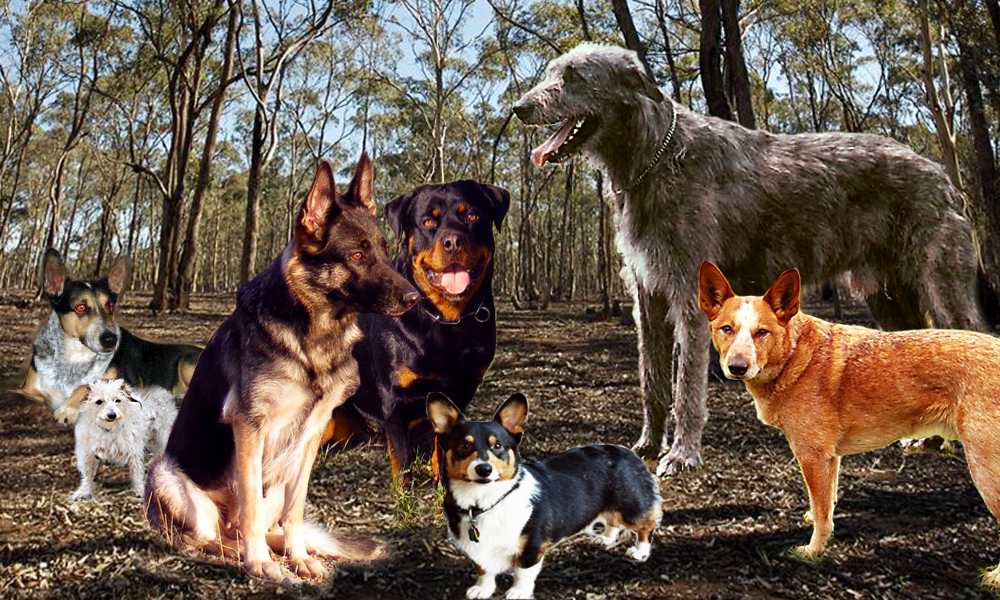
Lorcán Ua Tuathail Cúchulain it said on his pedigree papers but that was too much of a mouthful so even the Gaelic-speaking fathers at St Laurence’s just called the wolfhound Loccy. Like most domestic pedigree pets his conformity to his breed was more a novelty than a necessary utility. It would never have occurred to the good fathers that this tallest of dogs, this noble paragon of graceful speed, breeding and bearing, was a war dog. His kind had once struck mortal fear in the hearts of toughened Roman Legionaries and he was precisely this shape because this was best for chasing down and killing wolves in the eighteenth century wooded fastnesses of western Ireland. It was from there that Loccy’s pedigree could be traced.

But this wasn’t the eighteenth century and this wasn’t Ireland. Loccy was in the garden of the rectory with one of the fathers. The man was gardening in his cassock and a broad straw hat. He was down on his knees getting his hands dirty and Loccy kept close to enjoy all the new smells the turned earth threw up. He could also smell Mrs. Delahunty’s kitchen, which was alive with action and a host of seasonal smells.

There was a lot going on for Loccy at the rectory. Which made it all the more odd when a few minutes later the gardening father looked up to see Loccy sloping off down the drive, apparently to meet up with three other dogs that were just standing in the shadow of the gateway awaiting his approach. The father watched as the wolfhound joined the other dogs. It upset his delicate sensibilities that dogs always had to do that when they greeted one another, and it seemed to go on for altogether too long this time. Strangely though, the priest was pleased to see that Loccy was the biggest dog in the small pack.

As he watched them go he thought, “What can go wrong? He can enjoy himself with his dog mates” He sang out, “See ya Loccy.”


The big dog barked from somewhere down the road.

The butcher shop was officially closed for Christmas and New Year and Porky and Harry were at home wrapping presents. Algernon had gone in to Orange to see Gruber for his final check and all clear. It wasn’t really necessary, the injury had healed completely leaving only the lightning strike scar that seemed always to be threatening Algy’s left eye. The headaches had passed, his vision was again 20/20; but Gruber and the young history scholar had got to know one another and discovered they shared an interest in medieval European history and the poetry of Schiller. The medical appointment gave them a chance for a natter. Algernon would catch the Broken Hill train at East Fork in Orange and be home in time for tea.

The Runt had been hanging around with Porky all morning but then suddenly The Runt stopped dead in his tracks and pricked his ears. Porky couldn’t hear anything and went back to wrapping his present for little Bill, a handsomely featured starter kit of Meccano. Porky was tempted to open the wrapping and get out the colourful metal parts, the chromed machine screws and tools, and make something. He’d never had such things as he grew up at Fairbridge.

When Porky put the wrapped box down and looked around the room The Runt had disappeared. Porky thought nothing of it. Probably just gone looking for Mongrel who’d vanished soon after Algy left for Orange. He’d be back later. Porky went to make himself and Harry a cuppa.

Down town there were now five dogs. King, the big German Shepherd from the Council Depot, had escaped his chain link enclosure and joined the pack. It wasn’t hard. He’d just slipped his collar over his head and climbed up onto the cabin of a conveniently parked truck. From there he leapt over the barbed wire that topped the chain link fence. He came down hard from that height but recovered well and went over to greet the other four dogs. Familiarity restored throughout the growing pack they all headed up Gidley Street, eventually making there way out of town along the Manildra Road.

Along the way the five big dogs were joined by The Runt and a Corgi called Owain. His sweet looks were deceiving. Owain was a made dog and had won prizes back in Wales. When he’d arrived in Molong with his now retired master the locals just laughed at the idea of a Corgi winning “Herd Dog Champion of Champions”. They’d stopped laughing when he’d romped second in the local Sheep Dog Trials. Owain was no foolish lap dog. He wore Glyndwr’s name with pride; this little tricolour Pembroke Corgi was a fighter too.

Now there were seven.

Some time around mid afternoon Paddy Noonan saw an improbable collection of dogs moving through the scrub at the side of the Manildra Road. They appeared to be making their way up to the top of the big limestone ridge to the west of Molong.

Paddy thought no more of it. He was rushing into Molong. He had to see the bloke at the Pastures Protection Board about some sheep he’d lost. He thought they might have been attacked by Dingoes or maybe feral dogs. The carcasses in the back of his ute showed that whatever had attacked these sheep had been intent of doing them damage but the carcasses showed that very little of the animals had been consumed. Paddy thought it was more likely feral dogs. He hadn’t seen a Dingo round here for years and Dingoes were generally better organised with their kills. His sheep looked like they’d been the victims of a frenzied and disorganised attack, then left for dead. It occurred to him that maybe it was the pack he’d seen climbing the ridge but he dismissed that thought almost immediately. It was the sight of Owain and The Runt that put the innocence to their purpose. Small dogs simply couldn’t have inflicted this damage on his sheep. But then Paddy had only seen Owain, The Runt and Chester clearly. The others, the big four, had been spread out following a spore, moving ahead through the scrub.

When Mongrel and The Runt failed to show for tucker at dusk, Harry, Porky and Algy assumed they must be off on one of their adventures. Though both dogs had begun to spend a great deal of time with the men at the house in Shields Lane, it was not unusual for them to come home late and sleep on the verandah where Porky had left a couple of old blankets for them to lie on. Some nights they didn’t come back to Shields Lane at all.

Down at the caravan park Chester’s owner, having come home and found Chester gone, had spent a great deal of time wandering around down town, whistling along the creek and around the railway station, looking for his mate. He’d gone into Jimmy Hang Sing’s place just to ask the customers waiting on their takeaways whether they’d seen Chester. No one had.

Still, Chester was a one-man dog. Nobody would try to take him, not without a whole lot of serious trouble, so his owner wasn’t really concerned. Chester would turn up when he was good and ready. It was just that the man missed his mate. Having a cold beer as the sun went down over the ridge just wasn’t the same without Chester by his side.

King wasn’t missed at all. Most of the blokes from the Council Depot were on “Christmas Time”, skiving off, getting a few drinks in with mates, Christmas shopping, the rest had taken annual leave for the festive season. None of them even noticed King had slipped his collar.

Loccy and Owain however were missed and Constable Molloy took a call from the rectory, and from Owain’s master, who’d told Molloy in his thick Welsh accent, “I tell you boyo, Owain is one of a kind.”

Molloy could hear the querulous uncertainty in the old man’s voice, even through the thick accent. He needed his dog back. It didn’t cross Molloy’s mind that the biggest dog in town and one of the smallest could be missing, together.

Molloy told the father’s and Owain’s master the same thing. Dogs are dogs and often suit themselves. He was sure they’d turn up and in the meantime there was little more that Molloy could do but keep a look out as he did his rounds.

After closing the garage Terry Perks dropped into the Telegraph for a beer. He asked Clarrie if he’d seen Ronnie. The publican said he hadn’t seen the dog, which only increased Terry’s discomfort.

With a look of deep concern Terry told Clarrie that Ronnie had been gone most of the day. He’d taken off with a bunch of kids this morning and Terry hadn’t seen him since.

“He’ll turn up mate.” Clarrie assured Terry. “He’s a big bloke, he can take care of ‘imself. Most likely he’s gone home with one of the kids. He’ll prob’ly come scratchin’ on ya door later.”

Terry’s unformed fears for his dog were somewhat assuaged by Clarrie’s sanguine attitude; but he still asked every bloke in the bar if they’d seen Ronnie. No one had.

Terry went back to the garage to make a few phone calls. Clarrie was probably right. He’d contact the families of the kids he’d seen Ronnie go off with this morning.

When Clarrie later went upstairs for a short break he found Porky and little Bill helping Beryl dress the Christmas tree. Jenny was visiting an aunt in Bathurst.

Just for something to say, Clarrie offered, “Apparently Ronnie Rotten’s gone walkabout. Terry’s a bit upset.” Clarrie made a sucking sound with the corner of his mouth for a little emphasis.

“Oh, he’s such a beautiful dog. He’s so big but so gentle with the kids.” Said Beryl as she dropped her head to one side and got a sort of dreamy look on. Beryl loved Christmas and at this time of the year everything was special.

“Yeah, The Runt shot through th’smornin’ too.” Said Porky. “Haven’t seen “im since.” He laid some fine silver tinsel across the needles of the fresh smelling pine.

Little Bill was remembering a day some time in his brief past when he’d been introduced to Ronnie. The big hound had given Bill a great big sloppy lick all over the face. Little Bill had been only an inch or two taller than the dog at the time. It was one of the memories he would keep his whole life.

“He’s a very licky dog, Ronnie is.” Said little Bill with all the sage seriousness a five year old could muster.

Clarrie joined the others at the tree and pitched in. Still no one thought that the two missing canines might be missing together.

In a small clearing in the cypress scrub that scrabbled a poor living from the impoverished limestone soils of the ridge the dogs had drawn up for the day and as the dusk deepened the dogs engaged in an all important display of obeisance and submission to finally decide the ranking and structure of this new pack.

The first to make the move had been Loccy. Wolfhounds are perhaps one of the most empathically gifted of dogs and Loccy had been uneasy about the apparent lack of structure in the pack. Though Locyy was the biggest dog in the pack he felt uncertain in himself. The only dog that didn’t seem uncertain was Mongrel. Pedigree was worthless here. In fact pedigree is meaningless when dogs get together. The only things that matter are ability and resolve. Loccy had ability but Mongrel had the resolve. Loccy stooped and licked Mongrel’s snout.  He whined a little. Mongrel gave him a quick nip on the neck and the wolfhound rolled over and showed Mongrel his belly, all the while panting, his red tongue lolling out of his mouth. Mongrel barked and the wolfhound jumped up, now panting happily.

For a big dog Loccy was surprisingly agile and while he had yet to show the others, he was also one of the fastest things on four legs in the district.

Ronnie was next, though he was more direct. He walked up to Mongrel and barked at him. Mongrel simply barked back and Ronnie went and sat down next to Chester, his mate. Chester then barked at Mongrel who growled viciously back, exposing his teeth and feinting toward Chester. Ronnie nipped Chester on the elbow and growled a low threatening growl. Mongrel lunged at Chester and bit him on the snout leaving a small line of red blood. Chester got the message, his ears went down and his tail tucked under him, he began to pant happily too. This was better. He was happy to be his old mate’s lieutenant and if Ronnie would work to Mongrel’s leadership, so would Chester.

King was the last of the big dogs to sign up. Normally aloof by nature, King was the only other natural leader among the dogs. He gave Mongrel some noisy growling and barking argy bargy but the numbers were against him. When Ronnie and Chester came in to enforce Mongrel’s legitimacy the shepherd gave in and licked Mongrel’s snout before dropping at the front and panting, his tail wagging like a flag on a windy day.

That was settled. It hadn’t taken long and it had to be done. The dogs moved away from Mongrel who began to wander around the small clearing in the gathering gloom, stopping here and there to turn a few circles and then move on. At last he came to a place where a log was lying across a shallow wash away below a small cropping of rock. The location offered security and a good view to west where the sun had dropped below the horizon leaving the few clouds in the western sky on fire with oranges and reds. Mongrel peed on the rock, turned a few circles scratching here and there and then settled down below the outcrop. As the boss dog it was his choice of the best nest site.

The other dogs then followed the same ritual. All circling occasionally, scratching, until all had found places.

Owain and The Runt had watched all this from a safe distance. The Runt knew who the boss dog was round here and Owain, though he was all pluck, wasn’t going to mix it with any of the big dogs. He knew what he could do and come the time he’d do it.

The two small dogs joined the main pack; the Runt as always snuggling up with Mongrel while Owain joined Loccy. The wolfhound was glad of the company. It was his first time in the bush. The Bubuk owls hooting in the dark unsettled him. He whimpered from time to time.

That first night they went to sleep footsore and hungry but now, having resolved the leadership issue, they were also more confident, more focussed on their pack. There was no telling when this new pack might be tested and the dogs, both individually and collectively, would not allow themselves to be found wanting.

To an outsider, having observed the packs formation and come upon the dog’s bivouac in the cypress scrub, the dogs would have appeared out of place, at odds with their surroundings. Here were five valuable pedigree dogs and two mongrels. They all showed the condition and coat characteristic of the domestic pet. They were for the most part healthy, clean and free of the infestations of fleas and ticks, gut parasites and most signally the scarring that feral dogs display after a life competing for food and position in the wild.

Yet here was the pride of the dogs of Molong, having apparently abandoned their secure lives, their hearths and homes and come instead to form a pack in a rough clearing in the bush a few miles from anywhere. No one could have known their purpose but it would have been clear that they definitely had one.


12. Mongrel and The Runt – Hearth Fires (Cont.)

20 Monday Dec 2010

Posted by Mark in Warrigal Mirriyuula

≈ 14 Comments

Tags

Australia, Dog, fiction, Mongrel, Runt, Warrigal

Porky always had a way with animals.


In the kitchen at the back of The Telegraph Beryl and Alice heard the siren too.  Alice looked at Beryl, “What can have happened?”

Young Molloy, having slept through the day, was now up and waiting for his tea to brew while he read The Express again. He heard the siren too, fading in and out along the highway. Forgetting his tea, he dropped the paper and ran out into the yard to his bike. He kicked the “Matchless” into life. Chook would almost certainly end up at the station and obviously something was going on. Molloy had never heard the siren on the Police ute before.

Round at Harry’s place the three men heard it too as Harry and Porky sorted out sleeping arrangements and Algernon took a quiet stroll around the garden.

Mongrel hadn’t left Algy’s side since the drive from the hospital but now Mongrel’s ears pricked at the sound. He became agitated, barking loudly and running up and down the fence. Then he took to howling. A deep chested howl that started big and low and ended in a strangled “woooorrrrrrr”, his head high and extended, jaws almost shut and his front legs stiff and forward.

Not to be left out, The Runt abandoned Porky who was making the beds, and raced down the hall, pushed his way through the fly screen door and joined the bigger dog. Together they made for a distinctly dissonant performance. Soon other dogs from all over town had joined in and by the time Harry and Porky had come out into the garden dogs could be heard all over Molong joining in the pack song.

Then Algy and Porky had joined in too, getting down on all fours and egging the dogs on, much to Harry’s amusement. Unfortunately the antics started Algy’s head aching again and he went and sat on the edge of the verandah. That worried Mongrel so the dog stopped howling and went to sit by Algy.

Without Mongrel as the canine choirmaster all the other dogs soon fell silent too, turning Harry’s amusement to astonishment. He looked at Mongrel and the dog barked a happy bark as if to say, “What did you expect? I am the big dog around here!”

“Somethin’ mus’ be goin’ on.” Harry said. “Praps they’re comin’ for you two, ya mad buggers.” Harry laughed as Porky picked himself up, still barking, and they all went back inside.

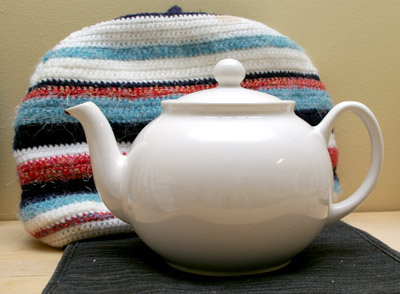
Some time earlier across town Mrs Bell had been tucking the knitted woollen tea cosy over the pot. She put it on the tray next to the platter of butterfly cakes. Young George Cassimatty had apparently been struck dumb the moment he crossed the threshold. After brightening up the fire box in the stove in the kitchen and lighting the fire in the parlour he just sat there fidgeting, his eyes occasionally darting around the room as if looking for an avenue of escape. When Mrs. Bell came in with the afternoon tea tray he jumped as if shocked.

“Now George, exactly what is it that seems to be troubling you? Asked Mrs Bell as she poured their tea. “Milk and sugar?”

“Yes thank you Mrs. Bell; two please.” George was grateful for this small ritual. It staved off the inevitable for a moment longer. He sipped his tea and diffidently took a butterfly cake. He picked the wings off and ate them.

“Well, ya know when Tinker was sick and ya had ta take ‘im t’ the vet?” George didn’t wait for a response. He just kept going, thinking that if he faltered now he might not go through with it. “Well it was me who made ‘im sick.” He blurted. “I give ‘im some o’ me lunch. I didn’t mean t’ make ‘im sick. Tinker’s a great moggy, the best cat I know.”

It was obvious that Tinker liked George too. The big cat was purring like a diesel in George’s lap.

“Well George…..,” Mrs Bell started, uncertainly, “You’re a very honest young man. Not like some of those children, I can say!”

Mrs Bell remembered all the Springs and all the nectarine thieves. Had George been one of them? She thought he had but she wasn’t sure. Anyway, children and fresh spring fruits right off the tree; of course they were going to swipe a few. She just wished they’d ask first.

“But honesty really is the best policy George and you’ve shown yourself to be a young man of good and honest character. Besides Tinker has forgiven you and so I will too.”

George was thrown right off balance. He hadn’t expected this at all and the butterfly cakes were really good, and maybe Mrs Bell wasn’t such a bad old stick after all.

George looked across the mantel as Mrs Bell sipped her tea. There were several of those spotty old brown and white photographs in darkened silver frames; people standing stiffly together, looking down the years from the timelessness of their sepia past. In one there was a young girl in a long white summer frock and broad straw hat. She was standing by a man in uniform. He had a big moustache and sorta fluffy feather stuck in his slouch hat. They looked very happy.

“That’s my husband Athol and me on the day we got engaged.” the old woman offered wistfully with a smile, noticing George’ interest in the photos, “and those are my sons Bernard and John, and my daughter Mary and her husband Eric. They’re all of family.”

It occurred to George that Mrs Bell must miss her family. He didn’t want to ask but he knew Mr Bell had died and it was well known around town that Mrs Bell led a solitary kind of life. George’s mum had often said how she kept herself to herself, even at CWA meetings.

George thought of his own boisterous family, the fun and the fights with his brother Paul, the talk and arguments, planning and work; the sense of security and home. Mrs Bell’s house was full of ghosts, happy ghosts maybe, but she must still be lonely.

“They’ve all gone away now, got their own lives to lead.” Mrs Bell put her teacup down, straightened her back and laid her hands in her lap as she looked across the framed photos. “Bernard’s up north on a cattle station. He’s doing very well for himself.” She brightened and added, “He’s trying to get down for Christmas but they’ve had some heavy flooding and he may not be able to get away.” She gently bit at one side of her lower lip. “It would be marvellous to see him and Ronnie, well Veronica, his wife, and the kids. It’s been years since we were all together.”

George was thinking of last Christmas at home; the extended family all talking at once in Greek and English, the mountains of food and the endless homemade wine, and Ouzo for the men. The dancing and singing and the gifts, always opened after lunch.

“I could come and cut ya grass or chop the firewood.” George blurted. He had no idea where that came from. “ya know, ta make up f’ Tinker.”

Mrs Bell gave George a beautiful smile that completely dispelled the years and the lines and the shadows on her face. Suddenly George recognised the young girl in the photo and he smiled too.

After that it was easy and they talked for a while and got to know one another.  It was odd to think of an old lady as beautiful, but that was how George was thinking of Mrs Bell as he later slowly made his way home.

Funny how things change. George was now actually looking forward to coming back on the weekend and cutting Mrs Bell’s grass. Maybe they’d have tea again, and some of those yummy butterfly cakes. With his tongue George retrieved a lime green icing escapee from his top lip and began to skip along, swinging his satchel and singing in time,

“It’s just a brown slouch hat, with its brim turned up, but it means the world to me.”

George liked the look of Mr Bell in his uniform with his big moustache and his feathered slouch hat. He might even work up the courage to ask Mrs. Bell about him. George was sure she’d be happy to tell him.

His skipping reverie was interrupted by the distant sound of a siren; and then, stone the crows, if every dog in town didn’t take to howling. George got a great big smile on his face and joined the dogs, howling fit to burst and running as fast as he could. When the siren ended and the dogs fell quiet one by one George just laughed, swung his satchel over his shoulder and thought to run all the way home. Maybe his dad would let him have a dog.

Down at Harry’s there was a change in the air too. Harry had been doing some serious thinking over the last few days. About himself, his son and Dotty, the butchery and life in Molong. He thought about these two young lads; good, straight boys, both of them. It struck Harry that while they probably wouldn’t have acknowledged it, they were very similar; both loners with baggage, both quick, confident in their individual ways.

It’d all started at the butchery on Saturday morning. The day had begun like every Saturday for years. In to the butchery early, get breakfast for Mongrel and The Runt, prepare and make the sausages, the mince, then start on butchering the carcasses. He’d been feeling twinges of pain “down there” for a day or two and it’d been getting worse.

He’d hardly had any sleep the night before but then, as the sausage machine pushed out Harry’s famous fat sausages, a stab of pain like a spear in the groin just dropped Harry to the tiled floor, the cleaver clattering out of his hand.

“Jesus H Christ!” Harry swore. “Bloody stones!”

He knew what it was straight away. He’d been having trouble with his waterworks for a year or two now and it didn’t seem to be getting any better. All Doc could suggest was that Harry eat less meat and change the tea he drank. Eat less meat! Harry was a butcher! What’s more, he just couldn’t see how tea could make kidney stones and so he’d continued to slurp down buckets of dark black Indian Char; but the pain this time…. Harry admitted to himself that maybe it was time to take Doc’s advice.

When the pain subsided to the point where it was merely excruciating, Harry dragged himself to the phone and called the ambulance. It was all he could do and it exhausted him.

The trip to the hospital was a bit of a blur, the pain being intense, and Harry was now feeling nauseous too.

He was grateful for the shot of morphia and the pain seemed to just drift away, and soon after Harry drifted off too. When he awoke he was in bed up at the Hospital, alone in the general ward. He had a drip connected to his arm and a tube running into his John Thomas. It was all a little embarrassing and somewhat uncomfortable but at least the pain had gone.

With nothing to do but lie down and watch the drip empty into his arm Harry had begun to reflect on the incident. For the first time in his long life Harry faced the simple, palpably obvious fact that he wasn’t a young man anymore. In a brief, fleeting moment of terror he even wondered what might have happened had he had a heart attack or some other equally serious and immobilising condition. He may have died, alone, with the sausage machine churning out snags till the meat hopper was empty or the gut ran out. He’d’ve gone to meet his maker in a bloodied blue and white striped apron.

“I’m MacCafferty from Molong. I’ve brought the big bloke’s breakfast snowlers.” Harry had joked to the empty ward.

“Yes, of course Mr. MacCafferty.” Harry now playing St. Peters part, “Come right in, he’s been looking forward to them.”

Harry chuckled, but this was quite serious really. He was seventy five, well beyond most bloke’s retirement, and while he was fit for his age and had led a healthy active life, there in the hospital it occurred to Harry, like a weight landing with a leaden thump, that these were his autumn years and winter wasn’t very far away.

Harry’s mood flattened, but soon the old optimistic Harry reasserted himself. He wasn’t going to go quietly. While he was still alive Harry had things to do. He was still able to make a difference and he was going to start the moment he got out of hospital.

He’d already decided that he’d ask Porky to join him at the butchery, a kind of late apprentice. Porky could already slaughter and butcher lamb and beef; he’d learned that at Fairbridge. Harry could teach him everything else he needed to know.

That was how it had started; but then the young bloke had been brought in with his battered bonce and they’d got to know one another and now it was a few days later and Harry’s plan had “growed” like Topsy. He was as excited as a schoolboy with his secret plan. A plan he would keep secret until he saw how things turned out between Porky and Algy.

It wasn’t only the three men at Harry’s that were in for some change. Mongrel and The Runt had things on their dog minds too, though how anyone might have figured out what was an open question.

To Mongrel and The Runt, their own company had always been enough. They were their own little pack of two and between The Runt’s cunning and Mongrel’s strength, and with occasional help from well meaning townsfolk, they’d lived a good life for two strays. They were fit and fly, well fed even, they were well liked, even cared for in a way and they had all the adventure two dogs could stand.

But for all this there was still stress in their relationships; to each other, to the people of Molong. Apart from Porky The Runt trusted no human, except maybe old MacCafferty, while Mongrel wanted to be everyone’s friend. This simple difference in the dogs’ personalities meant that their little pack of two had simply never become the ordered hierarchy that dogs feel best fitted in. Sometimes Mongrel was the boss dog, sometimes it was The Runt. Sometimes it worked well and sometimes it didn’t. To the dogs this was just a dog’s life. It didn’t occur to them, it couldn’t have occurred to them that it might be different, somehow better.

So it was that this evening round at Harry’s, the dogs had begun to feel different about each other, about Harry and Algy and Porky, about life in Molong. The dogs were about to discover the greatest truth a dog can know. That a dog’s life is almost always better with a human companion.

Even this late in Spring it had turned cool, so earlier Porky had lit a fire in the cast iron grate and the men had eaten their dinner, sausages, eggs and chips, from their laps as the house warmed up and lost that damp mustiness that old houses get when they’ve been closed up for a few rainy days.

The dogs had enjoyed a special treat of beef and bones with a couple of dried pigs ears for dessert.

As the dogs watched with uncomprehending but close interest the three men set to talking at length. It was Harry that started. His tone at first was serious. The dogs became alert. At length Harry became enthusiastic and he used his hands a lot as he talked. The younger men just listened, with a hint of apprehension at first but eventually responding to Harry with a like enthusiasm. The dogs became more relaxed. This felt better.

In the middle of it all Porky had unexpectedly scooped The Runt into the crook of his arm and gone to brighten the fire. Held there against Porky’s chest in the glowing warmth of the fire The Runt could hear and feel the man’s heart beating in his chest and smelled the sweet smell of Porky’s sweat. This was a man a dog could feel proud of. It felt right with Porky.

When Algy had entered into the talk his tone had lifted from uncertainty and apprehension to a more relaxed and confident one. He had become very animated, using his hands a lot. Mongrel had sat up, his tail wagging, he was panting happily; but then Algy had become a little sad, reflective. Mongrel drew in close and rested his head on Algy’s seated thigh. He wanted things to be better for Algy. Algy needed a friend.

As the evening wore on and the men continued talking, their voices slowly becoming quieter, more intimate, it was obvious to the dogs that the men had something planned and when the dogs had gone together to get a drink from the bowl in the laundry, with the men’s voices still babbling in the lounge, they found themselves with their heads down to drink but looking at one another.

Neither dog could know what the men had planned. They’d taken their cues from the men’s tone, how they related to one another; and it was obvious the men were forming a pack of their own. In that moment both dogs had unconsciously decided they wanted to be part of that bigger, better pack. They’d still be together and the men might give their pack a prestige even beyond that which they now enjoyed.

Satisfied that all was right at Harry’s house the dogs had taken a drink, gone back into the lounge and taken up their respective positions, Mongrel with Algy and The Runt on Porky’s lap. Soon both dogs were asleep while the men talked on.

Outside the moon was bright, the night remained clear and cool and as the hours slipped by, one by one across town lights were going out.

Harry was dreaming by the fire, occasionally grunting quietly and shifting in his overstuffed armchair; the clock on the mantel slowly ticking its way towards midnight.

Algernon was asleep too, on the couch, propped up on cushions; his bandaged head apparently giving him no problems. There was just the hint of a smile on his face and the darting of his good eye under the closed lid showed him to be deep in a dream too; dreaming of a girl with a fragrance like vanilla, they were walking their dog across sunlit green fields.

Lying on the floor next to the couch, Mongrel had come to rest so that Algernon’s left hand, having fallen from the couch as Algernon slept, rested gently on the thick ruff of blue fur around Mongrel’s neck. From time to time Mongrel woke, checked Algernon and reassured by his steady breathing, went back to sleep.

Porky had enjoyed a few beers while the men had been talking and was now fast asleep too, opposite Harry in front of the fire. His spare frame hardly touching the sides of the fat armchair; one hand holding his sleeping head, his other arm resting in his lap, his legs were spread before him on the hearthrug. The Runt was curled up in Porky’s lap dreaming of being curled up in Porky’s lap. Every now and then one or the other of them would let go a little fart. Beer always gave Porky gas and the Runt, though small, could “fart for Australia”.

The fire had now burned down to a few dull red embers among the ash and charcoal. The cast iron of the grate “ticking” as it cooled and contracted set a random rhythm against the steady regularity of the clock ticking into the future.

Out at “the scene” Young Molloy, pulling his slicker tighter around him with one hand and thankful the rain had held off, was stoking his little campfire with his free hand and thinking of making another billy of tea. The light from the campfire threw a dull yellow flicker across the blackened ruin and Molloy began to wonder again just what had gone on here. The boss had been emphatic. No-one was to go near the building until the D’s from Orange turned up in the morning.

Molloy had seen enough when he was rigging the tarps. That weird “smile” on the blackened head.

Every now and then the breeze would flap one of the tarps and Molloy would start at the sound. The young constable thought he’d heard someone a few times but it had turned out to be nothing. It occurred to him that he was expecting something to happen, he had no idea what. It was an eerie feeling and the blue silver light from the almost full moon gave the entire scene an otherworldly feeling.


11 The Adventures of Mongrel & The Runt – Hearth Fires

17 Friday Dec 2010

Posted by Mark in Warrigal Mirriyuula

≈ 16 Comments

Tags

Australia, Dog, fiction, Mongrel, Runt, Warrigal

By Warrigal Mirriyuula

After school young George Cassimatty dragged his sorry self around to Mrs Bell’s house. The rain had stopped and the sky was clearing. It had been a big day in young George’s mind and he was thinking that he’d better get this apology in before his father found out that it was him that made Tinker sick. And he would find out, George was sure of that. Mrs. Bell always dropped in to the Pantheon Café for a cup of tea and a sticky bun when she did her shopping. She’d tell George’s father for sure.

George hesitated outside Mrs. Bell’s gate. He knew he was in for it, but he felt he had an obligation and so he opened the gate and marched down the path, up the few steps to the verandah and knocked on the door.

As Mrs. Bell opened the door Tinker ran out and began rubbing himself on Georges legs, purring loudly. The salami sandwiches may not have done Tinker any good but the fat moggy obviously remembered George as a source of snacks.

George just blurted out his apology right there on the doorstep. He admitted the sandwiches were his and how sorry he was, because he liked Tinker, but the policeman had said it was wrong and Tinker might die, and he really was very sorry, and he didn’t want to get into trouble with the police, and was there anything he could do for Mrs. Bell that would make it up. He hung his head in contrition, waiting for what he imagined would be a severe rebuke. Maybe Mrs. Bell would chase him off with a broom the way she had before.

Mrs Bell however had been unable to follow George’s rushing, incoherent apology. She’d been snoozing in a chair before he arrived and was woken by the knocking. Frankly she wasn’t quite awake enough to work out what young George was saying. He seemed awfully agitated; something about his lunch and the Police, and Tinker being sick. Mrs. Bell looked at her cat. He had been sick a few weeks ago but he seemed fit and hearty now. Mrs Bell shook her head a little as if hoping to clear her mind.

It was perplexing, and while the rain had stopped and the sun had come out, it was also getting a little cooler and Mrs. Bell thought it best if they continue their conversation inside. She’d get George to light the lounge room fire for her and she’d make some tea and George could have one of her Butterfly cupcakes with her famous lime icing. Children always liked her lime iced butterfly cakes.

“Young George,” she said pulling her old cardigan tighter around her ample breast, “I haven’t understood a single word you’ve said but it must be important so why don’t you come in. You can liven up the firebox in the stove for me and we’ll have some afternoon tea and you can explain it all again to me slowly.

“Yes Mrs. Bell.” Said George with a little trepidation as he stepped over the threshold, Tinker still making a great fuss over him.

Down at the Telegraph Beryl and Alice had spent the afternoon dealing with the “Doc” problem. Alice had explained that her tears earlier had not been over her awkward feelings for Doc, but rather for her dear late father. They’d talked about Alice’s dread that she might turn out the same kind of wife as her mother, which she now considered no kind of wife at all. Beryl had dismissed this as highly unlikely given Alice’s passion for caring for people. Indeed Beryl had said that the very fact that Alice was so disconcerted by her feelings for Doc was proof of an emotional honesty not common in matters of the heart.

Clarry had come in right in the middle of this particularly intense moment hoping for a cuppa with his missus. He took one look at Beryl and Alice deep in collogue and backed out of the room on tip toes hoping he hadn’t disturbed them. When women got together like this, talking feelings and romance, Clarry felt like a cork in a storm. He went back down to the bar and had a squash instead. As he sipped the sour refreshment and chewed absently on the pulp he considered the days goings on.

The game was certainly afoot here at The Telegraph. Alice and Beryl had been holed up all afternoon in the small kitchen of Clarry and Beryl’s flat at the back of the hotel. They’d drunk enough tea to float a battleship. Meanwhile, having started out in the dining room, Doc and Gruber had now finished their lunch and decided a few frames of billiards might be therapeutic. They’d moved into the billiard parlour where Doc had quickly lit the fire and then joined Gruber in several Pilseners as the wet afternoon wore on.

As professional men will, their conversation had turned to politics and they’d worn down the afternoon discussing whether or not Menzies and this new fangled Liberal Party were any good.

Doc had said that he was with Labor and Evett and had voted John Breen for Calare at the election last May. He was unhappy that the Liberal Howse had got in. Doc considered Howse a lightweight who’d only been preselected on the back of his father’s reputation. Howse senior, Major General Sir Neville Reginald Howse VC, KCB, KCMG, KStJ, had been a real hero and held the seat from 1922 until 1929 Howse junior had always relied on his father’s reputation to get him over the line.

Gruber didn’t think much of Howse either. In fact he had little time for politics or politicians in general. He’d voted for Madge Roberts, the independent. He admitted to Doc that it was her “independence” that had convinced him. Gruber knew nothing else about Madge and she’d got less than 500 votes in the end.

Gruber was building up a run of nursery cannons, deftly shepherding the balls down the baize stopping now and then for a sip on his beer. When his skill ran out he racked up his score and slumped in one of the club chairs by the fire.

“Democracy is all things to all people, Berty. Look at this last election here. The current government won neither the popular vote or the two party preferred. Hardly sounds like a democratic mandate does it? Gruber asked rhetorically.

“Menzies is a mendacious, manipulative ersatz patrician, as the French so beautifully put it, an “arriviste”.” pronounced Gruber in perfect Parisienne.

Becoming terrifically animated and sitting on the edge of his chair, his hands, fingers spread before him as if to encompass the entirety of his argument, he dived in.

“You know Jimmy, Jimmy Hang Seng?”

Doc nodded but was somewhat surprised that Gruber knew Jimmy, and he was entirely uncertain as to what Jimmy had to do with the new Menzies government.

“You probably don’t know that Jimmy’s family have been here in Australia since the 1840’s.”

“Is that right? I didn’t know that.”

“That makes him more “Australian” than most Australians!” Gruber added with some gravity.

“His ancestor arrived on a whaler from San Francisco and somehow ended up working with explosives at the Copper Hill mine. When the Hill End rush was on he went there and made a modest pile from the gold, but more importantly, he ran a kitchen for the miners. When Hill End ran out he came back to Molong. He could have gone back to China a relatively rich man but he came back here. Why did he do that?”

Doc, having taken his shot and assuming this question was also rhetorical, sat down opposite Gruber and prepared for one of his friend’s enormously entertaining and occasionally bizarre analyses.

Doc entered into the spirit of the question as he topped up their beers, “I have no idea Karl. Why did Jimmy’s ancestor choose to stay?”

Doc sat back into the smooth brown leather of the club chair and took a sip of his own beer, waiting on the answer.

Gruber, his cue abandoned against the mantel, took a long pull on the amber fluid then putting his glass down on the chair-side table, he sat once again on the edge of his chair; leaning forward, his elbows on his thighs while his hands engaged in a kind of sorcery, somehow drawing the narrative of Jimmy’s family from the thin air between his knees. It was as if Gruber could actually see the story there, filled with characters and action, in front of him.

Doc loved this aspect of Karl; his enthusiasm for people and their stories.

“When Jimmy’s great, great grandfather landed in Sydney Town his accent must have confused the customs officer’s ear. Having landed with a crew of Americans, the single Chinese member of that cohort went completely unnoticed; a small Chinaman lost amongst the hulking blue pea coats of the American crewmembers. When finally confronted with authority in the form of a huge ticket of leave man who asked his name, he had been careful to pronounce it properly, but to no avail. Chinese phonemics was beyond the customs officer’s ear and he wrote the name down as Jimmy Hanson.

From that day forward he was known as Chinese Jimmy, presumably so that no one he met could be in any doubt that the man with the oriental face and English sounding name was actually Chinese.

His real name, his Chinese name, was Jie Meng and in honour of that industrious ancestor the name has been given to the first born male of Jimmy’s family ever since. It’s Jimmy’s true name, the name he thinks of himself as. It means “one who rises above the rest, energetically.” Gruber said nodding, as if to confirm Jimmy’s successful rise.

“And I think that’s why he stayed Berty; why I’m here, and you too in your way. This is a place for rising above the rest, for energy and innovation.”

Gruber paused again, then added, as if further confirmation of the success of the Hang Seng family were required, “Jimmy’s brother’s a surgeon in Adelaide. His sister’s a librarian in Orange. There are Hang Seng restaurants all over the Central West and you know why? Well I’ll tell you why. It’s because that original Jimmy understood a thing or two about the potential of this place, a place that might be big enough for a young man’s dreams.”

In his minds eye Doc saw a caricature Jimmy, coolie’s hat, queue and all, setting charges at Copper Hill; before the town, before the highway, before the railway; blasting away at the native rock to get at the first payable copper in the colony. As a figmentary explosion filled Doc’s daydream with dust, Gruber waded back into his exposition.

“When he came back to Molong he wrote to his family in China. He needed a wife. They sent one, a hardworking young woman from his home village. Her name was Mingmei which means intelligent and beautiful. Too apt to be true apparently but there you have it.  In time they grew into a deep love and depended entirely on one another. He had a big family, ancestor Jimmy, and while his wife never managed English all that well, their children all learned it and, what was considerably more difficult, they all learned to read and write Chinese. As the family grew they worked a market garden they ran on the flats along Molong Creek. As each son reached his majority he was staked in a small restaurant or grocery business. Those restaurants and grocers were guaranteed supply from the home gardens. Over the years some of the younger generations married local girls and boys but the first born son has always married a Chinese girl.”

Ancestor Jimmy’s English was good, he was amiable and hardworking. He and his family prospered, but more importantly he made a part of this country at a time when being Chinese wasn’t all that easy. In fact you might say that it was his early arrival that assured his place. Later, after all the anti Chinese rioting and murders that took place on virtually every goldfield, he wouldn’t have been allowed off the boat. And do you know why the Anglo-Celts didn’t like the Chinese?”

Doc just shook his head. This was no time to interrupt the flow. Karl was rolling now and he couldn’t stop until he came to the end. Gruber’s face took on that serious look that Doc always associated with Gruber having found something in human nature that assaulted his rationality and which Gruber recognised served only to brutalise those that had given in to its baser drives.

“The Chinese miners were what we’d now call “socialists” and tended to work in large organised groups. They exploited the entire resource; the gravel in the creek beds and the veins in the rock. If there was any gold there, the Chinese miners usually found it. They lived communally and frugally, and could get by on a much lower return than the other miners.

The agrarian background of most of the Chinese diggers suited them well to the hard physical life of being goldminers: they were used to long hours of heavy outdoor work. They saw themselves as parts of a greater whole, individually satisfied with a much smaller share of gold than the Europeans who tended, when they weren’t too drunk, to work alone or in small groups, always looking for a mother lode that would make them rich. Often times moving on when there was still gold for the taking, always staking their future on the next big rumour.

It was a cultural difference to be sure, and one the Anglo Celtic miners should have learned from. Instead they demonised the Chinese miners for their success, blaming them for a host of ills, none of which could have been proven, and set in train a kind of murderously ugly culturally ingrained racism that’s still with us today. You’ll recall Caldwell’s deathless line about “two Wongs not making a white.” Gruber’s mouth made an ugly grimace as he quoted the line. “So you see it’s not just the conservatives whipping this dog, we have bipartisan hateful stupidity”

“Fear of  “the other”, pure and simple.” Gruber face went motionless as he considered the ugly face of racism. Presently it turned to a more speculative aspect.

“It’s just possible that the reason ancestor Jimmy came back to Molong is because he read the writing on the wall at Hill End. Even though there were relatively few Chinese at the diggings on the Turon, anti Chinese sentiment arrived with the miners from previous fields. As the riches of the Hill End field declined, ancestor Jimmy decided to move on. Shortly after his return to Molong he purchased the deep rich loamy creek flats and started in the family vegetable business. He fed the locals, he added value to the town. He was a genuine pioneer and he did it all by the sweat of his own brow and his commitment to his family and his new country.” Gruber paused to let that sink in. “We’re all immigrant stock here except the aborigines.”

“Yes but what’s that got to do with Menzies?” Doc was openly puzzled but genuinely excited to hear his friend’s thesis come to its somewhat convoluted end.

“Well Menzies family were crofters, little better than ill educated agricultural serfs. They came here from Scotland at about the same time, maybe a little later. They’d been forced off their land by enclosure and had decided to join the exodus to the new world. Australia was a cheaper destination. They were in much the same straightened circumstances as Jimmy’s family and they too came for the riches the gold promised.”

“I won’t bore you with Menzies’ family history. It’s little better than the usual scrabble for prosperity and social position. They worked hard, put a little by, so that when our Menzies arrives his parents have a small shop in the Wimmera and for the rest of his life he is imbued with the small concerns and constrained view of a rural shopkeeper. Christ, have you read “The Forgotten People”, Berty?”

Gruber looked like his beer had suddenly gone sour.

“Turgid, tiny minded piece of nonsense masquerading as political homily. Boiled down it essentially says we should all be small shopkeepers and that the family so focussed, far from being a hotbed of neurotic psychopathology, an oven in which sociopaths are baked, is actually the basis of our society. I suppose from a terminally middle class shopkeeper’s viewpoint that may look like the truth. So why does he support the White Australia Policy? Possibly the single most antifamily policy ever devised in a country of immigrants! If you’re not quite white that is.”

Gruber paused and sipped his beer before ploughing in again. “Menzies, ever the great classicist, at least in his mind, sees himself as some kind of antipodean Greek hero. The Liberal Party is little more than his chorus, tasked to constantly sing his praises and provide the unquestioning support the “leader” requires. It’d be laughable except that the mistrust between the warring factions of the Labor party looks like crippling any meaningful opposition for some years to come. Looks to me like this so-called “coalition” may be Menzies answer to the possibility of a series of ineffective hung parliaments. The DLP obviously now has more in common with the Liberals that Labor. Whether we love him or would like to lacerate him, we’ve got Menzies pro tem. I only hope Evatt can hang on. Labor under Caldwell would involve a frying pan and a fire.”

Doc could see Karl mentally testing the cables of his argument, trying to pick up the strong line again.

“Where was I? Oh, yes. So here is where Jimmy and Menzies tie up. Jimmy and Menzies are more alike than they are dissimilar. Both families were immigrants from harsh circumstances, both used to struggling and both families find a future here. And yet, in a “Yellow Peril” climate of fear and loathing Jimmy’s family have worked hard, prospered, paid their taxes and contributed to the town and the country. In essence the family’s life has been entirely about family and the business that supports them. Perfect Liberal fit! You see Jimmy is Menzies constituency.”

Gruber shrugged as if to reinforce the obvious fit.

“Only problem is Jimmy’s Chinese ancestry. For purely ideological reasons Menzies continues to shamelessly manipulate the electorate’s long established historical fear of Asian immigration for his own base political advantage. In effect saying that the entirety of Jimmy’s family’s time here in Australia, a spectacular example of the triumph of hard work, dedication and commitment, are as nothing. Other “Chinese Jimmy’s” from the mainland of China cannot come simply because they are Chinese. Oh, and communist of course. Let’s not forget Menzies’ other great political theme, strident anticommunism, which has him shamelessly manipulating the electorate’s fear of a bogeyman totalitarian oppression. You must have followed the Petrov business. Low farce dressed up to look like international intrigue. I mean, really, can you see an Australian communist state Berty, regardless of what Santamaria says?” Gruber chuckled. “It’s ludicrous. The man’s a political cur barking as loud as he can for fear that anyone recognise he has nothing worthwhile to protect. Frankly Menzies is no better.”

Once again Doc had to admit to himself that his friend was truly a one of a kind. Only in the country a few years and yet he could hold forth not only on the individual life story of one of the locals but his understanding of local politics and the Byzantine intrigues of the parties was simply remarkable.

“You really are a one of a kind Karl…..” Doc began to say, and then stopped.

Off in the distance a siren could be heard. The Doctors both looked at one another and then after the sound. Maybe there’d been a smash on the highway.

10 Mongrel and the Runt – Fire and Rain

15 Wednesday Dec 2010

Posted by Mark in Warrigal Mirriyuula

≈ 7 Comments

Tags

Australia, Dog, fiction, humor, Mongrel, Runt, Warrigal

Story by  Warrigal Mirriyuula.

Pat Hennessey the Fire Warden was walking over as Chook pulled off the highway up through the road gate in the Police Ute. The building had been almost entirely destroyed by the fire and a plume of grey and black smoke was drifting into the sky. The rain had stopped and the clouds that had hung low over the district all day were now beginning to slowly clear. Chook got out and dragged his Wellingtons from the back of the ute. As he undid his bootlaces Pat filled him in.

“Thanks for comin’ out Chook. I would’na ordinarily bothered ya ‘cep’ this isn’ what it first seems. Now that we’ve got the thing pretty much out we’ve found some things about this one that aren’t right.” The warden paused. “For a start we’ve got a body.”

That got Chook’s attention. He quickly looked straight at the warden as he pulled the left Wellington on. “A body?”

“At first it just looked like an outbuilding fire with a few dead sheep but, yeah, then we found the body. Ya better come an’ ‘ave a look.”

The warden turned to walk up the muddy path to the remains of the burned outbuilding. Chook didn’t like the sound of this and the sight of Bagley standing off to the side, his hat dripping and his driz-a-bone glistening in the rain, his arms crossed and a foul look on his face didn’t auger well. Chook pulled on the other boot and followed after Pat.

As Chook caught up to the warden the building was still just alight in spots, tiny flames leaping like dancers across the charred timber. Most of the ruin was smoking and steaming as the firemen played water over the blackened mess. There was the distinct sickly stench of burned wool, sheep flesh and diesel.

The smoking pile had been used to store feed and hay, odd tools, discarded machinery and obviously fuel for the tractor. The foundations, floor and gabled end walls of the building were constructed from local rubble blocks mortared with lime cement made from Molong limestone. The front and back had been timbered with thick axe cut slabs. An iron roof had replaced the original Sheoak shingles over the rough timber trusses. It had survived for well over a hundred years, an iconic piece of bush architecture, a practical and pragmatic building from the very earliest days of white occupation. The stone and heavy timber walls providing some security for early shepherds worried about aboriginal attacks as the white man’s mutton invasion continued inexorably into the Wiradjuri lands beyond the early colony’s Limit of Settlement.

The roof iron had collapsed into the building and lay, twisted, still hot, amongst the ash and charred wall slabs, roof beams and trusses. The carcasses of the dead sheep lay in a deep bed of ash, all in one corner where they had no doubt retreated from the flames only to be trapped and burned alive. Chook noted they had been rams, the blackened bony cores of their horns clearly visible. Chook felt a shiver run up his spine. Were these the prize Merino rams that Bagley claimed had been interfered with? No wonder Bagley looked dark. This could put a whole different complexion on the day.

As Chook followed the warden around to the rear of the building the smell changed and then there where the wall had partially collapsed out, Chook saw inside, the body; only the head and shoulders were visible, all tangled in charred timber and bent iron, the head reduced to a leering skull with adhesions of cartilage, charred flesh and burnt hair. The eyes had cooked in their sockets. The lips, shrunken back revealing blackened gums; the teeth, big, strong and dazzling white against the black, gave the appearance that the skull was laughing hysterically. Chook gagged and shivered again. It was unsettling, gruesome to look at. This burnt offering had once been a human being.

The warden stood back as Chook tried to get a better look at the corpse. He leaned inside the wall line. The whole business was still smoking and the smoke was getting in Chook’s eyes. He pulled his head away, his eyes watering. He reached out to get his balance and leaned on the rubble-stone wall. The stone was still uncomfortably hot and Chook pulled his hand away too quickly, loosing his balance and falling on his bum in the mud.

“Bloody fantastic!” said Chook, getting up to wipe the mud of his uniform serge.

“Yeah, we’ll have to wait until the whole thing’s cooled down before we can get the body out.” the warden offered a little too late for Chook’s griddled hand and muddy bum.

“Yeah, let’s do that.” Chook said sourly, but enjoying the soothing relief the mud was providing his hand. He waved it around a bit.

“Listen, has Bagley offered anything on the cause or nature of the fire? Bagley was still pacing some way off, his face a mask of dark animus.

“Hasn’t said a word mate” pulling his head to one side, chin in, and looking at the ground. “Not a dicky bird.”

Chook’s eyes narrowed and he looked over at Bagley. “That’s not like him.” His gaze stayed on Bagley.

“No mate it’s not.” The air between the men thickened with suspicion as they both kept Bagley in their gaze. “Once ‘ed arrived I expected to get chapter and verse on fire fighting delivered in the usual style.” The warden paused and looked at Chook. “’e ‘asn’t said a word, to anyone. Not a word. He’s just stood there were ‘e is. Highly unusual I’d say.”

“So he wasn’t here when you arrived. Who reported the fire?”

“Miss Hynde at “The Pines” over on the other side of the valley.” The warden pointed to a cottage about two miles away on the opposite side of Molong Creek, nestled in a corner where two tall stands of old Monterey Pines met. The little white house was magically aglow in the deep dark green of the pines, at that moment illuminated, picked out in a beam of sunlight breaking through the dispersing rain clouds. “You can see the whole valley from her place.”

Chook was momentarily transfixed by the uncanny scene. He shook his head and deliberately looked at Pat.

“Does Bagley know about the body?” Chook looked back at Bagley.

“Well the men got pretty excited when they first saw it. There was some shouting and hoying but I don’t know whether Bagley knows or not. Like I said, ‘e hasn’ come any closer than “e is now since ‘e arrived.”

The fire was out and the rest of the fire crew had begun to rake out the embers to spread the heat and hasten the cooling. They were about to start pulling off the crumpled iron when Chook shouted for them to stop. The firemen stopped and turned looking to the warden for direction.

“What’s on ya mind Chook? The warden asked while the men waited.

“Something about this doesn’t sit right.” Chook said with classic understatement. He took a good long slow look around the area. “Look it could be anything at this stage. Misadventure, suicide, manslaughter, or it might be murder. I’m gonna have to call it a crime scene anyway, so no one touches anything until I can get the Inspector out from Orange. How much water have you got left in the tanker? Have ya got enough to just keep damping the hot spots?”

“Yeah, sure; we’ve prob’ly got a couple a hundred gallons left. If we run low we can call the other tanker but I don’t think that’ll be necessary. Why, whata ya thinkin’?”

Chook didn’t feel like explaining himself. He wasn’t sure he could anyway, but there was a growing feeling that the thing better be done by the book. Whatever had gone on here, it wasn’t simple. There was a whole lot more that Chook didn’t know. This was MacGuire’s land, his building; those were probably his rams; which meant Bagley was going to be a fixture of the investigation.

Chook wasn’t certain about what he was thinking and decided that a simple cover story would hold the warden. “Have you met Inspector Beuzeville from Orange? He’s a stickler for the regs. We’ve got a body therefore this is a crime scene until it’s released by the Inspector.”

“Whatever you say Chook.” The warden was happy to be shot of the responsibility of being boss of the fire. It’d save him from having to deal with Bagley. If the police said this was a crime scene then a crime scene it was. Someone else could do the worrying.

“I want your men to pace out 50 yards in all directions from the fire. Then they’re to stay outside that perimeter except for the bloke on the hose and he should try and move around as little as possible. As soon as there’s no more smoke or steam, he has to move outside the perimeter.” Chook looked over at Bagley again. He’d have to talk with him. “I’m gonna have a yack with Bagley then I’ve got some calls to make. I’ll get someone out here as soon as I can, just make sure that there’s someone here all the time until he gets here. I’ve got a feeling in me water about this one.”

“Whatever you say Chook.” the warden said again, taking his cue from Chook’s serious tone. He turned and shouted at the firemen, “Righto, disconnect the pumps, pack it up. Bob you hook up to the tanker and run the little pump. Set ya nozzle to spray and just keep it playing over the hot spots. Mick, you pace out and mark a fifty-yard perimeter; and remember, all of you, don’t move anything, don’t disturb anything. This is now a crime scene, the cops are in charge.” The half dozen young volunteer firemen got to it. Mick was pacing out the perimeter and flagging it with tagged stakes, the others were emptying and rolling the hoses. The one called Bob had reconnected to the tanker and started the little petrol pump. He took up a position on the high side of the blackened ruin and commenced damping down.

Chook walked over to Bagley who had stopped pacing and was looking blackly at Fowler.

“You took ya bloody time Fowler.” Bagley always started every encounter with an insult or criticism. “If you’d been here first thing like I said maybe this wouldna happened.” Bagley let that sink in. “Those bloody rams were worth a small fortune. Every one of ‘em’s a ribbon winner.” His anger and frustration were plain.

Chook wasn’t in the mood for Bagley. He had no patience for the man’s abrasive and insulting way.

“Ya can’t go up there Bagley. It’s a crime scene for the next few days. I’m gonna have ta call in the D’s from Orange.”

“What, can’t handle a little fire Fowler” Bagley smirked.

That was it. Chook had about as much from Bagley as he was gonna take. The man was unfit for civilised congress.

“Look Bagley, there’s a dead body in the back corner. This “little fire” is much more important than the loss of some bloodstock no matter how valuable they mighta been. Bloody hell man, the rams are insured aren’t they?”

Fowler was just hitting his straps. “A man’s dead Bagley. Burned liked a forgotten Sunday roast.” Bagley didn’t react and didn’t seem to care. Just like the bastard, thought Chook.

“You don’t go closer than fifty yards and if I find out you have, then I’ll arrest you for interfering in a police investigation.” Chook looked Bagley straight in the eye “Have ya got that?”

“Ya wanna watch ya self Fowler. I’m not without influence round here.” Bagley threatened, inflated with pride, “While ever I’m manager here I’ll go where I damn well please and do what I need to.”

The fact that a dead man had been found on the property he managed didn’t appear to be figuring in his calculations at this point. To Bagley it was obviously a bloody inconvenience but essentially someone else’s problem. “What about my bloody rams?”

“MacGuire’s rams Bagley. Remember? You’re just the help.” Chook was really getting on Bagley’s tits now, he could see it, and saw no reason to back off. “I’ve had enough of you Bagley. You may think you’re a big wheel round here but to me ya just a bully; a loud mouthed common thug. Those you can’t thump ya threaten. You push ya luck on this and you’ll find out just what the NSW Police are capable of. Have I made myself clear enough now?”

Chook always felt a slow surge of blood when he invoked the brotherhood of the force.

“You’ll regret this Fowler. I’m not a man to make an enemy of.” Bagley was fuming. He spat into the mud, turned and walked back to his Land Rover.

“I’ll need to talk to you later. Make sure you’re somewhere where I can find you.” Chook shouted at Bagley’s retreating back.

“You can go to buggery Fowler. I’m sure you know the way.” Bagley got in the Land Rover and took off down the valley towards the main homestead, on his way to report to MacGuire.

Chook wondered what made a man like Bagley. Even a dead body didn’t move him. He had no friends so far as the Policeman knew; and though he was married, he and his wife had no children. All he had was his job at MacGuire’s, his own high opinion of himself and an indefatigable drive to get what he wanted no matter the cost to those around him.

He was a brutal boss known for violence against casual hands. He’d blinded a young rouseabout in a fistfight when Chook was a teenager. He’d been charged with grievous bodily harm but the charges were dropped when the complainant failed to show for court. There was talk he’d been paid off.

Over the years there had been many stories of Bagley’s cruelty and he reserved a specially callous contempt for the Fairbridge boys he took on, treating them little better than the animals themselves and reminding them all the time that they were the waste and detritus of the empire and they should be bloody grateful he employed them at all. In short he was a shit of a man in Chook’s opinion, and this investigation was going to be all the more difficult with him involved.

Fowler got on the radio in the ute and contacted the station in Orange. He made a quick report to Inspector Beuzeville who agreed it was suspicious and that it should be looked into more thoroughly. He couldn’t come right away; he’d be out at 6AM tomorrow morning. Best to get the body out before the heat of the day. In the mean time the Inspector told the Sergeant to secure the scene, cover the body as best you can and no one to touch anything, he’d bring the Coroner’s Pathologist and a police photographer with him, “Over and out.”

Chook got out of the ute and walked back up to the burnt out building. He told the young fiery that he had to go into town but that there’d someone back in an hour to relieve him. The young bloke just nodded as he distractedly continued to hose the sodden remains of the building.

Chook got in the ute and took off back into town. The sky was now clearing rapidly and the road was steaming as the afternoon sun came out from behind the clouds. There were still several hours of light yet and there was a lot Chook wanted to get done before Beuzeville came out in the morning. He’d get young Molloy to sit the night watch at the scene, Chook wanted to talk with Miss Hynde and he’d have to beard Bagley at home; and just to be sure he’d talk to MacGuire too, if he wasn’t down in the smoke.

This was more like it, Chook thought. Real Police work, hopefully with a real outcome. This wasn’t dealing with drunks or scolding kiddies, or another turn in the eternal dance with Jack. This was meat and potatoes Police work.

There weren’t that many bodies turn up in Molong in suspicious circumstances and Chook always took these cases very seriously. People needed to know what happened and the dead man, lying in the cooling ruin, that horrible skull silently screaming for justice, he would have one last mate and Chook wasn’t about to let a mate down.

Chook realised at that moment that though procedure required an open mind, the gut feeling that was developing deep inside him was insistently shouting “foul play”. Chook had learnt young not to deny his gut feelings, but what had exactly gone on here was still a mystery waiting to be deciphered.

Chook put his foot down and for the first time in months turned on the siren.

9.2 Mongrel and the Runt – A Tea Party

13 Monday Dec 2010

Posted by Mark in Warrigal Mirriyuula

≈ 8 Comments

Tags

Australia, Dog, fiction, Mongrel, Runt, Warrigal


Story and Photograph by Warrigal Mirriyuula

Sergeant Fowler drove away from the sawmill shaking his head. According to Ted Condon, the owner and manager, the money and the chain saw had turned up again and as far as he was concerned that was the end of it. He wouldn’t be pressing charges; it had all been a big misunderstanding.

It didn’t jibe. Ted had been pretty pissed off when Chook responded to the original call. It was him that had originally made the suggestion that it might be one of the mill crew. The McCulloch chainsaw alone was worth nearly a hundred quid and Ted had been spitting chips about its theft.

Chook wasn’t buying any of this new story though, not for a moment; but without a complainant and with the alleged cash and goods back in the owner’s hands, this was no longer a police matter. Then, in that way that it often did for Chook, as he drove back into town, not thinking of much really, the whole affair fell into place.

Chook would bet his pension it was Nugget did the burg. He really was a sorry case. Years of piss and too many fights had addled Nugget’s brain. It was about all he could do to get the occasional day working as a general hand at the sawmill, or on the roads for the council. As soon as he had his pay in his hand he’d be off to the pub and wouldn’t stop drinking till his pay ran out. He lived in a coldwater rat hole in East Molong. You wouldn’t call it a life. He was only half there when he was sober, when he was drunk he had a chip the size of a river red gum on his shoulder and an ugly angry violent streak. Pissed, he could convince himself that his problems were always of someone else’s making.

Chook could see it now. Nugget got himself three days at the mill, he’d seen it in the mill’s day book; on the second day, the day of the night of the burglary, he’d’ve come back from lunch half cut, slung off at someone, who’d’ve slung back. Nugget would’ve brooded on it. Somehow it gets twisted up into some kind of sawmill conspiracy to do him down. Nugget, thinking to get even, would’ve come back later, even more drunk, and done the amateur burglary. Chook smiled sardonically as he imagined a pissed Nugget lugging the heavy chainsaw away, cursing it continually for its awkward weight. Nugget didn’t turn up the next day; that was in the daybook too. A dead give away in Chook’s mind. He’d have paid a few pressing bills and begun drinking the rest of the money. When that ran low he’da tried to sell the chainsaw. Not that many buyers there, and those that might be buyers woulda known where it came from. The word woulda got back to Ted Condon. Condon gets the mill crew to find Nugget, they take him to the Freemasons, outa hours, just Jack looking on, no trouble there; play some cards, get Nugget pissed and skiting about the burg; Nugget was too addled to know when to shut up; that loud abusive stupid mouth of his was his fatal flaw.  The mill crew woulda been dark on Nugget for stealing from Ted. They take Nugget outside, give ‘im a quick tune up then over to Nugget’s to pick up the chainsaw and any cash they could recover. Nugget ends up pissed, bruised and lumpy in the cell with young Molloy scraping off the blood and dried spew. Nugget’s oblivious, collapses in the cell, pisses himself and spends the rest of the night snoring and farting; just another Sunday night for Nugget.

Ted was never going to come clean. He had his chainsaw back. That was the main thing. If he’d done dough in the process then he’d extract it outa Nugget’s hide over the next few months. Nugget wasn’t going anywhere, and the sawmill was one of a very few places where Nugget would be taken on, even if only as a day labourer.  What’s more Ted needed his crew just as much as they needed him. Timber getting and milling wasn’t for weak men. They’d back one another’s stories and alibi one another up over the beating.  It was an investigative dead end but there might be one way to prove out his theory.

Chook shuffled his day in his mind. Bagley would just have to wait a little longer; Chook was off to front Jack Hornby at The Freemasons. He could rocket him for trading out of hours; then, on the back of his not reporting Jack, maybe get Jack to fill in a few blanks about Nugget and the burg, just a conversation between two blokes in a pub, no actual police involvement.

As Chook pushed through the main street doors of The Freemasons his appearance drew the usual response. Several of the drinkers pulled their beers in close to them, hunched their shoulders a little, adopted a watch and see posture. A couple skulled their beers and made their way out of the pub, others looked up, noted the sergeant’s stripes and went back to their counter lunch. Through out the front bar the level of conversation fell a notch or two.

Fowler took a stool at the bar, his back to the room. He chose the muttonchops, mash and peas from the counter menu, decided against a beer and had a squash instead. Chook wasn’t a big drinker, never had been, but he had nothing against the pubs or their patrons so long as nothing they did had to be written up at the station.

As he waited for his lunch the usual hubbub returned, the lunch patrons acclimatising to the presence of the law. There was a loose copy of “The Express” lying on the bar and Chook filled his wait with the local headlines. There was a great picture of Mongrel and The Runt on the front page. Chook had heard about the young Inspector’s mysterious mishap and when he’d called Billy Martin to retrieve the abandoned ute from the rye pasture, Billy had already taken care of it. Billy was like that. He just got on with it. Not like these no hopers that filled the Freemasons during the day.

Since The Royal had burned down during the war there were just the two big pubs in town and they couldn’t be more different. The Telegraph was more like a community club, a family pub with a dining room and billiards. It was Clarrie and Beryl’s pub and reflected their character and style. The Telegraph was no trouble at all.

The Freemasons was a horse of an entirely different colour. It was the regular resort of the hard men, the sportsmen, gamblers and straight out heavy drinkers. Jack the publican was ex British army. He’d been in Tobruk and El Alamein and in the midst of that misery had run a very successful black market operation.

The story that came back was that Jack was about to be taken in charge by the Redcaps when the Boche kicked off again, lobbing in heavy fire. The surprise attack had caught many in the open and there’d been serious casualties, mostly blast and shrapnel, lots of wounds to dress. Jack’d bought his way off the charge by handing over a purloined consignment of sulpha drugs and leading a party of commandos out past the German line by a secret route normally used to move contraband. The commandos destroyed fuel and amunition dumps and several vehicles as well as chopping up the guards. Even Jack got his arm in, silently and efficiently garrotting a sleeping kraut sentry.

The Germans, seeing their dumps exploding and on fire, and fearing a rear guard attack, fell back, taking the pressure of the town. The whole thing had gone like a clock. Tobruk could breathe again for a day or two.

Jack’s CO had even been tempted to mention Jack in the despatch reporting the failed German attack. He’d decided against it on the grounds that Jack was still a complete bounder who had recently been greatly profiting from the scarcity that beset the entire besieged garrison. Besides, Jack just couldn’t be trusted to do the right thing with any cache that might attach to “hero” status. Instead the CO had simply marked Jack’s record with the notation, “No promotion this theatre”, and curiously moved him under the wing of the Supply Corps. Perhaps the CO thought that Jack’s unconventional procurement skills might be more generally beneficial to the unit.

When he was demobbed Jack had chosen Australia over Canada and New Zealand. With all the post war shortages and civil disruption in Britain it was considered prudent to offer demobbing British servicemen assisted passage to attractive destinations in the Empire. There was even a modest cash incentive. The idea was to limit the impact of returning servicemen on the labour market at a time of rebuilding and deep change at home. There was nothing for Jack in England and he ended up in Molong. Bought the pub, license and freehold for cash and never looked back. He claimed he got the money from a freakish streak at the horses that included an accumulator over four races.

The way Jack told it, he got off the boat at Circular Quay, went to a pub aptly called “The First and Last”, met a bloke, they got talking, then took a bus to the races at Randwick where Jack and the bloke had enjoyed a supernatural streak of luck. Jack had always been coy about exactly how much he’d won but it must have been a considerable sum of money. The bloke came from Wellington. He was a wool classer in Jack’s story, said he was going to retire on his winnings. This is where the bloke disappears from the yarn; but not before telling Jack of this pub he knows is for sale in this place called Molong. The pub’s going cheap after years of wartime rationing and restrictions. Jack dreams big and quick and a few days later he’s in Molong, the deal is done and after jumping through flaming hoops and walking on hot coals with the licensing division in Orange, he’s confirmed as the licensee of The Freemasons Hotel. A sanitised and heroically proportioned version of his exploits in North Africa was no small part of his success in the Licensing Court. It all just added to the legend.

Jack wasn’t exactly a crook. He was just a bit of a “Jack the lad” who hadn’t quite grown up yet. He loved a caper and was happiest when he had a big deal going. Chook reckoned he fenced a bit of stolen goods, only occasionally and only if the goods weren’t from Molong. He had some scruples. He fiddled the hotel books to avoid excise and tax and ran a substantial part of the black economy in Molong. He accommodated Molong’s SP bookie in a dark corner of the front bar. He was well known and liked by a certain kind of Molong citizen and kept his record clean with the rest by making hefty donations to the local football and cricket clubs and being a “captain” in the local volunteer bush fire brigade. He was a loveable rogue with a flair for the fantastic. He’d have been the kind of bloke that’d be good to have as a mate Chook thought, if only he wasn’t into the fringes of every dodgy deal running.

What ever else Jack was, he was always reliable for a good story. The trick was to tease the truth out of Jack’s rococo embellishments. To Jack the truth was just what happened. A good yarn was something else altogether.

Chook pushed a bit of bread around his plate and stuffed it into his mouth, chewing while he shoved his plate away. Jack was at the other end of the bar talking with a truck driver whose lorry was parked illegally on the other side of highway. Chook got up, swilled the last of his squash and ambled down the bar.

“That your truck mate?” he asked the driver while Jack stood back smiling, waiting to see what would happen.

“Yeah mate. Ya gotta problem?” the driver asked as he sized up the police sergeant, scratching his ample gut through his worn blue singlet.

“No mate, not me; but you might have if ya don’t move it. Yer parked “near and close” mate. I’ll have to give ya a ticket if ya not away soon.”

The truckie, figuring he could do without the ticket said, “Yeah well I’m away right now boss.” He picked up the two bottles of Dinner Ale sitting on the bar. “See ya nex’ week Jack.” The truckie looked at Chook again still trying to size him up. “Sergeant…” he nodded. Chook nodded back, filing the face for future reference.

“What can I do ya for Chook?” Jack lent in, wiping the bar with a rag. He liked Chook. They’d be mates except that Chook was a rozzer.

“Ya wanna beer?”

“No thanks Jack.”

“On the house…”

“I’m on duty.” Chook said, looking to remind Jack.

“Suit y’self.” Jack said and shrugged his shoulders. It was only a beer. He put his rag down and gave Jack his attention. “What’s on ya mind?”

“When I got in this morning Nugget was sleeping it off in the cell. Looks like he got a seeing to last night.” Chook paused.

“He’s a fool for a fight, that Nugget.” all light and breezy like there’s nothing going on here officer.

“Yeah, well he’s a bit of a mess, the old Nugget.” Chook paused again watching for any reaction from Jack. There was none, just Jack’s affable smile.

This was where their conversations always got interesting. Chook never knew whether he was ballroom dancing or prize fighting. Jack wanted to be genuinely helpful, he was that sort of a bloke; but he couldn’t really be frank with Chook, tell him what he really knew; and Chook couldn’t give anything away either. He had to walk a fine line between encouraging Jack to open up while questioning him with just the right tone of intimidation appropriate in a policeman on an enquiry.

“He wasn’t in here earlier was he?” Chook asked directly.

“What, th’smornin’?” Jack played up “being confused”. “I thought you said he was in a cell at the station.”

“No, not this morning,” with softly played exasperation, “earlier yesterday, Sunday.”

“On a Sunday Chook? That would be against the law wouldn’t it?” Jack asked rhetorically. He picked up the rag and began to studiously wipe the bar again. It’d save him having to look directly at Chook.

“Look Jack, no names, no pack drill, OK? You wouldn’t want me to have a closer look at your license, maybe call in the Licensing Sergeant from Orange.” Fowler let that sink in. “I know Nugget was in here and I know there was some others from the mill.” Chook lied smoothly.

“Seems you know more than me Chook.” Jack wasn’t giving anything away. “The last I saw Nugget was at closing on Saturday night, after the darts. He was lying in the garden over at the railway station.” Jack’s face took on a look of innocent befuddlement as if to say he was at a complete loss as to how Chook could be so wrongly misinformed.

“So you know nothing about the burglary at the mill, the missing chainsaw now miraculously turned up again? What about the thirty-five quid? Anybody been a little too splashy with their cash?”

Jack was on easier ground now the conversation had passed by any direct focus on his license. He stopped wiping the bar and pulled in close to Chook so as not to be overheard by the regular patrons.

“Yeah I heard about that.” Jack heard about everything. “Ted Condon gave me a call. Asked me to be on the lookout for someone trying to sell a McCulloch chainsaw.” Jack did an impression of someone trying to remember. “You know, now that I think of it, Nugget has been a bit flash lately, and he lost a fiver on the darts.” This was the gem of truth around which this entire conversation had been skirting. “I didn’t hear anything about the chainsaw though;” Jack and Ted were both wheels in the local bush fire brigade, thick as thieves, “but Ted’ll be pleased to have it back.”

“Yeah, it’s almost as if it was never stolen.” Chook offered with thick irony. “So Nugget wasn’t here yesterday but he has been a bit flash lately, right?”

“That’s about the strength of it, yeah.” Jack confirmed.

“So he wasn’t in here drinking and playing pontoon with the other blokes from the mill. They didn’t ply him with piss and get him skiting, giving himself up. They didn’t take him out the back and sort him out then fetch the chainsaw from that dump he calls home, leaving him mindless blind drunk and bleeding on Bank Street.” Chook took a breath and fixed Jack with his copper’s stare. “None of that happened?” Chook asked in a tone of mocking disbelief.

Jack’s face became a mask of guileless innocence. “Nah Chook mate, nothing like that happened.” Jack said nodding his head.

That was the “tell”, the nodding head. For such an accomplished liar Jack was still easy to read and Chook felt vindicated. Not that it meant anything, the investigation was going nowhere, but it was good to know that his instincts had been basically right. Chook smiled at Jack.

“Right, well I s’pose that’s that,” Chook had all he came for, “except that if I were to find out, for sure, that you’d been selling on a Sunday I’d be bound to do something about it Jack. It’s the law. You understand that don’t you.”

“Of course mate, fa sure.” Jack took Chook’s diaphanously veiled meaning, assuring him that Chook would never have any reason to treat the pub or the publican any differently than from this friendly conversation. The balance was restored. Both men had their pride and both were oddly thankful to the other for the manner in which this curiously refracted conversation had been executed.

“Righto, well I better get cracking.”

“No worries Chook, any time.”

Fowler turned and took a quick squiz around the bar, just in case there was anyone else he might need to talk to, new faces to note. It was the usual crowd. He walked out through the highway doors.

Chook slung his slicker over his shoulders and ran for the ute. The radio was calling. Opening the passenger door Chook leaned in and grabbed the handset.

It was Pat the local Volunteer Fire Brigade Warden on the emergency services channel. He wanted Chook at an outbuilding fire on a block along the highway to the east of town.

“Let me get this straight”, Chook needed a little clarification; ”You’ve got a fire on a day like this?” The rain continued to rattle on the ute roof.

“Not just a fire mate. Ya better get out here smartish.”

There was something in Pat’s tone, an urgency, serious concern. It was all Chook needed. He jumped in, slid across the seat, lit up the ute, dropped a tearing “Uee” and took off back down the highway past the railway station. He could be there in ten minutes.

9.1 The Adventures of Mongrel and The Runt – A Tea Party

12 Sunday Dec 2010

Posted by Mark in Warrigal Mirriyuula

≈ 8 Comments

Tags

Australia, Dog, fiction, humor, Mongrel, Runt, Warrigal

By Warrigal Mirriyuula

Beryl had boiled the kettle and their tea was now brewing while she made some sandwiches. This morning’s shopping had taken a little longer than they thought and so it would be a light lunch rather than tea and a bun.

Alice had gone quiet since their almost encounter with Doc and Gruber, and Beryl was casting around in her mind for a way to broach the subject anew, perhaps help her friend get to grips with what Beryl now thought of as the “The Doc Problem.”

Alice’s quiet ruminations got there first and out of the blue she began to list the items on the positive side of the ledger.

“I have enormous professional respect for Doc.” She said nodding with that respect, “You know I trained and worked at RPA,” she knew whereof she spoke, “well Doc is a better diagnostician and a better physician than any I met there. Molong is very lucky to have him.” Alice pursed her lips, paused momentarily, as if hooking up the next component of her analysis. “He’s got a generous nature and a terrific bed side manner.” This last attribute though, was somewhat problematic, but she’d deal with that later. “He really does care for his patients, both bodily and spiritually.” Lips pursed again; “Hmmm”, that wasn’t quite right. Doc was known for denying the role of the spirit in human affairs. The care and curing of the body, the defeat of the various ails and ills it’s prone to, a matter of science and skill according to Doc. “Apart from his “godlessness” he’s a good man.”

“Godlessness,” Alice was surprised at the vehemence with which Alice had imbued the word and just had to jump in. “I wouldn’t say Doc was “Godless”. I think he believes in his own way.” but she wasn’t so sure about this. Maybe Doc was agnostic, but she wasn’t about to start the negative ledger with an uncertainty. “It might be that God works through Doc without permission.” Beryl looked over at her friend hoping her little joke might have lightened her mood. It hadn’t, so she continued, “Anyway, isn’t the important thing that he’s a good man and a wonderful doctor? His patients all love him. There are some women in this town that see Doc as some kind of Christ like figure.”

Beryl smiled as she and Alice both pictured Mrs. D, who even now would be putting the finishing touches to a meal fit for a vice regal dinner, let alone a Monday lunch for two doctors.

“I don’t think this has anything whatsoever to do with God Alice. He didn’t make the rules you’re applying to Doc.” Beryl said speculatively. She went on to explain, “When I was a young girl on the farm, even before I went to school, I loved the bible stories Mum and Dad read to me at bedtime. It seemed there was always a lamb in the story and I thought how lucky I was to be surrounded by lambs. To me it was as if Jesus was everywhere.” Beryl smiled inwardly as she remembered those pre-war days filled with sunshine and innocence. “That’s remained the shape of my faith ever since. Jesus is everywhere working with the faithful to do better and helping those who have lost the way, or never found it. Doc isn’t “Godless” Alice. That would mean that God had abandoned him and I can’t believe for a moment that Doc’s skill and knowledge aren’t God given.” It wasn’t usual for Beryl to interrogate her faith like this. She liked the stories, hers was a narrative faith and the more she thought about it the more certain she was that Doc’s story seemed to fit the mould; a good man struggling with life to find meaning and purpose. Besides, she was married to a good man who had trouble with his faith, and with good reason, she’d always thought.

“All sorts of things happen in life. You meet all sorts. The good people you cherish. The bad ones you turn away from.” Beryl began to wonder herself where she might be leading with this. “People can be a bad lot, do terrible things. Compassion and forgiveness seem at the heart of it for me.” Yes, that was it! “Don’t you think you could be a little more forgiving towards Doc? After all, he can’t know the rules you’re failing him on.”

That was the truth of it, Alice thought as she heard again her mother’s vituperative hissing whisper in her ear, “Men are evil thoughtless creatures; manured pasture for the devil to grow discord and division. Drunkards, whoremongers and criminals, the lot of them.” It was painful to remember.

Alice began to cry as she further remembered her father going quietly to an early grave. Having married for love he then failed throughout that marriage to meet his wife’s high standards of Godliness and Christian rectitude; but he never stopped loving her and Alice had never heard him utter a single word of criticism or dissatisfaction. Alice remembered again as she often did in times of trouble, his gently holding her hands in his and telling her of the love he had always felt for her, how proud he was of her accomplishments in nursing; his body emaciated by disease, his face a hollow sepulchral mask animated only by the fire in his eyes as the cancer ate away at him leaving little but pale skin and the bone almost visible beneath that loose papery blue and white sack. He’d been a big man, well liked outside his family, respected even, in that way that quiet, uncomplaining hard workers are in a country town.

His diagnosis had prompted his suggestion that Alice attend the Royal Prince Alfred Nursing School. He’d worked right up to his final illness to pay for it; and suddenly, today, as the rain rattled on the iron roof of the pub, she realised why. As her parents’ marriage descended into a siege of attrition and the progress of her father’s disease continued inexorably, her father, in his usual quiet way, had been trying to free his beloved daughter from the malign influence of his demanding wife and the spectacle of a decaying and cankerous marriage. To provide her with an experience of the wider world, different people, to make the place in which Alice might find herself and begin to make her own decisions, free from her mother’s rules and constant criticism. And now here she was, a grown woman, both parents gone, and she was still applying her mother’s malignant rules to the only man she’d ever felt anything for. She couldn’t help her feelings; not her love for Doc or the uncertainty she felt about him. As she had always been she was torn between her parents, between her past and a possible future.

Bee laid a comforting arm over Alice’s shoulder. “It doesn’t have to be like this Alice. Why can’t you just tell him how you feel? It’s nonsense you saying you don’t know. You can’t even think about him without losing your composure.” She offered Alice her hankie to dry the small tears and they both settled to sip their tea and quietly eat their sandwiches.

8. Mongrel and The Runt – A Long Lunch

11 Saturday Dec 2010

Posted by Mark in Warrigal Mirriyuula

≈ 10 Comments

Tags

Australia, Dog, fiction, Mongrel, Runt, Warrigal

Story and Angular  Mischief by Warrigal Mirriyuula

As expected Algernon had been released from the district hospital after both Doctors Wardell and Gruber had declared him fit, with the proviso that he keep quiet for at least a week and preferably two. All the cognitive tests had been clear but they were somewhat concerned that his left eye might yet have some trouble. The retina didn’t appear detached but the cornea was scratched and the aqueous appeared to be draining poorly increasing the intraocular pressure.

The doctors agreed that this may be due to the inflammation associated with the main injury. Perhaps the trabecular meshwork was damaged in some way or perhaps just inflamed. Time and rest would put that all right if there were no real structural damage.

Harry had been released too. He was free of pain and passing pee like a champion, his stones for now at least dealt with.

As Harry packed his small battered leather portmanteau with his pyjamas, shaving kit, his transistor radio and other odds and sods, it was obvious to Algernon that he had something on his mind.

Algernon watched quietly as Harry snapped the latches on the port and sat on the edge of his bed, ruminating on something. Algernon, having arrived in the clothes he was injured in had no packing to do. His clothing had all been washed and ironed by the hospital. There was no indication, no dull brown bloodstain, no green smear of rye grass, no rip or repaired tear, no sign at all of what had happened to him. Except that half his head was swathed in bandages and he now sported a fine looking patch over his left eye. Algernon thought of his ute for the first time since Saturday. He had no idea how he was going to get home or even if he could make it home with his head in the shape it was; and what was he going to do about the ute.

Algernon was surprised when Harry suddenly spoke up, his face as serious as Algernon had seen it.

“Algy, I’ve been doin’ some thinkin’. Not always a good sign, as Dotty use’ta say, but I wanna put somethin’ to ya.” Harry stood up and went over to the window to look down onto the little town. “I was a stranger ‘ere when I first came; didn’ know anyone, felt I didn’ fit in.”

Algy began to feel a little uncertain. Harry being serious was a new experience. While it had only been a few days since they’d met and not under entirely fortuitous circumstances, Harry had been implacably upbeat, a joker full of yarns about old Molong and the characters he’d known. Algernon looked intently at the old man wondering what was in store.

The old butcher plunged in. “The Shire’s got ya in one of their flats, right? I bet it’s pokey and hardly worth the subsidy they pay ya, which they keep anyway seein’ as they own the flat.” Harry paused, looked at the floor and pulled a disgruntled face. “Look I’ll jus’ say it. Why doncha come and stay at my place. At least until the docs give ya the all clear. I’ve got that whole house to rattle aroun’ in and I wouldn’ mind the company. We can look after one another while we recover. Whaddaya sayAlgy?”

Algernon certainly hadn’t expected this invitation; and Harry, realising he still hadn’t convinced him took a chance to land the clincher.

“Besides, you need the company too.” Harry looked directly at Algernon, the older man’s face showing the certainty he felt but at the same time masking his meaning.

Algernon didn’t know what to say. The offer was obviously genuinely felt and sincerely offered but Harry was still a stranger really. Amongst the manly advice offered by his father on his departure from Melbourne was an admonition to keep clear of strangers, to stick to your own kind. Well everyone in Molong was a stranger to Algernon. There were none of his own kind, whatever they were. A sudden and unexpected anger rose in Algernon, almost immediately washed away, transmuted into a magnificent sense of potential. Algernon felt his face flush warmly, he felt the first prick of tears, and then found himself laughing. He couldn’t remember laughing since he’d come to Molong.

The only problem with all this was that it set his head to pounding again.

“Ooooh”, he let go, wincing as he went and hugged the old man. “Harry I’d be honoured. I really would.” It was like the chocks had been kicked out from under his life and he had begun to slip into his future. He had no idea why the invitation sounded so attractive, but he had a growing sense of conviction that if he just let go, didn’t try to make everything conform to his ideas, took it a bit easy for a while, he might just be able to work it out, to find a place where he did fit, to discover his own kind for himself.

Harry didn’t quite know what to do or say. This wasn’t quite the reaction he’d expected and he stood stiffly, his arms locked at his sides, his head back a little, while Algernon wrapped his arms around him. A vivid memory of his son setting off on the Cooee March during the Great War filled Harry’s mind.

“Jesus Algy, it isn’ Buckin’am Palace.” Harry said awkwardly as Algernon released him.

“I’d need to get a few things from the flat first, if that’s all right.” For now all thoughts of his ute and his job and his future seemed less important. He could work all that out later.

Yeah, yeah. No worries.” Harry said, carefully putting the memory of his son back into that precious place where he kept his most private things. Harry too felt the prick of tears but it had been a long time. He sniffed once and smiled at the boy, recovering from this flurry of unfamiliar male intimacy, Harry said with a little too much enthusiasm, “Porky’ll be ‘ere with me van soon. We can get ya kit and get ya settled before tea time.”

Sure enough a little while later Porky turned up in Harry’s shiny black Anglia van and parked it under the ambulance awning.

In the back was a hundred weight bag of spuds and Mongrel and The Runt. The dogs jumped out as Porky put Harry’s port in by the bag of spuds. The Runt took off for a quick pee in the garden while Mongrel made a great show of affection for Algernon. Harry got in the passenger seat. Porky helped Algernon into the back of the van  where Mongrel joined him, resting his big head in Algernon’s lap as Algernon leant on the spuds. Porky turned and putting his fingers to his mouth, issued a piercing whistle, then “Com’on Butch! Gotta go!”

Porky closed the van doors and went and opened the driver’s door. The Runt jumped in, no hesitation, he was safe here with old MacCafferty and Porky. Mongrel could take care of the bloke in the back.

As Porky hit the ignition The Runt jumped onto his lap and sat there proudly looking over the steering wheel as Porky drove downtown, the windshield wipers slapping back and forth as the Anglia splashed through the potholes that always turned up with the rain.

“Transcendent, Mrs. D, that’s how I’d describe it. Ambrosia fit for Angels! Didn’t you think Karl?” Doc asked without taking his eyes off Mrs. D. Doc held her left hand firmly in both of his, covering her wedding ring and ensuring she couldn’t escape until he had finished lavishing praise on her piquant Spanish lamb roast and spicy vegetables. “A feast fit for kings, and perfectly complimented by Karl’s Gewurztraminer, yes Karl?” Still Doc didn’t look at Gruber, who had been drinking Pilsener anyway. The oddly aromatic German white with its curious tropical fruitiness had been a gift for Doc.

He was almost through with his shtick and Gruber was enjoying this almost as much as Doc. “Did I detect a hint of Juniper berries, and was that, anchovy, just the merest soupcon, as well? So adventurous Mrs. D! So exotic!” Doc gave Mrs. D a positively evil look as though he could eat her on the spot. “And not so easily procured ‘round Molong I’d wager. No wonder the good fathers hold on to you,” he paused and added cryptically, “as they do.” Doc continued, “You’re a magician, a culinary demi urge. A gourmet goddess! Why if your husband wasn’t as big as he is, I’d fight him for you right now.”

Doc smothered Mrs. D in his best most gracious and ingratiating smile. His entire focus on ensuring that Mrs D was completely aware of how well he thought of her cooking.

Mrs. Delahunty might have been floating several inches above the Telegraph dining room floor, saved from drifting completely away by the gentle grip of the doctor’s hands. “You exaggerate Doctor. It was never that good.” she gushed. Though it was obvious to anyone watching that she lived for this. “In honour of Doctor Gruber’s visit I’ve made you both a special strudel for desert.”

Doc’s eyes and mouth suddenly shot open wide. He immediately released her hand and threw his arms and head back. Mrs. D actually stumbled a step as though, having lost Doc’s steadying grip, she was without anything to hold her down.

“Take me now dear Lord. There’s nothing more for me here.” Doc mocked, crucifying himself across the back of his chair. The other diners, those that knew him, unable to miss the all too grandiloquent gesture, just put it down to Doc’s occasional theatricality. The strangers just thought him a bit queer.

It was a sign of the esteem Mrs. Delahunty held Doc in that she didn’t chip him about his taking the Lord’s name in vain. She was a very pious woman. It probably also had something to do with the girlish crush that seemed to consume her whenever she cooked for Doc. She simpered momentarily then said cocquettishly, “I’ll leave you two to enjoy your wine. I’ll bring out the Strudel in a few minutes.”

“Thank you my dear Mrs. Delahunty.” Said Gruber in his perfect but beautifully accented English. “You are truly too kind. I’ll try and gather my garrulous friend back to earth in time to enjoy it.” He smiled at Mrs Delahunty and as she turned to go he gave Doc a big wink. “How was I Albert? Do you think I’ll ever flatter in the first division?”

But Doc was visibly deflating. “You’ve a way to go Karl but I begin to discern the outlines of a champion.” He reached over for the wine bottle. “Sit at the feet of the master and learn the wisdom of the ages.” Doc intoned rather sourly while he poured himself another glass of the Gewurztraminer.

As the golden yellow wine tumbled into the glass, spritzing just ever so slightly, the sparkle that had so recently animated Doc seemed almost gone, as though someone were damping down his sun. This turn around in tone was not lost on his friend. Karl poured himself another glass of Pilsener and sat back in his chair his beer resting on his stomach, his chin almost resting on his chest. Suddenly he shot forward, the beer slopping in his glass. He was almost half way over the table before Doc knew what was going on.

Gruber took a pull from his Pilsener and adopted a rather intimate, conspiratorial tone.

“We’re friends Albert, you and I; much more than just professional friends, more even than boyhood friends simply grown up. We’ve chosen one another, as adults.” Gruber licked the froth from his top lip to fill the pause while he ordered his next thought. “We share a kind of shape, of thinking, of outlook. No matter the differences in our origins and upbringing.” With a quick wave of his hand he dismissed these things as unimportant and gathered himself in his chair, twitching a little from side to side as he warmed to his theme, “we’re objective and rational by training and we share a strong belief in the value and meaning of that training; its ability to help people, make their lives better,” Gruber paused and took hold of his glass of beer with both hands, the beads of chilled sweat gathering between his fingers, a single big drop falling onto the table top and spreading into the clean white linen, “but were still men, ordinary men.”

Gruber paused. How do you say the most important things you’ve got to say to a good friend when you know they aren’t likely to thank you for opening Pandora’s box.

Gruber took heart; that was a misunderstanding, an error. Pandora’s box had actually been a jar, and further; in the classic tale, apart from ills and woes the jar had also released hope. Thinking in metaphors wasn’t always the most illuminating process. In fact it often led to ever darker and more obscure insights that seemed to lack a definable connection to reality.

“If you’ll excuse me, indulge me, as a good friend with only your best interests at heart, I’d like to make this metaphorical observation,” Gruber paused again, then added impishly, “based as it is in my extensive training and experience.” Gruber chuckled a small self-deprecating laugh.

Doc was drawn back from the place he had gone a moment ago. Gruber’s insights were always fascinating, if occasionally uncomfortable.

“You strike me more and more these days like a gambler, slowly running out of winning cards, yet you stay in the game, upping the ante at every deal, risking it all on the next hand; and even when you win, the pot is never big enough.”

Doctor Karl-Lenhard Gruber, resident alien and gifted psychiatrist, good friend to all he met, but particular friend to Doctor Albert Edward Wardell took a quick, short pull on the Pilsener while he devised his punch line.

“Has it occurred to you that you may be playing the wrong game?” Gruber looked directly at Doc, his face impassively immobile hoping that his gambling metaphor hadn’t obscured his meaning.

“Metaphors are slippery buggers of things Karl.” Doc was slumped back in his chair, looking down into his lap. “Say what’s really on your mind. It’s not as if your English isn’t up to the task.”

Karl recognised and acknowledged how similar their thinking was with a quick satisfying “humph”. Seeing beyond his friend’s apparently grumpy reply, he struck out into the unknown and unexplored expanse of his friendship with Albert.

“It’s Alice Berty. For God’s sake man can’t you see she’s in love with you? More importantly why can’t you admit you’re in love with her?”

Doc looked up and across at his friend. He’d always construed Gruber’s past intimacy as the most European expression of his personality. Not exactly Germanic, and certainly not Australian; this desire of his to infiltrate to the very heart of a matter, laying bare all the emotion and thinking involved seemed most alien here in the Central West of New South Wales. Men simply didn’t talk to one another like this.

“So that’s your thinking.” Doc sat up in his chair, his eyes though, once more drifted down into his lap. “It’s not quite that simple Karl; and I’m not sure you’re right about her anyway.” He looked up at his friend. “You should have been there for the dressing down she gave me last Christmas at the hospital party.” Doc’s face showed the incomprehension he still felt at Alice’s reaction that day. “I’d saved a kiddie’s life before it had even begun! No one particularly thinks about the effect these things have on the doctor. I thought I was going to lose him,” Doc leant in on the table and added urgently, “I really did Karl.” He sat back again but kept his eyes fixed on his friend’s. “He was six weeks premi, all kinds of complications. It was the most difficult birth I’ve ever attended. It really shook me. I found myself questioning my ability. I was a wreck afterwards. I’d got the call at the hospital before the party kicked off and when I got back the party was winding down. I drank too much of the appalling punch. Someone must have dropped at least a quart of Gin in it, well a couple of tumblers of that, and then the father had given me a cigar; I don’t normally smoke but what with the Gin and the relief of having been able to bring the little bloke into the world without losing him or his mum. Well I did rather embarrass myself, loudly going on at length about the birth and blowing vast clouds of cigar smoke and gin fumes all over the place.”

Doc shook his head, lost for way to make it all come back together.

“My hat Karl, I’m not some spotty teenager to be chipped about underage drinking, or smoking in the toilets at school. I saved the little bloke’s life! Possibly the mother too! They had to take her, and him, to Orange Base. She was in intensive for a few days. He was in a humidicrib for weeks.” Doc nodded his head to one side a few times as if he still had something terribly important to add but just couldn’t get it out.

“It was a disaster Karl, a monumental disaster!”

Suddenly Mrs. D was there at the table with their strudel. Doc, a little uncertain as to how much of his outburst she had heard, tried slipping back into his former mode but he couldn’t get it off the ground.

“Sorry you had to come in on the end of that Mrs. D,” he said with genuine regret. “Just a couple of medicos tossing around a case.” he covered smoothly.

Mrs. Delahunty could see that Doc was uncomfortable and wondered what the queer German had said to upset him. She put the strudels down on the table and offered them both cream. Both quietly accepted. She poured in silence.

“Well I’m sure you’ll work it out Doctor.” Mrs. Delahunty said as she fixed Gruber with a gimlet-eyed stare that left him no wriggle room. As far as Mrs. D was concerned whatever was wrong at this table, the table of her favourite customer, must be Gruber’s responsibility. Doc was too much a gentleman to bring bad feeling to her dining room.

“We’re men of good will Mrs. Delahunty. We will always find a way.” Gruber offered in an attempt to cool things, but he ended up talking to her back as she walked off to the kitchen. Gruber chuckled quietly as she went. “How big did you say her Husband was Berty? You should hope that he never finds out about her secret passion for you. You might end up fixing your own splints.”

That was it for Doc. He just had to laugh; at his own foolishness, at the unending folly of humankind and the importance we give to silly absurd impossible things; but most of all he laughed with his friend who was right, again.

“You know Berty, this strudel is truly excellent,” Gruber said munching on his dessert, “and the cream, I can’t remember cream like this from before. So rich and thick, flavoursome; this is truly a lucky country.”

“Yes we are Karl. Lucky beyond measuring and you’re one of us now. Another denizen of God’s own little acre.”

Gruber’s eyes sparkled as he pushed another spoonful of crusty pastry and fat fruit all smothered in cream into his mouth.

“I really must get your reading list sorted out Berty. “God’s Acre” was a cemetery, in a Longfellow poem. American I know, but still if you’re going to use metaphors you should at least get them right.” Gruber smiled at his friend.

“Bookish bastard aren’t you Karl.” Doc replied with humour and piled into his strudel too

7. Mongrel and Runt, Monday Morning And It’s Coming Down.

08 Wednesday Dec 2010

Posted by Mark in Warrigal Mirriyuula

≈ 12 Comments

Tags

Australia, Dog, humor, Mongrel, Runt, Warrigal

Story and Photograph by Warrigal Mirriyuula


Chook Fowler started the day at the Central School. Best to get it out of the way early. That way he wouldn’t be able to concoct an excuse to put it off again.

As he walked across the hall after his introduction, the children all sitting cross legged on the floor, his uniform was doing all the work. The children seemed caught up in an uncertain expectation. It wasn’t everyday that a policeman came to assembly.

He stood on the low podium in front of the children, his tunic buttons glinting under the lights. Using his best policeman’s serious voice he said in a rather too stentorian tone for his young audience, “You headmaster has brought a matter to my attention that I feel must be dealt with swiftly.” conveniently sidestepping the fact that he’d been putting it off for a fortnight as not germane to his current purpose.

“Some of you are behaving like guttersnipes!”

A crash of thunder shook the assembly hall. That seemed to surprise them. He fixed the Kinders at the front in his steely gaze and looked along the entire row. Several of the children squirmed uncomfortably and twisted their little fingers together, their mouths slackly open, their eyes widening as another crack shook the window sashes.

“There have been complaints that some of you, an untidy and irresponsible minority, are throwing your lunch scraps anywhere it suits you, including over Mrs. Bell’s back fence.” Fowler’s eyes immediately darted to the little group of fifth class students, already singled out as the culprits. “It’s unsanitary, encourages vermin and worst of all, Mrs. Bell’s cat “Tinker” fell ill!” Young cat lovers throughout the hall began to scan the room for the culprit but Fowler was now looking directly at young George Cassimaty.

“She had to take it the vet. Cats aren’t supposed to eat salami and fetta cheese. Nor are they likely to thrive on olives, or bread. It blocks them up and they can’t do their business.” The children began to snicker. The stern police sergeant was talking about cats pooing.

“This sort of behaviour has got to stop right away.” Fowler said forcefully.

The children, thinking he meant the snickering, all fell instantly silent. Fowler, surprised by the sudden quiet, having thought just a moment ago that he may have lost his audience to uncontrollable scatological sniggering, recovered and went on, “The school has bins in the playground for that sort of thing and if I hear any more reports of this thoughtless behaviour, I’ll be back, and it’ll be “Goodnight Irene” for the untidy little beggars responsible.” Another shiver of uncertainty rippled through the hall as Fowler covered the room with his hard policeman’s stare.

That should do it, thought Fowler as he turned, and with a wink thanked the headmaster for “this opportunity”. The good-natured sarcasm was lost on the Head who had replied graciously, “Any time.” as Fowler walked from the hall.

George’s guilt kept him thinking. Mrs. Bell was a cranky old stick. It was only the brave that went over her fence to fetch a lost ball. She’d fly out of her back door faster than anyone her age had a right to, swinging her straw broom and threatening mayhem if you didn’t get out of her yard. She’d even turned the hose on him a couple of times when she’d caught him and his mates stealing the nectarines off her tree; but he didn’t want to hurt her cat. George liked cats and Tinker in particular.

George Cassimaty hung his head. All the kids had been doing it, but his was the only lunch with the menu described by the policeman in what George thought of as “the evidence”. Well him and his younger brother Paul, but Paul’s lunch box always went home empty. Paul had an enormous appetite and after Mum had made and packed the lunches for the boys Yaya always packed a little more for Paul; he was a growing boy she said. His mother, the junior Mrs. Cassimaty, was hoping that he might stop growing, around the middle. Young Paul certainly wasn’t little Paul and her elderly mother in law wasn’t helping by packing his lunch box with extra sweet Greek treats.

George felt the beginnings of an uncomfortable obligation begin to stir in him. It wasn’t as if he could hide from his responsibility as part of his little gang of mates. It hadn’t been their lunch scraps that made Tinker sick. He’d have to go and apologise to Mrs. Bell personally. He heard his father saying, “A good man admits his mistakes and makes amends.” George would have to go and make amends with Mrs. Bell. Finding the courage to take the first step, that was going to be the real problem.

Downtown a shop assistant tore off a good length of brown paper from the roll by the big brass cash register and wrapped Beryl’s purchases, sticking the large package down with broad sticky-tape. Porky had promised to teach Little Bill how to swim this summer so she and Clarrie had decided to get the little fellow a new pair of trunks, some flippers and goggles and a snorkel. It would be his big gift from Santa at Christmas. Beryl pushed the package down into her shopping trolley and, standing up on tiptoe and turning, she spied Alice over in Ladies Apparel and Accessories. Alice wanted a new pair of walking out gloves to go with the new summer hat she had bought in Orange a few weeks ago. As Beryl came over Alice was adjusting and admiring some new seasons cotton gloves in a mirror at the counter. Beryl stood by wondering whether she too needed a new pair of gloves and as she tried to make up her mind her eye strayed to a display that featured an elegant clear perspex arm dressed in an equally elegant silk and lace opera glove. The wrist was dripping with sparkling rhinestones. Beryl began to titter behind her hand.

“I’m sorry Alice. I’m not laughing at your choice,” Beryl said still chuckling, “they’re lovely.” she said indicating the gloves Alice was admiring in the mirror. Beryl flapped her other hand at the opera glove as she tried to explain and laugh at the same time, “It’s just that I can’t imagine for the life of me who in Molong would want opera gloves.”

Alice nodded assent but was still bound up in deciding between two different pairs of gloves.

While Alice tried to make up her mind the absurdity of the display got Beryl thinking. When it was all said and done gloves on women, particularly in the summer heat of Molong, was just another of those incredibly silly things forced on women by social convention. Out here in the country gloves were something you put on to protect your hands from the damage of hard work or against the bitter mid winter cold, not something to satisfy some unwritten social code. The Women’s Weekly idea that a woman wasn’t properly dressed if she appeared in public with out a hat and gloves and her handbag looped over the crook of her left elbow; well it was too silly; like the notion that only a certain kind of woman wore trousers. Beryl decided then and there that she’d never buy a pair of dress gloves again. Let the ladies at the CWA stare and tut under their breath. Beryl knew how good her scones were and her dark marmalade was admired at many breakfast tables around Molong. Beryl could hold her own and the CWA ladies would just have to get used to it.

Alice had been distracted all morning and finally decided she wasn’t in the right frame of mind for choosing gloves. She pulled them off finger by finger and handed them back to the assistant who enquired whether there was anything else she could help “Madam” with.

“Actually it’s Miss,” said Alice, as though somehow she had only just woken up to this seemingly incongruous fact, “and no, there ‘s nothing more I want.” though of course there was a great deal she wanted if only she could work out what it was and how to get it.

Alice turned to Beryl, “You know Bee, I think I’ve had just about enough of gloves for today. Let’s go and have our tea.” She turned and thanked the shop assistant who had already retired to lean on the cabinet at the back of the counter, her face assuming the bored teenage indifference of the universal shop assistant.

“Hhmmm.” said Alice disapprovingly, then hooked her right arm around Alice’s left elbow and they walked out of the store like two schoolgirls. Outside The Western Stores the rain was belting down on Bank Street so Alice and Beryl got out their brollies and dashed up the street towards the Telegraph, Beryl’s shopping trolley bouncing along behind.

Alice pulled on Beryl’s arm as they came under Jimmy Hang Sing’s awning. “Just wait a moment”, Alice said, indicating the two men sitting in the rain slicked, glistening green Humber pulled up outside the Telegraph next door. It was Doc and that funny German Gruber come for lunch. Alice pulled Beryl into Jimmy’s doorway.

Beryl saw the men and then turned to her friend and said, “You really must sort this out Alice. You can’t go on like this, you work with the man nearly every day.” Alice, embarrassed, turned her head away. Beryl gently laid a finger on Alice’s chin and turned Alice’s face to look into her eyes. “To be frank with you, I’m almost certain that you unsettle him as much as he does you.” Beryl smiled an encouraging smile. “Doc’s never going to make the first move. He thinks of himself as a lifelong bachelor, not the marrying kind. All that flirty ladies man palaver is just to cover his loneliness. I’m certain of it.” Beryl looked straight into Alice’s eyes. She was her best friend and apart from Clarrie and her Mum, Alice was the only other person Beryl felt she could share her most intimate thoughts and dreams with. If Alice and Doc could have a tenth of what she and Clarrie shared she’d be a lucky woman. “You really must tell him how you feel.”

Alice looked stricken. “But I don’t really know how I feel!” Alice exclaimed biting her bottom lip. She was disappointed with herself. A grown woman so discombobulated by a mere man; but then Doc wasn’t just any man. Alice let go a huge sigh.

The men got out of the car, jumped the streaming gutter, shook their coats off under the pub verandah and went inside, so Alice and Beryl stepped out of Jimmy’s doorway, finally entering the pub by way of the carriageway and the back stairs. In a few minutes the kettle was on in the kitchen and Doc and Gruber were seated in the Dining Room going over Mrs. Delahunty’s bill of fare.

This was going to turn out to be a very interesting lunch for them all.

← Older posts

Patrons Posts

  • The Question-Crafting Compass November 15, 2025
  • The Dreaming Machine November 10, 2025
  • Reflections on Intelligence — Human and Artificial October 26, 2025
  • Ikigai III May 17, 2025
  • Ikugai May 9, 2025
  • Coalition to Rebate All the Daylight Saved April 1, 2025
  • Out of the Mouths of Superheroes March 15, 2025
  • Post COVID Cooking February 7, 2025
  • What’s Goin’ On ? January 21, 2025

We've been hit...

  • 713,842 times

Blogroll

  • atomou the Greek philosopher and the ancient Greek stage
  • Crikey
  • Gerard & Helvi Oosterman
  • Hello World Walk along with Me
  • Hungs World
  • Lehan Winifred Ramsay
  • Neville Cole
  • Politics 101
  • Sandshoe
  • the political sword

We've been hit...

  • 713,842 times

Patrons Posts

  • The Question-Crafting Compass November 15, 2025
  • The Dreaming Machine November 10, 2025
  • Reflections on Intelligence — Human and Artificial October 26, 2025
  • Ikigai III May 17, 2025
  • Ikugai May 9, 2025
  • Coalition to Rebate All the Daylight Saved April 1, 2025
  • Out of the Mouths of Superheroes March 15, 2025
  • Post COVID Cooking February 7, 2025
  • What’s Goin’ On ? January 21, 2025

Enter your email address to subscribe to this blog and receive notifications of new posts by email.

Join 373 other subscribers

Rooms athe Pigs Arms

The Old Stuff

  • RSS - Posts
  • RSS - Comments

Enter your email address to subscribe to this blog and receive notifications of new posts by email.

Join 373 other subscribers

Archives

Website Powered by WordPress.com.

  • Subscribe Subscribed
    • Window Dresser's Arms, Pig & Whistle
    • Join 279 other subscribers
    • Already have a WordPress.com account? Log in now.
    • Window Dresser's Arms, Pig & Whistle
    • Subscribe Subscribed
    • Sign up
    • Log in
    • Report this content
    • View site in Reader
    • Manage subscriptions
    • Collapse this bar
 

Loading Comments...