
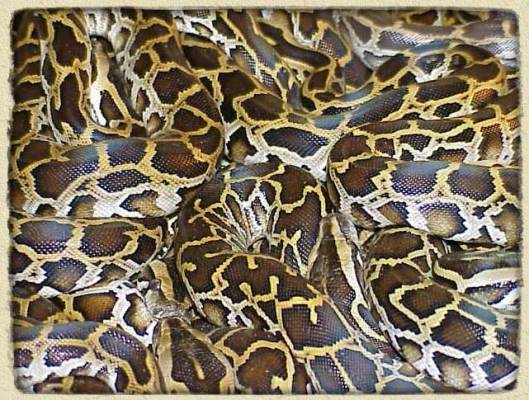
Python - or possibly the SBS test pattern
By Astyages or Theseustoo
Man, the Pythoness realized, was thus but an idea in the mind of God, who endlessly spun stories to amuse himself. Indeed, there were times when the pythoness suspected the gods of having a very strange sense of humour and actually deriving amusement from the delusions under which humans constantly suffered; misled as they almost invariably were by the illusions created for them by the very nature of their physical form; and deceived yet again by the unavoidable limitations of their merely physical means of perception. And on top of all of these illusions, they were oh, so eager to further mislead each other…
The presence of the spirits, which some called gods and others called ‘daemons’ or ‘teachers’, was, the Pythoness knew, imminent in and through all existence, corporeal and spiritual. She knew too that even these two concepts, the Physical and the Spiritual were in fact human constructions; and that in reality they were neither separate nor separable, except in the thought and speech of deluded human beings; rather they were two sides of the same coin. Every ‘thing’ was part of the Whole; and everything, she knew, implied its opposite; for everything becomes its opposite; and even the struggle to slow down or prevent this process only facilitates it. Even existence and non-existence implied each other; the one could not possibly ‘exist’ without the other.
The Pythoness shook herself out of her reverie; for it was time to deal with the physical realm once more. In any case, it was true, she reminded herself, as she frequently did, that the temple certainly benefited from the gifts the inquirers now traditionally brought as payment for her oracular services; and so the priesthood did not try too hard to enlighten them.
And if the Pythoness herself felt an occasional twinge of guilt at the manner in which the priesthood allowed such ignorant, if popular perceptions of the gods to persist; in spite of their superstitious nature; she did not allow it to take root too deeply in her soul. The gods, she knew, would enlighten poor benighted humanity in their own good time and nothing either she nor the priesthood could do would either hasten or delay that process by as much as the blink of an eye.
The persistent ignorance of her inquirers, and indeed, of humanity in general, was not so much the result of a lack of teaching, she knew; for humanity had always had teachers both human and daemonic; rather it was the lack of a desire to learn anything new. After all her years of experience as a counsellor, the Pythoness had finally understood that most people insisted on seeing things solely in the light of their own prejudices; that they habitually refused to see anything new. Even when a new thought or idea is clearly expounded; or clearly demonstrated and explained to them they would actually choose not see it; simply denying its existence at all; or else, when they could no longer deny its existence, they would call it ‘madness’; or ‘heresy’; or even ‘blasphemy’; and simply condemn new ideas out of hand before even giving themselves a chance to understand it.
Indeed, she knew that this recalcitrance was especially true whenever they had a problem. For, more often than not, the answers to their problems involved the inquirers doing things they did not want to do; and although she did her very best to point them in the right direction, she often knew right from the start that few, if any, of them would ever think about doing what was necessary, even if it were to save them from destruction.
How then, she had often wondered when she had finally donned the mantle of ‘Pythoness, could such recalcitrant folk as these ever hope to conceive of the true nature of God? She had eventually learned that the only means she could use in order to achieve a positive outcome to their problems; in cases where this was at least possible; was by deception: She must phrase her prognostications in such a manner that the enquirer would inevitably choose the road to their own spiritual progress in spite of themselves. It was a crude tool, she thought, but it often worked…
Clearly enough, the crude and unsubtle kind of mentality which imagines the gods can be bought for any price, could not possibly understand that a god is infinitely above and beyond all physical wants or needs; and not the least bit prone to either human vanity or human folly; so they neither feel nor respond to human emotions. Thus, she knew, they are not motivated by the same concerns as merely mortal human beings.
She sometimes wondered whether humankind would ever understand that, on those extremely rare occasions when the gods actually do intervene in the affairs of mortals, their interventions are usually the result of the infinite pity they feel for the incredible backwardness and recalcitrance of human nature…
Yet the Pythoness even empathized with all her inquirers’ weaknesses, which she realized were not always wilful, but often resulted from the limitations of their humanity. Indeed she felt compassion for all humanity, just as she had been taught in her mystical and entranced state, while communing with the god. She had compassion, even for all those who constantly deluded themselves with their own all-too-human ideas of just whom and what ‘the gods’ are for she knew that, in any case, the true nature of the gods could only ever be apprehended after many, many years of gruelling mental, physical and spiritual training; far beyond the capacity of most ordinary mortals, because it required a thoroughgoing and rigorous honesty about oneself and one’s own motives, of which most ordinary mortals are quite incapable.
But the Pythoness and her priesthood were not like most ordinary mortals. They were a special breed of human being; the messengers of the gods. As such they were obliged to be the most disciplined of all people; and the most ardent students of all matters, spiritual and mundane. These time-constraints imposed upon them by the requirements of their studies were far from the only restrictions imposed on the priestesses, scribes and acolytes: relationships with men, of course, were quite out of the question. Even their nearest relatives were discouraged from visiting them unnecessarily, as they tended to distract their attention from their studies.
Few indeed are the men and women who feel themselves drawn to such a cloistered and sedentary existence; but those who are drawn to it are very often absolutely devoted; and no-one was more devoted than the Pythoness herself.
Among even the best of these students, there were fewer still that had both the intellectual capacity and the personal discipline it took to study as broadly and as deeply as was necessary to even remotely approach the level of insight and wisdom necessary to perform as the Pythoness. Few indeed had the perseverance required to meditate on their lessons deeply enough to develop the great depth of philosophical insight which an oracle must have in order not only to see the regular patterns behind the almost infinite sequences of events recorded in Humanity’s history, but also to be able to understand those patterns and what they actually mean.
Only by developing a thorough knowledge and profound understanding of the past was it possible to understand the true meaning of the present moment in time; and only with a complete and thorough understanding of the present can it ever become possible to learn how to predict the future. And even then, any oracle must understand that the nature of any prediction was never that of an entirely fixed future, but of probable outcomes, which often largely depended on some determined action or other on the part of the inquirer for their fulfilment; or perhaps, for the avoidance of their fulfilment, in cases of predicted catastrophes.
Of course she was aware that this pitiful messenger from King Croesus knew nothing of all this, nor did he much care. So far as he was concerned, the Pythoness was a demi-god with the power to know and understand the minds not only of mere humans, but also of the very gods themselves. As such she was thus almost as far above his ability to conceptualise as were the gods themselves. Yet it behove a demi-god, she realized, almost as much as a god, to be gracious towards mere mortal humans in their frailty.
In reality, the Pythoness knew that humanity was neither Zeus’ intention nor his creation; they were in fact created by another Titan named Prometheus, who formed them out of the soil of the Earth, and who was eternally punished for his impudence. Yet they had always been such poor and frail creatures; unlike all the other creatures on Earth, they could not cope with extreme temperatures or conditions and fell prey not only to many other animals, but also to many kinds of ailments; the worst of which was folly.
Indeed Zeus thought of them at first as an abomination; yet they seemed to thrive in spite of the huge odds against them. Their abominable nature may have been forgiven but when Zeus discovered that Prometheus, out of his pity for humanity’s fear of the darkness, had stolen fire from his very thunderbolts, the rebellious titan incurred the All-Father’s wrath and was punished in the most horrifying manner for having done so. Yet at the end of time, which the gods can see as if it were today, Zeus, so they say, will finally forgive Prometheus and release him from the rock to which he has been chained for all eternity.
Indeed after watching the progress of humanity for several centuries even the gods themselves could only marvel at the progress they had actually managed to make, even in spite of themselves and all their folly. So finally Zeus had decided that since humanity did not actually ask to be created, it was not entirely to blame for its flaws, which he often managed to transcend anyway… Even Zeus had ultimately become quite fascinated by these unusual creatures; indeed it was as easy to admire humanity’s good qualities as it was to despise their bad ones. And Hera, the Mother of Heaven, and the Queen of Compassion, gave her bounty to all, and most generously to humanity, for she admired the courage they showed in the face of adversity.
 Window Dresser's Arms, Pig & Whistle
My father once reliably informed me that when he was in the lewd and licentious soldiery, copping the Kings Shilling in India; he and the other moist recruits were often woken by the RSM rattling the bottom of their wire bunks with his swagger stick and crying out, “Wakey, wakey, hands off snakey! Put down ya cocks and put on ya socks! Wakey wakey!”
That part would almost certainly be played by either a Welshman or a Scot. The natural enmity between the English and their marginalised celto-gaelic neighbours bringing that extra edge of race resentment to the orders of the RSM.
LikeLike
Mirri, I’ve struggled to remember the name of a little novel I taught many years ago to Year 9s which pretty much began with that aphorism. It was about a kid who trained eagles… anyone know it?
I think the book begins with the kid still in bed one morning when his brother (?) came in and said that very phrase. I was vewy, vewy embarrassed when we had to talk about that book in class!
LikeLike
Atomou, are you thinking of “Kes”, the story of a young Yorkshire lad who trained a peregrine falcon? There was a movie by this name… a pretty good one too… not sure who wrote/produced/directed it though.
🙂
LikeLike
Well done, asty! “A Kestrel for a Knave”. Author Barry Hines. Wrote in the late 60s! Thank you muchly!
LikeLike
A T-shirt with the olives to you!
LikeLike
My very first literary award!
Now, let me see, how did it go….
“Unaccustomed as I am to public speaking, I’d like to take this opportunity to thank all the LITTLE people who made this wonderful moment possible… My thanks go to Emmjay, Voice, Helvi and Gerard and all the other piglets whose support kept me going even through the darkest times in my Herculean struggle to bring you these stories…”
🙂
LikeLike
Don’t forget Manne – who actually cleaned out the Augeans.
LikeLike
This was supposed to turn up, in response to T2’s assertion that I like snake yarns, all the way down at the bottom.
LikeLike
Mirriyuula, at least your erratic posts are still on the same blog; maybe you forget to hit the reply button.
Gerard replied to Mike’s story on Unleashed, but carelessly sent it to the blog on intrest rates. He’s now re-sent it to Mike. According to him, this little post of his is very versatile…
LikeLike
No worries, Mirri; understood it and the context… Heard similar stories from my father and brother Trevor who were in the navy… Did I tell you I come from a family with a long naval tradition? Oh yes indeed! Everyone in our family has a naval!
Of course, depending on how one reads the symbolism, snake stories can have a broad variety of meanings; I wonder what you will make of the ‘snake story’ coming up in the episode entitled ‘A Prodigy Indeed’… coming soon on ‘Cyrus’… now showing at a theatre near you!
🙂
LikeLike
asty I’m desperately trying to make a pun that includes your background and oranges! A nobel for the novel about the navels in the oranges dished out to all the noble naval officers of HMS Nova… I’ll think I better think a bit more about that one, I think!
LikeLike
Asty, I don’t know where you’ve got all this material about the Pythian women. You’ve described her in this and in the previous chapter as some extremely wise critter who knew all about everything, including the nature of mortals. I have a feeling you’re giving her too many qualifications.
My reading of those girls is a great deal more pragmatic. About the only pythians you could give any credibility of “wisdom” are those who worked for Apollo: Delphi, Didyma (I’m translating Iphigeneia in Tauris now and she’s there, being Artemis’ priestess) and Claros… one or two shrines in Lycia, Troad and Boetia. Other than Apollo (the grandest prophet-God of all) there’s also Zeus, with his shrines in Dodona and, of course, Olympia. Aristophanes (in his “Plutus”) describes in a highly satirical way what goes on at Asclepius’ shrine in Epidaurus.
Then, other than the Greek oracles -which at the time were regarded as the ant’s pants of prophetic utterances- there was also the famous shrine of Ammon, in the then Egyptian Lybia, (the oasis of Siwa in Sahara) which Alex the great had visited and was told he was a god.
There were others but people went to Delphi, if they were dinkum about wanting results.
Delphi was an interesting phenomenon because it corresponded with many other Apollonian temples, in a sort of CIA way. Secret service activity. That’s why they had a great deal of understanding of what went on in foreign lands and what was likely to be asked by some foreign embassy. They knew what was going on in every corner of the then important cosmos.
Mostly oracles engaged virgins of middle class whose parents wanted to protect them from exploitation by other middle class families. Generally they were young, ignorant girls who did a lot of “purifying” and performed all sorts of “rites” before they were admitted to the shrine by the male priests, or managers of the shrine. After all, it was mostly a depository of all sorts of wealth.
The Delphic lot would also be initiated into the secret service part of it and they’d be pretty much told what to say, though it didn’t really matter, since it was the attendant oracle reader who’d do the interpretting. The Pythia would simply write her vision (the words she received from Apollo) and then she’d hand the paper over to the man with the long dress.
At the rest of the shrines, the priests and priestesses would be checking out the innards of sacrificed birds, or sheep, or cows (by the rich), or even look at the way the leaves were blown, listened to the whispers of the wind through the branches, chek how things they threw into springs fell… where a fly would land… or simply cast lots, throw dice, etc.
Prometheus, of course, according to Aeschylus, at least, was saved by Hercules who came and killed the eagle that was eating at the Titan’s liver during the day.
An extremely interesting creature, Prometheus -along with his brother Epimetheus and his sister-in-law, Pandora.
A great read. Ta muchly!
LikeLike
Don’t piss on his parade Mou! We more Hellenicly challenged porkers don’t know the difference. Or is this just how Greeks settle these sorts of discontinuities?
I do so love it when you two get down to tossing tacks.
LikeLike
Yes ato amd Asty, we find so many aspects to these ancient tales. Here is a fresh interpretation I came across recently in my scholarly labours:
LikeLike
I certainly had no such intention, Miri. I’m absolutely certain that asty has his sources but even if this is his own construct, it still makes no difference at all to the beauty of the story; but I’d love know which it is because I’d like to get the history of the greek temples and their function right. I’ve no probs at all about being either corrected or being told that -like much of my own tale- is a personal construct.
LikeLike
Voice, yes, Emmjay has already pointed me out to this little comic genius. I think I must have seen all his you tubes. He’s great!
LikeLike
Oh bother ato. And I had hoped to dazzle you with my classical research.
LikeLike
There’s certainly a lot of razzle dazzle with that young trannie. Very funny, too. Took a bit of the wind out of my own sails, though. I’ll have to try and compete now.
LikeLike
I don’t see why you need to compete ato. Just do what you do. No-one else has it covered.
LikeLike
Atomou, as I said, this ‘Pythoness’ is entirely my own creation based on what I imagine might actually qualify a person to call him/herself an ‘Oracle’…
If I have exaggerated the Pythoness’s actual qualifications I must beg forgiveness for historical inaacuracy and tolerance for poetice license for, where my knowledge falls short I am obliged to rely on my imagination.
By giving her a lot of qualifications, and by emphasizing her ‘demi-godhood’ and how this might be perceived, I had hoped to build up an aura of ‘mystique’ around her personage, that is all; my apologies if I overdid it just a tad!
I might add, however, that I have had a little experience as an ‘oracle’ of sorts, myself, in London, when my ex-wife and myself used to make a few extra quid out of doing tarot-card and I-Ching readings and constructing hororscopes for punters… indeed it was my interest in the Chinese oracle which prompted me to return to school and then go on to university so I could learn a little more about China’s (and humanity’s) history…
I thought it reasonable to put the Pythoness within the context of an educated cult; the ‘CIA’ aspect is no surprise to me and indeed, I think I hint at something similar; ie. that the Pythoness herself might be manipulating and controlling the production of history itself… (which she most certainly was, though whether or not she was ever conscious of this fact is perhaps open to debate!)
I’m happy that everyone else likes these bits though…
🙂
LikeLike
Absolutely right on all counts, Asty.
It’s just that I haven’t seen your disclaimer and, though I had worked it out during the last episode, in this episode you’ve embelished her talents so much more that I thought perhaps I had missed some passages in Herodotus or Plutarch or somebody. I haven’t been “in the loop” with the historical journals for a number of years now and I always get a bit too anxious lest I miss something. Stupid, I know but stupid I am, so what can one do? Have more ouzo, I guess… and olives from mum’s tree!
But I have enjoyed the telling of the tale very much. Thank you. Can’t wait for the next snakey story. (Note to self: Must get on with my story, too!)
LikeLike
Ato, I didn’t even know there WAS a loop…
😉
LikeLike
Not an overt one, asty but colleagues and used to buy a number of philosophical and historical journals -or read them at the Melb. Uni. Library and talk or write about them. I haven’t done that for quite some years, life having dragged me away from that milieu… Can’t even remember the names of any of them now. HJA, I think was one of them (Historical Journal of America?) a couple of English publications as well as a Greek one…
LikeLike
“About the only pythians you could give any credibility of “wisdom” are those who worked for Apollo: Delphi, Didyma (I’m translating Iphigeneia in Tauris now and she’s there, being Artemis’ priestess) and Claros…”
It is the oracle at Delph whom we are discussing atomou; the greatest of all the oracles in the world and one of only two found to be worthy of the name by Croesus’ test… I could hardly make her some ignorant peasant girl in a trance, now, could I? I’m not exactly sure what the education of such a phenomenon would have entailed other than history, politics and philosophy, but I’m quite sure it would be extensive.
🙂
LikeLike
I think that this one is asty’s best so far; there is a lot of wisdom here, and Pythoness was abbsolutely right about us mortals seeing everything in the light of our prejudices…
I’ll read it again to take it all in after the holiday boys have gone to bed.
LikeLike
Thank you Helvi; you’re too kind… I’m glad you like my Pythoness; there is a lot of ‘me’ in her…
🙂
LikeLike
asty, for me there always has to be something of the author in the story to touch the reader; to touch the heart , it has to come from the heart…
LikeLike
Bit lonely T2. I’m sure we’re all reading it though.
Yet again I shrivel to note the similarity between the Pythoness’ ideas and Mirriyuula’s. You realise that I am having to re write don’t you? Still the discipline will do me good and I am grateful to you.
I have to admit a happy admiration for these Pythoness pieces. Don’t stop whatever you do.
LikeLike
I agree, with Waz.
Keep it up, T2. As your Pig’s Arms mod, I see that there are far more people reading our pieces than there are people commenting. In most cases there are ten times as many reads as there are comments.
Might I point out that the massively greater exposed Unleashed often has fewer posts on their blogs than we do. Coz ours are so often far better pieces. Which is why we exist and why we all work for nix…..
FYI, we have had over 35,000 visits since we went live in May. For an amateur site with no money changing hands, this is bloody amazing
I for one find First Dog’s cartoons absolutely hilarious, but few people bother to comment – and why should they ? They hit the spot – let’s move on.
I’m hoping that he gets a Walkley.
Not sure what Pig’s Arms awards we need to contemplate.
Suggestions ?
LikeLike
A jar of home-grown olives?
LikeLike
Thanks for the encouragement, Emmjay; 35,000 views since May is encouraging indeed!
I love the ‘First Dog’ cartoons too, Emm, but cartoons generally don’t leave one with much to say; the punchline has already been made…
All the predictions have been made; the oracles have nearly finished prognosticating; “Rien ne va plus! No more bets!”
The wheel spins and the battle commences…
Some fight scenes in the next few chapters!
🙂
LikeLike
As for Pig’s Arms awards, atomou has already suggested a jar of home-grown olives; how about a tee-shirt with a jar of home-grown olives on it…?
🙂
LikeLike
“Coz ours are so often far better pieces”
And/Or our commenters are far better commenters. On the PA the contributor does not get accused of being a phoney, figure-manipulating, meddling, reactionary, inconsistent, nanny state promoting, illogical, controlling, simplistic, foolish, unAustralian lemming abuser.
LikeLike
I’d like to apologise to all the Pig’s Arms patrons for my Unleashed pieces. Sometimes I just can’t help myself. Might just be the textual equivalent of Waz’s digital mischief. Hopefully 1/10th as good.
Loved your lemming response, Voice.
LikeLike
Who? What? You talking to me? I was just filing my nails. OK, maybe my comments above are the blog equivalent of waving frantically in the air while jumping and and down in my seat. I do sometimes muse to myself though about human nature as exhibited by the Unleashed commentariat. Perhaps I’ll muse in writing one day. (No need, I am seated quietly and my nails require my full attention).
LikeLike
Well, to be fair to Unleashed, I’m pretty sure some of the comments are tongue-in-cheek. 🙂 But a remarkable number of people seem to completely ignore the substance and go straight for the superficial layer of controversy.
I guess that’s just the way it is.
LikeLike
Don’t be too downhearted, Mirriyuula, at the similarity between different cosmological traditions; the paradigm is similar in many traditions, including T. Lobsang Rampa’s conception of ‘mind and Overmind’; as well as the cults of ‘Kwoth’ in Africa, Purusha in India and the Zeus and Odin traditions in Europe.
That these should have some Aboriginal correspondant does not surprise me as it emerges, through a similar symbolic process, out of our species’ relationship with its environment; our culture is ultimately all about the manner in which we explore and express that relationship.
🙂
LikeLike
Who can forget the elephants child and his “satiable curtiosity”regarding what the crocodile has for dinner.
”Scuse me,’ said the Elephant’s Child most politely, ‘but do you happen to have seen a Crocodile in these promiscuous parts?’
The was a bi-coloured python rock snake in that yarn too.
http://www.boop.org/jan/justso/elephant.htm
LikeLike
There’s another snakey story coming up soon, Warrigal… Just love snakey stories, don’t you?
🙂
LikeLike