
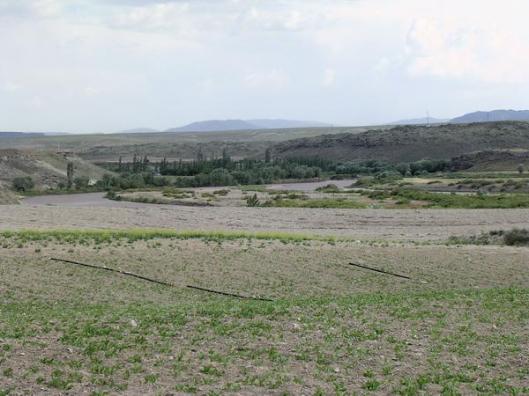
The river Halys at Guleshir - when Croesus crossed the river it meant war with Cyrus
By Theseustoo
Sandanis looked troubled as, seated on his horse in the centre of the front rank of Croesus’ massed forces, he surveyed the enemy’s ranks. Cyrus had arrived the previous evening under cover of the new moon; and had occupied the same position above the city, to observe it prior to attacking, as Croesus himself had done only a few days earlier. This however, did not surprise Harpagus in the least; for the low hill was the only piece of high ground in the broad and otherwise level plain which surrounded the small coastal city of Sinope on the landward side.
But the incredible speed with which he had mustered his forces and arrived even before winter had properly set in, had surprised both him and Croesus, neither of whom had been expecting to have to face Cyrus until the following spring, when their allies would be there to support them. As soon as the huge dust-cloud which indicated the position of Cyrus’ army was spotted Croesus immediately responded with a show of force by having his army parade in battle formation between Cyrus’ army and the city, demonstrating his willingness, if not his readiness, to defend his newly-seized Syrian territory.
The Persian horde, however, was also much bigger than Sandanis had imagined it would be; the momentum this revolution against Median suzerainty had gained was quite staggering, he thought. His spies had reported to him that Cyrus had given all of the cities he’d passed through an opportunity to levy a troop of volunteers to join his ranks and swell the size of his Persian army or else face subjection and enslavement. Many of these were the previously Median-dominated states and had joyfully welcomed Cyrus, seeing in him their liberator from the cruelty and oppression of the tyrant Astyages. Seeing now a potential threat rising from Lydia, such states had joined him willingly; and even eagerly; and had quickly supplied Cyrus with all the men, equipment and supplies he had requested for this expedition.
The few city-states who chose to resist the Persian horde soon realized the futility of their actions when they found themselves besieged by Cyrus’ vastly overwhelming forces. Faced with such overwhelming odds, even those city-states who resisted him; mostly those who were still tributaries to the Assyrians in Babylon; very soon capitulated. Individually they were just far too small to do more than put up token resistance anyway; and Cyrus had moved so swiftly against them that they had no time to coordinate their efforts. Those cities which still obstinately persisted in their resistance were quickly and thoroughly defeated; then their walls were torn down and reduced to rubble; and their inhabitants reduced to slavery.
Sandanis had not counted on this surprising willingness of the other states to join Cyrus’ cause; and he was especially surprised by the almost complete lack of resistance to his imperial claims and ambitions. Croesus’ advisors had also informed him that there was a prophecy which concerned Cyrus in an obscure century-old Hebrew text, the Book of Isaiah, which they said, named Cyrus as the Anointed One. In the light of recent events, however, he thought this could safely be ignored; Croesus, he firmly believed, was the true ‘Anointed One’; the true ‘Son of Heaven’…
But it troubled Sandanis somewhat that so many states had so willingly joined Cyrus’ cause. This Cyrus it seemed, was at the very least a man of charisma; and apparently very popular among his own people, as well as the people of many other nations. This spoke well of Cyrus’ character, he thought, grimly realising that it would make him a formidable enemy too. His master, Croesus, he now realized, was just about to commit himself irrevocably to an extremely bold and very dangerous course of action.
Was it possible that it had been a mistake to pick a fight with this fledgling Persian Empire in the first place? He could not help but wonder; and yet, thought Sandanis, at this point we could still retreat to Sardis without having to face Cyrus; although he realized that it would represent an embarrassing loss of face for Croesus to so easily relinquish a recently captured city. Even so, the general thought, at this moment it could still be done without any other serious losses; and they could always return in spring with their allies. With this in mind Sandanis turned to Croesus,
“Your majesty,” Sandanis said gravely, “before we commit ourselves irrevocably to this war, it is my duty to remind you that you are about to make war against men who wear leather trousers; who have all their other garments of leather; who do not feed on what they like, but on whatever they can get from a soil that is sterile and unkindly; who do not indulge in wine, but drink only water; who possess no figs nor anything else that is good to eat…”
Croesus appeared not to understand what Sandanis was getting at; he regarded his general quizzically; did he really think Croesus was such a coward as to retreat so easily at the first sight of the enemy? The puzzled frown with which Croesus now sternly regarded his general silently demanded further elucidation from the now embarrassed Sandanis, who coughed, a little nervously, and then continued quickly,
“So, if you conquer them, what can you get from them, seeing that they have nothing at all? But if they conquer you, consider how many precious things you will lose: and if they once get a taste of our pleasant things, they will keep such a hold of them that we shall never be able to make them loosen their grasp. For my part, I thank the gods that they have not put it into the hearts of the Persians to invade Lydia…”
Croesus was used to circumspection in his general; and he knew that Sandanis was not normally one to question his king. However, it is true, Croesus thought as he regarded the Persian host on the hill, that Cyrus’ army is much larger than either of us anticipated; and they have somehow managed to march them here much sooner than we expected; but he had never seen Sandanis quite so reluctant to fight.
Croesus knew from long experience that his general was anything but a coward; indeed, had he not been so confident of the gods’ goodwill himself, even he might have considered a cautious retreat to be the better course of action; at least until the spring, when their forces would be augmented by their allies. But now he knew for certain, he told himself, that the gods are on our side; and this is perhaps simply the first test he faced on his path to demi-godhood; after all, heroic feats, he reasoned, were always demanded of demi-gods.
And, he thought to himself to steady his nerves a little, that elusive goddess Fortune, though often fickle, usually favours the brave! In any case he was determined not to turn tail and flee like a whipped dog or a cringing coward, just because an unknown and hitherto untested enemy had suddenly put on an unexpected turn of speed. Yet he also knew that to allow himself to look weak by retreating, before even putting the enemy’s army to the test, could also be to invite disaster by starting to sow the seeds of a suspicion of cowardice among his own men; he must engage the enemy, he thought grimly.
“Thank you for your concern, Sandanis,” Croesus coolly replied, “but I assure you it is quite unnecessary; the gods are on our side in this battle; the oracle at Delphi said my kingdom will last forever; we cannot lose! As soon as we have won here we shall march on Media and Persia.”
Then, turning to address his other officers and the rest of the host in general, he grimly declaimed, in his loudest voice: “Now, gentlemen, you all have your orders; let each man do his own part nobly and you will all be rewarded with positions of honour in my new domain.” Then, turning to the trumpeter at his elbow, he ordered, “Trumpeter, sound the advance!”
*** ***** ***
 Window Dresser's Arms, Pig & Whistle
Atomou, thanks for your interesting and thoughtful question regarding my admittedly rather glib statement about the relationiship between war and religion.
As you say, prior to the invention of Christianity, religion per se was NOT a motive for war and no king or general ever went to war in the name of their god or gods. This much is true…
However this does not necessarily mean that religion did not play a part in pre-Christian warfare…
You see, it was the paradigm of the ancient world to believe in a particular kind or notion of ‘Virtue’ (hence my perhaps enigmatic statement of my desire to do a diachronic analysis of the changing nature of this concept).
‘Virtue’, of course, was, if I may attempt a brief definition of this word, is ‘that form or forms of behaviour which are believed to be pleasing to the gods and men’ (no sexism intended here!). For this reason sports heroes gave their all in the Panionium (the original ‘Olympic Games’) for the sake of a laurel wreath and eternal fame… immortality!
The other, and indeed, the original forms of behaviour which was regarded as ‘pleasing to gods and men’ were those which had to do with warfare… which also provided the other path to ‘immoratality’; through the immortal fame accorded to heroes. The chieftan who conquered all his local tribes became a king; a tibutary monarch and as such, recognized as being ‘favoured by the gods’, as evidenced by a successful career of empire-building… The king who subdues all other kingdoms is called ‘King of Kings’, the ‘Annointed One’, the ‘Chosen One’, the ‘Son of God’ and similar such titles. This is why I’ve set up the struggle between Croesus and Cyrus as a struggle between two rival claimants to the title, ‘Son of God’…
So you see, what you have said about warfare is really only partially true and religion was indeed a very strong part of the motivation of even ancient kingdoms to engage in warfare. This, of course is due to the all-pervading nature of religion and religious behaviours… which constantly shape and frame even mundane behaviours.
The Panionium itself might be interpreted as an attempt by the kings of the ancient world to engage in behaviour which was ‘pleasing to the gods’ without the necessity of having to actually go to war in order to do so… at least to some extent… though it never actually succeeded in becoming an actual ‘replacement’ for war… sadly! Indeed sadly it is nowadays often used as an ideological adjuct to warfare, as in the 1936 Olympics, for example.
Don’t worry too much about the ‘aesthetics thesis’ in Chapter 1, atomou; you may find it easier to understand after reading the rest of the book… It’s possible that it may have made a better final chapter, rather than an introductory one, but its positioin in my book is largely due to the demands of my tutors to ‘explain exactly what it is you mean when you use the word, ‘aesthetic”….
I could explain this in simpler terms perhaps, but it would take too many words to do so here. Suffice it to say that it is all about the communication of coded messages through the medium of aesthetics. In this sense (and in this sense ALONE) art and violence are parallel phenomena whose internal structural relationships are identical.
But I do promise you, atomou, that the rest of the book is much easier to read than the first chapter… and indeed, much more interesting too!
🙂
LikeLike
I think that was just a slip T2, and you meant to write Judaism (in agreement with atomou), rather than Christianity.
LikeLike
Before that gets misinterpreted, I should have said “prior to the invention of Judaism”, not just “Judaism”.
LikeLike
Thank you Voice, it was indeed a slip; I should really have said ‘prior to the invention of the Judeo-Christian paradigm’ (which also includes Islam and the Bah’ai faith…) (in fact, ’emergence’ was the word I was tempted to use initially but decided on ‘invention’ because all religions are invented by humans… and this word implies a human construction.)
Indeed, the Jews were unique among the people of the ancient world because they DID go to war in the name of their god and in response to the promptings of their prophets… and apparently still do!
Polytheists basically understood that, at some level, ‘all gods were one’ and thus never bothered to interfere with the religious practices of other countries… indeed, even when polytheistic kings conquered other countries, they usually went to great pains to pacify the local god(s) and incicentally, in doing so, pacify the population which then may be exploited and subjected to slavery, but which were rarely actually exterminated.
The difference is essentially that the followers of the Judeo-Christian paradigm see their claim to the ‘one and only’ TRUTH as an excuse to acculturate, subjugate, exploit and even kill (read ‘ethnically cleanse’) anyone who holds a different belief… It is here that we see the seeds of true ‘religious wars’.
I never did say, or intend to imply that warfare was solely a Judeo-Christian phenomenon; merely that their religious motivations for going to war had a tendency to upscale and intensify ANY conflict and make their wars so much bloodier. I particularly pity the poor old ‘Amalekites’ who were virtually wiped out (indeed the Bible says totally wiped out… even their cattle and other animals were slaughtered!) several times during the course of the Old Testament.
However, it is impossible to properly understand ‘Judeo-Christian’ violence (theoretically, at least, an oxymoron!) without understanding the relationship of violence to the polytheistic paradigm of the ancient world from which it emerges and of which it represents a transformation.
I hope this clarifies my position…
🙂
LikeLike
Yes T2, that’s how it happened in that region. But generalisation is a tricky business. I am particularly sceptical when it supports a fashionable hypothesis.
Religious wars can be and have been instigated for causes other than monotheistic religion. Here is an example.
“In 142 CE Zhang Daoling announced that Laozi had appeared to him and commanded him to rid the world of decadence and establish a new state consisting only of the ‘chosen people.’”
http://en.wikipedia.org/wiki/Way_of_the_Celestial_Masters
[P.S. I hope you are not implying that my replacement of “Christianity” with “Judaism” was somehow an implication that you meant “that warfare was solely a Judeo-Christian phenomenon.”]
LikeLike
As you say Voice, generalization is a tricky business… and please accept my apologies for the crudeness of my attempts to do so.
I am, of course, aware that some polytheistic religions have indeed perpetrated religious wars… (and that even secular philosophies have been responsible for wars of extermination/assimilation; such is the ubiquitous nature of human violence, I’m afraid!). I did not intend to imply either that warfare, or even religious warfare was the sole province of the Judeo-Christian paradigm… simply that because of the Judeo-Christian insistence on its own unique access to the ‘one and only TRUTH” that such wars were much more likely to be wars of extermination and/or assimilation.
Thanks for the link… it is an interesting example you cite.
However, leaving aside for the moment that in its more intellectual formulations, Taoism is an atheistic philosophy, rather than a religion, it is evident from your example of Zhang DaoLing that Master Zhang was attempting (with some success, apparently, at least in Sichuan province) to institute his own, most probably ‘neo-Taoist’ philosophy as a state religion, even to the extent of exterminating those who refused to accept it.
“Of old the sages used the Tao not to enlighten the people, but to confound them!” (Lao Tzu) Perhaps this was what Master Zhang was doing…?
But, in any case, since Master Zhang was attempting to impose a single, unique ‘TRUTH’, he was doing exactly what the early Christians tried to do with Christianity… ie. to impose an ‘orthodoxy’ or body of dogma upon the people, to the exclusion of all other epistemologies. Do you not see the parallel? So what happened in the middle-east has its parallel in the far east too.
I’m also quite sure that Lao Tzu would have been just as horrified by what Master Zhang was doing to Taoism as Jesus would be by what the more orthodox Christian religions have made of Christianity since his death.
Thanks for an interesting discussion, Voice.
LikeLike
PS: Voice, I was unaware that my hypothesis was as ‘popular’ as you seem to indicate, in spite of my frequent repetition of it on Unleashed…
🙂
LikeLike
Well yes ato I do see the parallel, however it’s not with mono-theism itself but with the imposition of dogma. As you said yourself. Having said that, mono-theism does seem more prone to it I agree.
Of course it doesn’t have to be epistemological dogma. Look at Mao Tse Tung (or however we write his name these days.)
Also it’s an easy trick to Google a counter-example so I can’t take too much credit for an interesting discussion.
Yes T2, the “Religion (particularly Judeo/Christian and now the more inclusive Abrahamic) is evil” line is a popular one these days. I suppose it is a pendulum swing against the “Religion is good” line.
I happen to know one minister in particular and a couple of priests for whom I have the utmost respect and admiration and who have done enormous good with their lives. It feels like they are getting denigrated in some way, ‘though I’m certain that denigrating good people is not the intention. Of the four people whose integrity, compassion, and wisdom I respect the most highly; 3 are ministers.
I was lucky enough not to meet any of the other sort, although I seem to recall you were not.
LikeLike
Voice, my grandfather was a priest. Right up until he died (when I was 11) I was virtually raised on his knees and on the knees of of his younger son, who eventually became a priest himself and a prof of Theology. He’s retired now. Grandpa had 11 kids, all of them devout, god-fearing Christians, and all of them -like the rest of the village, big hearted, generous, kind, loving, fun-loving, people-loving, charming, well tempered people. A child could not have asked for a better childhood.
But, the quality of people does not represent all of the people. This much you said yourself. It is the others.
To my mind, it wasn’t religion that made them good but something else. A whole lot of other things which probably acted against religion itself and helped them out of its worst excesses.
Good people, in other words are good people in spite of their religious beliefs; in spite also of their political beliefs, or their beliefs in social contracts.
My father walked out of religion when he was in his early 20s (or so he told me, while he was fighting in WWII) and worked against it with quite some passion throughout his life, though, funnily enough, he didn’t consider his own father or any of his siblings as religious beings. To him, too, they were simply good people. I don’t even ever remember him arguing with them about the existence of god or fairy godmothers. He thought of the Christian god as I do, just another god in the grand mythology of gods. But he did hated the notion that people went to war, or brought about war through religion. He hated proselytising do-gooders, bible bashers, god-botherers and wearers of religious symbols and flags. Hated all flags and symbols, really.
Your friends, therefore, I suggest, would still be good people, still be doing good work, whether they were religious or not. Something more powerful than religion is working there. It might well be Humanness, which, I believe is mightier than all the gospels in all the cathedrals, mosques, synagogues, temples and shrines in the universe.
These are the people I speak against.
LikeLike
Thanks again Voice… I think our possitions are not so widely separated as they sometimes appear. And I appreciate the honesty your reluctance to claim credit for an interesting discussion displays; though you are too modest… and it is STILL an interesting discussion.
However, to reduce what I have said to the bald statement that ‘religion is evil’ is something I can’t accept; it is NOT what I said; and, popular or otherwise, was not the basis of my hypothesis. The ‘hypothesis’ I was referring to was not that ‘religion is evil’ quite so much as that ‘some religious beliefs lead to evil practices’… and an intensification of other social evils such as warfare, which was the specific example I gave…
I think the ‘evil’ part of the Abrahamic religions stems mainly from three things:
1: Their ‘absolute’ notions of the nature of ‘good’ and ‘evil’… these are in fact relative concepts, but when they are personified and deified (ie. when ‘God’ is seen as everything that is ‘good’ and only ‘good’… and when the ‘Devil’ is seen as totally evil and only evil) the two concepts – which are actually two sides of the same coin – are separated, and given ‘purist’ notions which are ultimately absurd… not to mention socially destructive.
2: The notion that there is a single, solitary ‘TRUTH’ and that all other epistemologies are thus wrong and therefore ‘evil’… and of course this is far too often seen as ‘totally evil’ because of point #1, and therefore they must be demonic or diabolical… The implications of this single belief have led to far too much slaughter to attempt to document it here, but has historically been seen (again, far too often) as giving ‘belivers’ the right to exterminate ‘infidels’ (even if it’s only ‘recalcitrant’ ones, who refuse to convert)…
3: If ‘belief’ were a map, which represents ‘reality’ it would inevitably be at best inaccurate… and this can lead to some dangerous situations… it would be as if Strabo’s world map were used as the basis of modern navigation… Whilst it might hold good in large part, there will come times when reliance on it is absolutely lethal because of the differences between ‘assumed reality’ and ‘actual reality’ (assuming, for the time being, that there IS some kind of ultimate or objective reality…)
I’m aware that there ARE some very good and sincere religious ministers and do not doubt that they do a lot of good… nor was it my intention to denigrate them; but to indoctrinate children into what amounts to a misleading (#3) epistemology, which they then assume to be accurate and use as the basis of their own ‘life-navigational’ systems is heinous.
Of course, ironically, the original Hebrew conception of God was that he had both good and terrible aspects; the separation of ‘God’ from the ‘Devil’ which occurs in the New Testament IS a largely Christian invention, although even this has earlier parallels (in the personified dualism of Zoroastrianism, for example).
I do have other serious ‘quibbles’ with the Judeo-Christian paradigm… but these three are the main ones.
I don’t know that I’ve met such terrible priests and minsiters either, Voice… although one or two of the more traditional Irish ‘fire and brimstone’ priests came close… and some of what the nuns taught us in school can only properly be described as mental and spirtual child abuse…
However, my own personal ‘schism’ with the Catholic Church was the result of a revelation which occurred to me when my mother was excommunicated because she divorced my philandering father… The absolute injustice of thie action was so immediately obvious, even to my childish understanding that it revealed the inherent contradictions between the church’s dogma and any notion of ‘real justice’ in all its absurdity; but this I have always thought of not so much as the act of any individual priest, but the act of the Church as a whole, being based on the prevailing religious dogma of the time (I think it was pre-Vatican II).
And Vatican II just proves that this church is simply attempting to play ‘catch up’ with a world which has moved on beyond its own still largely medieval mindset. So far as I can see, as a belief-system, it (in this instance, I’m talking about Catholicism) has lost all relevance…
🙂
LikeLike
asty agree with all you said. I wish only to ponder a little further on your last sentence: “…as a belief-system, it… has lost all relevance.”
Quite so, with the Catholic religion but is there really a “belief-system” (and I mean ‘system’) that is relevant any more?
And there is a number 4, though, I think the aggregate of your three alluded to it: Religion IS purely a belief system and should not be treated as scientific dogma, which is where its adherents and vicars are wanting to take it. It is, as you said, merely Stabo’s atlas: bits of it are plausible but none are reliable, or worthy of trust (viz. faith, belief)
LikeLike
Oh yes atomou, subscribing to a belief system is part of the human condition. In fact, that’s one of the strongest points in favour of a reasonable organised religion. People (generally) need a belief system and if they don’t find it in a reasonable organised religion they look elsewhere. One of the the points in favour of the concept of heresy in fact.
But, get rid of organised religion, and what replaces it?
LikeLike
Replace it with the best possible replacement. It’s been under our noses since we emerged from the primal slime: Humanness. Believe in the immense ability of humans and their nature. It will work brilliantly if we educate it to believe in itself and not in fairy god parents. Teach humans truth only: Begin with 1+1=2 and do not stray into the supernatural.
LikeLike
Right with you there, atomou! (Though I would have used the word ‘Humanity’ or perhaps the Confucian ‘Human-heartedness’. Whatever… they all carry the same essential semantic content).
But I think it is esential that we start to teach kids to ‘do the right thing’ simply because it IS the right thing to do, and not because some god or other says that he’ll condemn you to an eternity of all manner of tortures if you don’t and on the promise that you will be eternally rewarded if you don’t!
I suppose it depends on what kind of human being you wish to cultivate; one who responds, donkey-like, to the ‘carrot and stick’ (perfectly adequate for totalitarian regimes and tyrannies, of course!) or one who can think for themselves and decide for themselves in any given instance whether or not any particular course of action is ‘right’ or ‘wrong’… remembering always the wise words of Sir Douglas Bader: “Rules are for the guidance of wise men… and the obedience of fools!”
Only the latter is appropriate in any society which seriously wishes to consider itself a ‘democracy’… and, for all its shortcomings, democracy is, as Winston Churchill said, “the worst possible system of government… apart from all the others!”
🙂
LikeLike
Oops! That should have read, “… eternally rewarded if they DO!”
Sorry!
😉
LikeLike
asty, this discussion brought to my mind a little short story written by no one in particular (so far as the enormous literary world goes) called “One-Leg Island.” The author was Sir Walter blah blah Murdoch (born in Scotland, I think) but one of the early fathers of the Literature faculty at Melb. Uni.
The story is beautiful in that it describes the ease with which idiotic and very dangerous traditions and laws can be put in place in a society, particullarly one which is separated from the rest of the world. I’ll see if I can find it somewhere, though I doubt I will. I remember teaching it to my Year 9s and 10s, though from which text, I canny remember!
It’s a great lesson.
LikeLike
I agree with a great deal of what you say, asty.
Mortals, back then, wanted to please their gods and they behaved in a manner and within a protocol which, they thought, would please their gods.
However, I don’t think that there is any evidence that wars had been waged, simply because gods have asked their subjects to wage them, on their behalf. So far as the eastern rulers were concerned, it is true that, due to obsequious shamans in their courts, they developed delusions of immortality and divinity, though, they must have all realised at some point in their lives that whatever deistic titles they cared to give themselves, their connections with the heavens were very tenuous indeed, since they and members of their families had all succumbed to the most common and most vulgar symptoms of mortality. In other words, they did not believe their own propaganda.
Caligula might have had delusions of immortality but even he did not instigate religious wars. Even he did not say, “I am the son of Jupiter and by virtue of that fact I order you to go to war, so as to accomplish the will of a god!”
Nor, do I think they believed that they would please their heavenly relos by going to war. Perhaps by defending their nation, yes; that would be a virtuous thing to do and a thing that, they could have and might have believed, would please the heavens but I can’t seem to be able to read the view that these tyrants went off to war to embellish their god’s kingdom (even if they thought that their kingdom was the kingdom of their god) or to gain favours from their god.
Virtue on the battlefield (even a sports arena) is another matter. Fate had placed you in that battlefield and you must act bravely, virtuously and the more virtuously you acted, the more likely you’d gain immortality because you’d leave behind a Story. A story which would be weaved in fine tapestries by the women, painted on expensive clay vases by men and sung by the bards in the courts of kings. But the battle would rage on. Achilles would kill Hektor and shame him in front of his own people but then, he’d do the virtuous thing of allowing his victim’s father, Priam, to take the corpse of his hero-son back home and give it the appropriate, religious, burial rites.
Also, what I mean not to say was that all wars since the emergence of the abrahamic religions were religious. Plenty of them were but obviously not all; and yes, wars of greed and power were and still are often propped up by disgusting religious propaganda, spun out by frenzied fools deluded by their own sense of divine contact.
Nor did I mean to say that all religious wars after the appearance of abrahamic religions were conducted by adherents only of these religions. But it does seem to me that these religions brought about a new “casus belli,” a new “prophasis,” that of religion.
But then again, this is my own interpretation of what I’ve read in the history books. I’d hate to be dogmatic about it.
LikeLike
In enjoyed this chapter particularly, T2. I could feel the tension – and the stuffed I you do, stuffed if you don’t decision about going to war has such resonance for every General, wouldn’t you think ?
While abhorring war per se, I must admit that I do like a good piece of strategy played out well. And then the victorious can pretend there was more to it than luck.
LikeLike
Thanks guys’n’gels… the response to this post has cheered me up somewhat (Don’t ask!). But I’m glad you’re all still enjoying the tale… Lots of battles and another snakey story coming up… but a different ‘snakey’ story this time!
Emmjay, I too abhor war, and indeed violence in general, but enjoy a ‘good strategy, well played out’… (Coming right up sir… You want fries with that?)
I also enjoy a good game of Medieval Total War II… and am not averse to a good game of ‘FEAR’ or even ‘Return to Castle Wolfenstein’. Occasionally I still like to play ‘Doom’… Not too keen on RPG’s though… Maybe we should just get our generals to sort things out over a chess board?
Do you like the way I’ve set this up as a battle between two ‘Chosen Ones’; two ‘Sons of God’? And I’m quite sure that this was exactly how their followers viewed their epic clashes… (Anyone who’s finished reading the second part of my ‘Aesthetics of Violence’ may understand why I have done this).
I often wonder how much more progress the human species might have made if we had not had religion to ensure we were all constantly at war with each other… One day maybe I’d like to write an anthropological essay on the changing nature of ‘Virtue’… One day… Maybe…
😉
LikeLike
Might I purchase a copy of your “Aesthetics of Violence” please T2 ?
LikeLike
Interesting you said this about religion and war, asty.
I’ve been thinking about it quite a bit recently, as I go about my work.
It’s a curious thing religion The religion of today, I mean. Enormous power behind it. Fear, hatred, love. All mighty forces that can move battalions and destroy everything in existence. Twists minds. Corrupts logic, begins devastation.
But then, what was the cause of the Trojan war?
How much did religion have to do with the Peloponnesian war?
What religious motive did Darius have to attack Greece? And his son, Xerxes? Cyrus, Croesus, Sardanis and all the rest of those warrior kings -were they moved by the wish to deliver their religion to each other’s land?
Where was religion when Alexander (the Great) marched into every corner of the then known world? Was Caesar, Pompey and a whole lot of others answering the call of some god when they went about taking over where Alexander left off?
Up until then, they paid homage to gods, hoping to gain their goodwill and help them. They consulted the oracles and gave lots of bribes to its priests to get favourable prophesies but where the gods, was religion the motive behind those ancient wars?
No, not yet!
Not until Judaism and Christianity spread its cancerous virus and then it was ALL religious wars! Asses’ jaws were used, trumpets were blown to bring down walls, the Roman Empire split and its two fragments covered the entire europe, Africa and the whole of West Asia. The Byzantine empire was constantly in turmoil. Monophysites versus triphysites… Crusade after mindless Crusade.
Genghis Khan had no religious motive. Just good old greed for power, an unquenchable thirst for blood and an implaccable belligerence. But, he was subdued by the maniacal Muslims of the time and his empire became the worthy enemy of Christiandom. They won for over 400 years. The Ottoman empire ravaged as much of the world, if not more than did the Roman empire and the Greek empire before it.
Those wars are still going on. What role does religion play now? Well, I look at the frenzied Zionists in Gaza and Palestine, the occupied teritorries and I see the frenzied Imams speaking from their mosques and I think that maybe religion is still the hydra that needs to be killed if we are to have any peace.
But it wasn’t so before the abrahamic religions sprouted – from lands where nothing but sand and rocks sprout. Monotheistic bullshit that’s been taken too seriously, too politically, too militarily.
Even the most devoted pagan -pre abrahamic religious person- wouldn’t go to war for the sake of religion. He might well blame the gods for bringing this destruction upon him but he’d never say I must attack for the sake of my god. It didn’t matter two peanuts if his neighbouring country had different gods. In fact, the romans were quite good at accepting other gods. The more gods on your side the better chance you had in the after life.
Not any more, alas, not any more!
Bloody ‘ell! Time for my medication! That’s what happens when I’m left unsupervised by the nurse of the house for too long!
I enjoy your work all the time, asty. Though I’m lost with the aesthetic thesis. I need to concentrate too much and I don’t have that sort of time in my hands these days. Busy, busy busy!
LikeLike
But I won’t let myself get away with omitting the other head of the serpent, the Christian evangelist barkers who beget the likes of Bush, Blair, Howard and so many others, too numerous to enumerate (as Jack Hibberd would say) -whatever their religious clan.
Anathema to the lot of them!
LikeLike
Emmjay, certainly you may purchase a copy of ‘AOV’… If you will email me your physical address I would be only too happy to wrap up a copy and post it off to you, trusting you at the same time to send me either a cheque or postal order for $25.00, which is the ‘cost’ price (RRP: $36.00). How would you like it inscribed? ‘To my dear friend, Emmjay…’ or ‘To my dear friend, Mike Jones…’?
I’m happy to offer this discounted price to any and all piglets who might also like a copy of this interesting anthropological work. I can promise you an interesting read.
🙂
LikeLike
I think we are too ready to accept that kind of criticism unquestioningly atomou. Possibly because it is to a certain extent self-criticism, i.e. criticism of our own (broadly speaking) civilisation, and that seems to be in vogue.
Religious wars are not limited to Abrahamic or even to mono-theistic religions.
Then again, it is always debatable to what extent so-called religious wars really are religious.
LikeLike
Hence the expression “crossing the Rubicon”. Or maybe not.
LikeLike
Not quite, Voice.
The Rubicon , a little river the location of which to this day is disputed, is the location of an incident that happened some 500 years later. Without going too deep into the Rivers and Tributaries of the Roman history itself, it was the place of great moment for one Julius Gaius Caesar who stood on its banks and pondered what he was doing and what he was about to do. The river was regarded as the northern-most border of the Roman Republic and crossing it with an army meant war. For Caesar, it meant civil war because the Republic was in a chaotically corrupt state, so far as its governing bodies were concerned.
On or about the 11th of January 46 BC, Caesar stood there for a moment and pondered the situation. He had only one tenth of his forces.
Two historians talk about that momentous incident: Plutarch and Suetonius. Suetonius reckons some supernatural being appeared, played the flute for a bit, then grabbed some military musos trumpet and sounded the “onward roman soldiers” blast and strode fast across the river, encouraging as it did, Caesar’s soldiers to follow it. Then Suetonius continues, Caesar said the Latin words “iacta alea est” (The die is cast) whereas Plutarch has him theatrically sweeping the air with his right hand and quoting an old Greek Comic writer, Menander, in Greek, with the words, anerivsqw kuvboß (let the die be cast).
At that point in time the consequences of Caesar’s crossing of the Rubicon were very iffy. Later, of course, we get to see that it was a good move, if for no one else, at least for Caesar, so far as his then current enemies were concerned. Unfortunately, a little later still, more enemies sprouted and the old boy ended up being a dart board for I think some 23 odd senators. On the morning of 15th March, 44, (The Ides of March) just a couple of years after he had crossed that little river and at the age of 56 the belligerent dictator breathed his last breath.
His words during those last moments again are disputed: Suetonius says that others have said that when Caesar saw Brutus coming at him with the dagger, he spoke in Greek, saying: kaiv suv tevknon… (You, too, son?) Plutarch says that Caesar said nothing but drew his toga over his head. Shakespeare, of course has him uttering the words, et tu, Brute? (And you, Brutus?).
LikeLike
Bugger! Why didn’t the Greek appear?
I know youz don’t care but I’m gonna try again anyhow:
The first two words should read like this: ανερἰσθω κὐβος (let the die be thrown) καἰ σὐ τἐκνον; (You, too, son?)
I’m crossing my rubicanian fingers!
LikeLike
Ha! This time the only thing it did wrong was to change the accent into a breathing mark. That’s all right, I’ll leave with that!
Bloody cyber gremlins!
LikeLike
Thanks for the description atomou. The similarity was so striking I had to comment.
LikeLike
I’m with Sandanis here I would not start wars with men that wear leather pants and who don’t drink wine. They don’t even have figs, my favourite fruit…why bother! 🙂
LikeLike
I’m with you H. I thought the same thing. Wise move taking care with dudes who wear leather armour. Isn’t that the armour you wear when you’re not wearing armour ? And for folks for who luxury is a roll in relatively clean dust, toughness might be something more than just a by-word.
Did they eat their own stragglers as well ?
LikeLike
Yep, leather is ‘Clayton’s armour’ alright… and I’m happy to be able to say it still works in this day and age; my own leather jacket saved me much skin, which I’m sure would have been stripped from my back and arms had I not been wearing one.
BTW, Emmjay… assuming the photo you attached (or was it Wazza?) is what it purports to be, and indeed represents the River Halys and surrounding territory, I must say I’m rather relieved as I wrote that description from my imagination only, not knowing anything really of the topography of the region. But your photo looks just as I imagined it except for the absence of the city of Sinope… which could, of course, be just off screen and out of view…
🙂
LikeLike
I always attribute Waz’ work. Otherwise mea culpa.
LikeLike
As rich as Croesus but to get as old as Methuselah. He reached the well earned age of 969 years.
I wonder if the age of Methuselah was reached by using the Greek calendar of the Metonic cycle of 19 years?
I just read that this Greek calendar is still used to for calculating movable feast days, such as Easter.
If so, then I am already older than him.
LikeLike
Gerard, I don’t think that’s how they calculated Metho’s age. If that were the case, other prominent figures around his time would have lived a very short time indeed. No, I think, Metho was just one of those lovely biblical myths. Lots of calendars around that time also, which were settled around Julius Caesar with his Julian calendar which he worked out with his astronomenrs and mathematicians not too long before he went to Dictator Heaven. It was implemented the folowing year and lasted until another emperor, well a Pope, really, (Gregory XIII) revisited it in 1582. The Julian calendar kept going in many countries pretty much until the ’90s when the last Orthodox (mainly eastern) strongholds thought they ought to get with the prgram and change. Though, when it comes to the orthodox movable feasts calendar (like Easter) and such like, the Julian calendar still persists.
LikeLike