
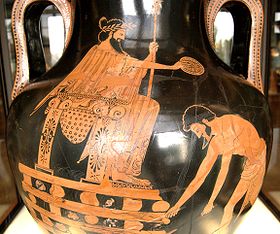
Croesus on the Bonfire
by Theseustoo
Cyrus ordered a huge bonfire to be built, on top of which fourteen Lydian captives were bound and laid; one for each day of the siege. Croesus too, was led to the pyre in chains and laid on it. The half-dozen guards who had been posted at regular intervals around the huge bonfire then lit its base with the flaming torches they carried, as Cyrus watched the flames begin to bite into the lower levels of the bonfire; but instead of cries for mercy, there arose from Croesus what sounded almost like a prayer… Yet Cyrus could not quite recognize the name his erstwhile adversary now invoked.
“Ah, Solon, Solon, Solon!” Croesus lamented bitterly from the top of the huge pyre, “How right you were! No-one can be called happy while they yet live!”
Cyrus was intrigued; his curiosity suddenly quenched any desire he may have had for revenge on this king, who by reputation was a very holy man, and renowned for his justice and wisdom. Cyrus could not help himself; he had to know who it was that this holy man was now invoking in his extremity. Shouting up at the now silent Croesus, he asked,
“What’s that you say, Croesus? Who are you calling on?”
“One whom I would give much to see converse with every monarch!” Croesus responded, very sadly, “Many years ago, an Athenian called Solon came to see my court and all its splendour and made light of it; and now everything he said to me then has fallen out exactly as he foretold, although it was nothing that concerned me especially, but applies to all mankind alike; most of all to those who think themselves happy.”
“By the gods!” Cyrus exclaimed, when he heard this sad tale, “Nothing that men do is secure! Here is a man who has in his lifetime been as favoured of the gods as have I… and I’m burning him alive! Guards! Put that fire out and bring Croesus down to me…”
The guards instantly ran to obey their king but they had not been expecting this order and although there was a large stream close to the bonfire, by the time they had formed a bucket brigade the fire already had too strong a hold on the huge wooden pile. It soon became clear that their efforts to extinguish it were in vain.
“Your majesty,” said one of the guards to Cyrus, “it is impossible to quench the fire! It has too strong a hold already!”
As the flames began to climb rapidly towards the sacrificial offerings laid out on top of the pyre, Cyrus was suddenly appalled to think that he might be the cause of this man’s death. Yet there was nothing he could do to save him. Suddenly, Croesus’ voice again arose from the top of the bonfire, in another, most earnest and heartfelt prayer:
“Apollo!” he intoned loudly, addressing the sun’s disc as it sank slowly towards the western horizon, “If ever you have received from my hands any acceptable gift, I implore you to come to my aid, and save me from this terrible death.”
Before this the sky had been cloudless and of the clearest blue, yet now, very suddenly, darkening storm-clouds swiftly gathered directly over the bonfire and a huge rainstorm burst overhead. Such a torrential rain then poured down upon them that the bonfire was quickly extinguished. The shower however, lasted no longer than was necessary for the fire to be quenched and then stopped just as suddenly as it started; the clouds now completely dissipated.
Cyrus’ astonished guards helped Croesus down from the pyre and escorted him to sit next to Cyrus. Since it was clear to everyone that the gods themselves had quenched the bonfire, Cyrus also freed the other fourteen men whom he had been just about to sacrifice to them, since they evidently did not require the gift. But, Cyrus thought to himself, he had certainly tested Croesus’ reputation as a holy man; and he had indeed discovered it to be well deserved. Turning to Croesus as the guards seated the captive monarch next to him, Cyrus was impelled to ask him,
“Croesus, now I am certain that you are a good man, and favoured by the gods! But tell me, who was it that persuaded you to lead an army into my country, and so become my foe when you could have continued to rule your kingdom as my friend?”
“What I did, oh king,” Croesus replied sadly, “was to your advantage and to my own loss. If there be blame, it rests with the god of the Greeks, who encouraged me to begin the war.” Here he paused and uttered a heavy sigh; but Cyrus’ gentle gaze silently encouraged him to continue, “No-one is so foolish as to prefer war, in which, instead of sons burying their fathers, fathers bury their sons, to peace. But the gods willed it so…”
Cyrus appeared to be lost in thought for some time and Croesus took the opportunity to look around him and assess the situation. A few moments later he cleared his throat to politely interrupt Cyrus’ contemplation. Once he had Cyrus’ attention, he said, “May I now tell you, oh king, what I have in my mind, or is silence best?” he asked.
“Croesus,” Cyrus said, his now kindly intentions towards his captive reflected in the gentleness of his tone, “you may speak freely; you need fear no further evil at my hands.”
Indeed Cyrus now felt terribly sad that things had come to such a pass as this. Had things been different he was sure that he and Croesus would have been the best of friends. To his surprise, however, Croesus was pointing at Cyrus’ men, who were busily looting the captured city and carrying off all manner of valuables, as he asked, “Then tell me, my king, what it is that those men over there are doing so busily…”
Startled by the unexpected nature of this question, Cyrus regarded the looters closely for a moment or two and then, painfully aware that he was stating the obvious, said, “They are plundering your city and carrying off your riches…” he could not help but sound a little embarrassed.
“Not my city, nor my riches.” Croesus said softly, ignoring Cyrus embarrassment, “They are not mine any more. It is your wealth which they are pillaging.”
Cyrus was amazed, “I hadn’t thought of it like that!” he said, “What do you suggest I do about it?”
“Now that the gods have made me your slave, oh Cyrus, it seems to me that it is my part, if I see anything to your advantage, to show it to you.”
Cyrus nodded his encouragement to the captive king and Croesus quietly continued, “Your subjects, the Persians, are a poor people with a proud spirit… If you let them pillage and possess themselves of great wealth, I will tell you what you may expect at their hands. The man who gets the most will rebel against you.”
Cyrus was startled for he could plainly see the truth of what Croesus was saying, as, making soothing motions with his hands, Croesus continued:
“Now then, if my words please you, do this, oh king: Place some of your bodyguards at each of the city gates; and let them take the booty from the soldiers as they leave the town; tell them that they are doing so because the tithes to the gods are due. Thus you will escape the hatred they would feel if their plunder were taken away from them by force; and they, seeing that what is proposed is just, will do it willingly.”
Cyrus was as impressed by the genuine concern Croesus was showing for his welfare as he was by the subtle wisdom of Croesus’ plan. Wishing to reward such loyal behaviour, he said earnestly, “Croesus, I see now that you are resolved to show yourself a virtuous prince both in word and deed: therefore you may ask me for whatever you want as a gift at this moment.”
Croesus was silent for a few moments; the only thing he really wanted was his kingdom returned to him in the same condition it was in before he had ever heard of Cyrus. He doubted that Cyrus’ generosity would extend quite so far even if it were possible; and, he thought to himself, there’s no point in wishing for what you know you can’t have. After thinking for a few moments, he replied, holding up his chains before him:
“My lord, allow me to send these fetters to the god of the Greeks, whom I once honoured above all others, to ask him if it is his habit to deceive his benefactors. That will be the highest favour you can confer on me.”
“This I readily grant you,” Cyrus said magnanimously, then he added, without reservation, “and also whatever else you may ask for; at any time.”
*** ***** ***
 Window Dresser's Arms, Pig & Whistle
Trust me. I thought this another fruity tale, when I did spy that the ‘Lydian captives’ were laid after being bound.
Perchance I should have known, if I had followed all your other chapters, that these were men. I erred in concentrating on the ‘laid’!!
Until…
“Cyrus also freed the other fourteen men”.
Is this a ‘true’ fable? Or is this an Asty version. I have to ask, since my cursory studies were in the sixth form in days of yore.
Anyway I enjoyed this segment young Asty. Moe so than the others.
Don’t ask me why.
It may have been the momentary suspense, since I don’t know the characters– and hence the outcome.
It may have been the partially happy outcome–or even the wistfulness expressed in the face of utter defeat. That fleeting glimmer. That pondering in the mind. Could he, Croesos, regain that which is so comprehensively lost?
Well of course he couldn’t. But he was given some salvation. Some retribution if you like.
As well as his life of course! More precious than the Lydian treasure.
Or was that Apollo?
LikeLike
I meant, ‘was that Apollo’ that gave him his life?
LikeLike
Yes, Julian, it’s always been one of my favorite ‘Cyrus’ episodes too… there’s a grace about Croesus’ total resignation to his fate which I find inspirational; later Greeks would call it ‘stoicism’.
Although he doesn’t actually ‘seek’ revenge, but rather, like a true nobleman, decides to serve the stronger party (Cyrus) as his slave, having been defeated by him in the contest of arms… yet it could be said that ultimately fate itself gives Croesus his revenge, as you will soon see!
As for whether this is a ‘true fable’ or not is anybody’s guess; certainly Cyrus made Croesus his slave… but Herodotus is as much a storyteller as an historian; even the story about hte ending of Cyrus’s life was chosen out of three versions which he’d heard because, ‘… that was the noblest one…” (Herodotus, in his own words)
My apologies to everyone for my recent absence and the lateness of the next edition of HH… to be quite honest, I’ve needed to take a few days off to rest and to play with some of my new toys…
Played my first amplified outdoor gig with my new guitar and equipment at another Baha’i Barbie this arvo… I received many hugs from gorgeous women who thanked me for my music… no-one told me I’d been playing in front of music teachers, members of the Gilbert & Sullivan Society and assorted professional musos!
I was undaunted, however; with SG Gibson in hand and, along with the Shure microphone, plugged into my 40 watt Zephyr amp; I gave it merry hell! I like to think that what I lacked in talent, I more than made up for in enthusiasm!
Oh, and I bumped into Sister Mou, a Samoan (I think!) sister from the Church of Jesus Christ of the Latter Day Saints on the Parade yesterday too; one of the three I told you about… She’s coming round to visit tomorrow arvo, and bringing a friend too I think… to hear me play!
I’m also having a few problems with my computer and will need to do a complete uninstall/reinstall of XP within the next couple of days so it may be a little while before I’m fully ‘back’ again… but I’ll get the next edition of HH out to you all asap… I promise!
😉
LikeLike
I’m catching up Asty
LikeLike
Did anyone notice? I posted the piccy all by my lonesome!
🙂
LikeLike
Yes, Asty, I noticed and I wondered about who might have put up the picture.You are a quick learner. Good story once more!
I feel sorry for all you brave people putting up your stories here when all the piglets are hanging around the dot. I’m certainly not brave enough to put my stories at Pigs Arms anymore…
LikeLike
A pity that, Helvi… I’ve always enjoyed reading your stories, so I do hope your courage returns. Why not give us some traditional Finnish tales? I’m sure I’d not be alone in wanting to hear a little Finnish folklore…
It’s easy enough putting up a pic at the top of one’s article; I haven’t yet figured out how to get them in the middle, although I seem to have discovered that if you put too many pics at the front end (top) of your article, they end up sometimes going to the bottom of the piece too… I’ll get it sussed eventually!
LikeLike
asty, the kids have gone home, so gez and I have a little bit more time to do other things.
Gerard gets rather frustrated when trying to put the pictures up, sometimes it goes without a hitch, other times I make myself invisible…
Nice to see some new conributors here, but we need more; I wish Maddie would come back !
LikeLike
Very good T2. You can click on it and then use the word-like centre function – or click on the centre radio button for even better effect.
Cheers, Emm
LikeLike
I don’t even post my own words so you’re way ahead of me.
LikeLike
“… good man and favoured by the gods.”
I thought the favour of the gods was more down to caprice than reward for goodness.
LikeLike
I’m with you on that one, Voice… you’ll get no argument from me on the capricious nature of the gods… whatever their denomination!
But the idea of gods rewarding the virtuous; or at least, punishing the wicked, is a very old idea, and can be traced back to the ancient Egyptians, “Book of Thoth”, in which the fate of the deceased in the afterlife is described:
The deceased’s heart is weighed in a balance against a feather; it is made heavier by sin and lighter by good deeds… crocodiles await to devour the souls of those with a ‘heavy heart’!
🙂
LikeLike
It’s good when the Gods are on your side. That Croesus knew a thing or two about the making of a money shot, how to wring out the suspense and the agony. Then he gets to sit at the right hand of his vanquisher. He’s got it all together that dude.
Do you think that if I had the neighbours tie me up on top of a burning pyre of old Eucalypt twigs and leaves and I then exhorted the Gods to make it rain, they might have mercy on me and rain just enough for my wilting Cyatheas and Dicksonia to get through this summer without browning off and dying?
Or maybe it’s just an olden days thing.
LikeLike
I’d be wearing my fireproof undies as a precaution Waz. Next essay topic ? Global Warming and Tempting the Fates…..
Safer and cheaper to put Perrier on your Cyatheas and Dicksonia.
LikeLike
Yep. Provided you do it before 9pm this evening. Then again, according to the weather forecast, if you just sit outside with a G&T you’ll get the same result without having to bother the neighbours.
LikeLike
You have the right idea, Voice… the trick is to make positive use of Murphy’s Law…
🙂
LikeLike
Mirriyuula,
if you want an infallible spell to make it rain (ie: a ‘rainy’ spell!), you could always do what I do… wash the car!
Works for me! Every time!
🙂
LikeLike
Asty, we’re not allowed to wash the car, in Melbourne. We’ve got to take it to a car wash service. It’s not quite the same with the gods because they want to see you toiling over something before they undo the rewards of your toil… and then they tell you, “We didn’t prophesy clear weather, you’ve misunderstood the Pythia… hahahaha!”
Apollo with his golden chariot and all those stallions, is particularly adroit at that. Very mischievous young man that one!
LikeLike
I’d try a rain-dance first Mirri… there’s less to go wrong!
😉
LikeLike
Duly amused. Thanks boundlessly, Asty!
LikeLike
I thought this might keep you all amused while I’m busy writing the next episode of Hell Hospital…
🙂
LikeLike