
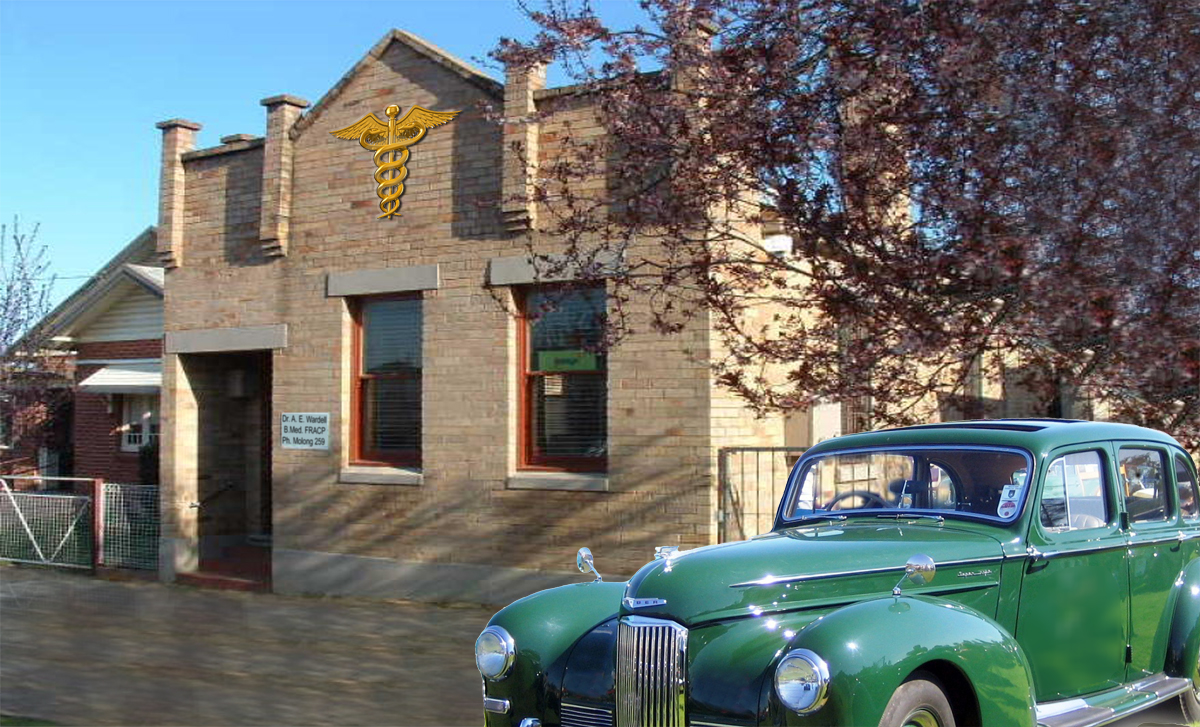
Doc's Humber and Rooms
Story and Digital Digital by Warrigal Mirriyuula
Porky was up at sparrow fart, boiling water for his tea before the sun had even topped the hills in the east. The Sunday sky was clear but the westerly breeze, brisker than yesterday, was beginning to turn to the North East. There might be rain later but the prospect didn’t dampen Porky’s enthusiasm. You see, Porky had a plan, and today was the first day of that plan.
He’d eaten a hearty breakfast; eggs, sausages and fat fried tomatoes from his own patch; gulped down the last of his sweet black tea, took a final bight out of a slab of Vegemite toast and headed out the door, down the steps and out to the little shed in the garden that his landlady let him use. Unlocking the padlock he swung the door open and dragged out a hundredweight bag of spuds he’d bought from Mrs. Hatter yesterday. Carefully relocking the padlock, Porky then hefted the bag of spuds up onto his shoulders and took off into the street at a trot. For a couple of hours, as the people of Molong awoke, had their breakfasts, nursed their hangovers, got ready for church or read the papers on their front verandah, a few of them would notice Porky and his bag of spuds still getting along at a trot. Jack Enderby, the retired principal of the Central School was just walking down Edward Street to St John’s for the early service when he came upon Porky and his spuds heading down Bank Street. Porky smiled and winked an acknowledgement of Old Jack’s “G’day” but didn’t stop, his breath coming in hard rasps as he kept up the pace.
Enderby crossed the street, smiling as he came upon the Reverend Gamsby standing in the gateway of St John’s.
“Morning Reuben. Big night last night.” said Enderby. “A fine morning Mister Enderby, and yes, it sure was.” the Reverend replied as they both turned to watch Porky and his potatoes’ puzzling progress down the street. Old Jack had taught both Porky and Reuben at The Central School. Both bright, inquisitive, quick. Both really quite sensitive boys. Of course Porky, like most of the Fairbridge kids over the years, had had to leave The Central School when he was 15. He would have to find himself some other way than education. Reuben, with the love and support of his family, had gone on to University and the Thomas Moore College before returning to Molong, a freshly ensoutaned junior Anglican reverend.
The start of early service was a flexible sort of affair. With a 7 o’clock kick off, the young Reverend was never certain how many might turn up. Old Enderby was a regular and so far this morning, the only parishioner to show. 7 o’clock had come and passed a few minutes ago but still both men stayed at the gate exchanging small talk, the low early morning sun throwing a bright yellow brilliance over the little town, the bitumen down Bank Street glowing like a golden highway. Though both were devout in their respective ways, both believers with their duty of prayer this Sunday morning, none the less they tarried at the gate enjoying the gift of this wonderful morning.
“The world is surely charged with the grandeur of God”, said the reverend with sincere piety. Old Enderby looked wryly at the young reverend and said somewhat didactically, “You don’t want the Bishop hearing you quote Catholic poets Reuben, no matter how apt the quote”. This brief reprise of their old schoolmaster and student roles gladdened and amused Reuben. He was right. The Bishop wouldn’t like it. For him the reformation was still in progress. He often bitterly called Catholics “papists” and swore in his darker moments that they weren’t to be trusted, that they engaged in irregular religious practises. The Bishop was getting old. It was nonsense of course. Reuben sometimes played cards with the brothers at St Laurence’s. They were fond of a dram and enjoyed their Rugby enormously, but they were good men. They just had a different way of looking at the same thing. In fact the brothers had invited the reverend to join them as they feasted St Laurence O’Toole on November 14. That was only tomorrow week. For Reuben Laurence was a bit too “Irish” as Catholic Saints go, but he’d join the brothers in the ecumenical spirit of the invitation. Besides, Mrs. Delahunty, their cook, was blessed with an uncanny culinary skill. No one refused an invitation to the brother’s table.
Old Jack and Reuben stood side by side not saying much and by a quarter past seven about a dozen or so parishioners had arrived and were milling around the church door. Not quite so many as usual but then it had been a big night in town last night.
“Well I suppose we’d better get in and get started.” said Reuben.
Old Enderby just nodded, “The sooner we get praying the better it’ll be.”
The small flock entered the little brick church and a few minutes later the pump organ could be heard belting out the first hymn. It wasn’t St George’s Day but Reuben did like “Jerusalem” and included it as often as he could.
Down at The Telegraph Mongrel and The Runt had taken off at dawn. Abandoning the sugar bag for a quick belt down to the creek and then over to MacCafferty’s for breakfast out the back door of the butchery. Back at The Telegraph Clarrie and Beryl were getting the guest’s breakfasts ready, checking the kegs in the cellar, cleaning up and wiping down, getting the big linen wash going; all the tasks that usually got left until Sunday. There was no day of rest for a busy publican even if the pub wasn’t open, but he and Beryl and the children always tried to get to the 9 o’clock service at St John’s. Beryl enjoyed the sermons and Clarrie told himself that it was for the kids, Jenny and little Bill. They needed to learn right from wrong.
The truth was that Clarrie’d had a pretty tough war in New Guinea and was a little uncertain about God’s great plan when he got home. He’d been blessed though, and that was how he thought of it, as a blessing; his wonderful loving, hard working wife, mother of his two happy, healthy children. He might have felt uneasy about his faith but he felt at ease siting amongst the people he knew and liked, knowing that they too like him where all hoping for the best and promising in their various prayers to do all they could to make it happen. God might be distant but the genuine sentiments of good people would do Clarrie ‘til God and he worked out their differences.
By the time Clarrie, Beryl, Jenny and little Bill, all in their Sunday best, were making their way up Bank Street to St John’s, Mongrel and The Runt had arrived at the back of MacCafferty’s Butchery. Mongrel gave a scrape on the screen door and barked a few times but there was no reply. MacCafferty was always up and doing by this time. It was odd that he wasn’t here. Mongrel made a quick round of the area between the back door and the small slaughterhouse at the back of the block. MacCafferty was everywhere and Mongrel loved the smell of dried blood. Even though the butcher thoroughly hosed and cleaned the slaughterhouse after each session, the traces were enough for Mongrel’s discriminating nose. It was intoxicating and made him even hungrier. The Runt was taking a drink from a muddy pool in a clay depression by the back door, his eye out for the arrival of MacCafferty with breakfast. A flurry in the breeze kicked up a little dust and brought a new scent to both Mongrel and The Runt. Only feint now, maybe from yesterday, but they both smelled sickness. It was the smell of the building on the hill where humans went when they weren’t right. Where they’d gone with the injured human yesterday. It wasn’t so much a bad place. It was just that sometimes humans who went there came out different or sometimes, didn’t come out at all. They just disappeared. That building fell into a very small category of places that only included one other locale. The fenced field where the humans sometimes buried their own in boxes. Mongrel didn’t like boxes. He’d been put in one when he’d been taken from his mother. If MacCafferty had been taken to that place he could be in trouble. Mongrel barked an urgent call to The Runt. The Runt yapped back and they both set off up the hill towards the Hospital, curiosity just overcoming their uncertainty about the place.
Doc Wardell pulled his dusty Humber into the doctor’s spot out the front of the Hospital. He’d called Gruber at home last evening and arranged for him to come out first thing on Monday morning to check the young patient for more serious head trauma. Wardell didn’t think there was anything to worry about but it had been a severe knock and it was always better to get a second opinion, particularly from an expert; besides it meant an opportunity for a bight of lunch with Gruber who was always intelligent company and offered a more complex and sophisticated world view than was usually on offer in Molong.
Gruber was an Austrian from an established commercial family. He had qualified at Vienna before the war and, being in a reserved occupation, had avoided military service in the Wehrmacht, something that made both him and his family mightily happy. His research work at the clinic in Dresden had been enormously satisfying and as the stories of the early German victories in Europe held the volks in their uplifting grip, Gruber had begun to see a path into his future that involved the seriously psychiatrically ill, particularly those suffering psychosis after significant somatic head trauma. There were a lot of them as the war grinded on. All of that, and the rest of Gruber’s life had been reduced to ashes in February 1945. On that dreadful night of the14th, Gruber’s home and family were incinerated by the allied fire bombing, along with the clinic and most of the rest of the city centre including nearly everyone Gruber had known as he grew up. Gruber had only survived as a result of being called out to assist in the treatment of a wounded soldier at The Albertstadt. This large military garrison had curiously not been on the target list that night and remained largely intact after the bombing. Whenever Gruber mentioned pre-war Dresden, Wardell would feel a twinge of guilt; a small knot would form in his stomach, the cost of victory exacting its price. Dresden, morally, had been a pyrrhic victory. Gruber’s home had been a beautiful medieval city; an historical and architectural gem until Harris and Bomber Command had unleashed that morally ambivalent attack. Almost a decade had gone by and the city was still mostly rubble and cheap concrete. The communists had no interest in restoring its former glory.
After a year or so in a DP transit camp Gruber had escaped to West Germany and finally emigrated to Australia. He was, he said, a new man, having had both his family and the physical presence of the city he grew up in taken from him, he said his slate was wiped and ready for him to write his own story. Gruber was sincere; he was genuinely interested in Australia. It wasn’t central Europe flirting with fascism, with its ossified social and cultural norms, now blown to bits. There were no shadows, no ghosts on the bright sunlit western slopes and plains of New South Wales. Its rawness, newness appealed to him. One of the few places left where a man could make an equitable life for himself he would often say, and in the years he’d been living in Orange and working at Bloomfield he’d become something of an expert on the local volcanic geology and had a far better understanding of the local aboriginal people than just about any other white person west of the Blue Mountains. He affected a kind of “country casual” in his dress and he never wore a tie. He dismissed the hidebound social conventions of his upbringing as an unnecessary impediment to meaningful personal contact, he drove a Holden and he really liked a beer. If it weren’t for his cultured central European accent and the monumental extent of his English vocabulary he might very well pass as an Aussie in any company. As it was he was an amusing confusion to most people he met. Highly respected, albeit from a distance, his enthusiasms and his personal drive marked him out as “not quite like the rest of us”. He was that very rare thing in country Australia, a driven intellectual with the common touch.
Wardell was looking forward to seeing him again tomorrow; but for now he grabbed up his bag and entered the hospital.
There was no one in reception as the doctor turned into the general ward. There by the window was young Algernon; the left side of his head looked like some overgrown eggplant was trying to escape the bandages, all purple shiny bruise under the dressing. As the doctor got a little closer he could see that the young Inspector’s eye was still closed. The inflammation and swelling were still quite severe. He might have to do something about that. Algernon was asleep and the doctor didn’t disturb him.
Instead he went to the next bed where the snowy haired old boy was studiously working his way through the cricket scores and fixtures in yesterday’s Central Western Daily.
“How are ya today Harry? Had any more pain? Doc Wardell said, sitting down on the side of the bed and taking the old boy’s pulse. He checked the flow from the catheter into the bottle hanging from the side of the bed. The urine was slightly discoloured with blood but the malabsorption must have passed. The fluid was free of solids and quite clear. “Looks like we were right to try and dissolve those stones.”
“Yeah, I had a bit of a turn when they brought the young fella in. Bit of excitement for a few minutes but it passed.” Harry didn’t seem fussed.
“If the stones continue to dissolve nicely you can get back to work in a day or two, but you’ll have to stick to the diet I gave you.” Doc Wardell got his serious look on and fixed Harry with his eyes. “Stay away from spinach and no more lashings of rhubarb and custard. Too much oxalate and calcium.” Doc leant in closer and said somewhat conspiratorially, “and you’ll have to find some other tea that you like. That black Indian Char you drink forms stones the size of cricket balls. You won’t be able to piss that problem away!” The doctor quickly looked over his shoulder for Sister MacGillicuddie. She was a terror for bad language.
The old boy looked contrite. He loved his rhubarb and custard, and a good cuppa, but the pain in his “John Thomas” every time he tried to pass one of his stones had finally convinced him he’d have to let it all go. “I’ll be good this time Doc. Promise.” The old boy said.
“Well see that you are.” Said Doc firmly.
Algernon was in the Dandenongs walking down a mossy path, the birds in the trees were discussing rhubarb and custard and drinking tea. A koala was listening to the cricket on a portable radio. The sun came steaming through the trees and Algernon had to turn away it was so bright. Someone was calling his name. He couldn’t open his left eye. That was odd…
Sister gently shook the young inspector awake. “I’ve brought you some tea.” She said putting the cup and saucer on his bedside table. “How are you feeling this morning?
Algernon’s mouth tasted like he’d eaten a hundred miles of dirt road, including the road kill; dry as dust, tasting foul and metallic. The throbbing pounding in his head kicked in the moment he opened his one good eye. He awkwardly grabbed the teacup with both hands, spilling some, and greedily slurped down the tea. “I feel absolutely dreadful,” he said between slurps, “and I’m famished.” He just got the teacup back to the saucer before, “I feel feint, really queer. I’ll just lie down again.” He collapsed back onto his pillow, moaning a little.
Doc Wardell quickly came over from Harry’s bed and picked up the young blokes wrist. “Bit fast.” Said Wardell quietly, taking his ophthalmoscope from his top pocket and holding Algernon’s one good lid open to have a peer inside. “Mmmm. Retina’s alright this side. How’s his pressure Sister?” Sister had applied a BP cuff and was pumping it up. They both paused, looking intently at the sphygmomanometer. “Hundred and ten over sixty five. Astonishing!” Doc Wardell exclaimed looking back at Algernon. “You must be fit as a mallee bull! Take a knock like that, all that healing going on, and your blood pressure’s taking a break.”
Algernon was breathing easier now. Sister released the cuff and folded it together. “That’s clean living Doctor.” She said somewhat archly. “He probably doesn’t smoke, or drink. Keeps himself nice. You should look to his example Doctor, and you too Harry.” She concluded, adjusting her shoulders in a rather prim manner before looking from one man to the other. Harry cringed back in his bed a little, while Doctor Wardell considered himself once again chastised for his behaviour at the hospital Christmas party last year. He’d drunk too much punch and insisted on smoking a huge cigar to congratulate himself on a particularly tricky birth.
“Oh Alice, you know the circumstances. You can be such a prig,” he said gently, “when really you’re quite a generous person.” He smiled intimately at her. “It just doesn’t seem right on you.”
Sister flushed bright pink. She didn’t know what to do or where to put herself. She smiled nervously, just a hint at the corners of her mouth, then turned and briskly walked away.
“Alice”, is that ‘er name? said Harry. “I never knew that. I thought she woulda come with a model number from the Sister factory.” Harry adjusted his pillows and sat up. “Handsome woman though Doc, ay, don’t ya think? A good armful.” Harry raised his eyebrows then winked somewhat lasciviously at Doc Wardell as if to say, “We’re men of the world. We’d know what to do with a big buxom nurse.”
“You’re an evil old bugger Harry”, Doc laughed.
Sometimes though, when he was feeling particularly carefree he would daydream of Alice. She had the most beautiful smile and it melted his heart whenever she chose to show it.
Algernon had listened to all this like it was some radio serial that he’d come in on half way through, though “Blue Hills” didn’t come with head injuries. Maybe he was still a bit concussed.
Doctor Wardell turned to Algernon, “You’ll be fine. Just rest.” The doctor began to fidget with his stethoscope then covered it by saying “I called Gruber last night. He’ll be here tomorrow morning to take a look at you, though I’m pretty certain he won’t find anything wrong. Well, apart from the obvious.” The doctor looked distractedly down the length of the ward. “Look, I’d better go and make sure I haven’t blotted my copybook again with Sister. She’s a marvellous woman, and a, and a great nurse,” he added hurriedly, before rushing after Sister.
Harry watched the Doc depart with a knowing smile on his face. “Haven’t seen ‘im move that quick in a while.” then he leaned over in his bed and said, “We haven’t been properly introduced. I’m Harry MacCafferty, the butcher.”
That delightful little building up there, which was Doc’s rooms way back when, is currently on the market for under $200,000.00. What’s more the sitting tenant and current owner is willing to lease back on a long term lease. Molong always was a town of opportunity.”
 Window Dresser's Arms, Pig & Whistle
http://www.centralwesterndaily.com.au/news/local/news/general/church-takes-its-place-in-the-sun/1869647.aspx
Just thought I’d add this in here.
LikeLike
I enjoyed this immensely WM.
Although I have made some infrequent trips to the dot and UL, I haven’t read much, just talked. As an old friend said, “you can’t learn by talking”. I knew this was here and wanted to get a mo to read through.
Really very good I read it in one hit and it just flowed; without any big words to bamboozle me. Apart from oxely something or other.
What a web you have weaved: Intimate smiles; unease with faith; glowing bitumen. Will Mrs Marples pop up……..or Bergerac appear? Even the degree-less John Betjman is lurking in the shadows I feel.
On to your next episode………………..echo…the neeext one…ecno
LikeLike
Why thank you JL. You good opinion is important to me.
I’m working on the next bit right now.
LikeLike
Oh, and while I’ve got you here. If any of you medical types notices any misinformation or outright errors in the medical content, please please sing out.
I don’t mind looking a fool so long as I know I look a fool.
LikeLike
I have a dreadful confession. I have made a huge boo boo! That’s what happens when you rely on your childhood memories.
I’ve spent this afternoon going through thousands of photos and letters and all manner of Fairbridge material. It’s amazing what I’ve found out about Mum and her life at Fairbridge. Things I wasn’t even dimly aware of.
Her brother, my Uncle David, (status and location unknown since 1950), was something of a poet if his efforts in the Fairbridge Magazine are anything to go by.
Most importantly I’ve come across some photos of Mum and a chap called Mickey Mitchell. It seems Mickey may have been the love of Mum’s life but he died of “wounds received” in The Repat. There’s a poignant photo of Mum at just nineteen attending his funeral. She looks heartbroken.
So there you are. My sisters, brother and I may never have been had Mickey survived. It’s certainly made me think.
But none of that is the boo boo.
It wasn’t Reuben Gamsby that married my parents. Reuben looms large in my childhood memory for some reason but he wasn’t a Reverend at St Johns. The reverend at St Johns was, I’m reasonably certain, Roland Bigrigg and it was he who married my parents. His marvelous sister, Ruth, is still going strong and helps run the Molong Historical Society’s museum.
Reuben and Roland didn’t even look alike.
LikeLike
Waz, do not worry, fret or obsess, we love your story of Mongrel and the Runt..
Gez is writing some story about his past and realised to his horror that Bonanza came on the scene much later than he thought…
We love your and Gez’ stories and are oblivious to the minor historical errors…
It’s the well told story that matters.
LikeLike
Warrigal, I remember you saying that you missed Mulga. Well he/she has been spotted on Unleashed, so you don’t have to look any further.
LikeLike
I’ve just dropped a reply on the Rudd board. Good to see the old Mulga style again.
LikeLike
There was also a car, ‘The Hudson’. Very large and wide. Is that true or am I getting a bit confused with Rock Hudson. Also very large and wide but a filmstar, not a car.
LikeLike
In a small twilight zone moment, the Hudson Hornet that plays one of the lead roles in The Pixar kids classic “Cars” is called “Doc”, Doc Hudson; and yes it was a genuine car and just for you one will be appearing in the illustration for the next installment of The Dogs.
Of course a car like that; what people used to call a “yank tank”, would only be purchased by a Cow Cocky. Sheep farmers with a good clip cheque drove British marques if they could afford them. Grain growers often had an International “Scout”, a sort of four wheel drive ute before the 4WD vehicle became more popular in town.
Those on small or marginal blocks like “soldier settlers” for instance could only afford a Holden or the utility model of the smaller British makes like Hillman.
Dad had a succession of Hillmans.
LikeLike
That’s funny. I had a Hillman, second hand of course. A panel van and it broke in half with the chassis poking upwards at the back of the front seat.
It managed itself to limp back to our house at Revesby. I can’t remember what happened to it. Perhaps it was reclaimed by the garden. It was very rusty.
LikeLike
Nice story Warrigal… and nice car too… those old Humbers were the poor man’s Rolls Royce back then!
🙂
LikeLike
I was just looking at the car, unusual colour, but it goes well with the style of the car…I hope the nursing sister (Alice) likes it as well.
LikeLike
Sister has only been in Doc’s Humber for purely professional reasons, but I can feel the day coming when she’ll proudly sit up front with Doc, the rice blowing off the bonnet as they drive away to the South Coast.
That might have to wait a while though. It’s pretty obvious to the rest of us here in Molong that they’ve got some differences to get through first. Nothing serious, but Doc is a confirmed bachelor, his recent epiphany notwithstanding; and Sister is rather set in her ways.
LikeLike
Sorry, of course you don’t know about Doc’s “change of heart” yet. That’s in the next installment.
LikeLike
I seem to recall Humbers being the car of choice for many medicos in my youth. There was a Doctor Death, (pronounced Deeth) who stitched my foot when I was about 11. I think he drove a Humber too.
LikeLike
Warrigal,
We had a Dr Death, in Harbord, where I grew up. He drove a small, black, English car, like a miniature hearse. Of course, he had black and white number plates “ND”, I think he may have been a “Neville”. He did lot’s of home visits, “Death is come…”
LikeLike
I agree. A great tail…er, tale. My mum grew up in Kilmore and as I read I picture a town very much like the one she grew up in. I had a great uncle Clarry who was given a table saw for his 82 birthday so he could finish building a new extension to his barn. Look forward to more Mongrel and Runt.
LikeLike
A Kilmore pub for you Neville. And what do we note about that pub?
The beautiful use of local stone blocks to build those side curtain walls. Many of the buildings in Kilmore are made from this heard wearing stone. You might remember the post office Nev.
Kilmore’s a great town. Full of the ratbag Irish. Molong too had its fair share of ratbag Irish back in the day. That’s why the major RC church is St Laurence O’Toole, a definitively Irish catholic saint.
LikeLike
The older Australian buildings are so much better architecture than what we have now; of course there are the Mercutt’s and others, but on the whole, to me anyhow ,they built more beautiful buildings in the past…
The Kilmore Pub is a good example of that.
LikeLike
‘He drove a Holden and he really liked a beer’. Now where did that come from? I love words and writing like that. A great story and thanks Waz.
Today we had a call to quickly do some sick grand son sitting. We left in a hurry and I forgot to leave some food for Milo. When we came back this evening, I imagined he was a bit reproachful. We gave him a good piece of stewing steak that was supposed to be made into a curry.
Milo approved.
LikeLike
It occurred to me that a German doctor driving a Holden would be significant proof of Gruber’s commitment to Australia. In 1955 which is when The Dogs is set, he could only have driven the 48/215, popularly known as the FX, or its successor the FJ. While both these models have gone down in Australian motoring history as “Classics” they were virtually the same car apart from the ” J” having a bit more chrome trim, a different grille and being available in twelve colours as opposed the “X”‘s four colours.
They were a pretty bog standard car compared to the British, European and American models available at the time.
Gruber’s enjoying drinking beer is not so unusual. Vienna University had a history of heavier drinking in the midst of a culture that drank heavily.
LikeLike
Warrigal,
You’ve probably offended all of the Holden fan club in one fell swoop!. They will go to great ends to prove that the two models were completely??? different, and members nearly feint when they find out about an FJ which has been retro-fitted with FX stub axles, and vice versa. The fact that all of these parts are interchangeable is completely lost on them!!
The story reads beautifully and, not only describes the characters, but also, that country hospital attitude of just knuckling down and looking after people regardless of what’s wrong with them. Fortunately for you country folk, they still have that attitude, though you may not get your scone and cuppa at the end of it all, due to cut backs!
LikeLike
Nice
LikeLike
Such praise, such exquisite condescension, I feel as though I’ve arrived.
Where did you say we were?
LikeLike
yo
LikeLike
Ah yes, Yo. Lovely this time of year, don’t you think?
LikeLike
I thoroughly enjoyed your wonderful yarn, Warrigal. We are slowly getting to know some more good folk of Molong, all interesting…
LikeLike
Everyone in Molong is “good folk”. I’m glad you’re still enjoying it. There’s loads more to come.
LikeLike