
Story and pictures by Warrigal Mirriyuula
When I was a kid I used to hang out with a crowd of mates most of whom lived in one street. We were known as The Dora Street Gang and we got into all sorts of trouble. One of our favourite pastimes was to select some hapless individual on whom our current ire was focussed and we’d go and “rock their roof”. Most roofs in those days being iron, this made an unholy racket inside the house and could be relied upon to wake the dead.
Well I’ve grown up a little but it seems the universe still wants to play this game.
One of the neighbours is coming to rock our roof and if it all goes to plan they’re going to make a mess like we’ve never seen.
This bad tempered neighbour goes by the unprepossessing name of Gliese 710. One of a number of stars that share the name Gliese; but this one is full of bad attitude and it’s on a trajectory that will see it pass within approximately 1 lightyear of the Earth.
We’ve got time to take cover though. This isn’t going to happen for about 1.4 million years. I can hear you all exhaling a sigh of relief.
So what’s it all about?
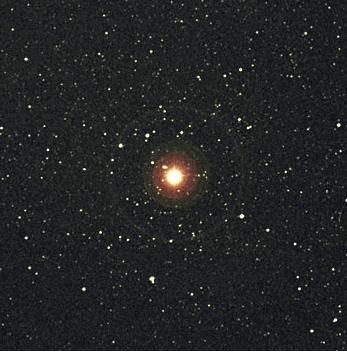
Gliese 710
Gliese 710 is a dull, red dwarf: a small, dim star. It only shines with four to five percent of the Sun’s luminosity and it’s mass is only half that of the Sun. Not so worried now? Well it’s still a STAR we’re talking about here! And that’s not the kind of object you want to find in your backyard in the morning: Gliese 710 is more than fifty times as big as the Earth, and more than 100,000 times as massive. Oh, and it BURNS with a thermonuclear fire!
The main problem isn’t the star itself but the gravitational and orbital shake up it will deliver to the outer solar system. Out there, way beyond the outer planets, even beyond the Kuiper Belt; that repository of all the left overs from planet building at the beginning of the solar system; is a halo of slush, ice and rocks called the Oort Cloud. It surrounds the whole solar system.

Outskirts of the local system
When Gliese comes to rock our roof it will be these stones and comets that it’ll be using as ammunition. The gravitational perturbation will see a great deal of this material torn from already unstable orbits and thrown in towards the centre of the solar system. The gravitational attractor that is the Jupiter Saturn combo will absorb a great deal of this incoming debris. Problem is they won’t catch it all and for many tens to thousands of years we are gong to have to keep our heads down.
Just like today and every day since the beginning of the solar system we are at risk of an impact event. Most of these impacts are small and do no more than minor and very localised damage. A lot of the incoming bolides, snow balls and the like don’t even hit the ground. They either evaporate or burn up on entering the atmosphere, some explode aerially, other touch down with a thump that probably frightens the cows but is of little consequence otherwise. Every now and then though we get a big one and those big ones do catastrophic damage locally and can effect the entire planet. In a “worst case scenario” we get an extinction level event or ELE. This last happened some 65 million years ago when a block of rock and ice about 10k across splashed down in what is now the Gulf of Mexico. Goodbye dinosaurs; and after an appropriate period of reorganisation and re speciation, hello mammals; and look what we’ve done with the old place.
“Yeah, yeah” I can hear you all saying, “but what’s really going to happen?”
No one really knows and we are unlikely to know until such time as some astronomer cries, “Incoming!” and starts plotting trajectories.
These bits of planetary flotsom will come in all sizes, shapes and compositions from solid rock to water and methane ice. The only certainty is that we will get hit. Whether we survive or not will be determined by the size of the imapctor and the velocity it strikes at so lets’s get a little perspective.
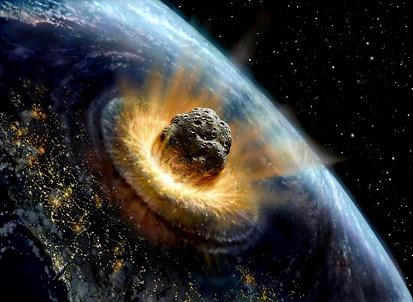
The Beginning of the Worst Day of Your Life
Let’s say the impactor is about the size of the average back yard; that’ll strike with the equivalent force of approximately 10 to 15 megatons of TNT and would entirely destroy any city that it struck. If it was the size of a couple of football fields, that’s about 100 megatons and would destroy a continent sized area. Now we really should be shaking in our boots because say it was the size of, oh I don’t know, say the Sydney CBD from Circular Quay to Park Street; that would devastate, entirely waste that half of the globe it struck, and the other side wouldn’t do so well either. 100,000 megatons of TNT can do that. Then there’s the big daddy of them all; say about the size of the distance from Sydney Heads to the Gladesville Bridge. If it’s that big then the entire planet’s in for a very bad day indeed, possibly the wost day for 65 million years. That’s the equivalent of 100 gigatons of TNT, a full blown extinction level event and the only advice I have is to stick your head between your legs and kiss you arse goodbye. No one’s coming out of that alive.
Here’s how it might happen.
As the impactor strikes the atmosphere it will immediately consume all the air it does not blow out of the way. The sky will light up with a blinding incandescence almost immediately followed by the impact itself. The impact will vapourise the ocean should it strike at sea, causing tsunamis hundreds to a thousand metres high. On land it would vapourise the earth’s crust and penetrate down to the upper mantle, simultaneously hurling all that vapourised rock up beyond the stratosphere. Moments after impact hundreds of cubic kilometres of impact debris is shot up into the sky leaving a vacuum into which crashes the atmosphere and similar volumes of water in the form of chaotic tsunamis should the impact happen at sea. The aerial blast wave begins propagating at high speeds and wraps the planet in very high winds tearing at the very fabric of the planet itself. Nothing within 1,000k of the impact can live. This is an 11 to 13 on the Richter scale and the whole planet would ring like a bell for some time after impact. On the opposite side of the globe to the impact the converging crustal shock waves will throw up a small mountain range almost instantly but they’ll still keep going for some time yet. The event will trigger wide scale vulcanism and fault related earthquakes. The oceans will be filled with criss crossing tsunamis, the sky will be filled with the gathering soot and dust of the impact.
But wait there’s more!
What goes up must come down. In less than a minute after impact a couple of hundred thousand cubic kilometres of molten rock has been thrown up into the sky. Some will reach escape velocity and exit the atmosphere, but it too like all the material that will be retained within the atmosphere will soon enough give itself over to gravity and begin it’s inevitable descent back to earth and this is where the destruction really begins.
Depending on where on the globe and the nature of the source rocks at the impact site, the atmosphere may very well be corrosively acidic, certainly unbreathable. Then the sky will light up again with a meteor shower quite unlike any ever witnessed by a human being. The sky will be quite literally filled with all the infalling burning debris and that will heat the entire atmosphere. It has been estimated by workers in this field that the heat reaching the ground may exceed 10 kilowatts per square metre within an hour of impact. That in turn cooks the soil to about 400degreesC.
And then comes the post impact winter. So much debris has been thrown into the air, so much soot and smoke from continent wide fires, acidic aerosols from smashed rocks, that the sun may not penetrate to the ground for months to years. No photosynthesis, no plants; no plants, nothing for the animals to live on.
It would take several million years for life to speciate back to similar levels of diversity and complexity and there’s no guarantee that any of us will be around to see it.
Sobering stuff, but it won’t happen for nearly a million and a half years so you’ve got time to plan for your family’s safety.
 Window Dresser's Arms, Pig & Whistle
Gee Waz, scary neighbors ewe got
LikeLike
The Gliese family are your neighbours too.
LikeLike
No. my neighbors are from Foreign
LikeLike
A million and a half years to plan for my families safety? I guess that is assuming my family first manages to get on one of those arks in 2012 right?
LikeLike
Getting no ah ark in 2012 means getting zarked in 2013, I guess. I suspect that humankind will have been long gone when Gliese 710 drops by for a cup of sugar. If not, it’d be an excellent day to be away on holidays.
LikeLike
That is of course the point of this story.
If I told you a dearly loved relative was going to die a horrible rending death and I nominated a date some years in advance but still well within the expected lifetime of that individual; I could prove it, show you undeniable data, photographs with circles and arrows and little text boxes full of dreadful portent; and you believed me; and further that you felt there was something you could do to obviate this harrowing outcome. You’d do it, whatever it was, you do it. It’s how we’re made. We don’t field those calls in in the brain. Those calls are answered somewhere more visceral.
Well this story, which is completely verifiable, not only in its overall suggestion but in the working of the minutiae and the manipulation of the data, fails to illicit that reaction. This is a star, not some tumbling rock and this will happen. Everybody’s loved relative and all their loved relatives are going to cop one hell of a roof rocking for quite some time.
So why aren’t we more moved?
I think because we’re about as far from those people, the one’s that will have that worst day; as we are from Turkana Boy in Nev.’s Rift Valley yarn.
We can have no concept at all what humans will be like. A million and a half years of evolution may have changed us completely physiologically. A million and a half years, should we survive as a species for that long, will wring such technological change as to give technology the appearance of magic to us.
Imagine that hominid boy. You meet him on the volcanic ash strewn slopes of some scoria cone. You look at him, he looks at you. You both recognise something, a pattern of similarity of looks, maybe a smell, something; but you also both know the undescribed gulf between you.
To lighten the moment you figure a little lightweight techno magic might bond you two. He’s curious and so are you. So you get out your trusty bic lighter and give it a flick or two.
What happens next?
Is he completed fascinated, can’t leave you alone, must see the little sparks fly again and again, not to mention the flame so easily drawn from the odd little coloured tube, and such colour, it must have to do with the concentrated flame demon inside. A trick it takes him some time to achieve with two sticks or hammering rocks together, you can do at will. It’s magic. You must be a powerful shaman, or maybe you are the flame spirit himself.
Or does he run away screaming, in fear for his life from the strange creature with fire dripping from his hands?
Both are entirely reasonable expectations in such a scenario, both display completely human reactions, to date.
But a million and a half years in the future…….
LikeLike