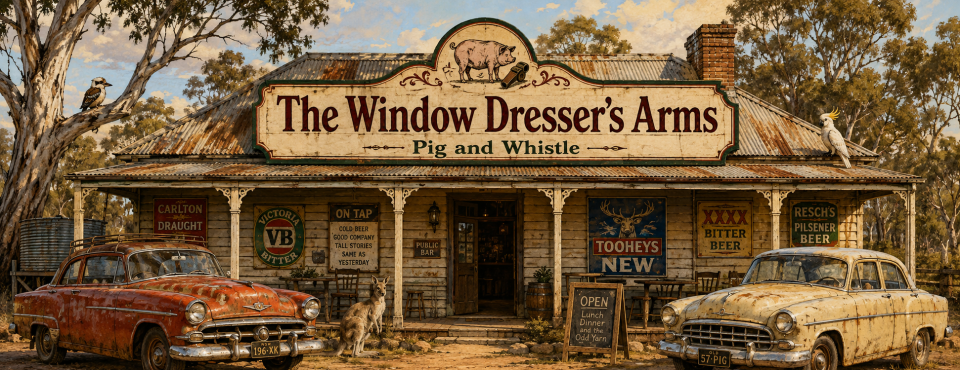
The Pig’s Arms Welcomes Gregor Stronach
I remember being taught to play when I was a child, by my dear father, and I thank him for providing me with such profound knowledge at such an early age.
But these days, I’m older and wiser. I’ve spent time and effort thinking about chess, and the manner in which it mirrors the outside world – a world where we can move in more than two dimensions, but where the rules of the chess board still, fundamentally, apply.
Let us explore this theory in words. Let me expound upon and thump the tub about the way I see the insufferable sadness of the human condition mirrored, errily accurately, atop the black and white surface of the world of chess.
The World.
The world is, essentially, black and white. Right and wrong. Truth or lie. Do or die. For the pieces that reside in the world of chess experience this stark dichotomy on a daily basis. Their world, such as it is, allows for only restricted movement. They have no real freedoms at all. Worse still, as with the real world, the white pieces have the pick of the action, always allowed to move first, in essence always dictating the moves of the black pieces.
Of course, there are times when the black pieces will move to such a position that the white pieces feel that they have no choice but to react, but we all know that it’s an inherited racism, preconditioned into all white pieces, that force the reaction. It’s fear – the boardgame equivalent of crossing the street when the white pieces see the black pieces approaching them at 2am with burglary and other assorted mayhems on their mind. Or so we think… the reality is that the black pieces are simply on their way to the shop to buy milk, and are happily minding their own business.
The Pieces.
Each of the players in life’s little game has their role, as in real life. From the menial, toilet-bowl washers through to the “do nothing but sit around and look magnificent” top tier of life, all facets of class system are there. As in life, the pieces are more or less defined by what they do. “You’re a doctor? Awesome… settle a bet – is this a boil or a mozzie bite?” – likewise each piece on a chess board is effectively hamstrung, their career chosen at birth and with little chance of respite from the gruelling daily grind…
We shall examine them – one by one – and hopefully gain an insight into each of the little tiny personalities that inhabit the ranks and files of life.
The Pawn.
It’s a damning indictment on the state of the world when you consider this fact: The most populous piece on the board is also the weakest. Like the serfs and peons of eras gone by, the fact that there are 16 of the so-called ‘little people’ on the world at the beginning of any match should supply some glimmer of hope – the most precious gift in the world – to the pawns. But they are not the sum of their parts. Repressed and homogenous, they simply exist to do the dirty work, and to die quietly with as much dignity as they can muster.
The lefty inside me wants to marshall them together, and have a quiet meeting at some out of the way square on the board.
“Listen… guys… seriously. Think this through. There are 16 of you here. 16! You can take anyone on the board on your own, so consider this. What if you all grouped together? Formed a union – a Coalition of the Little… you could rise up, seize the means of destruction and rule the board, making it a charming Utopia in which every piece is of equal value. Yes, even the black ones… It’ll be awesome!”
But we all know, deep in our hearts, that while I paint a picture of supreme clarity and truth, it will never, ever happen. Revolutions of any kind are generally doomed to failure one way or another.
And all it will take is for one pawn to reach the final rank at the opposite end of the board, elevate himself to Queen or King, and we’re back where we started. It’s a crying shame.
The Rook.
Ahhh… the safety and security of bricks and mortar are the lesson to be learned here. How solid and dependable are the rooks? They occupy and guard the outer edges of the world, keeping the other players safe from invading paws of curious kittens and insurgencies of spilt beverages. But how high is the price of such security?
I’ll tell you – it’s a terrible toll. Severely restricted movement, and a mindset programmed to think in unbending lines. Compare this to the United States, where the price of freedom is restrictions beyond their wildest nightmares – a government hellbent on tying down its own people to protect them from themselves, and others.
Thus, the Rooks are the US Government of the chess world. Bulky, cumbersome and programmed to defend and destroy, or die trying.
The Knight.
By immediate comparison comes the Knight, a piece with a wonderfully British outlook atop the chequered arena. It’s movements appear eratic, but are – in fact – carefully thought out in advance, taking into account the dual notions of sense of purpose and unpredictability. They like to give the impression that they might, if pushed, be a rogue state. Their wild nature is characterised by the brumby-like physical representation, which in itself speaks volumes.
But… and there’s always a but… on their own, they are all but useless. Any successful hostile action requires the recipient of violence to be backed, literally, into a corner with all avenues of escape cut off.
And then in rides the cavalry, to take the glory and claim the victory as their own. It’s typical, if you ask me… the horsey set always likes to think of itself as punching well above its social weight. When they’re not prancing about the board of life, you’ll find the Knights playing polo and drinking champagne.
The Bishop.
Imagine a life where you are confined in your thinking to a single shade. Black or white, once you are placed in your initial position, that’s it – you may not ever occupy a square of the other shade. You must only believe in the one thing, forever more, until you are killed or the war is won.
It’s a damning indictment upon life off-board – where religious views are expounded upon at length, but rarely scrutinised and never challenged. As with any belief that is set in stone, it invariably ends in tears – it’s okay to have convictions and a strong set of moral values, but without wriggle room, it’s easy to end up trapped. If you cannot see the other side of an argument, you are doomed to lose.
The other telling point about the Bishops is that they do not move in a straight line – not in the classical sense. They’re sneaky, often arriving unexpectedly from the far side of the world to wreak violence and brutality upon those least expecting it. All of this from a man of the cloth? It’s wrong… but it’s the way of the world.
The Queen.
The Queen is the most honestly representative piece on the board, in terms of power, gender politics and potential capabilities. As a female, the Queen is the sole representative of women. As in the real world, women are horrendously under-represented in the upper echelons of power. This is, of course, coupled with the obvious glass ceiling – the Queen can never become the King, as the King never dies. Add to that the constant threat that one of the pawns may indeed reach the far rank of the board, and suddenly the Queen has another contender for the favours of the King. It’s horrible… and an eerily accurate reflection of the real world.
This is tempered by another fine example of art imitating life. Despite the horrifying inequities faced by the Queen every day, she is quite clearly the most powerful piece in the world – and deservedly so. The iconic image of a strong woman with immense dynamism and efficacy is one that justifiably succeeds, transcending the hardship that women face to become, literally, the monarch of all they survey.
The King.
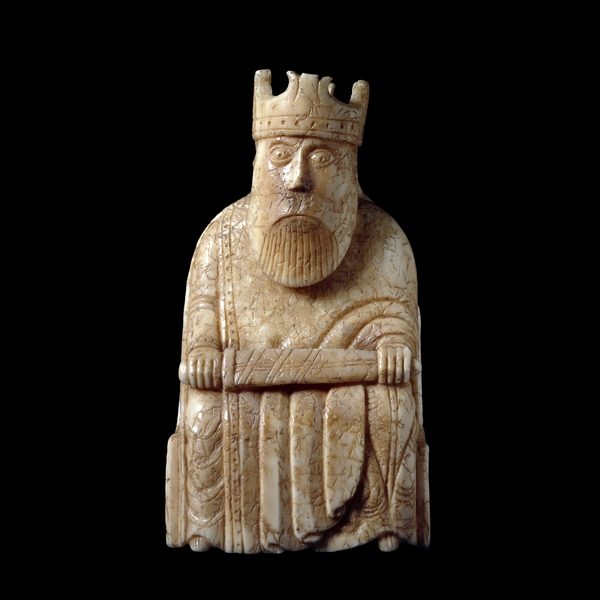
Bloated, corpulent and lazy, the King is a figurehead – a lumbering dinosaur whose only relevance to the world at large is to simply be. Without him, all is lost – but his presence serves only to provide purpose to the lives of others, who must live and die to protect him.
On many levels, I’m sure the other pieces have grown to hate the King. The King is little more than a chubby dictator – his whims to be observed, his life sacrosanct.
His slothfulness and propensity for avarice have clearly made him far too hefty to move too far too quickly – so that while he enjoys the same privileges of freedom of direction as the Queen, she will leave him far behind should the shit really hit the fan.
And to be frank, were I the Queen, I’d leave him behind too. If he can’t get his act together enough to be able to move fast should the need arise, he deserves to die. Let his lackeys from the church and stable look after him – the Queen will be seeking safe passage to Lichtenstein within the hour.
In conclusion.
It’s obvious to even the most casual observer that chess is indeed a game – one that has its roots in the violence of conquest and its complexities founded in the notion of human interaction. But at the end of the day it is – just like the life and universe it mirrors – just a game. It’s unbalanced and bigoted, often violent and strangely bleak… and that’s the way we seem to like it.
I give this game four and a half stars out of five.
 Window Dresser's Arms, Pig & Whistle
Pingback: Their drills were bloodless battles | BLOKE SCHOOL
Gregor, I seem to remember describing your picture on Unleashed once as looking like a portrait of a bomb throwing anarchist. I think it was the mo. I hope you haven’t shaved it off.
Well this is obviously one of your bombs.
It’s a wonderful, sly piece and I really enjoyed my first quick cursory read. I’ll now have to go back over it so that I can savour some of the more piquant flavours, the bijou absurdities you bring up as you analogise chess and real life.
Comer back often. Stay as long as you want. Say whatever’s on your mind.
LikeLike
Thanks Warrigal…
I’ll be back, with something a little fresher, soon…
I have five corporate feature stories to pen between now and close of play on Tuesday, as well as two post-graduate lectures to present. And a heavily pregnant wife to dote upon. and a new home to paint. and… and… and…
you get the picture – but I do promise something new as soon as I have the requisite time to do my ideas some justice.
gregor
LikeLike
I’d like to welcome Gregor too. I’m looking forward to some more vintage writing and fresh pieces too. Manne, a Trotter’s Ale for Mr G !
LikeLike
Welcome to the Pig’s, Gregor, and may you win this week’s meat tray in the raffle.
Chess is the game that in Russia is revered above all sports and encouraged to be taught as a subject in most schools.
My grandkids all play chess and like it. One of our daughters hasn’t yet won a single game against her son!
A pity that the game is not more encouraged. I think that the Rooks have more power than you give credit for.
I loved the description of the pawns and that you felt that in a union they would work better.
Asty (T2 )would probably know that the game of chess and Buddhism were interlinked more than a thousand years ago.
LikeLike
As it happens Gerard, I didn’t know about the link between Buddhism and chess, although it doesn’t surprise me; I DID know that chess was originally a Chinese game, with a board and pieces which are quite different from those we know in the west; the movements of the pieces are also totally different, although the object of the game is the same.
The version of the game we know and love in the west came to us through the Arabs, who must, I suppose, have encountered it along the Silk Road, or from traders who used this trade route, and adapted it to produce the more familiar version.
I’ve played the original Chinese game a long time ago (forgotten all about it now!) but because it is so different from western chess, I never did get the hang of it! I think Chinese chess sets may be available in some of the Chinese grocery shops one finds in Adelaide…
Could you tell us more about the link to Buddhism, Gerard?
🙂
LikeLike
The researchers on chess are not excactly united because the game that we play today has evolved over centuries. There is some agreement that it was India were it originated.
The link to Buddhism was mentioned in a few articles that I read. Here are some opinions;
From Wikepedia:
As far as the area of origin is concerned, Josten points to the Central Asian Kushan Empire, a culture that had intensive contact with the Near East, India, and China. It would have combined various elements from games from these regions in one game. The Kushans, called “the forgotten Kushans” by some scholars, ruled from about 50 BC until about 200 AD a big empire, which included a substantial part of India, and included the excavation place where the above mentioned 2nd century AD “Chess-pieces” were found. The Kushans, having become affluent by trading on the Silk Road, were privy to cultural mergers as shown by their contemporaneous tolerance of BUDDHISM and Zoroastrianism, as well as their gold coins displaying Greek, Roman, Iranian, Hindu and BUDDHIST deities.
LikeLike
Thanks Gez… great stuff! At least I was right about the Silk road…
😉
LikeLike
Wonderful article, Gregor! I’ve always loved a game of chess… and I love the parallels you draw between it and ‘real’ life. I do hope we’re going to see a lot more of you here at the PA.
🙂
LikeLike
Gez managed to get our kids and later on the grandkids interested in chess; no success in drawing me in…
I also don’t have an interest in queens of any kind, but I like Gregor’s idea as seeing the queen as an icon for strong and dynamic women…I love that!
LikeLike
Chess does take a lot of ‘getting into’, Helvi; but although it is very difficult to learn how to play a strong game, it is so satisfying when you achieve your first checkmate; it can be offputting, though, if as a beginner one always plays against a much better player, and always loses…
🙂
LikeLike
Lovely article, Gregor ! All this reminds me of the many times when I have felt that people were putting me in some pre- perceived category.
When our kids were little, we belonged to an inner-city baby sitting club.
One night we had a club member, a wife of a well-known architect, coming in to baby-sit for us; she looked around and asked me : Is your husband an architect?
My reply was an annoyed NO. Just because my talent (one of many 🙂 ) was to make house interiors attractive, she assumed Gez was an architect, and rudely by-passed ME, the one with the talent in interior decorating… 🙂
LikeLike
@Hung One On – Nope, my middle name isn’t Ian. it’s a closely guarded state secret (which will probably take about 30 seconds to google).
gregor
LikeLike
Thanks Ian
LikeLike
Gregor, nice analogy but is your middle name Ian?
LikeLike