
Tags
CYRUS
by
Theseustoo
CHAPTER 17:

The Assyrian Empire
An Importunate Deity
The progress of Cyrus’ expedition towards Babylon was slowed considerably when they came to the River Gyndes, a broad and deep river with a very strong current; which would clearly require either boats or a bridge to cross, for it could clearly not be forded. As Cyrus’ army drew gradually to a halt beside the riverbanks a sudden commotion arose from the van. One of the six sacred white stallions which pulled Cyrus’ great chariot, as soon as it had been released from its harness, had refused the restraining commands of its groom and had suddenly plunged into the river and attempted to swim across on its own. The current, however, was far too strong and the beautiful snow-white beast was quickly swept away downstream and drowned.
Thankfully, Cyrus had not been in the chariot at the time; he had been scouting the banks with Pactyas for fordable places; although as it turned out they had done so in vain. Distressed at the loss of one of his sacred charges, the groom immediately sought his master to inform him of the loss. He found Cyrus just as he and Pactyas returned from their search.
“My king,” the groom said with a deep bow, “I have terrible news to report…” Nervously he looked up at Cyrus, who merely stared at him silently, the intensity of his gaze now silently demanding further information. Even more nervously the groom continued, “As you can see, Lord, this river, the Gyndes, is both too wide and too deep to be crossed without boats, nevertheless, one of your sacred white horses tried to cross it on it’s own as soon as it was un-hitched from your chariot…” here the groom broke off to wipe away a tear which had sprung unbidden from the corner of his eyes, for he had loved his charges very dearly, “Such a courageous creature! But it did not succeed, Lord; it was swept away downstream and drowned. The god of the river has claimed it as a sacrifice!”
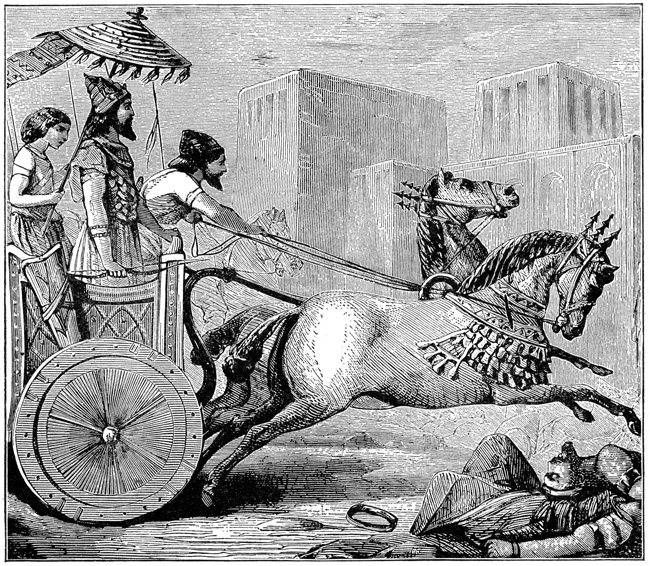
Cyrus' Chariot
Had it been any other horse, it would probably have been simply regarded as one of the inevitable losses any large armed force was bound to suffer on a major expedition; but as it was one of Cyrus’ own pure-white sacred horses, he took it as a personal insult. Another man might well think twice before complaining about such a sacrifice claimed by the river-god, but Cyrus was no ordinary man. His advisors had constantly insisted that his was no ordinary birth; it was foreshadowed with omens and portents they had said; the Magister had even said he had found Cyrus’ name in an old and obscure Hebrew prophesy which had suggested that he might well be the ‘Anointed One’; the Messiah whom the prophecy said would seize Babylon and destroy the Assyrian empire forever; and in doing so, unify the whole world. The manner of his accession to the throne, the Magister insisted, itself proved that it was certainly his destiny to rise from total obscurity to supreme power.

Babylon
At first Cyrus had wisely shrugged off such suggestions as fanciful, but as his empire had expanded, and victory piled upon victories were laid at his feet; often accomplished with remarkable ease, even in what were otherwise extremely difficult situations; that finally even Cyrus was persuaded that there may, after all, be some supernatural being guiding or even orchestrating his successes. The manner in which the path had been found which had given his soldiers the access they needed to Sardis and which had enabled them to take the city with little resistance, for example, had seemed even at the time like a gift from the gods.
The most ancient of all traditions held that a warrior who was victorious over all of his enemies; who thus subjugated them all to his own will, could only be the earthly incarnation of the son of the highest gods, Ea and Enlil themselves. Such a noble, indomitable and all-conquering warrior would eventually came to be recognized as the earthly incarnation of Merodach, their divine son; the Son of Heaven. Heracles, Cyrus had believed, was the last incarnation of such a demi-god, and before him, Perseus. But that he had been referred to as such even by his defeated enemies, he felt, was the final confirmation he had been waiting for before he allowed himself to be persuaded to believe in his own divinity.
So by the time Cyrus had reached the Gyndes, it was no longer any mere mortal whom the river-god had thus insulted with this involuntary sacrifice, but the Son of Heaven; a living demi-god, whose own status as the son of the highest god and goddess gave him superiority over any mere river-god. The insult to his dignity was thus, Cyrus decided, too much to bear.
“By all the gods!” he declared, “I cannot tolerate this insolence! The god of this river has overstepped his proper bounds with this theft! Have I not been called the Son of Heaven even by my defeated enemies? The god of this river must be punished! I shall break his strength so that in future even women will be able to cross it easily without wetting their knees. Divide the army into two parts, half on one side of the river, half on the other; I shall mark out trenches on either side of the river for the army to dig.”
*** ***** ***
Digging the channels which had been marked out by Cyrus cost him the whole summer and most of autumn; and now the first frosts of early winter gave the fresh morning air a crispy bite. Even so it was with evident satisfaction that Cyrus now surveyed his army’s handiwork, as he inspected the river’s depth with Hystaspes.
True to his word, the pair was able to wade across the river easily; the water coming only midway up their calves; and the current was considerably slowed; their knees were not even wet, Hystaspes noticed, as they climbed up the other bank, the gradient of which had been adjusted on both sides to facilitate the army’s crossing.
“Well then Hystaspes,” Cyrus crowed enthusiastically “we have shown this river, Gyndes, who its master is!”
Hystaspes, however, though pleased at his king’s success nonetheless felt that it had been something of a distraction from the main purpose of the expedition; and one which had cost them much valuable time.
“Yes my Lord;” he replied, a little wearily, “but we’ve lost the whole of the summer season digging the three hundred and sixty channels it took to do it!”
“Yes…” Cyrus drawled, thoughtfully. He could understand Hystaspes’ frustration; his general was eager to get at the enemy; like a hunting-dog, straining at the leash in its keen-ness to chase its prey, he thought. What Hystaspes doesn’t yet understand, Cyrus realized, is that by demonstrating my control over the natural elements like this, I have also just successfully completed my first act as a god. But somehow he felt that for him to say anything of this would still, he felt, have been rather immodest, so instead he simply ignored the implied criticism and changed the subject, “It looks like we shall have to winter here; we can raid the country-side for our supplies through the winter… we’ll attack in spring.”
“Yes your majesty,” Hystaspes said obediently, then, just a little hesitantly, he added, “but the disruption this will cause to the Assyrians’ economy will warn them of our intent to take Babylon.”
For such a great general, Cyrus thought to himself, the prince of the Paretacenae could certainly be obtuse at times. He found himself missing the quick, agile and subtle mind of Harpagus. Harpagus, he thought, would have been most amused by Hystaspes’ obtuseness. Patiently, Cyrus turned towards him, looking Hystaspes right in the eyes, so that he could see the twinkle that sparkled in his own, as the king laughed and said, ”Hystaspes, they know that much already! Their king, Labynetus, will be waiting for us even now, I’m sure.”
Hystaspes frowned; he was a little relieved that at least Cyrus was aware that his attack on Babylon would be no surprise to her current Assyrian occupants. Yet he was a little taken aback by what, to him, looked like Cyrus’ carefree attitude to their expedition. After all, he thought to himself, until Cyrus’ own great-grandfather, Cyaxares had evicted them from their capital city of Nineveh, thus forcing them to retreat to Babylon, the Assyrians had for centuries been the most powerful state in the world; Hystaspes could not help but feel that they were about to grab a tiger by its tail.
“Indeed your majesty;” he responded grimly, “the taking of Babylon will be no easy matter; her walls are of baked brick and they are very high and very strong…“
“Hmmm“ Cyrus hummed thoughtfully; mentally reminding himself that it was his extremely cautious nature which made Hystaspes such an efficient general. And he was right about the Assyrians taking a defensive position behind Babylon’s reputedly invincible walls; he was quite sure that will be exactly what they would do. What neither they nor Hystaspes knew, however, was that Cyrus had already learned of a weak spot in her defences. He had said nothing of this to anyone, fearing that if the enemy should get wind of what he was planning they would simply take steps to circumvent it. But, just to put the poor puzzled Hystaspes out of his misery; at least to some degree; he said enigmatically, “That’s true Hystaspes. But perhaps their very strength may prove to be their undoing!”
Now Hystaspes was genuinely relieved; he had no need to know what Cyrus’ plan was for the taking of Babylon; he merely needed to know that his king actually had a plan. And although he could make little sense of this, his king’s latest utterance, yet he was quite confident that it made perfect sense to Cyrus, at least; and that was all that mattered. Indeed, Hystaspes now thought that his king and emperor certainly seemed to know exactly what he had in mind; and if he said nothing further about it, Hystaspes knew now that this was because of the need for secrecy and not for want of a plan.
*** ***** ***
 Window Dresser's Arms, Pig & Whistle
The more I see of Australian politics, Warrigal, the more sympathy I have for Oedipus and the more I understand why he put out his own eyes, he was so disgusted with the nature of the world in which he found himself.
😉
LikeLike
Yes, sigh…..
LikeLike
Of course killing his father and doing It with his mother might have had something to do with it.
LikeLike
Oh, but Voice… those WERE accidents!
😉
LikeLike
Oedipus did not even know or properly understand the nature of his own evil actions; he was also consistently beset by evil at the hands of or instigated by others; thinking himself pious, Oedipus transgresses the greatest of all taboos, but his penitence is such that he is ultimately forgiven…
😉
LikeLike
Wasn’t it Fate? I seem to recall something about it having been foreseen well in advance.
LikeLike
Just that something has been ‘foreseen’, VoR, doesn’t mean to say that you will recognize it when it happens to you…
😉
LikeLike
Wouldn’t wanna spill Cryrus’s beer down the pub, one could find oneself in a lot of trouble. When I pick up my signed copy I shall re-read the whole thing again. A very good tale. Pity my dad is no longer alive, he would have liked this story immensely.
LikeLike
The Assyrian came down like the wolf on the fold,
And his cohorts were gleaming in purple and gold;
And the sheen of their spears was like stars on the sea,
When the blue wave rolls nightly on deep Galilee.
Like the leaves of the forest when Summer is green,
That host with their banners at sunset were seen:
Like the leaves of the forest when Autumn hath blown,
That host on the morrow lay withered and strown.
For the Angel of Death spread his wings on the blast,
And breathed in the face of the foe as he passed;
And the eyes of the sleepers waxed deadly and chill,
And their hearts but once heaved, and for ever grew still!
And there lay the steed with his nostril all wide,
But through it there rolled not the breath of his pride;
And the foam of his gasping lay white on the turf,
And cold as the spray of the rock-beating surf.
And there lay the rider distorted and pale,
With the dew on his brow, and the rust on his mail:
And the tents were all silent, the banners alone,
The lances unlifted, the trumpet unblown.
And the widows of Ashur are loud in their wail,
And the idols are broke in the temple of Baal;
And the might of the Gentile, unsmote by the sword,
Hath melted like snow in the glance of the Lord!
Don’t mess with Cyrus if you know what’s good for ya!
LikeLike
Yes boss, question though, how much sauce have you been on lately?
LikeLike
That’s a great poem Warrigal… where’s it from? It sounds like it may have been translated from some Persian epic poem…? Or was it your own?
As you say, though, one does not mess with the ‘Chosen One’!
🙂
LikeLike
Asty, I’m so flattered that you could even think for a moment that I could write such a thing, but sadly no. It’s by George Gordon Noel Byron, otherwise known as Lord Byron (1788-1824). You remember him. He was “mad, bad, and dangerous to know” according to Lady Caroline Lamb who was described thus; “…a woman of society and of the world, the belle, the toast, the star of the day. She was adored but not content. She had a restless craving after excitement…she was bold and daring in her excursions through the debatable land between friendship and love.” So I guess she should have known all about Byron.
However I digress.
The above poem was originally published as “The Destruction of Sennacherib” and is from “Hebrew Melodies” put out in 1815.
Even for those that are unfamiliar with the work specifically, that first line has come down to us as a commonly used phrase; Sche uses it all the time as a metaphor for complete and utter destruction at the hands of an implacable enemy, which I think is what Hung meant about spilling Cyrus’ beer down at the pub, and now we’ve come full circle.
LikeLike
Well… as to your possible authorship of above poem, to be truthful, I thought I’d better at least cover that base out of politeness, Warrigal… I didn’t really think you had… but that yes, it was conceivable…
After all it’s a pretty simple rhyme and metre pattern; I could rhyme couplets like that all day!
In fact, after the popularity of my poem about Anne Boleyn, I think I shall soon post another of my poems about beheadings… (I only have these two so far, but I’m thinking of writing a series of such poems; if I can think of enough inspiring examples; not necessarily beheadings; maybe Joan of Arc is begging to get my ‘treatment’… and maybe Lucrezia Borgia… and if you or the piglets have any other suggestions for subjects, I’d be only too happy to consider them)
😉
LikeLike
Thanks Warrigal… It’s nice to be appreciated.
😉
LikeLike
You sure that was Cyrus’ chariot up there. It looks like Robin Askin on that day he deathlessly uttered that wonderful phrase in reply to his driver’s question as to what to do when the protesters surrounded the car.
“Run over the bastards!” was Robin’s reply.
As that wonderful piece of graffiti in Wooloomooloo once said, “Robin Askin loves Laura Norder!”
Just so there’s no misunderstanding, I remain a Cyrus tragic and now attend meetings twice a week…, “My name is still Warrigal and I’m still a Cyrus addict.”
LikeLike
Robin Askin, Warrigal? Pardon my ignorance, but who is Robin Askin; remember I’m not a native of these shores, but a mere ‘blow-in’ from O/S…
🙂
LikeLike
Former NSW premier – famous quote in reference to protestors trying to disrupt LBJ’s motorcade “Run the bastards over”. Judged by history to have had the finest police force money could buy. And did.
LikeLike
It was rumoured but never proven that it was a young Neville Wran who brought the bag full of dirty folding to Askin’s office on a Friday afternoon. Curious example of political reprochment for the day. Of course both sides of the house were completely bent in those days.
It’s not like that today. Oh, no of course not children!
If you can find a copy you should read “The Prince and The Premier” by David Hickie. Beats Underbelly hands down. A fabulous read.
LikeLike
Thanks for the recommendation, Warrigal, but I’m not sure I enjoy reading such matters; far too depressing, that’s why I’ve refrained from commenting an much political stuff lately…
😉
LikeLike
… I’m ignoring politics and hoping it will go away!
😉
LikeLike