
Tags
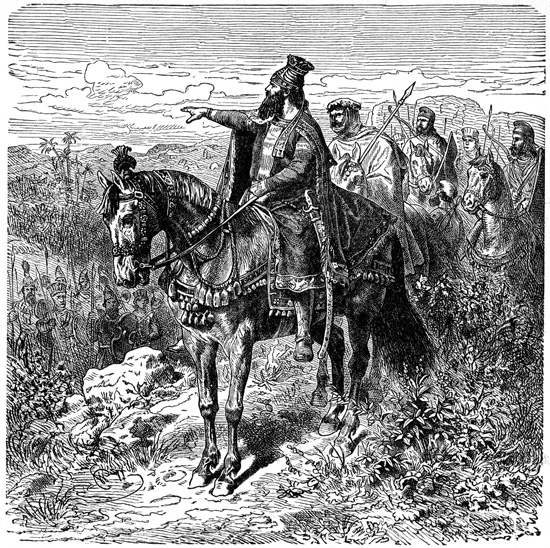
Cyrus breaks the power of the river god, Gyndes.
CHAPTER 18: Babylon
The Persian forces sat down outside Babylon, ensuring a complete embargo on all possible roads into the city. When the Assyrians saw this, at first they came out to offer battle, but seeing that Cyrus’ forces heavily outnumbered their own, they quickly withdrew back into the city, where they were prepared to withstand even a very lengthy siege. Indeed, Labynetus’ quartermaster had estimated that Babylon had supplies enough to last many years. Although Cyrus’ army attacked them immediately, most of the Assyrian forces made it back inside the huge brass gates of the fabled city.
As the last of the retreating Assyrians withdrew inside their city walls, and her huge brazen gates clanged shut behind them, Hystaspes rode up to Cyrus to give him his report on their first encounter with the Assyrians.
“Hah! These cowardly Assyrians!” he exclaimed, with utter contempt, “Knowing they would be completely defeated in an open fight they have withdrawn inside their city walls, where we cannot get at them! It looks like we are in for a long siege your majesty…”
“Perhaps…” Cyrus said enigmatically, “But there are more ways than one to skin a rabbit, Hystaspes!”
The general was again astounded at Cyrus’ apparent lack of concern; although once again he was relieved to see that his king had some kind of plan in mind, as Cyrus continued giving the general his instructions,
“Divide your army into two sections” he said. Pointing to the break in the walls where the river flowed into the city, he continued, “Put one section there… Where the river enters the city; and the other section on the other side of the city, where it leaves. I shall take the camp-followers and all of the unwarlike part of the host with me… You are to wait for the right moment and when you see the river become shallow enough, use it as a pathway into the city!”
“Yes, your majesty!” Hystaspes responded with a broad grin, for now he could see what was in Cyrus’ mind. Filled with admiration for his king’s cleverness and cunning, he added, “To hear is to obey!” Then he bowed deeply and left to carry out his king’s orders.
*** ***** ***
The city of Babylon stands on a broad plain and is an exact square a hundred and twenty furlongs on each side; so the entire circuit of her perimeter is four hundred and eighty furlongs. While Babylon’s size is impressive, no other city even comes close to rivalling her magnificence. The city is surrounded by a broad and deep moat, filled with water from the Euphrates, behind which rises a massive midnight-blue wall of glazed bricks, fifty royal cubits wide and two hundred royal cubits in height (the royal cubit being longer by three fingers breadth, than the common Persian cubit).
The soil which was excavated from the moat had been used to make the famous glazed bricks, their colour a blue as deep as midnight, which not only lined the moat itself, but from which Babylon’s fabled cobalt-blue walls were built. But their incredible size and strength and the fabulous deep blue colour of the glazed bricks were not the only marvellous features of these walls.
At regular intervals along their whole length they were decorated with enormous bulls, lions, chimerae and other animals, some real and some mythical, which were depicted in raised reliefs, which had been created in huge moulds using the clay from the moat. While the clay was still wet, these huge moulds were then cut into individually-numbered bricks and painted with the characteristic ceramic glaze which gave Babylon’s walls their famous deep blue colour; except of course where the moulded reliefs required other glazed colours. Finally the bricks, each of which was thus shaped and numbered to fit a very specific place in the wall, were then baked in huge kilns which had been specially built for the purpose. The reliefs were then reassembled as they were built into the walls as their outer course; their places in the walls already encoded in the individual numbers of each brick; which could then be exactly reassembled as the walls were built.
In this fashion, as fast as the soil from the moat was dug, it was moulded and made into bricks and then baked in the kilns. Then they started to build, first lining the moat with bricks and then constructing the wall itself, using hot bitumen for cement throughout; interposing a layer of wattled reeds at every thirtieth course of bricks. The bitumen used in the work was brought to Babylon from the River Is, a small tributary of the Euphrates far to the north of Babylon, where there also stands a city by the name of Is. This city is eight days’ distant from Babylon and lumps of bitumen are easily found in great abundance in this river.
Undoubtedly the tremendous amount of bitumen required for the mortar in Babylon’s walls were ferried down the river in the same huge rafts, made of skins stretched over a huge, wickerwork frame, which even now constantly ferried huge loads of grain and straw as well as other goods into the city.
These rafts varied in size but sometimes reached a diameter of a hundred and fifty cubits or more; and each carried at least one donkey; the larger rafts carrying several donkeys. When they arrive in Babylon, their cargoes are sold and then the rafts are disassembled and packed on the donkeys, which were used for the return trek upstream as the current was too strong for them to use the rafts for the return journey; and besides, they only carried two large oars, one on either side, which they used only to steer with down the middle of the river’s broad channel.
The walls of Babylon are so thick that along their tops, at regular intervals are small buildings to house sentries and guards; each has a single chamber and they face each other across the breadth of the wall, leaving enough room between them still for a four-horse chariot to turn. The circuit of the walls is so great that there are one hundred huge gates, equally spaced along the whole length of the wall, all made of brass, and with enormous brazen lintels and side-posts.
The city is, however, divided into two portions by the River Euphrates, which runs through it. This river is a broad, deep, and swift stream, which rises in Armenia, and empties itself eventually into the Erythraean Sea. The city wall comes right down on both sides to the very edge of the stream: and from the corners of the wall a high fence of burnt brick runs along either bank.
The houses in the city are mostly three or four stories high and the streets all run in straight lines, both those which run parallel to the river and those cross streets which lead down to the riverside. At the ‘river’ end of these cross streets there are low brass gates in the blue-brick fence that skirts the stream, which open onto the water and which, like the great gates in the outer wall, are also made of brass.
The outer wall is, of course, the city’s main defence. There is, however, a second inner wall, not quite as thick as the outer wall, but very nearly as strong. Each division of the town had a fortress at its centre. In one stood the palace of the kings, surrounded by a wall of great strength and size: in the other stood the sacred precinct of Ea the War-Maker; this was a huge square enclosure, two furlongs on each side, with gates of solid brass. In the middle of this precinct stands a tower of solid masonry, a furlong in length and breadth at the base, upon which was raised a second tower; and on top of that a third; and so on up to the eight level.
The ascent to the top is made on the outside by a path which winds up and around all the towers. About half-way up there is a resting-place with seats where religious pilgrims and tourists from every part of the known world habitually sit for some time to rest and meditate on their way to the top.
At the top of the topmost tower there is a spacious temple; inside this temple there stands an enormous richly-decorated couch with a huge table of pure gold beside it. There are no statues of any kind in this chamber and at night it is occupied a single native woman, who; so the Chaldaean priests of this god solemnly affirm; is chosen by the deity for himself out of all the women of the land.
These priests also declare that the god comes down in person into this chamber, and even sleeps upon the couch, in a similar manner to what the Egyptians say happens in Thebes, where a woman habitually spends each night in the great temple of the Theban god, Ammon. In either case the woman is a virgin and forbidden any contact with men. This practice is also similar to the custom in Patara, in Lycia, where the priestess who delivers the oracles is shut up in the temple every night.
Below, in the same precinct, stands a second temple, in which there is a seated figure of Ea-Zeus-Baal-Ammon in solid gold. Before this figure stands an immense golden table and the throne on which it sits and even the base on which it stands are all made of gold. Inside this temple there is also a figure of a man, twelve cubits high, entirely of solid gold. The Chaldaeans who serve in this temple boast that the total weight of all the gold in these items is eight hundred talents.
Outside the temple there are two altars, one of solid gold, on which it is only lawful to offer sucklings; the other is a common altar, but it is of great size, on which full-grown animals are sacrificed. It is also on the great altar that the Chaldaeans who serve as priests in these temples burn offerings of frankincense to the amount of one thousand talents’ weight, every year, at the festivals of the God. It was said that if the wind was in the right direction, the scented aroma of Babylon’s festivals could be smelled in Ephesus.
***** ******* *****
 Window Dresser's Arms, Pig & Whistle
yo
LikeLike
Yo, Hung!
😉
LikeLike
Hi T2. Did you write this recently, or is it part of your collection.
The detail seems more comprehensive than I remember.
You described the people’s thoughts and actions before, but this time you have gems like, “At the ‘river’ end of these cross streets there are low brass gates in the blue-brick fence that skirts the stream, which open onto the water and which, like the great gates in the outer wall, are also made of brass.”
I have a penchant for detail: it brings it off the page.
I could be mistaken any way, perhaps I have just noticed it now…:)
LikeLike
🙂
LikeLike
Who are you?? 🙂
LikeLike
I think it’s the Inquisition… funny… I wasn’t expecting the Inquisition!
😉
LikeLike
Or maybe the Grammar Police; I’ve just noticed an unnecessary repetition of the word ‘brass’…
Guilty as charged, your honour, but I ask your honour for leniency as I have been in Australia so long I’ve forgotten some of the basic rules… and in any case at my age I plead ‘mental incapacity’, your honour!
Surprised that anyone noticed; you’re not a ‘dinkie-die’ Australian are you CA? And why do you not answer direct questions? Why are so determined to remain a ‘person of mystery’?
😉
LikeLike
Do you have a problem with my describing peoples’ thoughts and actions, and if so, why? I’m afraid I can take little or no credit for my description of Babylon; it comes more or less straight from Herodotus so any inaccuracies must be addressed to him.
I’d also like to echo Little Hadron’s question; do we know you from another blog, under another name, perhaps?
😉
LikeLike
“Do you have a problem with my describing peoples’ thoughts and actions,”
“I have a penchant for detail: it brings it off the page.”
LikeLike
I see… so it was actually a compliment, if a roundabout one… merci bien!
😉
LikeLike
BTW, Ive a reason for so detailed a description…
😉
LikeLike
Warrigal,
…’family delivered from below the sink’
I thought the babies came out of mum’s ‘tummy’ and that Big M helped to deliver them.
I don’t mind blokes with nice bottoms bending over, but expect them to be half- decently covered… at least during working hours.
LikeLike
Asty, good that Karen has given you time off to write us a good story with a fitting picture 🙂
LikeLike
Karen is not who or what you think, Helvi; I’ll post a story on her a bit later…
😉
LikeLike
A good plumber is hard to find, Warrigal; make sure you keep him sweet… I’ll have a word with my young grandson and see what he can do for you, but really he only does Persian rivers, so I can’t promise anything.
😉
LikeLike
Perfect timing! I was Jonesing for another installment of Cyrus and how apt is that illustration!
Another tap has exploded here, in the kitchen this time. We’re up to our eyeballs in plumbers crack and advice from Dorf. It appears that our plumbing is now in open revolt. Asty maybe you could intercede with Cyrus for us. Gyndes has obviously got it in for Sche and I over some imagined aquatic indiscretion or insult.
(You’d think tradies who have to bend over a lot would buy shorts that suit their trade. If this keeps up I’m gonna start parking my bicycle in the kitchen. He’s a good’n though our young plumber, always full of amusing yarns about his young family delivered from below the sink while he works.)
LikeLike
I reckon all male plumbers must be made to wear overalls; make it mandatory… female plumbers may keep teir options open…
😉
LikeLike