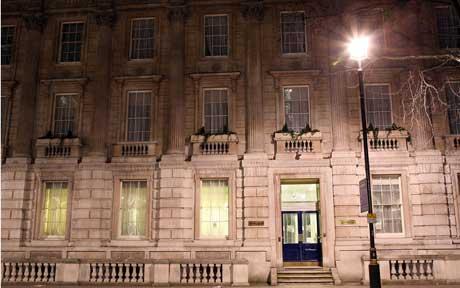
In another lifetime and on another planet, Foodge had the good fortune to spend a while in the Cabinet Office – the Special Forces Unit of a government. The members of this elite crew were the hand maidens of the head of that government and the gatekeepers for incoming flak (letters from shock jocks and hard-to-resist FOI requests) and outgoing (and I use the word loosely) “policy”.
Foodge was just breezing through cleaning the Ethernet cables.
But these Special Forces Cabinet Office people were a driven lot, usually hard and experienced from being bloodied in former campaigns in lesser theatres (inner and outer budget departments). These were the gentle folk who could turn a complex issue and a complex set of attendant costs into a one page decision document for Cabinet’s consideration. Cabinet would decide on the strength of say 300 words to spend or not spend say $300 million of taxpayers’ money – or money borrowed on behalf of taxpayers.
Cabinet discussions, papers and cabinet meeting minutes are sacred and Foodge thinks it’s fair to say that a person found to have engaged in a bit of pillow talk that led to a traceable leak could reasonably find themselves promoted to a challenging position on a wild pig eradication program or be posted to a vibrant centre 200 kilometres from Woop-Woop where the nearest viable cappuccino was 3,000 light years away. It’s surprising how much leaking goes on these days at stratospheric levels that not even Wikileaks can fabricate. Assange that, will you, Oaks …… showing that the failure of fatal consequence has the Cabinet leaking like a sieve.
Foodge, in an idle moment, once asked a wizened old wizard maven what constituted “good policy” ? The Wiz thought for a moment, smiled and answered “no unintended consequences”.
This suggests an uncommon insight into the world of policy. According to Foodge, “policy” involved what Sir Humphrey Applebee habitually referred to as a “brave” decision to actually do something about a problem that government was unable to slough off to some other hapless organisation – say the not for profit non-government charity sector. Policy is clearly becoming an increasingly rare species with even fundamentals like incarceration of citizen criminals being outsourced to the for-profit commercial-in-confidence very very private (immune to even FOI) sector.
The genesis of policy apparently had to be a problem, but the problem was not necessarily explicit. The problem of deaths on unsafe roads was really only a problem in certain swinging electorates. The problem was more generally the incumbent needing to stay in government. And the policy was nothing so fancy as building a dual carriageway to totally prevent head-on crashes with an outcome as clear as X fewer crashes and Y fewer fatalities. The policy became the spend.
Hear the announced policy, brethren “ MY government will spend $1.7 billion upgrading the <insert whatever here>”. This saves the government from messy things like details and allows for massive adjustments to policy imposed by other more competitive policies.
A failure of policy then becomes an accounting exercise. The opposition will attack the government because it has: a) overspent (79% of cases), b) spent too late (21% of cases), underspent (a whopping 43% of cases) and d) no idea what it has spent or what it promised in the first place (39.6%). Smart arse readers will notice that these percentages don’t add up to 100%. That was a conscious policy decision – so, tough.
So when we hear critics say that government has, for example, not delivered on its promise to do something, to develop and implement a policy and (whoa Nellie) deliver a wanted outcome…… it wasn’t a case of the fact that a) some politicians had no understanding of the problem, b) no idea about what to do or c) refused to listen to people not in the Cabinet Office who actually DID know what to do and how to do it.
But the policy itself was basically sound. MY government’s policy was basically sound.
It was well-intentioned at least, but it had an unintended consequence.
It was a cane toad moment. It was a spending f*ck up. Accounting blame game starts now.
Foodge looked balefully into his receding Trotter’s Ale, skipped the 24 hour news coverage of the election, opened his paper and checked the form of the Dapto doggies.
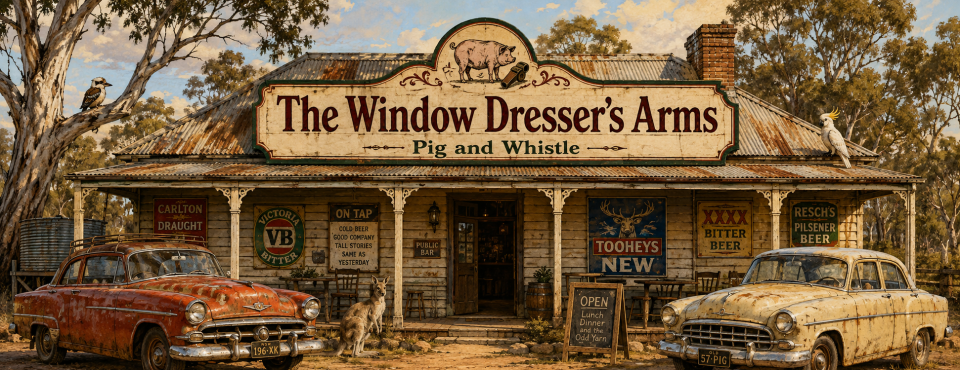
 Window Dresser's Arms, Pig & Whistle
I am probably projecting my own thoughts onto this article, but it stands out really starkly to me that Spend is about how you look, not what you do. When some bimbo who used to work for PM Rudd wrote on Unleashed about his achievements in office, five out of seven were spending increases. I wrote:
“If spending more is an achievement I must change to a more expensive plumber.”
Spending money is easy. I dare say even I could do it. Government has to do more than collect large sums of money from us and collect it into named piles.
LikeLike
… a more expensive plumber ….. I wish I’d said that, Voice.
Marvellous sledge !
LikeLike
Nice article Emmjay; sorry it’s taken me so long to read it; I find anything to do with politics incredibly depressing these days and so I try to ignore them as much as possible…
😉
LikeLike
I really liked this piece. I really did. So much so that I’ve cut and pasted it to a few friends, with attribution.
LikeLike
That’s very kind, Waz. Thanks, much appreciated.
Now I’ll go back and look up the definition of “policy” and seek that which I think we’ve all been missing. Is “policy” a metaphor for “leadership”, I wonder ?
When I went to send you this reply, the spell checker offered “shambolic” for “schmolicy”. Resonance from unlikely quarters !
LikeLike
This comment prompted me to look up schmolicy. I came across this from a year ago, where a native Mandarin speaker is asking the meaning of Policy Schmolicy.
http://forum.wordreference.com/showthread.php?t=1575831
English is incredibly difficult I think because it keeps absorbing so many influences.
LikeLike
I think leaking is an important issue. Just the other night I got up and had a leak, then had a good lie down and felt much better in the morning.
LikeLike
Gillards best moment of recent times was when she came out fighting yesterday . I hope Kev not dumb enough to be the leaker – maybe one of his idealistic young minders – or godwin grech!
LikeLike
Hi Sally, we took a break from all the leaks and went to Sydney to see the Chinese Exibition in The White Rabbit gallery in Chippendale, fantastic…go and see it if you have a chance. I believe it ends this Sunday.
LikeLike
Bugger
LikeLike
good idea to have break from campaign – trying to bore us all to tears! shall try and get to exhibition – am very interested in chinese art. Warwick has seen the terracotta warriors and loved them – i am keen to see also
LikeLike
Yes,
I tried our GPS for the first time. In the city it is very handy but it took us to a large building site with a huge fence. The gallery was amazing, an architectural wonder. A knock-out exhibition too.
On the way home I tapped nervously ‘Canberra’ on the GPS but it took the car to the Domestic Terminal airport into the ‘departure lounge’.
We drove around aimlessly but finally managed to get back to Sydney’s Bourke Str from where I changed the GPS to Moss Vale. That helped, and it took the car past a Harvey Norman store and finally on the M5. Apart from that, we had a nice day and some lovely crispy ricotta pastiches from a Greek coffee shop in Newtown. The rotten GPS kept saying ” you are over the speed limit”.
LikeLike
I would leak on the Libs anytime, especially on Abbotts bike or preferably inside his helmet. What about the cheek of the Catholic Bishop questioning the disadvantage of having an atheist PM?
Geez, after all the buggerings going on’s by hordes of Catholic Priests you would think they’d be lying low for a while.
LikeLike
Amazing that they have the nerve to say anything – hardly the pillars of the community judging from many repeated offences …
LikeLike
There’s Barry Cassidy looking for ‘an enemy within’, and Annabel playing Cluedo and everybody else looking into their bottom drawers for something, maybe for Abbott’s receipts for his travels…
The Monk and Julia promising the world…I’m sick of it and I’m ready for a pint of Trotters Ale (what is it?), better stay with the pink, and keep the suitcases packed just in case.
LikeLike
Yes,
where does this appalling paucity stem from?
Are we too full of oversize steaks or is it more due to growing up in oversize houses, or those mind-boglingly, blindfolded desolate suburbs?
Having had a dekka at the Gillard’s abode; jeez, no wonder. How can anyone survive that? Mind you, at least the fence was honest hardwood paling. Where and how did Abbott grow up and live. Has he been over exposed to zinc alume or Juliet Balconies?
Funny thing is, it starts alright with expectations of finally getting a ‘normal and progressive forward’ looking PM and then it collapses. Rudd with his thing about Bill Henson’s pictures and now Gillard with her ditherings on refugees and going endlessly forward.
Perhaps just whittling on a wooden stick with my pocket knife might give an answer. (Do they get paid enough?)
LikeLike
I would not get too mean with Gillard Gez. Look where you grew up and survived!
Talk about Dapto doggies. Our Jack Russell, the incorrigable ‘Milo” has become the sensation of the Southern Highlands. People cross the street,shopowners leave their shops, all wanting to stroke and pat him. Some ask permission, others just pat him spontaneously.
I am half inclined to tie him up near Woolies with a hat with some coins next to him. He would make a fortune.
As for the good intentions of political parties but bad execution. It’s probably tied up with bad skill training and our overriding delight in getting away with making a fast buck.
LikeLike
Gez, I was foolish enough to express my disappointment in both party’s proposed treatment of asylum seekers via facebook, and was accused of being a ‘latte sipping whining homo’. So much for political debate!
LikeLike
it is sad isn’t it – as a faithful labour voter I would still like to be able to express disappointment about their policy on climate change and asylum seekers – whilst i dont think libs any better i expect more from ALP
LikeLike
but you are a latte sipping whining homo. And you left out nancy boy
LikeLike
Thanks Hung, I knew some incontinent bastard would say it!
LikeLike