Tags

Four Ten Pound POMs
By Susan Merrell
Although I’ve never met our Prime Minister Julia Gillard, her background is so similar to my own that I think of her as ‘our Julia’. It’s how she would have been known to those closest to her in the vernacular of South Wales from where both she and I hail and where, for a time, we lived seven miles apart before both our families migrated to Australia – mine two years after hers.
In the Australian vernacular we were ‘ten pound Poms’. But ‘Poms’ were the English and although used to refer to people from Britain generally, we Welsh knew we were different and that applied particularly to politics. For when England and Scotland voted Conservative last century, Wales never did.
The Welsh novelist and humorist Gwyn Thomas, who hailed from the Rhondda Valley in south Wales once explained to an interviewer that he was born with socialism running through his veins and that it would take the efforts of a whole blood bank to shift him to the right. As for Gwyn Thomas, so it was for many of us.
Although Ms. Gillard hardly had had the time to absorb the political context in Wales before her fifth birthday, her parents, nevertheless, were well versed and clearly imbued Ms. Gillard with this commonplace Welsh political outlook judging by her own rise through the ranks of the Australian Labor Party via the union movement.
In Wales, it was the issues of the coalfield that created the political mindset that has lingered even through shifting paradigms. Coal miners were some of the most exploited and oppressed of all workers even though the mine owners were the some of the richest men in the world (and yes, they were mostly all men).
Welsh miners became militant. Having nothing worth conserving, political conservatism was never a viable option. They organised and unionised to improve their sad lot. They embraced socialism and the Labour Party and they took the rest of Wales to the political left with them.
How ironic then that one of the first issues that Ms. Gillard faced as Prime Minister was the mining super profits tax.
For she was born in the shadow of the docks in Barry built by David Davies Llandinam who was one of the richest men in the world thanks to the ownership of South-Welsh coal mines. He built the docks in Barry to ensure a cost-effective and efficient passage for his coal, in preference to relying on the nearby Cardiff docks. Davies’ super profits must have been huge!
But it’s not the entrepreneurial Davies – who had risen to his position of wealth from a very lowly beginning (his father was a sawyer) – that Ms. Gillard has identified as her Welsh hero, but one Aneurin (Nye) Bevan, who was one of the architects of Britain’s ‘Welfare State’.
It was our Nye that designed and implemented Britain’s National Health Scheme as part of the 1945 Labour government of Clement Atlee.
Bevan’s move to political prominence in Britain was very similar to Ms. Gillard’s, firstly through the union movement as an official of the very powerful South Wales Miners Federation and then latterly through the British Labour Party.
Yet Bevan often found himself at loggerheads with the unions later on his career, deracinating him from his own union roots as a miner. Did Ms. Gillard’s winding back of the ‘super profits tax’ similarly deracinate her from her natural constituency?
The major difference in the trajectory of both careers resides in the fact that Ms. Gillard was successful in wresting control of the party away from her predecessor and gaining the ultimate political power in Australia whereas Bevan never succeeded in Britain.
For Bevan alienated many in his party. He was authoritarian and difficult. The press dubbed him the ‘Tito from Tonypandy’ (invoking the authoritarian leader of the then Yugoslavia, Marshall Tito, and Tonypandy where a miners’ strike provoked Winston Churchill, then home secretary, to controversially send in the army to quell it). Hugh Gaitskell, the politician who was the Labour Party’s preferred leader in a two-way tussle against Bevan nicknamed Bevan a ‘Cymric Hitler’.
So are there lessons for Ms. Gillard here?
With so many changes of leadership in our two major national political parties lately, there ought to be.
So, our Julia, heed the lessons well. The legacy of the militant Welsh miners is yours too. Pob hwyl i chi (Good luck to you.)
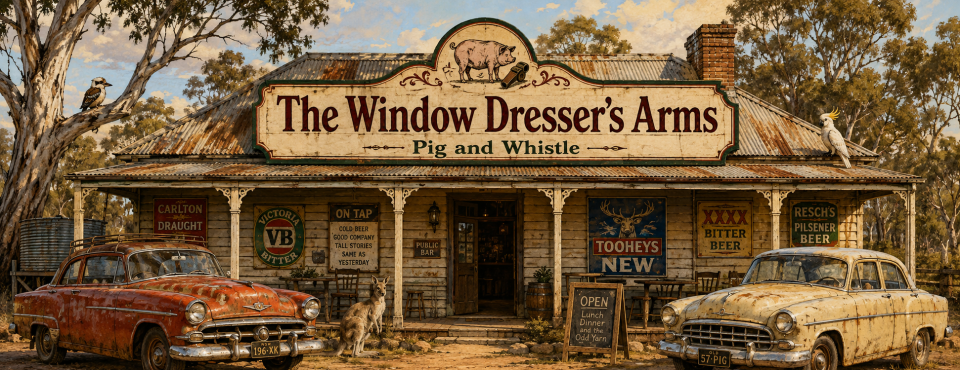
 Window Dresser's Arms, Pig & Whistle
Hi Susan
I was thinking about your story, that’s how I started that music-video story on the Dot page. I met a woman who was one of the kids brought from Ireland as war orphans. It was the first time I’d looked on the other side of the story of the immigrants. Elvis Costello starts it with Shipbuilding; the desolation of a life with only War as a way to earn a wage. Sometimes I get the impression that the efforts of people who moved to escape old wars helped us all to avoid the mistake of drifting into new ones.
LikeLike
sandshoe, ‘the boys’ are on a virtual bender on The Dot, we have to entice Lehan to come down and write a story, maybe the boys will follow 🙂
LikeLike
LO(Loud)L 😀
That Lehan. Gosh she can write. What a brain. 🙂
LikeLike
Nice article Susan… and always nice to see you here at the Pigs’… Merv! A long pink drink for our Susan!
🙂
LikeLike
Thanks mate. I needed that!
LikeLike
Yeah… good luck to her alright… Gord knows she’ll need it!
😉
LikeLike
You, asty, have been at The Dot! To all appearances on a virtual bender! Je t’accuse!
I thought you would never get here!
LikeLike
Hmmm. Hereditary class warfare. I think it often transmutes into a positive thing for the children though; less so for those who immigrate as adults.
LikeLike
Class warfare is not allowed to become hereditary in Oz, Voice:
One of the notable effects of the fact that social studies classes are often the first to go west when schools cut back on classes as a result of funding, in those schools whose student cohorts are largely working class, ie. primarily state schools, is that it divorces the children of working class parents from their own social context, alienating them in their ignorance, from any understanding of their place in a continuing struggle against the otherwise unmitigated oppression of the greedy classes. Now which side do you suppose controls education funding…?
🙂
LikeLike
OMG. I too am old enough to remember something called Social Studies. But the life of me I can’t remember anything ELSE about it.
LikeLike
P.S. You are talking about money. Not class. As an ex-Brit you should be well aware of the difference.
LikeLike
Voice, the two are not entirely unrelated you know! Today’s ‘nouveau-riche’ becomes tomorrow’s ‘Old Money’…
😉
LikeLike
Good one Susan, nice to read a bit about Welsh history, about your and Julia’s and our dear Allan’s background…
Sorry about my reply to sandshoe popping up with a twin, this is my daughter’s computer and it does not listen to me, all I wanted to do is a correction in my second paragraph…
LikeLike
A 10 pound POM I know whose family went back to the Old Country and returned again on reflection entertained me when we were flatmates with her story about the ships passing in the ocean. On that family’s first voyage to Australia, she recalled returnees hallooing across to the new chums, “Go back. Don’t go there. It’s terrible there.”
Interesting my now identifiably ‘Australian’ friend demonstrated herself to me as a devoted and exciteable fan of Julia for PM.
We wonder, don’t we, in our lives would we choose otherwise in a storm, in a fight, in a teacup and if a story is true as far as a story teller and her characters’ main motivations and broad sweep outcomes can be measured against bare facts; place of birth, year, weighing in at…perhaps and childhood direction and deviance.
I had wondered when Julia named Bevan as an inspiration might she have named Billy Hughes, a Welshman regardless born in London, were she a vintage product of that further era. I believe she might have. It would have been a punt on an Australian image of an heroic leader tussling with the variegated hues of Labour party mechanisms and international coincidences, going to and fro perchance in identity as an Australian and a product of Welsh forebears. Without say that was necessarily personal. She did not. I felt disappointed.
That does not make her a lesser leader. It does not make her better. Excellent and stimulating reading, Susan. Thank you kindly!
LikeLike
Of course, Billy Hughes changed direction and affiliation more than severally in his political career. He did not finish his race to the top waving a Socialist flag, but only began it.
LikeLike
Good point Shoe. I don’t think Hughes would have been a good example at all.
LikeLike
My piece is, really, toying with comings and goings backwards and forwards between countries and cultures and the political spectrum and compromise. I remember, clearly, when Julia made the Bevan reference, primarily thinking… o, what a pity she did not name an Australian politican, but anyway regardless, the subject that is unavoidable is “the Welsh” so my next reflection at that time of her reference was on Billy Hughes. Billy Hughes was, 50 years I think, in Australian federal parliamentary politics.
I find it an extraordinary view to imagine that passengers yelled from one boat to another mid-ocean…whatever they yelled about. I found that delightfully entertaining as a story. 🙂
LikeLike
Sandshoe, due to the fact that my time yesterday with my helper was occupied in the purchase of a new guitar, which necessitated a long trek in an opposite direction from the post office, I’ve been unable to post your personally-hand-signed-by-the-author-himself copy of Cyrus thus far; though I received your money order yesterday (thank you!)
It will, however, be winging its way towards you via Australia Post tomorrow… although hell, I could drive it to you personally tomorrow evening and it would cost me less and get to you at least a day or two sooner… If you’d like me to do so, please let me know by email or phone (I seem to remember emailing you my number…) before 3.o0 pm tomorrow; otherwise I’ll carry on with plan ‘A’ and post it.
🙂
LikeLike
OOPS! Sorry, Sandshoe, I mean, before 3.00 pm TODAY, not tomorrow… just noticed how late it is… must go and get some shuteye now… Hope you get my msg in time; wish I’d though of it sooner, actually…
🙂
LikeLike
Dear astyages, I have not bought a new book since about 2000 when I bought a friend a copy of Oliver Sacks’ The Man Who Mistook His Wife For A Hat’. I am a poor too regardless creative, brilliant even at moments. Lingering alive in Australia as we know it in 2010. I only really mention this so as to not withhold insight into how astonishing (deliciously delightful of course, as well!) I find it to contemplate a book being especially delivered to me, hand signed (yes, don’ bring me no robot signed ones!), by an author. ANY author, let alone … don’t be mad! A bloke with a crook foot!
This turn of life experience because I am buying a (beautiful brand new and I have been surprised at my excitement!) book takes the cake for poignant humour, sweetness, irony, pathos… delivered! Giddy gods! For cheaper than it takes to post! By the by, I did think I paid adequately for postage to me of one volume of Cyrus by astages, but it is is ENOUGH for it to be DELIVERED!!!??? By the AUTHOR!!!???.
‘Shoe, piglets, has to get her head around this at sun up on November 11!
🙂
LikeLike
sandshoe, I had married Gerard whom I met on my travels, and we were going to live in Australia for two years as Gerard had things to sort out there. My youngest brother, maybe seven at the time, was very concerned that Australia was ‘a convict country’, and it would very scary and dangerous place to live in…
It has been pretty good, we are still here….I just walked the two grandsons to school in a leafy, sleepy suburb, saw no monsters lurking anywhere, neat lawns and a friendly gentleman greeting me a good morning and adding God bless….
LikeLike
Morning Helvi, I was almost all day yesterday in the sun travelling across town and back. The weather has changed to a glorious heat. The most unusual eventuation of my day (in almost a year) was when I first heard a knock on my door earlier in the morning and opened the door, I found my daughter (happy and looking delightfully well) standing there.
Helvi, I identify more with your youngest brother than I can with your perspective. It occurs to me I could have told my sister she would fall afoul of a bear trap and get eaten by grizzlies when she went to Canada. If I had my time again, I would let down the tyres of the plane to gain some plea bargaining time.
LikeLike
sandshoe, it’s hard to leave sisters and brothers behind, but at least it’s easier and cheaper to see each other these days than before, even tho not always safer 🙂
Being sibling-less in the new country teaches you to make your own family of friends.
One of my single girlfriends lamented that she would like have less of these adopted brothers, but more ‘un-related’ nice single men about and around 😉
LikeLike
I reckon Women’s Centres ought to have the eligibles in packages on a shelf, Helvi labelled Potential Brothers only, Especially Likely to be Good and Moral as well at Rumpy Pumpy, and Hairdressers (Various). Those of us with that irksome (sometimes perhaps) status of Many Brothers could trade some likely in such a Women’s Centre. 🙂
LikeLike
sandshoe, I had married Gerard whom I met on my travels, and we were going to live in Australia for two years as Gerard had things to sort out there. My youngest brother, maybe seven at the time, was very concerned that Australia was ‘a convict country’, and it would very scary and dangerous place to live in…
It has been pretty good, we are still here….I just walked the two grandsons to school in a leafy, sleepy suburb, saw no monsters lurking anywhere, neat lawns and a friendly gentleman greeting me a good morning and adding God bless….
LikeLike