

Pictures and Story by Vivienne
These are my favourite cookbooks and I write about them in no particular order – I love them all.
The Cook’s Companion by Stephanie Alexander (1996 and 816 pages) – This really is a ‘must have’ cookbook and that is exactly what I said to myself when I heard that it had just been published. It is almost an encyclopaedia and very much Australian. There is a lot of cross referencing (Stephanie is a trained librarian) and it works its way alphabetically – anchovies, apricots, bacon, coriander, lamb, melons, rabbit, sage, trotters, yabbies etc. So, for example, if you happen to have a big crop of X vegetable here you will find how to store, prepare and cook it. Want to know what to do with a duck? Stephanie gives you all you need to know to cook it chinese style, french style, in a salad or with fruit. Her marinated boned leg of lamb is a little ripper. This too has some basics but it is so much more and it is written with a lot of love.
Mediterranean Food by Elizabeth David (a Penguin paperback, reprinted 1970) – This is the first cookbook I bought for myself and it is now in six pieces held together with a rubber band. Elizabeth includes quotes from such people as Henry James regarding a lunch he had at Bourg in France – these are all fascinating and reflect her own attitude to food and eating. Her section on eggs is amazing – two pages on the details of cooking an omelette. Some of her recipes omit certain details but commonsense usually overcomes that and the results are always delicious. Many recipes are remarkably short and simple (five lines on how to cook a stiphado). Elizabeth David was a pioneer cook and ahead of her time (she also loved oysters). A must have book.
South East Asian Cookbook by Charmaine Solomon (hardback, 1972). Over the years I have found that even if you don’t think one of Charmaine’s dishes is ‘for you’ give it a go and trust her. All the recipes are very good and taste great. She takes you through India, Ceylon, Burma, Thailand, Indonesia, Malaysia and Singapore, China and Japan in just 120 pages. If you like ‘asian’ food you can have it all in just one book – it is like a best of the best. There is an introduction to each country but the one on Burma is significant as that was where she spent her childhood.
Wogfood – an oral history with recipes by John Newton (1996) – and my copy is autographed! John came to Albury for a festival and I had a lovely chat with him. When he wrote Short Black for the Sydney Morning Herald I won his competition for an original regional dish and he sent me Australia, the Beautiful Cookbook (a very big book). Wogfood is a story of migrants from the Mediterranean and what happened to them in Australia. Quite a number of them lived and prospered in North East Victoria as well as Melbourne. You can read about people like Greg Malouf and his kitchen at O’Connell’s Hotel in South Melbourne. It is 240 pages including old family photos and a good sprinkling of recipes (duck confit, fennel salad, harissa, kapamas, Italian tomato sauce etc). Wonderful reading.
Greek Cookbook by Tess Mallos – my copy from 1978. It is an A4 paperback which starts with 26 pages on their regional specialties and the joy of sipping an ouzo while enjoying mezethakia. The recipes are focused on soups, sauces, seafood, meats, pastries etc and they are easy (uncomplicated) and work. If I want to do something Greek this is my first port of call. I spent three weeks in Greece and this book reflects my experience there – all good and a lot of fun.
Lebanese Cookbook by Dawn, Elaine and Selwa Anthony – also from 1978 (A4 hardback). It has a similar format to the Greek Cookbook. There are suggested menus for breakfast, lunch and dinner followed by mezza, pastries, soups, fish, meats, stuffed vegetables, salads, pickles etc. It contains the only recipe for stuffed grape vine leaves which, when I cooked it, tasted terrific and better than any I have had elsewhere.
Note:
I have a lot of cookbooks and some are only used for inspiration, others contain a few recipes which I regularly use and then there are those which contain vital information on such things as how to kindly kill a crayfish. The last cookbook mention here is included as a basic best book – not a favourite but highly recommended.
The Australian Women’s Weekly Original Cookbook by food editor Ellen Sinclair (reprinted 1989) – a must for some people because of the fact it is excellent if you haven’t a clue how to make a pavlova or a good scone. Follow the recipe and you’ll be very happy (Cream Scones recipe a total winner and was made often when I had plenty of homemade raspberry jam). I don’t actually refer to this book very often but it is an excellent reference for anyone who knows little about how to cook anything. It covers all one would need if you only ever bought one cookbook and didn’t want something which one might call ‘modern Australian cooking’.
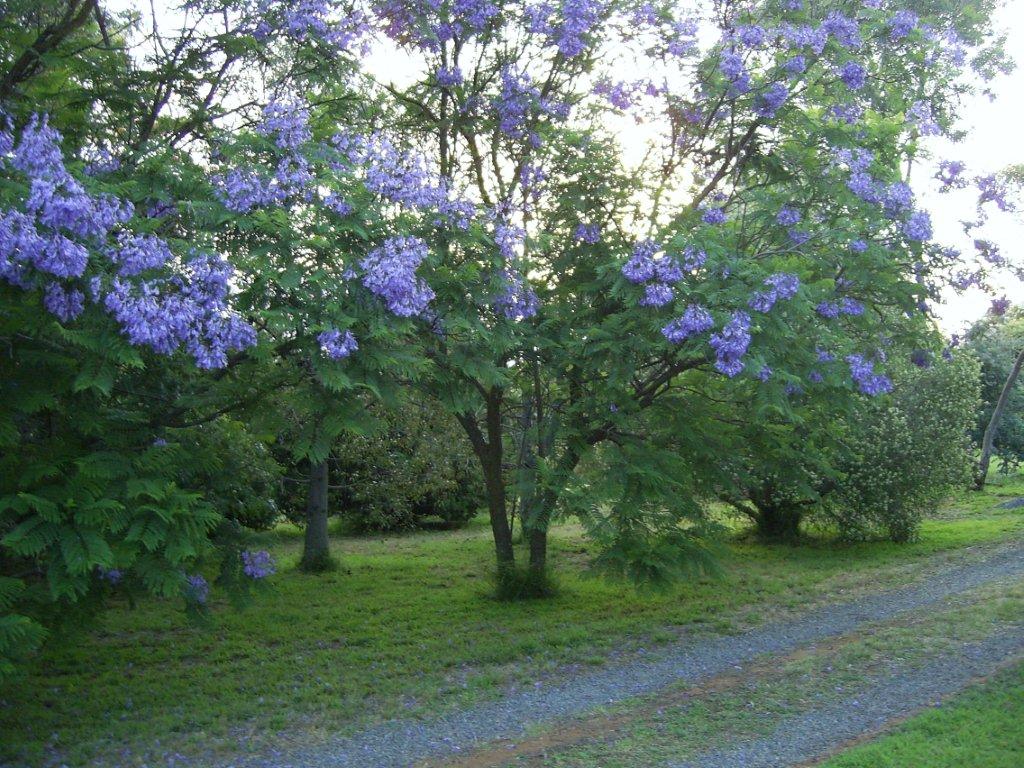
For those who don’t care much for cookbooks, here is a photo of another part of our driveway, taken in December 2010 and proving you can grow jacarandas in frost prone areas.
 Window Dresser's Arms, Pig & Whistle
I was just checking to see if the Farmer’s Mrkt is open tomorrow, since The Magic Millions Carnival has taken over the venue. And yes it’s on. Hoorah! And look what I discovered, a video of my own favourite Sunday morning venue. Blink and you’ll miss me. That’s me over their standing by Farmer Dave’s stall ; you know the gay winner of something wifelyish.
I wonder how much produce they will have with the lack of vegies in Brisbane. I am told the shops have all sold out!
LikeLike
I was remembering that someone asked about if we were willing to put some recent photos up and I will perhaps with my next story… tell me Jayell is your cameo walk on or stand around part before or after the segment with Huey and the stall holder dressed in orange brilliantly?
LikeLike
Yes agree Viv, the WW Cookbook is a must. Our first version feel apart then came across a mint condition one a an op shop, very greatly relieved to have it back in the collection.
Got a Donna Hay one for number two son but he didn’t use it. Tutu and I use it for inspiration.
LikeLike
Wow Sandshoe, you are a woman of many talents, what a fantastic list of cookbooks; I’m sorry now that I gave so many of mine away before moving…lots of them were not just for recipes but also good for reading and finding out about this world.
Please don’t make the same mistake when you move, shoe 🙂
LikeLike
Still waiting for Sandshoe to return and comment. Sandshoe asked for an article on cookbooks!
LikeLike
I’ll be back. Unexpected turns of events with transits and transports and I should have known. Sorry, Vivienne. My player piano…
LikeLike
Hello Vivienne, yes thank you and I did not forget thus squealed with delight when I saw you had posted a piece on cookbooks…
Elizabeth David’s ‘Spices, Salts and Aromatics in the English Kitchen’ was my own first … a ‘good read’ and got me interested in the social and cultural context of food. Rosemary Hemphill’s books were a useful accompaniment mastering herbs.
There were:
Curries from a Sultan’s Kitchen: Doris Ady.
Adele Davis and Lelord Kordel for titbits about wholefoods, and old American Home Manuals.
Elizabeth David’s amazing ‘English Bread and Yeast Cookery’.
‘The Alice B. Toklas Cookbook’ … ‘a good read’.
Molly Katzen’s ‘The Enchanted Broccoli Forest’.
‘The Vegetarian Epicure’ by Anna Thomas.
‘The American Heritage Cookbook’ (Volume 2). Lovely Swedish Rye Bread recipe in that.
Moving to live in Adelaide from the tropics meant ‘Greek’, but that certainly began with Elizabeth David’s ‘Mediterranean Food’ … mind, basil is the most beautiful food using it layered in a ‘Gypsy Salad’ alternately with a range of greens and alternate herbs, but you have to know how (from a Cairns restaurant).
Italian: ‘Australian Women’s Weekly Italian Cooking Class Cookbook’.
I learned Asian cooking, with the help of the shopkeepers in the Central Market in Adelaide, ‘Australian Women’s Weekly Chinese Cooking Class Cookbook’ and a volume I borrowed from a library, from which I made Asian sweets made from palm sugars, semolina, tapioca… and cooked Lebanese from ‘Lebanese Cooking’ by Dawn Anthony and Elaine and Selwa.
My favourite described the quality of chapati dough feeling like ‘an ear lobe if you have one’… John Downes’ ‘Natural Tucker: Traditional Eastern & Wholefood Cooking’. Maybe ‘faves’ too the ‘Green and Gold Cookery Book’ and ‘Advanced Commonsense Cookbook’… and the series ‘Wonderful Ways to Prepare… ‘ (Soups/Meats/Chinese etcetera) published in Australia by Ayer and James. Good absorbent paper for cooking spills. 🙂
eg Sunbeam recipe books supplied with Mixmasters and Frypans and Kelvinator’s refrigerators are desired collectibles to some people … because they originated in test kitchens.
O, yes, I knew a gent who revealed that years before his retirement, in his position as Sales Manager for a major paper supplier in NZ, he wrote a cookbook in accordance with his idea that one page of or more, ready to load into a spiroflex binder, would be supplied to customers depending on the quantity of paper they bought, thus rendering the individual recipes ‘collectibles’. He said the recipes were popular. 🙂
Did I say Salvador Dali’s ‘Les Diners de Gala’ signed is especially collectible … mmm, no, I don’t have a copy and that’s OK. 🙂
LikeLike
‘Shoe, on the first mentioned book – Spices, Salts…… Do you know whether there is any salt regularly used in food other than sodium chloride or common salt ?
LikeLike
http://www.manhattanrarebooks-art.com/dali_diners.htm
LikeLike
Sorry to be so slow out of the blocks, ‘Shoe. I just chanced on this in my Email clean-up. Really interesting link. Wish I had a cool 4 grand to spare !
LikeLike
Another great collection. I still have the Sunbeam frypan cookbook and now I know why it is pretty good.
LikeLike
Aye, emmjay there will be many an old sea salt, shiver ‘is timbers, ‘ho ‘as bin used in … cookin’ it is wha’ is the subject, emmjay, cookin’ … tho’ I’ll be might’ surprised wit’ m’ eyes wide ope’ if a few ‘a’en’t bin used in food. Och.
Is it Pirate Day, again already, emmjay?
🙂
LikeLike
We love our cookbooks here, too, Vivienne. They sit on four rows of our kitchen book shelf. Greeks, of course, don’t read cook books for the recipes but for the philosophy that engenders them. What they say about the humans that conjure them up, about their human relationships, the place of food in their lives, their creativity, imagination, personal expression. That sort of thing. One look at the picture of the dish, check the ingredients and they need not read the method. They take the idea, the philosophy and begin the arranging of the pots and pans, the knives and the cleavers.
Here’s a small list of our most frequently referred:
Larousse Gastronomique: Prue Leith
La Methode -An Illustrated guide to the fundamental skills of cooking: Jacques Pépin.
The Book of Ingredients: Philip Dowell and Adrian Bailey
Encyclopedia of Herbs and their Uses: Deni Bown.
Penguin Cordon Bleu: Rosemary Hume and Muriel Downes
The Harrods Book of Entertainment: Caire MacDonald of MacDonald. (true dinks, that’s her name)
Lots of books on cooking from various parts of Greece and Italy, as well as of other places are also looked at occasionally.
But you’re right about ancient history blokes, Vivienne. The whole dining room is very untidy with all my books and newspapers! I sort them out one minute but the next they’re all back there again, strewn all about the place in a most indecorous way.
Food for the stomach versus food for the brain. The war is monumental!
LikeLike
Atomou, the books you list sound magnificent.
Since my husband retired I have had our dining table returned to normal use as he turned his attention to motor car and bike racing, Le Tour de France, Tour Down Under and Australian heritage and the like. Occasionally the table disappears under a pile of maps as he plans his next adventure. Makes a nice change from the days when he was marking assignments and used the floor to sort things out when it was like walking through a maze. I used to compile the marks on a spreadsheet throughout each semester.
LikeLike
That photo of my cookbooks represents about one quarter of the actual number. Stephanie’s book is elsewhere as it is the most expensive and I don’t want it to get mangled up with the regular fiddling which goes on when plucking a book out and the space disappears and everything has to heaved to one side to replace a book. That is what happens when a collection is a mix of paperbacks and hardbacks of many sizes.
LikeLike
I adore Jacarandas and good food even more.
You have put some thought into your selection above and that is appreciated cos there’s so many to choose from these days.
Our household has too many really, but they are such pretty literature with the modern photography: food porn!
I have a dog eared Elizabeth David and a Larousse amongst my collection. The Larousse is particularly satisfying on a rainy day; proffering historical feasts and obscure recipes. Not to mention fifty ways to leave your lover! Ooops sorry–make that fifty ways to cook snails. Actually I’m lying, but I’m sure that you get my point.
Just polished off a Waldorf salad accompanied by cold roast chicken, stuffed with a home-made mixture. Dessert was more salad …yum.
Where’s Tomokatu? Recipes? He has some beauts.
I’ll see your Indonesian book and raise you a JL satay sauce gerard!!
LikeLike
Either way Jayell, I love snails but haven’t had any for ages. Just the snail in the shell with butter loaded with garlic.
LikeLike
I also notice Viv that you’ve got a book there titled “Good Cooking With Wine”.
I’d have thought this simple statement of fact goes without saying.
LikeLike
How appropriate then that the book is upside down (I just noticed) …!
It’s best in the cook and in the food.
LikeLike
Vivienne, my wife on her wedding day was given “The CWA Cookery book and Household hints” by the local CWA as was the tradition in the country town that she grew up and we got married in (23 years ago this Sunday in fact). First produced in 1936 it really is history showing who some things were done then.
We’re always amazed and get a laugh out of the “Catering” section, like catering for 50 people or afternoon tea at a fete, maybe a wedding breakfast for 100 guests with tins of theis and that. The catering for a public stock sale for 300 is one of our favourites.
We still use this book as a reconner for many things and some of the useful hints in the section “Hints that help in the home and preserve the temper” or “Laundry hints, soaps and pastes” work better than many modern solutions.
LikeLike
Don’t forget to partake in a beverage of tea-as you recommended to Zorba-Algy.
LikeLike
Two weeks in a row, Jayell, her birthday is the following week.
LikeLike
To Warrigal – amazing to have to tell you that I nearly included a non-book mention – my collection of handwritten and typed recipes (plus some cut out of magazines) which I keep in a funny manila folder I made a long time ago. It includes a real motley collection as well as a photocopied page from my high school cookbook on how to cook cornish pasties.
LikeLike
We’ve just finished spicy lamb meatballs and broccolini wokked in oil and garlic, plus mashed potatoes, (I love mash), followed by freshly cut fruit salad.
The meatballs come from the A5 folder. Apparently that recipe was one Sche got from the gardener’s wife when she was just a child in Rangoon.
LikeLike
Because it was a rainy day here, (I suppose everywhere), the visiting daughter felt like cooking a shepherd’s pie. Funny enough I have never eaten or cooked it before. She prepared the mince mix, and I made mash potatoes…I wanted to eat it on it’s own, there and then, it’s a bit of comfort food for me, another one is risotto, and I might add one more, potatoes Anna…
I’m feeling a Nigella moment coming on, cold mash from the fridge…
LikeLike
One of our most treasured cookbook is the Indonesian Cooking one. It is spiral bound and like some photo albums, the metal spiral seems to want to escape. I rewind the spiral into all the pages but within a couple of months when I want to brush up on some sauce or other, the spiral has gone out again.
Anyway, today is shepherd’s-pie without the shepherd knitting away counting his sheep, leaning against an old gnarled Argyle.
LikeLike
My only contribution to the art of cooking is that I’m always happy to eat well prepared and exciting food. This is another of life’s happy fortuosities as Sche comes from a long line of great cooks.
Sche too keeps a library of cook books and is happy to pour over them for hours on end when she’s of a mind to cook big.
In fact Viv, you and Sche have similar tastes in some areas. Sche too has Solomon, and the Woman’s Weekly, the David and Don Dunstan’s little tome too; but the main source of her recipes is a collection of handwritten secret formulae bound up in a small A5 binder. Most of these recipes came from Persia by way of Burma and India with side trips to Armenia and Thailand. Some are scrawled in their original languages and are entirely impenetrable to me but they represent powerful culinary touchstones to Sche.
“That’s Uncle Victor’s recipe for fish mollie. He got that when he was teaching in Kerala before the war.” or “I remember eating Hranoosh’s nazook when we were kids. I’ll make some for afternoon tea.” etc etc. Never a dull moment when it comes to tucker around here.
In fact I think it’s fair to say that I hadn’t really eaten good food outside a restaurant until I met Sche. Having been brought up on mutton and three boiled veg it’s fair to say my palate had never been stretched buy the concept, “home cooking”. The downside is that now we hardly ever go out to restaurants because the eating’s better at home; and the strange thing is that I remember that’s exactly how Sche’s dad Kervork was.
LikeLike
Waz, Charmaine is so pervasive, even I’ve got one. Also Tess Mallos for middle east cooking – is an equivalent great in my “cannot cook to save his life” wasp estimation.
LikeLike
It feels uncanny that this morning early hours I sat to savour my collection of now cookbooks. Vivienne, thank you for the essay! Later on when I accomplish some day tasks I will read again and savour and chat.
LikeLike
I love cookbooks as anthropology. The lushness of Stephanie Alexander, the austerity of Day to Day Cookery – my high school cooking textbook, given (back) to me by my grandmother.
LikeLike
Viv, you have taken that pic of my Elizabeth David book, I actually had all three, gave the other two to Daughters and kept the Mediterranean one….
I also kept Stephanie’s wonderful , ‘everything-is- there-in orderly manner’ tome.
Charmaine is there amongst the most treasured….
Daughter (with the Greek friend) was eyeing my most beautiful ‘Falling Cloudberries’, but she has to wait. She has already got my two Margareth Fultons and some of the Indian cookbooks.
I gave away some of the most rattiest looking ones, but could not part with Elizabth!
LikeLike
…the other picture reminds me of ‘our ‘farm !
LikeLike
Hi Helvi. Everything on our property we planted and grew ourselves. When we bought the land it had nothing but rye and clover and a few thistles. We do have a lot in common and it proves you can judge a person by what they write – that first response of yours to my comment about telling Gerard to cheer up and have some anchovy olives and brie!
LikeLike
Viv, you are a real sweetie ! Which story of Gerard’s was it?
LikeLike
Don’t actually remember. But we had a conversation about anchovies – I had to correct a spelling error, I wrote ‘anchovey’ and it should have been ‘anchovy’.
LikeLike
Falling Cloudberries ! What is that, H ? Some kind of sorbet made from hail ?
LikeLike
They are the best wild berries in the whole wide world, Emm.
They are the Finnish manna from heaven, lovely amber coloured berries that we used collect as children….heavenly!
LikeLike
Do adults find them as tasty as children do, H ?
LikeLike
Helvi – I looked up your gorgeous berries and apparently they grow well in the tundra so I gather we can’t grow them in Oz. They look beeyooootifullllll.
LikeLike
Cloudberries of Childhood always taste good; you still cherish Mum’s chokos, Emm? 🙂
At our Balmain Christmas party the food was plenty and very international, yet when the hostess wanted us take some of the delicacies home, I only wanted to have some Potatoes Anna, dish that my Canadian friend had made; it tasted just like Mum’s!
LikeLike
H, Mom’s chokoes were pretty much like all her veggies. Limp stewed Kleenex of slightly different pastel hues. They all tasted like the salted water in which they met their collective fates 🙂
LikeLike
I’d never heard of or seen a choko until I lived in Sydney. They grow there like a weed. Cooking chokos and then eating them must be a leftover from depression (I reckon) when people made a virtue out of eating tripe. I’d rather settle for bread and dripping!
LikeLike
Correct ! Chokoes were a depression era food. I railed against them in my Unleashed piece so long ago, now – along with other vegetable matter 🙂
LikeLike
Yes, Viv, bread and dripping….mmm, or even just good bread without dripping….
LikeLike
Yes Helvi, perhaps just the bread! But, my grandmother lived with us from when I was six and she saved the homemade dripping and actually gave me bread and dripping and I have to admit that it tasted okay! Of course, I meant ‘the’ Depression. I was fed tripe once a week and did not like it but was made to eat it because my mother loved it. Well, I do happen to like lambs’ brains but would never force anyone else to eat them if they didn’t want to. Therein lies the source of my cooking adventures – volunteering to cook something instead of having to put up with bloody tripe. First dish for the family was asparagus wrapped in crepes served with a cheese sauce. It was a winner of course and I was on my way.
LikeLike
Chokos are food or we’d all be dead I reckon we would agree from eating tinned pears once too often and too many slurps of tom sauce, whichever way you look at it in a dump or on a back fence newly moved in, perhaps in a Brissy suburb or even growing on the back of the chook house at the Pig’s at a pinch . Just thought I’d say eh, Foodge painted over every flower he could there one year he reckons when Boss gave him the contract to paint the Wardrobe when someone told him he [the Boss] wuz Wardrobe Mgr. Bout same as he [the Boss] knows about cookin’ I sometimes think, doin’ Wardrobe. Likely Himself put Foodge up to that paintin’ over the chook house choko flowers.
Same as green punkin’. Punkin’ flours. Nasturshim flours. Chokos, I mean. It’s all food and it all depends on how it’s prepared.
Now why did I expect someone to launch into or be led into telling us about the terrible cookin’ of their mum. I t’inks I detect ‘being led into’. 😉
ROFL… are cloudberries a sorbet made from hail, emmjay asked?
Giddy question! Huzza, I like that! 🙂
LikeLike
Sandshoe – more info for you – my grandmother did all the cooking and it was at my mother’s behest that she dished up the tripe week in and week out. All the Depression food was not bad but the lining of a cow’s guts may have been put to other good uses instead of being offered as food.
LikeLike
Hi Vivienne, I’m partial to no tripe myself (yummmm), count me in for no brains (a lot of us have been alienated from those), no offal is nice. Red meat does not stand me in good stead these days. Something flawed one way or another with most of us, but as well I sickened of the farming of red meat and its slaughter, which was really not a choice, just happened. I cook meat for folks tho’.
I mostly have to eat fish one sort or t’other to be a well Sandshoe, vegetables and salads…lentils, chickpeas, beans, green beans. Poor you who were children in the era of the tripe meals and such concoctions…somehow I was spared… when food was running out mum’s jam tarts were yummo with her home made custard and how she managed puftaloons that rose like little puff balls and we smothered in Golden Syrup do not know… but the cupboard then was otherwise bare.
Vivienne, I was the youngest home on my own for most of the years of my childhood and my parents were established enough that in my time, by the time cupboard was bare, it was an extraordinary expense that had emptied it.
We had two mango trees I fed off along with the birds and the bats in their seasons though and pawpaws were delivered by neighbours, passionfruit and lychees so I was so privileged in respect of food. Thank you for the comment and reminder.
Better off than with tripe with a nicely steamed until just tender choko with its gentle moisture beginning to gleam on its flesh with a generous slice of nicely steamed pumpkin and condiments and herbs layered in a white china bowl I reckon and not intending any disrespect of course to the mistaken idea tripe is a food. If it is a food, I will eat my hat.
I serve food (since I thought of it in my 20s) as a smorgasbord most usually so nobody need eat anything they are averse to… my children are diverse in their food habits and I think they are well served by their childhood experience of learning the range of foods and exercising choices. We have been lucky as well to have been able to do better by the generations in some respect and isn’t there irony in that considering fast food and all the food problems that beset our now world. Cripes what conflicts over food people endure.
LikeLike