
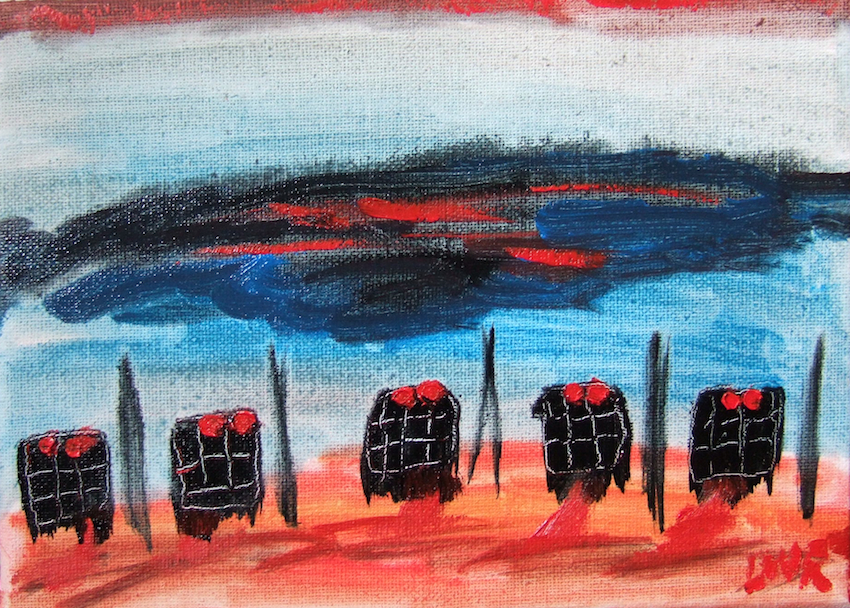
Maybe Nothing
Painting and Story by Lehan Winifred Ramsay
Sometimes we lose sight of what a system is, drawn into some kind of mystical enlargement of the concept. System engineer, systems analyst, computer system. A system is just a reusable format after all. We make a system for preparing our lunch, a system for figuring out what to wear to work. Systems have become a specialization, even the foundation of a career. We can take a three year course on systems. Nobody in that course is going to say: we are teaching you how to make a reusable format.
There is no refuting that systems are important. We put layers and layers of new experience over our lives. But we still need all the basics, and a dependable understanding of systems is going to help us to navigate all of that information. There is no doubt that the rise of systems goes hand-in-hand with the rise of complexity.
The nuclear power plant in Fukushima, Japan is an interesting problem to consider in regards to systems trouble. Systems were put in place that seemed to be good, and those systems worked without major trouble for a long time. The problem that emerged – an oversize tsunami – was not one that could have been foreseen. Modelling had been done, estimates had been made, nobody expected the problem to be as large as it was; an earthquake compounded with the lifting of the sea bed. Now we know that we must build to withstand an event far more extraordinary than had been factored in. But that is not enough. Now that a serious event has occurred, all kinds of small errors in managing such a problem – such a system – are compounding and growing. There are fundamental flaws in the design of the system itself.
I want to reconsider the system. To consider the ways in which our systems cause us to lose our consciousness of what we do and fall into default. It’s fine to have a system for preparing your lunch. You just have to remember that your options are not limited to what you make. They also include what you don’t make but may one day have no alternative but to make. Likewise you need to remember that your options for what to wear to work may also be helped along by adding another element now and then. And that at some point those new elements are going to shift your wardrobe into something completely different. In the case of the nuclear power plant, people prepared for a particular size of disaster, they prepared for forty years. Over that forty years, though, as nothing as large as their planned disaster happened, no doubt they began to forget that things could actually be worse than that.
We lose sight of systems by taking them for granted. You’re looking for a new outcome. You use an old form. What you need this form to do is different from what you needed in the past, but you figure you can just work that in later. We make up forms as a kind of shorthand system, and then because they’re convenient we stick with them. Forms, though, make an idea rigid; the form is what makes the shape. If we continue to reuse the same form over and over when our aims have changed we run the risk of having the form define what we do. It’s important to regularly go back to very basic working systems and take a look at what those core elements mean. The nuclear power plant was built to withstand a certain level of disaster. But forty years of use meant that that level may well have decreased without anyone being the wiser. New concrete, pipes, joints and old ones do not have the same ability to endure stress.
Systems develop flaws through repeated use, and often those flaws are not noticed. Not noticed by the people who use them anyway. Other people might notice but think that they are seeing mistakes by people. But often it isn’t a mistake of the moment but a mistake from deep in the system. And often those flaws come out when something big happens. It’s not until the nuclear power plants in Japan are abruptly shut down by tsunami that the company understands fully what happens when they shut down abruptly, and at that time any simple flaws will be in full view.
When we lose sight of systems, they start to take us where we don’t want to go. There was some anger that the TEPCO power company had submitted a plan to the government to expand their plant. The submission was written before the earthquake and submitted without adjustment after the earthquake. It’s interesting to note that without this disaster, this aging plant may have grown even more dangerous in the future. Over the years there has been some serious opposition to nuclear power in Japan. But up until now the positive aspect of ample home-grown energy has outweighed the possible risks to people’s health.
Now we have the system clearly in our sights. We can see that it contains multiple flaws and errors, oversights, inadequacies. More than that, we can see that should a problem occur, we with our global connection all stand to be affected by it. Isn’t nuclear power a little dangerous to be staking our futures on? I hope to see some positive outcomes from a little more scrutiny of where this technology is taking us. Perhaps Japan could not afford in the past to invest heavily in developing alternative technologies. I can’t see now that it will have a choice.
Sometimes we lose sight of what a system is, drawn into some kind of mythical enlargement of the concept. Isn’t that what we did with nuclear energy? Baffled by the science of it, we felt unable to have a judgement. The science may be complicated, but the solution to the problem of a faulty nuclear reactor is not. There is radioactive material, and despite a half a century of messing around with it, we have not worked out how to make it safe. There is no great advance on the Three Mile Island accident, no great advance on Chernobyl. The only solution the scientists seem to come up with is to contain it. I say: this is systems trouble.
 Window Dresser's Arms, Pig & Whistle
What we need is a system for stopping people from handing over control to systems. 🙂
Systems make very good tools, but poor masters.
LikeLike
The reactors have become characters in their own entire universe in which nothing is left and they are bleeding. This reminds me of some of the greatest of the work done by Australian painters showing us the stark reality of the interior where distance isolates the artist with the eerie qualities of bush and dirt that is often rubble like and branches and trees that are broken, dried out by sun and wind. These otherwise harmless creatures of this canvas are losing what made them what they intrinsically were. They already were and had we known of their hearts about to break – or at least if more people had known – something might have been previously done that would have averted this sytematic breakdown. Yes, for me this is systems trouble as Lehan has considered. Writing as I am thinking.
Lovely experience your work Lehan .
LikeLike
Lehan,
I finally read your article. As Emmjay says it’s too good for the fighting forces of The Drum.Visiting daughter said yesterday that The Drum is starting to sound like 2GB. I don’t know about that as I have never listened to that radio station.
There are some good stories there still, but they disappear out of sight too soon.
LikeLike
Thanks for another great story and painting, Lehan… I love the colors in this one, though it looks somehow ominous (probably the dominance of the red/black motif).
We like to think of ourselves as free, but ultimately we’re all slaves to the economic system… chained to the wheel!
🙂
LikeLike
I keep coming back to look at the picture, and now I can’t get beyond thinking that the “blocks” are actually Fukashima Reactors 1 to 5, and those blazing eyes are pure Caesium fire.
There seems insufficient foundation to hold them in place. At any moment they might all pull themselves up out of the ground and set off across Japan leaving a trail of ionising contamination.
Nuclear Blue Meanies.
LikeLike
Fukashima Reators crossed my mind too..
LikeLike
Well, that was my second thought…
😉
LikeLike
yep
LikeLike
Lehan, another nice painting…
The little ones are going home tomorrow, and I’ll have more time to read your story.
LikeLike
William Butler Yeats (1865-1939)
THE SECOND COMING
Turning and turning in the widening gyre
The falcon cannot hear the falconer;
Things fall apart; the centre cannot hold;
Mere anarchy is loosed upon the world,
The blood-dimmed tide is loosed, and everywhere
The ceremony of innocence is drowned;
The best lack all conviction, while the worst
Are full of passionate intensity.
Surely some revelation is at hand;
Surely the Second Coming is at hand.
The Second Coming! Hardly are those words out
When a vast image out of Spiritus Mundi
Troubles my sight: a waste of desert sand;
A shape with lion body and the head of a man,
A gaze blank and pitiless as the sun,
Is moving its slow thighs, while all about it
Wind shadows of the indignant desert birds.
The darkness drops again but now I know
That twenty centuries of stony sleep
Were vexed to nightmare by a rocking cradle,
And what rough beast, its hour come round at last,
Slouches towards Bethlehem to be born?
LikeLike
Yeats? Are you sure that’s not Sand shoe?
LikeLike
No, reasonably sure it was written by Yeats.
LikeLike
Very nice piece, Lehan. Too good for the ABC, in my opinion.
LikeLike
…and two Diana Kralls is better than one, this will do for me for PA’s Friday music.Many thanks, WM.
LikeLike
LikeLike
Cold shower time for me, Waz…..
LikeLike
Agreed, I had to run to the kitchen to get a cold spoon…
LikeLike
A cold spoonful of ~ ? Nah, I’m not that dumb, Big. I waz just kidding 🙂
LikeLike
Macro, is that true? Do they really use a spoon or is that one of those commonly believed but none the less apocryphal memes that do more in error than truth?
LikeLike
Is it true?
Is it true?
I get the cold spoon treatment all of the time!!
P.S. I just love Diana.
LikeLike
Well then this is for you.
LikeLike
O.K. Waz, she goes to my ‘head’, I get it!
Lovely stuff. Saw her at the Sydney Opera House, a few years back. Just great.
LikeLike
I think I’ve just been put off ever eating either soup or desert at your place, Big M…
😉
LikeLike
I was rather hoping for your sake that you might be going to her head.
LikeLike
I think that Elvis Costello is the lucky guy there. That’s her only failing, BTW.
LikeLike