
Tags

For Julian.
Recipe and Photos by Sandshoe.
I wash rice first before cooking it. I swirl it in enough cold water to cover it, usually in the saucepan I am going to cook it in, and just incline the saucepan so most of the water drains and trickles out of the rice.
No drama and sparing with the water.
I add cold water and bring it to the boil on the stove element or a gas flame at high heat.
Leave the heat on high and boil the rice until the water has almost all evaporated and holes appear in the rice. Turn your heat down to the lowest possible, which is easy with a gas flame and if cooking on a wood stove or slow combustion just move the saucepan to the coolest part of the stove top.
If you only have solid elements as I do, that retain heat, you will simply turn off the element as soon as you see the holes begin to form. Best timing is just before (you will learn when just as a lover learns the skill of loving.)
Set a lid on the saucepan to finish with a tea towel under the lid to create a tight seal for 20 minutes.
The first time I ever cooked this, its original recipe, I followed the instructions by scientific measure. The saucepan was a specific volume or depth or something, the rice was weighed or spooned into a chef’s measuring cup, and the cold water was a precise amount in relation to the number of cups of rice. That’s alright if you have a choice of saucepans and a measure cup.
Your rice will vary between sticky and dry and fluffy until you establish the proportions yourself of rice and water depending on what sort of rice you use, the dimensions of the saucepan you have or can choose, your source of heat but importantly, ‘the feel’ you develop for cooking rice this way. As well, the recipe was for Basmati rice. You can make a particularly light and dry dish of rice by this method if you use Basmati.
I prefer brown rice for its nutty flavour and beautiful colour.
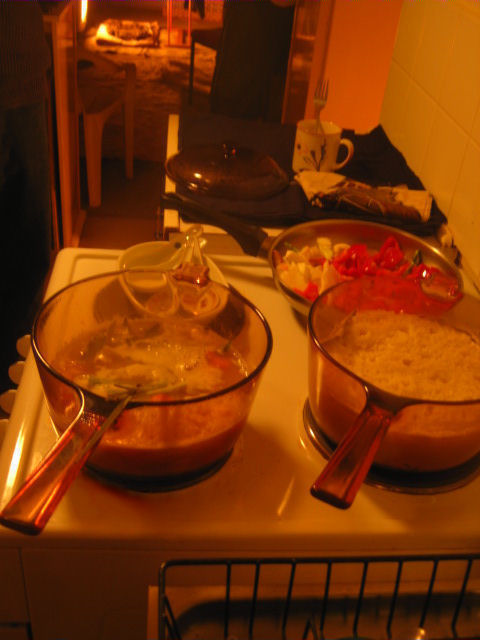
See the holes appearing in the rice
I use a lot of water to start with. Brown rice is better for being boiled a little longer, but whatever sort of rice I use, I’m watching from time to time for the holes to appear.
You find you have a saucepan full of froth and cannot see and fear you are burning the rice?
You might burn the rice.
More likely you will see the froth suddenly disappear if you are courageous.
You will see your rice has holes appearing on its surface. Otherwise if the anxiety is too much, slide the saucepan sideways to reduce the amount of heat at its base and voila, the froth subsides and you will see the rice is glistening and appears sticky. Cook it a matter of seconds longer on high heat and proceed to finish it as I have described, 20 minutes, tightly covered, on the lowest heat possible.
Experience teaches. I don’t always jam the lid tight on the saucepan by using a tea towel. It depends.
The rice is the nicest and sweetest when its base is a pleasant amber colour or mottled with a golden look contrasting with the luscious grains of the main body of the rice, yet every time rice is cooked by this method, central to its mystery and delight is its flavour is subtly different. John Downes refers to the crunchy rice at its base as a complete food or wording to the effect. He describes it-and who knows but it’s a nice idea-as both the yin and the yang (Natural Tucker-Traditional Eastern and Wholefood Cooking for Australians. pub. 1978).
The process of the cooking once daunting and fearful even is a living friend with characteristics I know as well as I do any. I can hear what stage the rice is at. What I put in, that I do not detract from, is evident in the quality of the dish. I don’t tamper with the rice and water as it is coming to the boil or stir it and upset its natural evolution. I don’t add water or drain any off before cooking is finished. I am patient and watchful.
I read the original recipe that inspired this plain method of cooking rice in Elizabeth David (Spices, Salt and Aromatics in the English Kitchen. pub. 1970). It was elaborate and required me to first brown some ingredients I do not completely recall and spices. In the years since of cooking and through the natural adaptation of recipes I once followed to their letter I have followed this method sometimes but create my own blends and you can add in the style of Miss David eg a bay leaf to the water or a flake or more of a cinnamon stick, some celery leaf perhaps.
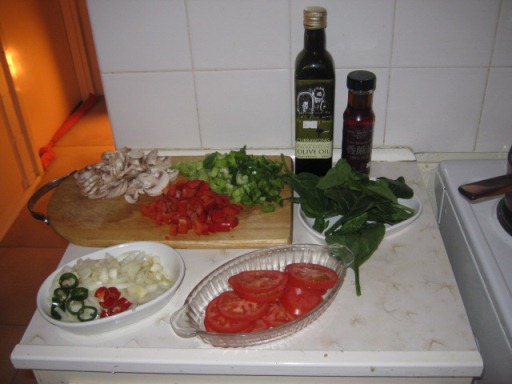
In readiness to prepare a simple vegatble side dish... not leaving the board overhanging a bench!
I like the presentation of food as an art form. An aspect of watching television chefs I really do not enjoy is their abandon handling food to the purpose of decoration and that has put me off enjoying dining in restaurants, or ‘eating out’ as we call it. It alienates me to see these highly trained and professional people even licking their fingers as they demonstrate their skill.
When you are serving your creations, if you have splashed a little on the side of your plate (on a rare occasion) wipe it clean with a small and freshly clean muslin square cloth you keep for the purpose. I like the cheerful red and check ones I keep a supply of in my tea towel drawer.
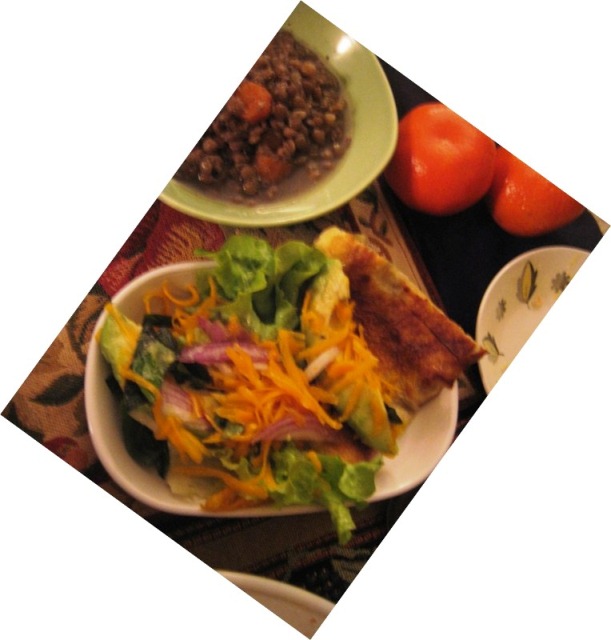 Decorate your meal using the food to speak for itself and set it down gently on its serving plate with love for what you have made and kind respect for yourself.
Serve the rice with a variety of dishes as you choose, especially including leafy green vegetables. A favourite of mine is plain lentils with if anything added to their cooking a little diced carrot for its sweet and nutty flavour.
Image of cookbook: http://www.leurabooks.com.au/?page=shop/flypage&product_id=80152
 Window Dresser's Arms, Pig & Whistle
Hello piglets
I am sorry to be late replying to your comments.
But wait. This (itself) is not ‘the absorption method’ which sounds like the process is that simple. I never think of it as that in my colourful head (meaning that for me absorption is a flat word without ‘colour’ as well says nothing about the evaporation of water and the steaming if and when the pot is tightly sealed). This description is simply how Shoe cooks rice, usually I ought have added. I know a range of methods and I am open to learn more, but what I have particularly out of writing my first recipe and submitting it here is learning how to write a recipe for a general market…and I would rewrite some of this as result of reading your comments and the chat I have enjoyed so much. This pub really is a wonderful place.
The intention in the recipe is to achieve a crusty and naturally flavourful base.
Emmjay describing how to feed chooks is the funniest coincidence. My new landlord showing me around took me on a garden tour that week. He said I can have chooks if I like, showing me a chook pen in the back corner ready to go. I commented to someone I would really like to understand feeding chooks before I even thought of getting any. I tell you all. When I want to know something, I pop into my local. 🙂
It’s wondrously funny reading Emmjay’s chook feeding treatise especially as my dad was an entomologist. It’s like sitting at the kitchen table listening to my father giving me the real deal gist of one thing or another post-the Agricultural Hour on ABC radio at midday. Emmjay’s ag science slip is showing and it’s all frills.
But add my father’s Scottish accent. I now since truly understand why the yobbo locals used to roll around in helpless laughter at some of my father’s expositions. 😉
Not laughing at you, Boss. Well maybe just a little but in the nicest way.
Have a round of pink drinks on me, piglets, on my tab. I’m good for it next pay day. And I’ll give another recipe a go. I do still owe The Pig’s Arms troubador a shaggy dog and Big M particulartly wants Suse to wake up so I have to get cracking on the next episode of The Castle.
For now,
Cheers
😉
LikeLike
Always good to hear from you ‘Shoe. Cheers !
LikeLike
When the kids left home (sometimes only temporarily), we had some Asian students to fill up the place. All lovely, well-behaved considerate people, and when they cooked rice, they all used their rice-cookers. They could not believe that we used the fail-proof absorption method.
Our friend also had to teach this simple way of rice-cooking to her Japanese student.
LikeLike
‘Fraid I use rice cooker too, Helvi… I’ve tried the ‘fail-proof’ absorption method only a couple of times and it failed miserably both times… I’m not sure why. So I’ve given up on this method…
But strangely enough, my rice cooker also uses an ‘absorption method’ of its own: All I do is put three and a half glasses (which used to be ‘Tommy’ mustard jars!) of water to one glass of rice into the rice cooker and turn it on…
I can then forget about it while I make the curry because it just bubbles away nicely, with steam escaping from under a lid which is, I’m sure, just perfectly weighted to ensure that the steam escapes at just the right speed… When the bubbling stops you can hear the lid go quiet and you know your rice is ready, nice and fluffy every time.
🙂
LikeLike
I thought I saw a rice cooker in the cupboard at the new address and I do sort of, but it’s this teflon covered stuff and has been scratched to billy-o. I did look forward to trying out a rice cooker for the fun of it. Not sure though about the coating on those teflon (whatever it is) dishes.
What a wonderful thing it is that you are able to move around and cook, Asty. I hope you get lots of chance to play your guitar where you are. I forgot to ask. May you go from strength to stregth.
LikeLike
HI SHOE,
Julian from London.
Can’t write much; jetlagged and Ipadded.
Good rice is like a good joke. The attraction is personal. When cooking in a restaurant it is expected to be served up the way that customers are used to. That’s why they pay.
When at home, use your favourite method.
Thanks for taking the trouble to write that. As you say, “experience teaches”.
LikeLike
Hello Julian,
Hope you are having the best of London.
The method I describe Julian is a way of getting the nutty flavour from the base you spoke (on The Dot, here at the Arms) of discovering I think it was in Greece. My proffering my method to you how I do that is a gesture to your enquiry for information on The Dot, while I suspect the rice you enjoyed so much in Greece was likely finished on a wood fired cooker where it sat as I describe above but for an extended period .
I thought of it as gift from the Arms as you were off on your way away travelling. Lighter to carry than a presentation gentleman’s leather valet case inscribed with your initials and a bottle of scotch. 🙂
LikeLike
Delightful stuff rice; and so versatile!
And I agree, sands: cooking is an exercise in love -from the beginning to the end. At the table, the dishes should look like a pair of lovers; or a threesome, foursome, manysome!
Begin the lovemaking with a shot of ouzo.
Splendiferous, as Zorba would say.
LikeLike
Yep, ato meatballs with brown rice sounds good!That calls for a nice Shiraz…
LikeLike
We learnt the absorbtion method from our Dutch-Indonesian friend, it works every time. We made a mistake of buying a big bag of rice at Aldi. It’s not as good as our usual Pakistani Bashmati. Will buy even bigger bag of that today and will alternate the good with the bad…I’m too sensible to throw away good food(Aldi rice)…
Setting the table nicely and presenting food to it’s best advantage is important. Not candles every day, Big M, but well cotton or linen napkins 🙂
LikeLike
Helvi, two of our previous dogs just loved rice (cooked any way). You might use some of the Aldi rice up on feeding Milo. I used to cook up a pot of rice and beef mince. Just a thought.
LikeLike
Viv, Milo already gets the leftover rice, there are leftovers only when the said Aldi stuff has been cooked.
We mix it with whatever meat is left, the not so good bits.
Gez came up with the idea of making rice pudding. I don’t know about that as I’m not a pudding person. Maybe there is a fantasic Vivienne Version of a Rice Pudding???
LikeLike
Desserts are not my forte and so no special rice pudding. Must be one in the Women’s Weekly Cookbook of course. I wonder where the Aldi basmati rice came from as most brands are in fact Pakistan in origin – maybe it was the equivalent of seconds, i.e. not the finest. Pity.
LikeLike
Viv, tthe Aldi rice was not Bashmati…we’ll get through it one way or the other, I hate wasting food so it will be eaten 🙂
LikeLike
If I didn’t like eating it I would not eat it ! Of course there is only so much Milo can eat ! Julia my chook loves rice and I usually have half a cup left over just for her. She gives me a special brook,brook,brook when rice is on her menu. She is a total dag.
LikeLike
Just a question – and I reckon I can guess the answer. Does J get more than rice ?
Asking because white rice has fairly low protein compared to wheat, barley and corn and rice shouldn’t make up the bulk of the carb part of Julia’s diet if you want generous eggs. But free range chooks get their protein from lots of other sources (possibly including pelletised layer feed) and insect / worm etc protein – even lucerne hay is good. The chlorophyll and other pigments in lucerne and fresh green pick are great for lovely golden yolks.
The problem with pelletised layer feed is that there is a fairly high concentration of crushed limestone or shell grit – for the chook to make good shells without depleting her skeleton too much – and the limestone lowers the energy and the protein unless they put something else in – like a vegetable oil – which makes crumbly pellets that tend also to go rancid – or a high protein source like meatmeal (expensive) or blood meal (80% protein but a woeful amino acid profile). Soy meal is good for protein and energy – but not as good as meat meal for calcium.
There endeth the chook nutrition lesson 🙂
LikeLike
What can I say Emmjay? I had my first lot of chooks 25 years ago, built a magnificent chookhouse and yard and had bins for chookfood much along the lines you describe. Chooks always freerange during the day when they roamed the house 2 acres (not the whole 8 acres). We have a curry once a week and once a week Julia gets leftover rice. Julia does very well – we guess she is about 6 years old now and last laying season she managed to lay about 4 eggs a week (from July through to end of March).
LikeLike
Ideal setup, Viv. Good old Julia. Well done, old girl !
LikeLike
In reality Julia is a spoilt brat. I inherited her (she’s such a lovely chook mum, don’t you just love her…). She thinks she is human half the time. Rides in the trailer when hubby goes collecting kindling and is always there to help with any outdoor chore (I’m not in your way am I?)
LikeLike
Good stuff Shoe. For me it only works with spanish rice dishes (mainly) of the kind which include chicken etc. My electric hot plates and pots and pans just don’t agree with the absorption method for plain or flavoured rice. The heat retention, as you mentioned, is too great.
LikeLike
We had an electric stove on the farm. After a couple of years we exchanged it to a gas cooker, cheaper to run and better for cooking as well. We had bottled gas. Here we have town gas…We sit in a dark as Gez turns the electric lights off when I’m still reading, I might have to invest in a good torch and revert to my childhood reading habits , reading under the blankets…
No Big M, I’m not going to read by candle-light…
LikeLike
Thank the gods!! All of them.
LikeLike
It might depend on your stove, Viv, or whether you come from a gas/electric backrgound.. My Mum has cooked rice by the absorption method since I was a kid, and she has an irrational fear of gas cooking, having had her eyebrows singed off as a child, so we always had electric cooking. The thing was just to turn the heat down early. In fact I find I can get a lower heat on her electric stove, but then my current gas stove is not a particularly good one.
LikeLike
Ta for that Voice – I have been cooking on the same stove for 33 years and can finish off cooking with the dial on 1 minute past 12. My pots etc are all le Crueset but I do ‘boiled’ rice in a heavy bottom stainless steel pot. The truth is that I don’t like the absorption method, full stop. It doesn’t suit me or my style of cooking. I am beyond help! (Probably also why I didn’t take to the rice cooker!)
LikeLike
Dear ‘shoe, I think the absorption method outlined above is just perfect for rice. My addition is using half light coconut cream/milk in the cooking water, with Basmati rice. A bit of extra flavour for the Thai/Indian meals.
LikeLike
Only recently I started using a couple of kaffir lime leaves for that extra flavour, Big. The local Woolies stocks them.
LikeLike
We stock them in the front garden. I’ll send you some, if you like, cheaper than Woolies!
LikeLike
You’re right there, fresh herbs and such like cost a packet. I’ve been thinking of growing one in a pot..
LikeLike
My “don’t die, you old fart” adviser says to substitute light coconut milk with tinned Carnation light coconut-flavoured milk. I’ve done that. It tastes like the real McCoy but has way less fat – and the fat is not of the nasty saturated kind.
LikeLike
Yes, another quick cheat is low fat milk with coconut essence.
LikeLike
I used to hoe into coconut cream without any notion it is thought not desireable regards saturated fats. Now that I do know it has put me off the cream and I associated the flavour as well with that aversion to make sure I don’t go back to my profligate ways with the stuff.
But I do so hope it is not the dairy industry making bad press for coconut cream. Life seemed so delicious with it for breakfast on cereal, on fruit salads instead of cream, at the end of cooking some savoury dishes etc… I can’t imagine the coconut essence option in low fat milk.
LikeLike