

FM, FM’s Mum and I went to the Museum of Sydney today to check out Louise Hawson’s photo exhibition – 52 suburbs of Sydney. It’s highly recommended. You should go if you can.
I was amazed to learn that there are currently 638 suburbs in Sydney. Louise visited a fairly wide-ranging selection – one each week for a year. She said that she took photographs for three days, spent another two working on them and then grouping them into related pairs. Six days a week for a whole year. And of course, she’s just scraped the surface. She asks the rhetorical question “Just where is the suburb called ‘Canoelands’ and what might the good people of that suburb do ?” Damned good question.
It brought home to me how amazingly culturally diverse our city of many tribes has become – from the Anglo white bread village of my youth to quietly (with the exception of the occasional Cronulla race riot) morph into something unrecognisable as a suburb of the middle of last century . Dramatic change – in a good way.
Thinking that a city of four and a half million people that grows (apparently) at the rate of 1,000 people per week might in any way be comprehensible at a glance is clearly a big mistake on my part. Louise’s exhibition is a wonderful study of colour, contrast, character and texture and her use of diptychs comparing and contrasting time and place and cultural reference is brilliant.

So – it’s a fascinating study, which BTW leads into two other really important small exhibitions. First was a history of WWI German internment camps in NSW – Berrima Gaol, Holdsworthy and Trial Bay camps.

Holdsworth Internment Camp about 1915 (Government documents of the time refer to it as a "concentration" camp)
This is an extraordinary story about how about 7,000 people of German origin – even Australian citizens were locked up – some for six months after the WWI armistice. Many were deported back to a devastated Germany. These clearly dangerous and criminal krauts included none other than Herr Resche (whose Australian born sons were running his breweries while he was interred, and Australia’s only specialist orthopaedic surgeon of the day. There was a class system where the wealthier German Australians got a better gig in a northern beach-side encampment. And in addition the camps were run on a law of the jungle system where the “Black HandGang” at Holdsworthy terrorised other inmates and extorted and victimised them for gain – until remaining members of the crew of the Emden were interred with them, formed the “White Hand Gang”, and beat the crap out of the “Black Hand Gang”. These beatings included throwing victims (deserving and otherwise, apparently) amongst the barbed wire while the guards turned a blind eye.
It makes it easier to understand the obscene way that Australians of many different ethnic backgrounds are so easily able to turn a blind eye to the plight of refugees – we’ve had form.
Then we went into an adjacent exhibition on housing in Australia. There he was – the beaming visage of famous Viennese refugee architect, Harry Seidler –surrounded by images of his wonderful creations – Rose Seidler House (1950).
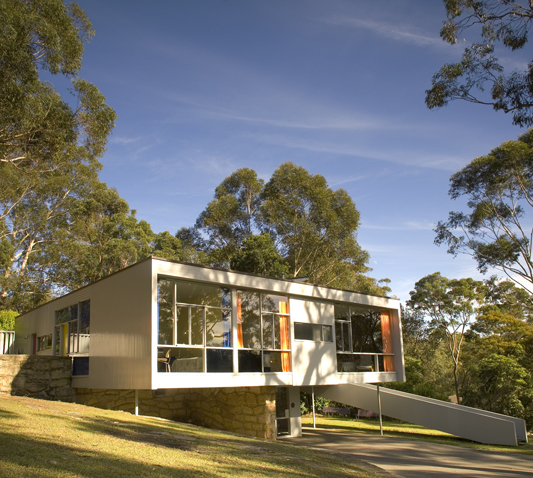
BTW Rose Seidler House is the venue for the annual 1950’s fair at Wahroonga on August 16. Don’t miss it hep cats and cool kitties.
Seidler’s MLC Centre remains one of the CBD’s iconic buildings.

Construction started in 1960 (completely obliterating the delightfully bohemian Rowe Street) and was completed in 1967. MLC Centre was for a very long time the tallest building in Australia at sixty something stories. It was my workplace for five years in the middle 1980s. The view from level 41 was spectacular. The lifts were something less than spectacular and offered a service reminiscent of Sydney’s public transport systems.

And they also had pictures of the arsehole of Sydney Harbour landscape – Seidler’s Blues Point Tower. We used to live across the harbour in Birchgrove and had to look at this eyesore every day. I used to fantasise about starting a fund to buy all the units in there and pull the bastard building down – it is so ugly. I gather that the alternative strategy is to save up, buy one of the tightly-held / rarely-sold units and look outwards.
But then the exhibition’s images looped back to another form of Australian ugliness – and perhaps the definition in my view of a total lack of charity and uncaring mongrel behaviour.

This image – reproduced without all the palaver that the State Library insists is necessary to have permission to republish, is a picture of William Roberts and his family – evicted from their home in Redfern in 1934. William Roberts was an original Anzac. And this is how he was treated.
My Mom used to tell me stories about the depression. Her Intermediate certificate is dated 1939. She got an A in History. She said that neighbours used to help evicted families by waiting until the bailiffs had left and then break into the house again to let the evicted people back in. If a landlord was such a bastard as to want to try it again, he would risk having the place burnt down – with a not-surprising lack of witnesses. Not helpful for William, but not a bad way to discourage a lack of landlordly compassion. My Dad used to tell me about how a kid with a pair of shoes to wear to school was the mark of a wealthy family. And he also told me how the poorer kids used to beg apple cores from the richer kids because they were so hungry.
So while it is fashionable to wax on lyrical and wallow in the “Tradition of ANZAC”, it should not be forgotten about how Australia has a well-developed cultural capacity to act like total bastards towards those less fortunate in our midst. Can’t accuse us of playing favourites, though. We mistreated both ANZACS and Australian citizens of German descent. We seem to have at least a hundred years’ practice at being bastards. Probably twice that, really.
This visit to the Museum of Sydney (that likes to call itself the MOS for short) is a very worthwhile experience – this time, especially so. It shows us at our best, culturally diverse, colourful, tolerant and inclusive, and also reminds us of how bad we can truly be if we try really hard.
 Window Dresser's Arms, Pig & Whistle
Interesting story on Mrs G and Harrow Mansions. However, that building has NOT gone. Still here! I am sitting in it now. The Harry Seidler building is the Horizon apartment block, on the other side of Clapton Place.
LikeLike
Love to know where to get the glasses worn by the gorgeous girl in the Postcard advertising the exhibition…Can anyone help?, Michelle
LikeLike
I enjoyed the article Emmjay, particularly before heading home from the library post a bus trip to Naracoorte where the wide spaces of pastures and dotted gums remind me every time how well off we are for space in Australia. The topic of architecture leaps to mind when I see nearer to the township the rows of vines, but large depots dedicated to making alcohol. Stonehaven has an imposing feature that has from the road the appearance of a block of ferro cement emblazoned with its title and another winery has a front cellar door sales office and reception that is a sprawling train carriage wreck of shiny metal and glass so jarring to my eye, but I reflect perhaps not unlike a simulation of a rectangular wine bottle, thus perhaps pleasing to the connoisseur’s eye… purest imaginative speculation on my part as I attempt to come to grips with the jarring intrusion on the face of an otherwise interesting landscape of beautiful contrasts and new farm machinery and old and beautiful rusted metal.
Gee, mate that buildin’ smack bang in the way of the view of the Sydney Harbour Bridge is a corker of an example of how a buildin’ can be a eye sore.
Hope everybody is healthy and happy.
LikeLike
Great to hear from you, ‘Shoe. All well in our neck of the woods. And sometimes quite happy too 🙂
LikeLike
Looking at houses in any suburban street, what strikes you are the huge garages, not the beauty of the place. You think the places are homes for cars not for people.
I don’t think there are too many GOOD architects designing these monstrosities, not Australian, or foreign.
LikeLike
When we renovated a Californian Bungalow (that had been bastardised by its previous owner – pulling off the tuck-pointed bricks and leadlight windows and putting in clinker bricks and aluminium sliding windows), pulling down the brick and picket fence and putting in an aluminium pool fence ! My GOD !), we shopped around and tested out four architects before we found one that had a clue about how to put on a second story and extend out the back of the house.
We gave him a budget. We loved his design – and for over a later we got people knocking on the door asking us about the job – they liked it too). Four builders quoted within $20,000 of each other – and two and a half times the budget we had.
My point H, was that a) good architects are hard to find and b) good design doesn’t come cheap.
We also had an interior designer help us through the whole project – and she was the best of the lot. Thirty years’ experience and she could spot a good design idea – and one that would prove to be a problem if we went that way – a mile off. We used recycled bricks that matched the originals and we had new leadlights made to match the remaining few. We painted in heritage colours outside that blended with the many trees and grey / greenery – cool greens, clean creams / off whites and vibrant caramels and ochres inside.
I’ll never forget when the builder insisted that what the architect had drawn for the upstairs ensuite bathroom – could not be built, in front of all the subbies she announced to the world at large that “it’s a bloody bathroom – it’s not the fucking space shuttle – Work it out !”.
He came back after lunch – with a good solution.
It’s a great house now – a true-to-type Californian bungalow – but with a second story, four bedrooms and a study.
But the several years of stress, living in a construction site and the cost of the renovation were major contributors to the death of our marriage.
So, a good house and a good home are not always the same thing – and a beautiful house can have some serious downsides.
LikeLike
I rather like the look of Rose Seidler house. God I hope those windows face north though. It’s almost unbelievable that they have no external shading designed in. Talk about taking a philosophy to extremes.
LikeLike
It does face North, Voice. It’s a good house by today’s standards, visually interesting and very functional, but it was way way out there by 1950s standards.
LikeLike
I saw this exhibition advertised in the paper recently and thought is worth a look which I haven’t yet.
The other part was about the Germans had some resonance for me. Not that I’m German. My father Australian born of Italian parents and my mother mostly of English/Irish stock though she had a Portuguese grandfather. Her family arrived here at least as early as the 1840’s and possibly earlier. It’s the Italian side I’ll talk about. My grandparents arrived in just after the WW1, over time they sponsored much of their families to Australia. They were hard workers running fishing trawlers and fruit shops on Bondi Road. Assimilation was important to them and a prerequisite to the sponsorship was to take out British citizenship (Australian citizenship didn’t really exist until after WW2.
I can tell you that my father was persecuted for having an Italian name in the 1930s as well as during the war. He was barred from joining organizations such as the Scouts during that time. He bore no resentment of his treatment though. My grandmother detested people who would speak to one another in English then revert to the mother tongue when people approached. To her that showed mistrust. Some of the family who didn’t take out the British citizenship was interred as undesirable aliens during WW2. Some even learnt a trade as part of this interment. My Grandfather who fought during WW1 tried to sign up for WW2 but at 49 was too old. He played a role in other ways though.
Growing up in the 60’s and 70’s I encountered persecution but not to the extent my father did. Might have had to with my parents moving from the Eastern Suburbs to white bread and a very much British country town as it was then in 1958, Hornsby. Probably some of the worst was that the Italian side of me was suppressed. Also in 4th class I had a Jewish school teacher, whose parents had survived concentration camps. Her hatred of all things German and their allies eventually sent her mad. Pity for all of that she was a good teacher from a teaching perspective. However, almost every lunchtime that year, for me was spent standing outside the Headmasters office. If the bell went I was spared me the cane. The cane was probably once or twice a week though I think later in the year most of that faded when he’d tell me to go.
Nowadays none of this happens with my kids. The racism of the past appears to be a lot less, though incidents like the Cronulla riots show that it is just there under the surface. Watching the rodent on Insiders where he spoke of how he stopped the asylum seekers in 201 today though showed me that there are many of his revolting ilk still about.
LikeLike
I love it when people from overseas point out how racist we are in Australia because when you visit their countries you realise how they aren’t racist, no never ever.
LikeLike
All points further to the need for real history. Remember Howard had the National museum exhibits changed to suit his idea of our history (basically wipe out the not so good bits and just talk about all our lovely inventions and achievements). Howard then wanted school history curriculum changed according to his view. Then we had the history wars and how nice we were to all aboriginals and we didn’t kill any of them etc etc…. Good on the people at the Sydney museum. Just being aware of the truth of the past helps you deal with the reality of the present. Would do Abbott some good to abandon one of his shop stop stunts (cutting up a dead fish, for heaven’s sake) and spend a couple of hours at the museum.
LikeLike
Viv, I was shocked to see the and read about how badly the Germans were treated – including over a thousand who had become Australian citizens before the war started in 1924. Disgraceful. As for the rodent Howard and his Fox News style revisionism, I would not cross the street to piss on his gums if his teeth caught fire.
LikeLike
I have a very similar saying.
LikeLike
Abbott should have finished his work-experience efforts by now, and know if he wants be a fishmonger or a fruit-packer when he grows up. On the other hand he might never grow up, cutting live fish might be too hard for him.
Nice picture, you look only a teeny bit more mature than in the previous one (with the girlfriends in London)!
LikeLike
Flattery will get you everywhere Helvi. You don’t seem to have aged at all for a grandmother. Abbott has been and continues to talk down the country, the economy and the brains of all our scientists and economists and most of the population.
On the history of our doings, they also changed the names of a number of Aussie towns (Germanton etc). It was of course disgraceful but at the time we were it seems all still British (was on my passport) and acted like them too – the Brits established (invented) the first concentration camps. Everytime this country takes a big step forward (in the right direction) we get flung back by people like Howard. When Howard was 16 on that radio quiz show he did not know what kind of tree was one which dropped it leaves. His answer was a ‘shedding tree’. He had the nerve to question our standard of education !!!
LikeLike
Blues Point Tower was just the first of many such highrise anthill shitholes that Seidler had planned for the point. Have you ever been inside one of those apartments? They’re tiny, dingy boxes you wouldn’t keep a dog in. Just imagine an army of those monstrosities marching up the spine of the point, getting higher as they rose up the ridgeline.
If memory serves it was the builders labourers under Saint Jack that put paid to that plan, and a similar plan for The Rocks, and Victoria Street in Kings Cross.
Just imagine downtown Sydney without The Rocks, or more particularly, with The Rocks forgotten under a highrise precinct. It doesn’t bear thinking about.
LikeLike
Then the greedy bastard had the nerve to try to shut down Luna Park to capitalise on his investments in that area. Adding insult to his injury to Sydney is his architecture of the Australian Embassy in Paris, which demonstrates that he was actually capable of desgining decent commercial buildings, not just houses, had there been regulations in place to control him. Probably the greedy ‘developers’ would have just got some other sell-out to do their dirty work though.
LikeLike
I never saw the City of Sydney before most of it had been knocked down, but looking at the human friendly exterior of what’s left I always think it seems a shame.
LikeLike
Let’s balance that to some of the good stuff.
Please put in an Australian born architect with international awards for architecture. Perhaps Glenn Murcutt?
Here awards for Harry Seidler. (Do you think, those judges had it all wrong?)
Sir John Sulman Medals, RAIA 1951 Rose Seidler House, Wahroonga, NSW
(subsequently owned and managed by the Historic Houses Trust of NSW)
1967 Australia Square, Sydney, NSW
1981 Harry Seidler & Associates Offices, Milsons Point, NSW
1983 MLC Centre, Sydney, NSW
1991 Grosvenor Place, Sydney, NSW
Wilkinson Awards, RAIA 1965 Ski Lodge, Thredbo, NSW
1966 Muller House, Port Hacking, NSW
1967 Seidler House, Killara, NSW
1999 Horizon Apartments, Darlinghurst, NSW
other awards 1957 Honourable Mention,Sydney Opera House Competition
1960 Architecture and Arts Award,Ithaca Gardens Apartments, Sydney
1960 Architecture and Arts Award, Paspaley House, Darwin, NT
1967 RAIA Civic Design Award, Australia Square, Sydney, NSW
1969 RAIA Project House Award, House, Thornleigh, NSW
1970 Harry Seidler, Life Fellow RAIA
1974 RAIA: Offices, Milsons Point, NSW
1976 Harry Seidler, Gold Medal RAIA
1977 RAIA: Municipal Library, Fairfield, NSW
1979 RAIA: MLC Centre, Sydney, NSW
1980 RAIA(Vic.) Architecture Medal, Ringwood Cultural Centre, Vic.
1980 Prize Winner, Parliament House Competition, Canberra, ATC
1981 RAIA Civic Design Award, MLC Centre, Sydney, NSW
1982 RAIA(Qld.) Honourable Mention, Augusta Village, Kooralbyn, Qld.
1983 RAIA: Basser House, Castle Cove, NSW
1984 RAIA: Bland House, Rose Bay, NSW
1985 RAIA: Civic Centre, Waverley, Vic.
1985 RAIA: Lakeview Town Houses, Yarralumla, ACT
1985 RAIA: Hannes House, Cammeray, NSW
1987 RAIA Sir Zelman Cowen Award, Riverside Centre, Brisbane, Qld.
1989 Lustig & Moar National Prize, Grosvenor Place, Sydney, NSW
1989 First Prize, Marble Architectural Awards (Carrara, Italy), Riverside Centre, Brisbane, Qld.
1989 First Prize, Marble Architectural Awards (Carrara, Italy), Penthouse Apartment, Milsons Point, NSW
1989 RAIA(Qld.) Robin Dods Triennial Medal, Riverside Centre, Brisbane, Qld.
1991 RAIA: Shell House, Melbourne, Vic.
1991 RAIA: Capita Centre, Sydney, NSW
1991 RAIA: Extension and Penthouse, Milsons Point, NSW
1991 RAIA Interior Design Award Penthouse Apartment,Milsons Point, NSW
1991 RAIA Commercial Architecture Award, Shell House, Melbourne, Vic.
1992 RAIA(WA) Architecture Design Award, QV1 Office Tower, Perth, WA
1992 RAIA(WA) Commendation, Civic Design Award, QV1 Office Tower, Perth, WA
1992 RAIA Commercial Architecture Award, QV1 Office Tower, Perth, WA
1999 RAIA (ACT) 25 Year Award, Edmund Barton building
2000 RAIA Special Jury Award, Wohnpark Neue Donau, Vienna, Austria
2001 RAIA Blacket Award, Berman House, Southern Highlands, NSW
2001 RAIA(WA) Commercial Architecture Award, ARCA Showroom, Perth, WA
2004 RAIA Urban Design Award – Commendation, Cove Apartments, Sydney, NSW
2004 RAIA Multiple Housing Award, Cove Apartments, Sydney, NSW
2004 International High Rise Award, Cove Apartments, Sydney, NSW
2005 Lighting Design Award – ERCO Commendation, Cove Apartments, Sydney, NSW
LikeLike
Thanks for the tip, Waz. I reckon something about Jack’s visit to the Pig’s Arms next week is on the cards.
LikeLike
Maybe Australian building regulations were even more relaxed in the fifties than they are now. Not that they are tough enough now. Before moving to Bowral, we spent six months in a brand new townhouse that was hardly more than a windbreak. It would take me a day to list all faults it had…
LikeLike
Can you believe that Seidler used to complain that Sydney building regulations were too restrictive? It boggles the mind.
LikeLike
I had a great aunt, known lovingly within the family as “Mrs. G”, who used to live in a building called Harrow Mansions just behind the ABC on William Street. It was where the Horizon is now. It was the venue where my father, Mrs. G’s nephew, met our mother.
She was an old woman when I was a boy and as well as boarding young men of good character, she kept house for a woman who lived on Eastern Hill in Manly. Right up until she was 93, 3 days a week, she would walk down the five flights of stairs to the street, and then down those sandstone steps to William Street. She’d then catch a bus to the Quay, ferry to Manly, and then walk up Eastern Hill. Well she did take a bus in her later years. She would clean the woman’s house and prepare her dinner before taking the reverse journey home. She was indefatigable, the last of a lion breed.
She spoke with a very broad Scots brogue which was entirely incomprehensible to my young ears, but my father and she would speak long into the night; well I was five, I fell asleep about 7, but it was always very reassuring to hear them talking, and it only occurs to me now as I type that she was his mother’s sister. His mother who had died when he was still a swadling child.
Anyway that’s another story.
The point is that the Horizon, which Harry designed, is also characterised by low overhead space, particularly in the common areas and access halls. The building has also had its share of plumbing and waterproofing problems, most of which it must be said have been worked out under insurance arrangements. Harry didn’t always get it right. But then hardly any architect would make such a claim.
So, while I don’t don’ mind the look of the building per se, it is none the less an affront to its surroundings and an assault on the eye as one drives up William Street. Once again, in my opinion, Harry’s sense of his own exceptionalism overcame him and he built an inappropriate building on an important site.
His many awards are a tribute to his life’s work, a legacy his wife nurtures with vigour. He was a very important Australian architect, who did some good work overseas. He was however, never that which I suspect he always saw himself as; the Hungarian refugee transcending his holocaust shadowed beginnings to rise to the first rank of international architects. He may have been that boy but he was never that man, and I think it niggled him a little, added somewhat to his famous irascibility, particularly if things weren’t going quite right. He’d become tetchy, short and often reflect, sotto voce, on how stupid everyone else in the room was, and how it wasn’t, or wouldn’t be like this in Europe, or America, or anywhere else than where he was.
So my point is that Harry’s gone, can’t defend himself against my perhaps unjustified or uninformed opinions; and so Mrs. G, years ago, and Harry built over her memory and that’s enough for me to feel somewhat discommoded by what he built over it with.
And all being said and done I wish Harrow Mansions was still there and I could go and visit Mrs G. and enjoy a cup of tea and her fabulous chocolate wafer tubes while she prattled happily, incomprehensibly, to me while I look dreamily out the window down to Woolloomooloo and the sparkling harbour water.
LikeLike
I hate it when a story within a story comment is better than my piece. 🙂 Just kidding. A brilliant vignette, Waz. Prompts me to do a bit of research on the disappearance of Rowe Street – under the MLC Centre Goliath. Which, incidentally was reproduced in Melbourne’s CBD. I cannot fathom why a city as wonderful as Melbourne would contemplate even for a second the construction of a “mee too” Sydney icon building. Curious.
LikeLike
Perhaps that’s a problem that some just have coming from another world, trying to fit in, make the best of it. Try and get a handle on this problem has been tackled by Andrew Reimer. He wrote a few books on it and I thought that ‘Inside-Outside’ is probably one of his best efforts. A ‘Family history of Smokers’ is another one and Hapsburg Cafe another effort.
One remains torn between both worlds and the reasons are complex and almost beyond solving.
Personally, I never felt the beauty of William Street, even though I almost bought a little unit somewhere down towards the middle of it. I think it was one of those ‘Stock’s and Holdings’ edifices. I would put William Street almost on par with Parramatta Road for ugliness. For some reason or other destined to remain so. Perhaps, if I had been born here I would think differently and find beauty in both of those Streets. That is something that is most likely also not going to happen.
LikeLike
“I hate it when a story within a story comment is better than my piece.”
Your story was OK Emmjay.
Warrigal’s (beautiful anecdotal)story exonerated the silly comments though. I wasn’t going to comment at all, since all the silly Abbott & Howard comments ruined (squandered) what was otherwise an interesting and unique opportunity to engage about the article.
Julia Gillard has a fat arse….So what??
LikeLike
That’s very much the impression that I have of Seidler too, Warrigal.
His insensitive buildings, the antithesis of Glen Murcutt’s, could be plonked anywhere in the world. If he could have found another place with low enough self esteem to let him build with no social or historical regard.
LikeLike
Even so, I don’t think that Australia ever needed the expertise of Hungarian born architects to outshine the local bred architectural ugliness. Just brush up again on Robin Boyd’s ‘The Australian Ugliness’, it soon puts that one right. Take an exterior photo of anything man-made almost anywhere and its likely to be instantly recognisable as Australian and very likely to be either ugly or mediocre.. Your best chance to find beauty is to either exclude man made buildings or confine it to old shearing sheds, settler’s cottages or inner city weather boards or The Argyle Cut, stone steps and old foundries, old pubs, Dawn Fraser swimming pool.
LikeLike
Whatever turns you on, gerard.
LikeLike
I found a picture of Harrow Mansions. The building may be gone but obviously I’m not the only one to remember it.
LikeLike
Brilliant Emm!
There was always the idea blown about how welcoming and friendly our country was. Mostly that is right, but, there is always another side and another story of an opposite truth.
Today, we have the spectacle of boat people; self-harming, burning their accommodation, hurling stones from roof tops and…. instead of looking into why they resort to those things ,they get charged with being criminals and we lower their chances of being accepted as genuine refugees. Some say, they have TV and can walk about!
Malcolm Fraser points out on the DRUM the following:
Here is an extract.
Australians are often not good at understanding how other people see us. We have our own view of ourselves and as an island continent we too often seem to believe that we can do as we want to do without much concern for the views of other countries. That might not have mattered in the days of the British Empire but it certainly matters in today’s increasingly global world.
We will not be able to conduct effective and sensible policies unless we learn to understand how our actions impact on other countries.
We forget that Australians are used to speaking bluntly, often too bluntly, whereas in many countries of our own region and indeed further afield, leaders will be gentle and polite and not critical of our policies. It is sometimes difficult for Australian governments really to know what people in the wider world think of us.
After the Tampa incident I had communications from the Kennedy School, from Cyprus, from Latvia, from Finland, as far as, what were we doing? Why? Did we have no concerns or compassion? Recent debates between major parties have reinvigorated the concern and the suspicion that people have of Australia. The credit we had gained through 40 years of large-scale post-war migration culminating in the largest ever migration from one region in the late ’70s and ’80s has been thrown into doubt.
We might think our actions have no consequences beyond our shores. That is dangerous self deception.
Many examples can be given. Opponents of climate change legislation say Australia produces so little that it does not matter what we do. Many others, indeed most others, look at emissions per capita and then we come out if not worst, second worst.
End of Fraser’s summing up on Drum.
So, there you have it. While we are a good country with many qualities there are also things that are not so good. I think that piece by Emmjay points it out superbly. Well done!
LikeLike
Thanks, Gez.
LikeLike
I thought Fraser’s comment was interesting, that Americans don’t see us as a good ally, because we kowtow to their every whim, unquestioningly following them into every little war.
I’ve met a few people who were children of migrants in the late 40’s- early 50’s who remember the whole family being treated like criminals for having the temerity to try to make a home here.
Of course, Australia refused to take any Jewish refugees prior to WWII because ‘we don’t want that sort of racism here!’
LikeLike
It’s all happening on The Memory Lane of Life lately; Gez’ Maltese migrants, Waz’ Quiddities and Emm’s changing Suburbs…
I remember Leigh Sales writing about this book on Unleashed last year, it might have still been in the making at that time. We had some free time to spend between appointments in Sydney this week, if I had known about this exhibition I would seen it, instead I went Myers and David Jones sales. I felt I had to support poor DJ !
I’m telling all my friends to read Hugo Hamilton’s memoir ‘The Speckled People’, it’s wonderful, it’s about finding your identity, in Hugo’s case for someone born in Ireland of a German mother and an Irish father, who wanted his children to speak only Irish and German, no English was allowed…A good read like your article!
LikeLike
Nothing like a visit to the gallery or a museum to get the nostalgia engine cranking over. Today, our dear H, I retrieved my old Ducati bike from FM’s old house (now the family’s old shed) – and took it to Gowanloch (specialist vintage Duke restorers – and race enthusiasts). Fingers crossed that bringing it back into service after 15 plus years in the shed will not cost more than twice the cost of a new one.
Nostalgia – and the headlong pursuit of a fleeing youth – rampant !
LikeLike
We’ll be expecting photos, and a story!!
LikeLike