
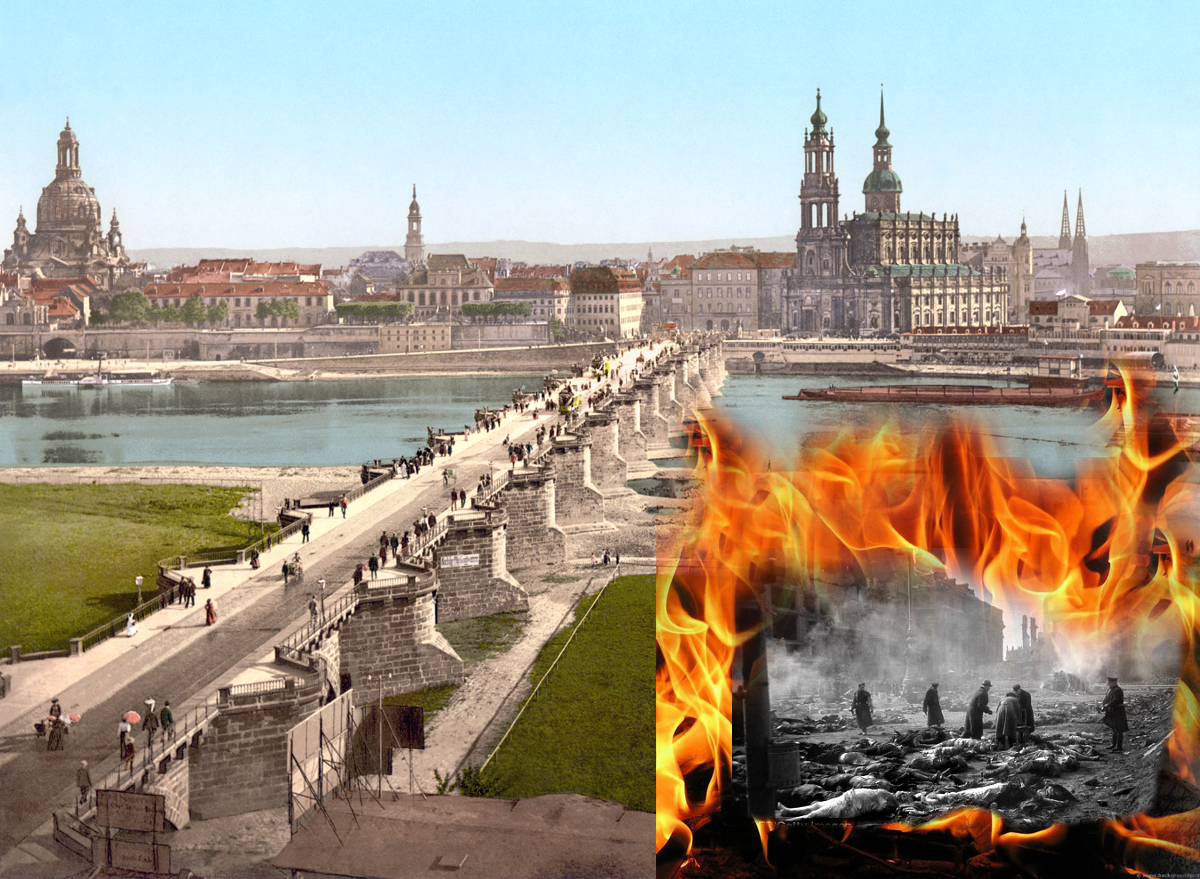
Dresden - Florence on the Elbe
Story and Digital Imagery by Warrigal Mirriyuula
Karl Gruber sat at his desk nursing a mildly annoying hangover; just enough to turn the morning into a minor mental effort. It was the Kirschwasser Karl had taken to Molong as a treat for Bertie that had done the damage; they’d emptied the bottle in front of the fire as they put the world to rights last night.
The sunrise drive back to Orange had been slow and tiring in itself; the low morning sun blinking and blinding between the trees had made Karl’s eyes water and finally given him a headache. The price of friendship, and over indulgence thought Karl a little ruefully.
He’d driven straight to his rooms at Bloomfield, showered and shaved, crunched a few aspirin then donned the uniform common to his profession; the white overcoat with stethoscope round the neck.
The stethoscope was an affectation, a conceit that Gruber had maintained since his graduation in Vienna. As a psychiatrist his primary function was to heal the mind and a stethoscope wasn’t much help there. But Gruber was proud of his abilities as a physician and the stethoscope was his badge of honour. Besides, Bertie, his dearest friend, was a physician, so the more often idle stethoscope was also a kind of fetish of solidarity with his friend. He fiddled with the tympanum end for a bit, thinking again of Bertie.
Karl pushed himself back from his desk and intoned in his best high German; “die Freundschaft”, then continued, in English, the pertinent fragment from one of his favourite poems by Schiller;
Happy, O happy, I have found thee, I
Have out of millions found thee, and embraced
Thou, out of millions, mine! Let earth and sky
Return to darkness, and the antique waste
To chaos shocked, let warring atoms be,
Still shall each heart unto the other flee!
Karl was fondly pondering the poem and his friendship with Bertie, how much he relied on his friend, when the phone rang, jangling his reverie to shards.
He picked up the phone; “Gruber.” he stated curtly, a little annoyed that his train of thought had been interrupted. The caller apologised for disturbing him; which Karl dismissed as completely unimportant finishing with, “How can I help?” At the other end of the line a narrative began to be delivered.
“Yes, I saw the activity as I was driving back from Molong this morning.” Karl’s tone was just a little huffy. His headache was getting worse.
As the call continued Gruber’s eyes began to narrow, as if he was trying to focus on what was being described down the phone.
“Yes, it certainly sounds like a mystery but I’m not sure how I can help”.
Gruber’s head was throbbing and this was his way of trying to get the caller to come to the point.
As the caller continued Gruber’s shoulders shifted a little inside his white coat. His chest puffed and a quick prideful smile flitted across his face.
“That’s very flattering though I’m not sure it’s entirely true; but yes, I’d be more than happy to come and have a look. I could be there in about twenty minutes.” There was a pause while the caller made a last point. “I’ll try and make it fifteen then. Goodbye.”
Gruber shucked off his coat and put the stethoscope away in his top drawer, an expression on his face somewhere between quizzicality and simple puzzlement. Either way he was happy to have an excuse to flee his rooms; with this hangover there’d be little work done today anyway. He grabbed the keys to his car and walked out of the office.
Fifteen minutes later, with Spring in the warm late morning air and his headache subsiding, he was walking through the rose gardens that surrounded the Orange Base Hospital on Sale Street. The blooms were beautiful; from light pink to bright red. A few spectacular vivid cerise flowers particularly caught his eye.
He was still mentally wandering around the subject of roses as he pushed his way through the swing doors into the pathology lab, tying the tabs on his gown and pulling on his gloves.
The young pathologist, one dirty gloved hand already extended for the shake that would come, moved quickly across the brightly lit space.
“Ah, Doctor Gruber is it? I’m so glad you could come. I’ve heard so much regarding your reputation that I feel a little remiss at not having made your acquaintance sooner. My name’s Watts and I am, for my sins, as you see, the pathologist.” Watts noticed that the German doctor wasn’t wearing a tie and couldn’t resolve why this made him feel uncomfortable.
Watts extended a darkly soiled glove to shake Gruber’s hand. Karl was responding appropriately, but for Karl the room had begun to dizzyingly shrink inward on itself, until there was just the body on the autopsy table filling his consciousness. He felt light headed and had to take a deep breath.
He’d seen bodies like this before, hundreds, if not thousands of them. Four of them had been his own family. His mind closed further in on itself; his face visibly tightened.
“Yes, it’s pretty bloody gruesome.” Watts said with what he hoped might be a comforting seriousness. He was completely unaware of the affect the sight of the partially pyrolysed body was having on Gruber.
Gruber, his hand still, just lightly, gripping Watts’, turned from the awkward pleasantries of introduction to the blackened corpse. He noted the shrunken facial skin, the leering vivid white of the strong teeth and the absence of eyes, the nose reduced to a bony edged black hole. Unbidden, Gruber’s memory threw up a horror of its own. The scene that cold, bitter morning in early 1944 as he returned home.
He had picked his way into the devastated heart of Dresden, already knowing there was no hope, but still, being unable to believe it, compelled to make this pilgrimage home to say goodbye to his family and his past.
He had approached from the rear of the property; it was easier going, there was less debris than in the main avenues; their trees reduced to ash and their pavements interred under the tumbled rubble of a thousand burned buildings. All around in the dun tones of destruction Dresden was still smoking and smouldering; the air thick with an acrid stench of high explosive, burning and death.
At last he recognised the back wall to his family’s demesne, though the ancient Linden and Elms that had shaded the lane were now little more that a few crooked black fingers reaching into a toxic leaden sky.
As if reliving the scene Karl found himself, though present in the brightly lit pathology lab, back in Dresden that dreadful day; shocked and horrified again, seeing, desperately wedged between the cobbles and the deeply charred timbers of the carriage gate, the head and one shoulder of a blackened grotesque with outstretched arm, the char black stick fingers curled as if in pleading supplication.
It had crashed in on Gruber that this humanoid charcoal must have been Fritzy, his family’s gardener and odd job man.
The world, reliable things, certainty, had begun to shift and slip around Karl. Fritzy had been Karl’s first true friend and had taught a young Karl all about their family garden, its seasons and systems; and it was the system of it that had impressed young Karl.
Though in truth Fritzy was a little slow, Karl had always allowed that it was Fritzy’s understanding of natural science that had first kindled the scientific spark in himself.
The shifting and slipping in Karl’s consciousness had reached a tipping point and Karl had turned away, collapsing to his knees in the ash of the lane. He hadn’t eaten much since the firebombing, yet he found himself contorted with vomiting as his eyes filled with tears, now angry, then pleading and confused. The acid bile seared his throat and left a harsh metallic taint in his mouth. He felt weak and began to shudder. Later that day, numb from the surrounding nightmare, he had found his family huddled together in one another’s arms in a corner of the cellar. Like the body on the autopsy table, they too had been smoked and cooked.
Karl had to very deliberately, and with some mental and emotional exertion, draw himself back to the present.
Obviously the body had been burned. The feet and lower legs had been charred to the bone by fire; the ankle bones and metatarsals of both feet just a collection of separate blackened cores. The end of the right fibula had been completely burned away and the medial malleolous of the tibia reduced to a blackened stump. The Talus looked like little more than a blackened knucklebone a child might play “Jacks” with.
The rest of the body, including the head, had suffered less actual reduction. The skin had been dried and smoked to a dark brown black and the now empty chest cavity showed that this “cooking” had penetrated deep into the body. The organs sat stiffly on stainless steel trays.
“I’ve found some very interesting things in there,” Watts said, noting Gruber’s attention moving back and forth from the gaping chest cavity to the arrayed organs. “But that’s not what I’ve invited you here for.”
Watts’ face took on a mildly combative cast. “They tell me you’re an expert on head injuries.” He said with a hint of challenge.
Gruber just shrugged self effacingly.
“Well we’ve got a problem here that might be right up your alley.”
Gruber, his difficult memories receding and his attention still entirely on the body, replied, “That alley’s already jammed with difficulties, so much so that it’s often hard to see the real problems.” He stopped and fixed Watts with his dark eyes.
“So what is this problem that has so recklessly wandered up my alley.”
Watts had heard that Gruber could be difficult. Not exactly unfriendly, but demanding in the way brilliant men often are. Watts determined that the time for soft soap and shilly-shally was past. He fell easily into the professional jargon he felt they would both feel more comfortable with.
“I’ve established that he was alive when the fire was burning around him. His upper respiratory tract and lungs are full of soot and the alveoli are packed with tiny contaminants. There’s no doubt in my mind he died of asphyxia after inhaling the heavily contaminated smoke from the fire. That having been said, there appears to be no other somatic injury than this,” Watts picked up the head and turned it, creaking, on its neck, revealing an area of mashed hair, scalp and bone. The area was heat affected but hadn’t actually burned.
“Probably saved from the worst of it by having come to rest on the floor. No fuel and not enough heat or air to burn, save the hair.” Watts offered.
Gruber, gesturing and making subdued inarticulate noises, indicated he wanted to hold the head. Watts shrugged and passed the head into Gruber’s outstretched palms.
Gruber closed his eyes like a mystic and began to gently feel the bumps and contours of the skull with the tips of his fingers. Watts thought it all a little “music hall” but stood back, giving Gruber room. He didn’t want to get on the wrong side of the queer German this early in their acquaintanceship.
Gruber began to mumble to himself as he felt the skull. His eyes still closed, he looked more and more to Watts like some fairground fakir; his flatly intoned mumbling like some weird mantra.
“Mumble, mumble, gabling of the vault, mumble, something bossing, mumble, mumble, glabella, mumble, prognathism, mumble, mumble.”
It went on for some minutes before Gruber opened his eyes again, placed the skull back down on the stainless steel of the table. With the skull in repose, Gruber pushed back what remained of the lips, fully exposing the large bright white teeth and what was left of the dark coloured gums. He then forced the mandible wider and felt around inside the mouth. There was a kind of creaking and a little snap. Gruber let go a small “humph” and looked directly at Watts for the first time.
“I think that what we have here, Doctor Watts, is a member of that much maligned and misunderstood race, the Australian Aborigine. I should have known the moment I saw those teeth. Caucasians just don’t have teeth like that, and certainly not in middle age.”
“An abo you say?” Watts questioned with a hint of incredulity, as if this was somehow completely out of the realms of possibility. “He’ll be my first then. We don’t get many dead abo’s round here. More out west, past Dubbo.”
“None the less, I’m almost certain you have an aboriginal man,” Gruber emphasised the word “aboriginal”. “Abo”, while the preferred term by a lot of white Australians, just didn’t come from Gruber’s lips with any comfort. It made a magnificent people, one of the world’s great peoples in Gruber’s mind, somehow small; and Gruber knew this to be untrue.
“Somewhere in his middle years I’d say from teeth wear, and of course he’s sustained a significant insult to the rear of the skull. It feels like there’s a non-displaced compression fracture centred on the suture between the Parietal and Occipital bones of the left skull. What’s more, whatever he was hit with appears to have had a defined corner; perhaps a heavy piece of timber, maybe a brick.”
“Yes, I thought so.” Watts added hurriedly, not wanting to appear completely without ability or insight. He was enjoying Gruber’s mercurial presence though.
Gruber stood looking at the body for a moment. “Can you help me turn him? I’d like to get a better look at that impact.”
Watts and Gruber gingerly manhandled the body. Quite fragile now, it was like a bundle of dry sticks wrapped in a leather swag; brittle and considerably lighter than it would have been in life after removal of the viscera and the reduction of bodily fluids and fatty tissue in the fire.
When they’d got the body positioned to Gruber’s satisfaction, the injury exposed in all its gory detail under the bright white swing lamp, Gruber bent in close over the wound, asking Watts for a magnifying glass and some tweezers without even looking up. Receiving them he bent in even closer and commenced mumbling to himself again, though this time hardly any of it was intelligible to Watts, who felt increasingly surplus to requirement as he watched Gruber pick and pluck at the injury, conjuring answers from the head wound like a magician might pull tricks from a hat.
“Given the extent of this injury and the insult to the brain that would have resulted, he was almost certainly unconscious while the fire took hold around him. He may very well have suffered greater torments before unconsciousness but I’ll need to see the remains of the brain, and if I could ask that you remove the head and clean the skull so I can get a diagnostic look at the damage.”
Gruber stood looking at Watts with a no nonsense look on his face. “You were right Doctor Watts, this is right up my alley. Tell me, did anybody find the rock that did the damage?”
“Rock?” Was all Watts managed.
“Yes. It looks like basalt, possibly rhyolite, though I would have to look at it microscopically to be sure. Pass me a specimen dish would you.”
Watts responded like a schoolboy obeying a masters’ request and Gruber began to pick tiny fragments of dark stone from the wound and drop them into the dish with a metallic “plink”. The last piece was quite large; well anchored in the bone of the skull, it took a determined moment to remove it. As it “clanked” into the tray Gruber saw the fragment had a small but noticeable swelling on one side.
“Ah ha!” exclaimed Gruber. “This was murder. I’d wager on it.”
“Murder?” The surprised one word question was again all Watts could manage, but Gruber was back down over the wound again.
“We don’t get all that many murders out this way either.” Watts continued, as if his world were somehow beginning to creak around him.
Gruber looked up at Watts, “Then imagine how unlikely it must be that you have a murdered aboriginal man on your table.”
“I suppose so,” said Watts uncertainly, not knowing if this was meant as a joke, or an admonition for Watts’ parochial attitude toward the corpse’s origins and condition.
“But not so unlikely as me being called in on the off chance to find an aboriginal man who died of complications from a complex head injury delivered by a piece of the local volcanic geology. This isn’t up my alley, it’s up three lanes of autobahn”, thought Gruber enthusiastically, estimating the odds as astronomical.
Watts meanwhile had begun to imagine himself as a young student again, standing before his professor engaged in some particularly difficult “viva”. He didn’t feel he was doing all that well. Gruber sensing the younger man’s anxiety smiled at Watts and instantly the younger man relaxed, the odd tension between them beginning to ease.
“My very preliminary analysis goes something like this. We have a healthy aboriginal man in his forties. You’ve already determined that he died of asphyxia and this head injury suggests that he may have been unconscious when he was placed in the building.
I say “placed” because the head injury would have certainly affected his vision, and possibly his spatial cognition and motor control. I think we can say categorically that the extent of the injury means our friend here was clinically “brain damaged”. While there is a slight possibility he may have been conscious or semiconscious, there is no way he could have walked into the building himself.
Moreover, if the injury had happened in the building where he was found, say as a result of falling onto the rock or the rock falling onto him, then the rock would have been found with him. That it wasn’t, suggests that the injury happened elsewhere and the unconscious or semiconscious body was taken to the building, “placed” there and then the building either caught fire or was set alight. Either way it’s murder or manslaughter. It can’t be anything else.” Gruber paused momentarily, looking around the lab. “Do you have the photographs from the scene?”
“Absolutely.” replied Watts enthusiastically, moving quickly to a steel credenza nearby and producing a think manila folder full of high contrast black and white photographs showing the removal of the debris from the body and then the body in situ from every conceivable angle.
Gruber spread the photos across an empty autopsy table, took up the magnifying glass again and began to minutely inspect each image.
Watts, at a loss as to what he should be contributing to the autopsy at this stage, rather lamely offered, “Tea?”
“Coffee, thanks.” was all Gruber replied without shifting his attention from the image of the rough limestone slab floor of the outbuilding. With the body removed, it was possible to see the differential heating of the floor had produced a marked outline of the dead man but there was no rock, nothing. Gruber continued to shuffle through the photographs. The images of the body on the stone floor looked as if he had been placed there, legs together, arms at his sides. There was no indication in the arrangement of the body that suggested the chaos of a dead fall, and a heavy blow to the back of the head would almost certainly have toppled the body onto its front. He would have been found face down. Karl was now convinced it was murder, pure and simple.
When Watts returned with their drinks Gruber was much more relaxed. He sipped his coffee, complimenting Watts on the brew.
“I love Australia Watts, I’ve become a proud Australian, but one thing that Australia hasn’t worked out yet is good coffee.” Gruber gratefully sipped the dark liquid, enjoying it enormously.
“Australians make a good cup of tea but coffee seems still to elude your ingenuity. This coffee of yours is a delightful surprise Doctor Watts.”
“I’m glad you like it but I can’t take the credit. I couldn’t brew a coffee like that to save my life. I had to get the Chief Registrar’s secretary to make it. He’s a bit of a coffee aficionado, got all the gear, the Chief.
The coffee in the canteen is undrinkable and I knew I couldn’t insult you with that. Not on so short an acquaintance. I’ve got some German friends living at “The Dude Ranch” near EMMCo. You know, the refo camp run by the commonwealth. I know how you Germans like your coffee.”
“Ah, the refugee camp.” Gruber nodded, chuckling darkly. “Of course, you do know that I’m a “refo” too.”
Watts good naturedly blustered a little as though the very proposition was ridiculous, but Karl could see that that one had landed. He was beginning to like Watts. What was it Bertie said about these young Australians? That’s it, “they had no sides”, “what you see is what you get.”
Karl enjoyed Australian idioms and the young man’s good humour and enthusiasm was doing wonderful work clearing away the few remaining wisps of horrific history that had flooded over Karl earlier.
“So, murder you say.” Watts took a noisy slurp on his tea and looked at Gruber.
“Yes, I’m absolutely certain now and I believe that when I’ve looked at the brain and skull more closely, we’ll find there can be no other explanation. It will also confirm my speculation regarding his aboriginality. He’ll show a relatively thick skull. It’s one of the main diagnostic differences between them and us.
Given that, and the location and extent of the injury, not to mention this fragment,” Gruber held the large chip in the light and Watts leaned in to have a close look.
“This swelling here,” Gruber pointed to the visible roundness on one side of the chip, “that’s called a bulb of percussion. You only get those when the source rock is fine grained, hard and receives a heavy blow at just the right angle. It must have been just chance here, but it does mean the blow to this poor fellow’s head must have been delivered with considerable force, a coward’s blow from behind.” Gruber replaced the chip amongst its kind in the specimen dish.
“I just can’t see a fall doing as much damage. What’s more, the clean, orthogonal shape of the injury suggests it might have been dressed stone, but small enough to heft in the hand, so bluestone facing, perhaps. The interesting thing is, looking through the photographs there appears to be no basalt in the construction of the building this poor fellow was found in. Yes, it seems certain he was attacked elsewhere and perhaps the fire was an attempt to burn the body and cover up the killing.”
The two men swapped insights for a while longer and Gruber promised to write up his conclusions as a formal contribution to the pathologists report to the coroner. Watts for his part offered to retrieve what was left of the brain and clean the skull for Gruber to inspect, but that would have to happen here in the lab. It was a matter of legal evidentiary protocol. The body was about to officially become evidence in a murder.
Gruber was preparing to leave, but seeing as he was coming again, Gruber offered to bring Watts a copy of his aboriginal morphology data sets, based on the American, Joseph Birdsell’s work in the thirties and forties. It might help Watts recognise a future Aboriginal body. Watts thanked Gruber a little too effusively, trying to give the impression that he knew what Gruber was talking about.
“All the best work on the Australian Aborigines has been done by people from overseas, a lot of them German.” Karl pronounced, a tad didactically as he held the swing door open to leave.
“Well, you’re certainly keeping your side’s end up.” Watt’s joked.
“Oh, you knew I was German then, before you called?”
Watt’s began to bluster up again, then noticed the twinkle in Karl’s eye. He stopped and a huge grin took up residence across his face.
“Sly bugger, you got me there.” The young man owned.
Karl smiled at the young pathologist. He had grown to be quite fond of him, even in the short time they’d been acquainted. They shook hands like friends.
As Karl turned to go through the doors, he threw over his shoulder, “Did you know I was from Dresden?”
Standing in the doorway, Watts’ face had suddenly gone ashen, his jaw slack and slightly open. That explains a lot, he thought.
Karl didn’t look back as he briskly walked up the corridor.
 Window Dresser's Arms, Pig & Whistle
Warrigal, I have deliberately delayed my reading of this until today, in order to give your piece the time and consideration it deserves. Clearly your student days were well spent at the Morgue. You have remembered the details, including the correct anatomical descriptions perfectly. I have attended one autopsy at Glebe. We are trying to attend more post-mortems at work. It reminds one that the babies are small and delicate, even if the images we examine on X-ray, ultrasound and MR look full sized (scaled up to fill the field of view).
I guess we all feel small and delicate when one considers that a fall in a particular direction, clot into a vital organ, or rogue tumour cell may end it for any of us. Anyway, I’m with Gez, the writing is exquisite, you really have mastered the art of assembling words into a certain order to create something wonderful.
Congratulations!
LikeLike
As basketballers sometimes say, “its all net.”
Though I do always pass it by my sister who is a bit of a medical player and understands these things better than me. She started out in maternity and went on to specialise in post natal intensive care. These days she works placing medicos, its much less stressful.
She was in Tallin last week; promised me pictures of the Cathedral of Aleksander Nevski , one of my favourite buildings in the world, and one which I’m sure H is familiar.
It looks like an orthodox ginger bread house covered in just a little too much marzipan. Ranks right up there with St Basil’s in Red Square, another favourite that looks like the winner in a kid’s “colouring in” competition. I suppose when the surroundings are reduced to tones of winter white for several months of the year, a little colour is a good thing.
http://www.britannica.com/bps/media-view/92522/1/0/0
http://www.destination360.com/europe/russia/st-basils-cathedral
LikeLike
I up for the Imperialists 😉
LikeLike
That’s a 1, BTW.
LikeLike
“Watts’ face had suddenly gone ashen”!
I smell a dreadful set of circumstances linking Dresden and both doctors.
If you think you are not yet a writer, what hope has anyone got, or are you just being very modest?
LikeLike
G, I can’t even begin to tell you how chuffed I am at your comments. Not just here but all over The Pigsarms.
I have no idea whether I’m being modest or full of myself, but I can’t deny a little pride when you or one of the other piglets says something complimentary about my writing.
When I read it back it still isn’t good enough for me but I keep at it because I really enjoy it, and frankly while the opinion of a professional editor wouldn’t go astray, even should such a professional tell me that there isn’t a hope of being published, I’d keep at it still, just for the fun.
I’m just so happy that you like the yarn. That’s enough for me.
LikeLike
A good read. Excellent.
.
.
An idlescope?
LikeLike
Thank you for that.
.
.
If ya like…
LikeLike
I like this Doctor Karl Gruber; I also like that he’s not totally perfect, I’m relieved that he occasionally drinks too much , be it Kirchwasser or something else…
Some cultural differences emerging there, ‘Australians have no sides’ …hmm…
Tea versus coffee, I think it’s to do with your age these days, the older Aussies prefer tea, understandably…
How anyone can drink instant coffee though I’ll never understand 🙂
LikeLike
I BEG YOUR PARDON, Miss H!
Such ageisisisism!
I far prefer my coffee to the piddly tea, thank you very much! And I don’t mind the instant stuff either, though, this am, like all ams, I began the day with a laaaaarge Greek coffee with a smaaaaall ouzo and a meeeedium kourabies!
I really can’t see the fuss about instant coffee. Sure flavour-wise might not be as intense as the freshly ground stuff but, on a busy day, it’s quite energising.
(NOTE: a common mistake is to use “enervating” instead of “energising.” They’re at the opposite spectrum of human state.)
Pissing down rain in Box Hill today. I think I’ll be slowly going stir crazy.
LikeLike
Ato, you were born in the coffee drinking culture, so was I, so I’m not talking about blow-ins like us. Tea has always been an Anglo bevarage, so even if you can get fantastic coffee in OZ, the old real Aussies prefer tea. Just ask Warrigal and John Howard.
My choice of bread is made with rye, Gez loves white because that’s what his mum gave him, he hates anything with ‘seeds’.
We are our parents children 🙂 (Such a profound statement,H )
LikeLike
You’ve mentioned me and Howard in the same sentence. I need to go and wash my eyeballs with carbolic and put my fingers down my throat.
I don’t care if Tiny Johnny Small The Turd Long Boy drinks tea or cats piss, it’s a cert that he drinks it with a cryptofascist air about him. Vile little ponce.
Has anybody else noticed the amount of Howard revisionism that’s been going on in the press lately? Particularly the Murdoch press unsurprisingly.
LikeLike
Yeah, I noticed that too, Warrigal… Jug-ears can’t handle the press without making a total prick of himself so they dug up Little Johnnie to help him out and give him some PR… Why can’t they just let old pollies moulder and fester in peace once we’ve finally got rid of ’em (or at least, think we have!)?
😐
LikeLike
Isn’t Gruber the name of a bad guy in a Hollywood movie? I remember back to the TV shows and movies when you could pretty well pick the really bad guy by who had the German accent. Of course later on they were usually Russians. It’s kind of weird that the bad guys were Germans back in the 60s and 70s when the USSR had been the Enemy for a while , but I suppose it’s explained by having to wait for a generation of writers to grow up without a heavy WWII influence.
LikeLike
Gruber was a lazy ne’er do good sailor in McHales Navy – starring Ernest Borgnine and Tim Cassidy.
LikeLike
Talking about Ernie, Emms, did you see the movie “Marty?” (50s, I think)
The whole family enjoyed that one. The bits about his mum and aunt, particularly.
LikeLike
Nope, can’t say I did, ‘Mou.
LikeLike
Borgnine won an deserved Oscar for his role as Marty. It was a Paddy Chayefsky play first I think. The character of Marty was a big hearted butcher, just like old MacCafferty.
I chose Gruber because it was a statistically common name amongst the mercantile class in pre war Dresden. His forenames however are pure conceit. Karl-Lenhard means “a free man with the heart of a lion. Typical Warrigal hyperbole.
There’s a fabulous but often unregarded film called “the Keep”. It starred Jurgen Prochnow and pits a crack Nazi company of Einsatzkommandos against a subterranean force of unspeakable evil. Too late Jurgen discovers that the eponymous medieval “Keep” was built for holding something in rather than keeping it out. Ian MacKellan plays a Jewish “professor” type who is the only one to understand the true portent of the power within the keep.
The Nazi’s learn that there’s something worse than the final solution; eternal torment at the hands of the keeper of “The Keep”.
LikeLike
I’ve heard of ‘The Keep’ Warrigal… I think my neighbour, Peter’s got it… I’ll check with him tomorrow and if he has I’ll get him to bring it round for our movie arvo next Sat’dee…
Seizure later!
😉
LikeLike
Mate, this is as close to fanbloodytastic as you can get!
Such forensticity! Such pathologism! Such morpholocicity!
You must have done so much research for this one! Unbloodybelievable!
Schiller and I spent some dreadful time together, many many years ago! He’s so thick, so intense, so… impassable! But Beethoven gave him the humanity he needed. The serenity, the majesty.
I can’t remember if I had to write any essays on him but I DO remember struggling to answer questions about him in some tute or other.
Where are the dogs today?
Zeus’ blessings to you Waz and may the muses continue to be generous to you.
LikeLike
I met a Mrs Schiller and a Madame Crystal (emphasis on the second syllable) whilst working for ‘Paris House’ (belt-makers by appointment to HM Queen Elizabeth II) in Bruton Street in London, Atomou… in the same building as Norman Hartnell (whom I also met when he brought some champagne down for us all to celebrate winning the contract to make Princess Di’s wedding dress; Paris House was given the task of making the bodice for said dress).
I mention this because I can’t help but wonder if perhaps she may have been related to your poet, Schiller… As Jews, both Mrs Schiller and Madame Crystal had been imprisoned in the same concentration camp (Belsen, I think, but I’m not sure on this point) and Mrs Schiller told me she had known ‘Mahler’ (referring to the niece of the composer, who had also been in a concentration camp and about whose experiences there was some drama show on the BBC2 at the time), when I happened to speak about the show to them. They both showed me the tattooed registration numbers they had on their forearms…
Gord alone knows how they managed to survive… Though I very much wanted to, I didn’t dare ask, thinking it too impolite to remind them any further of what must have been such a dreadful experience.
🙂
LikeLike
Asty, I love Mahler’s music, but I’m amused by Mark Twain’s (?)comment that it’s better than it sounds 🙂
Of course I’m a fan of Mark Twain too, he is as good as his writing …
LikeLike
Doubt the Mrs Schiller you met, Asty was related to the famous poet. He wasn’t a jew, so far as I can remember, though, perhaps a freemason. The poet died in his early 40s and I was working on one of his translations at the time. Euripides, I think. Can’t remember why him in particular but, there you go.
LikeLike
The poet Schiller died 1805. That’s something I still remember from my uni days. The German lecturers did not let you forget that. 🙂
LikeLike
Ato, unless you and Helvi are talking about two different German poets with the name of Schiller, if you were working on one of his translations at the time of his death in 1805, that makes you well over 200 years old! No wonder you need your coffee to get going in the morning!
No doubt you are correct about my Mrs Schiller being no relation; I merely wondered because it was evident that my Mrs Shciller moved in artistic circles during the run-up to WWII… I believe Mahler’s niece was a fine, even a virtuoso violinist before the holocaust; if I remember rightly from the BBC’s programme about her, she died in the concentration camp…
Helvi, I can’t say I’m very familiar with Mahler’s music, though I have liked what little I’ve heard… though Twain’s comment on Mahler’s music actually does seem to make a peculiar kind of sense; and of course, I’ve always loved Mark Twain ever since I first read ‘Tom Sawyer’ and ‘Huckleberry Finn’ as a ten-year-old boy… his sense of humour and his humanity shine through every page of his writing; and he was known as one of the funniest speakers on the planet while he lived. A true sage if ever there was one!
🙂
LikeLike
I prefer “Mistress Schiller” and “Madame Crystal”. They sound like a pair of freelance Nazi dominatrixes; the one barking incomprehensible 19th century poetry at you while the other whips your buttocks with a light weight glass impregnated whip. Nothing to severe, but enough to leave a welt across the client’s bum. A souvenir of the encounter.
Can you imagine the Tory politicians that would line up for that service? Reliving their good old golden rule days.
LikeLike
I think you’ve got the characterisations just about right Warrigal!
Mrs, or, as you prefer, Mistress Shciller was definitely VERY naughty: on the one (and ONLY) occasion I was late, she refused to move from her bench to let me get past her to my own (it was a VERY small workroom) thus forcing me to ‘squeeze’ past behind her as best I could… and I noticed that he had a broad smile on her face after I’d done so! Ya gotta watch out for them ‘older’ women, Wazza!
Both were punctiliously grammatical in their Germanically-precise use of the English language, and both had lovely long, snooty noses for looking down on you! Which was a good trick in the case of Mistress Schiller, ’cause she was about five foot nothing in her ‘sensible shoes’ and must have weighed only about sixty pounds all up; Madame Crystal was taller; about 5’10”, but just as trim… Even so, both of these ladies really knew how to intimidate a guy! I was terrified of ’em both! (But somehow, at the same time, they were really both lovely ‘old dears’; darndest thing!)
🙂
LikeLike
There’s that Melbourne-Adelaide distance problem again, asty!
By “spending some time together with him” I meant, metaphorically. Spiritually. Via Muses and channeling, that sort of thing, asty! I also used spend some time with Homer… I think I had words with him about his Iphigeneia, if I remember correctly but that was during another ice age.
Literally minded people are never literal!
I was also alluding to his “Ode to Joy” (“An Die Freude” – via Beethoven)
We must jiggle with our scratchy connection somehow, asty…
LikeLike
Ato… I was being deliberately obtuse for the sake of the gag… Hmmm maybe the dodgy connection’s at your end…?
😉
LikeLike
Thanks for that. There’s Greek and dog action in the next episode Mou. Nick Cassimatty gets a new Victa Rotomo and Mongrel takes the catch of the day at the cricket.
Its getting interesting in Molong. Even I’m not sure what’s going to happen next.
As for Schiller, its like H said the other day, you struggle and struggle and maybe one day you get it, and sometimes the struggle is more important than the “getting it”.
LikeLike
A wonderful piece of writing Warrigal!
What it makes me wonder most of all is where on earth did you get such detailed knowledge of autopsies and related forensic procedures and terminology? Certainly not from watching ‘Bones’!
This sounds so real and so finely-detailed that I find I can only believe that you are describing an event you have either personally witnessed or experienced… Yet this fascinating snippet of data does nothing to enlighten we piglets, but only serves to further deepen the mystery, on the question of ‘who is Warrigal Mirriyuula’?
🙂
LikeLike
The closest I’ve ever been to an autopsy was playing cards on a Friday night with a mate who worked at the morgue in Glebe when we were both at Uni.
Friday night was always busy and we could put our “hands” aside while we helped him roll bodies around and generally help out. Morbid fun I suppose, but we were young and death was something that happened to other people.
As for the apparent knowing in the piece. It’s only apparent, not real. The internet is a wonderful thing and its truly amazing how much you can find out in a few clicks. Though I am conversant with Birdsell’s aboriginal morphology datasets, and the type and “in situ” location of the source rock in the dead man’s skull is real. Its the one place for hundreds of kilometres around where peralkaline rhyolite outcrops. But that’s all mechanics.
LikeLike
It’s a tribute to your skill as a writer, Warrigal! I tips me hat to yuz!
😉
LikeLike
I write T, but I’m not a writer yet. Indeed I may never be, but it is fun finding out.
LikeLike
You’n me both old buddie!
😉
LikeLike