
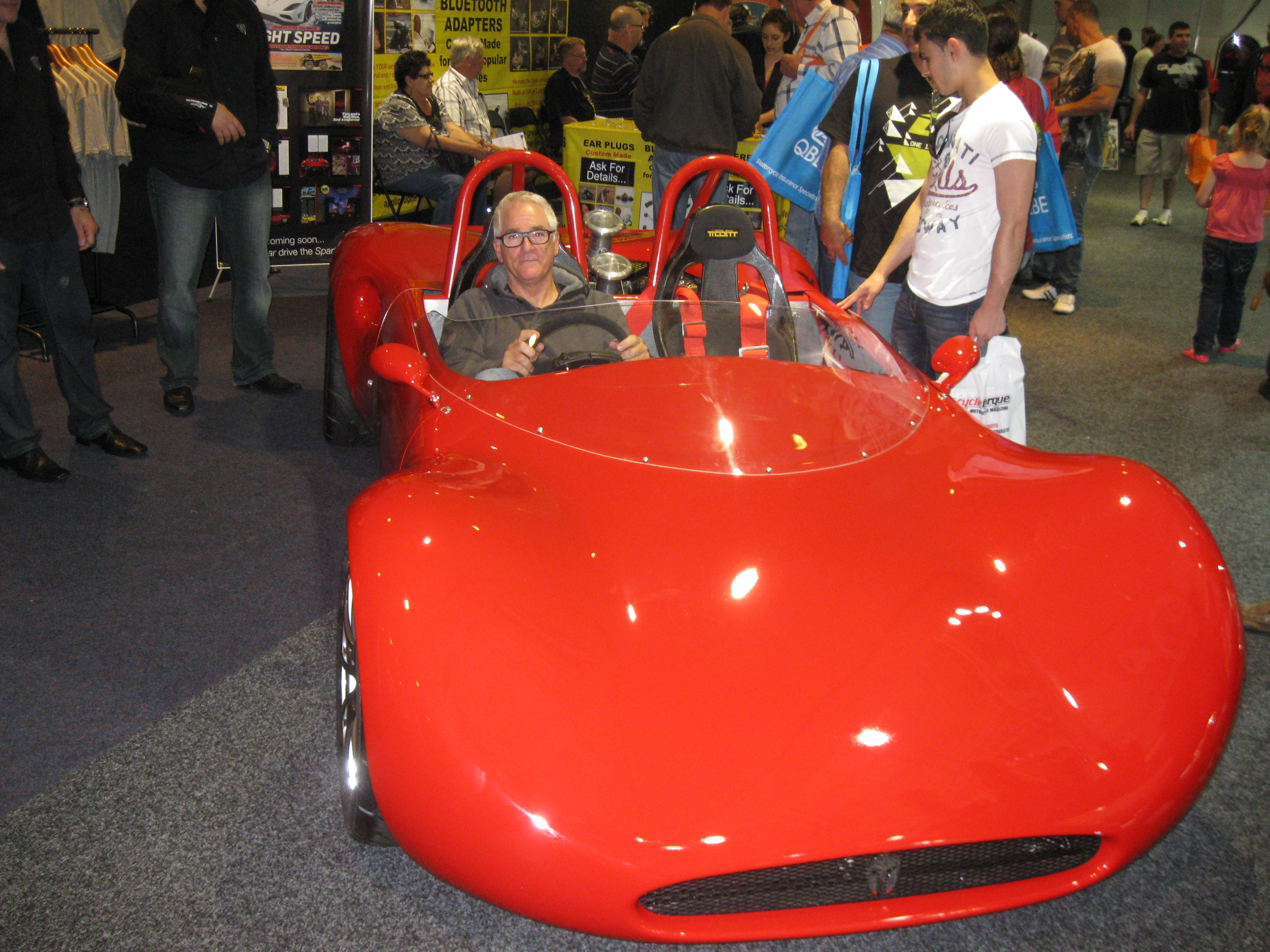
..... and it goes even faster than it looks.... the car, not the driver
Well, the 2011 Sydney Motorcycle (and Scooter) Show was an interesting affair – not merely because Ducati unveilled their new – soon to be world conquering superbike …. the 195 horsepower (145 kilowatts) Panigale 1198. Nor was it that BMW showed their new 1,300 cc six cylinder monster (which, let’s be clear about this, is roughly the size of a four seater lounge …. but not as easy to move through Sydney traffic).
There were two highlights of the show – the first is this lovely hand made carbon fibre miracle – the Spartan V. Why the Spartan ? Because the designers and builders (aircraft engineers) Dad comes from Sparta.
This one above is truly an amazing car. It’s a prototype, fully compliant with Australian automotive race car design – and when it goes into production it will cost about $90k.
Considering that the Spartan can thrash a Ferrari with less than half of the prancing horse’s power and just two cylinders – compared with the Ferrari’s big V8 – and with the Ferrari costing about five times as much, that’s not a mean feat. The reason it can perform this racing miracle is straightforward – power to weight ratio.
The Spartan’s engine is a Ducati twin 1198 cc – a relatively simple but awesome donk with massive grunt – well-used by Ducati to win numerous Superbike World Championships. But here’s the trick … (note ellipsis, grammar police). The Spartan weighs just 300 kilograms (not counting a fat arsed geriatric driver). Now considering that the bike from which the engine comes weighs 173 kilos, and the roll-cage in the car must meet minimum crash strength standards, it’s amazing how the engineers can add a body, two extra wheels and race tires, steering gear and massive brakes for so little weight gain.
The Spartan can go from rest to 100 kph in under three seconds and pull up well before the driver’s lunch.
This machine is put together with such care and precision that it’s a joy to look at. The design and craftsmanship is sublime. I wish the men from Sparta all success for their baby rocketship.
But wait… there’s more.
Many modern bikes are huge capacity massive monsters that seem to be more like furniture or motor homes to me. I’m a simple(ton) guy with simple tastes and I am attracted to the industry trend to what is referred to as “naked bikes” – stripped of all that fibreglass gee-gaw and gimmickry like bluetooth communications and heated handlebars – down to the basics – engine, wheels, tank, seat, brakes, lights – all one needs to belt around and have a good time.
There were some pleasant naked offerings from Triumph and Moto Guzzi – as well as a thin slice of the massive baby-boomer brand reminiscent of chrome plated aircraft carriers – Harley Davidsons.
But best of all was a bike – near and dear to my own heart – from the days when the Beatles were still in short pants in primary school. It was a display bike to attract attention to a book-selling fundraising lady (Alana) who was raising money in support of research into the rare genetic condition called Batten’s disease. Batten’s disease is a heart-breaking motor-neurone degenerative condition that claims the lives of children sufferers usually before they are ten.
The bike was … a 1954 BMW 250 single – beautifully restored. And it caught my eye because I have one too… not restored and not running since about 1970. I bought it in that condition in 1980 from a chap who lived a couple of doors up the road from my place (at the time) in Wagga. Here’s the real deal:

1954 BMW R25/3
Astute observers will notice that this bike lacks a chain – and as far as I’m aware distinguishes itself by being the smallest shaft-drive motorcycle. More than that, the wild, post-war austerity Germans added knobs to the frame for the attachment of a sidecar.
This one has the sidecar knobs on the right – suggesting that it is an import from America.
Alana quietly let me in on a secret that I already knew “The owner says it’s a bit of a pig – he’s inclined to get off and walk it up hills”. The bike came about when BMW (who had been making superb 500cc flat twin bikes went for parsimony and basically rooted a beautiful engine design by chopping the flat twin in half, stuffed the natural engine harmonics of the flat twin and turned the surviving cylinder into the vertical plane – also not helping the air cooling much).
Such is life. But since this little BM was made for my first birthday, it’s a nostalgic favourite – and the only other one I’ve seen in the flesh in over 30 years of being interested in bikes.
 Window Dresser's Arms, Pig & Whistle
Here’s one for the Enthusiasts.
LikeLike
There is no basket for your shopping !!!!
LikeLike
Viv, I’ll have to take some snaps of my old Beemer. She’s got a couple of leather pannier bags for the shopping. They’re about a centimetre thick! I figure the leather must have come off one of Sophie Mirabella’s relative’s hides. Or maybe Andrew Blot.
LikeLike
Assume thats you in the car Emm. Like the bike.
LikeLike
Yep, that’s himself all right. I was lucky enough to be offered a seat – by the young bloke who works at Gowanloch (Ducati restorers to the gentry, the fine chaps who brought my Duke back to life). He is also a member of the Spartan family. The Beemer is a sweet restoration, isn’t she ?
LikeLike
Wow! No chain!
LikeLike
Oh oh, Iv’e just realised you’ve already mentioned it. Silly me 😉
LikeLike
H says:
November 30, 2011 at 5:36 pm (Edit)
Emmjay looks leaner and Big M is not at all big…(I opened our door wider than usually just in case)
What’s going on, any reason for FM and Mrs M to be worried….I get a bit concerned when Gez puts on weight 🙂
LikeLike
I absentmindedly put this on the Dot first…
LikeLike
Mr Glas with the 250cc Goggo mobile was far too advanced for his time. It was awesome, especially when the air-cooled engine was increased to 300 and 350cc. It was fiendishly fast, I used to sometimes race one on Parramatta Rd at 5am on a Sunday at Homebush, made it to Parramatta Ambulance Hall at 7.30am to prepare for the Parramatta scooter club’s treasure hunt to Palm Beach..
LikeLike
Sound of a body falling over backwards and hitting the deck…..
LikeLike
I hope you won’t be offended if I say back to your old photographer, Emmjay. This one got a red car in the way for the top photo, and there’s nothing in the second photo apart from some old motorbike!
LikeLike
OK Emmjay, just been to the Spartan V website. My only question is, how do I deal with this priapism??
LikeLike
Go to Lehan’s philosophy zone, Big one. Or, even better, ask Gez.
LikeLike
A friend of mine who cracked it said that not trying to get out of the car in any hurry is a good start.
LikeLike
I’ll remain seated, and look at Lehan’s blog!
LikeLike
WHAT is that man on the right of the picture DOING? First I though it was you Big M, but then I realised in was someone slightly taller, thinner and more handsome.
LikeLike
I feel like a shadow of my former self, but can’t vouch for that character.
LikeLike
Have you tried putting salt on it?
LikeLike
All relaxed…now.
LikeLike
Don’t look too laconic to me!
The Spartans were very… spartan with their possessions: a spear, a shield, a few reeds to use as bed and black bean soup once a day. Mother would hand the shield to the son as he’s heading off to battle and say to him five tiny words… in laconic Greek: “Η ταν η επι τας” which means, “either you return bearing this as a victor or upon it, dead!” Mostly the mothers never saw either their son or his shield again.
But they never -never handed them a motor bike!
The very idea!
LikeLike
The Beemer does look gorgeous.
When do we get to see your Duke?
LikeLike
When I get around to polishing the cases (still looking a shabby, Big. But running fine 🙂
LikeLike
Looks like it would give the Ariel Atom a run for it’s money, or the KTM X-bow (both cars are not registerable in NSW and cost 110,000 to over 200,000 depending on state of tune, etc).
LikeLike
Are people starting to make customized cars now?
LikeLike
Well people have been customising cars that already exist for a long time – most noticeably the sixties penchant for hot rods – based on old 1930s and 1940s cars with huge new engines – mainly from Ford and General Motors.
There is a small but vibrant market for kit cars – where you buy all the components for a specialist car (usually for sports car racing) and drop in one of the main manufacturer’s engines.
Australian custom car manufacturers included names like Bolwell, Alpha, G-Force and Catterham – making small production runs. These cars are often road registered – so a differnt kettle of fish to the Spartan V. But this one is the first to my knowledge to drop a motorcycle engine into a hand made chassis / roll cage – and then lay a carbon fibre skin over the top. It is a bit like how they make go-karts. It was way cool. I’d love to have a real ride in it !
LikeLike