Tags

Melbourne before the storm
By Neville Cole
The summer of 1901 was unreasonably hot and windy and, though I need not add this, excessively dry. This was especially difficult on my slowly recovering mother. Doctor Lockett did finally arrive on the morning of my birth to attend to my mother. He praised Mr. Webb for his surgical efforts but nevertheless administered a dose of opiate and did what he could to clean the wound and stop the bleeding. He wanted to have my mother moved to the new hospital in town but she would not hear of leaving her family and instead my father hired a Chinese nursemaid from the goldfields who was known for working miracles with injured miners.
I, of course, was too young to remember any of this – being but a mewling and puking babe at the time – but during a recent visit the State Library in Melbourne I happened upon some articles written over the summer of my birth.
HEAT AND GALES the headline read and DUST STORM IN THE CITY; but the one that struck the clearest chord simply noted LOSS OF LIFE AND PROPERTY.
The Argus scribe wrote on February 7th, 1901 that shortly after 6 o’clock “one of the most violent dust storms that has ever been experienced in Melbourne swept over the city, and came as a fitting climax to a day of almost unprecedented heat.” He described the “rushing, mighty wind” as seemingly “converting the city into a gigantic railway train, rushing with headlong speed into a tunnel.” He also wrote that storm formed an “impenetrable grey wall causing vehicles to come to a standstill, and that the trams, after endeavoring to maintain snail’s pace motion amid the incessant clanging of warning bells, finally gave up the attempt”. But perhaps the most telling description I read pointed to the fates of innocent bystanders caught up in this furious whirlwind: “Luckless pedestrians clutched their hats and made for the nearest portico or doorstep, or clung to verandah-posts, burying their faces in their hands to escape the blinding cloud of dust and pebbles. The tornado swept through the metropolis in a few minutes, warning messages of its approach being sent over telegraph wires from places it had just left, though, as a rule, the recipients had no time to make use of the warning given to them.
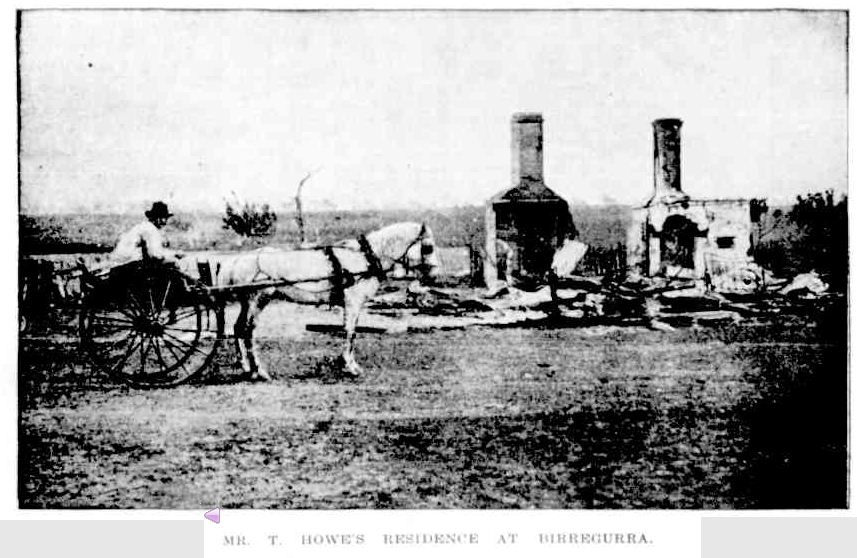
1901 fire
Melbourne was smothered by dust that day but spared the flame. We country folk were not so lucky. We had not only hurricane force wind and dust but also faced fires travelling at a terrific rate in front of that wind. Account after account in the Argus noted the devastation.

In Lower Byeduk, for example, “three houses alone stood out of the original fifteen. Nothing was saved, not a stick of furniture, and women and children, who had dashed out of their houses, just in time to save their lives had to stand by and see a mass of flame lick up their houses. People,” he went on, “with clothing burning, rushed to the creeks and dams, and many stood therein, while with hurricane force and cyclonic speed the fire swept past them actually singing their hair.”
While engaged in the act of reading these accounts I could not help but to imagine my dear mother, still partially invalid from the trauma of my birth sitting by me in my cot trying to formulate an escape from the fiery darkness that raced toward her like a headlong train.
No one ever told me an exact account of that day; but from snippets I did take in it appears that even in the days leading up to the great fire my father was often heard to curse his own father’s name. “Who but an arrogant fool,” he was said to exclaim, “would build his house on a hill instead of next to a cool and comforting stream?” What man would rather watch over his dominion than allow his family to live in comfort and safety?”
All of which is to explain why my father and my two young brothers were down by the creek in the heat of the day on February 7th. They were gathering water to cool my mother’s brow. The flames I am told blew up suddenly and without warning from the valley behind our house. By the time, my father even saw the smoke, the wind and dust was on top us and we were blanketed within that impenetrable wall of grey. It is not known what took place inside the house and I certainly don’t recall a thing but, as my brother told it, my father took off toward the flame but became disoriented in the wind and dust; and then, when the storm had passed as quickly as it arrived, out of the maelstrom staggered the Chinese nursemaid clutching me to her yellow breast.
My brother’s watch in silent horror as my father ripped me from her grip and beat her to the ground with back of his free hand. The Chinese girl, Clarry once whispered, managed to heft herself to her feet and ran off into the falling ash that was already decorating the plain like some snowy English Christmas scene. Like my mother, the Chinese girl was never seen and rarely spoken of again.
 Window Dresser's Arms, Pig & Whistle
Stunning illustration the photo at the head of this article. It seems to match the story line so well. There is a stark contrast between the upright character of the chap in the pith hat and the images in the story of a harsh environment in its background.
LikeLike
In mild dust storms it’s still possible to walk around although you wouldn’t want to. You can’t see anything because of the dust particles flying around. It’s not just the dust you want to avoid. The wind carrying the dust will leave things looking like they were just hit by a tornado. The best thing to do is find safe cover in a building or stay in your car.
LikeLike
Hmmm… Melbourne dun’t look much different to Adelaide… Haven’t had time to read this yet, Nev, but I’ll get round to it soon… gotta go and grab something to eat now…
🙂
LikeLike
I must say this music belting out here just above us in the little enclave is brilliant driving music to read Neville story by. Similarly I read Gez’s story of personal experience of the war in Holland with some brilliant music pulsing out.
LikeLike
correction … Neville’s story.
LikeLike
Trove has made available to us a treasure trove of insight on history through digitised newspapers. Nice work, Neville. Regards from a Cairns internet cafe.
LikeLike
Loved the language of the time. Looking forward to more.
LikeLike
I do love reading old newspapers for the language. The description of the dust storm is from the Argus. We have dust storms in Phoenix too often these days and I will think of the train thru the tunnel very time one comes along. The language is one of the main reasons I started the Aussie tales.
LikeLike
Compelling reading…
LikeLike
Oz weather can be so unpredictable, in my Sydney days I never had separate wardrobes for winter and summer clothes…it was hot one day, next day the heating was needed…
Interesting story, Neville.
LikeLike
Is Mr Cole 111 years old? I love the old pictures. Good story too. Why did the father beat the Chinese girl to the ground?
LikeLike
Aussie will ask that question many times throughout his life I imagine…but it will be clear the father is lost without his wife. Food for further tales I imagine.
LikeLike
But did Manly beat Collingwood?
LikeLike
As a boy from Essendon, I would have to say “Carn Manly! Beat the Colliwobbles!”
LikeLike