Tags
Architecture, Barangaroo, Brickfield Hill, bricks, Broadway, Gehry, Sydney, Ultimo, UTS

Triple Fronted Double Brick with Picture Window
Story by Warrigal Mirriyuula
You could say that Australians are known for their love of bricks and mortar. Indeed if we had a national building the way we have national birds, animals, flowers and the like, it would almost have to be a “triple fronted double brick with picture window”. We can argue about tiles or iron.
Indeed, the manifest for first fleet transport Scarborough sets out 5,000 bricks and molds to make more. No building tools though, which is an odd oversight on the part of the expedition quartermasters in England.
It was high summer when they landed. Stinking hot or thundering rain; a typical January. So no surprise that shortly after the Royal Marines barked at the convicts, to “get them tents up sharpish!”, Philip and the senior members of the colonial establishment noted that they better find a good source of brick making clay or the colony would be under canvas until such time as they’d determined which timbers where workable, or they’d imported a boatload of stone masons.
Given that even Philip would be under canvas, albeit a swanky prefab job costing well over a hundred quid back in blighty, and that this canvas didn’t fair all that well against the summer storms, there was something of an imperative in the search for suitable clay. Besides, building in brick would give this antipodean adventure a permanence it would otherwise lack.
The first suitable clay was found in what is now Sydney’s Chinatown and very soon several brick making enterprises where established in the area exploiting a resource that would eventually stretch from Elizabeth Street to Cockle Bay, Liverpool Street to Campbell Street.
The boss brickmaker was a convict called James Bloodworth and he’s come down to us as the chap that first recognised the potential value of the many clay lenses in what was to become known as Brickfield Hill. This area was to remain the centre for clay quarrying and brickmaking until the 1840’s when the expansion of Sydney to the south meant that the almost exhausted resource was abandoned to the developing city and brick making moved to other areas, including St Peters where the remains of the brickmaking enterprise are still visible today.

1802 French Map of the Brickfield Hill Area
Note the two “Briqueteries” down by the stream. Also worth noting is the inclusion by the cartographer of the broken sandstone slope adjacent to the stream. These rough outcrops of weathered sandstone would have been common through out what is now the CBD. The road through the centre became George Street turning into Broadway. The area top centre is now the location of The Sydney Entertainment Centre.
Snap forward two hundred years and we find bricks again being used to construct one of the most interesting buildings going up anywhere in the world, The Chau Chak Wing Building at The University of Technology, designed by Frank Gehry.
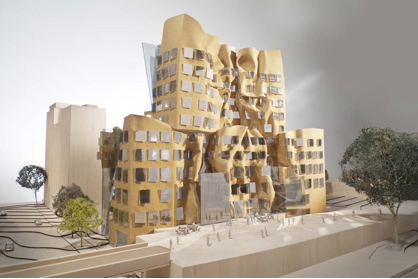
The Chau Chak Wing Building (East Elevation)
With a budget of over $150million this striking building will take bricklayers to the very limits of their talent and experience. That folded façade, inspired Gehry says by the folds in the drapery of classical Greek statues, will be entirely composed of laid bricks and the building will have a view of what was the first source of brickmaking clay in the early colony.
A few hundred metres uphill to the south, on Broadway, a vast collection of old brick buildings has been removed to make way for another startling building.

This has gone.

The Old Kent Brewery on Broadway
This is coming.
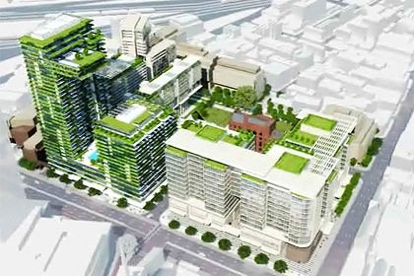
One. Central Park, Sydney – Visualisation of Entire Site
This building will give an entirely new meaning to “green building”.

One, Central Park showing cantilevered “Heliostat”.
Yes that is “a hovering cantilever” that will contain 24 very ritzy penthouses for the very wealthiest tenants.
What’s more, there’s this from the developers website:
“Here too, is a jettying heliostat – a beguiling assemblage of motorized mirrors that captures sunlight and directs its rays down onto Central Park’s gardens year round. After dark, the cantilevering structure (a favoured Nouvel architectural device) is the canvas for leading light artist Yann Kersalé’s LED art installation that carves a shimmering firework of movement in the sky and brings a new architectural shape to One Central Park by starlight.”
I kid you not. That’s what it says. I particularly like “jettying”, I assume from the verb “to jetty”.
There is so much innovation, so many new ideas, new techniques and technologies in this building that I still haven’t had a chance to go through it all. Suffice it to say that it will be one of the most energy efficient and sustainable residential buildings in Sydney; and for mine, the hanging gardens, which are an integral part of the water capture and reuse system, promise a building that will turn its back on concrete, glass and steel and present itself to Broadway as a giant vertical garden, a modern day Babylon on Broadway.
And across Broadway, UTS isn’t sitting on its hands either.
The UTS tower* and podium are also slated for change.

UTS podium development visualisation. exterior above, interior below
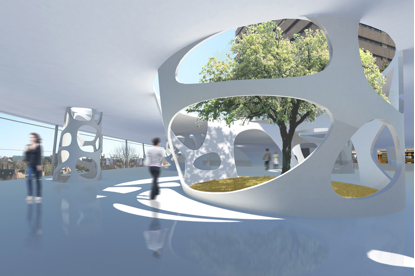
At the moment only the podium is in design phase. The tower redesign will probably have to wait for braver souls to green light Chris Bosse’s radical reskinning of the UTS tower, perhaps the most depressing and intimidating building ever devised for the toture of students. (Did you know that the original design brief for the tower demanded that there be no spaces where students could congregate in large numbers. It was 1968 and the French students where tearing up the cobblestones. Local educators didn’t want to take the chance.)

An active skin from Chris Bosse of LAVA
The skin generates electricity, captures water, moderates insolation and most importantly, entirely covers that grotesque ‘turd’ of a tower.
Talk about “building an education revolution; UTS will spend over a billion dollars in the next few years building in the Ultimo campus precinct, including the upgrade of open spaces where students will be encouraged to congregate.
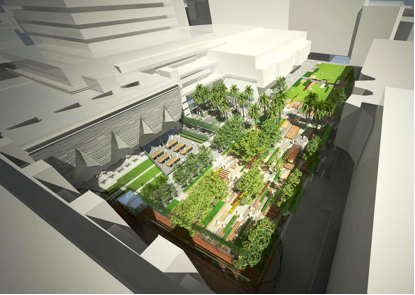
Alumni Green UTS visualisation.
Somehow this bosky park doesn’t look the part as the location for a student revolution.
Adjacent to the Green will be the new Science Building designed by Durbach Block Jaggers and BVN Architecture.
And if that isn’t exciting enough for you, just down Broadway work is well progressed on the ITE Building which will house what UTS hopes will become an international centre for excellence in Information Technology and Engineering.

ITE Building on Broadway
This “5 Star” green rated building will also have an active skin which the designers believe will deliver a 10 to 15% operational energy saving on its own. Oh, did I mention that the skin is laser cut with this really cool “binary” pattern? It is!
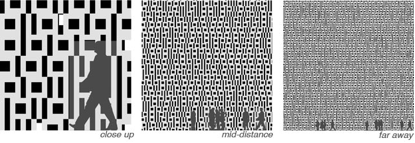
The “Binary” pattern of the ITE skin.
The interior is just as mind blowing.
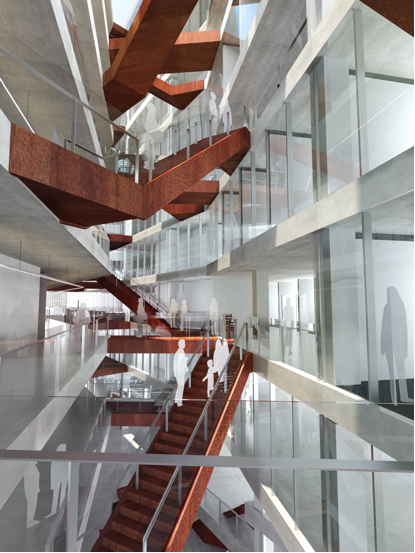
Interior visualisation, ITE Building at UTS.
Puts me in mind of that other great educational institution, Hogwarts, and all those moving stair cases.
There’s new student housing and a host of other building going on at UTS all slated for occupation between the end of this year and 2015. This program and others funded both publicly and privately will turn the top of Broadway into what one architectural pundit called, (Hyperbole Warning!), a “mecca”, a kind of stations of the cross for architectural innovation nerds.
It may not reach such exaltation but it won’t be for lack of trying.
If we add to the already mentioned building sites, the Ultimo Pedestrian Network or UPN, (You must watch the embedded video here, http://www.aspect.net.au/wps/wcm/connect/web/w/spotlight/featured+projects/upn) , which will join the UTS campus with the Gehry building and points north to the Powerhouse Museum, including all the plans the state government has for the Entertainment Centre, The Exhibition Centre and Darling Harbour proper, and then throw in Barangaroo you begin to see a huge urban area in the throws of vigorous reinvention.
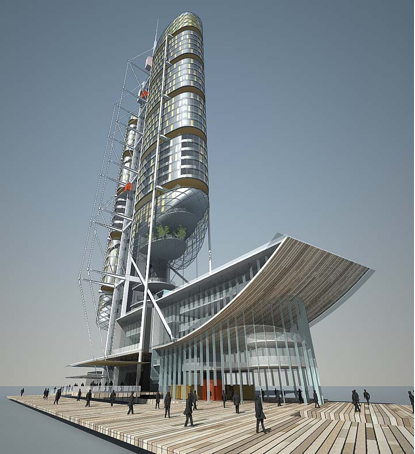
Barangaroo South Hotel Concept
Unfortunately we won’t see this one. It’s already been shelved in favour of “The Packer Plan”. I guess that’s a plan for Jamie’s retirement fund, or O’Farrell’s perhaps.
By 2020 there will be no doubt but that UTS will have stamped its presence all over the top end of Broadway and in time this will lead to redevelopment of the entire area as clinics, labs, and associated businesses snap up remaining real estate to get themselves closer to the “glow” of the campus.
High density, low to medium rise apartments will become more common and the rows of remaining terraces will become gentrified, their values exploding as academics, staff and students look for somewhere nearby to live.
No longer the suburb that dare not say its name, Ultimo will have become hip, progressive, with innovation at every turn. The “shock of the new” will have become commonplace as Ultimoans wonder why the rest of Sydney are still catching up to the twenty first century
But in amongst all this twenty first century building will remain some of the most beautiful brick buildings in Sydney, other brick piles will be adaptively reused, while others are demolished and their bricks recycled.
The humble brick was there at the beginning of the colony and is still with us at the cutting edge of architecture. You could say that the brick has been “a brick” down the years and there’s no end in sight to its utility.
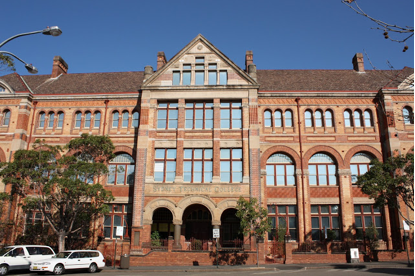
Sydney Technical College, Ultimo.
Bricks as a proud and permanent statement of the value of learning.

The Quay Apartments, Chinatown.
Bricks as valued heritage adaptively reused as anchoring feature of these new upscale apartments. That brick façade was once The Sydney No. 2 Poultry Market.

Bricks and lace, Ultimo.
The ubiquitous terrace survives into another century.
http://penultimo.tumblr.com/ This site is wonderful and rewards a wander through its many pages, including pictures of nearly every brick building in Ultimo, old and new, ugly and beautiful.
* Editor’s note: I so wanted to describe the current UTS Tower – wherein I once did a course on Assembler Programming – as “Plug Ugly”, but I didn’t think the term was strong enough. Nor was “nuclear-proof”.


So that would be the Lend Lease crane on top of the ITE building then. A 1000 litres of diesel can be quite a problem burning uncontrollably fifteen floors up in the air.
http://www.abc.net.au/news/2012-11-27/ultimo-crane-fire/4394144
LikeLike
Someone reckons it was a particular stern and deadly stare from Bishop that richocheted and made the crane catch fire.
LikeLike
Yes, that flinty stare is never found knapping is it?
LikeLike
Like your work, Warrigal, the built environment certainly has a huge effect on us. I love brick buildings, particularly old ones which incorporate custom made feature bricks to great effect. The old Newcastle technical college:
http://collections.ncc.nsw.gov.au/keemu/pages/nrm/Display.php?irn=51847&QueryPage=%2Fkeemu%2Fpages%2Fnrm%2Fnlibrary%2FQuery.php is gorgeous (probably a sister to Sydney tech), as are many old Newcastle buildings.
I love those skins they put over ugly buildings, cheaper than knocking down and rebuilding, attractive, and many have the potential for embedded photovoltaics, solar-thermal heating and cooling, etc.
I also love the way engineers manage to retain the original masonary facade, and construct a modern building behind…the best of both worlds. Those beautiful old warehouses, factories, breweries and flour mills have huge spaces which lend themselves so well to apartments and offices.
Oh, and I really like the proposed UPN. This sort of thing works well, if it’s done right. In Newcastle there’s a big push to get rid of the main railway line that goes all the way into the CBD, and use the space for bike and walking paths, gardens, skate boarding, etc. There’s a huge opposition to it, based on the 2200 passenger trips per day on the trains. there are also commercial interests eying off the land. Something may happen in the next two or three decades!
LikeLike
What a wonderful piece Waz, brings back some memories of my years studying in that precinct. I looked for my old watering hole The Agincourt where many a lunchtime drinking black beer was spent.
I love an “Artist Impression” they have a habit of making places look anything but how they actually become, well the buildings look something like what they should but the congregation of children and young parents etc seem to be anything but reality. Ultimo has some very interesting architecture and some very ugly stuff as well.
Where I work we’re watching the what should be the first of the Barangaroo buildings. Currently it a massive hole in the ground, it probably 15 metres below the water level at Darling Harbour. The vastness of the site shows is often hard to gauge. Yet the big truck look like ants as they remove the dirt from the site.
LikeLike
I should have added I was very impressed with the 1802 French map of Brickfield Hill. so much clearer than some of the plans from the 1800’s that I have to deal with most days.
LikeLike
The links in the article, Warrigal, are a delight. This is a treasure of an article. Once in, difficult to pull out of the steep descent into the entertainment without end. I pulled on Google Maps as well for a help out tying ribbons around locale. The Goods Line appears likely to be a fabulous leader and the environment around Central Station will be in for an overhaul. In late August I walked through Belmore Park considering what a tiny jewel it is in an otherwise bitumen and concrete dominated hood. It takes no time to walk through to the Gardens but you have to know. I thought so many buildings seemed due for an overhaul. I didn’t have time to walk down Broadway. I had run out of money before I got to Sydney. My feet got sore. I want to go back for a couple of days after reading your article. It is a fabulous stimulus.
LikeLike
That double brick is crying out for some plants, for a bit of a garden, my fingers are itching, it needs some shade and beauty around it, sadly most owners prefer it just as it is, just bare bones…
What the heck is a Picture Window, when you are obviously not looking out at anything picturesque..
LikeLike
I had a quick look at the UPN website and was mightily impressed with the plaza between the buildings showing a raised garden with people squatting in the grass and no cars. One man on the left was on a bicycle and this is what struck my attention immediately; he wasn’t wearing a helmet. I am totally convinced that the use of a bicycle as a mode of transport will never take off seriously if the helmet wearing remains law.
The benefits of protection are negated by the many that would ride a bicycle (and avoid heart attacks and obesity problems) but will never do so because of having to lug a helmet around. It is a pet hobby of mine and I deliberately cheer on cyclists that are not wearing a helmet. The not wearing of helmets seems to take on little by little and some serious people are trying to overturn the legislation.
Cycling is just a faster way of walking and with adequate cycle paths and an awareness of drivers, cycling, especially with the lithium battery powered one available now, could be a serious way to get about.
LikeLike
The UTS in Broadway brings back fond memories. During the digging of the hole, well a hole is putting it modestly, it was more like a Grand canyon, people used to row across it, I won the contract to coat the huge hoarding facing Broadway with a protective oil or preservative. I can’t think who the building contractors were. It could have been A.F.Little. Pty Ltd
Anyway, it turned out to be slow going with sections being built intermittently which would then resume at a staccato rate and I managed to get the the original contract from a set quote changed to a fee per hour per man. I think the Government was at a loss to know what they wanted precisely, but the enormous hole needed protecting and shoring up as the sheer drop down came right next to the footpath. The hoarding was above the footpath and rose up majestically and run for several hundred metres facing Broadway with huge signage on it about its proposed ultra modern UTS plan.
The hoarding stood there for many years and I could not get enough of pointing out to Helvi about how the protective oil kept on staying true to its colour. I was lucky!
The original quote was based, as is normal, on an extract of what is called ‘a bill of quantities’. I knew a little about this as I had studied this and as a result obtained a certificate on quantity surveying.
The oil specified had some kind of wax in it but I can’t think of the trade name, perhaps it was a Canadian product. Anyway, to make an extra buck and knowing how protective the simple boiled linseed oil is, I changed the original specified product to the boiled linseed oil and used burnt sienna to colour it, making it indistinguishable from the waxed Canadian product, at least in colour. At its peak I had perhaps 6 men applying this protective oil. Of course the quote per hour per man meant that the longer and the slower it took, the better the returns. It was one of those perks of the building game. The per hour acceptance came compliments of a 5 gallon protective oil ‘gift’ to the clerk of works whose name I do remember. His name was Jack.
LikeLike
I recall Broadway when it was a traffic bottleneck and Chinatown. Tres exotique to a child at heel. The scape in recall is so crammed with traffic and crazed it feels as if tomorrow had arrived then already. Where did everybody fit. I had not thought about it before.
My brother lived in a high rise appartment block of red brick like a beacon overlooking Bondi Beach if you stood on the toilet seat and peered through an aperture. I think the corners of the building were rounded. Its stolidity was comforting. That children lived in it was beyond my previous understanding of how kids were incubated and fledged. In Brisbane in an earlier year he arranged a loan of a house for us, his visiting family and it was a red brick comforter, big and solid. I watched the first television I ever saw for hours there. It is an expression isn’t it of stickability that someone built their fortune or their home ‘brick by brick’.
LikeLike
My idea of high rise is three storey. After that I feel sick. Can’t even look at some of these marvellous photos without feeling icky in the stomach. I’m no good at heights!
LikeLike
I feel dizzy going down David Jones escalators, Gerard dreams of flying; a good match we make.What I like tho is living in a two-storey place; keeps us fit running up and down many times a day..the computers are upstairs…
LikeLike