
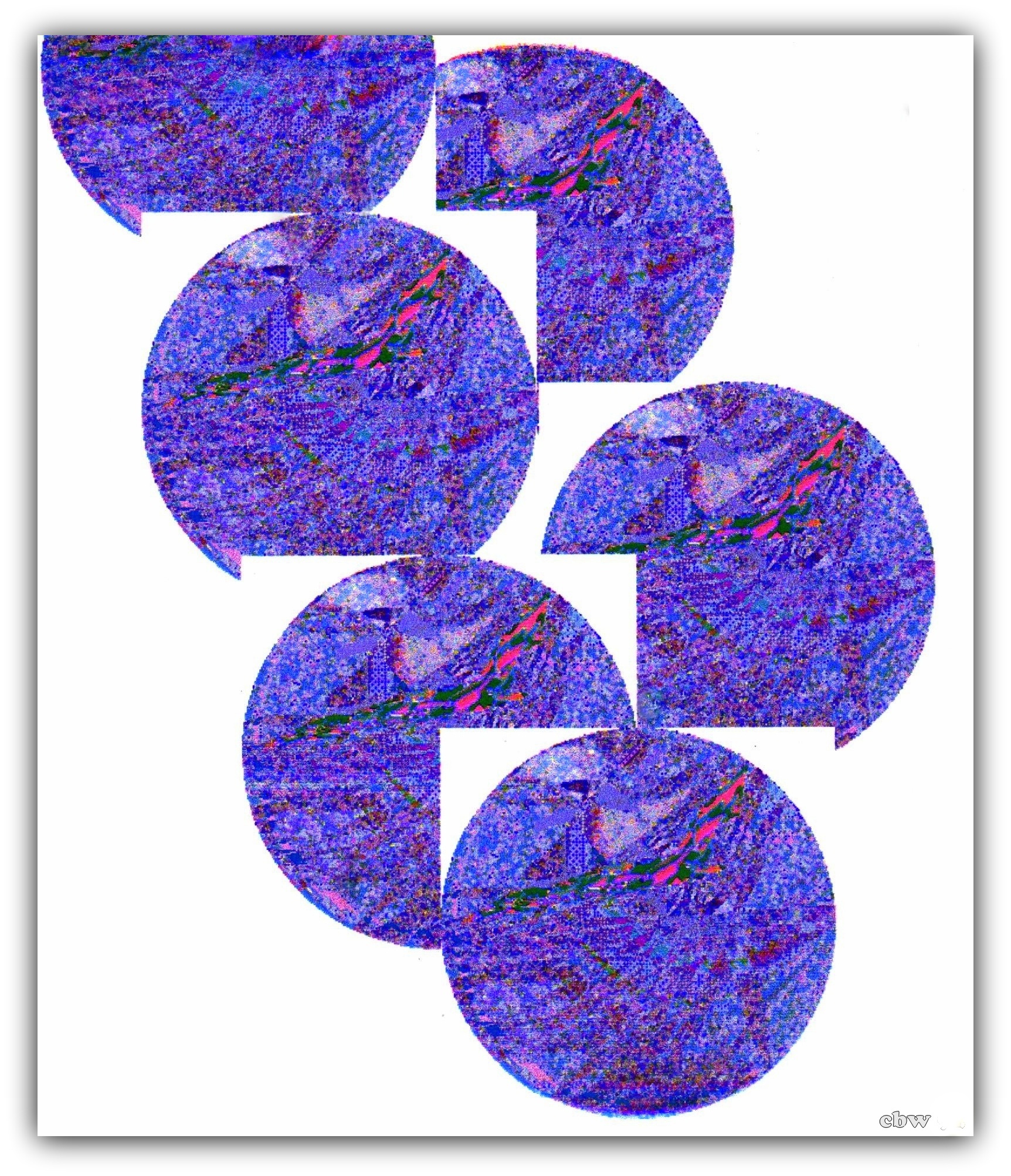
Marble Earth
Story and illustration by ‘Shoe
For readers the story so far, link to The Castle: Episode 7 – Terence
https://pigsarms.com.au/2014/04/04/the-castle-episode-7-terence/
The phone rang. Isobella supposed it was Matthias so close on the alarm. She found the telephone in the kitchen. Matthias was at work. Terence and The Busker had accepted an offer of a ride back into the city. Quiet Jack was nowhere to be seen when Matthias left. Did Isobella have everything she needed? On the couch again, Isobella slept.
He was standing there with a cardboard box. In the box when she looked in was an apple wrapped in tissue paper.. Who was he?
Isobella woke and stood up off the couch in a startle. In the kitchen she peered out to see between the frame of a vertical canvas awning on the exterior of the kitchen window and the window’s frame. She glimpsed empty undeveloped land through the wire of a cyclone fence across a driveway. The kitchen was an alleyway from the living room. “Is anybody there ?” she called into a hallway of closed doors offset from where the kitchen met with an entrance hall. She listened. There was not a sound. In the kitchen again she filled an electric kettle with water for coffee.
Sun she saw through a gap between window curtains in the living room was low in afternoon cloud to her left hand. Both ways she looked when she pulled open the drapes their full extent, a green lawn lay flat in front of her. Angled fence tops in view over a plain aluminium back yard fence made a maze of green and silver fence lines and washing lines. Roofing scattered with aerials scudded grey and silver as clouds rolled out their shadows across a new urban landscape.
Matthias said there was no coffee she remembered. When he loped in the back door, she was tense for coffee. He said he saw Hugh and Quiet Jack at the University at a lunch time rally. Hugh and Quiet Jack were lovers.
We meet people and they are strangers. People stay strangers and sometimes we are married to them. We uphold sacred text. We keep secrets.
She offered to help Matthias with chores. He would not be long he said. She watched him from the opened back door. The wind was fierce from the ocean. He pointed to show her direction Together they made a meal of rice and vegetables and sat cross legged on the floor to eat it and drink chamomile tea. She noted there was no television and no books or bookshelves. The house was new.
She told him her dream.
“Your dreams are the only things you have that are the truth,” Matthias said. He laid claim to an intense loneliness of being. He sat forward with his head bowed and his body curved into his hands. He began to sob.
“My father is in prison.”
“How long has he been there.” She imagined the grimy walls of Mt Eden prison and the heart of Auckland.
“He left our house one day. He never came home. He went with friends. They went to free our country. They were arrested when they stepped off the plane. What did he expect.”
Her heart thudded as she saw his face raised was contorted with grief. They half looked at each other then. He looked away.
“I have felt so much shame. I am so ashamed.”
“What are you ashamed of?”
“All those years at school and my father. In prison. I have to keep my mother and my sister safe. He taught me. He left us. I could never be the same as my friends. What could I tell them. I felt so ashamed.”
He fell backwards on the carpet in front of the fire. His two hands side by side made a cover over his face.
“Where is this?”
He told her and she knew she would never say.
“Why did your father think he would save the country?”
He sat up in an awkward movement that was a casting off from shame. He wrapped his two arms around one of his knees he propped up and bent his other lanky leg away from her under it. His shoulder length hair had curled in boyish locks as they dried from the evening’s early dewfall and, later, light rain outside.
“He was a soldier. He was an important man in his uniform. His friends thought the same way. They were all soldiers for their people. For us? I don’t think his heart was here. It stayed there surely. My father was brave. He was brave in a special way. In the War, when my father got separated from his battalion, he walked the mountains thinking he was walking to his battalion. He walked into Italy. Where he was hidden from the Fascists was a farm house. The people were hiding their daughter. She fell very ill. He was hidden with her. Mussolini’s soldiers came. They left. He fed the girl soup. She was dying.”
Isobella barely wiser about detail cried out as he cried again in half light gashing his face.
“What happened to the girl?” she cried out
“It is my mother. He went back for her after the war. My parents have a great love. We have between us in our family.”
She felt a great grief for him as he wept. She knew grief of all the emotions of harm and defence.
The telephone rang. Matthias started. His tears went. He wiped his face with the back of a hand as he unfolded himself and rose to his feet. His tone of voice was sardonic.
“This will be the owners. They said they would ring me late one night.”
She listened to Matthias walk across the carpet, the length of the kitchen aisleway and the telephone stop ringing in the kitchen. She heard a singing noise like a cry.
Isobella stood up from the floor quickly and walked to the kitchen entrance from the living room to see if Matthias was harmed. He leaned in stark profile against the door frame at the other end of the kitchen’s alley where the phone was on its bench and caressed the mouthpiece in his two hands. His voice in contrast to the first sound he had made in answer to this intrusion was level and reasoned. At his feet a jostle of fowl shocked her imagination as she saw a young and strikingly handsome man in a Mediterranean farm house where she had never been far from this new house and housing estate so new and so new to her. Two more fowl stepped through the kitchen entrance onto the large white outlay of contemporary kitchen tiles towards the brood at the young man’s ankles.
‘Alright, I will see you there.” Matthias concluded his conservation. He put the phone down. His body looked a burden as he turned and walked towards Isobella.
“My father is home,” he said staring at her as he walked. They stood close in the frame of the door where she had stood motionless.
“What do you mean?” she asked, “He has been released? He will come home?”
“He is here. He walked in the house a half an hour ago. My mother rang to not shock me. She put him on.” Matthias looked around as if searching for the identity of an object he didn’t know was missed. Isobella kept her eyes on his face and his returned fixed on hers.
“You have to go then, “ she said.
“Have to. I have to go straight there.”
“Go,” she said, “I can find my way home by early public transport in the morning if you will leave me here. I feel a great deal better. Refreshed.”
“I don’t know where that is.”
“What? The bus? I will find a bus. There will be one.”
He looked at her closely and a cloud of resentment rolled abruptly across his mood. “Typical. That is so typical of him,” he said and turned away. “He turns up. Without telling us. He could have rung.”
In her office the first person the next day was Dinia, her closest colleague. He stopped her with a turn of his small and elegant frame. He shimmered with light reflections from sunshine off the internal glass walls that made their office partitions.
“Are you in love? So early today too. This is none of my business. What has happened?”
In the chaos of this bloody market place they had grown respectful of each other. Such respect was not everyone’s in this place. The lives of people they had themselves known would be lost and some measure of their own. They shared the thought in an agreeable moment. They both knew war.
“No,” she said, affectionate for him. “I’m not in love. I have been a witness, Dinia, to great love. Experience I could never imagine. I witnessed the unexpected return to his family of a prisoner out of imprisonment.”
“Who?” he said.
“I can’t say. I will never say. Not here. From outside the country.”
Dinia smiled at her. She saw his beautiful charm was intact and kindness that was its strength. “Pity,” he said, “What a story you have. I have no doubt you experienced the world itself. I can see. So nice to see you back. I missed you.”
“I truly haven’t given anyone a further thought beyond calling to say I was not well. I am very happy to see you now I’m back. No-one seemed to be here to let me in to the office the other night as I expected by the way. ”
“I wonder how long in these circumstances will we last here. How long can it hold.” Dinia smiled. “There’s another boat going in, anyway. Business as usual today,”
 Window Dresser's Arms, Pig & Whistle
Liked this very much shoe. Thanks for sharing it.
LikeLike
O, wow, no, thank you so much, algernon.
LikeLike
Only just read it, ‘shoe. I need time to take it all in, like only eating when one is hungry. So much going on, and so many layers of complexity, in short, I like it.
LikeLike
I imagined the entirety before I began as a series. but that each episode is in a sense so different a reader might be lured to read over for meaning and joining dots. This episode is complex. Thanks, Big M. And I understand – I am pretty sure – what you mean. 🙂
LikeLike
Great story shoe. Really inspiring.
LikeLike
It is a thrill you like it, HOO. This episode has quite a lot of detail in it that expands the context of the story, as well. I like the idea and gist of it. I hope I can get episodes off the drawing board soon. Many thanks. You know…it is you who is an inspiration.
LikeLike
Shoe, thank you, however there is something about your writing that stirs things within me similar to Gez, things that have passed. Thank you and keep them coming.
LikeLike
Fascinating. Is this story a mix of actual recollections?
LikeLike
Dear Vivienne
Your one word comment means a great deal to me.
I have found an answer to this enquiry I have been asked before essentially about personal recollections. I could not answer it better as follows.
In a 4-disk set of episodes of the first and second series of ‘Widows’ by Lynda La Plante, included are interviews of Lynda about the process of writing. I recommend the series and the actors highly from the viewpoint of watching women’s writing and production too … and the support the male actors lend. It’s a yarn if you’ve not seen it about four women who are a gang in response to their husbands, thieves and brigands if ever there were … being killed.
Impossible to tell a story or make up its colour without characters. Lynda La Plante describes a woman she saw and eventually spoke to who seemed to her to be the essence of the lead she was looking for and then discovered so much more when she told the woman she was chosen as a role model. From another place, she saw an action of another women that gave her the prop she made the feature of the lead character’s persona. The lead character became rounded. Ideas flowed.
Viv, I have never dreamed about a man standing with an apple wrapped in tissue paper in a box (to refer to a specific). The element that drives colour remains the poetic imagination that runs the rhythm to the ear and look of language on the page and its commentary. Another example is until I wrote this I didn’t know Hugh and Quiet Jack were lovers. And I had someone – right from the beginning – entirely different in mind who was ‘Hugh’. Lynda la Plante says it in one. None of her characters are plucked from air. Every character has basis in the observations – and experience – of lived reality whether the role in that reality be major, minor or on a sideline.
Thank you, Viv.
LikeLike
I think to say that is my reference added … whether the role in that reality be major, minor or on a sideline. I don’t want to be seen as misquoting or misrepresenting what is said in those interviews.
LikeLike
And thank you for the answer. I think I get it ! Observation. I forgot to add that the illustration, the art work is lovely. You have talent there Shoe.
LikeLike
Pleasure. Viv, I am very fond of this art work I titled Marble Earth. It is a great joy to me that you like it. I have more to show that I think you will enjoy.
Christina.
LikeLike