• The Pig’s Arms
  • About
  • The Dump

Window Dresser's Arms, Pig & Whistle

~ The Home Pub of the Famous Pink Drinks and Trotter's Ale

Window Dresser's Arms, Pig & Whistle

Author Archives: Therese Trouserzoff

The Nuclear Break

30 Monday Apr 2012

Posted by Therese Trouserzoff in Lehan Winifred Ramsay

≈ 11 Comments

Tags

alternative energy, deactivating reactors, Japan, Nuclear energy

Cafe Wall

Story and Photograph by Lehan Winifred Ramsay

Coming up in Japan: a dilemma. Since last year’s triple disaster in Japan the nuclear power stations have been suspending operations, one by one, for checking and maintenance. The last reactor is scheduled to be de-activated on May 5.

The dilemma is a little complicated. Many people say that this is a time that Japan really needs a “miracle recovery”, like the one that took place after World War II. But there are a lot of factors needed for this miracle recovery, and one of them is power. Since March last year, power has been a concern to the government. As the nuclear reactors shut down, companies are asked to reduce their power consumption. So instead of increasing production, in many cases they have had to reduce it.

A further problem is the looming increase in the price of electricity. Many companies are considering moving their manufacturing and production off-shore, and increases in electricity prices will strengthen the argument to do so. Aside from industry, there is concern that ordinary people will be affected by rising electricity prices and blackouts.

The government seems to be of the opinion that before the last nuclear power station suspends operation, it is important to start up one of the stations that has been inspected. But the public is currently divided over whether they want to do this. On the one hand, there is a great deal of concern about the safety of nuclear power plants. On the other, they are being warned that there may be widespread blackouts over the summer, and that the shutting down of the plants may contribute to further economic troubles. It seems that the government wants to prevent the anti-nuclear movement growing stronger.

The closure of all nuclear stations might make it harder to get the support to restart them. On the other hand, if there are numerous blackouts over the summer, that might cause support for nuclear power to resume to grow. The government also appears to be a little unsure of how to persuade the people.

It seems clear that the Central Government is committed to nuclear power. Not so the Municipal Governments, some of which are opposing efforts to get the plants restarted. Many local governments too are opposed.

Another problem is that the increased use of fossil fuels as an alternative to nuclear power has many problems. Increased cost, pollution, reliance on outside energy sources. There seem to be huge investments going into alternative sources and research. Nobody is really sure if a cheap and safe alternative can be found, and it is unclear as to whether a cheap and safe alternative is really being searched for. It may be that these efforts are aimed more at placating the public.

I feel a lot of sympathy for the Japanese people. This dilemma comes at a time when the country was already experiencing a drop in economic power, and started a serious conversation about what the future should be, which direction to take. It’s a discussion we all need to take, because once the babble about carbon, offsets, all those airy-fairy economic games stops, we still haven’t made any serious choices or serious decisions about how to stop the world from ending up on a junk-pile. People here are thinking.

Coming up in the beginning of May are the Golden Week holidays, when we will experience our first Nuclear Break.

…the toggle, brown beret, blue slouch hat

29 Sunday Apr 2012

Posted by Therese Trouserzoff in Sandshoe

≈ 9 Comments

Tags

ANZAC Day, boy soldiers, Gordonvale

Story by Sandshoe

I am deeply moved by the dedication of the Japanese teacher filmed in the documentary ‘Inside Hana’s Suitcase’, who wrote a letter to the Holocaust Museum asking for a loan item for a class project. Hana’s suitcase was sent from Auschwitz, off the top of a display of innumerable suitcases supplied to children in the Holocaust of Hitler’s Germany.

The school children with the help of the teacher create a museum in their classroom beginning with what they find is in the suitcase. They assemble a history of Hana as far as it can be.

It is a story of motivation, co-operation, process and construction.

I decide I want to contribute to the story, of war and research the experience of someone who may have no-one else to honour their story.

My personal inspiration to accomplish this resolve begins with detail my father recorded in a document he sent to me 30 years ago. In a list of genealogical notations (#1 – #15) intended to be read alongside a family tree of his paternal lineage, he scribed as follows:

(#5) on death of father, John (and William) were admitted to the Caledonian Orphanage maintained by regiment: Both became long-service army bandsmen, John as drummer, for 21 years, in 92nd Regiment Gordon Highlanders in Aberdeen, was personal signal drummer to Lord Roberts on active service in Middle East, married an Aberdeen girl, had no children, adopted a boy, son of a sergeant in the regiment: served as verger in Anglican Church in King Street, Aberdeen

(#6) became clarinetist, served 22 years, in Grenadier Guards Band: married, no issue

(#5) and (#6) inclusive refer to my paternal great-grandfather’s siblings, his brothers John and William Wilson.

I felt I knew Great-grandfather George Wilson, retired sea captain and Harbour Master of Dundee, passably well, innocent of my naivety thought I had the measure of the man from stories told me by my father who travelled by train to spend school holidays in Dundee with his Wilson grandparents c.1909-c.1918. My father recounted that home in Aberdeen he spent every moment he could on the wharves, looking out, yearning to run away to sea. His grandfather  was (#3) ‘when his father died too old for admission to regimental orphanage; went to London as a draper’s apprentice; briefly, then went to sea; served many years in sail as first mate with captain’s certificate; went ashore to college and qualified to command in steam’.

To potentially represent him there were on face value 9 children inclusive of two sets of twins and their families in turn.

I embarked on researching why, when their father died, my g-grandparent’s brothers (#5) John and (#6) William were placed in an orphanage.

Had their mother contracted and died of smallpox as their father (#1) did according to my father’s notation ‘at Castle Hill barracks, Edinburgh circa 1856 while regiment was preparing to embark for Crimea’?

I found record of the death from smallpox in June, 1856 of the boys’ father, 37 years old, married, Private John Wilson of 92nd Foot (the 92nd Regiment of Foot, the Gordon Highlanders). His burial site is the Canongate graveyard at Edinburgh Castle.

My great-grandfather’s brother John was 2 years old at the time of the death of their father. The birth of John is the first evidence I have of his mother whose name I know from my father’s notation of (#2), Isabella Birse.

I meanwhile fail to find record of the birth of the younger brother William who is either unborn or no older than 15 months at the time of the death of his father in 1856.

I turn my attention to researching ‘the Caledonian Orphanage’, the ‘Caledonian Asylum’, ‘the Royal Caledonian School’, the ‘Cally’ as it is called. A view of the census records of the inmates shows children are listed as Scholars. I may find them yet, but my initial gut response to this public record is that these were the lost boys and they were stolen for indoctrination into military service.

Inmates were aged between 7 and 14.

My second thought immerses me in anxious reflection on the welfare of Isabella, the boys’ mother. Did she ever see the children again? I feel her suddenly close, the mother of my father’s beloved grandfather, even though she was born in 1819. Maybe she dies a childless mother. I am overcome with distraught anxiety, search for her in a frenzy.

I find her, the widow, Isabella Wilson nee Birse, living in her later years in the family home in Dundee of her first born son, George, my father’s grandfather, the residence where my father subsequently visited his grandparents from Aberdeen in his school holidays. I find John, her second son, married, living with his wife and an adopted son, a short walk away, which is after his discharge from his regiment, regardless 21 years military service and separation from his mother as a young child. I note John’s signature is ‘Informant’ on Isabella’s death record. The place of death is a hospice close to the address of his brother George and his own residence.

Still I cannot imagine what the years were like for Isabella after the death of her husband John with the responsibility of the two children, John and William who were babies, her oldest child apprenticed in London. I don’t know if Isabella saw the youngest, William ever again after he was admitted entrance to the ‘Cally’, or even for how long after the death of her husband she was able to maintain the charge of the children and could meet the responsibility.

For now as it is not yet researched, we can believe only because my father provided information that is proving to be remarkably accurate, William like his brother John had a distinguished career as a military musician. Was it as event filled? How did these soldiers fare? What did they survive? I send to the Gordon Highlanders Museum in Aberdeen for information about John, When John joined the 92nd, he was promptly sent overseas and the regiment was away for years.  He was in Afghanistan and India and South Africa: was awarded the Afghan Star which was recognition of the famed march to Kandahar, and the Afghanistan War Medal with 3 clasps – Charasia, Kabul and Kandahar. When he left military service John was only a man in his 30s.

Mulgrave Sugar Mill, Gordonvale, QLD. Photo by Sandshoe

It is the 25th day of April, Anzac`Day. I write thinking on my own experience of war that I know of at first hand, contemporary wars of media and guided attack missiles, how will I finish this essay. With a flourish or a whimper. I turn desultory pages in my mind, the boys of the family marching in front of me out of my mother’s family about one of whom it is known he lied about his age to get accepted into military service in the First World War and he was wounded. He was wounded again (I think again). I remember him as a loving and gentle gentleman. My sister all those years ago won the prize for an essay that was the annual competition, What Anzac Day Means to Me. My older brother I learn from a Trove search had won in his year the same essay competition. I think I relearn that. I think I wanted to win the same essay competition. We marched. I marched, young and soon without them, fearful because I was younger by far and my siblings had left our country town in the Far North of Queensland to follow dreams, higher education, to make their way. One thing leads to another. The heat of the sun exemplifies Anzac Day, the raucous retort of the 21-gun salute, my white dress, blue beret, the badge of a Pathfinder, the later years of a Brownie and a Girl Guide of the Scouting Association, the toggle, the brown beret, blue slouch hat.

I am opposed to children being sent to war at a distance, disengaged from their families, not only because of the inhumanity of the gesture but because the effect is generational. The psychology of forebearance of loss is a learned response. It translates to emotional loss, physically violent loss, the loss of possessions, home and family. It tolerates significant onslaught on dignity, raises the pain threshold beyond potential endurance. Coming to understand I am from a military family in the sense everything I have learned as a child from my father is an acculturation in militarism and discipline, I propose it is the death of my antecedent, John Wilson in Edinburgh Castle 156 years ago that has lent me every appearance of the courage I have been told I exhibit, which is tolerance of grief and dislocation whereas change is requisite.

When we laud the traditional concept of courage, equally, by inference holding up for social example a soldier particularly because he has successfully applied for enlistment regardless under-age we might be best advised to recognize a problem of the administration of the law. For successive years the debate raged in the House of Commons, result of a continuously thwarted attempt to introduce an Amendment of s. 76 of Army Act as follows; I quote from Hansard (HC Deb 17 April 1928 vol 216 cc97-113]:

§ “In Section seventy-six of the Army Act (which relates to the limit of original enlistment), after the word ‘person,’ where that word first occurs, there shall be inserted the words ‘of not less than eighteen years of age,’ and after the word ‘may,’ where that word first occurs, there shall be inserted the words ‘upon production of his birth certificate.'”

Mr. DUNNICO

I beg to move, “That the Clause be read a Second time.”

The substance of the Clause, if not its actual terms, has been moved now for several years. Hitherto the Government have refused to concede the request contained in it, and if to-night there is nothing original in the Clause or in the speeches supporting it, I hope there will be something original in the Government’s reply, and that it will be affirmative rather than negative. The request in the Clause is a very sane, sensible and reasonable one and, on grounds of principle or expediency, there is no real answer to the case. We are simply asking that the procedure governing entrance into the Army shall be brought into line with that governing entrance into any business house or bank, the teaching profession, the Civil Service, the Inns of Court and all professions. I have never been accused of being unduly biased on the side of the defence forces of the country, but I recognise that, under existing conditions, a defence force is necessary and, in view of that, I see no reason why the calling of a soldier should not be as honourable as any other professions. Yet, if the answer of the Minister last year to this request is to be taken seriously, he hardly accepts that view. He gave two reasons for refusing this request. The first was that it was necessary to take recruits under 18 to maintain the band. That is rather a paltry excuse for embarking on so serious a procedure. The other reason he gave was that, if a birth certificate were demanded from the new recruit, it would hinder recruiting. I admit there may be occasions where its production might give certain private domestic information which the applicant would prefer to keep private. That argument, if it be an argument at all, would apply not only to the Army but to every other calling and profession.

I ask the Minister of War whether he would be in favour of exempting applicants for the Civil Service, the teaching profession, the Inns of Court, or a business house from producing their birth certificates, because, if there be an argument against the production of birth certificates on enlistment, there is a far greater argument for exempting those entering the Civil Service from producing their birth certificates than there is for exempting those entering the Army under 18 from doing so. In the first place, the entrant to the Civil Service or a profession has a certain degree of freedom. If he dislikes it, he can retire from it, but the boy under 18 who joins the Army has mortgaged his liberty and freedom for many years ahead and has really affected his whole future life. (HC Deb 17 April 1928 vol 216 cc97-

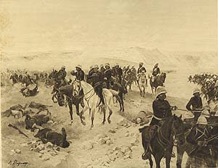
Kandahar, 1879 by Henry Dupray

http://www.military-art.com/mall/more.php?ProdID=5462

92nd Highlanders at the Battle of Kandahar by Richard Caton Woodville

http://www.military-art.com/mall/more.php?ProdID=5462

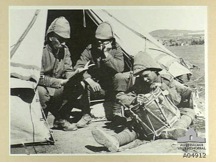
The English drummer boy’s letter (1901).

http://cas.awm.gov.au/photograph/A04912

Family Secrets

27 Friday Apr 2012

Posted by Therese Trouserzoff in Algernon

≈ 30 Comments

Tags

Japanese Midget Submarines, secrets, Sydney Harbour

Story by Algernon

A child came home with an assignment about family secrets. Don’t ask you parents the teacher said ask you grandparents.

Dad recalled life in the Loo where he spent much of his early years. His father owned a fishing trawler his mother a fruit shop on Bondi Road. Mother had arrived in the country shortly after the First World War with her first husband. She had attended University something her father disapproved of but being the headstrong women she was she completed the course she had enrolled in. Her first husband died not long after her arrival. She married again sometime after. He was a fisherman from one of the small islands off the coast.

Much of the family emigrated and was sponsored by the family with the proviso that that they naturalized at the earliest opportunity. Many did, some however didn’t.

Now the son had an idyllic lifestyle in the Loo. He proudly attended Plunkett Street Primary and recalled much of his time spent on or around the wharves and on the fish trawlers.

My grandfather had fought in WW1 on the allied side, and when the Second World War broke out he chose to enlist. He was at the time 48 years old and not surprisingly the armed forces chose not to enlist him. He continued plying his trade trawling off the coast of Sydney anywhere between Newcastle and Wollongong. They of course had their favourite fishing spots. On returning they’d stop and sell some of the catch to the odd fish restaurant on the way to the markets. WW2 curtailed how far they were allowed to trawl and eventually they were stopped completely with the trawler acquired if you like for the war effort.

One day, in the first half of 1942, my grandfather was approached by some oriental gentlemen, Japanese. The asked if they could hire the trawler for cruising the harbour, to look for picnic spots. Now a little concerned about this request he reluctantly agreed, he felt he should as military intelligence what he should do. Take them and note what the take interest in.

A few days later the Japanese men returned, he said to them what if I don’t take you to where you want, well we shoe shoe (we’ll shoot you).  He took them on their “cruise” and noted where they had been taken to, and reported back as he had been asked.

As Japanese subs had entered the harbour and parts of the Eastern suburbs bombed, fishing in open waters off the coast ceased. With the bombing my father was packed off to boarding school in the country as it was then. My grandfather would work in the fruit shop until the end of the war, when he returned to trawling until he finished working.

Dad had a love of boats and managed to work on the odd one or few when he worked in the Department.  Catching ferries occasionally to work as I do now I can appreciate, why he had that love.

This event was a family secret for the better part of 60 years, not a word to anyone from what I could gather. That he’d tell a child after all that time well perhaps it’s a story whose time had come to be told.

William Barclay Binning

26 Thursday Apr 2012

Posted by Therese Trouserzoff in Sandshoe

≈ 13 Comments

Tags

William Barclay Binning, WWI Poetry


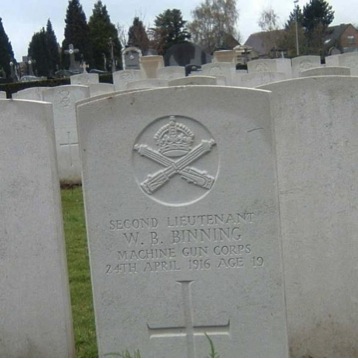
Contributed by Sandshoe (Christina Binning Wilson).

My late father, George Wilson, was 11 years of age when his cousin, Willie, was killed in France. The First World War Poetry Digital Archive contains a comprehensive project detailing the memory of William and can be accessed at the link below the image: if ever a diary project conveys an unavoidable sense of the waste of war the project presented does. In memory of William Barclay Binning.

http://www.oucs.ox.ac.uk/ww1lit/gwa/document/9630/8675

 Acknowledgement: ‘This item is from The First World War Poetry Digital Archive, University of Oxford (www.oucs.ox.ac.uk/ww1lit); © [Beath High School/Contributed by Christine Plummer]’.

We Will Remember Eric Herring

23 Monday Apr 2012

Posted by Therese Trouserzoff in Emmjay

≈ 14 Comments

Tags

AIF, Anzac, Eric Herring, FLERS, Somme, Villers-Bretonneux, WWI

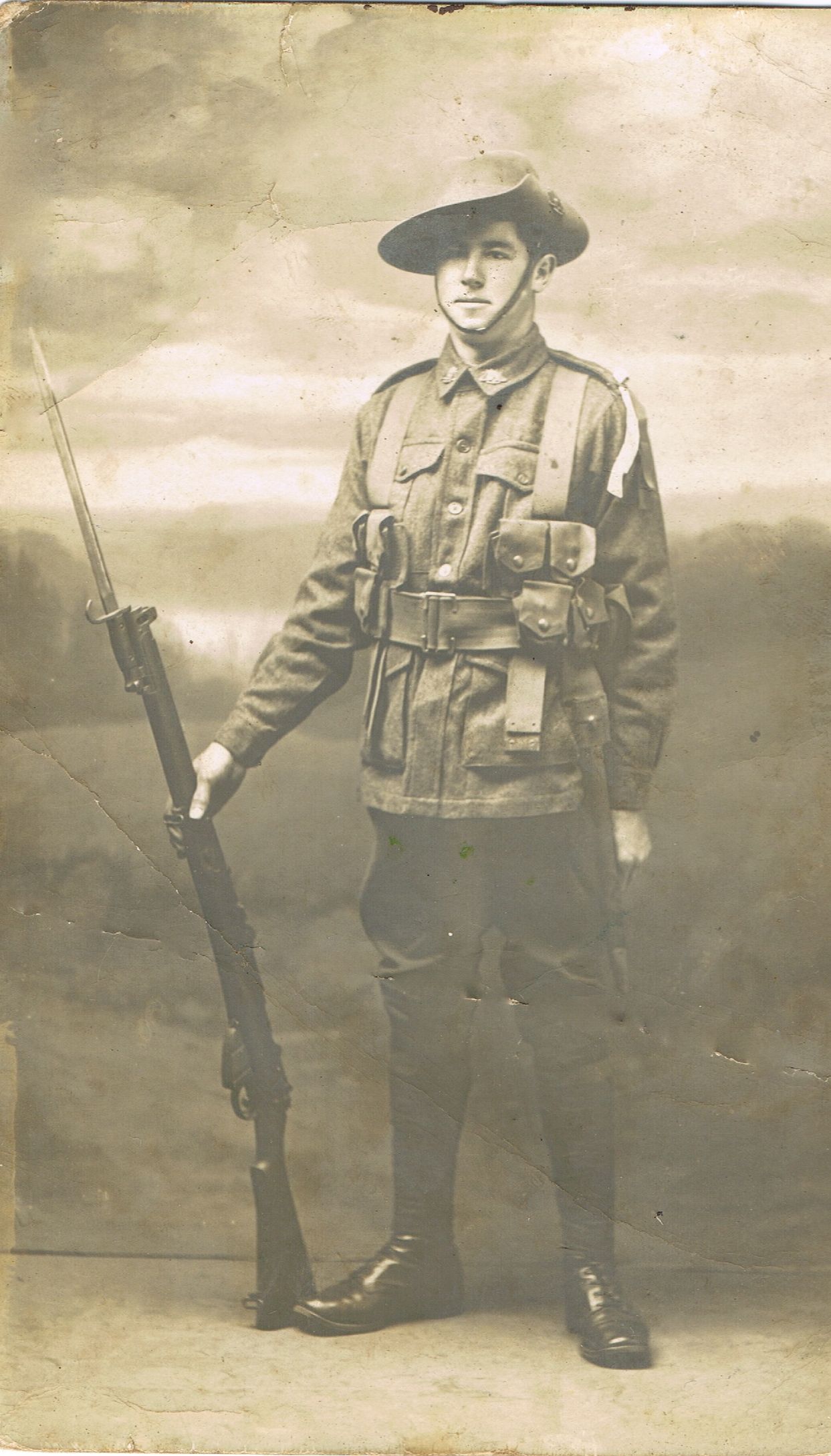
Eric Herring, c 1915 age 18.

On this ANZAC Day, I will remember our grandfather Eric Herring, 5th Division Artillery , 13th Field Artillery Brigade, 113th Field Artillery (Howitzer) Battery howitzers.

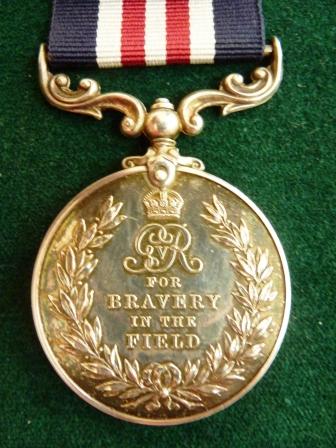
He was a man I never met.  He served at the Somme in WWI and was awarded the Military Medal for bravery.

Military Medal for Bravery (example only)

The action was at FLERS (north east of Amiens).  He was awarded the medal for going out and repairing the communication lines under fire, several times.  His division commander made the award recommendation at the end of February, 1917.

Many of my generation grew up in suburbs with street names like Amiens, and Poziers, names that seemed strange and unfamiliar but which, like the ANZAC memorials in every Australian town had a resonance for us.

FM and I (and five other Aussies in a minibus led by a wonderful Frenchman formerly from Togo, West Africa – a walking encyclopaedia more than the match with the one of our number who is a history teacher) visited the Somme Battlefields around Amiens where the ANZACS and Canadians saw most of the action on the Western Front.  We visited some of the many immaculately-kept Adelaide and other cemeteries around Villers-Bretonneux – the first town liberated by the ANZACS

TO THE GLORY OF GOD AND IN MEMORY OF THE AUSTRALIAN FORCE IN FRANCE AND FLANDERS 1916-1918 AND OF ELEVEN THOUSAND WHO FELL IN FRANCE AND HAVE NO KNOWN GRAVE.

This memorial has some 73,000 names but most of the unknown ANZAC casualties lie in cemeteries the responsibility of the Commonwealth War Graves Commission.  We also visited the WWI museum at Peronne, one of the last remaining trench sites – maintained and revered by the Canadians whose young men fought there with success and distinction and one of the remaining giant craters

Lochnagar Crater from the air - is about 100m across and 30m deep.

The Somme – named for the main river winding through the region was cold, wet  and windy in this late Spring of 2012.  Not uncommon weather.  The conditions reminded us of how harsh those winters in the sea of mud and frozen trenches would have been for the Diggers and the Tommies – as well as for their foes.

The Somme is in the northern Picardy region of France a couple of hundred kilometres from the Belgian border.  It is mainly flat country with a few low hills and ridges that the Germans had the forethought to occupy first and which gave them tremendous tactical advantage.

Like it was for so many other ANZAC boys, it was tough for Eric Herring.  He enlisted at 18 in the Australian Imperial Forces.  His enlistment papers show his next of kin as his uncle.  His unit landed first in North Africa where he spent time in hospital overcoming a chest infection, then he sailed on to Marseilles and travelled the length of France to Picardy where the ANZACs and other empire countries – Northern Ireland, Canada, South Africa and India were under the command ultimately of the British under (the strongly criticised and hotly debated leadership of) Field Marshall Haig.

It is true that there are Allied forces and German war grave cemeteries dotted all throughout the Somme and other WWI theatres of war in France.

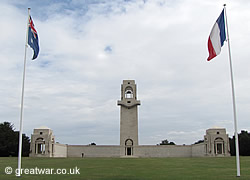
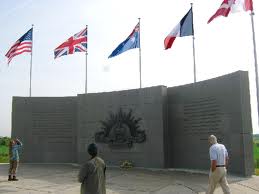
Australian Memorial le Hamel

In the Memorial to the 1st Division AIF near le Hamel (a tiny village) had two pieces of information that particularly struck me.

Baron von Richthofen

The first was the story of the downing of the most successful air ace of WWI – the infamous Baron von Richthofen – the Red Baron, named for the confronting colour of his Fokker triplane.  There is strong contention over the kill today between Canadian claims that he was shot down by one of two Canadian fliers in hot pursuit and the Australian machine gunners on the ground who are recorded as having opened fire on him as he flew overhead.  They were part of the 5th AIF Division – the same division as the one to which gunner Eric Herring belonged.

The second is a quotation recorded in bronze from the French Prime Minister Clemenceau after the ANZACs, led by General Sir John Monash delivered an exemplary victory at le Hamel in 1918.

Clemenceau said “When the Australians came to France, the French people expected a great deal of you, but we did not know that from the very beginning you would astonish the whole continent”.

The autumn and winter of 1916 was a severe one for trench warfare.  Eric Herring’s record shows that he was sent to England for a spell to recover from frostbite and trench foot.  It was also a time that would see the seeds of a major breakthrough in the way the war was being conducted –the first use of tanks, by the British and allied forces – at FLERS through September.

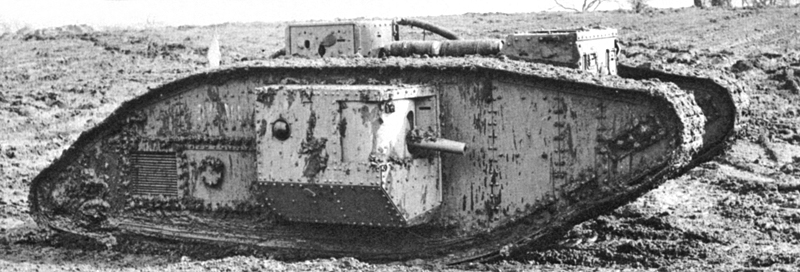
British_Mark_V_(male)_tank

While the tanks would prove pivotal in ANZAC and British tactics in 1918 (much accredited to Sir John Monash), their first use showed more promise than initial success.  They were difficult to drive, not very reliable and crews were inadequately trained according to Trevor Pigeon[1].  However the tanks proved that they were capable of charging over and through the German barbed wire and trenches and breaking the enemy lines.  And when ANZAC troops under Monash integrated the use of tanks with preparatory artillery bombardment – carefully co-ordinated to roll forward in front of the tanks, with the infantry following behind – using the protection of the tanks and the enemy chaos caused by the bombardment, the combination of tactics was decisive in the 1918 victories.

Our guide stressed that the battle lines were in a constant state of flux throughout the battles of the Somme and the 1916 ANZAC victories were eclipsed by the German attacks that were stopped in 1918 some 65 kilometres west of the 1916 positions.

We have quite a lot more research to do and there are many as yet unanswered questions about Eric Herring’s war.  The documents – many war histories for ANZAC Divisions are digitised and available for research through the Australian War Memorial and War Archives, but they are sometimes very difficult to read with feint and elaborate handwriting on fragile, sometimes smudged pages.  We have something of a lack of clarity over unit numbers and the differences between Divisions and sub-units.

We are sure that he was a gunner and that he was awarded the Military Medal for bravery at FLERS, but at this stage, we haven’t made the connection between his AIF unit and FLERS – the battles there were predominantly fought by British 41st Division soldiers and New Zealand ANZACS in 1916.

It’s wonderful that he was one of the WWI ANZAC survivors but one of the sad things for me is that our grandfather was, like so many returning soldiers, not the same person who left Australia in early 1916.  The family photographs and my Mom’s old stories suggest that he had problems with the drink when he came home and as the Nation as well as individuals fell under the Depression of the 1930s, he struggled to adequately provide for his family.

Our Nan divorced him and he died when I was a child – a man I never met, but will not forget.


[1] Pigeon, Trevor, “Fleurs and Guudecourt, Somme”, Pen and Sword Books Limited, Yorkshire, 2002.

Difficulty Blending

22 Sunday Apr 2012

Posted by Therese Trouserzoff in Lehan Winifred Ramsay

≈ 19 Comments

Tags

robot friends, Sony robot dogs, Tamagotchi

Difficulty Blending

Painting and Story by Lehan Winifred Ramsay

Well I don’t like to mention The Other Place, the one I used to work at. Sometimes its because I start to blow smoke through my ears. But usually its because I don’t have anything good to say, and I feel like a grumpy old Prohibition campaigner. Nor do I like to mention The Other Place where I used to study, because I sometimes feel like the only thing they taught me there is when to put the apostrophe on my its – and that knowledge rests only tenuously in my command of the language.

But some of the students are doing very well. So well that I find myself having to UnFriend them. They have moved into Contentious thoughts and actions. Unlike the general stream of public announcements of ground-breaking research; work I read and snort coffee through my nose, they now have the ability to get me worked up. I am kind. I have learned now that technology researchers don’t like to be upset by unfavourable reviews, and so at the first itching of my fingertips I UnFriend them and liberate them.

Recently one has been involved in ground-breaking research in robotics. That’s really a great indication of the impact of our educational philosophies. When these students first arrived on our doorsteps we showed them our pack of wild robot dogs from Sony, the ones that wagged their tails and yipped before tripping over themselves and lying, little fat legs flailing, on the carpet.

And lo and behold, they’ve made a robot girlfriend. She’s hot, and she’s in huge demand, tirelessly working the Valentines Shift in a department store in Japan, before scooting over to Hong Kong to model her extensive repertoire of facial expressions and blinks in a Pierre & Gilles – like tableau for her many fans there.

It wasn’t, though, until I got word of her latest foray that I became truly aware of the potential in this for me. She went off to the hairdresser, and got a very sexy ‘do. Not only that, but she let someone else decide the style! Imagine that! The girlfriend or boyfriend you always wanted, who will let you take him/her to the hairdresser, and actually let you choose their ‘do! Now there’s my boyfriend! I can take him along to karaoke, he’ll carry the bags of stuff I couldn’t do without, he’ll sit absolutely uncomplaining and listen to every overly-sugary song I want to sing, no complaining, and I can put an absolutely beautific expression on his face after every one of them! Starting off contemplative and curious, of course, and moving to beautific toward the finale.

You know, if you can’t afford the blinking model, you can get life-size dolls for your home now. Not sex toys. Companions. I don’t know if they have any boys yet, but certainly if it’s cute girls you want, you don’t have to suffer to get them, you can just order them online. But if it’s a relationship you’re after, there’s always a game, right? In this case it’s LovePlus, by Konami. You can choose from three animation character cuties, and once you sign up they’ll stick by you thick or thin until the subscription runs out.

Of course you’re going to have to learn commitment. There are certain things you have to do to maintain this relationship. You have to care for her. If you don’t, I’m afraid there will be a little strife between you. No, she’s not going to die, like the tamagocchi chicken. We’ve moved on to a more sophisticated era, here. But you might find that the next time you get back to her, things are not all happy anime music and roses. She’s showing her Sad Face. Or, even, her Angry Face. Daunting. You may have to change models after that. On the other hand, it’s quite worth looking after her. If you do, she’ll send you emails that you can smile over at work. Pet names, stuff like that. Stuff that really is what relationships are about.

I have to say that it could have been worse. Had we shown them a bunch of tamagocchis when they walked in the door, would they now be making – ah – a bunch of augmented reality chickens to help us in our senior years? Had we known about the Great Philip K. Dick headless model, would they have made a bunch of robotic old guys spouting erratic science fiction predictions for the future? With a weakness for sheltering in overhead lockers? At least these girls are going to be quiet.

One Step Beyond

22 Sunday Apr 2012

Posted by Therese Trouserzoff in Algernon, Bands at the Pig's Arms, Entertainment Upstairs

≈ 7 Comments

Tags

Madness, SKA, Skatelites

Playlist by Algernon

Following on from Do the Reggay, perhaps some SKA.

http://www.youtube.com/watch?v=WQg_t8NYfvo

One step Beyond – Prince Buster

http://www.youtube.com/watch?v=VTGemShG6Q0

On My Radio – The Selector

http://www.youtube.com/watch?v=XJOLwy7un3U

Baggy Trousers – Madness

http://www.youtube.com/watch?v=N-uyWAe0NhQ

One step beyond – Madness

http://www.youtube.com/watch?v=3Shq4U27Ieo

King of Kings – Prince Buster and the Skatalies

http://www.youtube.com/watch?v=FbxQqtkcx6E

Oil in my lamp – Eric “Monty’Morris

http://www.youtube.com/watch?v=nxHcx7FO8nI

Too Much too young – The Specials

http://www.youtube.com/watch?v=EPKOT6P3OXA

Montego Bay –Allnighters

http://www.youtube.com/watch?v=F6fQnTyEniM

Lip up Fatty – Bad Manners

http://www.youtube.com/watch?v=d31TBNubY6w

Perfect Teeth – The Porkers

http://www.youtube.com/watch?v=NIGMUAMevH0

The impression that I get – The Mighty Mighty Bosstones

http://www.youtube.com/watch?v=0bM0wVjU2-k

Save it for later – The English Beat

http://www.youtube.com/watch?v=9DFTxdGzQkM

Train to Skaville – The Ethiopians

http://www.youtube.com/watch?v=O9HyXc4e7Qc

Simmer Down – The Skatalites

http://www.youtube.com/watch?v=AR7n2zILQCA

The tide is high – The Paragons

http://www.youtube.com/watch?v=2JicW0JeiSQ

Do rock steady  – The Bodysnatchers

http://www.youtube.com/watch?v=jqZ8428GSrI

Ghost Town – The Specials

http://www.youtube.com/watch?v=netBTEHQYWM

Too Much pressure – The Selector

Not Going There, Done That.

20 Friday Apr 2012

Posted by Therese Trouserzoff in Emmjay

≈ 12 Comments

Tags

Apple, Champs Elysees, Eiffel Tower, Paris, retail

Champs de Retail

Travel Yes and No – A Reply for Gez and Helvi.

Three weeks in Paris with FM.  I had this planned for some time but it took an eternity to work up the courage and find the cash to make the commitment.

Although she has travelled the world many times before Tim the Cabin Boy was born, this is her first trip to the city of light and my fourth – in 30 years.  Two years ago I came here with Emmlet II and her old school pal – for five days only – but it was the trip before that in 2004 with the whole tribe – for 10 days over Easter that put Paris in my “must go every now and then” list.

In every visit I always had that “I wish I had seen ……..” feeling when I came home.  There is simply too much to experience in perhaps even a year or two.  And in every case I learnt things that I should avoid or find some way around.

The first thing was that it is so far away that the trip can be exhausting – so we spent a bit more cash and flew premium economy (where your nose just misses the passenger in front’s head instead of touching it).  The second distance buster was breaking the trip at Singapore for a couple of days.  Both of these proved to be good ideas but stole time and cash.  Always the trade-off.

Luck out #1 was an upgrade to business class – free champagne and a “reclining bed”, no crowd and delightful QANTAS cabin service for the ten hours to Singapore.

Less wonderful event #1 back to premium economy for the Singapore to Paris leg – departing at 23:30 and flying all night – which means three or four movies and no cabin service and no reclining bed when you could really benefit from it.

Getting from Charles de Gaulle into Paris can be a nightmare for the language challenged.  Solution: I booked a great hotel in an ideal location (for just two nights to get over the trip and because the cost was frightening) and a car to pick us up – avoiding jetlag on the peak hour metro plus navigation on and off the thing with bags. This proved to be very good thinking and the hotel people were great.

After that we moved to an apartment I found on the internet through the massive TripAdvisor site – which had used in the last two visits – TripAdvisor that is, not the same apartment.  First it was only five minutes walk away from the hotel – easy.  Second it was very economical and proved to be huge and modern by Paris standards (like 55 square metres huge) – close to three metro stations (ideal), shops, the twice a week giant open air markets at Boulevard Richard Lenoir near Bastille.  Food there is cheap and excellent – even in this early Spring (cold, by our standards and unreliable weather like Sydney in October).

Echoing your sentiments, visiting monuments, galleries, churches and museums has been an interesting event for us.  FM loves art, but is easily put off by giant queues – and so I confess, am I.  So whereas I kind of expected to line up at Musee D’Orsay and the Louvre, we have decided to give them a miss.  Just too hard and big wasters of time.  Everyone goes to the Eiffel Tower.  But not us, this trip.  The Parisian engineers had carefully ensured that on the Easter public holidays, one of the lifts was broken down and the massive queues (in biting cold wind and light rain) were advised that the wait was over two hours.  To get a birds eye view of three or four landmarks and what is a beautiful but rather homogenous Paris central skyline.

You might recall that I expressed disappointment with the Picasso exhibition visiting Sydney recently.  Our apartment manager lunched with us on the first day and asked me what I thought of the Picassos – still on travelling exhibition while their Paris digs are under renovation.  I was honest.  She beamed and almost shook my hand.  She said that the story behind the collection is that the heirs to the Picasso legacy were facing a huge tax bill when he died – which, under French law they could “pay” in kind.  So they took all of the crap that was still in the paintings shed and gave it to the people de la Republic.  She thought they got the unsaleable rubbish – which I feel reflected a certain slight anti-Spanish sentiment as much as it did a major disapproving artistic judgment.

But to be fair to Paris, the exhibition in the Musee Marmotan (many smaller Monets and other impressionist and post-impressionist artists ) was on a human scale and excellent to visit.  Musee Carnavalet (Museum of the History of Paris) was also a good experience – FM said she thought it might be better going two or three times.

But perhaps the most significant difference was in our views about what is important and therefore should be the focus of spending our time.  FM is a fashionista – hard core and many of her favourite designers are here and in London.  So shopping – the real exchange of serious wads of cash and the indolent wandering – flaneur-style around the cities are her priority.  My kind of Y chromosome carrier detests shopping in all its forms – so we have trod a careful compromise of DIY.  More Shakespeare and Co for me than any number of designers.  And more time to take it easy, read, drink wine and coffee and eat (oh, my fat and growing torso) for me.

Getting back to your reluctance to travel as sightseers, I think the internet and international security and all the hassles of travel are speaking loudly in support of your view.  If you want – for some reason – to see monuments, they are only as far away as google.

But shopping is apparently not like that.  I cannot imagine anyone being a monument-viewing-aholic.  Stuff from precisely the same designers in Paris is different in exclusive shops all over the world – and surprisingly little choice is available in Australia – relative to what you can see wandering (with intent) in Paris.  So for FM, the London and Paris designer-specific shops have been a real eye-opener.  And so too were the shops in Singapore.  You really (apparently) do have to be there to feel the width.

A tiny snip of the Orchard Rd Retail Megatropolis

Australians have for years spoken of Singapore as a Mecca of shopping.  It was incredible in terms of the scale of the retail universe there.  But perplexing too.  There was shop after shop after shop all selling the same “exclusive” brands.  Exclusive by cost, not by availability, believe me.  I’m surprised that a Zegna suit failed to attach itself to me just through repeated exposure.  for reasons of personal financial safety, I’m OK about not returning to the Asian capital of retail.

As a person somewhat interested in information technology, I paid a special visit to the “Can’t Remember Jalan Centre”.  A tired and dilapidated, if not downright grubby octagonal building of six stories each with a double ring of mainly small one man stores, many temporarily closed or just plain dead, met my countenance.  Hundreds of little businesses all selling much of a muchness with a little specialisation in communications, security or whatever, here and there.  Things have clearly moved on from the cowboy PC with everything days.  The Apple stores are nowhere to be seen in this retail backwater.  They are amongst the high fashion stores.  And they are packed to the raffles with products and customers clamouring for today’s and tomorrow’s IT.

This is in itself surprising, because anyone with a quid can buy any Apple product from the comfort of their own house without ever having to step outside.  But Apple have made their technology and their retail palaces cool places to be and to be seen.

So maybe that’s where the 21st century monuments will be found.  Not in the expensive real estate of major cities far away, but on the desk in the spare bedroom – now called “the home office”.  And since the internet can usually provide us with a picture of just about anything, I think it will be OK to pull down the Eiffel tower and build a few more Apple and Big Mac stores – and save us the cost and hassle of the trip and the bother of the retail zone.  It’ll be locals only – but then, we are all locals anyway, are we not ?

Alternatively, perhaps we can take a leaf from Lehan’s book and send a hologram of ourselves to visit a hologram of the Eiffel tower – just so we can, with some confidence, say “yeah, haven’t been there, done that.”

Come and See the Real Thing

19 Thursday Apr 2012

Posted by Therese Trouserzoff in Uncategorized

≈ 22 Comments

Peach Buns

Painting and Story by Lehan Winifred Ramsay

Long long ago, we had trouble with our Tobacco Machines. They got a little ambitious, a little entrepreneurial. Started to think they could play with reality;  mix in other nice things with our tobacco – make it sweeter, more fragrant, mature, sexy. Started to think that if they could just get us interested younger, we’d be theirs for life. They forgot that the reason we liked smoking was to give us a warm relaxed feeling. Cancer doesn’t do that, nor do the reproaches from those around us. It wasn’t until the financial burden of medical treatment outgrew the tax windfall that governments chose to listen to what Cancer had been telling us for some time. Cigarettes might just be good for taking the edge off life, but perhaps not so good for edging life out the window and onto a ledge. There were people who needed some relief, but the Tobacco Machines made cancer where none was needed.

But we have new Smoke Machines. They seem the same innocent product peddlers that our Tobacco Machines did in their youth. Now they’re peddling the picture, rather than the product. Because they’re Middle Men – Middle Mad Men. They sell the image (cool young men and women, in love, stop for a cigarette, he with the match, she with the lips). But the product? We don’t produce product any more, it’s expensive, it’s tiring, it’s third-world. The problems of the Tobacco Machines and the Asbestos Machines and the Nuclear Machines have made us a little averse to liability, too.

The new Smoke Machines make us augmented reality. Reality augmented with product. Down the sides of our newspapers, augmented news. Down the sides of our entertainment videos, augmented entertainment. Down the sides of our real estate sites, augmented real estate. It’s all property; unlimited property.

Down the sides of my reality now, online or off, is a stream of virtuality. Not-real people, dancing in hologram, invade my real life, and real links to my real stream of online browsing invade my newspapers. I do not any longer know if I read news because it is there or because it is being put there for me, cunning infomercials. But the newspaper world online leaks into the real world, it doesn’t stay where it belongs. Is my reality being augmented? Or is my data – my new DNA – being corrupted.

People don’t know, when they fall into mental illness, that that is the new world they inhabit. They think it’s the world they’ve always occupied. When the page on the computer starts to talk to them – only them – and the world in the computer starts to mirror the world inside their heads, it seems real enough. Perhaps it is? The image producers and online real estate peddlers – our new Smoke Machines – are peddling something that approximates mental illness.

I had a dream: a vision. I saw myself dancing, performing in Coachella, on stage. Was that me? I thought it was me, they were my tattoos, it was my body.Or was it someone else? Or a delusion, a hologram, a fake.

Poodling on the Ritz

15 Sunday Apr 2012

Posted by Therese Trouserzoff in Emmjay, Entertainment Upstairs

≈ 21 Comments

Tags

Poodle, Ritz, Taco

She moved as might a monarch approaching the opening of some great show,  preceded by a minion leading a miniature poodle.

She stopped, surveying her realm left and right, squatted and delicately placed three perfectly formed turds on the satin granite pavement.  No hurry.

Her minion waited ahead, indifferent to the Ritz doormen who feigned not noticing her indiscretion.

The standard poodle rose like a filling spinnaker, full of self-importance and padded on with careless graceful steps deigning to look neither left or right.

One white-gloved doorman withdrew to the telephone in arrears and delegated the unpleasantness to the Mairie – who delegated the job to a north African more appropriately positioned for the actual removal of the faecal treasures now adorning the forecourt.

This girl knew social ordure.  She knew her place – elevated by the wealth of her owner; above the niceties and social graces of polite company.  She was Canus aristocraticus and that was that.  Her minion knew his place too.  Minions of lesser beings – perhaps the bourgeoisie would be expected to scoop, bag and withdraw everything except their dignity – the ghost of which would remain there on the pavement.   But not this chap.  He was not a groveller to mere doormen, Ritz or no Ritz.  They were just draft stoppers in plush uniforms they didn’t even own, (but for which they paid their own laundry costs) and he was not obligated to treat them with anything greater than the poodle’s disdain.

The doormen were practiced nose downlookers and they adored exercising their imagined status by applying their stonewalling indifference on rubber necked passers-by.  Even Dolce and Gabbana-clad bling monsters.  No, particularly D&G bling monsters.  Gold was not class and bling was certainly not class.  You may park your Maserati momentarily here sir.  I’m sorry sir, but we just don’t have the space for sir’s BMW.

It was not their job to doff a white glove, don a rubber glove and abduct a Richard the Third.  But they were growing concerned at the time being taken by the Mairie’s man to appear.  They conferred.  There were discrete utterances from corners of mouths, cheesy smiling at residents entering and leaving the hotel and subtle body language suggesting that sir and madame might prefer an upwind route for the moment.

It was decided.  The youngest doorman – perhaps a doorboy was despatched and returned at a clip with an empty poubelle which he gently placed upended over the still steaming pile.  This had the effect not so much of warding passers by off or preventing them from stepping in the offending ordure, but it seemed to create a kind of public exhibit.  Passers by gathered to see the Ritz’s latest piece of installation art.

The Mairie’s  emergency van arrived.  Out sprang two men in blackface in overalls with brooms.  The tall one approached the upturned bin with due caution.  The short one pushed back the growing crowd.

The tall man carefully lifted the upturned bin, placed it on his head – helmet like, tapped the ground twice with the end of his broom stick.  The short man stood next to him and eyed the doormen.  He tapped his broomstick twice on the ground … and sang “If you’re blue and you don’t know where to go to, Why don’t you go to where fashion shits ?  Put one on the Ritz…….”

Editor’s Note:  The Ritz is a fine organisation and no way does Emmjay or anyone vaguely resembling Emmjay have any hard feelings just because they closed the Hemingway Bar and denied him a nostalgia dry martini.  But some of this story is true.  We are led to believe that the faecal matter was removed but according to Emmjay, not while he was there.

← Older posts
Newer posts →

Patrons Posts

  • The Question-Crafting Compass November 15, 2025
  • The Dreaming Machine November 10, 2025
  • Reflections on Intelligence — Human and Artificial October 26, 2025
  • Ikigai III May 17, 2025
  • Ikugai May 9, 2025
  • Coalition to Rebate All the Daylight Saved April 1, 2025
  • Out of the Mouths of Superheroes March 15, 2025
  • Post COVID Cooking February 7, 2025
  • What’s Goin’ On ? January 21, 2025

We've been hit...

  • 791,338 times

Blogroll

  • atomou the Greek philosopher and the ancient Greek stage
  • Crikey
  • Gerard & Helvi Oosterman
  • Hello World Walk along with Me
  • Hungs World
  • Lehan Winifred Ramsay
  • Neville Cole
  • Politics 101
  • Sandshoe
  • the political sword

We've been hit...

  • 791,338 times

Patrons Posts

  • The Question-Crafting Compass November 15, 2025
  • The Dreaming Machine November 10, 2025
  • Reflections on Intelligence — Human and Artificial October 26, 2025
  • Ikigai III May 17, 2025
  • Ikugai May 9, 2025
  • Coalition to Rebate All the Daylight Saved April 1, 2025
  • Out of the Mouths of Superheroes March 15, 2025
  • Post COVID Cooking February 7, 2025
  • What’s Goin’ On ? January 21, 2025

Enter your email address to subscribe to this blog and receive notifications of new posts by email.

Join 374 other subscribers

Rooms athe Pigs Arms

The Old Stuff

  • RSS - Posts
  • RSS - Comments

Enter your email address to subscribe to this blog and receive notifications of new posts by email.

Join 374 other subscribers

Archives

Website Powered by WordPress.com.

  • Subscribe Subscribed
    • Window Dresser's Arms, Pig & Whistle
    • Join 280 other subscribers
    • Already have a WordPress.com account? Log in now.
    • Window Dresser's Arms, Pig & Whistle
    • Subscribe Subscribed
    • Sign up
    • Log in
    • Report this content
    • View site in Reader
    • Manage subscriptions
    • Collapse this bar

Loading Comments...