
Tags
AIF, Anzac, Eric Herring, FLERS, Somme, Villers-Bretonneux, WWI
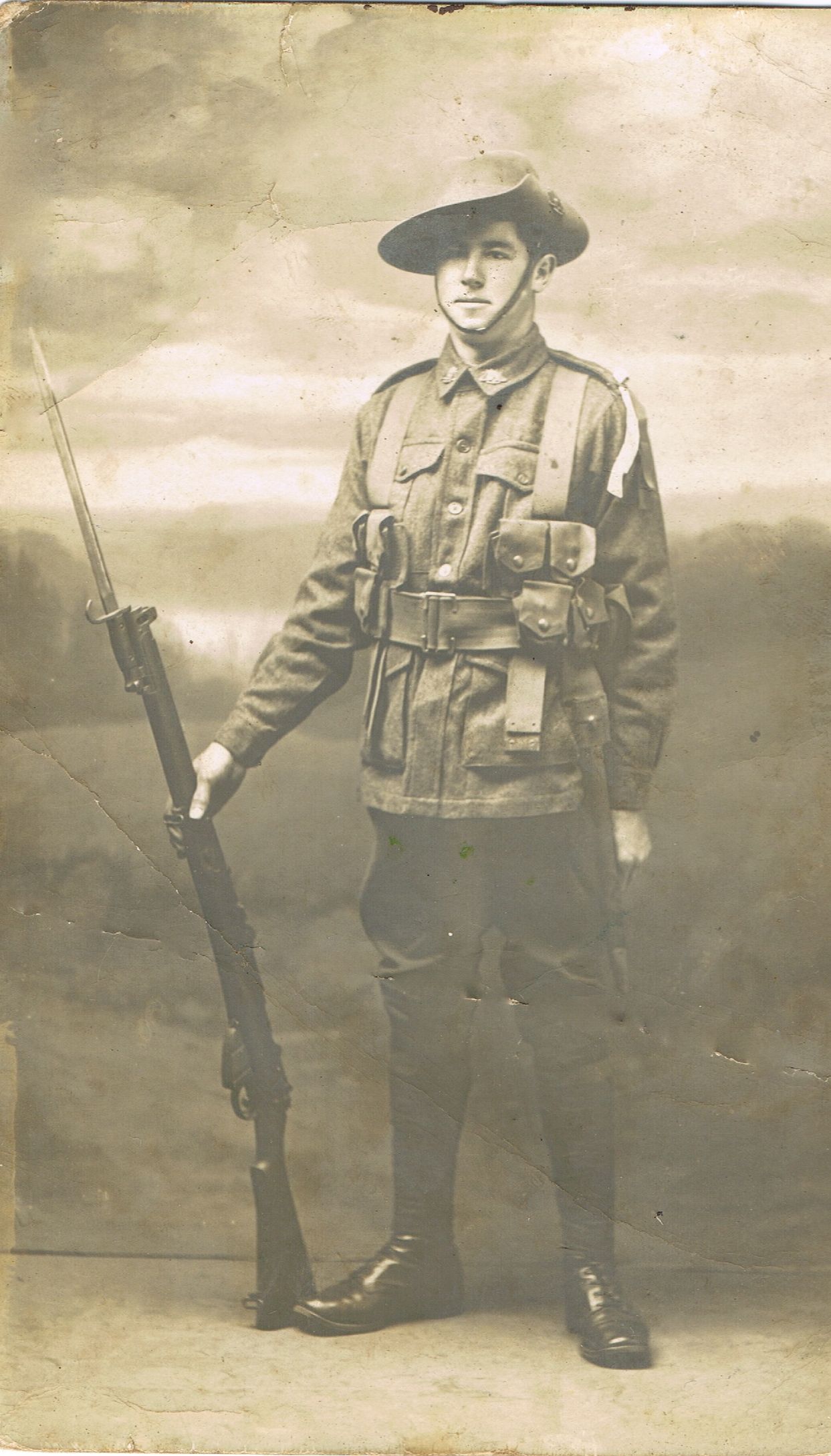
Eric Herring, c 1915 age 18.
On this ANZAC Day, I will remember our grandfather Eric Herring, 5th Division Artillery , 13th Field Artillery Brigade, 113th Field Artillery (Howitzer) Battery howitzers.
He was a man I never met. He served at the Somme in WWI and was awarded the Military Medal for bravery.
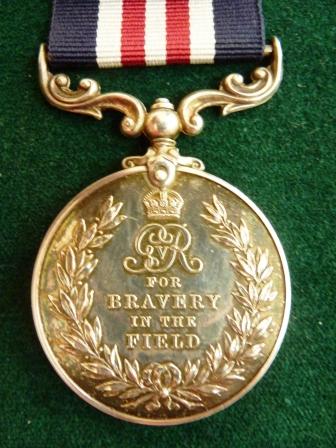
Military Medal for Bravery (example only)
The action was at FLERS (north east of Amiens). He was awarded the medal for going out and repairing the communication lines under fire, several times. His division commander made the award recommendation at the end of February, 1917.
Many of my generation grew up in suburbs with street names like Amiens, and Poziers, names that seemed strange and unfamiliar but which, like the ANZAC memorials in every Australian town had a resonance for us.
FM and I (and five other Aussies in a minibus led by a wonderful Frenchman formerly from Togo, West Africa – a walking encyclopaedia more than the match with the one of our number who is a history teacher) visited the Somme Battlefields around Amiens where the ANZACS and Canadians saw most of the action on the Western Front. We visited some of the many immaculately-kept Adelaide and other cemeteries around Villers-Bretonneux – the first town liberated by the ANZACS
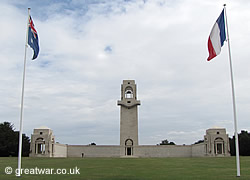
TO THE GLORY OF GOD AND IN MEMORY OF THE AUSTRALIAN FORCE IN FRANCE AND FLANDERS 1916-1918 AND OF ELEVEN THOUSAND WHO FELL IN FRANCE AND HAVE NO KNOWN GRAVE.

This memorial has some 73,000 names but most of the unknown ANZAC casualties lie in cemeteries the responsibility of the Commonwealth War Graves Commission. We also visited the WWI museum at Peronne, one of the last remaining trench sites – maintained and revered by the Canadians whose young men fought there with success and distinction and one of the remaining giant craters

Lochnagar Crater from the air - is about 100m across and 30m deep.
The Somme – named for the main river winding through the region was cold, wet and windy in this late Spring of 2012. Not uncommon weather. The conditions reminded us of how harsh those winters in the sea of mud and frozen trenches would have been for the Diggers and the Tommies – as well as for their foes.
The Somme is in the northern Picardy region of France a couple of hundred kilometres from the Belgian border. It is mainly flat country with a few low hills and ridges that the Germans had the forethought to occupy first and which gave them tremendous tactical advantage.
Like it was for so many other ANZAC boys, it was tough for Eric Herring. He enlisted at 18 in the Australian Imperial Forces. His enlistment papers show his next of kin as his uncle. His unit landed first in North Africa where he spent time in hospital overcoming a chest infection, then he sailed on to Marseilles and travelled the length of France to Picardy where the ANZACs and other empire countries – Northern Ireland, Canada, South Africa and India were under the command ultimately of the British under (the strongly criticised and hotly debated leadership of) Field Marshall Haig.
It is true that there are Allied forces and German war grave cemeteries dotted all throughout the Somme and other WWI theatres of war in France.
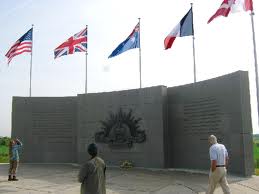
Australian Memorial le Hamel
In the Memorial to the 1st Division AIF near le Hamel (a tiny village) had two pieces of information that particularly struck me.

Baron von Richthofen
The first was the story of the downing of the most successful air ace of WWI – the infamous Baron von Richthofen – the Red Baron, named for the confronting colour of his Fokker triplane. There is strong contention over the kill today between Canadian claims that he was shot down by one of two Canadian fliers in hot pursuit and the Australian machine gunners on the ground who are recorded as having opened fire on him as he flew overhead. They were part of the 5th AIF Division – the same division as the one to which gunner Eric Herring belonged.
The second is a quotation recorded in bronze from the French Prime Minister Clemenceau after the ANZACs, led by General Sir John Monash delivered an exemplary victory at le Hamel in 1918.
Clemenceau said “When the Australians came to France, the French people expected a great deal of you, but we did not know that from the very beginning you would astonish the whole continent”.
The autumn and winter of 1916 was a severe one for trench warfare. Eric Herring’s record shows that he was sent to England for a spell to recover from frostbite and trench foot. It was also a time that would see the seeds of a major breakthrough in the way the war was being conducted –the first use of tanks, by the British and allied forces – at FLERS through September.
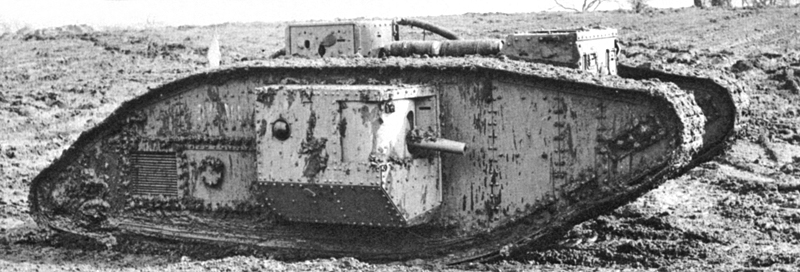
British_Mark_V_(male)_tank
While the tanks would prove pivotal in ANZAC and British tactics in 1918 (much accredited to Sir John Monash), their first use showed more promise than initial success. They were difficult to drive, not very reliable and crews were inadequately trained according to Trevor Pigeon[1]. However the tanks proved that they were capable of charging over and through the German barbed wire and trenches and breaking the enemy lines. And when ANZAC troops under Monash integrated the use of tanks with preparatory artillery bombardment – carefully co-ordinated to roll forward in front of the tanks, with the infantry following behind – using the protection of the tanks and the enemy chaos caused by the bombardment, the combination of tactics was decisive in the 1918 victories.
Our guide stressed that the battle lines were in a constant state of flux throughout the battles of the Somme and the 1916 ANZAC victories were eclipsed by the German attacks that were stopped in 1918 some 65 kilometres west of the 1916 positions.
We have quite a lot more research to do and there are many as yet unanswered questions about Eric Herring’s war. The documents – many war histories for ANZAC Divisions are digitised and available for research through the Australian War Memorial and War Archives, but they are sometimes very difficult to read with feint and elaborate handwriting on fragile, sometimes smudged pages. We have something of a lack of clarity over unit numbers and the differences between Divisions and sub-units.
We are sure that he was a gunner and that he was awarded the Military Medal for bravery at FLERS, but at this stage, we haven’t made the connection between his AIF unit and FLERS – the battles there were predominantly fought by British 41st Division soldiers and New Zealand ANZACS in 1916.
It’s wonderful that he was one of the WWI ANZAC survivors but one of the sad things for me is that our grandfather was, like so many returning soldiers, not the same person who left Australia in early 1916. The family photographs and my Mom’s old stories suggest that he had problems with the drink when he came home and as the Nation as well as individuals fell under the Depression of the 1930s, he struggled to adequately provide for his family.
Our Nan divorced him and he died when I was a child – a man I never met, but will not forget.
[1] Pigeon, Trevor, “Fleurs and Guudecourt, Somme”, Pen and Sword Books Limited, Yorkshire, 2002.
 Window Dresser's Arms, Pig & Whistle