
KYOKO
Painting and Story by Lehan Winifred Ramsay
It is Big Burnable Garbage Day and I have waited three weeks and four or five years for this, it is the last of the Big Burnable Garbage of my little junk house in this seaweed village.
And it is the second time I have put out this garbage. One one of my first holiday days here I went for my morning walk and found garbage up and down the street all put out and ready to be collected, and I came back and assembled my own pile, very excited. From the dilapidated General Store I bought a page of Garbage Stickers, ten for three dollars and stuck them on each and every bundle.
There was a very big chest of drawers with all the drawers taken out and tied up into more piles. Stacks of plywood, wooden doors, paper doors, a bicycle. Sadly my neighbours were wrong, and their garbage was rejected, but worse still was that almost all of mine was too. They took the rusted bicycle. They put the doors into the truck, smashed out all the glass and then put the doors back on the road. And I had to pull it all back in. I stacked it in the lane with the permission of my neighbours and it cluttered up the street for two weeks.
And then again today was Big Burnable Day and there was nothing, nothing that was going to keep me from being here. Even the final funeral ceremony of my friend did not keep me from being here. Early I rose and dragged the chest of drawers back up to the road. All the plywood, now swollen with rain and mouldy and full of bugs, threatening to fall apart, to be retied, and the drawers, retied, and all the bits of wood from the glass doors, bundled, and I stacked this big pile by the side of the road and this time I did not check to see what my neighbours had put out because two weeks ago they were wrong.
And it was all out there, and quite early the garbage men came, about nine-thirty, and I went out to see them trying to figure out how the hell they were going to get it all into the truck, already pretty full, and lest they find a reason not to take some of it and break my heart I just waved and fled back into the house. And it was gone.
Even though it was a huge pile of garbage and I had fretted over it for two weeks and for five years before that it did not give me that feeling of huge success, because there was already more. All the plywood that had splintered and fallen apart in my garden, I had bags full of that, and all the broken glass from other doors people had put over the weeds to try to control them in my absence, that had all been scraped up and pulled up and put into more bags and all I could see were those bags. Was I going to be able to rid my house of those bags before my holiday was up.
There was a knock at the door and a neighbour appeared, one of the women who work part-time for the konbu fishermen, laying out the konbu to dry, sorting it, picking it up, laying it out to dry again. She had a bag. Here, she said. This is curry. This is seaweed. This is nira. I don’t know what nira is in English, it is a bit like a green onion and a bit garlicky.
It was all frozen, she had brought it from her freezer but I only have an esky in my kitchen and only sometimes with ice in it, ice is laughably expensive now that it is only for luxury, so it is not so practical. She stepped out of her shoes and into the house, which is only half-properly built these days, and sat down on all the things I had thrown onto the couch because I have thrown all the cupboards away. I cleared the couch for her and made her a cup of coffee and she had a cigarette and looked around.
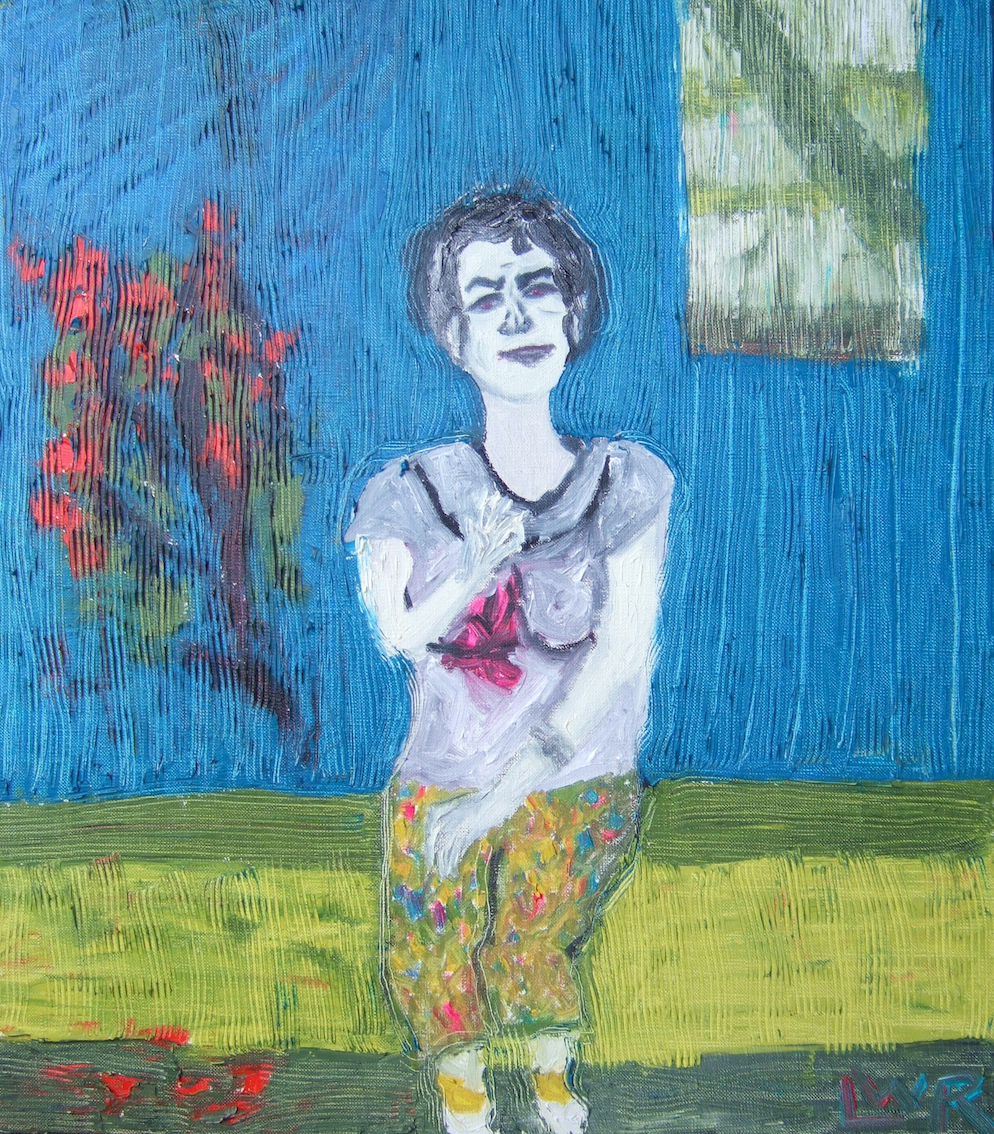
Oh that’s a good painting she said, I made it I said make one of me she said okay come here at nine o’clock tomorrow I said, I have one canvas left.
She laughed with delight, had some cigarettes and the big cup of coffee and told me about her family; three sons and one daughter and six grandchildren and the youngest son married only last month and her husband and some complicated arrangements to be where things are now.
My next-door neighbour appeared, she was wearing a bright yellow scarf and she was pretty happy, she went to the Big Town on Monday and saw some movies with her friends and I think she may not have done that nearly enough since her husband died earlier this year but today – again! – she is going into the Big Town for an enka concert – some old-fashioned folk-wailing about love and the sea – and she said it wasn’t really her thing but anyway she was off soon on the bus.
And she pointed out the bags of plastics I had put beside the house because I put them out on the wrong day last week and they were refused, and that the crows had got into them and thrown everything around. My life here is about garbage disasters, I tell her and she says you BOUGHT garbage! You bought this HOUSE! It is true, I am without any common sense. Anyway while I have my neighbour in my house drinking coffee I can ask her lots of questions. She gave me some food. This is curry I thought she said but actually it is kare, a kind of fish. Quick! It’s an exchange of local produce! Throw it in a pot!
This village is dying out, is what people say. Even with the shinkansen coming in, still maybe five years away if we are lucky, it is dying out. They are lucky to make three classes for the Junior High school but the big thing is that even if the kids in High School were smart their parents cannot afford to send them to university, they don’t have dreams of going to university so it is unlikely that they will bother to do particularly well at high school. They get jobs and they go away. All of her kids live in Tokyo, and Sapporo, they got jobs there because there were no jobs here.
The sea is unwell, for a long time it hasn’t had much fish, it hasn’t had much seaweed, people only just manage on what they catch. She says the coast of Korea is much the same, the sea is dirty, who would swim in it. For a long time, not just for the three years of nuclear disaster. The sea is dirty from people using it as a dump. That is pretty terrible for an island like Hokkaido.
Perhaps it’s not a bad thing to be neglected at all in such circumstances. My student says it’s not so much the dirtiness of the water as the temperature of it that has risen, sending all the fish who lived around here up north to Russia, it’s global warming that is the problem. And then my friend the car man rides his motorcycle down for morning tea and says the coastline around here is much dirtier than other places, people have no respect for the sea and it’s that that’s the problem. But he also says we’re too far from the big town and anyway the big town has sea. And the sea walls aren’t very high and the houses close to the shore, there are more earthquakes and more tsunami than there used to be and it’s just dangerous these days.
I would like to feel that there was a way in which these villages could thrive. But what incentive is there for that. When you want fish you go to the big supermarket and you buy what everyone else buys. There is no fresh fish shop, there is no fresh vegetables shop to sell the produce that is grown around here. You buy what people in the city buy and it is more expensive and you have less choice because nobody will buy expensive stuff so only cheap stuff is what you see here.
But the worst thing I think is the kind of evolution of neglect. If your best kids cannot be their best then the natural effect of that will be that kids settle for moving to a big city and being second best. They don’t get what the city kids get – a fair chance. So they will always have lives that are a bit if a struggle and it is more unlikely that they will thrive and come back here, saying: I have some good ideas for this town.
This kind of city-led intelligence is creating overcrowded cities and dying towns, and just when our technology could be making a difference, when our enlightened thinking could be finding ways to bring people back to their villages, we are settling for big-town/moderate-climate intelligence.
I think that it is not intelligence. I think that any time a moderate climate dictates construction know-how, living know-how and system know-how the extreme edges of the climate are going to suffer, I see that in Australia too, where the very hot places are still negotiated using moderate-climate thinking. And where centralized distribution ensures that the advantage lies in a cluster and there is little advantage to not joining that cluster.
We should somehow be giving these small town kids, who have experienced life here, a way to use their knowledge to make something of their towns. And we’re not. My neighbour says that nobody famous has come from Matsumae in the past twenty years and I think in a country where there is a constant search for local specialities and curiosities, that should not be the case.
If seaweed kids do not go to university and become Masters and Doctors we will have no more seaweed kids, we will lose the species. More simply, more short-term, if we forget how easy it is to say to someone: that is very good, you are very good at that, then we are relying on the system to find those people. This moderate-climate city-cluster system is never going to find anything that doesn’t suit it. It is not to be relied on.
Here is the painting I painted of my neighbour, her name is Kyoko.




 Window Dresser's Arms, Pig & Whistle